
You are currently browsing the category archive for the ‘Social Media’ category.
 Last week I listened to a Dutch podcast that gave me an unexpected inspiration. The podcast “Zo Simpel is het Niet” (“It is not that simple “in English) is a podcast with a focus on economic topics and trends, not at all about PLM, sometimes a little about the effects of digital transformation and AI is more and more mentioned.
The episode I listened to was about the decline of literacy in the Netherlands. The conclusion is based on research discussed from the PISA test from the OECD. Learn more about the OECD and PISA test here on this Wiki page.
I asked Notebook LM to make an English slide deck from the podcast – You can download the deck HERE.
The conclusion: We are in a free fall in the Netherlands (image below) and likely in other countries too, because we are reading less, writing less, and consequently thinking less deeply.
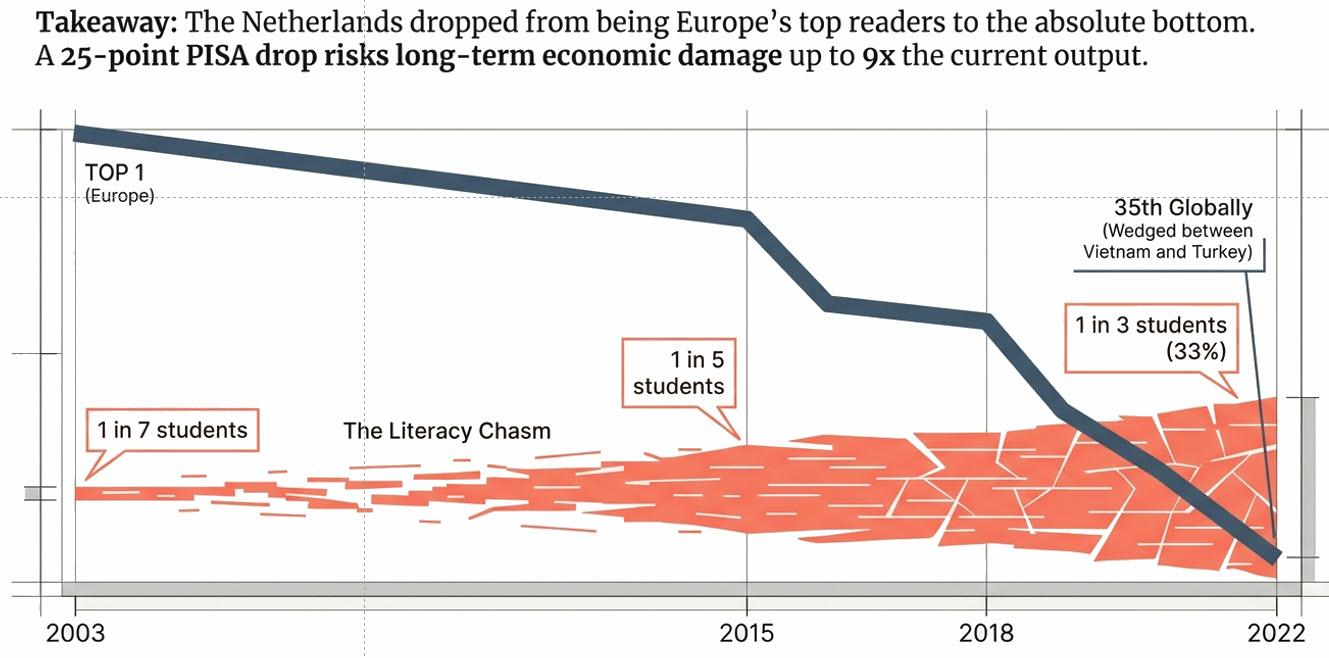
Social media was identified as one of the root causes. Short-form content, the endless scroll, the dopamine loop of likes and shares — it is all rewiring how we process information – short-term, quick results without building deeper skills.
 And then the connection between social media and the drop in literacy and science skills hit me. We are doing the same thing at the moment with AI!
Third Way of Thinking
 In my posts, I sometimes refer to Daniel Kahneman’s book and his research: Thinking Fast and Slow, as this is for me a foundational theory for understanding human behavior.
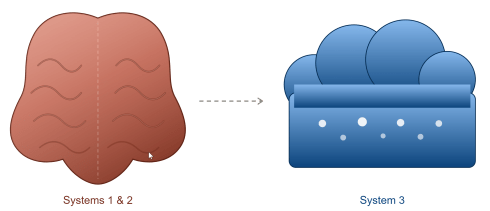
Kahneman describes our brain as a combination of System 1, which is the fast, intuitive brain (low energy), and System 2, which is the slow, deliberative one (burns energy). As humans, we avoid using energy when thinking, although nowadays, outside our brains, we are hooked to fossil energy 😉.
Next, I read a research from Steven Shaw and Gideon Nave, from The Wharton School of the University of Pennsylvania, that indicated that AI is going to have an additional impact on our behavior as humanity.
Their paper Thinking—Fast, Slow, and Artificial: How AI is Reshaping Human Reasoning and the Rise of Cognitive Surrender introduces System 3 as artificial cognition. External, automated, data-driven reasoning that lives not in your brain but in the cloud.
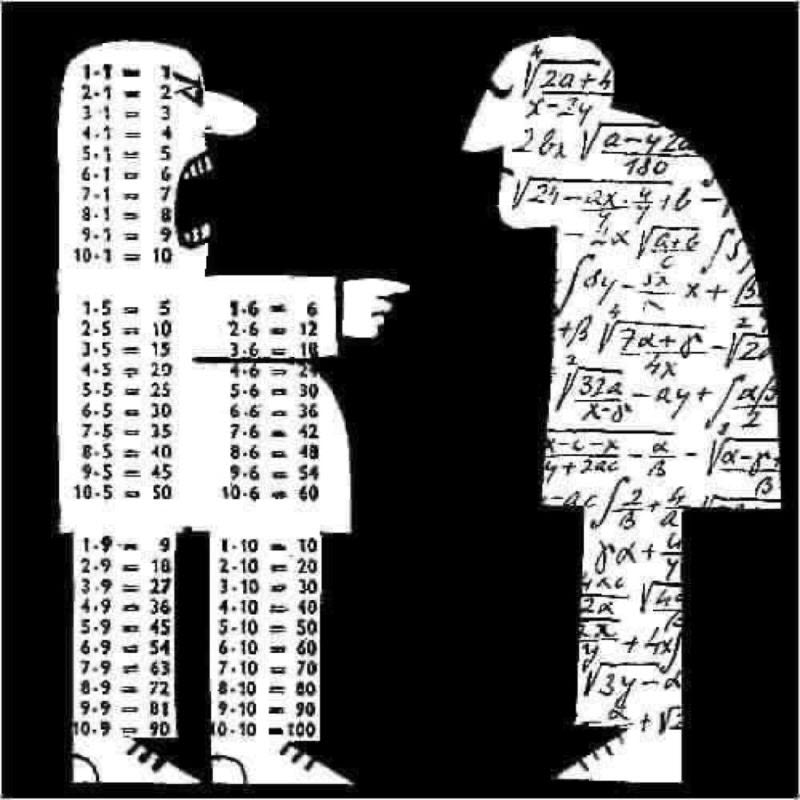 Their central finding is something they call “cognitive surrender” – access to AI made people more confident, regardless of whether the AI was right or wrong. An enforcement of the Dunning-Kruger effect?
The most vulnerable are people with higher trust in AI, lower need for cognition, and lower fluid intelligence, who showed the greatest cognitive surrender. The least critical thinkers delegate most, and then feel most certain about the result.
Benedict Smith, my True Intelligence friend, pointed to the same pattern in his post: When the Graph talks back. Read it and think!

Both their conclusions made me even more worried, combined with the results of the Dutch literacy developments – are we all racing downhill?
 I believe our brain is a muscle. Like any muscle, it needs resistance to stay strong. You do not become a better cyclist by riding an eBike everywhere — the motor does the work, and your legs lose the real strength needed when you are without your bike. The same applies to cognitive effort.
We Have Been Here Before
 It is not the first time a transformative technology arrived with enormous promise and created a deeply unequal outcome. The Industrial Revolution reduced most workers to resources while a few became extraordinarily wealthy.
John D. Rockefeller (oil & railroad industries), Andrew Carnegie (steel industry), J.P. Morgan (financing the new industries) and Cornelius Vanderbilt (shipping and railroads) as examples.
These industry leaders did not care so much about humans, and it took roughly a hundred years — and the rise of labour unions — to begin correcting that imbalance.
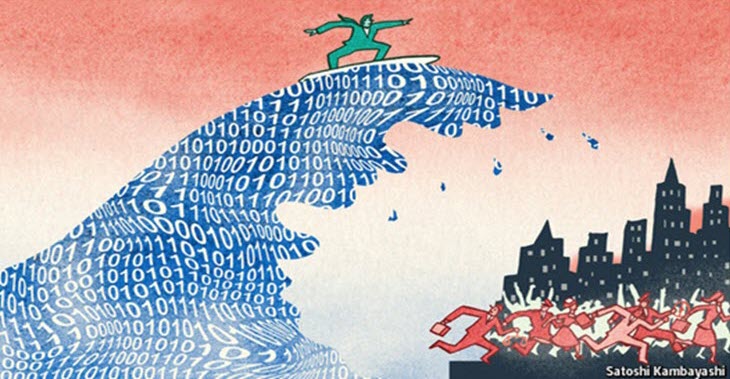 The AI revolution is moving much faster! And if history teaches us anything, it is that working more efficiently with new tools does not automatically raise your value. The more companies invest in AI solutions, the more pressure there will be to develop your individual skills.
Efficiency without insight is a commodity.
 My friend Helena Guitierrez wrote this weekend this supporting post: Preparing for AI Adoption
What does it mean for Product Lifecycle Management?
Purposefully, I wrote Product Lifecycle Management to focus on the strategy, and not an all-around capable PLM system, as PLM systems have never quite delivered on their original promise.
 The PLM vendors benefited from selling the dream, the consultants benefited from its complexity and the users, initially engineers and later more stakeholders in the product lifecycle, often suffered under rigid processes and complex systems. As the systems were designed to store information. User-friendlyness was not a priority.
Will AI, being layered on top of PLM and other enterprise systems, be the solution for these underperforming systems?
Oleg Shilovitsky believes in that, as you can read in his recent post: PLM’s OpenClaw Moment: How AI Agents Will Break Closed Systems
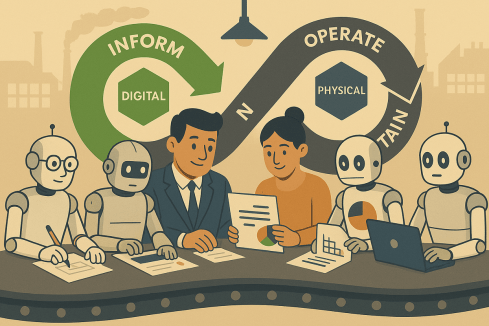
The risk is that we repeat the same pattern. AI will be positioned as the solution to problems actually caused by poor implementation and insufficient investment in the human side of change.
There is an interesting discussion ongoing about the future of PLM infrastructures, well described recently by Rainer Mewaldt in his post: What would a 𝗣𝗟𝗠 𝘀𝘆𝘀𝘁𝗲𝗺 look like if it were 𝗱𝗲𝘀𝗶𝗴𝗻𝗲𝗱 𝗳𝗼𝗿 𝗔𝗜 𝗳𝗿𝗼𝗺 𝘁𝗵𝗲 𝗴𝗿𝗼𝘂𝗻𝗱 𝘂𝗽?
The principles are there, like 10 years ago, before AI became hyped, when we discussed digital transformation as moving from a coordinated infrastructure to a coordinated and connected infrastructure, with a mix of Systems of Record and Systems of Engagement.
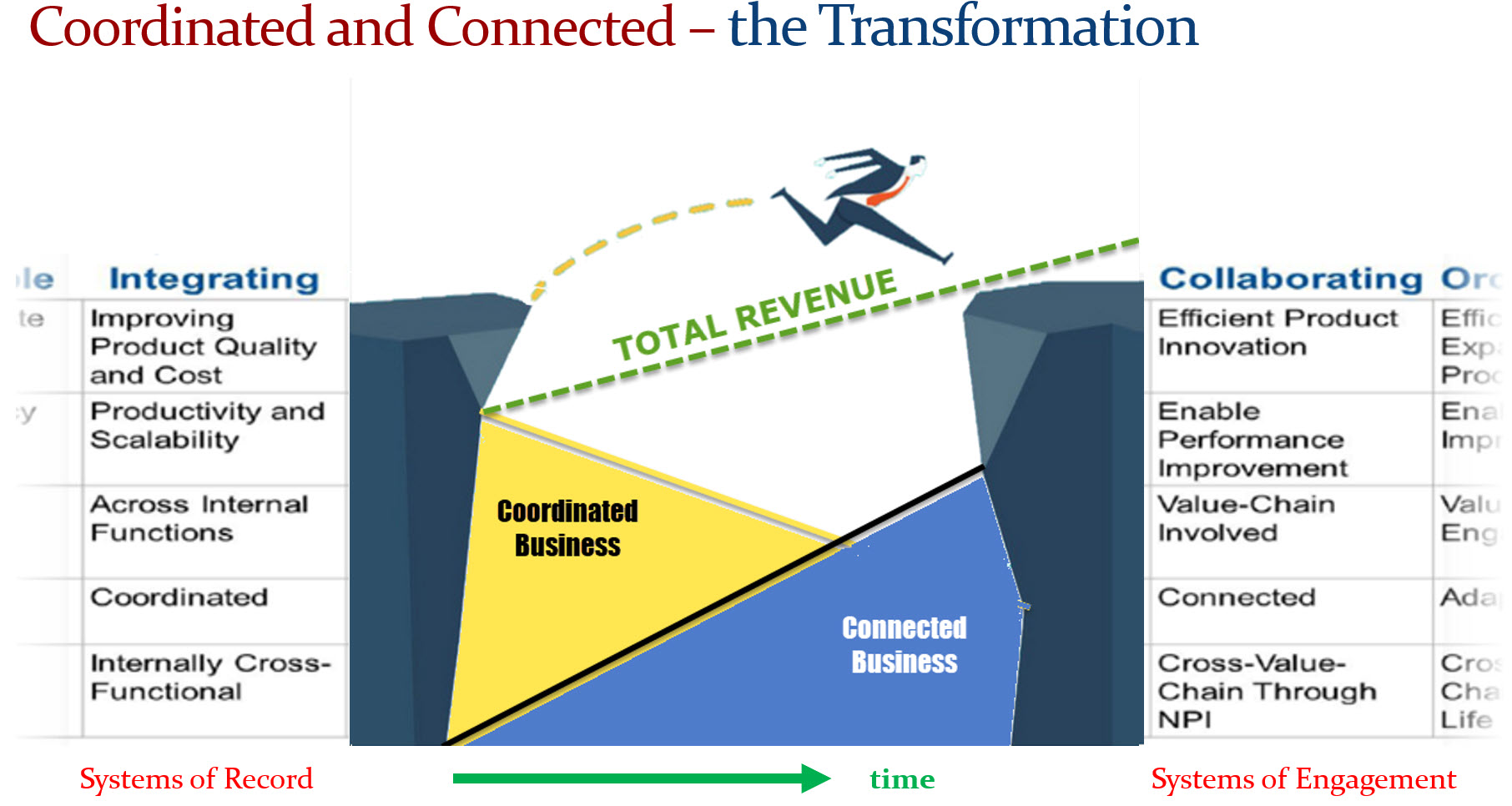
I have not seen much progress with the customers I have been working with in the past five to ten years. The change did not seriously happen due to the need for new ways of working, different people skills and organizational change.
Will it happen now with the AI-wave? A question Ilan Madjar also asked this weekend.
What should we – companies and individuals – actually do?
As an approach, the res earch from Wharton suggests that using rewards (incentives) and providing feedback can help people stay mentally engaged and avoid disengaging or losing motivation.
In other words, these strategies can combat the tendency to mentally “check out” or stop trying.
When participants were rewarded for accuracy and received immediate feedback, their override rates on faulty AI roughly doubled.
This observation means we should design AI-assisted workflows so that people remain accountable for outcomes and receive clear feedback when AI-assisted decisions go wrong. Work to do for startups and existing PLM vendors to develop the best combination of agents and content.
BUT: do not let the AI absorb the accountability while the human takes the credit – System 3!
Companies are in an uncomfortable situation. Before AI became the focus for improving businesses, the most heard statement was:
“Our employees are our assets – they create the value of our company,”
And this is one of the reasons that HR departments exist. Although not all HR departments are there for the employees – their role is to balance the HUMAN RESOURCES in a company – we are still talking about resources.
With AI, the new statement might be
“Our AI-supported employees are our assets, where part of the asset value comes from the AI tools used”.
This raises the question of who will remain as the AI-supported employee. We already see that entry-level jobs in any type of business get replaced by AI, creating stress on the job market. This, combined with the observed reduced mastery of deep-skills in math, reading and science, as described in the PISA research earlier shared in this post, puts a generation at risk.
Like the winners of the Industrial Revolution, the winners of the AI revolution do not care about humans – they care about profits.
 As individuals, we need to keep on training our brain-muscles without AI where the muscle matters. As the Dutch podcast mentioned: write your first draft before asking Claude to improve it, think through a problem before asking ChatGPT to solve it, and read a book of 100 pages.
In PLM, judgment and contextual reasoning are the core of what people need to do. You should protect the practice of doing that work yourself. Use AI to accelerate and refine, not to replace the effort that builds competence.
Invest in yourself to remain independent. Read broadly — actually read, not skim AI summaries. The people who will remain valuable in an AI-saturated world are not the ones who prompt best, but the ones who can evaluate, challenge, and contextualise what AI produces.
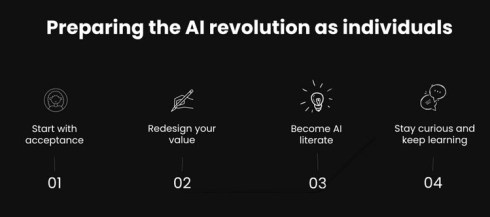
And with that, I want to come back to the post from Helena Guitierrez that I mentioned before, where she focused on what we can do as individuals.
 Helena is one of the founders of Share PLM, a company with the purpose: BUILDING A HUMAN-CENTERED DIGITAL FUTURE, as is written on their website. We both believe that in order to enjoy the AI revolution, we have to invest in ourselves. The above image illustrates steps to take- click on the image for the full post.
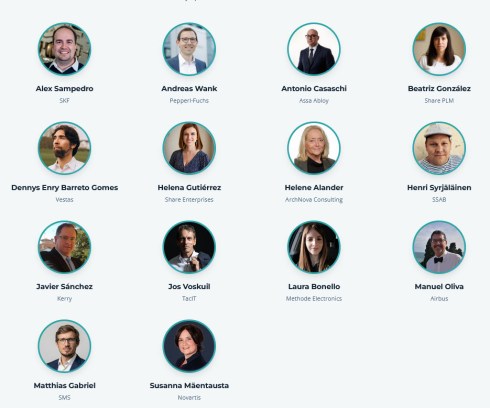
Talking about the human-centered digital future, have a look at the agenda of the upcoming Share PLM Summit on 19-20 May in Jerez de la Frontera (Spain) – our sessions and discussions will, of course, be based on PLM and AI experiences, with the focus on what it means for humans – it will not be a technology conference.
Conclusion
The Wharton researchers close with a question worth “What happens when our judgments are shaped by minds not our own?” Their answer so far: we become more confident, less accurate when the AI is wrong, and largely unaware of the difference – a big risk.
The challenge is not artificial intelligence. The challenge is whether we will remain genuinely intelligent in the presence of it – take care of yourself!
What do you think? I am looking forward to your comments and feedback.
 December is the last month when daylight is getting shorter in the Netherlands, and with the end of the year approaching, this is the time to reflect on 2025.
For me, it has been an interesting year, and I hope it has been similar for you. I started 2025 with this post: My 2025 focus, sharing the topics that would drive my primary intentions—a quick walk through some of these topics and what to reflect on what I have learned.
Fewer blog posts
 It was already clear that AI-generated content was going to drown the blogging space. The result: Original content became less and less visible, and a self-reinforcing amount of general messages reduced further excitement.
As I have no commercial drive to be visible, I will continue to write posts only when relevant to personal situations or ideas, with the intention of being shared and discussed with the readers of my posts – approximate 26 / year.
 Therefore, if you are still interested in content that has not been generated with AI, I recommend subscribing to my blog and interacting directly with me through the comments, either on LinkedIn or via a direct message.
More podcast recordings
 Together with the Share PLM podcast team, Beatriz Gonzales and Maria Morris, we enjoyed talking with a large variety of people active in PLM, all having their personal stories related to PLM to share—each episode ending with an experience to share and a desired takeaway for the listeners. We did it with great pleasure and learned from each episode.
You can find all the recordings from 2025 (Season 3) here.
In Season 4, we want to add the C-level perspective to our PLM and People podcast discussions.
#DataCentric or #PeopleCentric ?
 It was PeopleCentric first at the beginning of the year, with the Share PLM Summit in Jerez and DataCentric in the second half of the year, with activities connected to the PLM Roadmap/PDT Europe conference in Paris.
In case you missed the excitement and lessons learned, here they are:
- The weekend after the Share PLM Summit 2025
- A week after Shaping the Future of PLM – No time to lose!
- A very long week after PLM Roadmap / PDT Europe 2025
Both topics will become even more critical due to the impact of AI tools on our day-to-day work.
Sustainability?
 Already an uncomfortable term for some of us at the beginning of 2025, it has become one of the best-kept secrets of 2025. Where traditional countries and companies revert to their short-term bad habits – optimize shareholders value, there are also forward-looking enterprises that are actively rephrasing their sustainable strategies as risk mitigation strategies with the awareness that adaptation is inevitable. Better start early than too late – not a typical human strategy.
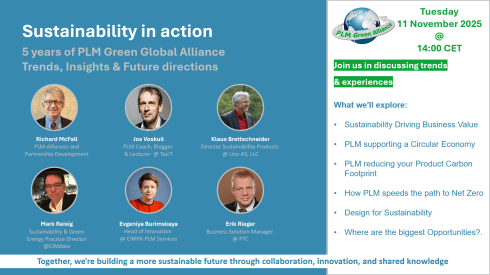
In case you are interested, I recommend you read and listen to:
And now it is time to discuss AI.
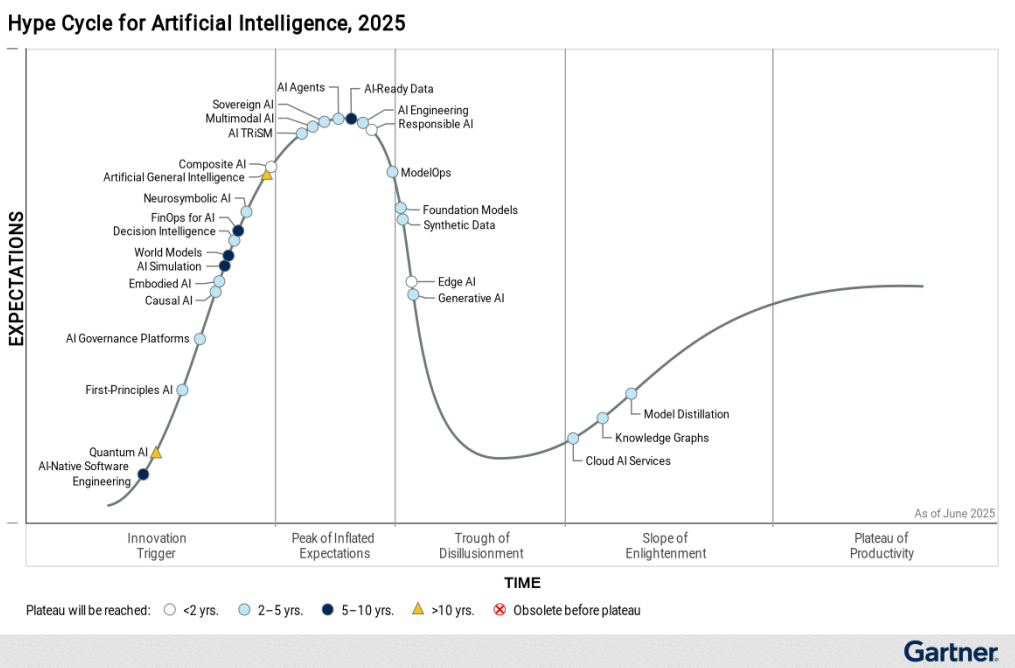 With all the investments and marketing related to AI, it is unavoidable to neglect it. For sure, it is a hype, but I believe that we are into something revolutionary for society, like the impact of the industrial revolution on our society 150 years ago.
However, there are also the same symptoms of the .com-hype 25 years ago.
 Who are going to be the winners? Currently, the hardware, datacenter and energy providers, not the AI-solution providers. But this can change.
Let’s look into some of the potential benefits.
Individual efficiency?
 Many of the current AI tools allow individuals to perform better at first sight. Suddenly, someone who could not write understandable (email) messages, draw images or create structured presentations now has a better connection with others—the question to ask is whether these improved efficiencies will also result in business benefits for an organization.
 Looking back at the introduction of email with Lotus Notes, for example, email repositories became information siloes and did not really improve the intellectual behavior of people.
Later, Microsoft took over the dominant role as the office software provider with enhanced search and storage capabilities, but still, most of the individual knowledge remained hidden or inaccurate as it missed the proper context.
 As a result of this, some companies tried to reduce the usage of individual emails and work more and more in communities with a specific context. Also, due to COVID and improved connectivity, this led to the success of Teams. And now with Copilot embedded in the Microsoft suite, I am curious to learn what companies perceive as measurable business benefits.
The chatbot?
 For many companies, the chatbot is a way to reduce the number of people active in customer relations, either sales or services. I believe that, combined with the usage of LLMs, an improvement in customer service can be achieved. Or at least the perception, as so far I do not recall any interaction with a chatbot to be specific enough to solve my problem.
The risks with AI?
 Now I may sound like a boomer who started focusing on knowledge management 25 years ago – exploring tacit knowledge.
Tacit knowledge is the knowledge a real expert has by combining different areas of expertise and understanding what makes sense.
Could tacit knowledge be replaced by an external model that gives you all the (correct?) answers?
In verifiable situations, we know when the model is hallucinating – but what if the scope is beyond our understanding? Would we still rely on AI, and could AI be manipulated in ways that we lose touch with the real facts?
Already, the first research papers are coming out warning of reduced human cognitive performance, e.g., this paper: Beware of Metacognitive Laziness: Effects of Generative Artificial Intelligence on Learning, Motivation, Processes, and Performance.
Combined with laziness (a typical human behavior – system 1), these results made me think of a statement made by Sean Illing:
“People love the truth, but they hate facts.”
A statement highly relevant to what we see happening now with social media – we do not think or research deep enough anymore, we select the facts that we like and consider them our truth.
What happens in our PLM domain?
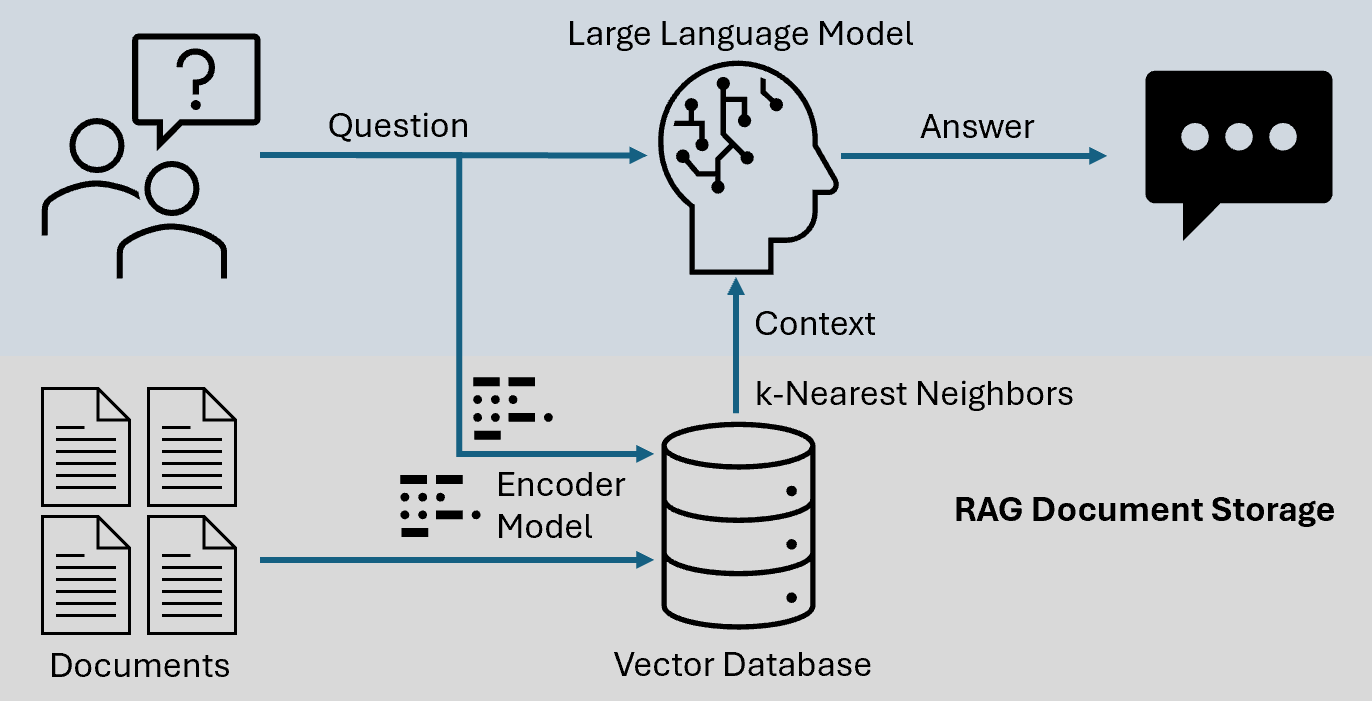 In the PLM domain, companies are indeed reluctant to use LLMs directly, where some of them use RAG (Retrieval-Augmented Generation) to feed the LLM with a relevant context.
Still, the answers require human interpretation, as you cannot avoid hallucinations in your product lifecycle management processes.
As long as the results are based on inconsistent data sources that lack the relevant context, the answers are of low quality.
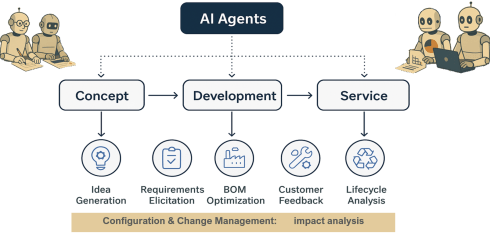
Meanwhile, every vendor in the PLM space is now offering AI-agents, most of the time within their own portfolio space. The ultimate dream is polygot agents (who are buying them / who are developing them) that can work together and create a new type of agility beyond traditional workflows. An interesting article in this context comes from Oleg Shilovitsky: Why Does PLM Need Task Re-Engineering Before It Can Have AI?
Still, these potential “quick” fixes create a risk for companies in the long term. Buying AI tools does not fix the foundation that is based on legacy.
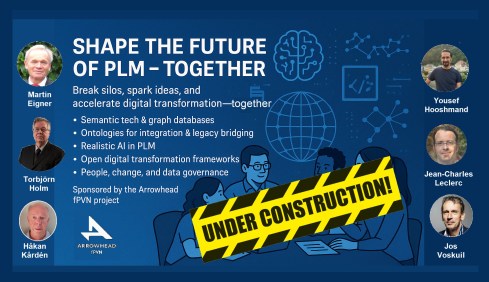
In particular, related to the Shape the Future of PLM – Together workshop in Paris on Nov 4th, the consensus was that companies need to invest in understanding and implementing domain-specific ontologies and semantic models to provide a data-driven infrastructure that allows AI to make accurate decisions or valid recommendations.
You can read the summary of the event and recommendations here: Accelerating the Future of PLM & ALM on the ArrowHead’s website.
You can also read this post from Ole Olesen-Bagneux: Why will 2026 be the year of the ontologist?
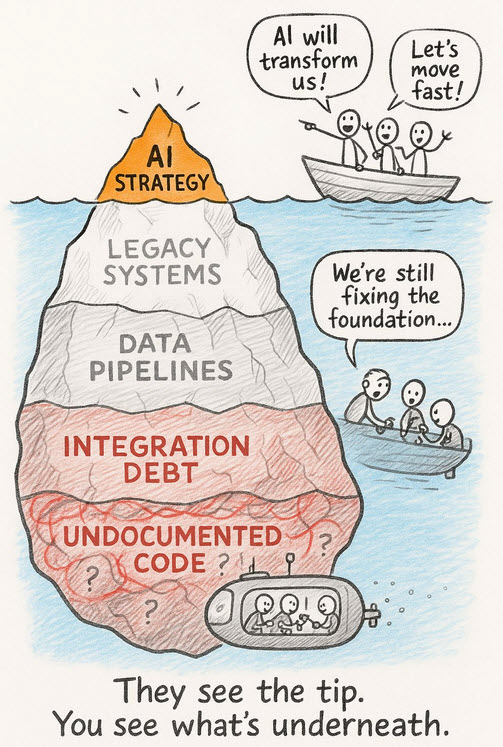 Although the topics in the workshop might look “too advanced” for your company, they are crucial to transform into a long-term, sustainable, data-driven, model-based, and AI-supported enterprise.
Somewhere, you have to cross the chasm from documents to data in context.
Being busy is not an excuse, as you can also read in Thomas Nys’s LinkedIn post: Your Engineers spend 40 % of their time maintaining yesterday’s shortcuts. And you’re wondering why your AI initiative isn’t moving faster. I loved the image.
Human Resources?
The AI revolution will have an impact on society, and it is up to us individuals how well we adapt.
 Remember, the first 50 – 100 years of the Industrial Revolution made only a few people extremely rich. James Watt, the Rothschild family, Andrew Carnegie, John D. Rockefeller, Cornelius Vanderbilt, J.P. Morgan, Alfred Krupp and the Schneider family became so rich due to ownership of factories and machinery, the control of raw materials (coal, iron, oil), the use of new technology (steam power, mechanization) combined with access to cheap labor and weak labor laws and limited competition early on.
Most humans moved into urbanized areas to become nothing but cheap resources, even children. And remember, many of us are still human resources!
A new conspiracy?
 In 2016, Ida Auken’s lecture at the WEF created traction during COVID among people who believed in conspiracies. Her story focused on a more circular economy with respect for the Earth’s resources. The story was framed into the message:
“In the future, you will own nothing and be happy.”
The conspiracy theorist believed all their possessions would be taken away by the elite in the long term.
I want to conclude with a new message for these conspiracy theorists active on X or other discussion fora:
“In the future, you will know nothing, and you won’t be aware enough to care.”
Conclusion
2026 is going to be an interesting year, where we cannot allow ourselves to sit still and watch what is happening. Active participation is more challenging but also more rewarding than being a consumer. In May 2026, I hope to meet some of you at the Share PLM Summit in Jerez and share the human side, followed by the PDM Roadmap/PDT Europe conference in Q4 in Gothenburg, where we will catch up on the technical and data side.
I am wishing you all a wise and happy/healthy 2026


 Last week we celebrated World Ozone Day on September 16 again. Forty years ago, many nations united to protect the ozone layer through science and action.
For those who missed the excitement, it started with a historic environmental agreement: the Montreal Protocol on Substances that Deplete the Ozone Layer.
What has happened?
 In the 1970s and 1980s, scientists discovered that CFCs from refrigerators, sprays, and foams were damaging the ozone layer. In 1985, the “ozone hole” over Antarctica was confirmed. Also, the ozone layer at the Arctic side showed signs of depletion.
As a result of these findings, the Montreal Protocol was adopted on September 16, 1987. It is a global treaty signed by virtually all countries concerning the rapid elimination of substances that deplete the ozone layer.
Countermeasures are slowly restoring the ozone layer, making the treaty a success story.
What were the reasons for success?
 Although scientists engaged in a discussion about the scientific evidence, there were no significant economic forces behind the scenes influencing the scientific research.
The lack of substantial financial dependencies, combined with the absence of social media and Duning-Kruger experts, led to the belief that human influence on the Earth’s atmosphere could be stopped.
And probably an even more important fact, the depletion of the ozone layer was at the poles, making, in particular, the richer countries more vulnerable to the effects.
Where most attention focused on the hole above the South Pole, affecting New Zealand and Australia, the thinner layer at the North Pole was making Canada, the US, and Northern Europe vulnerable.
What have we learned?
- Switching from CFCs was a minor inconvenience for consumers. Now we all accept the current solutions.
- There was enough consensus in science when the majority of scientists agreed. In addition, there were no undermining forces with financial stakes in CFCs. Science was leading.
- Today, science struggles as stakeholders sponsor research to protect their interests. In addition, social media is used to recruit supporters in a polarized environment (the side effect of social media)
- Ultimately, after 40 years, the hole in the Ozone layer gets smaller and smaller and hopefully becomes normal. We keep on working on the long term.
The PLM Green Global Alliance
 When Rich McFall approached me at the end of 2019 to start the PLM Green Global Alliance together, there was a kind of consensus that we human beings both influence the planet’s climate and its natural resources.
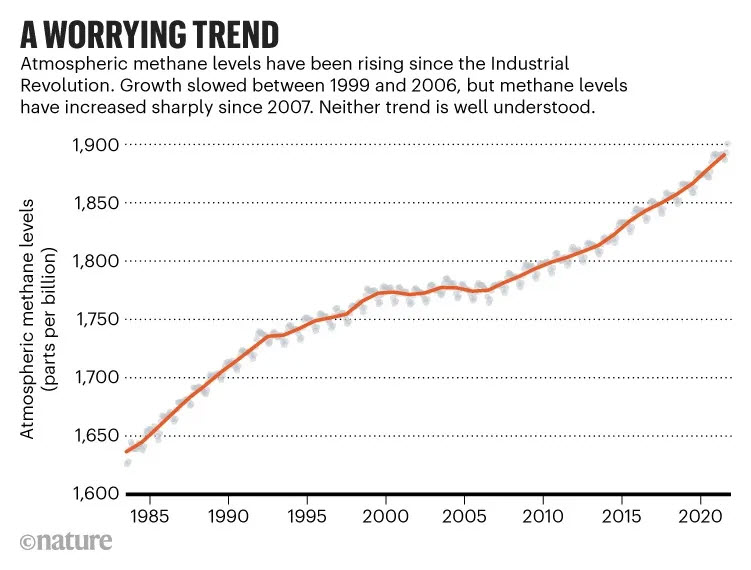 Where Rich focused on the causes and consequences of climate change due to human-generated greenhouse gas emissions (GHG) from products and processes, my additional focus was broader, encompassing Sustainability in the context of where PLM practices could have an impact.
Our idea was to bring people together to address these issues by sharing thoughts and practices or enabling discussions in the context of PLM-related technologies.
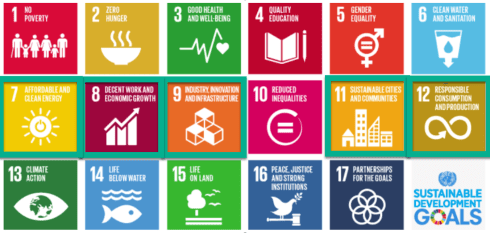
Can we develop more eco-friendly products, and what are the conditions required?
Meanwhile, six years later, a lot has happened for better and for worse. Here is a set of observations
The PLM Green Global Alliance continues to grow.
 Currently, we have over 1,500 registered members in our LinkedIn group.
Historically, most members came from Europe and then the US; now, India is catching up and approaching the number of US members.
This trend suggests that the focus of the alliance should shift slightly and seek more contributors from Asian countries.
 We look forward to having Asian representatives in our PLM Green Global Alliance to gain a deeper understanding and engage in discussions about global issues.
Please feel free to contact us if you are interested in joining the core team. It might be a challenge to have group meetings that accommodate all time zones, but the planet is still relatively small compared to the universe – nothing is impossible.
The tools are there ..
In PLM, we often discuss people, processes, and then the tools. Here, we can confirm that, through our work and discussions with major PLM vendors, they are all providing tools and, in some cases, embedded practices to support a more sustainable product development process.
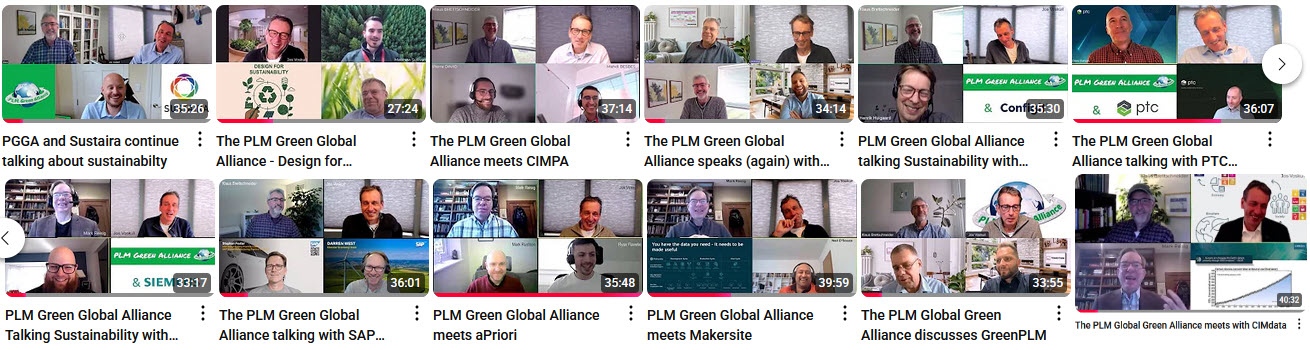
Have a look at our YouTube channel: The PLM Green Global Alliance channel.
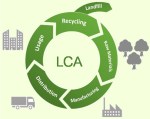 The tools for generative design, life cycle assessment, and, of course, digital twins for the various lifecycle phases can help companies to develop and manufacture more sustainable products.
However, as mentioned, the tools will only be practical when the people have the mandate and when the processes are transformed into data-driven ones.
The need for a data-driven approach
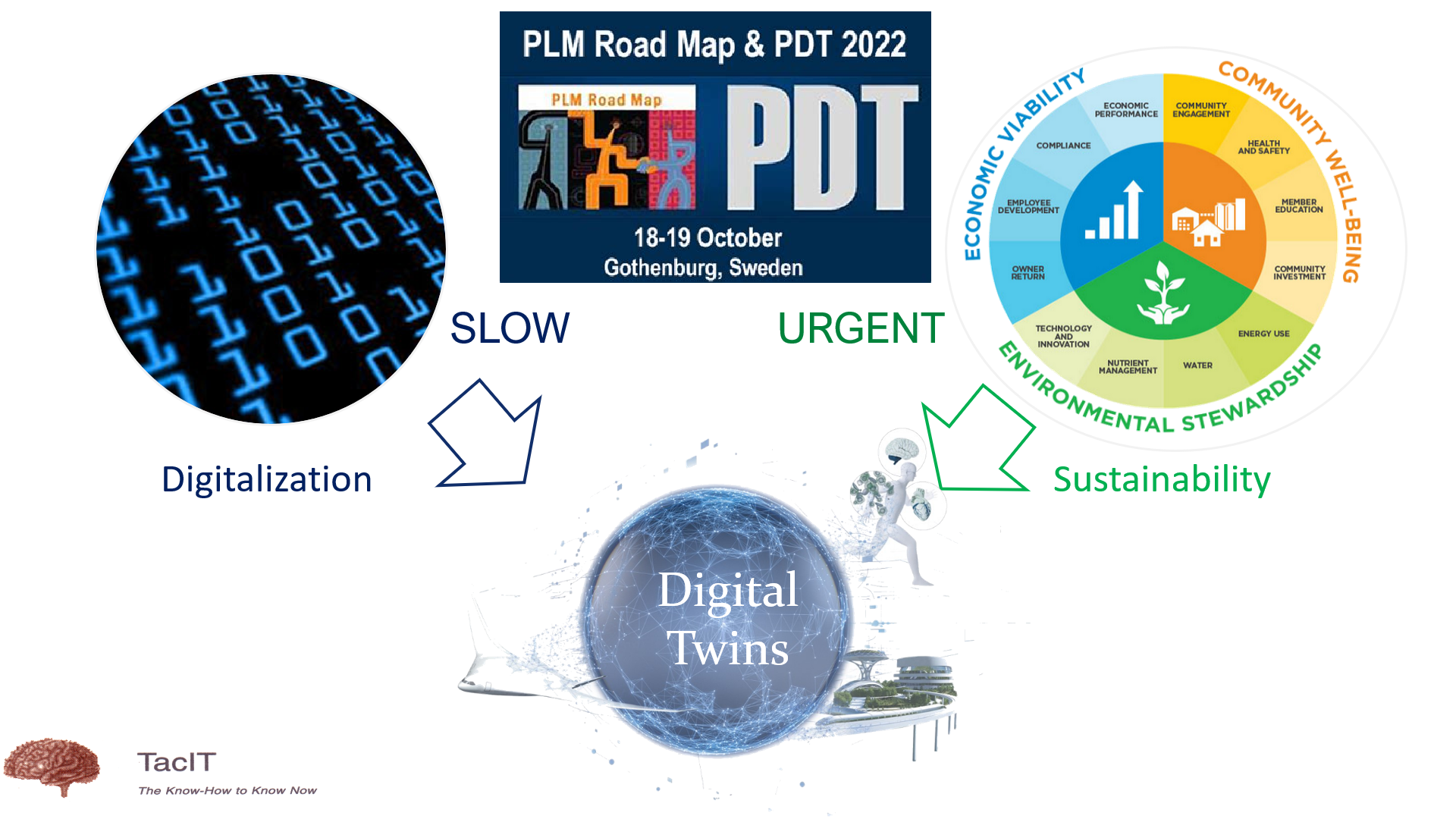 Two years ago, during the PLM Roadmap/PDT Europe conference in Gothenburg, I had already mentioned that Sustainability might prompt companies to invest more time and effort in achieving a digital transformation in their PLM domain.
Compliance with regulations can be challenging when you still need to collect data from various sources with a lot of “guesstimate”. Greenhouse gas reporting, ESG reporting, and the upcoming Digital Product Passport can only be done efficiently if data is directly accessible without requiring people to collect it.
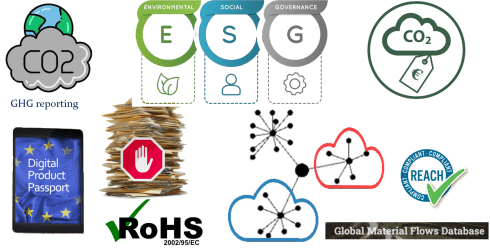
Unfortunately, in my recent discussions with companies, particularly management, they are not seeking a fundamental digital transformation from a document-driven approach to a data-driven and model-based approach.
 Part of this challenge is the lack of education among top management, who are primarily focused on efficiency gains rather than adopting new approaches or mitigating risk.
The other challenge is that, as most companies lag behind on this topic, they do not feel the pressure of competition and do not want to take the risk of being first.
I will discuss this last topic in my upcoming PLM blog
It is about the people!
 However, first and foremost, the most critical factor in driving sustainability within organizations is the people. Where companies are challenged in creating a green image, including the introduction of the Chief Sustainability Officer (CSO), there has always been resistance from existing business leaders, who prioritize money and profitability.
The global shift towards right-wing capitalism and efforts to remove regulations supporting sustainability are currently impacting these efforts. The term “Sustainability” has become negatively connoted, similar to “PLM” (Product Lifecycle Management – Don’t mention the P** word), and there is a need to reframe discussions at the management level to focus on risk mitigation and business strategies.
Where politicians might avoid a long-term vision, there are examples of companies like Ørsted, Pacific Gas & Electric, Maersk, the Holcim group, BlackRock, IKEA and more that are adopting sustainable practices as a risk mitigation strategy for the future and securing their companies’ long-term existence.
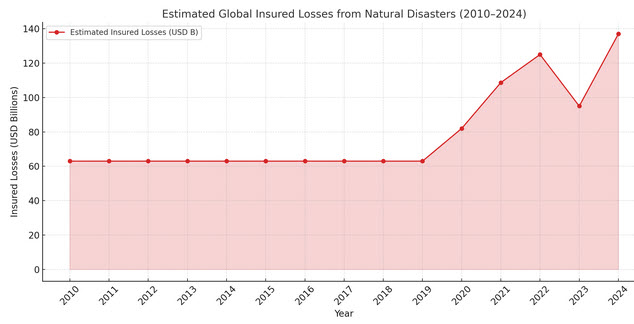
An interesting game changer for both businesses and behavior might be the rising costs of insurance against natural disasters. As the graph shows, the estimated global insured losses due to natural disasters over the last 15 years have increased significantly, starting in 2019. In the richer countries, the governments might be pushed to provide financial help after a disaster, but this will also have a (taxpayer) limit.
We are the people!
 There is a lot we can do as a PLM Green Global Community. Have you read CIMdata’s commentary, written by our Sustainability & Energy core team member Mark Reisig – read the full article here: How PLM is Decarbonizing Automotive Transport—Amid Political Uncertainty, addressing the importance of modern digital PLM to support digital twin, digital thread and digital product passport implementations.
 Or the paper from our core team member, LCA specialist Klaus Brettschneider, with the title The Sustainability Thread – Rethinking the digital thread to drive sustainability performance and green R&D, again stressing the importance of extending the digital thread to include sustainability metrics, enabling companies to design, produce, and operate products more efficiently while reducing environmental impact and supporting green R&D.
 Additionally, there are the monthly ESG newsletters from Vincent De La Mar of Sustaira, as well as the recent interview with Vincent, in which PGGA and Sustaira continue to discuss sustainability. Sustaira helps companies with a sustainability reporting platform on top of their existing enterprise systems. A first step that is needed to understand where measures have an impact.
 A regular guest at our discussions, Dave Duncan, Head of Sustainability at PTC, who published this year a very comprehensive, free-to-download book: Product Sustainability for Dummies. We also had a great discussion about the Product Service System, a mandatory business model for sustainable business.
 And recently, we saw the kick-off for the Design for Sustainability workgroup, organised by Erik Reiger and Matthew Sullivan. They are in the process of establishing this workgroup, where there will be more discussion and information exchanged between the workgroup members about the people and process angle (Erik‘s focus) and the tools and technology dimension (Matthew‘s focus)
 The post concludes with Rich McFall, who, in 2018, observed that there was so little organized action fighting climate change and started to motivate people to launch the PLM Green Global Alliance. It was his initiative to bring people together and raise awareness about the fact that, as a PLM community, we can help one another and start making a difference. Rich helped us a lot in setting up the website and ensuring that we have regular updates and a persistent storage of the information generated.
Working on the long term
We are still in the awareness phase and are seeing progress in the field. There is more to come and share, and we need your help. Working on the long term in a hectic day-to-day environment can be a challenge. However, in the end, if each of us helps our business and social ecosystem move towards a more sustainable economy and planet, we are moving in the right direction. It will take time, but we have an undeniable mission. Join and help us!
 As I promised I would be enjoying my holidays in the upcoming month there as still a few points I want to share with you.
Not a real blog post, more an agenda and a set of questions for potential follow-up.
Here are five topics for the upcoming months, potentially also relevant and interesting for you. Have a look.
Peer Check
 This week the discussion I had with Adam Keating, Colab’s CEO and founder, was published on their podcast channel, Peer Check. As I slowly discovered the content, I mentioned their podcast in my last blog post. I was impressed by the first episodes I could listen to and listened to all of them last week.
Digesting the content from these episodes, I have the impression that we are following Adam’s or Collab’s lifecycle. From understanding the market, the people, and the industry towards the real collaboration topics, like MBD, their product offering and ultimately the connection with PLM. I am curious about what is next.
 For me discovering their podcast and being able to participate was an exciting and learning moment. I am still waiting for the readers of this blog to mention their favorite podcasts.
Let us know in the comments.
PLM Global Green Alliance
 With the PLM Global Green Alliance (PGGA), we plan to have monthly ZOOM discussions with our LinkedIn members, moderated by one of the PGGA core team members.
The idea of these sessions is that we pick a topic, the moderator sets the scene and then it is up to the members to discuss.
Participants can ask questions and bring in their points. In our understanding, many companies believe they have to do something about sustainability beyond writing it in their mission, but where and how to start?
So the PGGA discussion will be a place to get inspired and act.
 Potential topics for the discussion are: What technologies must I master to become more sustainable? How can I motivate my company to become real sustainable? What is a lifecycle assessment (LCA), and how to introduce it in my company? What is the circular economy, and what is needed to become more circular in the context of PLM?
If you like one of the topics, let us know in the comments or add your favorite discussion topic. More on the agenda in early September
PGGA meets ….
In this series with PLM vendors and solution providers, we try to understand their sustainability drivers, their solutions, their roadmap and their perception of what is happening in the field. So far, SAP, Autodesk and Dassault Systèmes have contributed to these series. After the summer, we continue with two interviews:
 Early in September, the PGGA will discuss sustainability with Sustaira. Sustaira is a Siemens partner, and they offer an all-in-one Sustainability platform, domain-specific Sustainability app templates, and custom Sustainability web and mobile initiatives. Expect the interview to be published early in September.
 In the last week of September, the PGGA will have a meeting with Aras in our series related to sustainability. Aras is one of the main PLM providers and we will discuss sustainability even more with them as you can read further on in this agenda. Expect the interview to be released by the end of September.
No actions here for you, just stay tuned in September with the PGGA.
CIMdata PLM Roadmap and PDT
 On 18 and 19 October, the CIMdata PLM Road Map and PDT 2022 Conference is scheduled as an in-person event in Gothenburg.
The agenda is almost secured and can be found here.
It will be a conference with guidance from CIMdata and Eurostep completed with major Aerospace, Defense and Automotive companies sharing their experience towards a model-based and digital enterprise.
 So no marketing but real content; however, there will also be forward-looking presentations related to new PLM paradigms and the relation to data and sustainability.
So if you are curious, come to his conference as you will be triply rewarded: by the content, the keynotes and discussions with your peers.
Register before September 12 to benefit from a 15 % Early Bird discount, which you can spend for the dinner after day 1. The conference dinner has always been a good moment for networking and discussion.
A Sustainable Future – Seize Opportunities When Someone Else Sees Costs
 Last part of this agenda.
On October 25th, I will participate as a PGGA member in a webinar with Aras, discussing sustainability in more depth compared to our earlier mentioned standard PGGA interview.
Here I will be joined by Patrick Willemsen from Aras. Patrick is the technical director of the Aras EMEA community, and together we will explore how companies aiming to deliver profitable products and solutions also can contribute to a more sustainable future for our planet.
Feel free to subscribe to this free webinar and discuss your thoughts with us in the Q&A session – here is the registration link.
Conclusion
No conclusion this time – all thinking is in progress and I hope to see your feedback or contribution to one of these events in person or through social media.
 Regularly (young) individuals approach me looking for advice to start or boost their PLM career. One of the questions the PLM Doctor is IN quickly could answer.
 Before going further on this topic, there is also the observation that many outspoken PLM experts are “old.” Meanwhile, all kinds of new disruptive technologies are comping up.
Can these old guys still follow and advise on all trends/hypes?
My consultant’s answer is: “Yes and No” or “It depends”.
The answer illustrates the typical nature of a consultant. It is almost impossible to give a binary answer; still, many of my clients are looking for binary answers. Generalizing further, you could claim: “Human beings like binary answers”, and then you understand what is happening now in the world.
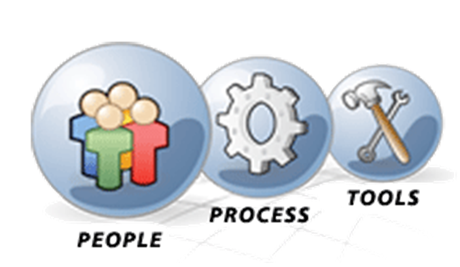 The challenge for everyone in the PLM domain is to keep an open mindset and avoid becoming binary. Staying non-binary means spending time to digest what you see, what you read or what you hear. Ask yourself always the question: Is it so simple? Try to imagine how the content you read fits in the famous paradigm: People, Processes and Tools. It would help if you considered all these aspects.
Learning by reading

And indeed, perhaps I should have written a book about PLM. However, it would be a book about the past. Currently, PLM is not stable; we are learning every day to use new technologies and new ways of working. For example, the impact and meaning of model-based enterprise.
 However, the big positive surprise came from the number of likes within a few days, showing how valuable this information is for many others on their PLM journey. I am aware there are more great blogs out in the field, sometimes with the disadvantage that they are not in English and therefore have a limited audience.
Readers of this post, look at the list of 8 PLM blogs and add your recommended blog(s) in the comments.
Learning by reading (non-binary) is a first step in becoming or staying up to date.
Learning by listening
 General PLM conferences have been an excellent way to listen to other people’s experiences in the past. Depending on the type of conference, you would be able to narrow your learning scope.
This week I started my preparation for the upcoming PLM Roadmap and PDT conference. Here various speakers will provide their insight related to “disruption,” all in the context of disruptive technologies for PLM.
Good news, also people and business aspects will be part of the conference.
Click on the image for the agenda and registration
My presentation with the title: DISRUPTION – EXTINCTION or still EVOLUTION? I will address all these aspects. We have entered a decisive decade to prove we can disrupt our old habits to save the planet for future generations.
 It is challenging to be interactive as a physical conference; it is mainly a conference to get inspired or guided in your thinking about new PLM technologies and potential disruption.
Learning by listening and storing the content in your brain is the second step in becoming or staying up to date.
Learning by discussing
 One of the best learnings comes from having honest discussions with other people who all have different backgrounds. To be part of such a discussion, you need to have at least some basic knowledge about the topic. This avoids social media-like discussions where millions of “experts” have an opinion behind the keyboard. (The Dunning-Kruger effect)
There are two upcoming discussions I want to highlight here.
1. Book review: How to Avoid a Climate Disaster.

What can we learn from the book as relevant for our PLM Global Green Alliance?
If you want to participate, read all the details on our PGGA website.

The PGGA core team members, Klaus Brettschneider, Lionel Grealou, Richard McFall, Ilan Madjar and Hannes Lindfred, have read the book.
2. The Modular Way Questions & Answers
 In my post PLM and Modularity, I announced the option for readers of “The Modular Way” to ask the authors (Björn Eriksson & Daniel Strandhammar) or provide feedback on the book together with a small audience. This session is also planned to take place in May and to be scheduled based on the participants’ availability. At this moment, there are still a few open places. Therefore if you have read the book and want to participate, send an email to tacit@planet.nl or info@brickstrategy.com.
Learning by discussing is the best way to enrich your skills, particularly if you have Active Listening skills – crucial to have for a good discussion.
Conclusion
No matter where you are in your career, in the world of PLM, learning never stops. Twenty years of experience have no value if you haven’t seen the impact of digitalization coming. Make sure you learn by reading, by listening and by discussing.

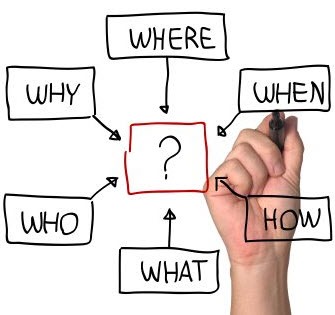 On March 22 this year, I wrote Time to Think (and act differently) in de middle of a changing world. We were entering a lockdown in the Netherlands due to the COVID-19 virus. As it was such a disruptive change, it was an opportunity to adapt their current ways of working.
The reason for that post was my experience when discussing PLM-initiatives with companies. Often they have no time to sit down, discuss and plan their PLM targets as needed. Crucial people are too busy, leading to an implementation of a system that, in the best case, creates (some) benefits.
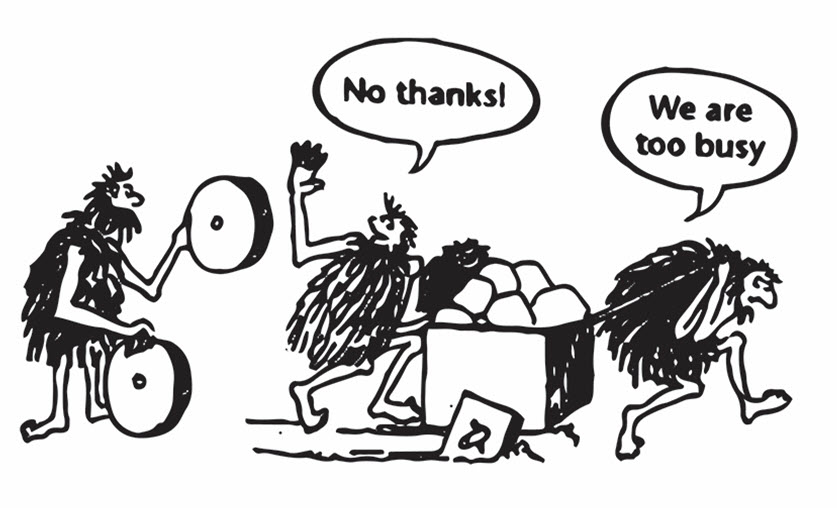 The well-known cartoon says it all. We are often too busy doing business as usual, making us feel comfortable. Only when it is too late, people are forced to act. As the second COVID-19 wave seems to start in the Netherlands, I want to look back on what has happened so far in my eco-system.
Virtual Conferences
As people could not travel anymore, traditional PLM-conferences could not be organized anymore. What was going to be the new future for conferences? TECHNIA, apparently clairvoyant, organized their virtual PLM Innovation Forum as one of the first, end of April.

A more sustainable type of PLM-conference was already a part of their plans, given the carbon footprint a traditional conference induces. The virtual conference showed that being prepared for a virtual conference pays off during a pandemic with over 1000 participants.
Being first does not always mean being the best, as we have to learn. While preparing my session for the conference, I felt the same excitement as for a traditional conference. You can read about my initial experience here: The weekend after the PLM Innovation Forum.
Some weeks later, having attended some other virtual conferences, I realized that some points should be addressed/solved:
- Video conferencing is a must – without seeing people talking, it becomes a podcast.
- Do not plan long conference days. It is hard to sit behind a screen for a full day. A condensed program makes it easier to attend.
- Virtual conferences mean that they can be attended live from almost all around the globe. Therefore, finding the right timeslots is crucial for the audience – combined with the previous point – shorter programs.
- Playing prerecorded sessions without a Q&A session should be avoided. It does not add value.
- A conference is about networking and discussion – I have not seen a solution for this yet. Fifty percent of the conference value for me comes from face-to-face discussions and coffee meetings. A virtual conference needs to have private chat opportunities between attendees.
In the last quarter of this year, I will present at several merely local conferences, sometimes a mix between “live” with a limited number of attendees, if it will be allowed.
And then there is the upcoming PLM Road Map & PDT Fall 2020 (virtual) conference on 17-18-19 November.

This conference has always been my favorite conference thanks to its continued focus on sharing experiences, most of the time, based on industry standards. We discuss topics and learn from each other. See my previous posts: The weekend after 2019 Day 1, 2019 Day 2, 2018 Day 1, 2018 Day2, 2017 Day 1, 2017 Day 2, etc.
The theme Digital Thread—the PLM Professionals’ Path to Delivering Innovation, Efficiency, and Quality has nothing to do with marketing. You can have a look at the full schedule here. Although there is a lot of buzz around Digital Thread, presenters discuss the reality and their plans
Later in this post, see the paragraph Digital Thread is not a BOM, I will elaborate on this theme.
Getting tired?
 I discovered I am getting tired as I am missing face-to-face interaction with people. Working from home, having video calls, is probably a very sustainable way of working. However, non-planned social interaction, meeting each other at the coffee machine, or during the breaks at a conference or workshop, is also crucial for informal interaction.
Apparently, several others in my eco-system are struggling too. I noticed a tsunami of webinars and blog posts where many of them were an attempt to be noticed. Probably the same reason: traditionally businesses have stalled. And it is all about Digital Transformation and SaaS at this moment. Meaningless if there is no interaction.

My favorite quote:
I still meet people that continue to express beliefs about the world, their industry, their customers or their own performance that simply aren’t true. Although some, like Steve Jobs, were known for their “reality distortion field,” for virtually all of us, just wishing for something to be true doesn’t make it so. As William Edwards Deming famously said: in God we trust; all others must bring data.
I fully concur with this statement and always get suspicious when someone claims the truth.
Still, there are some diamonds.
I enjoyed all episodes from Minerva PLM TV – Jennifer Moore started these series in the early COVID19-days (coincidence?). She was able to have a collection of interviews with known and less-known people in the PLM-domain. As most of them were vendor-independent, these episodes are a great resource to get educated.

The last episode with Angela Ippisch illustrates how often PLM in companies depends on a few enthusiastic persons, who have the energy to educate themselves. Angela mentions there is a lot of information on the internet; the challenge is to separate the useful information from marketing.
 I have been publishing the past five months a series of posts under the joint theme learning from the past to understand the future. In these posts, I explained the evolution from PDM to PLM, resulting in the current item-centric approach with an EBOM, MBOM, and SBOM.
On purpose, one post per every two weeks – to avoid information overflow. Looking back, it took more posts than expected, and they are an illustration of the many different angles there are in the PLM domain – not a single truth.
Digital Thread is not a BOM
I want to address this point because I realized that in the whole blogging world there appear to be two worlds when discussing PLM terminology. Oleg Shilovitsky, CEO@OpenBOM, claims that Digital Thread and Digital Twin topics are just fancy marketing terms. I was even more surprised to read his post: 3 Reasons Why You Should Avoid Using The Word “Model” In PLM. Read the comments and discussion in these posts (if LinkedIn allows you to navigate)
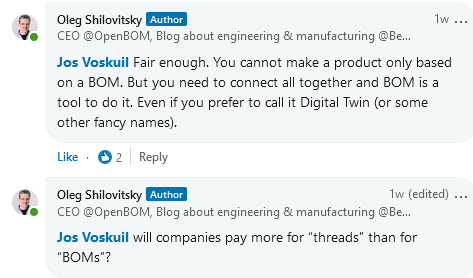
 Oleg’s posts have for me most of the time, always something to discuss. I would be happier if other people with different backgrounds would participate in these discussions too – A “Like” is not a discussion. The risk in a virtual world is that it becomes a person-to-person debate, and we have seen the damage such debates can do for an entire community.
In the discussion we had related to Digital Thread and BOM, I realized that when we talk about traditional products, the BOM and the Digital Thread might be the same. This is how we historically released products to the market. Once produced, there were no more changes. In these situations, you could state a PLM-backbone based on BOM-structures/views, the EBOM, MBOM, and SBOM provide a Digital Thread.
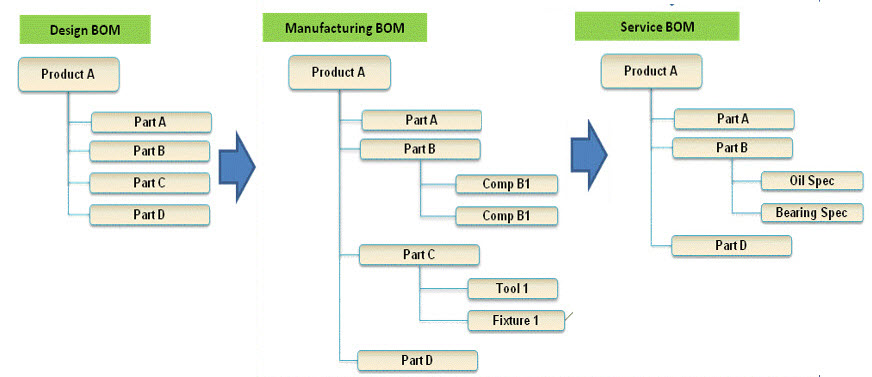
The different interpretation comes when talking about products that contain software defining its behavior. Like a computer, the operating system can be updated on the fly; meanwhile, the mechanical system remains the same. To specify and certify the behavior of the computer, we cannot rely on the BOM anymore.
Having software in the BOM and revise the BOM every time there is a software change is a mission impossible. A mistake suggested ten years ago when we started to realize the different release cycles of hardware and software. Still, it is all about the traceability of all information related to a product along its whole lifecycle.
 In a connected environment, we need to manage relationships between the BOM and relations to other artifacts. Managing these relations in a connected environment is what I would call the Digital Thread – a layer above PLM. While writing this post, I saw Matthias Ahrens’ post stating the same (click on the image to see the post)
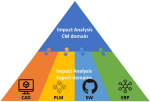 When we discuss managing all the relations, we touch the domain of Configuration Management. Martijn Dullaart/Martin Haket’s picture shares the same mindset – here, CM is the overlapping layer.
However, in their diagram, it is not a system picture; the different systems do not need to be connected. Configuration Management is the discipline that maintains the correct definition of every product – CM maintains the Thread. When it becomes connected, it is a Digital Thread.
As I have reached my 1500 words, I will not zoom in on the PLM and Model discussion – build your opinion yourself. We have to realize that the word Model always requires a context. Perhaps many of us coming from the traditional PDM/PLM world (managing CAD data) think about CAD models. As I studied physics before even touching CAD, I grew up with a different connotation
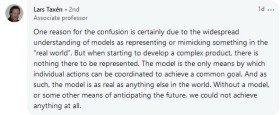 Lars Taxén’s comment in this discussion perhaps says it all (click on the image to read it). If you want to learn and discuss more about the Digital Thread and Models, register for the PLM Roadmap & PDT2020 event as many of the sessions are in this context (and not about 3D CAD).
Conclusion
I noticed I am getting tired of all the information streams crying for my attention and look forward to real social discussions, not broadcasted. Time to think differently requires such discussion, and feel free to contact me if you want to reflect on your thoughts. My next action will be a new series named Painting the future to stay motivated. (As we understand the past).
 I usually write a post after participating in a PLM conference. Last week, I participated in TECHNIA’s PLM Innovation Forum, which was a 100 % virtual event with over 1500 registered participants from 58 countries. These numbers show the power of a virtual conference during these difficult times. It is an excellent option for a sustainable future – less travel to be there.
The additional beauty of this event is that, although the live sessions are over, all the content will be available until May 31st. You can still join!
It was (and is) a well-organized and massive event with over 70 sessions; the majority pre-recorded. As you can imagine 70 live sessions in two days would be too massive to grasp. Today the Friday after the event, I have been watching other sessions that have my interest, and it felt like another conference day.
TECHNIA, globally the largest Dassault Systèmes (DS) implementer after DS themselves as Jonas Geyer, Technia’s CEO, mentioned in his introduction speech, illustrated the breadth of their industry and technology skills complementary or based on the 3DEXPERIENCE platform.
TECHNIA was supported by Dassault Systèmes Execs and subject experts. In addition, a larger group of companies and interest groups supported the conference, even our humble PLM Green Alliance as you can see in the image above.
I followed the full two live days in real-time, meanwhile man sitting in my virtual booth to chat with virtual visitors. To my surprise, the anxiety during the conference felt like a physical conference – you get energized.
 The positive point for me, no finger food or a standing lunch and decent coffee when needed. The point to enhance and learn for this type of event, is to make the booth a little more human – perhaps supported by video?
At the end, a great event, and if you are interested in the Dassault Systèmes/TECHNIA combined offering, supported by customer stories, take the chance till the end of May to register and browse the rich content.

Now I will share some of my picks from the live event. Another post will come based on my additional discoveries and networking discussions.
The B.CONNECT project
 Fabien Hoefer and Philip Haller both from B.Braun, a medical device, and pharmaceutical company, with a wide range of products. Their massive PLM-project, approx. sixty persons involved was driven by the fact that every product has a lot of related data stored in different silos that it becomes impossible to have the correct understanding and status and to maintain it for the product and service lifecycle, on average, 10 – 15 years.
Their target is a real PLM-platform implementation connecting the people, the processes, data, and systems. Their aim is really about the “connected” approach, a characteristic of a digital company.
As you can still watch the presentation, look at the following topics discussed:
- focus on product archetypes instead of division (portfolio management)
- data templates based on classification, global and specific data sets (data governance)
- the need to have a Master Data Management in place (data governance)
- the unique product identifier (remember the FFF-discussion in my blog)
- data-driven documentation (a perfect example of a digital PLM implementation)
- platform strategy (one application for one capability in a heterogeneous systems environment)
- Ownership of the PLM implementation at board level (it is not an engineering tool)
- in the Q&A – the mix of waterfall & agile – the hybrid approach (as in the medical world the validation of the system is required – a point we missed in the SmarTeam FDA toolkit – validation of a system is needed when the system/processes change)
 In the Q&A session, it was clear that the big elephant in the room, the migration, has been identified, but no answers yet. See my presentation to understand the reference to the elephant. I am curious about B. Braun’s approach, given my experience with PLM digital transformations. Will it be entirely digital or hybrid.
Looking forward to learning more from Fabien or Philip.
Business drivers for Sustainable Manufacturing
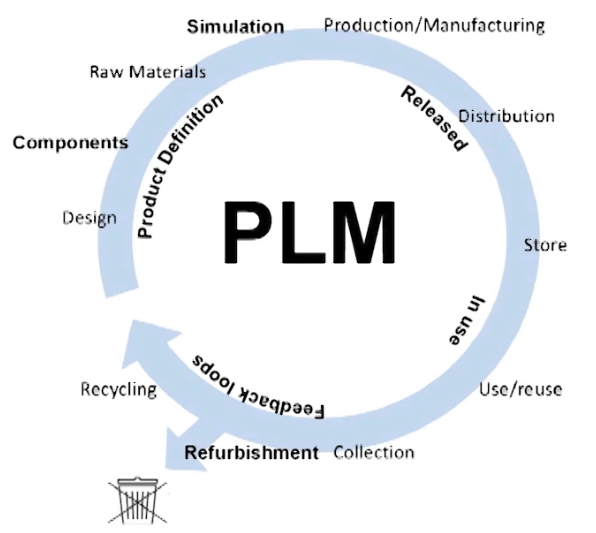 This session, presented by Hannes Lindfred from TECHNIA, was one of my favorite presentations, as it links tightly to what we want to achieve with the PLM Green Alliance.
The subtitle of the presentation says it all: “How PLM can support Supply chain transparency, Circular economy, and System oriented product development”.
In a relaxed and entertaining manner, he explained the concepts and the needs of a circular economy, combined with examples from reality. In particular, I liked his closing statement linking the potential of digitization, modern PLM, and the circular economy. We have to learn to think and act circular. Highly recommended to watch!
Leading PLM Trends & Potential Disruptors
 A PLM conference would not be a PLM-conference if Peter Bilello from CIMdata would not be speaking. We share a lot of insights related to digital transformation and the understanding it requires the involvement of PLM. However, it is not the traditional PLM that is needed.
PLM needs to be rethought, think about the concept of a Product Innovation Platform. A digital platform is required if we want end-to-end digitalization; otherwise, we keep working in optimized silos.
Peter shared some survey results (see below) from early this year. It illustrates that most companies currently invest in traditional PDM aspects. Restating the need for our PLM communities to learn and educate and rethink aspects of PLM and learn to communicate them.

Remarkably similar to some of the aspects I explained in my: From Coordinated to Connected presentations. Changing to data, changing workforce, changing processes meaning systems thinking. Another plea for everyone to invest in learning. See his concluding remarks:
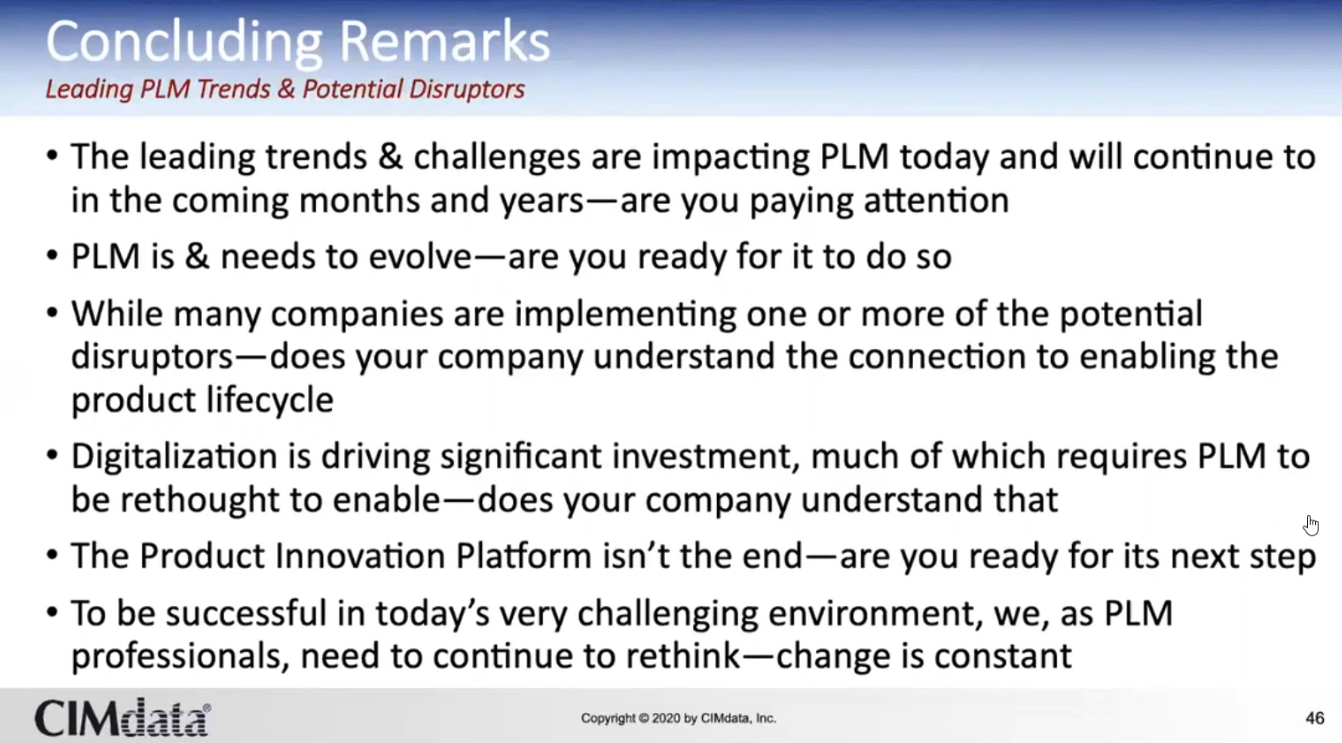
The closing Q&A session was interesting, addressing additive manufacturing, the graph database, and potential PLM disruptors coming from outside the traditional PLM space.
I recommend, pay attention to the closing questions – so many good points to put PLM in perspective.
From Coordinated to Connected & Sustainable
 Of course, I recommend you watch my presentation. It is one of the few opportunities to hear in a short time all the thoughts and concepts that I developed over the past 5 – 6 years. It saves you reading all my blog posts, which are less structured than this presentation.
I recommend you to watch this presentation in the context of Peter Bilello’s presentation as there are a lot of similarities, told in different words.
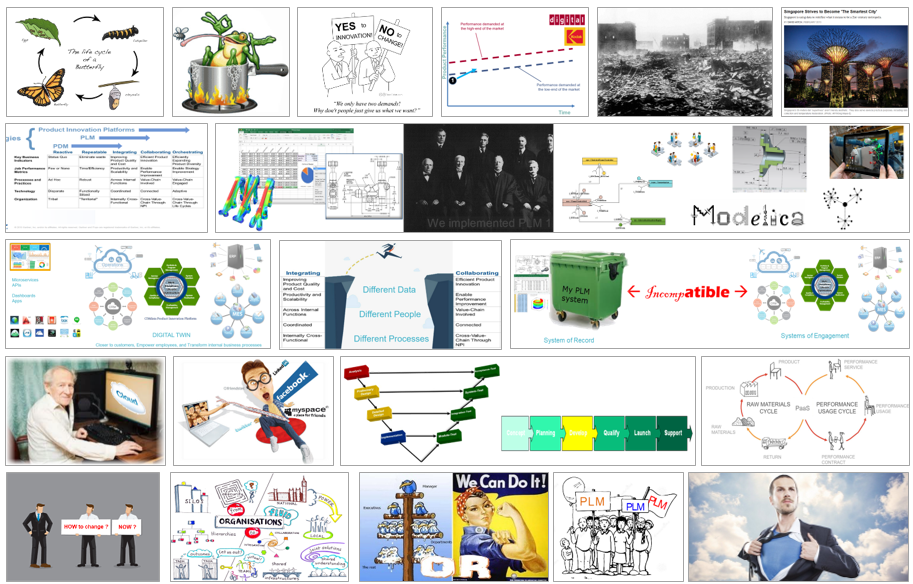
 After my presentation, I appreciated the Q&A part, as it allowed me to point to some more of the related topics: Legacy CAD-issues – the incompatibility of the past and future data, Management vision and the Perception of ROI.
Professional PLM
Raise your standards and your horizons
 An interesting presentation to watch, after seeing Peter Bilello’s presentation and my presentation, is the one given by Roger Tempest. Roger is another veteran in the PLM-world and co-founder of the PLM Interest group. For many years Roger is striving to get the PLM professional recognized and certified. We both share the experience that being a PLM consultant is not a profession to become wealthy.
One of the reasons might be that the scope of PLM and what is the required skill level is not precise. PLM considered as an engineering tool and PLM having so many diverse definitions.
The challenge of Roger’s approach is that it tries to capture people within a standardized PLM framework, which becomes apparent in the Q&A session. Currently, he is in the stage of building a steering group, “looking for companies that are fairly committed to PLM”. So which companies are the ones interested in PLM to commit time and resources to build a professional PLM body? This can be only academic people and PLM Vendors/Implementers. The last group will probably not likely agree on standardization.
Also related to the question about the different industries and maturity levels for companies came with an unsatisfactory answer. He talks about “absolute” PLM and no need to compare PLM with other industries. Here I believe there is such a fundamental difference in the meaning of PLM when talking to the traditional manufacturing companies as compared to high-tech/software-driven industries. I inserted here Marc Halpern’s maturity/technology diagram that I have been referencing in my presentation too.

The final question about vendors joining the PLM standardization group seems to be a utopia. As I expressed in my presentation, referring to Marc Halpern’s business maturity diagram, the vendors show us the vision of various business aspects related to PLM.
Marc already indicated this is the phase of the Product Innovation Platform.
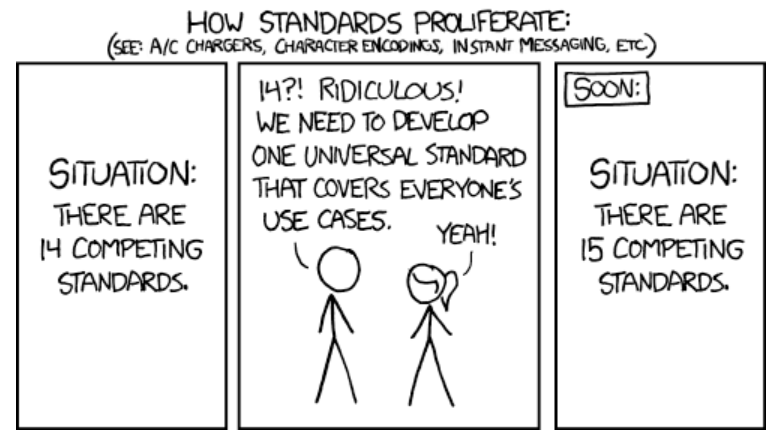
As long as the professional PLM organization is focusing on defining the standard, I foresee the outside world will move faster and be more diverse than a single PLM expert can handle. A typical issue with many other standards as you can see below.
What’s Next
I hope to see and participate more in virtual PLM conferences as it allows much larger audiences to connect compared to traditional conferences. However, there are things to improve, and therefore I want to propose some enhancements:
Make sure during the “live” sessions, there is the experience of “being live and connected”. Even when streaming a pre-recorded lecture, always follow-up immediately with a live Q&A session. I found the Q&A sessions very educative as they clarify or put the presentation in a broader context.
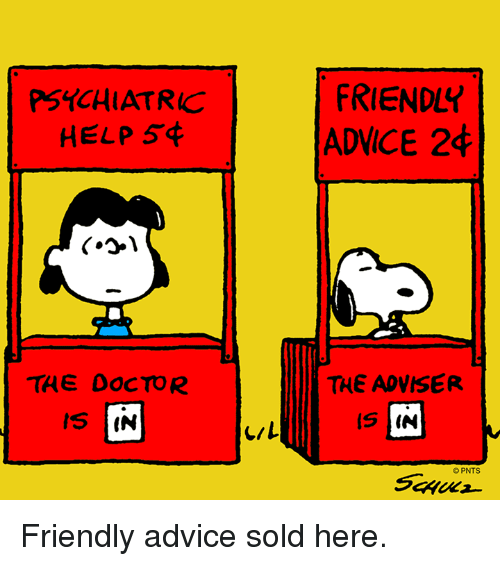
The current virtual booth as only a chat room is too primitive – it reminded me of the early days of internet communication – discussion groups in ASCII-terminal mode through Compuserve (remember). A booth could become a virtual meeting space on its own – all, of course, depending on the amount of bandwidth available. The feeling of “The Doctor is in”
 It is great that the content is available for 30 days, and I agree there is a need for a time limit on the content; otherwise, the conference becomes more a library. What I would like to see after the “live” days to still have a kind of place for sharing. What are your favorite presentations, and why should others look at it?
Conclusion
A great event and learning experience for me. Virtual conferences are the future for sure, and I encourage others to develop this type of conferences related to PLM further. It is a way to share knowledge and discuss topics in a sustainable manner. In the upcoming 30 days, I will come back to the conference one more time, based on interesting topics discovered or discussion related to the content.
Meanwhile, I encourage you too – if you are still in lockdown and if there is time to study – this is one of these unique opportunities.
 It is the holiday season many groups, religions have their celebrations in this period, mostly due to the return of the light on the Northern hemisphere – Christmas, Diwali, Hanukkah, Kwanzaa and Santa Lucia are a few of them. Combined with a new decade upcoming, also a time for me to reflect on what have we learned and what can we imagine in the next ten years.
Looking back the last decade
 Globalization is probably one of the most significant changes we have seen. Almost the whole world is connected now through all kinds of social and digital media. Information is instantly available and influences our behavior dramatically. The amount of information coming to us is so huge that we only filter the information that touches us emotionally. The disadvantage of that, opinions become facts and different opinions become enemies. A colorful society becomes more black and white.
These trends have not reached us, in the same manner, the domain of PLM. There have been several startups in the past ten years, explaining that PLM should be as easy as social communication with Facebook. Most of these startups focused on integrations with MCAD-systems, as-if PLM is about developing mechanical products.
In my opinion, the past decade has shown that mechanical design is no longer a unique part of product development. Products have become systems, full of electronics and driven by software. Systems Engineering became more and more important, defining the overall concept of a product, moving the focus to the earlier stages of the product design – see image below.
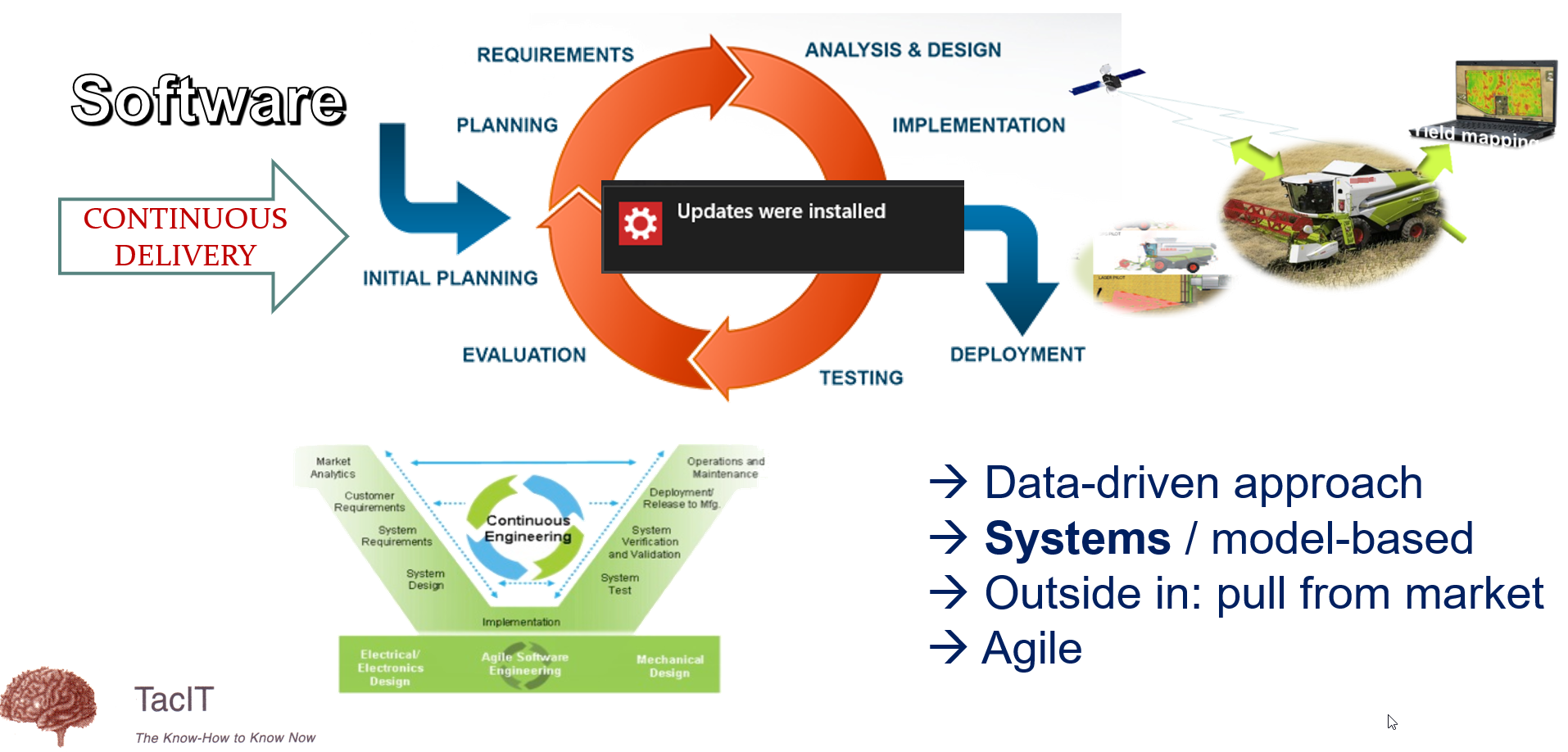
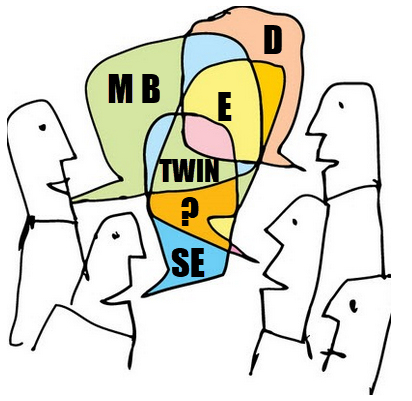
During Ideation and system definition, we need “social” collaboration between all stakeholders. To get a grip on this collaboration, we use models (SysML, UML, Logical, 2D, 3D) to have an unambiguous representation, simulation and validation of the product already in the virtual world.
Actually, there is nothing social about that collaboration. It is a company-driven demand to deliver competitive products to remain in business. If our company does not improve multidisciplinary collaboration, global competitors with less nostalgic thoughts to the past will conquer the market space.
 Currently in most companies there are two worlds, hardware and software, almost 100 %-separated managed by either PLM or ALM (Application Lifecycle Management). It is clear that “old” PLM – item-driven with related documents cannot match the approach required for ALM – data-elements (code) based on software models (and modules).
In the hardware world a change can have a huge effect on the cost (or waste) of the product, however, implementing a hardware change can take months. Think about new machinery, tooling in the worst case. In the software domain, a change can be executed almost immediately. However here testing the impact of the change can have serious effects. The software fix for the Boeing 737 Max is not yet proven and delivered.
Therefore, I would like to conclude that in the past decade we learned in the PLM-domain to work in a Coordinated manner – leaving silos mostly in place.
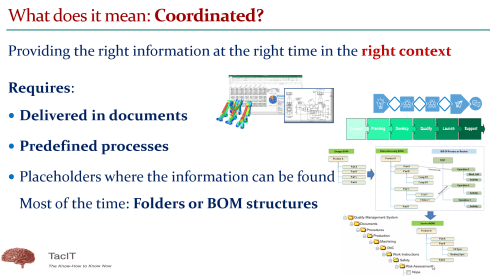
Next week I will look forward to our challenging upcoming decade. Topics on my list for the next decade are:
- From Coordinated to Connected – Generation Change
- Sustainability of our Earth (and how PLM can help)
- Understanding our human behavior to understand how to explain PLM to your execs- PI PLMx London 2020
- All combined with restoring trust in science
I wish you all a happy and healthy New Year – take time to listen and learn as we need dialogue for the future, not opinions.
See you in 2020


During my holiday I have read some interesting books. Some for the beauty of imagination and some to enrich my understanding of the human brain.
 Why the human brain? It is the foundation and motto of my company: The Know-How to Know Now.
In 2012 I wrote a post: Our brain blocks PLM acceptance followed by a post in 2014 PLM is doomed, unless …… both based on observations and inspired by the following books (must read if you are interested in more than just PLM practices and technology):
- The Innovator’s Dilemma by Clayton Christensen
- On Intelligence by Jeff Hawkins
- Thinking, Fast and Slow by Daniel Kahneman
In 2014, Digital Transformation was not so clear. We talked about disruptors, but disruption happened outside our PLM comfort zone.
Now six years later disruption or significant change in the way we develop and deliver solutions to the market has become visible in the majority of companies. To stay competitive or meaningful in a global market with changing customer demands, old ways of working no longer bring enough revenue to sustain. The impact of software as part of the solution has significantly changed the complexity and lifecycle(s) of solutions on the market.
Most of my earlier posts in the past two years are related to these challenges.
What is blocking Model-Based Definition?
 This week I had a meeting in the Netherlands with three Dutch peers all interested and involved in Model-Based Definition – either from the coaching point of view or the “victim” point of view. We compared MBD-challenges with Joe Brouwer’s AID (Associated Information Documents) approach and found a lot of commonalities.
No matter which method you use it is about specifying unambiguously how a product should be manufactured – this is a skill and craftsmanship and not a technology. We agreed that a model-based approach where information (PMI) is stored as intelligent data elements in a Technical Data Package (TPD) will be crucial for multidisciplinary usage of a 3D Model and its associated information.
If we would store the information again as dumb text in a view, it will need human rework leading to potential parallel information out of sync, therefore creating communication and quality issues. Unfortunate as it was a short meeting, the intention is to follow-up this discussion in the Netherlands to a broader audience. I believe this is what everyone interested in learning and understanding the needs and benefits of a model-based approach (unavoidable) should do. Get connected around the table and share/discuss.
 We realized that human beings indeed are often the blocking reason why new ways of working cannot be introduced. Twenty-five years ago we had the discussion moving from 2D to 3D for design. Now due to the maturity of the solutions and the education of new engineers this is no longer an issue. Now we are in the next wave using the 3D Model as the base for manufacturing definition, and again a new mindset is needed.
There are a few challenges here:
- MBD is still in progress – standards like AP242 still needs enhancements
- There is a lack of visibility on real reference stories to motivate others.
(Vendor-driven stories often are too good to be true or too narrow in scope) - There is no education for (modern) business processes related to product development and manufacturing. Engineers with new skills are dropped in organizations with traditional processes and silo thinking.
Educate, or our brain will block the future!
 The above points need to be addressed, and here the human brain comes again into the picture. Our unconscious, reptile brain is continuously busy to spend a least amount of energy as described in Thinking, Fast and Slow. Currently, I am reading the Idiot Brain: What Your Head Is Really Up To by Dean Burnett, another book confirming that our brain is not a logical engine making wise decisions
And then there is the Dunning-Kruger effect, explaining that the people with the lowest skills often have the most outspoken opinion and not even aware of this flaw. We see this phenomenon in particular now in social media where people push their opinion as if they are facts.
So how can we learn new model-based approaches and here I mean all the model-based aspects I have discussed recently, i.e., Model-Based Systems Engineering, Model-Based Definition/ Model-Based Enterprise and the Digital Twin? We cannot learn it from a book, as we are entering a new era.
First, you might want to understand there is a need for new ways of working related to complex products. If you have time, listen to Xin Guo Zhang’s opening keynote with the title: Co-Evolution of Complex Aeronautical Systems & Complex SE. It takes 30 minutes so force yourself to think slow and comprehend the message related to the needed paradigm shift for systems engineering towards model-based systems engineering
Also, we have to believe that model-based is the future. If not, we will find for every issue on our path a reason not to work toward the ultimate goal.
You can see this in the comments of my earlier post on LinkedIn, where Sami Grönstrand writes:
I warmly welcome the initiative to “clean up” these concepts (It is time to clean up our model-based problem and above all, await to see live examples of transformations — even partial — coupled with reasonable business value identification.
There are two kinds of amazing places: those you have first to see before you can believe they exist.
And then those kinds that you have to believe in first before you can see them…
 And here I think we need to simplify en enhance the Model-Based myth as according to Yuval Harari in his book Sapiens, the power of the human race came from creating myths to align people to have long-term, forward-looking changes accepted by our reptile brain. We are designed to believe in myths. Therefore, the need for a Model-based myth.In my post PLM as a myth? from 2017, I discussed this topic in more detail.
Conclusion
There are so many proof points that our human brain is not as reliable as we think it is. Knowing less about these effects makes it even harder to make progress towards a digital future. This post with all its embedded links can keep your brain active for a few hours. Try it, avoid to think fast and avoid assuming you know it all. Your thoughts?
Learning & Discussing more?
Still time to register for CIMdata PLM Roadmap and PDT Europe
PLM is required to become customer focused is one of the marketing statements, in the same way as PLM and Innovation are connected. Before moving into PLM topics, I want to share some personal experiences related to customer focus. These experiences happened to me almost within a one-day timeframe.
 Two weeks ago I landed late in the evening at Schiphol airport. A bus took us from the plane to an arrival gate to go through security. With the other passengers, I arrived in a passage which was planned to be closed during the night as maintenance should take place. Two servicemen were frustrated by the crowd passing by.
One of them said: “How was it possible that passengers still arrive and disturb our work?” ** . The other serviceman said: “The bus driver has gone crazy to drop these passengers here where we are supposed to work?”**
** Free translated from a native Dutch local accent.
 As a customer, I realized this is a common problem of large enterprises. Most employees are not connected to their customers anymore. They focus only on their work, and every disruption (even by customers) is an element of irritation. They do not realize it is the customer at the end that pays their salary.
Next I went to the railway station to catch my train to Utrecht. Waiting on the platform, the announcement for my train to arrive did not pop up as expected on the billboard and disappeared from the list. A few minutes after the train should have departed from the station, a speaker announces the train to Utrecht has been cancelled.
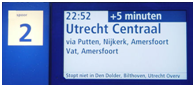 Why this happened nobody knows. There were no railway employees around to provide more information. (Perhaps too late – their shift was over?) Half an hour later the next train was supposed to come in. At the scheduled time, a train arrived at the platform, and everyone got into the train.
The train speaker announced that this is NOT THE TRAIN to Utrecht, and he advised all travelers for Utrecht to get out. Many passengers including me went outside looking for a railway employee who could explain what was happening. But there was no one around. At a certain moment, the right train arrived and finally after 1½ hour delay I came home and decided to file a complaint. Mainly because there was no interaction possible with any railway employee to understand why it happened, get rid of my annoyance, and what the alternatives to travel were.
Next surprise: It was not possible to file a complaint directly; you had to go through a virtual assistant named Eva. Probably they use a female name as men are usually more respectful in their conversation towards a woman than to man. Imagine it would have been Joe. Still lack of intelligence can be annoying for everyone as you can see below:
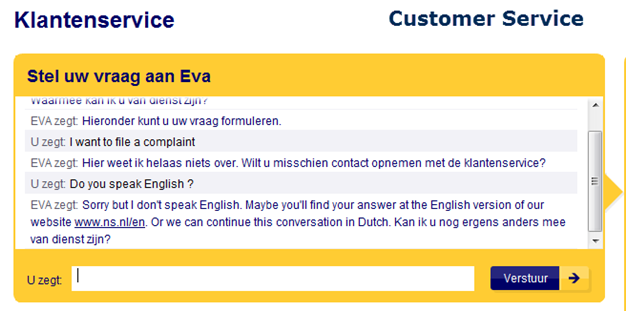
Only when you provide Eva with your personal details and email address, you get a mail back from customer service to which you can respond with your complaint. This is somehow the same principle as a firewall with a reverse proxy. How to shield yourself from customers / virus attacks.
So I sent my mail and got a confirmation mail that I would get a response within 2 working days. And indeed within two days the answer came. They were really sorry, and they have taken so many measures already in the past to avoid this kind of situations it was almost impossible this had happened. Sorry. It was a classical answer, and what was missing any link to the actual event – nobody probably inside the railway company would take an initiative to understand what has happened. Disappointing.
 As a customer, I realized this is a common problem of large enterprises. They are not connected to their customers anymore. They are afraid of direct contact and build a solid defense wall around their organization. They do not realize it is the customer at the end that pays their salary.
The next day ….
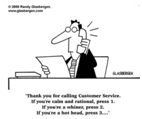 I had an issue with my telephone system (Murphy´s law). The telephone company, like the railway company, was in the past a state-owned company, meaning they had a monopoly for 50 years and more. They are still struggling to become customer centric as the older staff is still in control.
If you try to interact with them through the regular means, by phone (long waiting times – many times diverted to other departments), or by email (thank you for your email – we will try to respond within two working days), you will have a similar response.
 As a customer, I realized this is a common problem of large enterprises. They are not connected to their customers anymore. People try to do their best in their domain, and if it does not fit anymore you are diverted or set aside as there is enough to keep you busy. They do not realize it is the customer at the end that pays their salary.
Enough fun now, I am sure this happens in many other places.
Back to become customer centric
 When you look at a small startup company, they are focused on the outside world. To gain market share and market attention they need to focus on their potential customers and learn to engage with them as soon as possible. They have a distinctive or new proposition and the faster they understand the dynamics of their potential market, the better they have the likelihood customers will choose their offering and become successful.
And as the company is small, everyone knows who is doing what. People are multitasking and flexible. Somehow the same characteristics you find in a small mid-market company. Every customer order is celebrated there and known.
When companies become large, people start to become specialized, and they create departments. There is a need for globalization and more people will join the company around the world, combined with a layer of middle management. And more and more the management approach becomes MBR (management by results) as this has become the standard. I wrote about MBR and about MBM (management by means) in a previous post – profit beyond measure.
The disadvantage of the MBR approach is that instead of having a company looking outside to their customers, the organization turns inwards. Instead of “I need to satisfy my customers as at the end they pay my salary” the mind switches towards “I need to satisfy my boss as he/she pays my salary”
 Departments optimize themselves to attain efficiency and get the numbers they need to provide. For many departments, here the decision is made that customers are too disruptive or evil as they disrupt the ideal process – customer interaction becomes a threat. It is safer to do nothing and keep responding to what your boss / management wants, instead of acting in a customer centric manner as it disrupts the daily work.
Still all companies want to be customer centric as this is THE WAY to stay in business. If you know what your customers want or even better, if you can give them their unique experiences, you are ahead of the competition. And keep in mind to think glocal (global but act local – customer centric)
Glocaliszation ?
How can we bring the customer centric approach to large companies, where most departments work totally isolated from customers for various reasons? In my younger days, when I was connected with software development, I noticed most R&D organizations want to spend all day and their energy on developing new (cool) things, instead of optimizing existing (boring) stuff. Where optimizing existing stuff is what customers want, and new stuff is perhaps what marketing and sales think is needed. I think there is a lot of coolness possible in optimizing boring stuff (look at Apple).
 Clayton Christensen wrote in his book “The Innovators Dilemma -When New Technologies Cause Great Firms to Fail” about why leading companies lose their connection with the market. They focus on their large customers and want to satisfy these large ones. The strange situation is here that they are customer centric but only for a few, where the benefit often lies in volumes of customers. Big companies focusing on key customers do not see disruption and innovations coming up, and at a certain moment they can become obsolete. Read his book if you work for a great firm. I wrote about his thoughts in the context of PLM –: The Innovators Dilemma and PLM
Finally, the extreme you find in governmental organizations. With their lack of competition and most of the time tax money coming in, there is no need to be customer centric. Even if an individual wants to be customer centric, the system will not allow this person much room to act different.
However, there is hope, and my hope is based on the Millenials or the so called “generation Y”. I described them in a recent post after reading the book Fast Future: Mixing past and future generations with a PLM sauce
If we go back to my problem with the telephone system and the large phone company, there a change is happening. A year ago I discovered they have a “social” helpdesk. If you send them a direct message through Facebook or Twitter; you receive a response within a few hours. And next they pick up the issue and take the initiative to solve it.
The same is valid for my favorite airline, KLM. As part of the big joint venture with Air France, all official contact through mail became hopeless, but their responses through Facebook are fast and to the point.
 What happens behind the scenes in these two companies, and I am sure it happens in more companies, is that new employees (generation Y) become the focal point to the customer and they take away the burden of dealing with a large, rigid organization. Because they understand the company better and are considered as one-of-us inside the company, they have access to the information. They can push and pull information, initiate actions and at the end come back with a customer focused response.
This approach of personal customer interaction brings you in a better mood, although I must say in the case of the activities with the telephone company, issues were not resolved much faster. The old processes internally were still not in sync with each other. Probably because there is not “a single version of the truth”-concept like in most companies. Different systems for different purposes, not integrated cause mistakes, especially when the customer wants an immediate response and resolution.
Maybe an example to explain this approach. When working in a classical PLM system, it is all about the data inside the system with the right status and version. In modern PLM, it could be the most credible information the system could provide based on (search) algorithms. It is the similar to the way Google translate works – this was a translation a year ago:
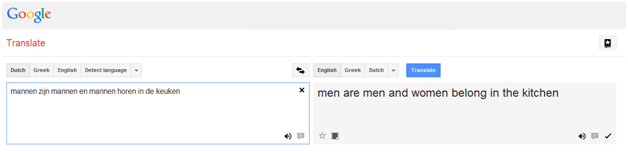
In Dutch, the text is only about men, but as the combination women and kitchen was more commonly found, Google translated the sentence as above. Sexistic, based on historic associations. If you try the same sentence now, you get:
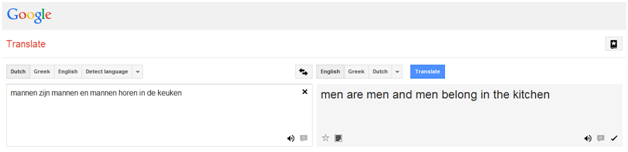
An accurate translation based on error fixing once. Google does not keep the one-to-one translation of words but presents the sentence with the highest probability. And when corrected it reminds the fix. This is somehow in the same manner as our brain associates information. Ultimately in a few years these engines can become as powerful as an experienced worker.
But what intrigued me more was the fact that these “social employees” somehow became the glue in the organization, connecting people and departments internally. Bringing to the customer a positive experience. Instead of specialists there was a need for generalists who can communicate.
Could this also work in the context of PLM? Instead of trying to tear down the silos, use a team of “social workers” who will interact with customers or the people in the field?
 I am not sure. The type of customer interaction I described was mainly related to standard products and services. Not sure if this approach of generalists (data miners) would work in manufacturing companies.
When asking myself this question in the PLM domain, it realized it is somehow describing the work I am doing most of the time. Working with companies implementing PLM, working with PLM vendors and implementers on building plans to solve or resolve issues, without being part of a single project (silo) all the time – a “social worker” – a generalist is becoming an expert in generalizations.
So I am interested to learn, is anyone of the readers of this post aware of the “social approach” in their environment? Do you see companies hire generalists (generation Y) to connect the old world back to their customers?
The downside of the “social worker” is that the internal organization is even more shielded from annoying customers who disturb their plans and daily rhythm. It does not solve the silo problem.
However look at it from the modern data centric (PLM) approach, where storing information is no longer the goal. It is about identifying the right data in the context of an activity where data might come from different sources. Exactly what generation Y is used to do, the data scientist. With their mindset of connecting data instead of owning data, this generation might produce the next evolution of PLM.
Will the future be working towards access to information as likely the single truth, or will we keep on working towards a single version of the truth? If it is going to be disruptive? (Probably yes) If it is in the near future? (Why not) this is still unclear to me.

No conclusion this time.
Many questions ……
Your thoughts / comments?
 Jos Voskuil's Weblog
Interesting reflection, Jos. In my experience, the situation you describe is very recognizable. At the company where I work, sustainability…
[…] (The following post from PLM Green Global Alliance cofounder Jos Voskuil first appeared in his European PLM-focused blog HERE.) […]
[…] recent discussions in the PLM ecosystem, including PSC Transition Technologies (EcoPLM), CIMPA PLM services (LCA), and the Design for…
Jos, all interesting and relevant. There are additional elements to be mentioned and Ontologies seem to be one of the…
Jos, as usual, you've provided a buffet of "food for thought". Where do you see AI being trained by a…