
You are currently browsing the category archive for the ‘intelligence’ category.
 In nearly twenty years of coaching PLM implementations, I’ve noticed something striking: these projects often mirror politics—not just in complexity, but in the blame game that follows when things go wrong.
When something goes wrong, people rarely see it as an opportunity to solve the issue together. They look for someone to blame instead.
That happens in politics and in Product Lifecycle Management. I wrote about it in 2019, The PLM Blame Game—and most of those observations still hold—although the emphasis has shifted.
But what if the real issue isn’t the system or the technology? What if it’s the human connections—or lack thereof—that determine success?
Political systems/ PLM approaches
In democracies, everyone debates priorities, but progress is slow. Stakeholders defend their own interests, consultants favor preferred solutions, and vendors promise the moon. Long-term plans such as digital transformation often stall.
 The result is familiar: each leadership change resets ambitions, leaving users with mixed messages and less commitment – sounds familiar in PLM?.

From: Communication charts around the world
Then there are the autocracies, where a single dominant view determines the path. Usually, that view comes not from the CEO but from the CFO or CIO. These leaders often have a limited understanding of product lifecycle management and instead rely on trusted networks.
That is why some companies choose SAP because “all enterprises run on SAP” or Teamcenter because “everyone in automotive uses Teamcenter.” Strategic consultants reinforce the same pattern with their own preferred solutions.
The result: Surface-level alignment, but resistance beneath the surface—another familiar PLM scenario.

From: Communication charts around the world – 2014 China
In smaller companies, a populist version often appears. Without a strong strategic layer, the loudest voices from vendors and implementers shape the company’s view. That is the riskiest setup because vision and strategy are effectively outsourced. Early in my career, I often heard:
“You know solution XYZ, so tell us what to do.”
The result is predictable: no one in the company feels a true sense of ownership of the business outcome – the type of situations I have been mediating the most.

Of course, the analogy is imperfect. Countries usually lack competition, so citizens cannot simply switch. Still, it is a useful way to frame what happens in PLM.
They – not us – are the problem!
 In the past, debates focused on who was to blame for project problems, often blaming the stakeholder who was not at the table.
Vendors and implementers blamed customers, vendors and customers blamed implementers, and implementers blamed vendors. My role in PLM mediations was to get everyone into the same room.
 But one issue always remained:
Blaming the customer is difficult when the customer is assumed to be right – They are paying the bill and not always with pleasure.
Why 70 % of PLM implementations fail – or not?
 For decades, we have heard horror stories about failed PLM implementations, each supposedly explained by one simple cause.
Depending on who tells the story, the culprit is the software, the company culture, poor user involvement, or unrealistic ambitions without a budget or understanding.
But the truth is more nuanced: many of these implementations did not actually fail completely.
People react strongly to the word failure because no one wants to be associated with it.

Yet, in software, ‘failing fast’ is often celebrated—it’s a way to adapt early. PLM is slowly catching on, with the rise of Minimum Viable Product (MVP) approaches. Instead of waiting for a ‘perfect’ big-bang rollout, companies now start with a working foundation and iterate as needs emerge.”
 That only works if the company owns its vision and strategy. An MVP approach also demands end-to-end stakeholder involvement, because everyone contributes to the solution. At the same time, our limbic brain works against us: it pushes us to protect what we know and react strongly to change.
That reaction shows up in PLM projects too. The loudest critics get the most attention, which makes it easy to conclude a program failed—even when it is working for most people who have adapted to the change.
And now, a new trend has emerged:
PLM systems are failing!
Now, a new claim is gaining traction: PLM systems themselves are failing. With the rise of AI, traditional vendors are being blamed for failing to provide the right infrastructure or opportunities for AI-enabled capabilities.

After years of success built on legacy platforms, vendors now face growing pressure from opinion leaders calling for change.
 Martin Eigner has made this point in several posts:
- Why We’re “Optimizing” Problems We Created Ourselves
- 50 % failure rate is not an accident
- My vision for the next 5 years
 Oleg Shilovitsky has made similar arguments:
- Did We Solve PLM, or Just Learn How to Describe It?
- Who can replace the big three PLM and why that may be the wrong question in the Age of AI?
- Is Product Memory Just a New Name for PLM?
 Prof. Dr. Jörg W. Fischer wrote:
- Will we ever solve PLM? We did, but AI has taken over.
- Digitalization has failed to deliver on its central promise! Why?
 Doug Macdonald wrote about the shortcomings of Legacy PLM, which most companies imagine/practice:
- The shortcomings of Legacy PLM
- Could you manage the development of a toothbrush in a Legacy PLM system
I agree with much of this critique, for sure, if you still consider PLM a system rather than a product lifecycle management strategy implemented through a federated infrastructure of systems.
 The posts I referred to highlight real problems from the past and suggest that new insights and AI might help us build better businesses. The question is whether that promise will be fulfilled.
Creating the human thread
 AI could help businesses break through organizational silos by pulling together information across functions.
That would make concepts such as the digital thread and digital twin easier to implement without relying on dedicated interfaces.
This shift creates both opportunity and risk.
If AI reduces the need for siloed optimization, traditional middle-management roles will change. The key question is whether companies are willing to rethink their structures or stay constrained by Conway’s Law.
It could also make many methodology debates less important.

Today, we as consultants often promote methodologies shaped by our own experience or vendor narratives. The long-running eBOM–mBOM debate is a good example. Across industries and platforms, the answer is often more straightforward than the discussion suggests.
As AI absorbs more collective knowledge, the role of PLM experts and consultants will shift. At the Share PLM Summit in Jerez, we discussed what should come next: a stronger focus on human connection.
 That is why I use the term human thread: the network of relationships that connects people across the business. Michael Finochario (Fino) touches on the same shift in his post on the changing balance between humans and technology, in his review of my session in Jerez.
Others are moving in the same direction. This week, Helene Älander shared a post that makes a similar point.
Helene’s post and the related discussion suggest a growing belief that transformation depends less on technology alone and more on human connection and motivation inside the company.
A quote from Helene’s post, and I recommend reading the full post and thread.
One lesson has stayed with me ever since:
Transformation rarely fails because of technology. It slows down when the distance between executive ambition and middle-management reality becomes too large.
For now, I call this the need for the human thread. A successful transformation starts with an end-to-end human connection across the business, with people treating that connection as a shared priority.
Because people are intrinsically motivated by a human connection.
The human thread requires a new approach, new forms of workshops and learning sessions where leaders, managers, and employees work together on the desired business flow.
Helene Älander points in this direction, and Share PLM supports it through initiatives such as Share The Nest.
Also this year at the Share PLM Summit in Jerez, Andreas Wank described how Pepperl+Fuchs made a breakthrough by bringing people together. As Fino in his review post quoted:
No one on the team wanted to make a decision because every decision affected someone else. So they put 30 people in one room for a week and forced them to make decisions. Not perfect decisions. Working hypotheses. That was a critical insight: In PLM, waiting for perfect certainty kills momentum.
The year before, at the 2025 Share PLM Summit, Andrea Järvrén already shared a similar lesson, describing how Tetra Pak used design sprints to advance its PLM work by prioritizing human interaction.
It is an unstoppable trend – the human thread popping up in more and more conversations.
Conclusion
The time for blaming systems, technology, and methodology should fade into the background. Companies need to focus on building business flow through the human thread—the human connections that drive commitment, motivation, and change.
So, here is the question: Are we ready to stop blaming systems and start building the human thread? Or will we keep repeating the same patterns, just with fancier technology?

 Those who follow my blog know that whenever I visit an event, I push myself to write a review the weekend after to share the experience. However, this time after the conference, I have been exploring further the Andalusian culture, making me realize that this is exactly what makes the conference different and stand out.
Where traditional conferences are often in cold high-tech places, efficiently to reach, making it for attendees an event in their comfort zone, the Share PLM Summit is held in a grand bodega in the unhurried scenery of Jerez de la Frontera.

An experience best described by Helena Alander in her recent post: “I have never taken the time to invest in myself.” – Read the post, she shares a great reflection.
As the focus of Share PLM is to focus on human-centric transformations, there is much more focus on the human experiences of people implementing transformations in their companies.
The human focus translates into a diverse audience and one big common theme for all, instead of a traditional industry or technology focus.
With more than a hundred attendees, the conference felt like a big family gathering where you can easily connect and learn from everyone. I believe this type of conference will be the future in the age of AI.

The many sponsors that joined the conference were also a part of the success. Without their support and human-centric messages, it would be hard to make this event sustainable 😉
If you want to read an impression of each session, Michael Finocchareo made a great effort to share the highlights of each session – you can find all his excellent reviews here: Share PLM Summit – Fino Summary Post Index.
And now some of my personal highlights from the conference!
The Role of People in Transformation Programs: Experience LEAN
 An interesting learning experience was the session from Javier Sánchez, who is a plant manager at Kerry in Spain, about the implementation of LEAN at several plants in Spain.
Where initially we might think that PLM and plant operations are two different worlds, Javier was able to take us on the journey of implementing a LEAN program for the Spanish plants. There was so much communality to PLM implementations when dealing with behavioural change and the uncertainty of people.
Change can only happen when people in the organisation understand and trust what is going to happen and that they are part of a change for their benefit.
TRUST is the word that I noted down, and to build trust, you can see how Javier shared the org chart of the Kerry Sevilla plant – upside down – people at the top and the manager at the bottom to support everyone.

This image above really illustrates that you have a people-first approach.
Javier further elaborated on the difference of such an approach and how an organization can be fully engaged, as the picture below illustrates.

 And after a successful implementation, Javier also warned about the rebound effect.
Where initially the excitement and energy come from the new situation, companies might slowly fall back into the traditional, as over time people have and bring their habits, the pyramid falls over as the image to the left illustrates and Javier shared several potential causes for such a rebound.
Important to see C-level change as #1 point, a point I have seen popping up in many PLM implementations too. After starting with a great vision, new people at the C-level come in questioning the vision (and strategy).

Note: GENBA is a term coming from LEAN, and is also relevant to PLM. It refers to the location where value is created—such as a factory floor, construction site, sales floor, or any workplace where the core work happens.
The concept emphasizes the importance of direct observation and engagement at the source of the action, rather than relying on reports or second-hand information.
It is a key principle in lean manufacturing and continuous improvement methodologies, encouraging leaders to “go to the GENBA” to understand problems and opportunities firsthand.
Combined with his great storytelling skills, Javier took us on an interesting story, very relevant for a human-centric approach and showing that we can learn from other disciplines.
Adapting PLM implementation strategy in evolving organizational realities
 Susanna Mäentausta, also a guest in our Share PLM season 2 podcast with that time the title The ROI of Digitalization: A Deep Dive into Business Value gave an interesting lecture about her experiences with the PLM implementation at her current company, Novartis.
She excels in keeping her focus on both PLM business value and strategies to achieve this.
I knew Susanna from her earlier presentation at the Product Innovation 2019 conference in London. Here she stood out because of her strategic and tactical approach to implementing PLM – at that time at Kemira – where she was able to get PLM business benefits to be discussed at the C-level – it was more than a technical story.
You can read my observations from that time here: The weekend after PI PLMx London 2019
In her session this time, she explained all the challenges that she had to address at her current employer. It was not such a nice, linear step-by-step approach as presented by Andreas Wank earlier that day, talking about his implementation challenges at Pepperl & Fuchs.
Susanna’s tactics were all about securing the progress of the PLM project – design for change and awareness in the organisation. Javier Sanchez mentioned that the change at the C-level had a serious impact on the roadmap, as did both Susanna and Andreas. It remains a continuous point of attention when you want to guarantee a long-term outcome.
The image below says it all:

Susanne ended with some tactics:
- Design for non-removable anchor points that keep the PLM vision connected even when priorities shift.
- Define the non-negotiable cornerstone for the future: process & design frameworks and necessary authorities.
Her final recommendation was also interesting – the core team should have a clear long-term understanding of the future and work in an entrepreneurial mindset, meanwhile shielding execution from organizational politics.
Don’t get involved in politics – a recommendation that I also often shared, as politics is so much about emotions and subjective arguments, it’s better to work around it in silence.
The Human Advantage: Working and Leading in the Age of AI

Helena Gutierrez, well known as one of the founders of Share PLM and her AI-related newsletter, shared her positive view on how AI, in one way, destroyed Share PLM’s actual business practices, as a lot of material development now could be done with the help of AI in hours, compared to days of actual design work.
Companies won’t pay anymore for weeks of development of specific materials, she also pointed to the need for human skills in the future.
 I think we agree on the fact that with AI, we will need people who can bridge and work with agentic AI to achieve unmet benefits for organisations. These people will have a special role; they are there for their human skills, combining emotion and logic, potentially a highly rewarding job, however, in smaller quantities than current knowledge workers in companies.
In my session Are Humans Still Resources?, I shared a pessimistic viewpoint and an optimistic end.
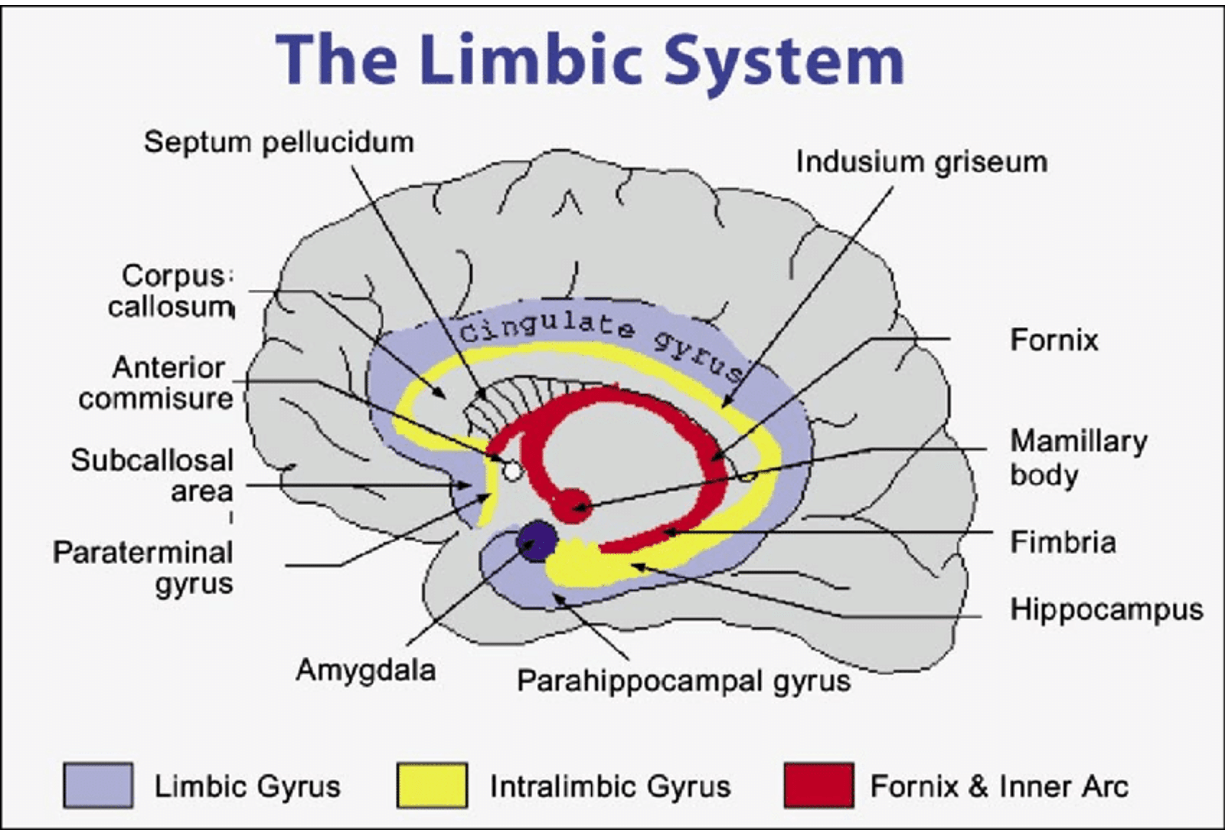
The pessimistic part is based on the fact that we humans run on our old biological hardware, the limbic brain, which urges us to save energy (think fast) and may lead to cognitive surrender. This situation might push companies to invest even more in AI and consider humans as a difficult resource to handle – are we back in the early days of the industrial revolution?

The optimistic side, which was also mentioned by others, and we see it happen, is that thanks to AI, the entrepreneur has a much easier life. A lot of the supporting activities for an entrepreneur can now be done using AI agents – the image below from this post by Dr.Sam Zolfagharian says it all:

For sure, the discussion will go on between the optimists and the realists (pessimists in disguise)
Scaling human capabilities
 I am closing this impression with a train of thought that I can’t get out of my head. We can scale tools and resources with AI, leaving only a space for people with a combination of specific human skills – not only deep thinking, but also emotional and empathic roles, like healthcare providers, coaches and entertainers.
These roles are hard to scale – you become a coach by learning from experiences, and AI will not have an “experience transfer function.” How will business scale in the future, as we also see that junior roles in an organisation disappear due to AI?

The topic was also discussed in the interesting AI panel discussion – image above – with a mix of participants. It was a balanced discussion between tech, vision and reality and one of the highlights was the response from Susanna to a question from the audience:
“I don’t know.”
Have you ever seen someone honestly say this in a panel discussion? And what would AI respond? Great to see the human presence.
Where will humans build their experience and skills to think? I wrote about this already in March and have not yet answered: PLM, AI, and the Risk of Cognitive Surrender: A Call to Stay Sharp!
How to stay sharp in an AI-dominated world?
Conclusion
The Share PLM summit demonstrated again that a human-centric approach related to product lifecycle management has many benefits, as these shared experiences and outcomes from the discussions are directly applicable. Big kudos to the Share PLM team that dared to invest in such an event last year and exceeded expectations this year.
For those who want to learn more, join us at the upcoming event, Putting People in PLM: A Share PLM Summit Recap! and get excited.
For those who are interested in a lifetime, full-time job, watch this excellent short movie below:
 December is the last month when daylight is getting shorter in the Netherlands, and with the end of the year approaching, this is the time to reflect on 2025.
For me, it has been an interesting year, and I hope it has been similar for you. I started 2025 with this post: My 2025 focus, sharing the topics that would drive my primary intentions—a quick walk through some of these topics and what to reflect on what I have learned.
Fewer blog posts
 It was already clear that AI-generated content was going to drown the blogging space. The result: Original content became less and less visible, and a self-reinforcing amount of general messages reduced further excitement.
As I have no commercial drive to be visible, I will continue to write posts only when relevant to personal situations or ideas, with the intention of being shared and discussed with the readers of my posts – approximate 26 / year.
 Therefore, if you are still interested in content that has not been generated with AI, I recommend subscribing to my blog and interacting directly with me through the comments, either on LinkedIn or via a direct message.
More podcast recordings
 Together with the Share PLM podcast team, Beatriz Gonzales and Maria Morris, we enjoyed talking with a large variety of people active in PLM, all having their personal stories related to PLM to share—each episode ending with an experience to share and a desired takeaway for the listeners. We did it with great pleasure and learned from each episode.
You can find all the recordings from 2025 (Season 3) here.
 In Season 4, we want to add the C-level perspective to our PLM and People podcast discussions.
#DataCentric or #PeopleCentric ?
 It was PeopleCentric first at the beginning of the year, with the Share PLM Summit in Jerez and DataCentric in the second half of the year, with activities connected to the PLM Roadmap/PDT Europe conference in Paris.
In case you missed the excitement and lessons learned, here they are:
- The weekend after the Share PLM Summit 2025
- A week after Shaping the Future of PLM – No time to lose!
- A very long week after PLM Roadmap / PDT Europe 2025
Both topics will become even more critical due to the impact of AI tools on our day-to-day work.
Sustainability?
 Already an uncomfortable term for some of us at the beginning of 2025, it has become one of the best-kept secrets of 2025. Where traditional countries and companies revert to their short-term bad habits – optimize shareholders value, there are also forward-looking enterprises that are actively rephrasing their sustainable strategies as risk mitigation strategies with the awareness that adaptation is inevitable. Better start early than too late – not a typical human strategy.

In case you are interested, I recommend you read and listen to:
And now it is time to discuss AI.
 With all the investments and marketing related to AI, it is unavoidable to neglect it. For sure, it is a hype, but I believe that we are into something revolutionary for society, like the impact of the industrial revolution on our society 150 years ago.
However, there are also the same symptoms of the .com-hype 25 years ago.
 Who are going to be the winners? Currently, the hardware, datacenter and energy providers, not the AI-solution providers. But this can change.
Let’s look into some of the potential benefits.
Individual efficiency?
 Many of the current AI tools allow individuals to perform better at first sight. Suddenly, someone who could not write understandable (email) messages, draw images or create structured presentations now has a better connection with others—the question to ask is whether these improved efficiencies will also result in business benefits for an organization.
 Looking back at the introduction of email with Lotus Notes, for example, email repositories became information siloes and did not really improve the intellectual behavior of people.
Later, Microsoft took over the dominant role as the office software provider with enhanced search and storage capabilities, but still, most of the individual knowledge remained hidden or inaccurate as it missed the proper context.
 As a result of this, some companies tried to reduce the usage of individual emails and work more and more in communities with a specific context. Also, due to COVID and improved connectivity, this led to the success of Teams. And now with Copilot embedded in the Microsoft suite, I am curious to learn what companies perceive as measurable business benefits.
The chatbot?
 For many companies, the chatbot is a way to reduce the number of people active in customer relations, either sales or services. I believe that, combined with the usage of LLMs, an improvement in customer service can be achieved. Or at least the perception, as so far I do not recall any interaction with a chatbot to be specific enough to solve my problem.
The risks with AI?
 Now I may sound like a boomer who started focusing on knowledge management 25 years ago – exploring tacit knowledge.
Tacit knowledge is the knowledge a real expert has by combining different areas of expertise and understanding what makes sense.
Could tacit knowledge be replaced by an external model that gives you all the (correct?) answers?
In verifiable situations, we know when the model is hallucinating – but what if the scope is beyond our understanding? Would we still rely on AI, and could AI be manipulated in ways that we lose touch with the real facts?
Already, the first research papers are coming out warning of reduced human cognitive performance, e.g., this paper: Beware of Metacognitive Laziness: Effects of Generative Artificial Intelligence on Learning, Motivation, Processes, and Performance.
Combined with laziness (a typical human behavior – system 1), these results made me think of a statement made by Sean Illing:
“People love the truth, but they hate facts.”
A statement highly relevant to what we see happening now with social media – we do not think or research deep enough anymore, we select the facts that we like and consider them our truth.
What happens in our PLM domain?
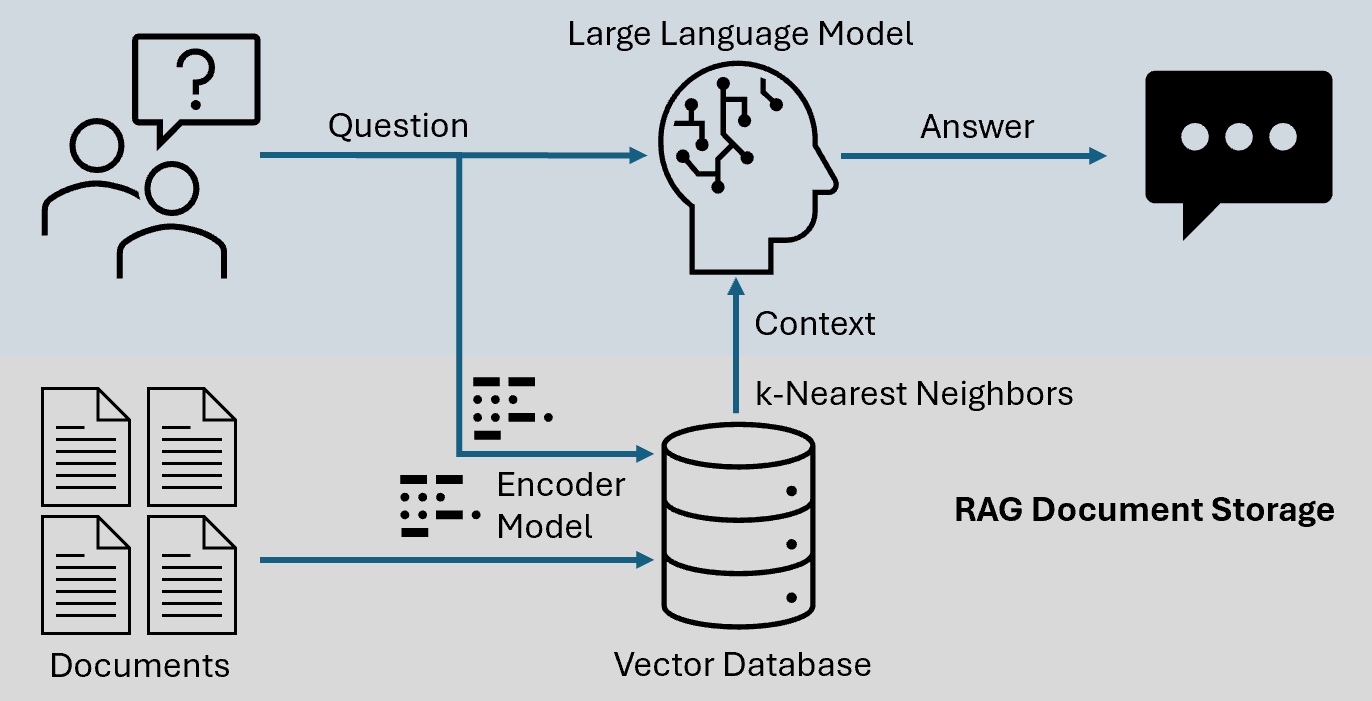 In the PLM domain, companies are indeed reluctant to use LLMs directly, where some of them use RAG (Retrieval-Augmented Generation) to feed the LLM with a relevant context.
Still, the answers require human interpretation, as you cannot avoid hallucinations in your product lifecycle management processes.
As long as the results are based on inconsistent data sources that lack the relevant context, the answers are of low quality.

Meanwhile, every vendor in the PLM space is now offering AI-agents, most of the time within their own portfolio space. The ultimate dream is polygot agents (who are buying them / who are developing them) that can work together and create a new type of agility beyond traditional workflows. An interesting article in this context comes from Oleg Shilovitsky: Why Does PLM Need Task Re-Engineering Before It Can Have AI?
Still, these potential “quick” fixes create a risk for companies in the long term. Buying AI tools does not fix the foundation that is based on legacy.

In particular, related to the Shape the Future of PLM – Together workshop in Paris on Nov 4th, the consensus was that companies need to invest in understanding and implementing domain-specific ontologies and semantic models to provide a data-driven infrastructure that allows AI to make accurate decisions or valid recommendations.
You can read the summary of the event and recommendations here: Accelerating the Future of PLM & ALM on the ArrowHead’s website.
You can also read this post from Ole Olesen-Bagneux: Why will 2026 be the year of the ontologist?
 Although the topics in the workshop might look “too advanced” for your company, they are crucial to transform into a long-term, sustainable, data-driven, model-based, and AI-supported enterprise.
Somewhere, you have to cross the chasm from documents to data in context.
Being busy is not an excuse, as you can also read in Thomas Nys’s LinkedIn post: Your Engineers spend 40 % of their time maintaining yesterday’s shortcuts. And you’re wondering why your AI initiative isn’t moving faster. I loved the image.
Human Resources?
The AI revolution will have an impact on society, and it is up to us individuals how well we adapt.
 Remember, the first 50 – 100 years of the Industrial Revolution made only a few people extremely rich. James Watt, the Rothschild family, Andrew Carnegie, John D. Rockefeller, Cornelius Vanderbilt, J.P. Morgan, Alfred Krupp and the Schneider family became so rich due to ownership of factories and machinery, the control of raw materials (coal, iron, oil), the use of new technology (steam power, mechanization) combined with access to cheap labor and weak labor laws and limited competition early on.
Most humans moved into urbanized areas to become nothing but cheap resources, even children. And remember, many of us are still human resources!
A new conspiracy?
 In 2016, Ida Auken’s lecture at the WEF created traction during COVID among people who believed in conspiracies. Her story focused on a more circular economy with respect for the Earth’s resources. The story was framed into the message:
“In the future, you will own nothing and be happy.”
The conspiracy theorist believed all their possessions would be taken away by the elite in the long term.
I want to conclude with a new message for these conspiracy theorists active on X or other discussion fora:
“In the future, you will know nothing, and you won’t be aware enough to care.”
Conclusion
2026 is going to be an interesting year, where we cannot allow ourselves to sit still and watch what is happening. Active participation is more challenging but also more rewarding than being a consumer. In May 2026, I hope to meet some of you at the Share PLM Summit in Jerez and share the human side, followed by the PDM Roadmap/PDT Europe conference in Q4 in Gothenburg, where we will catch up on the technical and data side.
I am wishing you all a wise and happy/healthy 2026


 First, an important announcement. In the last two weeks, I have finalized preparations for the upcoming Share PLM Summit in Jerez on 27-28 May. With the Share PLM team, we have been working on a non-typical PLM agenda. Share PLM, like me, focuses on organizational change management and the HOW of PLM implementations; there will be more emphasis on the people side.
Often, PLM implementations are either IT-driven or business-driven to implement a need, and yes, there are people who need to work with it as the closing topic. Time and budget are spent on technology and process definitions, and people get trained. Often, only train the trainer, as there is no more budget or time to let the organization adapt, and rapid ROI is expected.
 This approach neglects that PLM implementations are enablers for business transformation. Instead of doing things slightly more efficiently, significant gains can be made by doing things differently, starting with the people and their optimal new way of working, and then providing the best tools.
The conference aims to start with the people, sharing human-related experiences and enabling networking between people – not only about the industry practices (there will be sessions and discussions on this topic too).
 If you are curious about the details, listen to the podcast recording we published last week to understand the difference – click on the image on the left.
And if you are interested and have the opportunity, join us and meet some great thought leaders and others with this shared interest.
Why is modern PLM a dream?
 If you are connected to the LinkedIn posts in my PLM feed, you might have the impression that everyone is gearing up for modern PLM. Articles often created with AI support spark vivid discussions. Before diving into them with my perspective, I want to set the scene by explaining what I mean by modern PLM and traditional PLM.
Traditional PLM
Traditional PLM is often associated with implementing a PLM system, mainly serving engineering. Downstream engineering data usage is usually pushed manually or through interfaces to other enterprise systems, like ERP, MES and service systems.

Traditional PLM is closely connected to the coordinated way of working: a linear process based on passing documents (drawings) and datasets (BOMs). Historically, CAD integrations have been the most significant characteristic of these systems.
 The coordinated approach fits people working within their authoring tools and, through integrations, sharing data. The PLM system becomes a system of record, and working in a system of record is not designed to be user-friendly.
Unfortunately, most PLM implementations in the field are based on this approach and are sometimes characterized as advanced PDM.
You recognize traditional PLM thinking when people talk about the single source of truth.
Modern PLM
 When I talk about modern PLM, it is no longer about a single system. Modern PLM starts from a business strategy implemented by a data-driven infrastructure. The strategy part remains a challenge at the board level: how do you translate PLM capabilities into business benefits – the WHY?
More on this challenge will be discussed later, as in our PLM community, most discussions are IT-driven: architectures, ontologies, and technologies – the WHAT.
 For the WHAT, there seems to be a consensus that modern PLM is based on a federated
I think this article from Oleg Shilovitsky, “Rethinking PLM: Is It Time to Move Beyond the Monolith?“ AND the discussion thread in this post is a must-read. I will not quote the content here again.
After reading Oleg’s post and the comments, come back here
The reason for this approach: It is a perfect example of the connected approach. Instead of collecting all the information inside one post (book ?), the information can be accessed by following digital threads. It also illustrates that in a connected environment, you do not own the data; the data comes from accountable people.
Building such a modern infrastructure is challenging when your company depends mainly on its legacy—the people, processes and systems. Where to change, how to change and when to change are questions that should be answered at the top and require a vision and evolutionary implementation strategy.

A company should build a layer of connected data on top of the coordinated infrastructure to support users in their new business roles. Implementing a digital twin has significant business benefits if the twin is used to connect with real-time stakeholders from both the virtual and physical worlds.
 But there is more than digital threads with real-time data. On top of this infrastructure, a company can run all kinds of modeling tools, automation and analytics. I noticed that in our PLM community, we might focus too much on the data and not enough on the importance of combining it with a model-based business approach. For more details, read my recent post: Model-based: the elephant in the room.
Again, there are no quotes from the article; you know how to dive deeper into the connected topic.
 Despite the considerable legacy pressure there are already companies implementing a coordinated and connected approach. An excellent description of a potential approach comes from Yousef Hooshmand‘s paper: From a Monolithic PLM Landscape to a Federated Domain and Data Mesh.
You might recognize modern PLM thinking when people talk about the nearest source of truth and the single source of change.
Is Intelligent PLM the next step?
 So far in this article, I have not mentioned AI as the solution to all our challenges. I see an analogy here with the introduction of the smartphone. 2008 was the moment that platforms were introduced, mainly for consumers. Airbnb, Uber, Amazon, Spotify, and Netflix have appeared and disrupted the traditional ways of selling products and services.
The advantage of these platforms is that they are all created data-driven, not suffering from legacy issues.
 In our PLM domain, it took more than 10 years for platforms to become a topic of discussion for businesses. The 2015 PLM Roadmap/PDT conference was the first step in discussing the Product Innovation Platform – see my The Weekend after PDT 2015 post.
At that time, Peter Bilello shared the CIMdata perspective, Marc Halpern (Gartner) showed my favorite positioning slide (below), and Martin Eigner presented, according to my notes, this digital trend in PLM in his session:” What becomes different for PLM/SysLM?”

2015 Marc Halpern – the Product Innovation Platform (PIP)
While concepts started to become clearer, businesses mainly remained the same. The coordinated approach is the most convenient, as you do not need to reshape your organization. And then came the LLMs that changed everything.
Suddenly, it became possible for organizations to unlock knowledge hidden in their company and make it accessible to people.

Without drastically changing the organization, companies could now improve people’s performance and output (theoretically); therefore, it became a topic of interest for management. One big challenge for reaping the benefits is the quality of the data and information accessed.
 I will not dive deeper into this topic today, as Benedict Smith, in his article Intelligent PLM – CFO’s 2025 Vision, did all the work, and I am very much aligned with his statements. It is a long read (7000 words) and a great starting point for discovering the aspects of Intelligent PLM and the connection to the CFO.
You might recognize intelligent PLM thinking when people and AI agents talk about the most likely truth.
Conclusion
Are you interested in these topics and their meaning for your business and career? Join me at the Share PLM conference, where I will discuss “The dilemma: Humans cannot transform—help them!” Time to work on your dreams!

Join us to discuss the (Intelligent) PLM dream
 Happy New Year to all of you, and may this year be a year of progress in understanding and addressing the challenges ahead of us.
To help us focus, I selected three major domains I will explore further this year. These domains are connected – of course – as nothing is isolated in a world of System Thinking. Also, I wrote about these domains in the past, as usually, noting happens out of the blue.
 Meanwhile, there are a lot of discussions related to Artificial Intelligence (AI), in particular ChatGPT (openAI). But can AI provide the answers? I believe not, as AI is mainly about explicit knowledge, the knowledge you can define by (learning) algorithms.
Expert knowledge, often called Tacit knowledge, is the knowledge of the expert, combining information from different domains into innovative solutions.
 I started my company, TacIT, in 1999 because I thought (and still think) that Tacit knowledge is the holy grail for companies.
Let’s see with openAI how far we get ……
Digitization of the PLM domain
 The PLM domain is suffering from its legacy data (documents), legacy processes (linear – mechanical focus) and legacy people (siloed). The statement is a generalization.
More details can be found in my blog series: The road to model-based and connected PLM.
So why should companies move to a model-based and connected approach for their PLM infrastructure?
 There are several reasons why companies may want to move to a model-based and connected approach for their Product Lifecycle Management (PLM) infrastructure:
- Increased efficiency: A model-based approach allows for creating a digital twin of the product, which can be used to simulate and test various design scenarios, reducing the need for physical prototypes and testing. This can lead to faster and more efficient product development.
- Improved collaboration: A connected PLM infrastructure allows for better collaboration between different teams and departments, as all product-related information is stored in a central location and can be accessed by authorized personnel. This can improve communication and decision-making within the organization.
- Enhanced visibility: A model-based PLM system provides a single source of truth for all product-related data, giving management a clear and comprehensive view of the product development process. This can help identify bottlenecks and areas for improvement.
- Reduced risk: By keeping all product-related information in a centralized location, the risk of data loss or inconsistencies is reduced. This can help ensure that the product is developed in accordance with regulatory requirements and company standards.
- Increased competitiveness: A model-based and connected PLM infrastructure can help companies bring new products to market faster and with fewer errors, giving them a competitive advantage in their industry.
The text in italics was created by ChatGPT. After three learning cycles, this was the best answer I got. What we are missing in this answer is the innovative and transformative part that modern PLM can bring. Where is the concept of different ways of working, and new business models, both drivers for digitalization in many businesses?
 Expert knowledge related to Federated PLM (or Killing the PLM Monolith) are topics you will not find through AI. This is, for me, the most interesting part to explore.
We see the need but lack a common understanding of the HOW.
Algorithms will not innovate; for that, you need Tacit intelligence & Curiosity instead of Artificial Intelligence. More exploration of Federated PLM this year.
PLM and Sustainability
 Last year as part of the PLM Global Green Alliance, we spoke with six different PLM solution providers to understand their sustainability goals, targets, and planned support for Sustainability. All of them confirmed Sustainability has become an important issue for their customers in 2022. Sustainability is on everyone’s agenda.
Why is PLM important for Sustainability?
 PLM is important for Sustainability because a PLM helps organizations manage the entire lifecycle of a product, from its conception and design to its manufacture, distribution, use, and disposal. PLM can be important for Sustainability because it can help organizations make more informed decisions about the environmental impacts of their products and take steps to minimize those impacts throughout the product’s lifecycle.
For example, using PLM, an organization can consider the environmental impacts of the materials that are used in a product, the energy consumption of the manufacturing process, the product’s end-of-life disposal, and other factors that may affect its overall Sustainability. By considering these factors early in the design process, organizations can make more sustainable choices that reduce the environmental impact of their products over their lifecycle.
In addition, PLM can help organizations track and measure the Sustainability of their products over time, allowing them to continuously improve and optimize their products for Sustainability. This can be particularly important for organizations that are looking to meet regulatory requirements or consumer demand for more sustainable products.
Again not a wrong answer, but there is no mention of supporting the concepts of the circular economy, the potential of using digital twins at the various lifecycle stages of the products to perform trade-off studies in the virtual world, or to analyze the product behavior from the physical world in the virtual world for optimization.
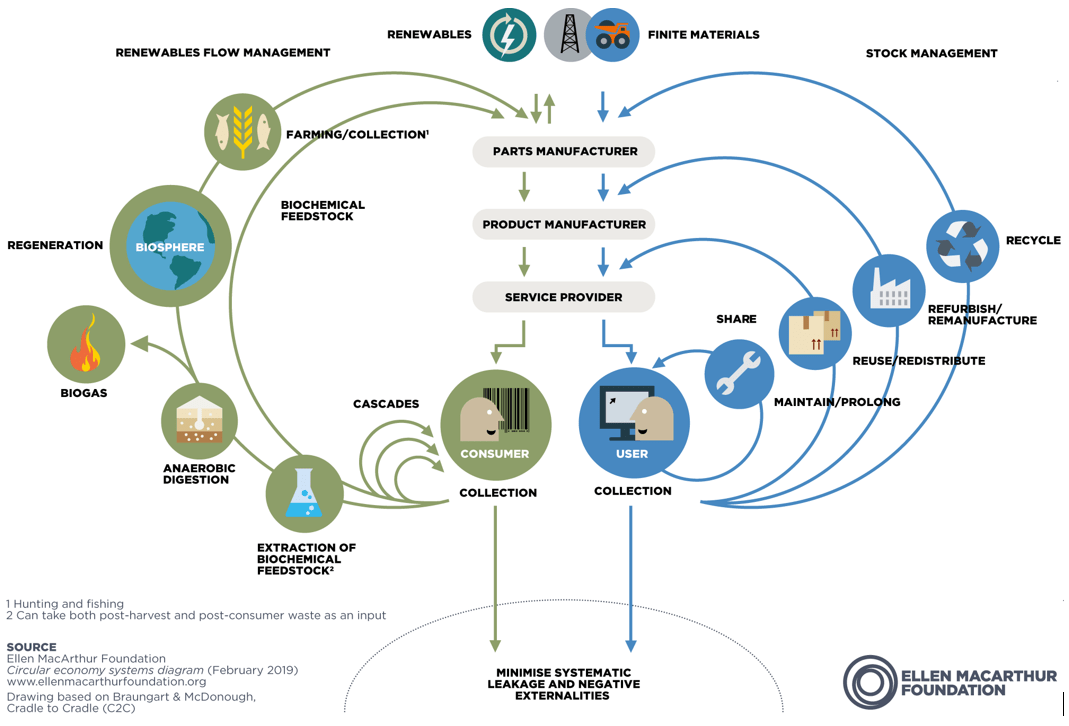
This is (again), for me, the most interesting part to explore.
We see the need but lack the sense of urgency on the NOW.
More on Sustainability this year.
PLM Education at all levels
Historically PLM was framed as an “engineering thing” or a system needed for R&D/Engineering. Modern PLM is much broader and, unfortunately, more hard to grasp. I support the CIMdata definition:
CIMdata defines PLM as:
-
A strategic business approach that applies a consistent set of business solutions that support the collaborative creation, management, dissemination, and use of product definition information
-
Supporting the extended enterprise (customers, design and supply partners, etc.)
-
Spanning from concept to end of life of a product or plant
-
Integrating people, processes, business systems, and information
 And even here, I would say this definition is challenging as the scope is extensive and could touch a lot of activities inside an enterprise. As I wrote last year in my series of posts related to PLM and Education, there is:
Strategy education (what are the trends/potential of digital transformation in the business domain related to the company’s products)
Methodology/ Academic Education (independent from tools, what are the best practices, where they reside, potential lessons learned and pitfalls to avoid)
Organisational Change Management (the Education and support needed to enable a business transformation – modern PLM is a transformation enabler)
By asking ChatGPT for their opinion, we learn the following:
Product Lifecycle Management (PLM) education refers to training and development programs that focus on teaching individuals how to effectively manage the lifecycle of a product within an organization. This can include a wide range of topics, such as product design, development, and engineering; supply chain management; quality control and assurance; and product retirement and disposal.
Some specific types of PLM education that a company may need to provide to its employees include:
- Introduction to PLM: This type of training is designed to provide a general overview of PLM concepts and practices and may be suitable for employees who are new to the field or who have limited experience with PLM.
- PLM software training: Many companies use specialized PLM software to manage their product lifecycle processes. Employees who will be using this software will need training on how to use it effectively.
- Industry-specific PLM training: Depending on the industry in which a company operates, there may be specific PLM practices and regulations that employees need to be familiar with. For example, a company in the aerospace industry may need to provide training on PLM practices that are specific to the aerospace industry.
- Leadership and management training: For employees who are responsible for leading and managing PLM projects or teams, additional training in leadership and project management may be necessary.
Overall, the types of PLM education that a company needs will depend on the specific needs and goals of the organization, as well as the roles and responsibilities of its employees.
In general, we see from the answer that strategy and organizational change management beyond the tool are not considered.
This is precisely the area where a PLM Expert can help.
We see the need for Education, but we lack the willingness to invest in it.
Conclusion
It was an exciting exercise to combine my blogging thoughts with the answers from OpenAI. I am impressed by the given answers, knowing that the topics discussed about PLM are not obvious. On the other hand, I am not worried that AI will take over the job of the PLM consultant. As I mentioned before, the difference between Explicit Knowledge and Tacit Knowledge is clear, and business transformations will largely depend on the usage of Tacit knowledge.
I am curious about your experiences and will follow the topics mentioned in this post and write about them with great interest.

 As I promised I would be enjoying my holidays in the upcoming month there as still a few points I want to share with you.
Not a real blog post, more an agenda and a set of questions for potential follow-up.
Here are five topics for the upcoming months, potentially also relevant and interesting for you. Have a look.
Peer Check
 This week the discussion I had with Adam Keating, Colab’s CEO and founder, was published on their podcast channel, Peer Check. As I slowly discovered the content, I mentioned their podcast in my last blog post. I was impressed by the first episodes I could listen to and listened to all of them last week.
Digesting the content from these episodes, I have the impression that we are following Adam’s or Collab’s lifecycle. From understanding the market, the people, and the industry towards the real collaboration topics, like MBD, their product offering and ultimately the connection with PLM. I am curious about what is next.
 For me discovering their podcast and being able to participate was an exciting and learning moment. I am still waiting for the readers of this blog to mention their favorite podcasts.
Let us know in the comments.
PLM Global Green Alliance
 With the PLM Global Green Alliance (PGGA), we plan to have monthly ZOOM discussions with our LinkedIn members, moderated by one of the PGGA core team members.
The idea of these sessions is that we pick a topic, the moderator sets the scene and then it is up to the members to discuss.
Participants can ask questions and bring in their points. In our understanding, many companies believe they have to do something about sustainability beyond writing it in their mission, but where and how to start?
So the PGGA discussion will be a place to get inspired and act.
 Potential topics for the discussion are: What technologies must I master to become more sustainable? How can I motivate my company to become real sustainable? What is a lifecycle assessment (LCA), and how to introduce it in my company? What is the circular economy, and what is needed to become more circular in the context of PLM?
If you like one of the topics, let us know in the comments or add your favorite discussion topic. More on the agenda in early September
PGGA meets ….
In this series with PLM vendors and solution providers, we try to understand their sustainability drivers, their solutions, their roadmap and their perception of what is happening in the field. So far, SAP, Autodesk and Dassault Systèmes have contributed to these series. After the summer, we continue with two interviews:
 Early in September, the PGGA will discuss sustainability with Sustaira. Sustaira is a Siemens partner, and they offer an all-in-one Sustainability platform, domain-specific Sustainability app templates, and custom Sustainability web and mobile initiatives. Expect the interview to be published early in September.
 In the last week of September, the PGGA will have a meeting with Aras in our series related to sustainability. Aras is one of the main PLM providers and we will discuss sustainability even more with them as you can read further on in this agenda. Expect the interview to be released by the end of September.
No actions here for you, just stay tuned in September with the PGGA.
CIMdata PLM Roadmap and PDT
 On 18 and 19 October, the CIMdata PLM Road Map and PDT 2022 Conference is scheduled as an in-person event in Gothenburg.
The agenda is almost secured and can be found here.
It will be a conference with guidance from CIMdata and Eurostep completed with major Aerospace, Defense and Automotive companies sharing their experience towards a model-based and digital enterprise.
 So no marketing but real content; however, there will also be forward-looking presentations related to new PLM paradigms and the relation to data and sustainability.
So if you are curious, come to his conference as you will be triply rewarded: by the content, the keynotes and discussions with your peers.
Register before September 12 to benefit from a 15 % Early Bird discount, which you can spend for the dinner after day 1. The conference dinner has always been a good moment for networking and discussion.
A Sustainable Future – Seize Opportunities When Someone Else Sees Costs
 Last part of this agenda.
On October 25th, I will participate as a PGGA member in a webinar with Aras, discussing sustainability in more depth compared to our earlier mentioned standard PGGA interview.
Here I will be joined by Patrick Willemsen from Aras. Patrick is the technical director of the Aras EMEA community, and together we will explore how companies aiming to deliver profitable products and solutions also can contribute to a more sustainable future for our planet.
Feel free to subscribe to this free webinar and discuss your thoughts with us in the Q&A session – here is the registration link.
Conclusion
No conclusion this time – all thinking is in progress and I hope to see your feedback or contribution to one of these events in person or through social media.
 In my last post in this series, The road to model-based and connected PLM, I mentioned that perhaps it is time to talk about SLM instead of PLM when discussing popular TLA’s for our domain of expertise. There were not so many encouraging statements for SLM so far.
SLM could mean for me, Solution Lifecycle Management, considering that the company’s offering more and more is a mix of products and services. Or SLM could mean System Lifecycle Management, in that case pushing the idea that more and more products are interacting with the outside world and therefore could be considered systems. Products are (almost) dead.
In addition, I mentioned that the typical product lifecycle and related configuration management concepts need to change as in the SLM domain. There is hardware and software with different lifecycles and change processes.
 It is a topic I want to explore further. I am curious to learn more from Martijn Dullaart, who will be lecturing at the PLM Road map and PDT 2021 fall conference in November. I hope my expectations are not too high, knowing it is a topic of interest for Martijn. Feel free to join this discussion
In this post, it is time to follow up on my third statement related to what data-driven implies:
Data-driven means that we need to manage data in a much more granular manner. We have to look different at data ownership. It becomes more about data accountability per role as the data can be used and consumed throughout the product lifecycle
On this topic, I have a list of points to consider; let’s go through them.
The dataset
In this post, I will often use the term dataset (you are also allowed to write the data set I understood).
 A dataset means a predefined number of attributes and values that belong logically to each other. Datasets should be defined based on the purpose and, if possible, designated for a single goal. In this way, they can be stored in a database.
Combined with other datasets, a combination can result in relevant business information. Note a dataset is not only transactional data; a dataset could also describe geometry.
Identify the dataset
 In the document-based world, a lot of information could be stored in a single file. In a data-driven world, we should define a dataset that contains a specific piece of information, logically belonging together. If we are more precise, a part would have various related datasets that make up the definition of a part. These definitions could be:
- Core identification attributes like ID, Name, Type and Status
- The Type could define a set of linked information. For example, a valve would have different characteristics as a resistor. Through classification, we can link data sets to the core definition of a part.
- The part can have engineering-specific data (CAD and metadata), manufacturing-specific data, supplier-specific data, and service-specific data. Each of these datasets needs to be defined as a unique element in a data-driven environment
- CAD is a particular case as most current CAD systems don’t treat geometry as a single dataset. In a file-based world, many other datasets are stored in the file (e.g., engineering or manufacturing details). In a data-driven environment, we want to have the CAD definition to be treated like a dataset. Dassault Systèmes with their CATIA V6 and 3DEXPERIENCE platform or PTC with OnShape are examples of this approach.Having CAD as separate datasets makes sharing and collaboration so much easier, as we can see from these solutions. The concept for CAD stored in a database is not new, and this approach has been used in various disciplines. Mechanical CAD was always a challenge.
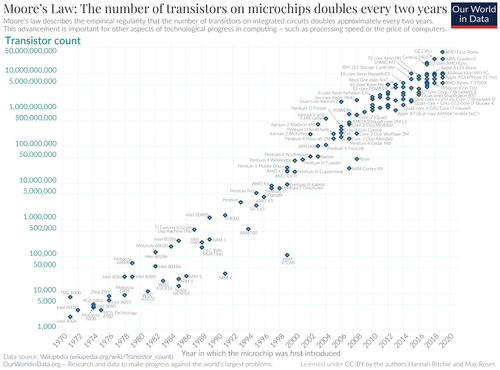 Thanks to Moore’s Law (approximate every 2 years, processor power doubled – click on the image for the details) and higher network connection speed, it starts to make sense to have mechanical CAD also stored in a database instead of a file
An important point to consider is a kind of standardization of datasets. In theory, there should be a kind of minimum agreed collection of datasets. Industry standards provide these collections in their dictionary. Whenever you optimize your data model for a connected enterprise, make sure you look first into the standards that apply to your industry.
 They might not be perfect or complete, but inventing your own new standard is a guarantee for legacy issues in the future. This remark is also valid for the software vendors in this domain. A proprietary data model might give you a competitive advantage.
Still, in the long term, there is always the need to connect with outside stakeholders.
Identify the RACI
To ensure a dataset is complete and well maintained, the concept of RACI could be used. RACI is the abbreviation for Responsible Accountable Consulted and Informed and a simplification of the RASCI Model, see also a responsibility assignment matrix.
 In a data-driven environment, there is no data ownership anymore like you have for documents. The main reason that data ownership can no longer be used is that datasets can be consumed by anyone in the ecosystem. No longer only your department or the manufacturing or service department.
Data sets in a data-driven environment bring value when connected with other datasets in applications or dashboards.
A dataset describing the specification attributes of a part could be used in a spare part app and a service app. Of course, the dataset will be used in a different context – still, we need to ensure we can trust the data.
Therefore, per identified dataset, there should be governed by a kind of RACI concept. The RACI concept is a way to break the siloes in an organization.
Identify Inside / outside
There is a lot of fear that a connected, data-driven environment will expose Intellectual Property (IP). It came up in recent discussions. If you like storytelling and technology, read my old SmarTeam colleague Alex Bruskin’s post: The Bilbo Baggins Threat to PLM Assets. Alex has written some “poetry” with a deep technical message behind it.
 It is true that if your data set is too big, you have the challenge of exposing IP when connecting this dataset with others. Therefore, when building a data model, you should make it possible to have datasets pure for internal usage and datasets for sharing.
When you use the concept of RACI, the difference should be defined by the I(informed) – is it PLM-data or PIM-data for example?
Tracking relations
Suppose we follow up on the concept of datasets. In that case, it becomes clear that relations between the datasets are as crucial as the dataset. In traditional PLM applications, these relations are often predefined as part of the core data model/
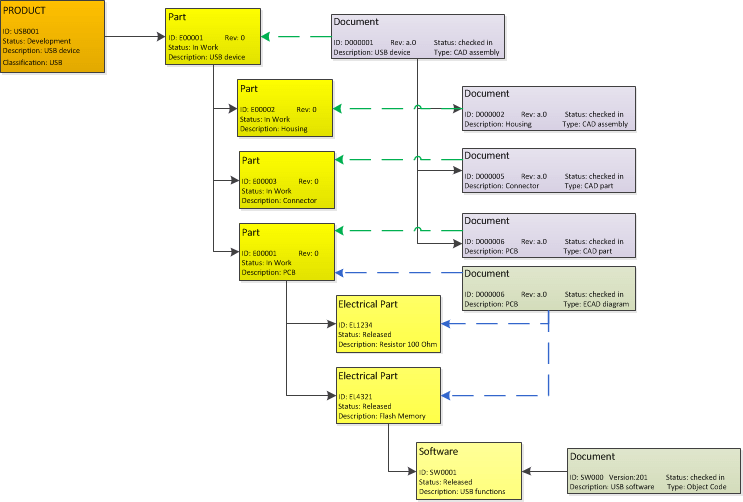 For example, the EBOM parts have relationships between themselves and specification data – see image.
The MBOM parts have links with the supplier data or the manufacturing process.
The prepared relations in a PLM system allow people to implement the system relatively quickly to map their approaches to this taxonomy.
 However, traditional PLM systems are based on a document-based (or file-based) taxonomy combined with related metadata. In a model-based and connected environment, we have to get rid of the document-based type of data.
Therefore, the datasets will be more granular, and there is a need to manage exponential more relations between datasets.
 This is why you see the graph database coming up as a needed infrastructure for modern connected applications. If you haven’t heard of a graph database yet, you are probably far from technology hypes. To understand the principles of a graph database you can read this article from neo4j: Graph Databases for Beginners: Why graph technology is the future
As you can see from the 2020 Gartner Hype Cycle for Artificial Intelligence this technology is at the top of the hype and conceptually the way to manage a connected enterprise. The discussion in this post also demonstrates that besides technology there is a lot of additional conceptual thinking needed before it can be implemented.
Although software vendors might handle the relations and datasets within their platform, the ultimate challenge will be sharing datasets with other platforms to get a connected ecosystem.
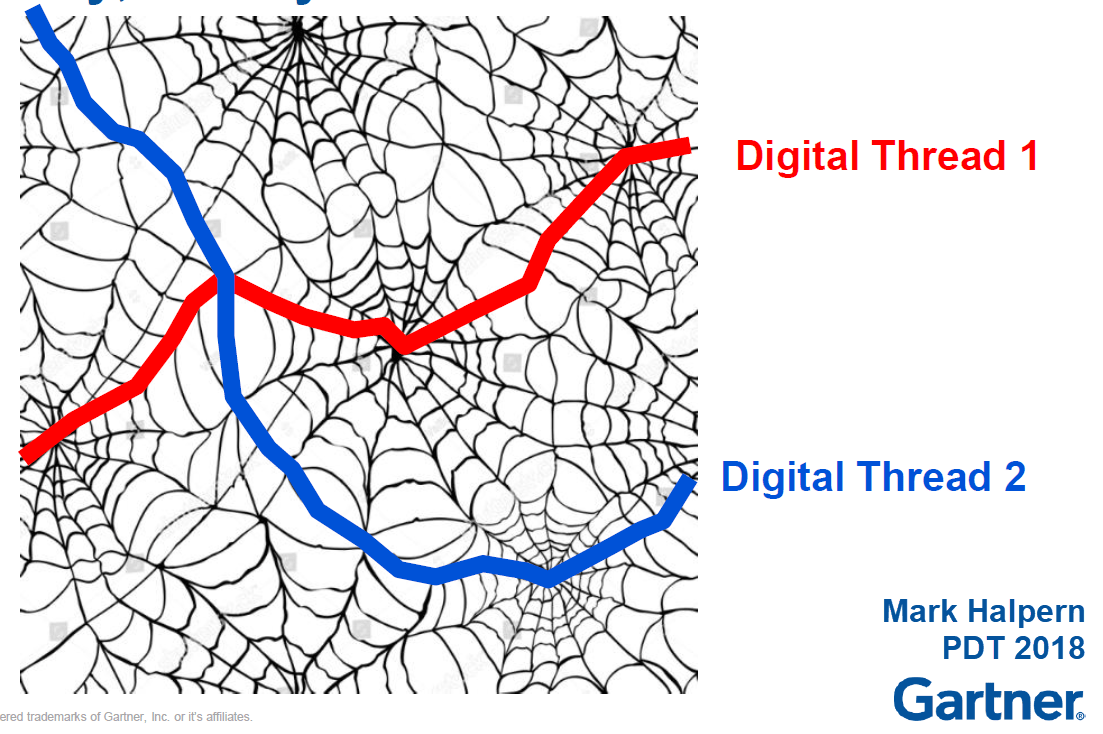
For example, the digital web picture shown above and introduced by Marc Halpern at the 2018 PDT conference shows this concept. Recently CIMdata discussed this topic in a similar manner: The Digital Thread is Really a Web, with the Engineering Bill of Materials at Its Center
(Note I am not sure if CIMdata has published a recording of this webinar – if so I will update the link)
Anyway, these are signs that we started to find the right visuals to imagine new concepts. The traditional digital thread pictures, like the one below, are, for me, impressions of the past as they are too rigid and focusing on some particular value streams.
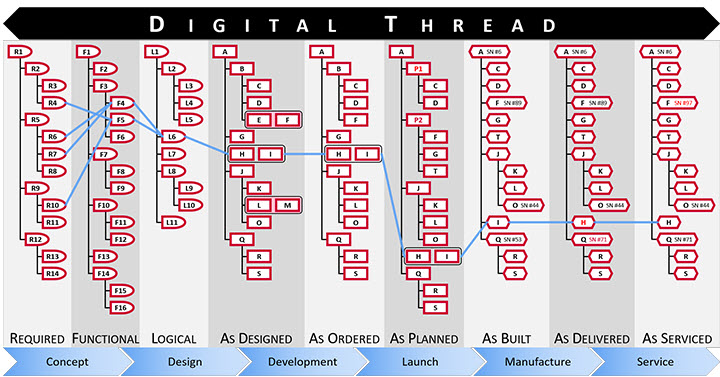
From a distance, it looks like a connected enterprise should work like our brain. We story information on different abstraction levels. We keep incredibly many relations between information elements. As the brain is a biological organ, connections degrade or get lost. Or the opposite other relationships become so strong that we cannot change them anymore. (“I know I am always right”)
 Interestingly, the brain does not use the “single source of truth”-concept – there can be various “truths” inside a brain. This makes us human beings with all the good and the harmful effects of that.
As long as we realize there is no single source of truth.
In business and our technological world, we need sometimes the undisputed truth. Blockchain could be the basis for securing the right connections between datasets to guarantee the result is valid. I am curious if blockchain can scale to complex connected situations, although Moore’s Law might ultimately help us here too(if still valid).
 The topic is not new – in 2014 I wrote a post with the title: PLM is doomed unless …. Where I introduced the topic of owning and sharing in the context of the human brain. In the post, I refer to the book On Intelligence by Jeff Hawkins how tries to analyze what is human-based intelligence and how could we apply it to our technology concepts. Still a fascinating book worth reading if you have the time and opportunity.
Conclusion
A data-driven approach requires a more granular definition of information, leading to the concepts of datasets and managing relations between datasets. This is a fundamental difference compared to the past, where we were operating systems with information. Now we are heading towards connected platforms that provide a filtered set of real-time data to act upon.
I am curious to learn more about how people have solved the connected challenges and in what kind of granularity. Let us know!
This is the moment of the year, where at least in my region, most people take some time off to disconnect from their day-to-day business. For me, it is never a full disconnect as PLM became my passion, and you should never switch off your passion.
 On August 1st, 1999, I started my company TacIT, the same year the acronym PLM was born. I wanted to focus on knowledge management, therefore the name TacIT. Being dragged into the SmarTeam world with a unique position interfacing between R&D, implementers and customers I found the unique sweet spot, helping me to see all aspects from PLM – the vendor position, the implementer’s view, the customer’s end-user, and management view.
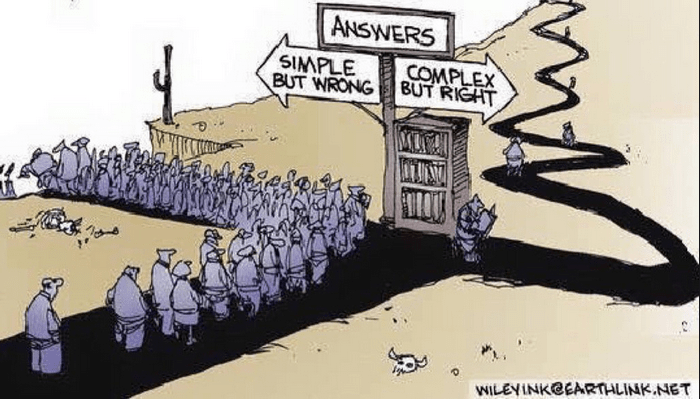
It has been, and still, is 20 years of learning and have been sharing most in the past ten years through my blog. What I have learned is that the more you know, the more you understand that situations are not black and white. See one of my favorite blog pictures below.
 So there is enough to overthink during the holidays. Some of my upcoming points:
From coordinated to connected
Instead of using the over-hyped term: Digital Transformation, I believe companies should learn to work in a connected mode, which has become the standard in our daily life. Connected means that information needs to be stored in databases somewhere, combined with openness and standards to make data accessible. For more transactional environments, like CRM, MES, and ERP, the connected mode is not new.
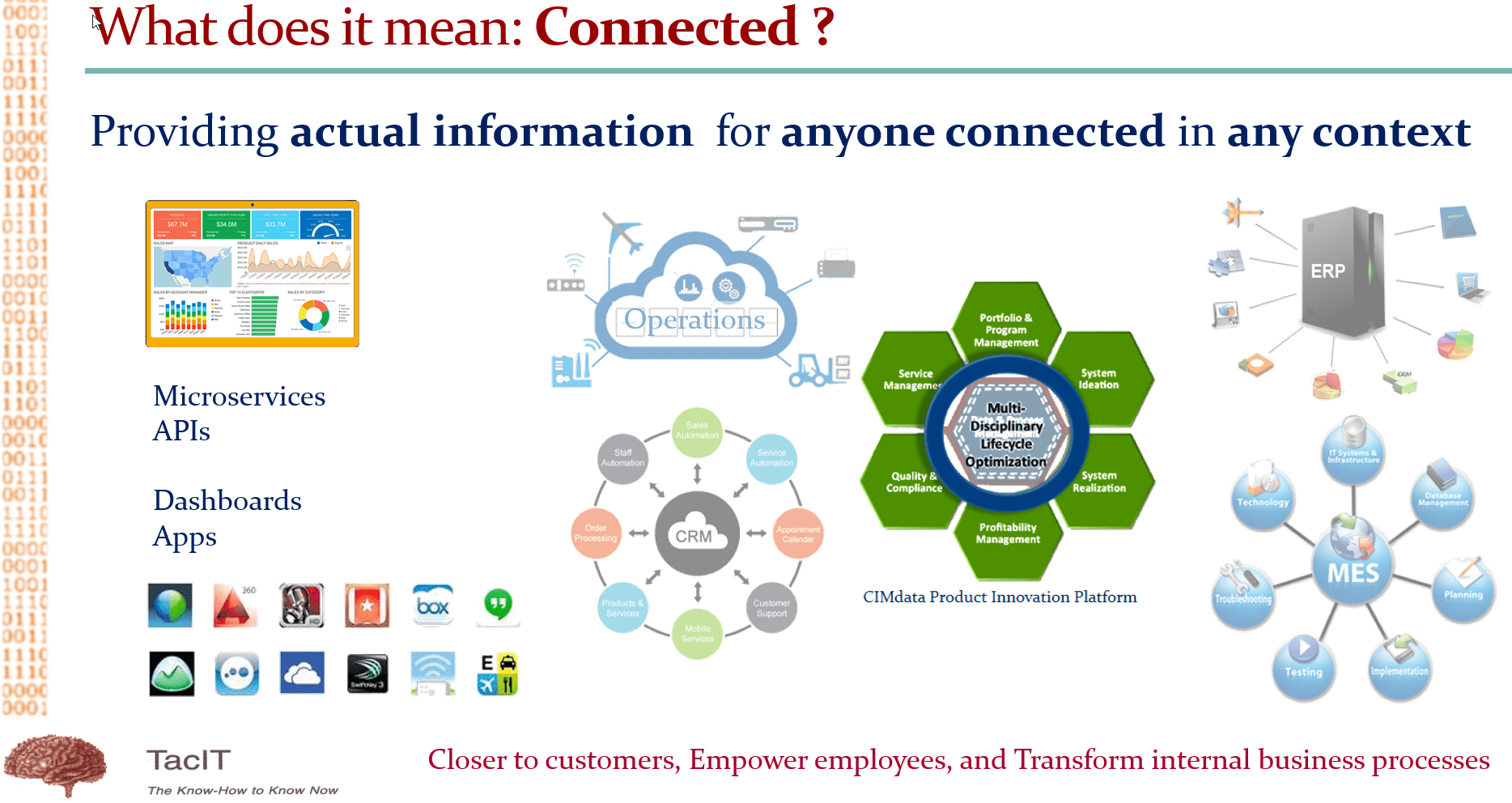 In the domain of product development and selling, we have still a long learning path to go as the majority of organizations is relying on documents, be it Excels, Drawings (PDF) and reports. The fact that they are stored in electronic file formats does not mean that they are accessible. There is still manpower needed to create these artifacts or to extract the required information from them.
The challenge for modern PLM is to establish new best practices around a model-based approach for systems engineering (MBSE), for engineering to manufacturing (MBD/MBE) and operations (Digital Twins). All these best practices should be generic and connected ultimately. I wrote about these topics in the past, have a look at:
 PLM Vendors are showing pieces of the puzzle, but it is up to the implementers to establish the puzzle, without knowing in detail what the end result will be. This is the same journey of Columbus. He had a boat and a target towards the unknown. He discovered a country with a small population, nowadays a country full of immigrants who call themselves natives.
However, the result was an impressive transformation.
Reading about transformation
Last year I read several books to get more insight into what motivates us, and how can we motivate people to change. In one way, it is disappointing to learn that we civilized human beings most of the time to not make rational decisions but act based on our per-historic brain.

Thinking, Fast and Slow from Daniel Kahneman was one of the first books in that direction as a must-read to understand our personal thinking and decision processes.

I read Idiot Brain: What Your Head Is Really Up To from Dean Burnett, where he explains this how our brain appears to be sabotaging our life, and what on earth it is really up to. Interesting to read but could be a little more comprehensive

I got more excited from Dan Ariely”s book: Predictably Irrational: The Hidden Forces That Shape Our Decisions as it was structured around topics where we handle completely irrational but predictable. And this predictability is used by people (sales/politicians/ management) to drive your actions. Useful to realize when you recognize the situation
These three books also illustrate the flaws of our modern time – we communicate fast (preferable through tweets) – we decide fast based on our gut feelings – so you realize towards what kind of world we are heading. Going through a transformation should be considered as a slow, learning process. Like reading a book – it takes time to digest.
Once you are aiming at a business transformation for your company or supporting a company in its transformation, the following books were insightful:
 Leading Digital: Turning Technology into Business Transformation by George Westerman, Didier Bonnet and Andrew McAfee is maybe not the most inspiring book, however as it stays close to what we experience in our day-to-day-life it is for sure a book to read to get a foundational understanding of business transformation.
 The book I liked the most recent was Leading Transformation: How to Take Charge of Your Company’s Future by Nathan Furr, Kyle Nel, Thomas Zoega Ramsoy as it gives examples of transformation addressing parts of the irrational brain to get a transformation story. I believe in storytelling instead of business cases for transformation. I wrote about it in my blog post: PLM Measurable or a myth referring to Yuval Harari’s book Homo Sapiens
Note: I am starting my holidays now with a small basket of e-books. If you have any recommendations for books that I must read – please write them in the comments of this blog
Discussing transformation
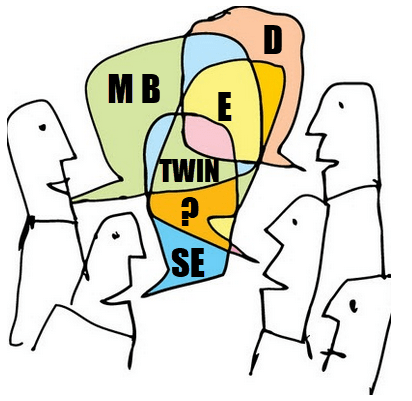 After the summer holidays, I plan to have fruitful discussions around topics close to PLM. Working on a post and starting a conversation related to PLM, PIM, and Master Data Management. The borders between these domains are perhaps getting vaguer in a digital enterprise.
Further, I am looking forward to a discussion around the value of PLM assisting companies in developing sustainable products. A sustainable and probably circular economy is required to keep this earth a place to live for everybody. The whole discussion around climate change, however, is worrying as we should be Thinking – not fast and slow – but balanced.
A circular economy has been several times a topic during the joint CIMdata PLM Roadmap and PDT conferences, which bring me to the final point.
 On 13th and 14th November this year I will participate again in the upcoming PLM Roadmap and PDT conference. This time in La Defense, Paris, France. I will share my experiences from working with companies trying to understand and implement pieces of a digital transformation related to PLM.
There will be inspiring presentations from other speakers, all working on some of the aspects of moving to facets of a connected enterprise. It is not a marketing event, it is done by professionals, serving professionals. Therefore I hope if you are passioned about the new aspects of PLM, no matter how you name label them, come and join, discuss and most of all, learn.
Conclusion

Modern life is about continuous learning – make it a habit. Even a holiday is again a way to learn to disconnect.
How disconnected I was you will see after the holidays.

This is the moment of the year to switch-off from the details. No more talking and writing about digital transformation or model-based approaches. It is time to sit back and relax. Two years ago I shared the PLM Songbook, now it is time to see one or more movies. Here are my favorite top five PLM movies:
Bruce Almighty
 Bruce Nolan, an engineer in Buffalo, N.Y., is discontented with almost everything in the company despite his popularity and the love of his draftswoman Grace. At the end of the worst day of his life, Bruce angrily ridicules and rages against PLM and PLM responds. PLM appears in human form and, endowing Bruce with divine powers op collaboration, challenges Bruce to take on the big job to see if he can do it any better.
A movie that makes you modest and you realize there is more than your small ecosystem.
The good, the bad and the ugly
 Blondie (The Good PLM consultant) is a professional who is out trying to earn a few dollars. Angel Eyes (The Bad PLM Vendor) is a PLM salesman who always commits to a task and sees it through, as long as he is paid to do so. And Tuco (The Ugly PLM Implementer) is a wanted outlaw trying to take care of his own hide. Tuco and Blondie share a partnership together making money off Tuco’s bounty, but when Blondie unties the partnership, Tuco tries to hunt down Blondie. When Blondie and Tuco come across a PLM implementation loaded with dead bodies, they soon learn from the only survivor (Bill Carson – the PLM admin) that he and a few other men have buried a stash of value on a file server. Unfortunately, Carson dies, and Tuco only finds out the name of the file server, while Blondie finds out the name on the hard disk. Now the two must keep each other alive in order to find the value. Angel Eyes (who had been looking for Bill Carson) discovers that Tuco and Blondie met with Carson and knows they know the location of the value. All he needs is for the two to ..
A movie that makes you realize that it is a challenging journey to find the value out of PLM. It is not only about execution – but it is also about all the politics of people involved – and there are good, bad and ugly people on a PLM journey.
The Grump
 The Grump is a draftsman in Finland from the past. A man who knows that everything used to be so much better in the old days. Pretty much everything that’s been done after 1953 has always managed to ruin The Grump’s day. Our story unfolds The Grump opens a 3D Model on his computer, hurting his brain. He has to spend a weekend in Helsinki to attend a model-based therapy. Then the drama unfolds …….
A movie that makes you realize that progress and innovation do not come from grumps. In every environment when you want to do a change of the status quo, grumps will appear. With the exciting Finish atmosphere, a perfect film for Christmas.
Deliverance
 The Cahulawassee River Valley company in Northern Georgia is one of the last analog companies in the state, which will soon change with the imminent implementation of a PLM system in the company, breaking down silos everywhere. As such, four Atlanta city slickers, alpha male Lewis Medlock, generally even-keeled Ed Gentry, slightly condescending Bobby Trippe, and wide-eyed Drew Ballinger decide to implement PLM in one trip, with only Lewis and Ed having experience in CAD. They know going in that the area is ethnoculturally homogeneous and isolated, but don’t understand the full extent of such until they arrive and see what they believe is the result of generations of inbreeding. Their relatively peaceful trip takes a turn for the worse when half way through they encounter a couple of hillbilly moonshiners. That encounter not only makes the four battle their way out of the PLM project intact and alive but threatens the relationships of the four as they do.
This movie, from 1972, makes you realize that in the early days of PLM starting a big-bang implementation journey into an area that is not ready for it, can be deadly, for your career and friendship. Not suitable for small children!
Diamonds Are Forever or Tron (legacy)
 James Bond’s mission is to find out who has been drawing diamonds, which are appearing on blogs. He adopts another identity in the form of Don Farr. He joins up with CIMdata and acts as if he is developing diamonds, but everyone is hungry for these diamonds. He also has to avoid Mr. Brouwer and Mr. Kidd, the dangerous couple who do not leave anyone in their way when it comes to model-based. And Ernst Stavro Blofeld isn’t out of the question. He may have changed his looks, but is he linked with the V-shape? And if he is, can Bond finally defeat his ultimate enemy?
 Sam Flynn, the tech-savvy 27-year-old son of Kevin Flynn, looks into his father’s disappearance and finds himself pulled into the same world of virtual twins and augmented reality where his father has been living for 20 years. Along with Kevin’s loyal confidant Quorra, father and son embark on a life-and-death journey across a visually-stunning cyber universe that has become far more advanced and exceedingly dangerous. Meanwhile, the malevolent program IoT, who dominates the digital world, plans to invade the real world and will stop at nothing to prevent their escape
I could not decide about number five. The future is bright with Boeing’s new representation of Systems Engineering, see my post on CIMdata’s PLM Europe roadmap event where Don Farr presented his diamond(s). However, the future is also becoming a mix of real with virtual and here Tron (legacy) will help my readers to understand the beauty of a mixed virtual and real world. You can decide – or send me your favorite PLM movies.
Note: All movie reviews are based on IMBd.com story lines, and I thank the authors of these story lines for their contribution and hope they agree with the PLM-related twist. Click on the image to find the full details and original review.
Conclusion
2018 has been an exciting year with a lot of buzzwords combined with the reality that the current PLM approach is incompatible with the future. How we can address this issue more in 2019 – first at PI PLMx 2019 in London (be there – last chance to meet people in the UK when they are still Europeans and share/discuss plans for the upcoming year)

Wishing you all the best during the break and a happy and prosperous 2019
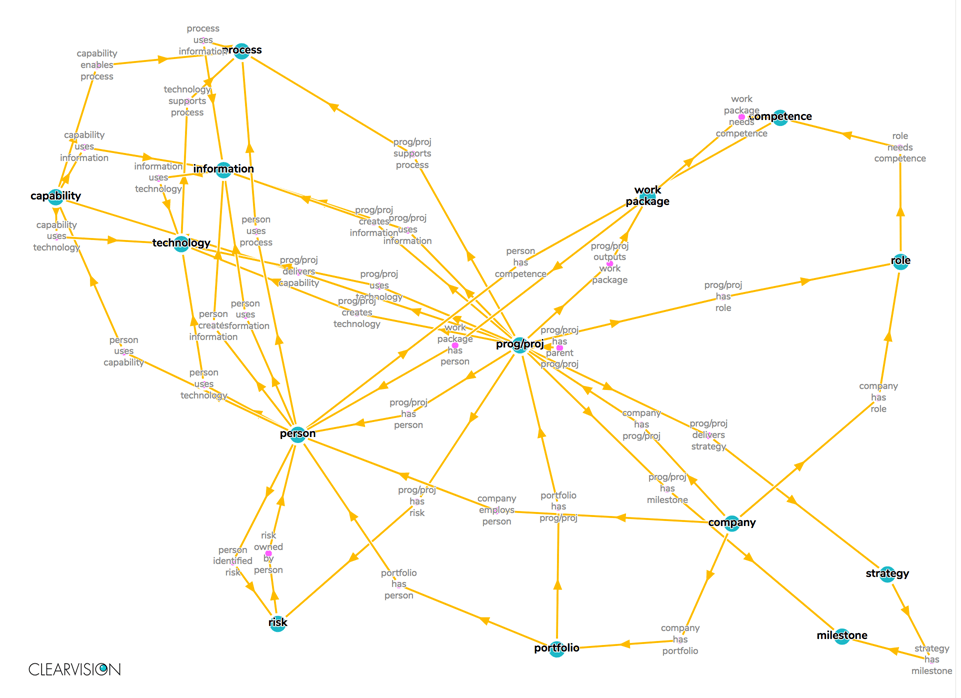
Ontology example: description of the business entities and their relationships
In my recent posts, I have talked a lot about the model-based enterprise and already after my first post: Model-Based – an introduction I got a lot of feedback where most of the audience was automatically associating the words Model-Based to a 3D CAD Model.
Trying to clarify this through my post: Why Model-Based – the 3D CAD Model stirred up the discussion even more leading into: Model- Based: The confusion.
A Digital Twin of the Organization
At that time, I briefly touched on business models and business processes that also need to be reshaped and build for a digital enterprise. Business modeling is necessary if you want to understand and streamline large enterprises, where nobody can overview the overall company. This approach is like systems engineering where we try to understand and simulate complex systems.
 With this post, I want to close on the Model-Based series and focus on the aspects of the business model. I was caught by this catchy article: How would you like a digital twin of your organization? which provides a nice introduction to this theme. Also, I met with Steve Dunnico, Creator and co-founder of Clearvision, a Swedish startup company focusing on modern ways of business modeling.
Introduction
Jos (VirtualDutchman): Steve can you give us an introduction to your company and the which parts of the model-based enterprise you are addressing with Clearvision?
 Steve (Clearvision): Clearvision started as a concept over two decades ago – modeling complex situations across multiple domains needed a simplistic approach to create a copy of the complete ecosystem. Along the way, technology advancements have opened up big-data to everyone, and now we have Clearvision as a modeling tool/SaaS that creates a digital business ecosystem that enables better visibility to deliver transformation.
As we all know, change is constant, so we must transition from the old silo projects and programs to a business world of continuous monitoring and transformation.
Clearvision enables this by connecting the disparate parts of an organization into a model linking people, competence, technology services, data flow, organization, and processes.
Complex inter-dependencies can be visualized, showing impact and opportunity to deliver corporate transformation goals in measured minimum viable transformation – many small changes, with measurable benefit, delivered frequently. This is what Clearvision enables!
Jos: What is your definition of business modeling?
 Steve: Business modeling historically, has long been the domain of financial experts – taking the “business model” of the company (such as production, sales, support) and looking at cost, profit, margins for opportunity and remodeling to suit. Now, with the availability of increased digital data about many dimensions of a business, it is possible to model more than the financials.
This is the business modeling that we (Clearvision) work with – connecting all the entities that define a business so that a change is connected to process, people, data, technology and other dimensions such as cost, time, quality. So if we change a part, all of the connected parts are checked for impact and benefit.
Jos: What are the benefits of business modeling?
 Steve: Connecting the disparate entities of a business opens up limitless opportunities to analyze “what is affected if I change this?”. This can be applied to simple static “as-is” gap analyses, to the more advanced studies needed to future forecast and move into predictive planning rather than reactive.
The benefits of using a digital model of the business ecosystem are applicable to the whole organization. The “C-suite” team get to see heat-maps for not only technology-project deliveries but can use workforce-culture maps to assess the company’s understanding and adoption of new ways of working and achievement of strategic goals. While at an operational level, teams can collaborate more effectively knowing which parts of the ecosystem help or hinder their deliveries and vice-versa.
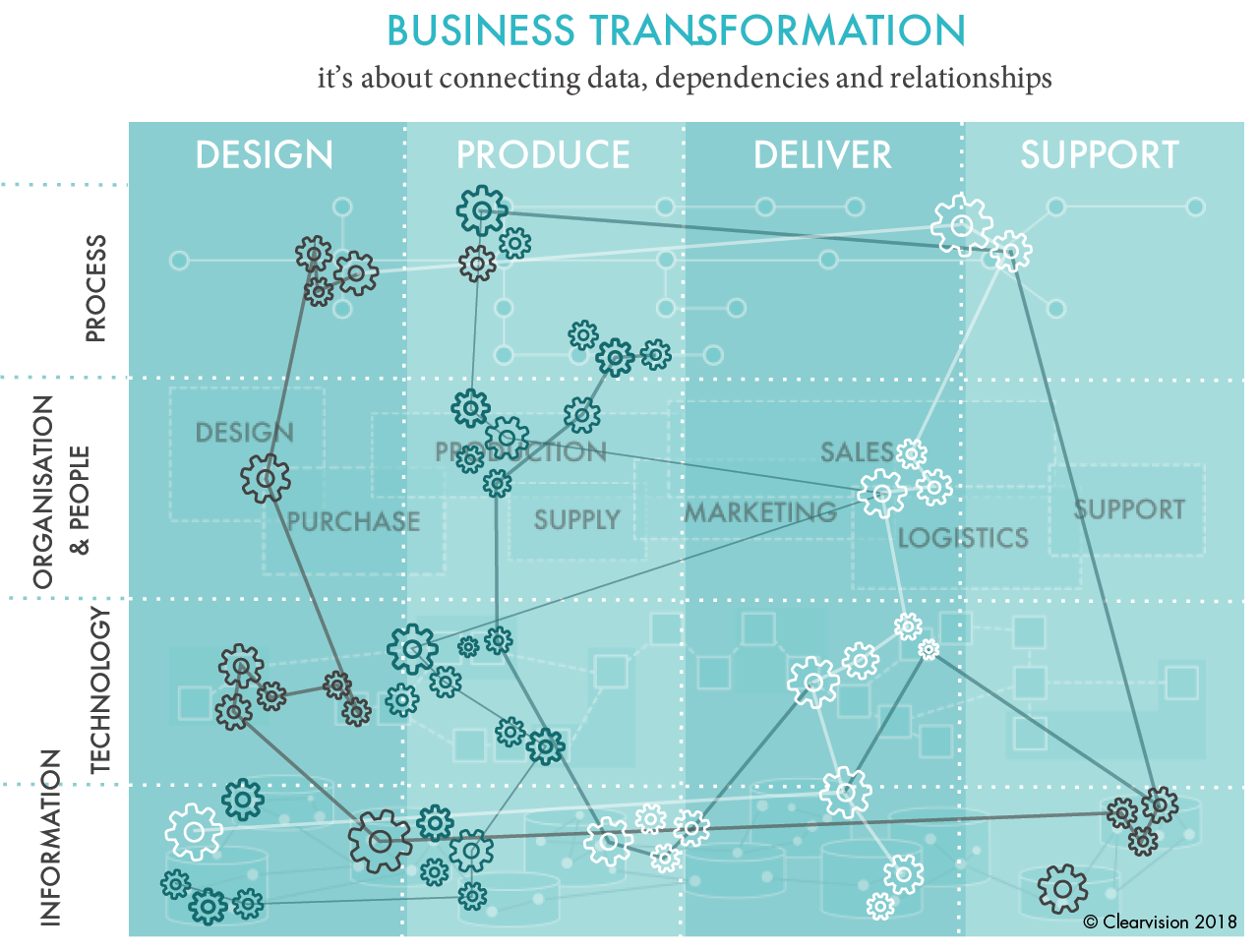
Jos: Is business modeling applicable for any type or size of the company?
The complexity of business has driven us to silo our way of working, to simplify tasks to achieve our own goals, and it is larger organizations which can benefit from modeling their business ecosystems. On that basis, it is unlikely that a standalone small business would engage in its own digital ecosystem model. However, as a supplier to a larger organization, it can be beneficial for the larger organizations to model their smaller suppliers to ensure a holistic view of their ecosystem.
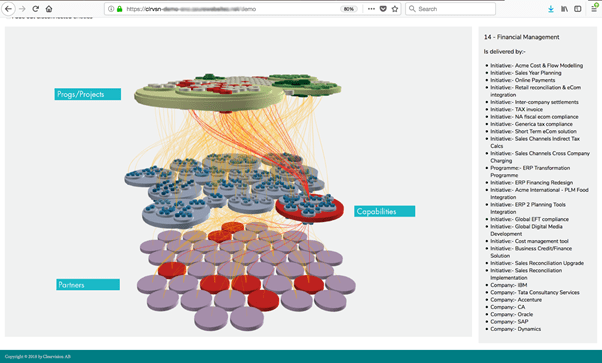
The core digital business ecosystem model delivers integrated views of dependencies, clashes, hot-spots to support transformation
Jos: How is business modeling related to digital transformation?
 Digital transformation is an often heard topic in large corporations, by implication we should take advantage of the digital data we generate and collect in our businesses and connect it, so we benefit from the whole not work in silos. Therefore, using a digital model of a business ecosystem will help identify areas of connectivity and collaboration that can deliver best benefit but through Minimum Viable Transformation, not a multi-year program with a big-bang output (which sometimes misses its goals…).
Today’s digital technology brings new capabilities to businesses and is driving competence changes in organizations and their partner companies. So another use of business modeling is to map competence of internal/external resources to the needed capabilities of digital transformation. Mapping competence rather than roles brings a better fit for resources to support transformation. Understanding which competencies we have and what the gaps are pr-requisite to plan and deliver transformation.
Jos: Then perhaps close with your Clearvision mission where you fit (uniquely)?
Having worked on early digital business ecosystem models in the late 90’s, we’ve cut our teeth on slow processing time, difficult to change data relationships and poor access to data, combined with a very silo’d work mentality. Clearvision is now positioned to help organizations realize that the value of the whole of their business is greater than the sum of their parts (silos) by enabling a holistic view of their business ecosystem that can be used to deliver measured transformation on a continual basis.
Jos: Thanks Steve for your contribution and with this completing the series of post related to a model-based enterprise with its various facets. I am aware this post the opinion from one company describing the importance of a model-based business in general. There are no commercial relations between the two of us and I recommend you to explore this topic further in case relevant for your situation.
Conclusion
Companies and their products are becoming more and more complex, most if it happening now, a lot more happening in the near future. In order to understand and manage this complexity models are needed to virtually define and analyze the real world without the high costs of making prototypes or changes in the real world. This applies for organizations, for systems, engineering and manufacturing coordination and finally in-field operating systems. They all can be described by – connected – models. This is the future of a model-based enterprise
Coming up next time: CIMdata PDM Roadmap Europe and PDT Europe. You can still register and meet a large group of people who care about the details of aspects of a digital enterprise

I think that it doesn't take a lot of imagination today to at least create some non-vendor-specific tooling. Build it…
Effective collaboration in product lifecycle management can help teams connect different functions and reduce gaps between development stages. I find…
Hi Jos, Knowing your background in methodology and education, I wanted to share a longer article with you: “What is…
Interesting reflection, Jos. In my experience, the situation you describe is very recognizable. At the company where I work, sustainability…
[…] (The following post from PLM Green Global Alliance cofounder Jos Voskuil first appeared in his European PLM-focused blog HERE.) […]