
You are currently browsing the category archive for the ‘Knowledge Management’ category.
 December is the last month when daylight is getting shorter in the Netherlands, and with the end of the year approaching, this is the time to reflect on 2025.
For me, it has been an interesting year, and I hope it has been similar for you. I started 2025 with this post: My 2025 focus, sharing the topics that would drive my primary intentions—a quick walk through some of these topics and what to reflect on what I have learned.
Fewer blog posts
 It was already clear that AI-generated content was going to drown the blogging space. The result: Original content became less and less visible, and a self-reinforcing amount of general messages reduced further excitement.
As I have no commercial drive to be visible, I will continue to write posts only when relevant to personal situations or ideas, with the intention of being shared and discussed with the readers of my posts – approximate 26 / year.
 Therefore, if you are still interested in content that has not been generated with AI, I recommend subscribing to my blog and interacting directly with me through the comments, either on LinkedIn or via a direct message.
More podcast recordings
 Together with the Share PLM podcast team, Beatriz Gonzales and Maria Morris, we enjoyed talking with a large variety of people active in PLM, all having their personal stories related to PLM to share—each episode ending with an experience to share and a desired takeaway for the listeners. We did it with great pleasure and learned from each episode.
You can find all the recordings from 2025 (Season 3) here.
 In Season 4, we want to add the C-level perspective to our PLM and People podcast discussions.
#DataCentric or #PeopleCentric ?
 It was PeopleCentric first at the beginning of the year, with the Share PLM Summit in Jerez and DataCentric in the second half of the year, with activities connected to the PLM Roadmap/PDT Europe conference in Paris.
In case you missed the excitement and lessons learned, here they are:
- The weekend after the Share PLM Summit 2025
- A week after Shaping the Future of PLM – No time to lose!
- A very long week after PLM Roadmap / PDT Europe 2025
Both topics will become even more critical due to the impact of AI tools on our day-to-day work.
Sustainability?
 Already an uncomfortable term for some of us at the beginning of 2025, it has become one of the best-kept secrets of 2025. Where traditional countries and companies revert to their short-term bad habits – optimize shareholders value, there are also forward-looking enterprises that are actively rephrasing their sustainable strategies as risk mitigation strategies with the awareness that adaptation is inevitable. Better start early than too late – not a typical human strategy.
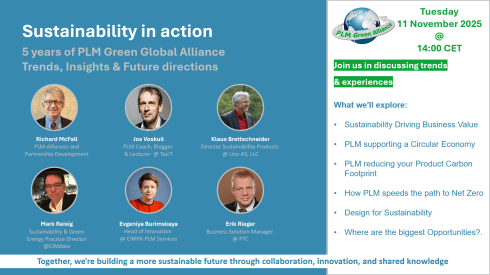
In case you are interested, I recommend you read and listen to:
And now it is time to discuss AI.
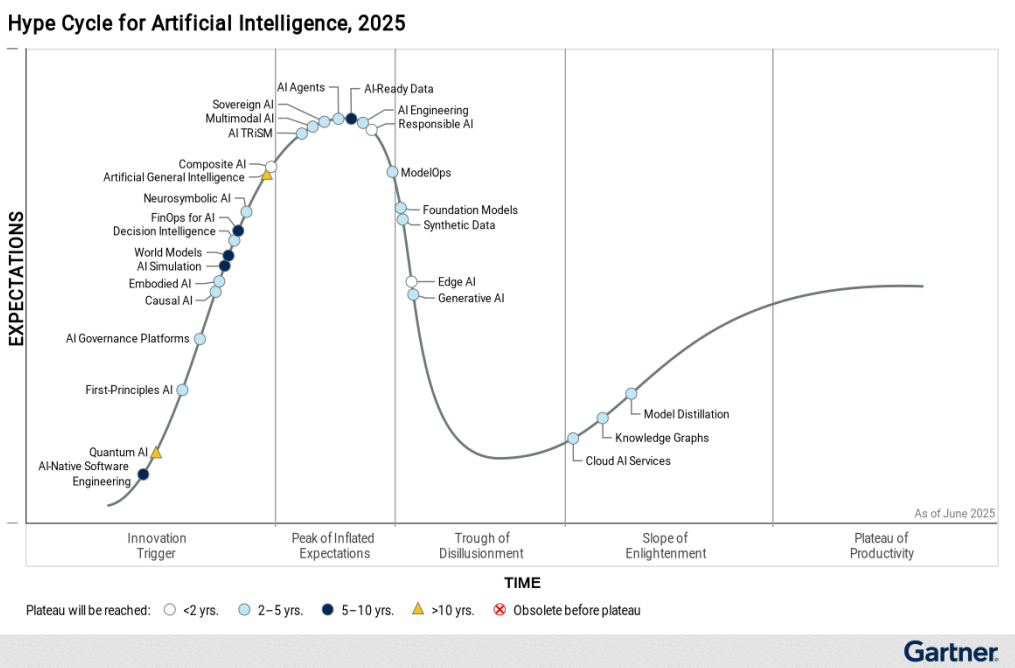 With all the investments and marketing related to AI, it is unavoidable to neglect it. For sure, it is a hype, but I believe that we are into something revolutionary for society, like the impact of the industrial revolution on our society 150 years ago.
However, there are also the same symptoms of the .com-hype 25 years ago.
 Who are going to be the winners? Currently, the hardware, datacenter and energy providers, not the AI-solution providers. But this can change.
Let’s look into some of the potential benefits.
Individual efficiency?
 Many of the current AI tools allow individuals to perform better at first sight. Suddenly, someone who could not write understandable (email) messages, draw images or create structured presentations now has a better connection with others—the question to ask is whether these improved efficiencies will also result in business benefits for an organization.
 Looking back at the introduction of email with Lotus Notes, for example, email repositories became information siloes and did not really improve the intellectual behavior of people.
Later, Microsoft took over the dominant role as the office software provider with enhanced search and storage capabilities, but still, most of the individual knowledge remained hidden or inaccurate as it missed the proper context.
 As a result of this, some companies tried to reduce the usage of individual emails and work more and more in communities with a specific context. Also, due to COVID and improved connectivity, this led to the success of Teams. And now with Copilot embedded in the Microsoft suite, I am curious to learn what companies perceive as measurable business benefits.
The chatbot?
 For many companies, the chatbot is a way to reduce the number of people active in customer relations, either sales or services. I believe that, combined with the usage of LLMs, an improvement in customer service can be achieved. Or at least the perception, as so far I do not recall any interaction with a chatbot to be specific enough to solve my problem.
The risks with AI?
 Now I may sound like a boomer who started focusing on knowledge management 25 years ago – exploring tacit knowledge.
Tacit knowledge is the knowledge a real expert has by combining different areas of expertise and understanding what makes sense.
Could tacit knowledge be replaced by an external model that gives you all the (correct?) answers?
In verifiable situations, we know when the model is hallucinating – but what if the scope is beyond our understanding? Would we still rely on AI, and could AI be manipulated in ways that we lose touch with the real facts?
Already, the first research papers are coming out warning of reduced human cognitive performance, e.g., this paper: Beware of Metacognitive Laziness: Effects of Generative Artificial Intelligence on Learning, Motivation, Processes, and Performance.
Combined with laziness (a typical human behavior – system 1), these results made me think of a statement made by Sean Illing:
“People love the truth, but they hate facts.”
A statement highly relevant to what we see happening now with social media – we do not think or research deep enough anymore, we select the facts that we like and consider them our truth.
What happens in our PLM domain?
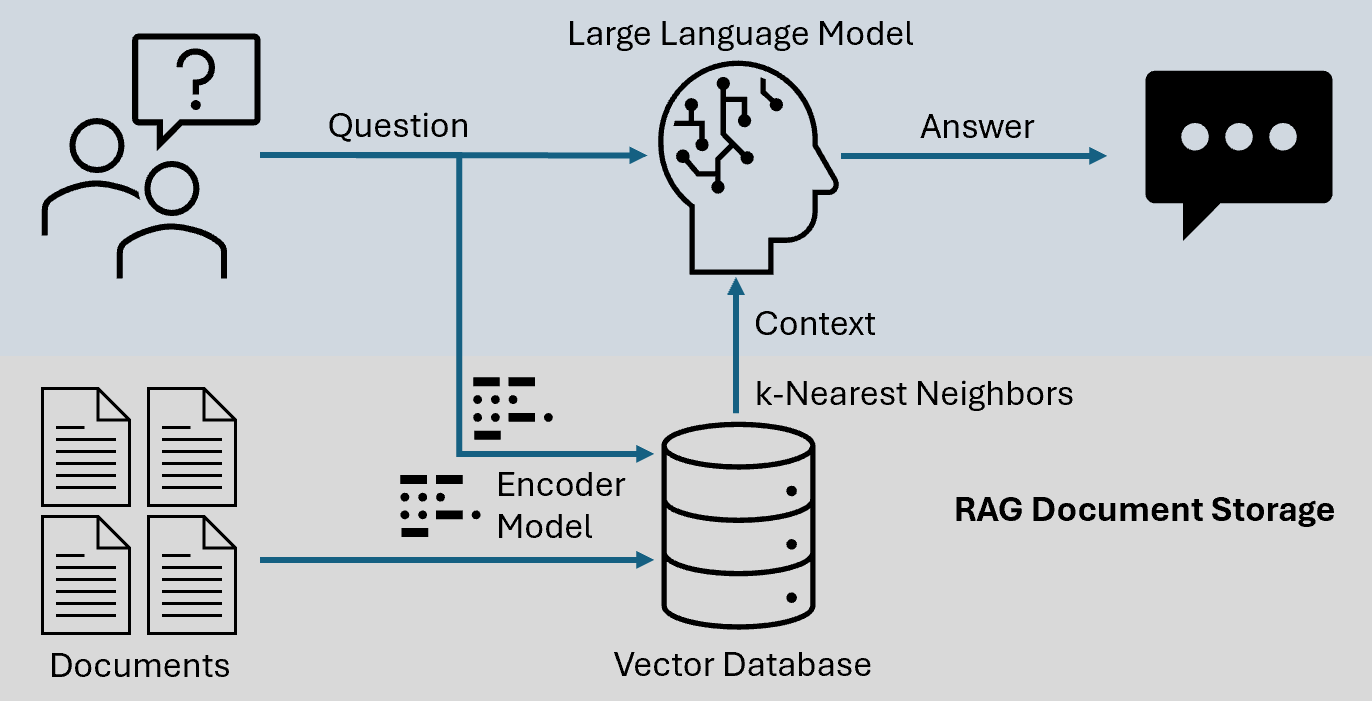 In the PLM domain, companies are indeed reluctant to use LLMs directly, where some of them use RAG (Retrieval-Augmented Generation) to feed the LLM with a relevant context.
Still, the answers require human interpretation, as you cannot avoid hallucinations in your product lifecycle management processes.
As long as the results are based on inconsistent data sources that lack the relevant context, the answers are of low quality.
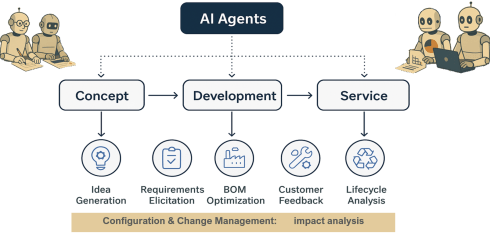
Meanwhile, every vendor in the PLM space is now offering AI-agents, most of the time within their own portfolio space. The ultimate dream is polygot agents (who are buying them / who are developing them) that can work together and create a new type of agility beyond traditional workflows. An interesting article in this context comes from Oleg Shilovitsky: Why Does PLM Need Task Re-Engineering Before It Can Have AI?
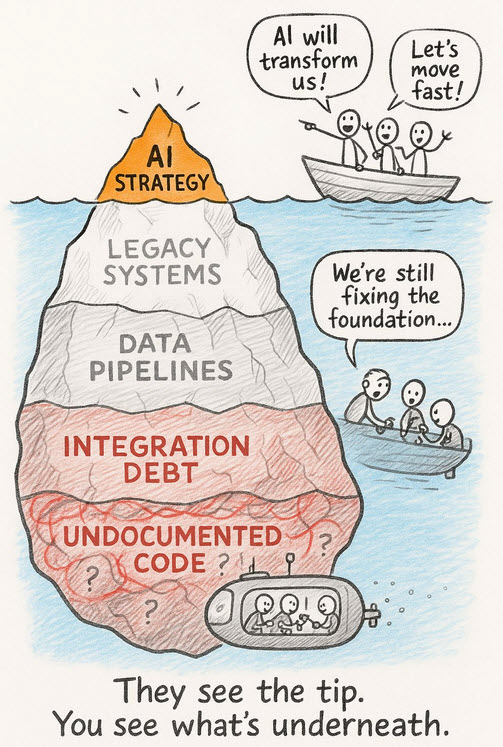
Still, these potential “quick” fixes create a risk for companies in the long term. Buying AI tools does not fix the foundation that is based on legacy.
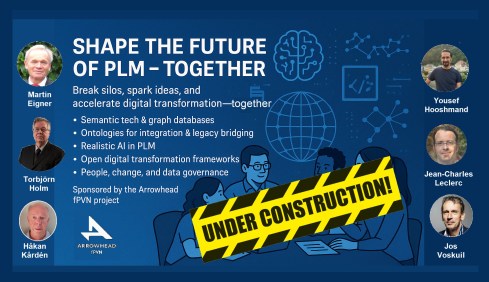
In particular, related to the Shape the Future of PLM – Together workshop in Paris on Nov 4th, the consensus was that companies need to invest in understanding and implementing domain-specific ontologies and semantic models to provide a data-driven infrastructure that allows AI to make accurate decisions or valid recommendations.
You can read the summary of the event and recommendations here: Accelerating the Future of PLM & ALM on the ArrowHead’s website.
You can also read this post from Ole Olesen-Bagneux: Why will 2026 be the year of the ontologist?
 Although the topics in the workshop might look “too advanced” for your company, they are crucial to transform into a long-term, sustainable, data-driven, model-based, and AI-supported enterprise.
Somewhere, you have to cross the chasm from documents to data in context.
Being busy is not an excuse, as you can also read in Thomas Nys’s LinkedIn post: Your Engineers spend 40 % of their time maintaining yesterday’s shortcuts. And you’re wondering why your AI initiative isn’t moving faster. I loved the image.
Human Resources?
The AI revolution will have an impact on society, and it is up to us individuals how well we adapt.
 Remember, the first 50 – 100 years of the Industrial Revolution made only a few people extremely rich. James Watt, the Rothschild family, Andrew Carnegie, John D. Rockefeller, Cornelius Vanderbilt, J.P. Morgan, Alfred Krupp and the Schneider family became so rich due to ownership of factories and machinery, the control of raw materials (coal, iron, oil), the use of new technology (steam power, mechanization) combined with access to cheap labor and weak labor laws and limited competition early on.
Most humans moved into urbanized areas to become nothing but cheap resources, even children. And remember, many of us are still human resources!
A new conspiracy?
 In 2016, Ida Auken’s lecture at the WEF created traction during COVID among people who believed in conspiracies. Her story focused on a more circular economy with respect for the Earth’s resources. The story was framed into the message:
“In the future, you will own nothing and be happy.”
The conspiracy theorist believed all their possessions would be taken away by the elite in the long term.
I want to conclude with a new message for these conspiracy theorists active on X or other discussion fora:
“In the future, you will know nothing, and you won’t be aware enough to care.”
Conclusion
2026 is going to be an interesting year, where we cannot allow ourselves to sit still and watch what is happening. Active participation is more challenging but also more rewarding than being a consumer. In May 2026, I hope to meet some of you at the Share PLM Summit in Jerez and share the human side, followed by the PDM Roadmap/PDT Europe conference in Q4 in Gothenburg, where we will catch up on the technical and data side.
I am wishing you all a wise and happy/healthy 2026


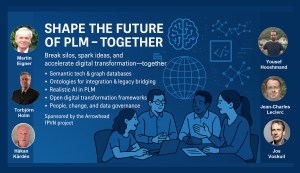 Together with Håkan Kårdén, we had the pleasure of bringing together 32 passionate professionals on November 4th to explore the future of PLM (Product Lifecycle Management) and ALM (Asset Lifecycle Management), inspired by insights from four leading thinkers in the field. Please, click on the image for more details.
The meeting had two primary purposes.
- Firstly, we aimed to create an environment where these concepts could be discussed and presented to a broader audience, comprising academics, industrial professionals, and software developers. The group’s feedback could serve as a benchmark for them.
- The second goal was to bring people together and create a networking opportunity, either during the PLM Roadmap/PDT Europe conference, the day after, or through meetings established after this workshop.
Personally, it was a great pleasure to meet some people in person whose LinkedIn articles I had admired and read.
The meeting was sponsored by the Arrowhead fPVN project, a project I discussed in a previous blog post related to the PLM Roadmap/PDT Europe 2024 conference last year. Together with the speakers, we have begun working on a more in-depth paper that describes the similarities and the lessons learned that are relevant. This activity will take some time.
Therefore, this post only includes the abstracts from the speakers and links to their presentations. It concludes with a few observations from some attendees.
Reasoning Machines: Semantic Integration in Cyber-Physical Environments
 Torbjörn Holm / Jan van Deventer: The presentation discussed the transition from requirements to handover and operations, emphasizing the role of knowledge graphs in unifying standards and technologies for a flexible product value network
The presentation outlines the phases of the product and production lifecycle, including requirements, specification, design, build-up, handover, and operations. It raises a question about unifying these phases and their associated technologies and standards, emphasizing that the most extended phase, which involves operation, maintenance, failure, and evolution until retirement, should be the primary focus.
It also discusses seamless integration, outlining a partial list of standards and technologies categorized into three sections: “Modelling & Representation Standards,” “Communication & Integration Protocols,” and “Architectural & Security Standards.” Each section contains a table listing various technology standards, their purposes, and references. Additionally, the presentation includes a “Conceptual Layer Mapping” table that details the different layers (Knowledge, Service, Communication, Security, and Data), along with examples, functions, and references.
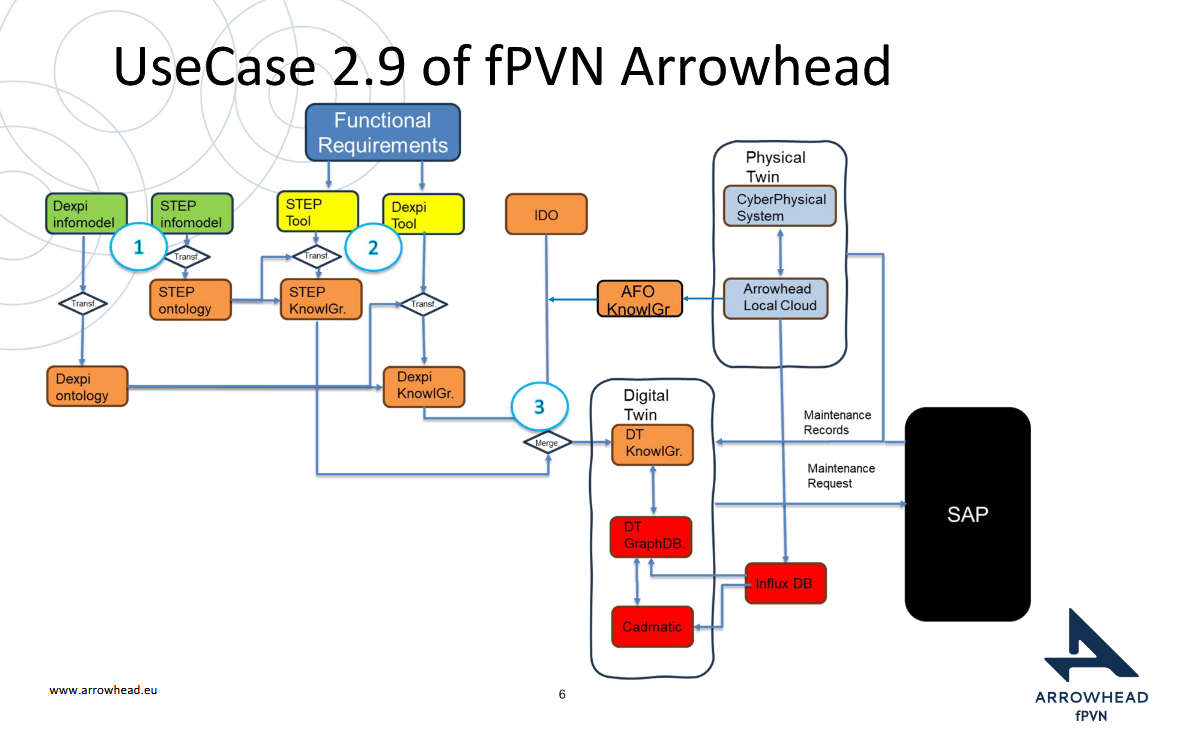
The presentation outlines an approach for utilizing semantic technologies to ensure interoperability across heterogeneous datasets throughout a product’s lifecycle. Key strategies include using OWL 2 DL for semantic consistency, aligning domain-specific knowledge graphs with ISO 23726-3, applying W3C Alignment techniques, and leveraging Arrowhead’s microservice-based architecture and Framework Ontology for scalable and interoperable system integration.
The utilized software architecture system, including three main sections: “Functional Requirements,” “Physical Twin,” and “Digital Twin,” each containing various interconnected components, will be presented. The Architecture includes today several Knowledge Graphs (KG): A DEXPI KG, A STEP (ISO 10303) KG, An Arrowhead Framework KG and under work the CFIHOS Semantics Ontology, all aligned.
👉The presentation: W3C Major standard interoperability_Paris
Beyond Handover: Building Lifecycle-Ready Semantic Interoperability
Jean-Charles Leclerc argued that Industrial data standards must evolve beyond the narrow scope of handover and static interoperability. To truly support digital transformation, they must embrace lifecycle semantics or, at the very least, be designed for future extensibility.
This shift enables technical objects and models to be reused, orchestrated, and enriched across internal and external processes, unlocking value for all stakeholders and managing the temporal evolution of properties throughout the lifecycle. A key enabler is the “pattern of change”, a dynamic framework that connects data, knowledge, and processes over time. It allows semantic models to reflect how things evolve, not just how they are delivered.
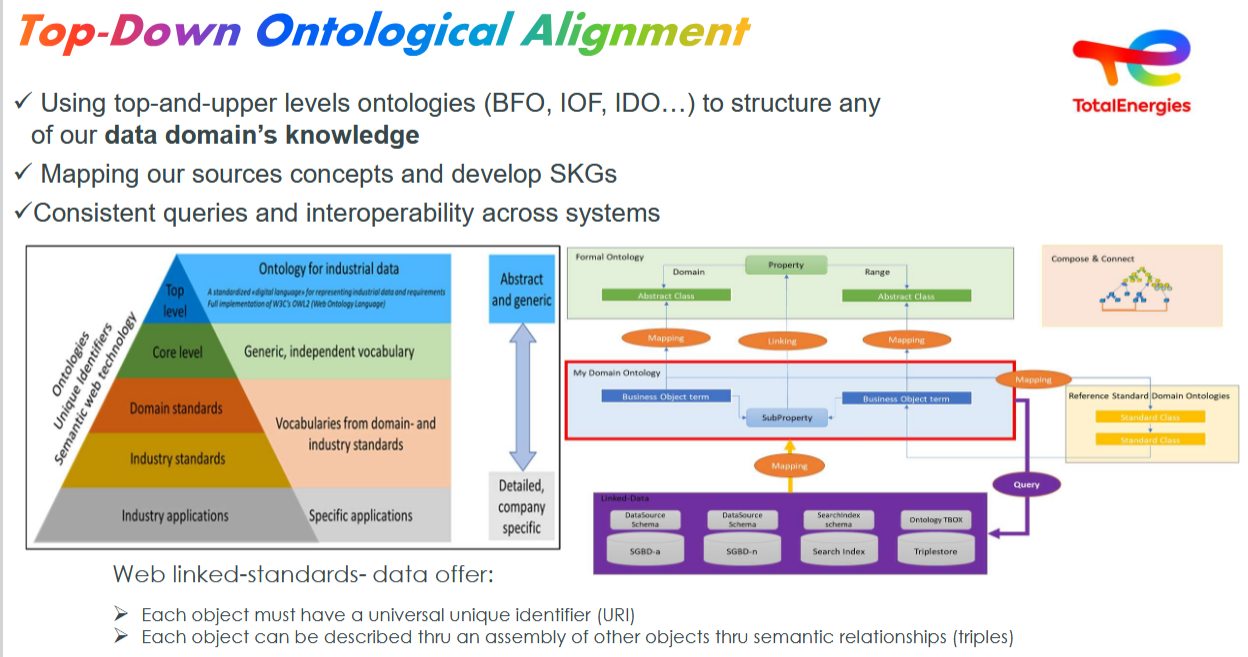
By grounding semantic knowledge graphs (SKGs) in such rigorous logic and aligning them with W3C standards, we ensure they are both robust and adaptable. This approach supports sustainable knowledge management across domains and disciplines, bridging engineering, operations, and applications.
Ultimately, it’s not just about technology; it’s about governance.
Being Sustainab’OWL (Web Ontology Language) by Design! means building semantic ecosystems that are reliable, scalable, and lifecycle-ready by nature.
Additional Insight: From Static Models to Living Knowledge
To transition from static information to living knowledge, organizations must reassess how they model and manage technical data. Lifecycle-ready interoperability means enabling continuous alignment between evolving assets, processes, and systems. This requires not only semantic precision but also a governance framework that supports change, traceability, and reuse, turning standards into operational levers rather than compliance checkboxes.
👉The presentation: Beyond Handover – Building Lifecycle Ready Semantic Interoperability
 The first two presentations had a lot in common as they both come from the Asset Lifecycle Management domain and focus on an infrastructure to support assets over a long lifetime. This is particularly visible in the usage and references to standards such as DEXPI, STEP, and CFIHOS, which are typical for this domain.
How can we achieve our vision of PLM – the Single Source of Truth?
Martin Eigner stated that Product Lifecycle Management (PLM) has long promised to serve as the Single Source of Truth for organizations striving to manage product data, processes, and knowledge across their entire value chain. Yet, realizing this vision remains a complex challenge.
Achieving a unified PLM environment requires more than just implementing advanced software systems—it demands cultural alignment, organizational commitment, and seamless integration of diverse technologies. Central to this vision is data consistency: ensuring that stakeholders across engineering, manufacturing, supply chain, and service have access to accurate, up-to-date, and contextualized information along the Product Lifecycle. This involves breaking down silos, harmonizing data models, and establishing governance frameworks that enforce standards without limiting flexibility.
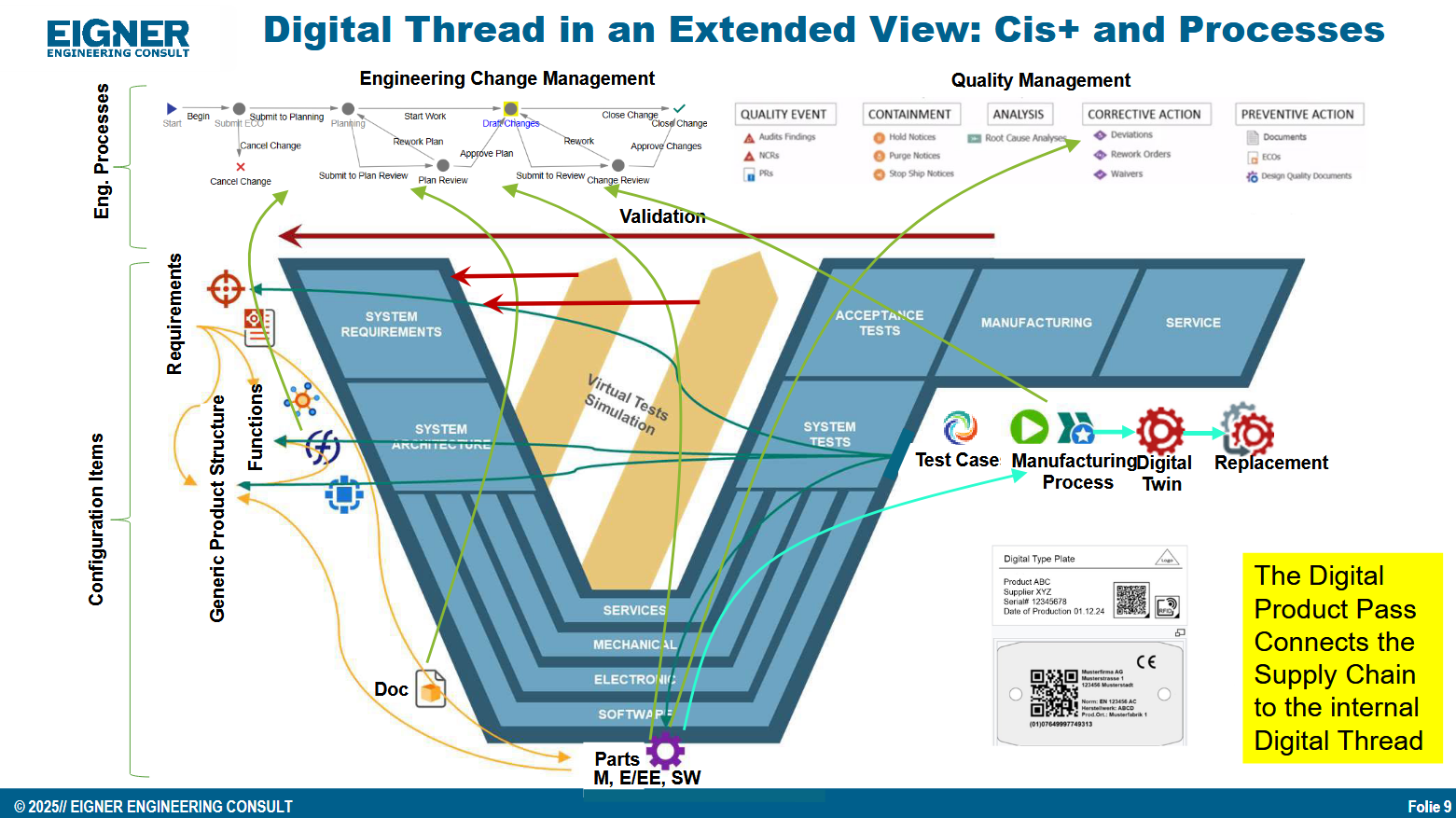
Emerging technologies and methodologies, such as Extended Digital Thread, Digital Twins, cloud-based platforms, and Artificial Intelligence, offer new opportunities to enhance collaboration and integrated data management.
However, their success depends on strong change management and a shared understanding of PLM as a strategic enabler rather than a purely technical solution. By fostering cross-functional collaboration, investing in interoperability, and adopting scalable architectures, organizations can move closer to a trustworthy single source of truth. Ultimately, realizing the vision of PLM requires striking a balance between innovation and discipline—ensuring trust in data while empowering agility in product development and lifecycle management.
👉The presentation: Martin – Workshop PLM Future 04_10_25
The Future is Data-Centric, Semantic, and Federated … Is your organization ready?
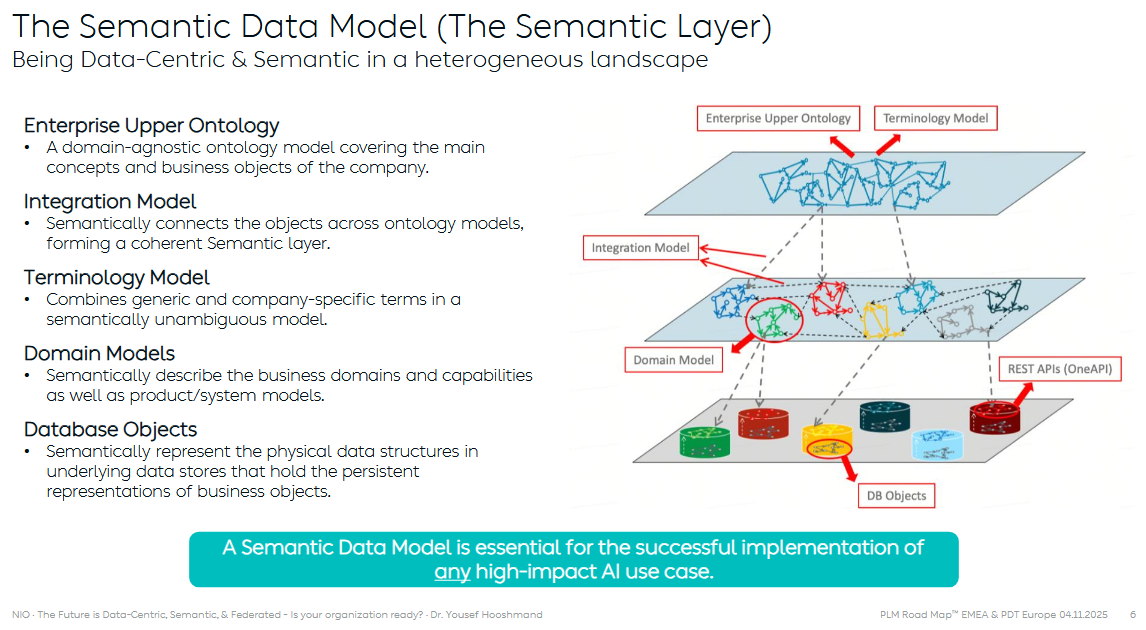
Yousef Hooshmand, who is currently working at NIO as PLM & R&D Toolchain Lead Architect, discussed the must-have relations between a data-centric approach, semantic models and a federated environment as the image below illustrates:
Why This Matters for the Future?
- Engineering is under unprecedented pressure: products are becoming increasingly complex, customers are demanding personalization, and development cycles must be accelerated to meet these demands. Traditional, siloed methods can no longer keep up.
- The way forward is a data-centric, semantic, and federated approach that transforms overwhelming complexity into actionable insights, reduces weeks of impact analysis to minutes, and connects fragmented silos to create a resilient ecosystem.
- This is not just an evolution, but a fundamental shift that will define the future of systems engineering. Is your organization ready to embrace it?
👉The presentation: The Future is Data-Centric, Semantic, and Federated.
Some of first impressions
👉 Bhanu Prakash Ila from Tata Consultancy Services– you can find his original comment in this LinkedIn post
Key points:
- Traditional PLM architectures struggle with the fundamental challenge of managing increasingly complex relationships between product data, process information, and enterprise systems.
- Ontology-Based Semantic Models – The Way Forward for PLM Digital Thread Integration: Ontology-based semantic models address this by providing explicit, machine-interpretable representations of domain knowledge that capture both concepts and their relationships. These lay the foundations for AI-related capabilities.
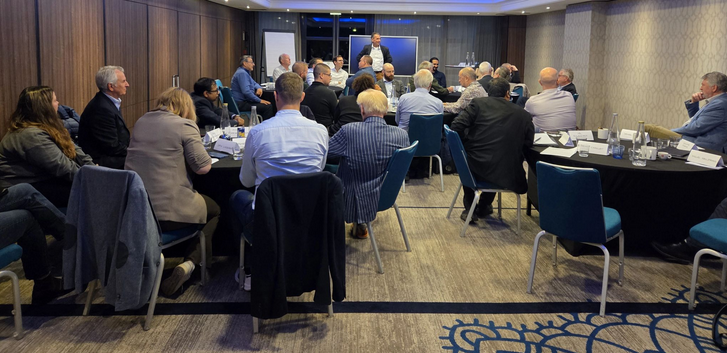
Today’s discussions provided valuable insights into how the PLM language is evolving in the AI era and how we can better bridge the gap between business and technology to achieve fundamental transformation.
It’s clear that as AI, semantic technologies, and data intelligence mature, the way we think and talk about PLM must evolve too – from system-centric to value-driven, from managing data to enabling knowledge and decisions.
It’s clear that as AI, semantic technologies, and data intelligence mature, the way we think and talk about PLM must evolve too – from system-centric to value-driven, from managing data to enabling knowledge and decisions.
A quick & temporary conclusion
Typically, I conclude my blog posts with a summary. However, this time the conclusion is not there yet. There is work to be done to align concepts and understand for which industry they are most applicable. Using standards or avoiding standards as they move too slowly for the business is a point of ongoing discussion. The takeaway for everyone in the workshop was that data without context has no value. Ontologies, semantic models and domain-specific methodologies are mandatory for modern data-driven enterprises. You cannot avoid this learning path by just installing a graph database.
These infrastructures are necessary to implement AI meaningfully, which extends beyond data retrieval to managing and exploring knowledge. Due to the limited time we had in this workshop, we were not able to explore other dimensions of this transformation
For the participants of the workshop – stay tuned and we will send you the final conclusions
 First, an important announcement. In the last two weeks, I have finalized preparations for the upcoming Share PLM Summit in Jerez on 27-28 May. With the Share PLM team, we have been working on a non-typical PLM agenda. Share PLM, like me, focuses on organizational change management and the HOW of PLM implementations; there will be more emphasis on the people side.
Often, PLM implementations are either IT-driven or business-driven to implement a need, and yes, there are people who need to work with it as the closing topic. Time and budget are spent on technology and process definitions, and people get trained. Often, only train the trainer, as there is no more budget or time to let the organization adapt, and rapid ROI is expected.
This approach neglects that PLM implementations are enablers for business transformation. Instead of doing things slightly more efficiently, significant gains can be made by doing things differently, starting with the people and their optimal new way of working, and then providing the best tools.
The conference aims to start with the people, sharing human-related experiences and enabling networking between people – not only about the industry practices (there will be sessions and discussions on this topic too).
 If you are curious about the details, listen to the podcast recording we published last week to understand the difference – click on the image on the left.
And if you are interested and have the opportunity, join us and meet some great thought leaders and others with this shared interest.
Why is modern PLM a dream?
 If you are connected to the LinkedIn posts in my PLM feed, you might have the impression that everyone is gearing up for modern PLM. Articles often created with AI support spark vivid discussions. Before diving into them with my perspective, I want to set the scene by explaining what I mean by modern PLM and traditional PLM.
Traditional PLM
Traditional PLM is often associated with implementing a PLM system, mainly serving engineering. Downstream engineering data usage is usually pushed manually or through interfaces to other enterprise systems, like ERP, MES and service systems.
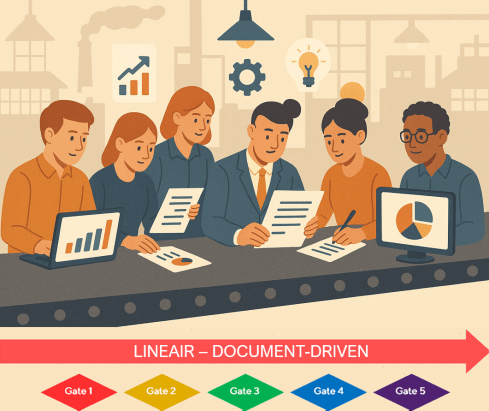
Traditional PLM is closely connected to the coordinated way of working: a linear process based on passing documents (drawings) and datasets (BOMs). Historically, CAD integrations have been the most significant characteristic of these systems.
 The coordinated approach fits people working within their authoring tools and, through integrations, sharing data. The PLM system becomes a system of record, and working in a system of record is not designed to be user-friendly.
Unfortunately, most PLM implementations in the field are based on this approach and are sometimes characterized as advanced PDM.
You recognize traditional PLM thinking when people talk about the single source of truth.
Modern PLM
 When I talk about modern PLM, it is no longer about a single system. Modern PLM starts from a business strategy implemented by a data-driven infrastructure. The strategy part remains a challenge at the board level: how do you translate PLM capabilities into business benefits – the WHY?
More on this challenge will be discussed later, as in our PLM community, most discussions are IT-driven: architectures, ontologies, and technologies – the WHAT.
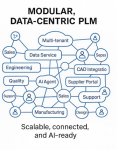 For the WHAT, there seems to be a consensus that modern PLM is based on a federated
I think this article from Oleg Shilovitsky, “Rethinking PLM: Is It Time to Move Beyond the Monolith?“ AND the discussion thread in this post is a must-read. I will not quote the content here again.
After reading Oleg’s post and the comments, come back here
The reason for this approach: It is a perfect example of the connected approach. Instead of collecting all the information inside one post (book ?), the information can be accessed by following digital threads. It also illustrates that in a connected environment, you do not own the data; the data comes from accountable people.
Building such a modern infrastructure is challenging when your company depends mainly on its legacy—the people, processes and systems. Where to change, how to change and when to change are questions that should be answered at the top and require a vision and evolutionary implementation strategy.
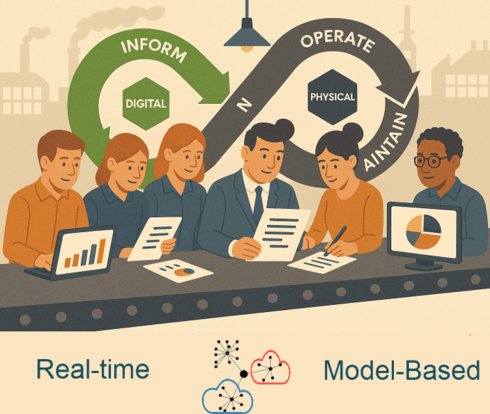
A company should build a layer of connected data on top of the coordinated infrastructure to support users in their new business roles. Implementing a digital twin has significant business benefits if the twin is used to connect with real-time stakeholders from both the virtual and physical worlds.
 But there is more than digital threads with real-time data. On top of this infrastructure, a company can run all kinds of modeling tools, automation and analytics. I noticed that in our PLM community, we might focus too much on the data and not enough on the importance of combining it with a model-based business approach. For more details, read my recent post: Model-based: the elephant in the room.
Again, there are no quotes from the article; you know how to dive deeper into the connected topic.
 Despite the considerable legacy pressure there are already companies implementing a coordinated and connected approach. An excellent description of a potential approach comes from Yousef Hooshmand‘s paper: From a Monolithic PLM Landscape to a Federated Domain and Data Mesh.
You might recognize modern PLM thinking when people talk about the nearest source of truth and the single source of change.
Is Intelligent PLM the next step?
 So far in this article, I have not mentioned AI as the solution to all our challenges. I see an analogy here with the introduction of the smartphone. 2008 was the moment that platforms were introduced, mainly for consumers. Airbnb, Uber, Amazon, Spotify, and Netflix have appeared and disrupted the traditional ways of selling products and services.
The advantage of these platforms is that they are all created data-driven, not suffering from legacy issues.
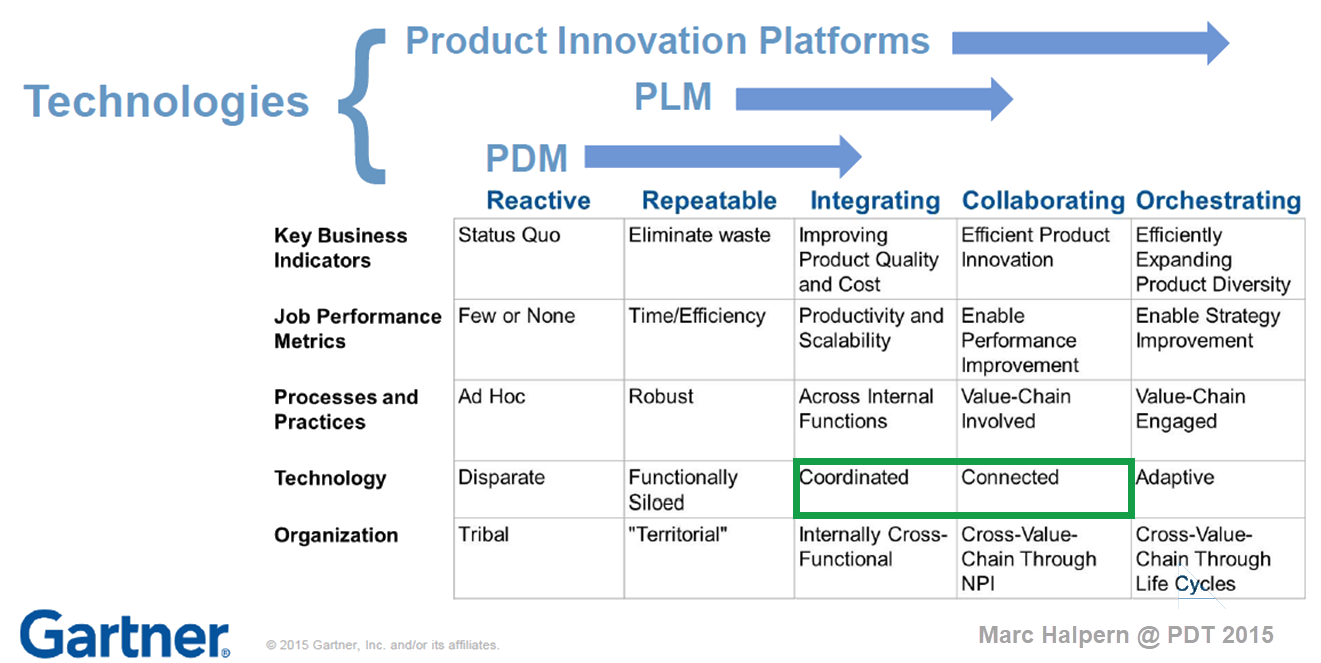
 In our PLM domain, it took more than 10 years for platforms to become a topic of discussion for businesses. The 2015 PLM Roadmap/PDT conference was the first step in discussing the Product Innovation Platform – see my The Weekend after PDT 2015 post.
At that time, Peter Bilello shared the CIMdata perspective, Marc Halpern (Gartner) showed my favorite positioning slide (below), and Martin Eigner presented, according to my notes, this digital trend in PLM in his session:” What becomes different for PLM/SysLM?”
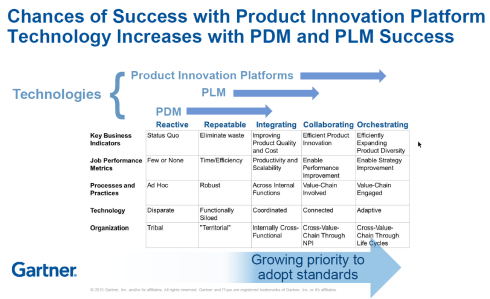
2015 Marc Halpern – the Product Innovation Platform (PIP)
While concepts started to become clearer, businesses mainly remained the same. The coordinated approach is the most convenient, as you do not need to reshape your organization. And then came the LLMs that changed everything.
Suddenly, it became possible for organizations to unlock knowledge hidden in their company and make it accessible to people.
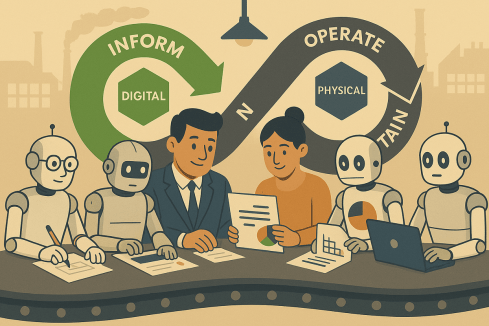
Without drastically changing the organization, companies could now improve people’s performance and output (theoretically); therefore, it became a topic of interest for management. One big challenge for reaping the benefits is the quality of the data and information accessed.
 I will not dive deeper into this topic today, as Benedict Smith, in his article Intelligent PLM – CFO’s 2025 Vision, did all the work, and I am very much aligned with his statements. It is a long read (7000 words) and a great starting point for discovering the aspects of Intelligent PLM and the connection to the CFO.
You might recognize intelligent PLM thinking when people and AI agents talk about the most likely truth.
Conclusion
Are you interested in these topics and their meaning for your business and career? Join me at the Share PLM conference, where I will discuss “The dilemma: Humans cannot transform—help them!” Time to work on your dreams!
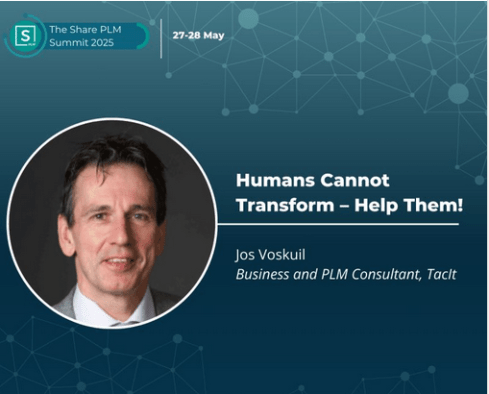
Join us to discuss the (Intelligent) PLM dream
 In the last two weeks, I had some interesting observations and discussions related to the need to have a (PLM) vision. I placed the word PLM between brackets, as PLM is no longer an isolated topic in an organization. A PLM strategy should align with the business strategy and vision.
To be clear, if you or your company wants to survive in the future, you need a sustainable vision and a matching strategy as the times they are a changing, again!
I love the text: “Don’t criticize what you can’t understand” – a timeless quote.
 First, there was Rob Ferrone’s article: Multi-view. Perspectives that shape PLM – a must-read to understand who to talk to about which dimension of PLM – and it is worth browsing through the comments too – there you will find the discussions, and it helps you to understand the PLM players.
Note: it is time that AI-generated images become more creative 😉
 Next, there is still the discussion started by Gareth Webb, Digital Thread and the Knowledge Graph, further stirred by Oleg Shilovitsky.
Based on the likes and comments, it is clearly a topic that creates interaction – people are thinking and talking about it – the Digital Thread as a Service.
One of the remaining points in this debate is still the HOW and WHEN companies decide to implement a Digital Thread, a Knowledge Graph and other modern data concepts.
 So far my impression is that most companies implement their digital enhancements (treads/graphs) in a bottom-up approach, not driven by a management vision but more like band-aids or places where it fits well, without a strategy or vision.
The same week, we, Beatriz Gonzáles and I, recorded a Share PLM podcast session with Paul Kaiser from MHP Americas as a guest. Paul is the head of the Digital Core & Technology department, where he leads management and IT consulting services focused on end-to-end business transformation.
During our discussion, Paul mentioned the challenge in engagements when the company has no (PLM) vision. These companies expect external consultants to formulate and implement the vision – a recipe for failure due to wrong expectations.
The podcast can be found HERE , and the session inspired me to write this post.
“We just want to be profitable“.
I believe it is a typical characteristic of small and medium enterprises that people are busy with their day-to-day activities. In addition, these companies rarely appoint new top management, which could shake up the company in a positive direction. These companies evolve …..
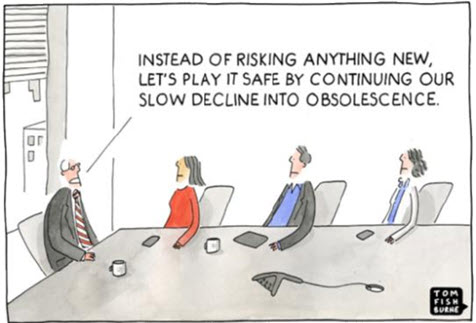
You often see a stable management team with members who grew up with the company and now monitor and guide it, watching its finances and competition. They know how the current business is running.
 Based on these findings, there will be classical efficiency plans, i.e., cutting costs somewhere, dropping some non-performing products, or investing in new technology that they cannot resist. Still, minor process changes and fundamental organizational changes are not expected.
Most of the time, the efficiency plans provide single-digit benefits.
 Everyone is happy when the company feels stable and profitable, even if the margins are under pressure. The challenge for this type of company without a vision is that they navigate in the dark when the outside world changes – like nowadays.
The world is changing drastically.
Since 2014, I have advocated for digital transformation in the PLM domain and explained it simply using the statement: From Coordinated to Connected, which already implies much complexity.
Moving from document/files to datasets and models, from a linear delivery model to a DevOps model, from waterfall to agile and many other From-To statements.
Moving From-To is a transformational journey, which means you will learn and adapt to new ways of working during the journey. Still, the journey should have a target, directed by a vision.
However, not many companies have started this journey because they just wanted to be profitable.
“Why should we go in an unknown direction?”
With the emergence of sustainability regulations, e.g., GHG and ESG reporting, carbon taxes, material reporting, and the Digital Product Passport, which goes beyond RoHS and REACH and applies to much more industries, there came the realization that there is a need to digitize the product lifecycle processes and data beyond documents. Manual analysis and validation are too expensive and unreliable.
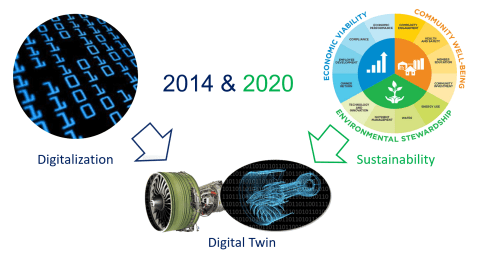
At this stage, there is already a visible shift between companies that have proactively implemented a digitally connected infrastructure and companies that still see compliance with regulations as an additional burden. The first group brings products to the market faster and more sustainably than the second group because sustainability is embedded in their product lifecycle management.
 And just when companies felt they could manage the transition from Coordinated to Coordinated and Connected, there was the fundamental disruption of embedded AI in everything, including the PLM domain.
- Large Language Models LLMs can go through all the structured and unstructured data, providing real-time access to information, which would take experts years of learning. Suddenly, everyone can behave experienced.
- The rigidness of traditional databases can be complemented by graph databases, which visualize knowledge that can be added and discovered on the fly without IT experts. Suddenly, an enterprise is no longer a collection of interfaced systems but a digital infrastructure where data flows – some call it Digital Thread as a Service (DTaaS)
- Suddenly, people feel overwhelmed by complexity, leading to fear and doing nothing, a killing attitude.

2014 The Economist – the onrushing wave
I cannot predict what will happen in the next 5 to 10 years, but I am sure the current change is one we have never seen before. Be prepared and flexible to act—to be on top of the wave, you need the skills to get there.
Building the vision
The image below might not be new to you, but it illustrates how companies could manage a complex change.
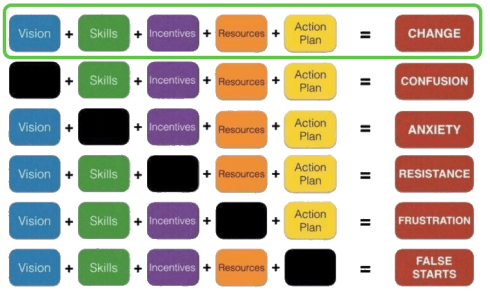
I will focus only on the first two elements, Vision and Skills, as they are the two elements we as individuals can influence. The other elements are partly related to financial and business constraints.
Vision and Skills are closely related because you can have a fantastic vision. Still, to realize the vision, you need a strategy driven by relevant skills to define and implement the vision. With the upcoming AI, traditional knowledge-based skills will suddenly no longer be a guarantee for future jobs.
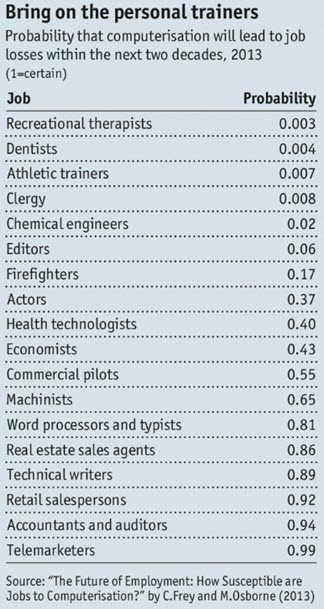 AI brings a new dimension for everyone working in a company. To remain relevant, you must develop your unique human skills that make you different from robots or libraries. The importance of human skills might not be new, but now it has become apparent with the explosion of available AI tools.
Look at this 2013 table about predicted skills for the future – You can read the details in their paper, The Future of Employment, by Carl Benedikt Frey & Michael Osborne(2013) – click on the image to see the details.
In my 2015 PLM lectures, I joked when showing this image that my job as a PLM coach was secured, because you are a recreational therapist and firefighter combined.
It has become a reality, and many of my coaching engagements nowadays focus on explaining and helping companies formulate and understand their possible path forward. Helping them align and develop a vision of progressing in a volatile world – the technology is there, the skills and the vision are often not yet there.
 Combining business strategy with in-depth PLM concepts is a relatively unique approach in our domain. Many of my peers have other primary goals, such as Rob Ferrone’s article: Multi-view. Perspectives that shape PLM explains.
And then there is …..
The Share PLM Summit 2025
Modern times need new types of information building and sharing, and therefore, I am eager to participate in the upcoming Share PLM Summit at the end of May in Jerez (Spain).
See the link to the event here: The Share PLM Summit 2025 – with the theme: Where People Take Center Stage to Drive Human-Centric Transformations in PLM and Lead the Future of Digital Innovation.
In my lecture, I will focus on how humans can participate in/anticipate this digital AI-based transformation. But even more, I look forward to the lectures and discussions with other peers, as more people-centric thought leaders and technology leaders will join us:
Quoting Oleg Shilovitsky:
PLM was built to manage data, but too often, it makes people work for the data instead of working the other way around. At Share PLM Summit 2025, I’ll discuss how PLM must evolve from rigid, siloed systems to intelligent, connected, and people-centric data architectures.
We need both, and I hope to see you at the end of May at this unique PLM conference.
Conclusion
We are at a decisive point of the digital transformation as AI will challenge people skills, knowledge and existing ways of working. Combined with a turbulent world order, we need to prepare to be flexible and resilient. Therefore instead of focusing on current best practices we need to prepare for the future – a vision developed by skilled people. How will you or your company work on that? Join us if you have questions or ideas.
 In the past two weeks, I had several discussions with peers in the PLM domain about their experiences.
Some of them I met after a long time again face-to-face at the LiveWorx 2023 event. See my review of the event here: The Weekend after LiveWorx 2023.
And there were several interactions on LinkedIn, leading to a more extended discussion thread (an example of a digital thread ?) or a Zoom discussion (a so-called 2D conversation).
 To complete the story, I also participated in two PLM podcasts from Share PLM, where we interviewed Johan Mikkelä (currently working at FLSmidth) and, in the second episode Issam Darraj (presently working at ABB) about their PLM experiences. Less a discussion, more a dialogue, trying to grasp the non-documented aspects of PLM. We are looking for your feedback on these podcasts too.
All these discussions led to a reconfirmation that if you are a PLM practitioner, you need a broad skillset to address the business needs, translate them into people and process activities relevant to the industry and ultimately implement the proper collection of tools.
 As a sneaky preview for the podcast sessions, we asked both Johan and Issam about the importance of the tools. I will not disclose their answers here; you have to listen.
Let’s look at some of the discussions.
 NOTE: Just before pushing the Publish button, Oleg Shilovitsky published this blog article PLM Project Failures and Unstoppable PLM Playbook. I will comment on his points at the end of this post. It is all part of the extensive discussion.
PLM, LinkedIn and complexity
 The most popular discussions on LinkedIn are often related to the various types of Bills of Materials (eBOM, mBOM, sBOM), Part numbering schemes (intelligent or not), version and revision management and the famous FFF discussions.
This post: PLM and Configuration Management Best Practices: Working with Revisions, from Andreas Lindenthal, was a recent example that triggered others to react.
I had some offline discussions on this topic last week, and I noticed Frédéric Zeller wrote his post with the title PLM, LinkedIn and complexity, starting his post with (quote):
I am stunned by the average level of posts on the PLM on LinkedIn.
I’m sorry, but in 2023 :
- Part Number management (significant, non-significant) should no longer be a problem.
- Revision management should no longer be a question.
- Configuration management theory should no longer be a question.
- Notions of EBOMs, MBOMs … should no longer be a question.
So why are there still problems on these topics?
You can see from the at least 40+ comments that this statement created a lot of reactions, including mine. Apparently, these topics are touching many people worldwide, and there is no simple, single answer to each of these topics. And there are so many other topics relevant to PLM.
 Talking later with Frederic for one hour in a Zoom session, we discussed the importance of the right PLM data model.
I also wrote a series about the (traditional) PLM data model: The importance of a (PLM) data model.
Frederic is more of a PLM architect; we even discussed the wording related to the EBOM and the MBOM. A topic that I feel comfortable discussing after many years of experience seeing the attempts that failed and the dreams people had. And this was only one aspect of PLM.
 You also find the discussion related to a PLM certification in the same thread. How would you certify a person as a PLM expert?
There are so many dimensions to PLM. Even more important, the PLM from 10-15 years ago (more of a system discussion) is no longer the PLM nowadays (a strategy and an infrastructure) –
This is a crucial difference. Learning to use a PLM tool and implement it is not the same as building a PLM strategy for your company. It is Tools, Process, People versus Process, People, Tools and Data.
Time for Methodology workshops?
I recently discussed with several peers what we could do to assist people looking for best practices discussion and lessons learned. There is a need, but how to organize them as we cannot expect this to be voluntary work.
 In the past, I suggested MarketKey, the organizer of the PI DX events, extend its theme workshops. For example, instead of a 45-min Focus group with a short introduction to a theme (e.g., eBOM-mBOM, PLM-ERP interfaces), make these sessions last at least half a day and be independent of the PLM vendors.
Apparently, it did not fit in the PI DX programming; half a day would potentially stretch the duration of the conference and more and more, we see two days of meetings as the maximum. Longer becomes difficult to justify even if the content might have high value for the participants.
 I observed a similar situation last year in combination with the PLM roadmap/PDT Europe conference in Gothenburg. Here we had a half-day workshop before the conference led by Erik Herzog(SAAB Aeronautics)/ Judith Crockford (Europstep) to discuss concepts related to federated PLM – read more in this post: The week after PLM Roadmap/PDT Europe 2022.
It reminded me of an MDM workshop before the 2015 Event, led by Marc Halpern from Gartner. Unfortunately, the federated PLM discussion remained a pretty Swedish initiative, and the follow-up did not reach a wider audience.
 And then there are the Aerospace and Defense PLM action groups that discuss moderated by CIMdata. It is great that they published their findings (look here), although the best lessons learned are during the workshops.
However, I also believe the A&D industry cannot be compared to a mid-market machinery manufacturing company. Therefore, it is helpful for a smaller audience only.
And here, I inserted a paragraph dedicated to Oleg’s recent post, PLM Project Failures and Unstoppable PLM Playbook – starting with a quote:
How to learn to implement PLM? I wrote about it in my earlier article – PLM playbook: how to learn about PLM? While I’m still happy to share my knowledge and experience, I think there is a bigger need in helping manufacturing companies and, especially PLM professionals, with the methodology of how to achieve the right goal when implementing PLM. Which made me think about the Unstoppable PLM playbook ©.
I found a similar passion for helping companies to adopt PLM while talking to Helena Gutierrez. Over many conversations during the last few months, we talked about how to help manufacturing companies with PLM adoption. The unstoppable PLM playbook is still a work in progress, but we want to start talking about it to get your feedback and start the conversation.
It is an excellent confirmation of the fact that there is a need for education and that the education related to PLM on the Internet is not good enough.
 As a former teacher in Physics, I do not believe in the Unstoppable PLM Playbook, even if it is a branded name. Many books are written by specific authors, giving their perspectives based on their (academic) knowledge.
Are they useful? I believe only in the context of a classroom discussion where the applicability can be discussed,
 Therefore my questions to vendor-neutral global players, like CIMdata, Eurostep, Prostep, SharePLM, TCS and others, are you willing to pick up this request? Or are there other entities that I missed? Please leave your thoughts in the comments. I will be happy to assist in organizing them.
There are many more future topics to discuss and document too.
- What about the potential split of a PLM infrastructure between Systems of Record & Systems of Engagement?
- What about the Digital Thread, a more and more accepted theme in discussions, but what is the standard definition?
- Is it traceability as some vendors promote it, or is it the continuity of data, direct usable in various contexts – the DevOps approach?
Who likes to discuss methodology?
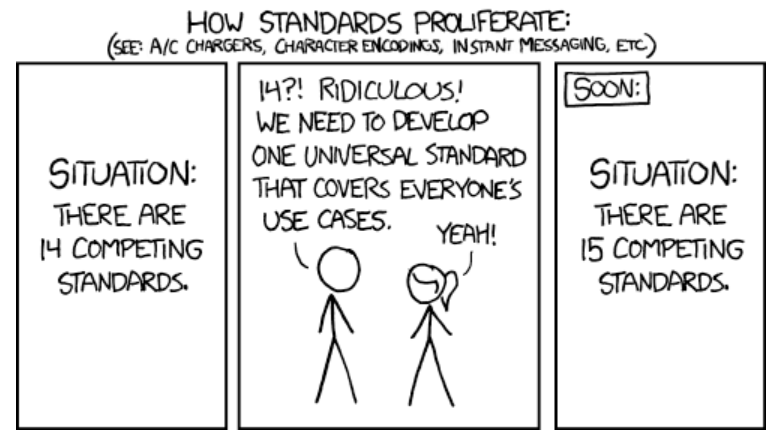 When asking myself this question, I see the analogy with standards. So let’s look at the various players in the PLM domain – sorry for the immense generalization.
Strategic consultants: standards are essential, but spare me the details.
Vendors: standards are limiting the unique capabilities of my products
Implementers: two types – Those who understand and use standards as they see the long-term benefits. Those who avoid standards as it introduces complexity.
Companies: they love standards if they can be implemented seamlessly.
Universities: they love to explore standards and help to set the standards even if they are not scalable
Just replace standards with methodology, and you see the analogy.
We like to discuss the methodology.
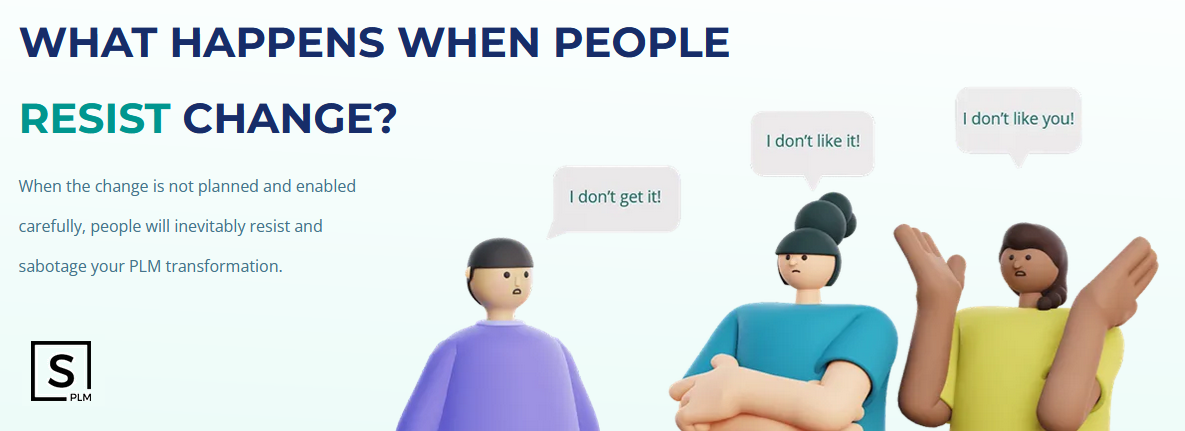 As I mentioned in the introduction, I started to work with Share PLM on a series of podcasts where we interview PLM experts in the field that have experience with the people, the process, the tools and the data side. Through these interviews, you will realize PLM is complex and has become even more complicated when you consider PLM a strategy instead of a tool.
We hope these podcasts might be a starting point for further discussion – either through direct interactions or through contributions to the podcast. If you have PLM experts in your network that can explain the complexity of PLM from various angles and have the experience. Please let us know – it is time to share.
Conclusion
By switching gears, I noticed that PLM has become complex. Too complex for a single person to master. With an aging traditional PLM workforce (like me), it is time to consolidate the best practices of the past and discuss the best practices for the future. There are no simple answers, as every industry is different. Help us to energize the PLM community – your thoughts/contributions?
Announcing PLM Road Map & PDT EMEA 2023
 Imagine you are a supplier working for several customers, such as big OEMs or smaller companies. In Dec 2020, I wrote about PLM and the Supply Chain because it was an underexposed topic in many companies. Suppliers need their own PLM and IP protection and work as efficiently as possible with their customers, often the OEMs.
Most PLM implementations always start by creating the ideal internal collaboration between functions in the enterprise. Historically starting with R&D and Engineering, next expanding to Manufacturing, Services and Marketing. Most of the time in this logical order.
In these implementations, people are not paying much attention to the total value chain, customers and suppliers. And that was one of the interesting findings at that time, supported by surveys from Gartner and McKinsey:
- Gartner: Companies reported improvements in the accuracy of product data and product development as the main benefit of their PLM implementation. They did not see so much of a reduced time to market or reduced product development costs. After analysis, Gartner believes the real issue is related to collaboration processes and supply chain practices. Here the lead times did not change, nor did the number of changes.
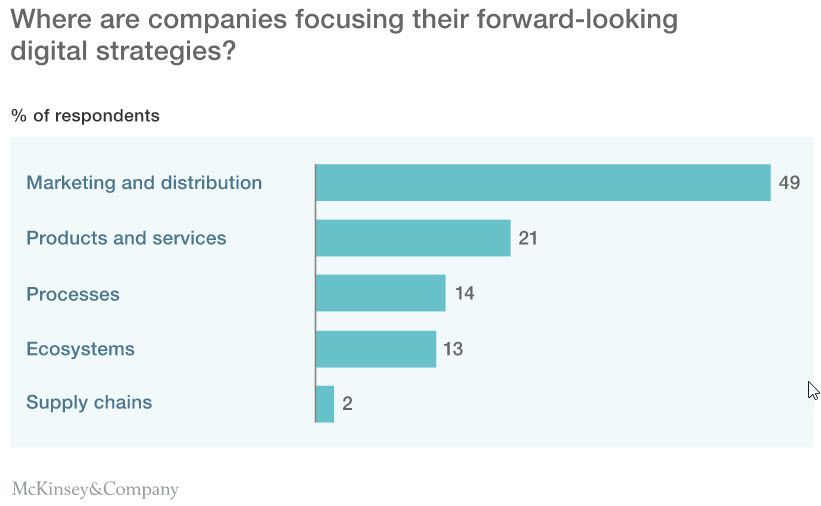
- McKinsey: In their article, The Case for Digital Reinvention, digital supply chains were mentioned as the area with the potential highest ROI; however, as the image shows below, it was the area with the lowest investment at that time.
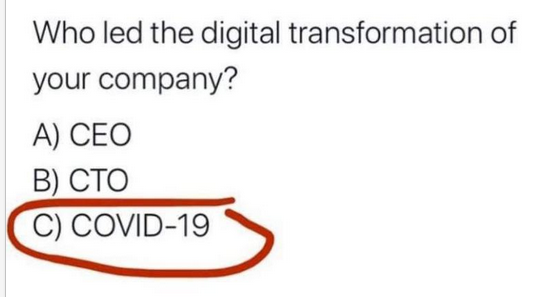 In 2020 we were in the middle of broken supply chains and wishful thinking related to digital transformation, all due to COVID-19.
Meanwhile, the further digitization in PLM (systems of engagement) and the new topic, Sustainability of the supply chain, became visible.
Therefore it is time to make a status again, also driven by discussions in the past few weeks.
The old “connected” approach (loose-loose).
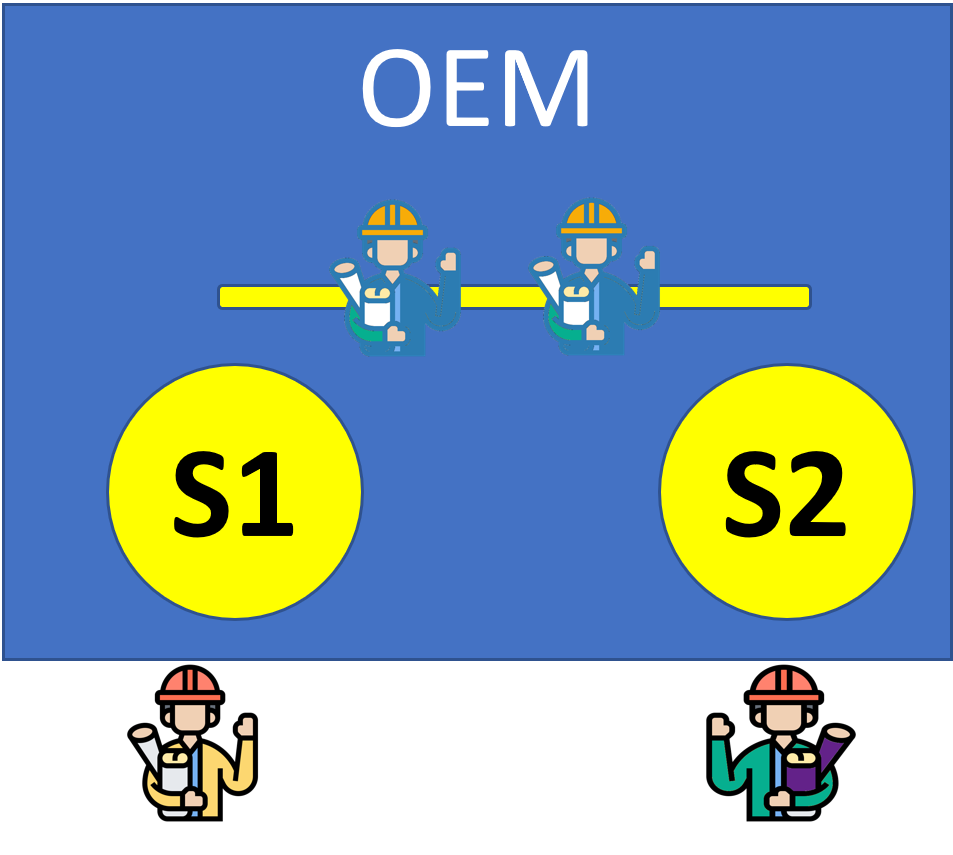 A preferred way for OEMs in the past was to have the Supplier or partner directly work in their PLM environment. The OEM could keep control of the product development process and the incremental maturity of the BOM, where the Supplier could connect their part data and designs to the OEM environment. T
The advantage for the OEM is clear – direct visibility of the supplier data when available. The benefit for the Supplier could also be immediate visibility of the broader context of the part they are responsible for.
 However, the disadvantages for a supplier are more significant. Working in the OEM environment exposes all your IP and hinders knowledge capitalization from the Supplier. Not a big thing for perhaps a tier 3 supplier; however, the more advanced the products from the Supplier are, the higher the need to have its own PLM environment.
Therefore the old connected approach is a loose-loose relationship in particular for the Supplier and even for the OEM (having less knowledgeable suppliers)
The modern “connected” approach (wins t.b.d.)
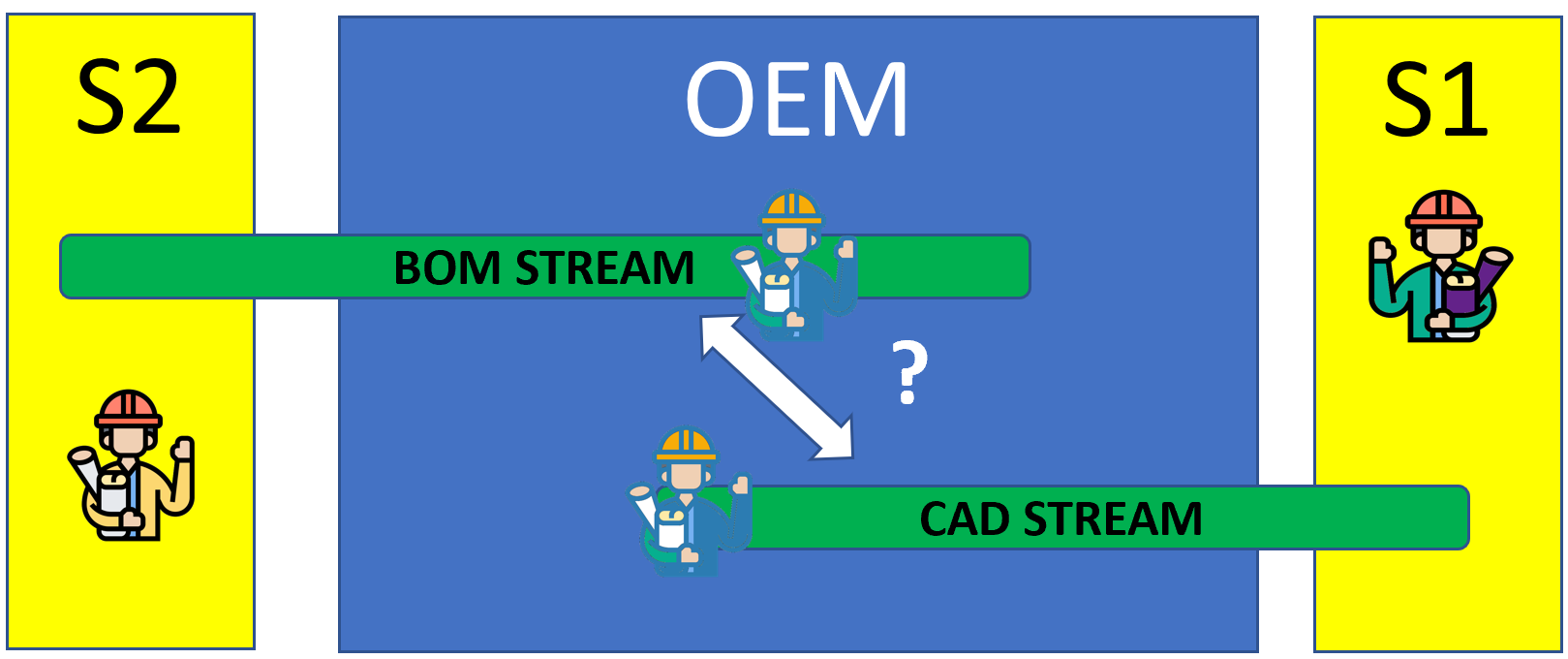 In this situation, the target infrastructure is a digital infrastructure, where datasets are connected in real-time, providing the various stakeholders in engagement access to a filtered set of data relevant to their roles.
In my terminology, I refer to them as Systems of Engagement, as the target is that all stakeholders work in this environment.
The counterpart of Systems of Engagement is the Systems of Record, which provides a product baseline, manufacturing baseline, and configuration baseline of information consumed by other disciplines.
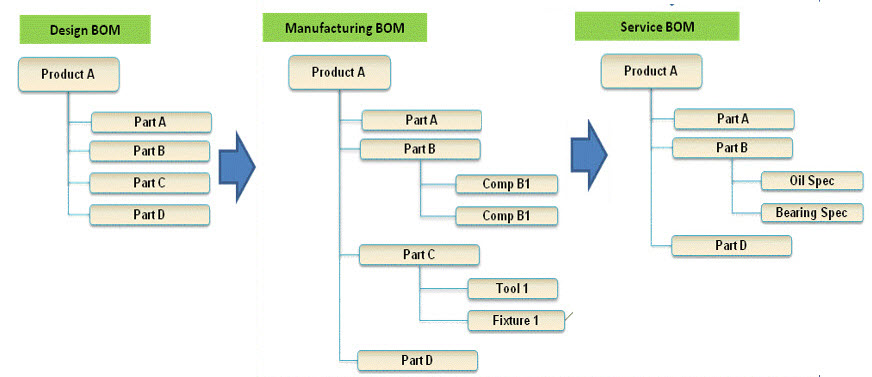 These baselines are often called Bills of Information, and the traditional PLM system has been designed as a System of Record. Major Bills of Information are the eBOM, the mBOM and sometimes people talk about the sBOM(service BOM).
Typical examples of Systems of Engagement I have seen in alphabetical order are:
- Arena Solutions has a long-term experience in BOM collaboration between engineering teams, suppliers and contract manufacturers.
- CATENA-X might be a strange player in this list, as CATENA-X is more a German Automotive consortium targeting digital collaboration between stakeholders, ensuring security and IP protection.
- Colab is a provider of cloud-based collaboration software allowing design teams and suppliers to work in real time together.
- OnShape – a cloud-based collaborative product design environment for dispersed engineering teams and partners.
- OpenBOM – a SaaS solution focusing on BOM collaboration connected to various CAD systems along with design teams and their connected suppliers
These are some of the Systems of Engagement I am aware of. They focus on specific value streams that can improve the targeted time to market and product introduction efficiency. In companies with no extensive additional PLM infrastructure, they can become crucial systems of engagement.
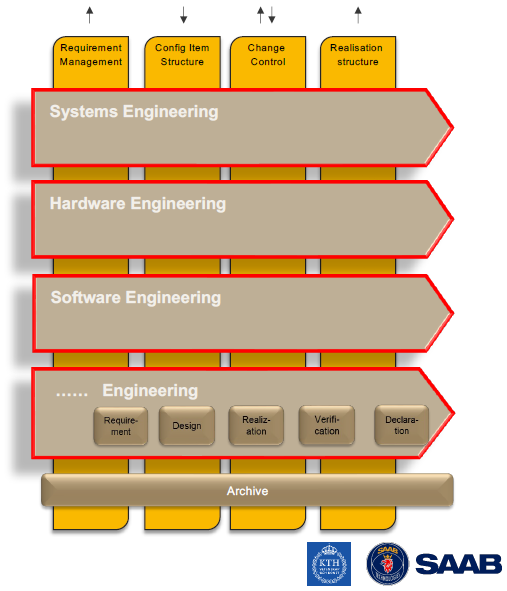 The main challenge for these systems of engagement is how they will connect to traditional Systems or Records – the classical PLM systems that we know in the market (Aras, Dassault, PTC, Siemens).
Image on the left from a presentation done by Eric Herzog from SAAB at last year’s CIMdata/PDT conference.
You can read more about this here.
When establishing a mix of Systems of Engagement and Systems of Record in your organization digitally connected, we will see overall benefits. My earlier thoughts, in general, are here: Time to split PLM?
The almost Connected approach
As I mentioned, in most companies, it is already challenging to manage their internal System of Record, which is needed for current operations and the traceability of information. In addition, most of the data stored in these systems is document-driven, not designed for real-time collaboration. So how would these companies collaborate with their suppliers?
The Model-Based Enterprise
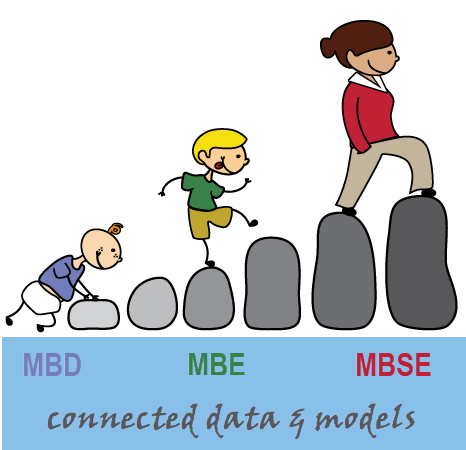 In the bigger image below, I am referring to an image published by Jennifer Herron from her book Re-use Your CAD, where she describes the various stages of interaction between engineering, manufacturing and the extended enterprise.
Her mission is to promote and educate organizations in moving to a Model-Based Definition and, in the long term, to a Model-Base Enterprise.
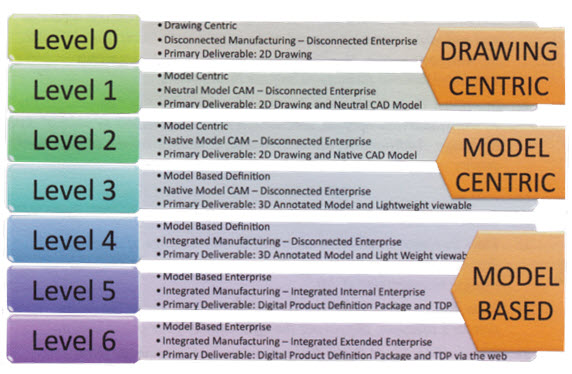
The ultimate target of information exchange in this diagram is that the OEM and the Supplier are separate entities. However, they can exchange Digital Product Definition Packages and TDPs over the web (electronically). In this exchange, we have a mix of systems of engagement and systems of record on the OEM and Supplier sides.
 Depending on the type of industry, in my ecosystem of companies, many suppliers are still at level 2, dreaming or pushed to become level 3, illustrating there is a difficult job to do – learning new practices. And why would you move to the next level?
Every step can have significant benefits, as reported by companies that did this.
So what’s stopping your company from moving ahead? People, Processes, Skills, Work Pressure? It is one of the most common excuses: “We are too busy, no time to improve”.
A supply chain collaboration hub
On March 21, I discussed with Magnus Färneland from Eurostep their cloud-based PLM collaboration hub, ShareAspace. You can read the interview here: PLM and Supply Chain Collaboration

I believe this concept can be compelling for a connected enterprise. The OEM and the Supplier share (or connect) only the data they want to share, preferably based on the PLCS data schema (ISO 10303-239).
In a primitive approach, this can be BOM structures with related files; however, it could become a real model-based connection hub in the advanced mode. “
Now you ask yourself why this solution is not booming.
In my opinion, there are several points to consider:
- Who designs, operates and maintains the collaboration hub?
It is likely not the suppliers, and when the OEM takes ownership, they might believe there is no need for the extra hub; just use the existing PLM infrastructure. - Could a third party find a niche market for this? Eurostep has already been working on this for many years, but adopting the concept seems higher in de BIM or Asset Management domains. Here the owner/operator sees the importance of a collaboration hub.
 A final remark, we are still far from a connected enterprise; concepts like Catena-X and others need to become mature to serve as a foundation – there is a lot of technology out there -now we need the skilled people and tested practices to use the right technology and tune solutions concepts.
Sustainability demands a connected enterprise.
 I focused on the Supplier dilemma this time because it is one of the crucial aspects of a circular economy and sustainable product development.
Only by using virtual models of the To-Be products/systems can we seriously optimize them. Virtual models and Digital Twins do not run on documents; they require accurate data from anywhere connected.
You can read more details in my post earlier this year: MBSE and Sustainability or look at the PLM and Sustainability recording on our PLM Global Green Alliance YouTube channel.
Conclusion
Due to various discussions I recently had in the field, it became clear that the topic of supplier integration in a best-connected manner is one of the most important topics to address in the near future. We cannot focus longer on our company as an isolated entity – value streams implemented in a connected manner become a must.
And now I am going to enjoy Liveworx in Boston, learning, discussing and understanding more about what PTC is doing and planning in the context of digital transformation and sustainability. More about that in my next post: The week(end) after Liveworx 2023 (to come)

 Happy New Year to all of you, and may this year be a year of progress in understanding and addressing the challenges ahead of us.
To help us focus, I selected three major domains I will explore further this year. These domains are connected – of course – as nothing is isolated in a world of System Thinking. Also, I wrote about these domains in the past, as usually, noting happens out of the blue.
 Meanwhile, there are a lot of discussions related to Artificial Intelligence (AI), in particular ChatGPT (openAI). But can AI provide the answers? I believe not, as AI is mainly about explicit knowledge, the knowledge you can define by (learning) algorithms.
Expert knowledge, often called Tacit knowledge, is the knowledge of the expert, combining information from different domains into innovative solutions.
 I started my company, TacIT, in 1999 because I thought (and still think) that Tacit knowledge is the holy grail for companies.
Let’s see with openAI how far we get ……
Digitization of the PLM domain
 The PLM domain is suffering from its legacy data (documents), legacy processes (linear – mechanical focus) and legacy people (siloed). The statement is a generalization.
More details can be found in my blog series: The road to model-based and connected PLM.
So why should companies move to a model-based and connected approach for their PLM infrastructure?
 There are several reasons why companies may want to move to a model-based and connected approach for their Product Lifecycle Management (PLM) infrastructure:
- Increased efficiency: A model-based approach allows for creating a digital twin of the product, which can be used to simulate and test various design scenarios, reducing the need for physical prototypes and testing. This can lead to faster and more efficient product development.
- Improved collaboration: A connected PLM infrastructure allows for better collaboration between different teams and departments, as all product-related information is stored in a central location and can be accessed by authorized personnel. This can improve communication and decision-making within the organization.
- Enhanced visibility: A model-based PLM system provides a single source of truth for all product-related data, giving management a clear and comprehensive view of the product development process. This can help identify bottlenecks and areas for improvement.
- Reduced risk: By keeping all product-related information in a centralized location, the risk of data loss or inconsistencies is reduced. This can help ensure that the product is developed in accordance with regulatory requirements and company standards.
- Increased competitiveness: A model-based and connected PLM infrastructure can help companies bring new products to market faster and with fewer errors, giving them a competitive advantage in their industry.
The text in italics was created by ChatGPT. After three learning cycles, this was the best answer I got. What we are missing in this answer is the innovative and transformative part that modern PLM can bring. Where is the concept of different ways of working, and new business models, both drivers for digitalization in many businesses?
 Expert knowledge related to Federated PLM (or Killing the PLM Monolith) are topics you will not find through AI. This is, for me, the most interesting part to explore.
We see the need but lack a common understanding of the HOW.
Algorithms will not innovate; for that, you need Tacit intelligence & Curiosity instead of Artificial Intelligence. More exploration of Federated PLM this year.
PLM and Sustainability
 Last year as part of the PLM Global Green Alliance, we spoke with six different PLM solution providers to understand their sustainability goals, targets, and planned support for Sustainability. All of them confirmed Sustainability has become an important issue for their customers in 2022. Sustainability is on everyone’s agenda.
Why is PLM important for Sustainability?
 PLM is important for Sustainability because a PLM helps organizations manage the entire lifecycle of a product, from its conception and design to its manufacture, distribution, use, and disposal. PLM can be important for Sustainability because it can help organizations make more informed decisions about the environmental impacts of their products and take steps to minimize those impacts throughout the product’s lifecycle.
For example, using PLM, an organization can consider the environmental impacts of the materials that are used in a product, the energy consumption of the manufacturing process, the product’s end-of-life disposal, and other factors that may affect its overall Sustainability. By considering these factors early in the design process, organizations can make more sustainable choices that reduce the environmental impact of their products over their lifecycle.
In addition, PLM can help organizations track and measure the Sustainability of their products over time, allowing them to continuously improve and optimize their products for Sustainability. This can be particularly important for organizations that are looking to meet regulatory requirements or consumer demand for more sustainable products.
Again not a wrong answer, but there is no mention of supporting the concepts of the circular economy, the potential of using digital twins at the various lifecycle stages of the products to perform trade-off studies in the virtual world, or to analyze the product behavior from the physical world in the virtual world for optimization.
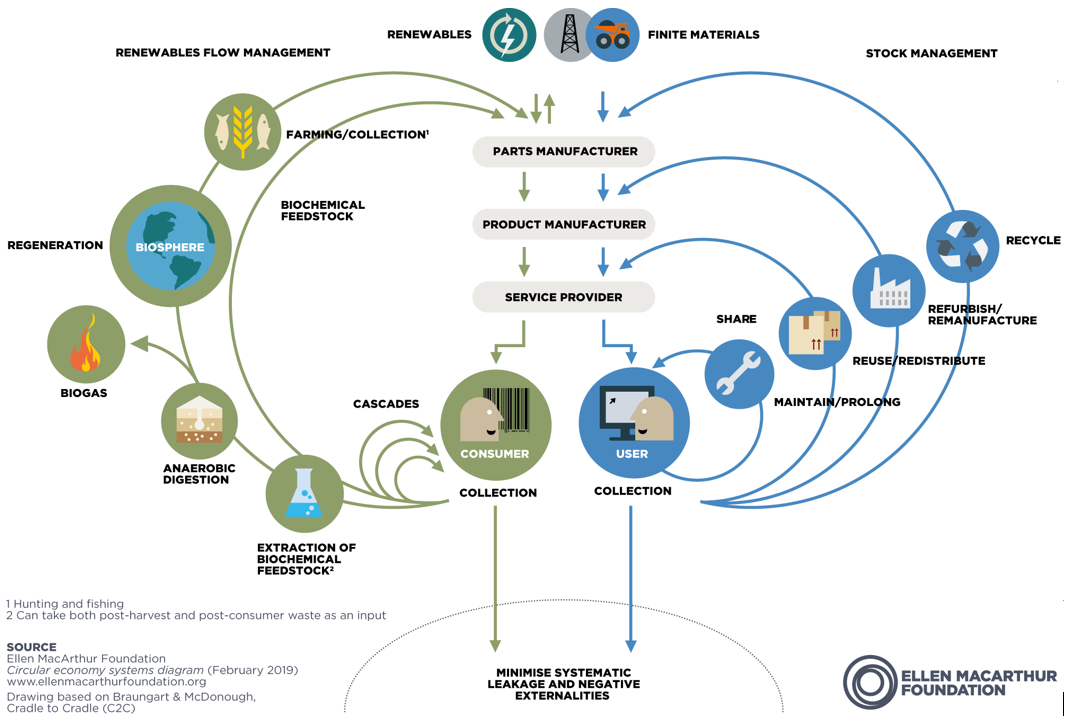
This is (again), for me, the most interesting part to explore.
We see the need but lack the sense of urgency on the NOW.
More on Sustainability this year.
PLM Education at all levels
Historically PLM was framed as an “engineering thing” or a system needed for R&D/Engineering. Modern PLM is much broader and, unfortunately, more hard to grasp. I support the CIMdata definition:
CIMdata defines PLM as:
-
A strategic business approach that applies a consistent set of business solutions that support the collaborative creation, management, dissemination, and use of product definition information
-
Supporting the extended enterprise (customers, design and supply partners, etc.)
-
Spanning from concept to end of life of a product or plant
-
Integrating people, processes, business systems, and information
And even here, I would say this definition is challenging as the scope is extensive and could touch a lot of activities inside an enterprise. As I wrote last year in my series of posts related to PLM and Education, there is:
Strategy education (what are the trends/potential of digital transformation in the business domain related to the company’s products)
Methodology/ Academic Education (independent from tools, what are the best practices, where they reside, potential lessons learned and pitfalls to avoid)
Organisational Change Management (the Education and support needed to enable a business transformation – modern PLM is a transformation enabler)
By asking ChatGPT for their opinion, we learn the following:
Product Lifecycle Management (PLM) education refers to training and development programs that focus on teaching individuals how to effectively manage the lifecycle of a product within an organization. This can include a wide range of topics, such as product design, development, and engineering; supply chain management; quality control and assurance; and product retirement and disposal.
Some specific types of PLM education that a company may need to provide to its employees include:
- Introduction to PLM: This type of training is designed to provide a general overview of PLM concepts and practices and may be suitable for employees who are new to the field or who have limited experience with PLM.
- PLM software training: Many companies use specialized PLM software to manage their product lifecycle processes. Employees who will be using this software will need training on how to use it effectively.
- Industry-specific PLM training: Depending on the industry in which a company operates, there may be specific PLM practices and regulations that employees need to be familiar with. For example, a company in the aerospace industry may need to provide training on PLM practices that are specific to the aerospace industry.
- Leadership and management training: For employees who are responsible for leading and managing PLM projects or teams, additional training in leadership and project management may be necessary.
Overall, the types of PLM education that a company needs will depend on the specific needs and goals of the organization, as well as the roles and responsibilities of its employees.
In general, we see from the answer that strategy and organizational change management beyond the tool are not considered.
This is precisely the area where a PLM Expert can help.
We see the need for Education, but we lack the willingness to invest in it.
Conclusion
It was an exciting exercise to combine my blogging thoughts with the answers from OpenAI. I am impressed by the given answers, knowing that the topics discussed about PLM are not obvious. On the other hand, I am not worried that AI will take over the job of the PLM consultant. As I mentioned before, the difference between Explicit Knowledge and Tacit Knowledge is clear, and business transformations will largely depend on the usage of Tacit knowledge.
I am curious about your experiences and will follow the topics mentioned in this post and write about them with great interest.
 With great pleasure, I am writing this post, part of a tradition that started for me in 2014. Posts starting with “The weekend after …. “describing what happened during a PDT conference, later the event merged with CIMdata becoming THE PLM event for discussions beyond marketing.
For many of us, this conference was the first time after COVID-19 in 2020. It was a 3D (In person) conference instead of a 2D (digital) conference. With approximately 160 participants, this conference showed that we wanted to meet and network in person and the enthusiasm and interaction were great.
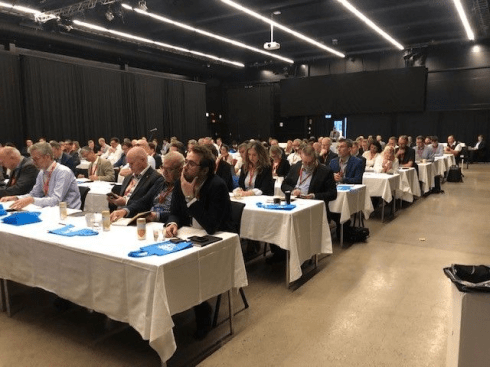
The conference’s theme, Digital Transformation and PLM – a call for PLM Professionals to redefine and re-position the benefits and value of PLM, was quite open.
There are many areas where digitization affects the way to implement a modern PLM Strategy.
Now some of my highlights from day one. I needed to filter to remain around max 1500 words. As all the other sessions, including the sponsor vignettes, were informative, they increased the value of this conference.
Digital Skills Transformation -Often Forgotten Critical Element of Digital Transformation
 Day 1 started traditionally with the keynote from Peter Bilello, CIMdata’s president and CEO. In previous conferences, Peter has recently focused on explaining the CIMdata’s critical dozen (image below). If you are unfamiliar with them, there is a webinar on November 10 where you can learn more about them.
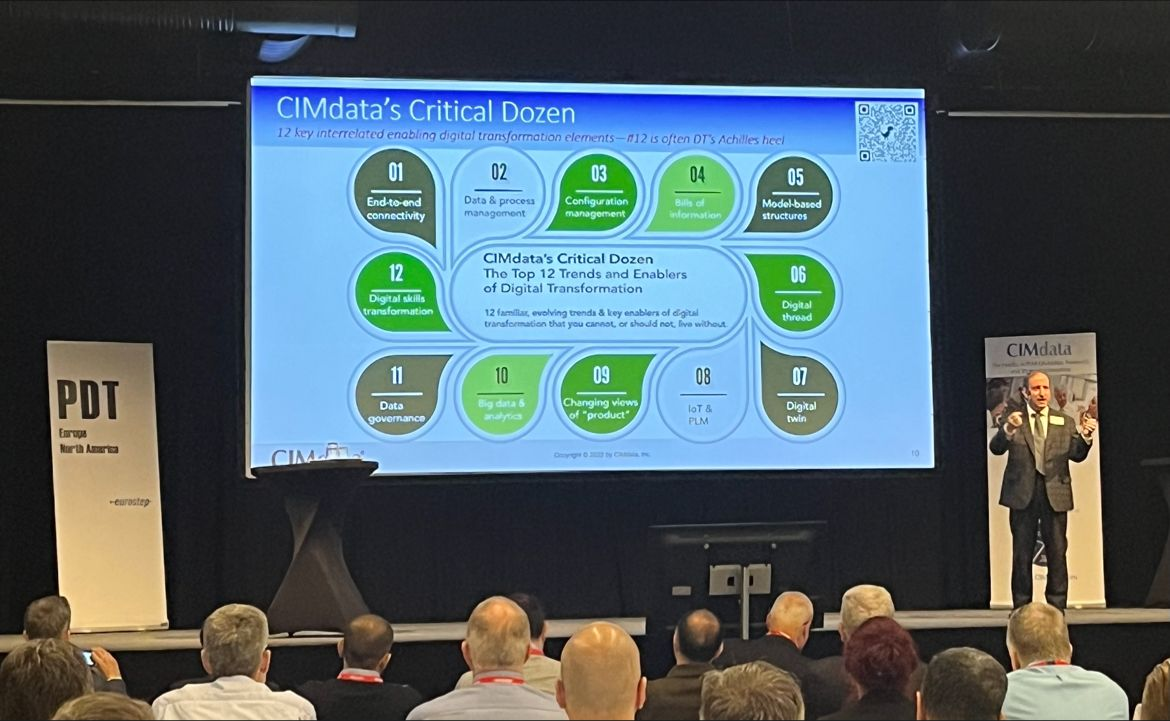
All twelve are equally important; it is not a sequence of priorities. This time Peter spent more time on Organisational Change management (OCM), number 12 of the critical dozen – or, as stated, the Digital Transformation’s Achilles heel. Although we always mention people are important, in our implementation projects, they often seem to be the topic that gets the less focus.
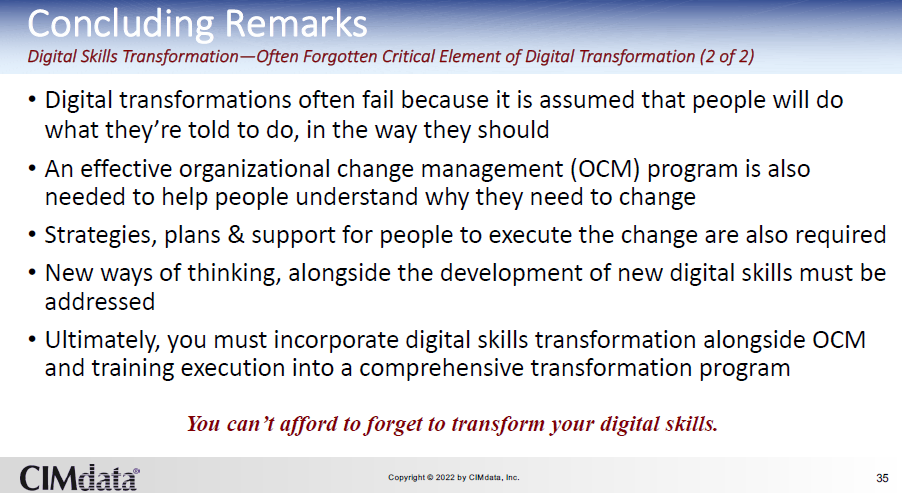
We all agree on the statement: People, Process, Tools & Data. Often the reality is that we start with the tools, try to build the processes and push the people in these processes. Is it a coincidence that even CIMdata puts Digital Skills transformation as number 12? An unconscious bias?
This time, the people’s focus got full attention. Peter explained the need for a digital skills transformation framework to educate, guide and support people during a transformation. The concluding slide below says it all.
Transformation Journey and PLM & PDM Modernization to the Digital Future
 The second keynote of the day was from Josef Schiöler, Head of Core Platform Area PLM/PDM from the Volvo Group. Josef and his team have a huge challenge as they are working on a foundation for the future of the Volvo Group.
The challenge is that it will provide the foundation for new business processes and the various group members, as the image shows below:

As Josef said, it is really the heart of the heart, crucial for the future. Peter Bilello referred to this project as open-heart surgery while the person is still active, as the current business must go on too.
The picture below gives an impression of the size of the operation.
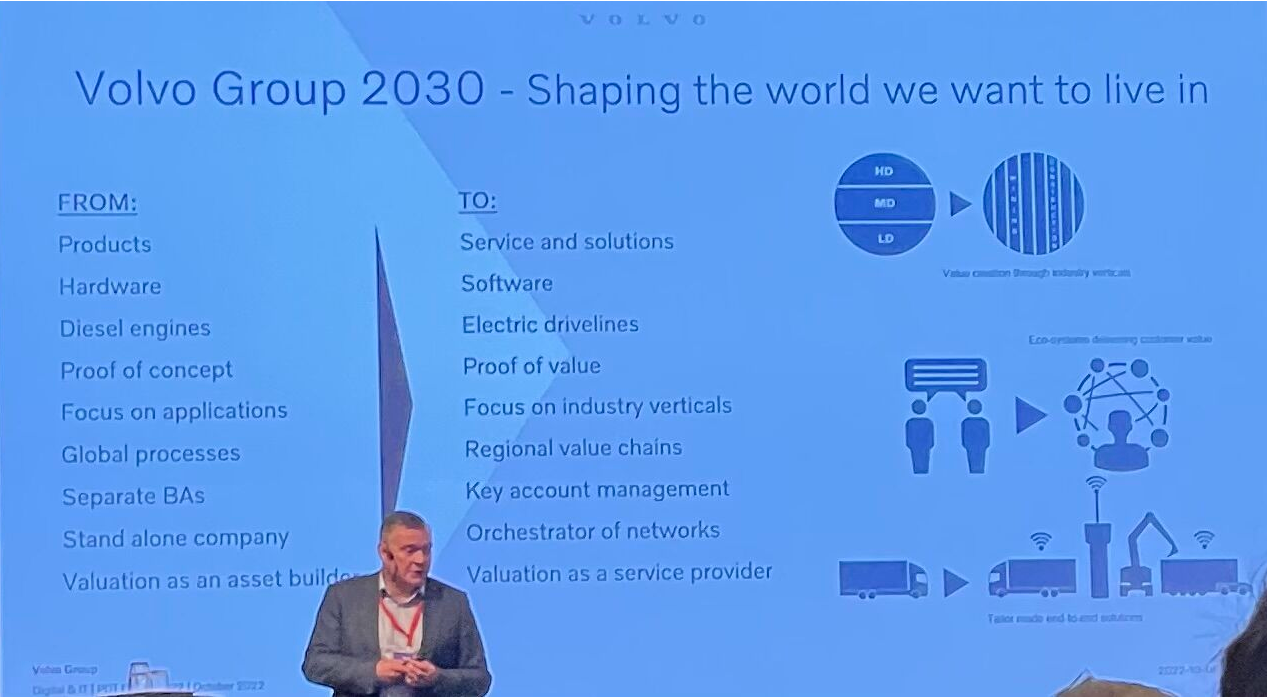
And like any big transformation project also, the Volvo Group has many questions to explore as there is no existing blueprint to use.
To give you an impression:
- How to manage complex documentation with existing and new technology and solution co-existing?
(My take: the hybrid approach) - How to realize benefits and user adoption with user experience principles in mind?
(My take: Understand the difference between a system of engagement and a system of record) - How to avoid seeing modernization as pure an IT initiative and secure that end-user value creation is visible while still keeping a focus on finalizing the technology transformation?
(My take: think hybrid and focus first on the new systems of engagement that can grow) - How to efficiently partner with software vendors to ensure vendor solutions fit well in the overall PLM/PDM enterprise landscape without heavy customization?
(My take: push for standards and collaboration with other similar companies – they can influence a vendor)
 Note: My takes are just a starting point of the conversation. There is a discussion in the PLM domain, which I described in my blog post: A new PLM paradigm.
 The day before the conference, we had a ½ day workshop initiated by SAAB and Eurostep where we discussed the various angles of the so-called Federated PLM.
I will return to that topic soon after some consolidation with the key members of that workshop.
Steering future Engineering Processes with System Lifecycle Management
 Patrick Schäfer‘s presentation was different than the title would expect. Patrick is the IT Architect Engineering IT from ThyssenKrupp Presta AG. The company provides steering systems for the automotive industry, which is transforming from mechanical to autonomous driving, e-mobility, car-to-car connectivity, stricter safety, and environmental requirements.
 The steering system becomes a system depending on hardware and software. And as current users of Agile PLM, the old Eigner PLM software, you can feel Martin Eigner’s spirit in the project.
I briefly discussed Martin’s latest book on System Lifecycle Management in my blog post, The road to model-based and connected PLM (part 5).
Martin has always been fighting for a new term for modern PLM, and you can see how conservative we are – for sometimes good reasons.
Still, ThyssenKrupp Presta has the vision to implement a new environment to support systems instead of hardware products. And in addition, they had to work fast to upgrade their current almost obsolete PLM environment to a new supported environment.
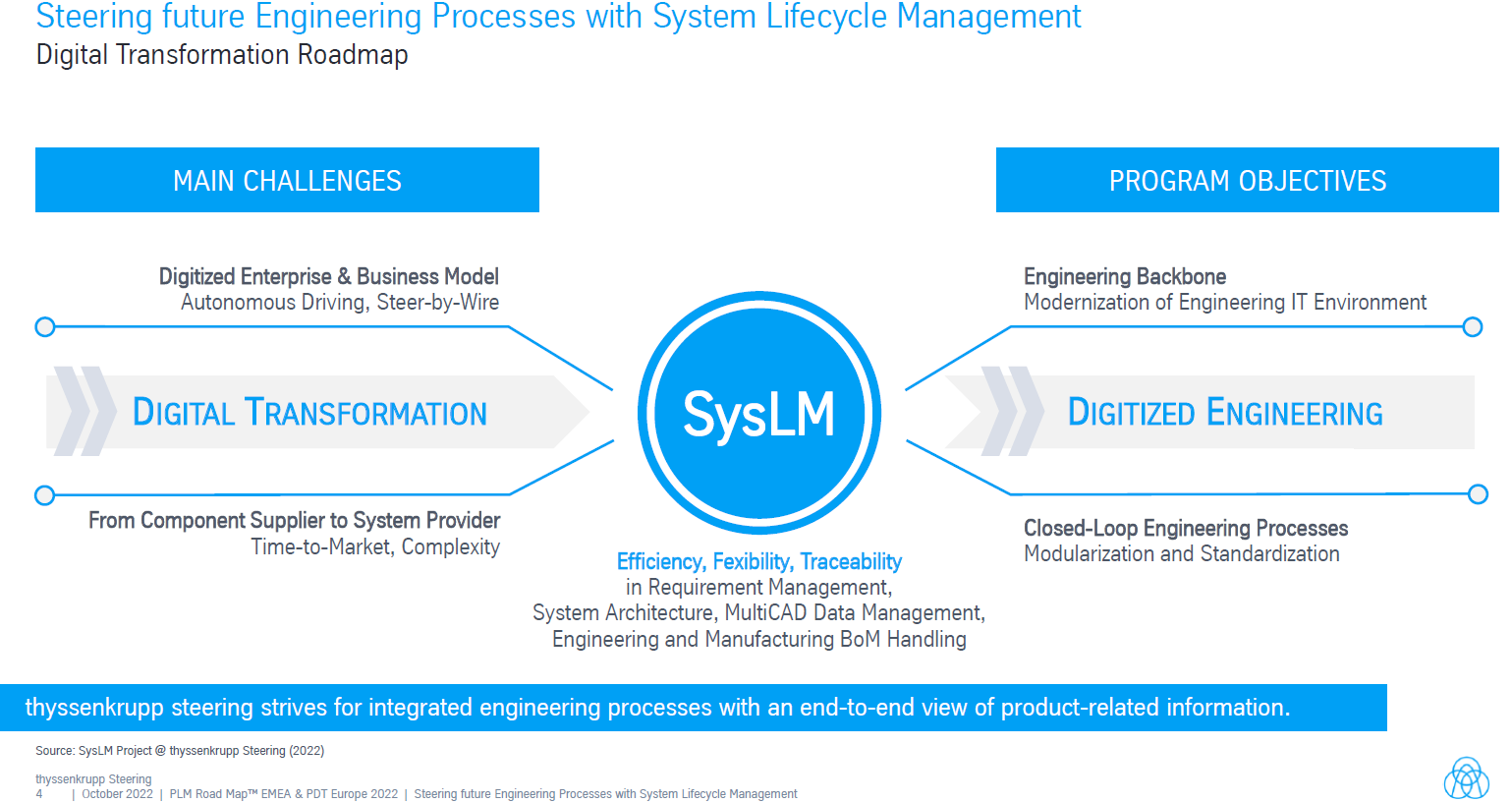
The wise path they chose was first focusing on a traditional upgrade, meaning making sure their PLM legacy data became part of a modern (Teamcenter) PLM backbone. Meanwhile, they started exploring the connection between requirements management for products and software, as shown below.
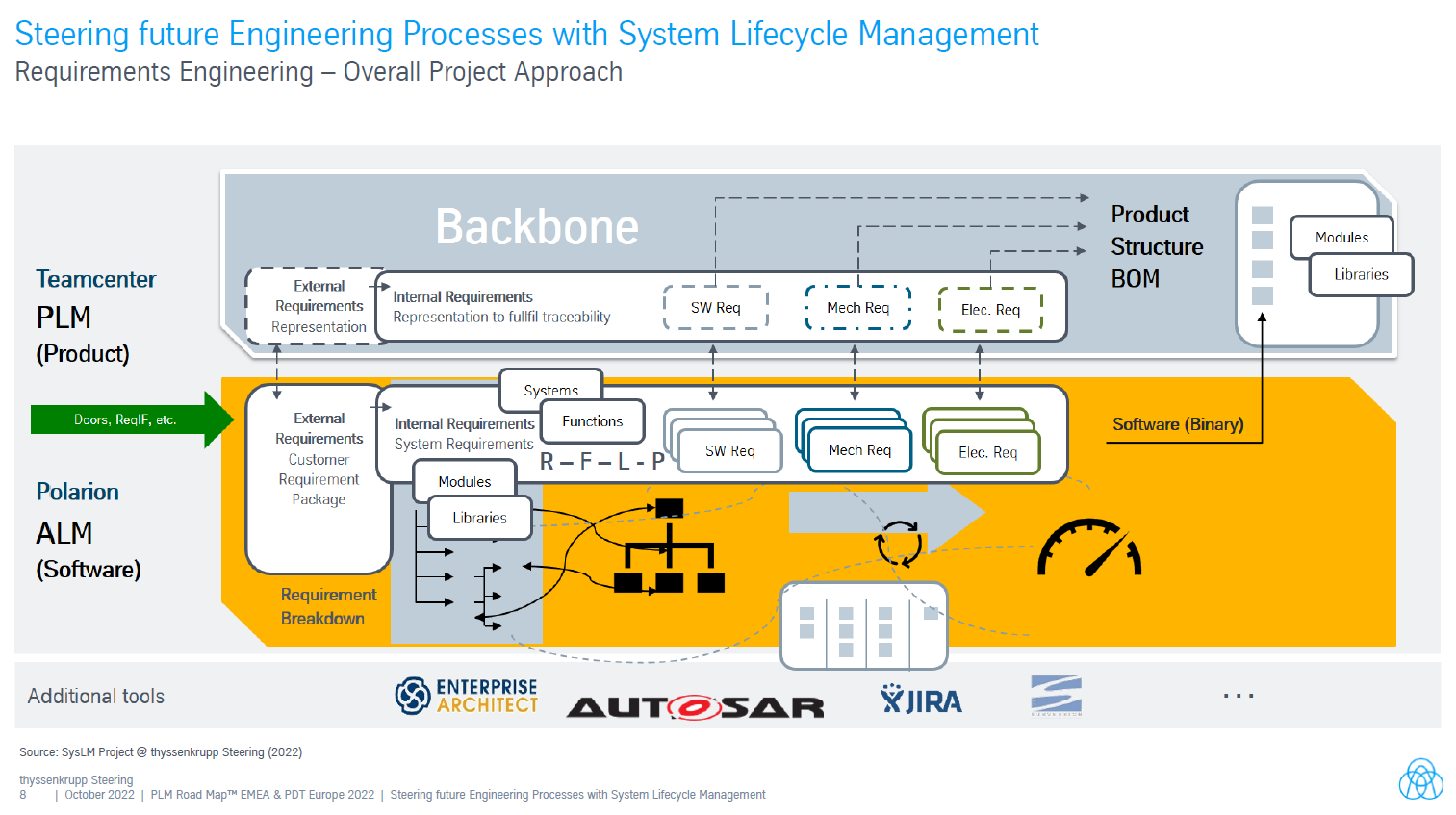
From my perspective, I would characterize this implementation as the coordinated approach creating a future option for the connected approach when the organization and future processes are more mature and known.
A good example of a pragmatic approach.
Digital Transformation in the Domain of Products and Plants at Siemens Energy
 Per Soderberg, Head of Digital PLM at Siemens Energy, talked about their digital transformation project that started 6 – 7 years ago. Knowing the world of gas- and steam turbines, it is a domain where a lot of design and manufacturing information is managed in drawings.
The ultimate vision from Siemens Energy is to create an Industrial Metaverse for its solutions as the benefits are significant.
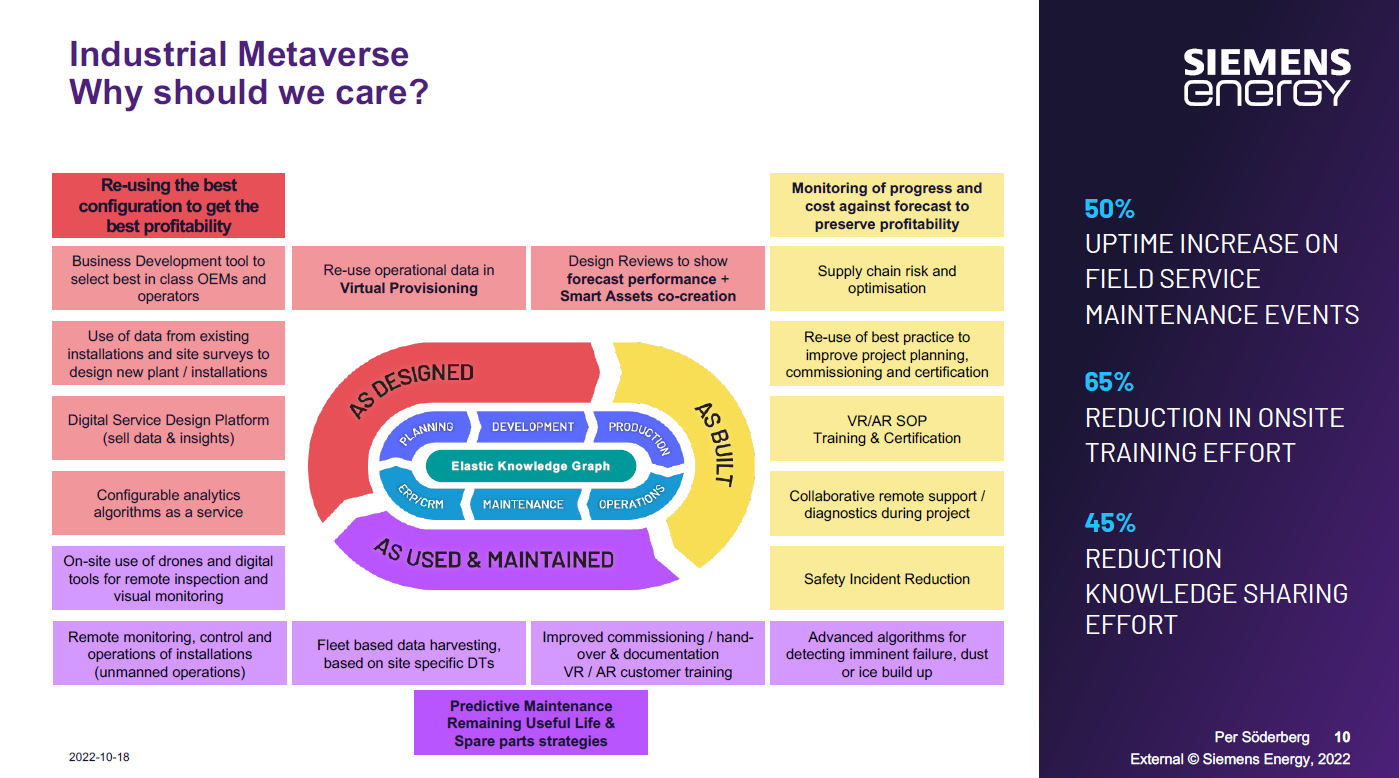
Is this target too ambitious, like GE’s 2014 Industrial Transformation with Predix? Time will tell. And I am sure you will soon hear more from Siemens Energy; therefore, I will keep it short. An interesting and ambitious program to follow. Sure you will read about them in the near future.
Accelerating Digitalization at Stora Enso
 Stora Enso is a Finish company, a leading global provider of renewable solutions in packaging, biomaterials, wooden construction and paper. Their director of Innovation Services, Kaisa Suutari, shared Stora Enso’s digital transformation program that started six years ago with a 10 million/year budget (some people started dreaming too). Great to have a budget but then where to start?
In a very systematic manner using an ideas funnel and always starting from the business need, they spend the budget in two paths, shown in the image below.

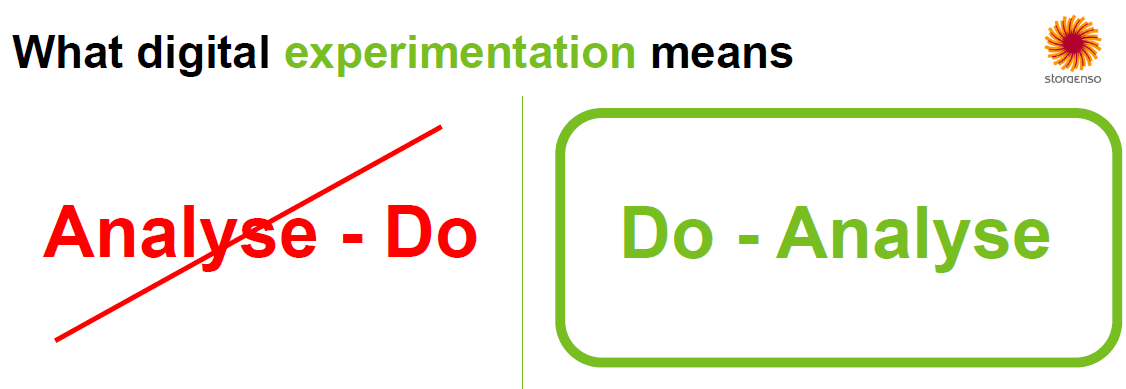 Their interesting approach was in the upper path, which Kaisa focused on. Instead of starting with an analysis of how the problem could be addressed, they start by doing and then analyze the outcome and improve.
I am a great fan of this approach as it will significantly reduce the time to maturity. However, how much time is often wasted in conducting the perfect analysis?
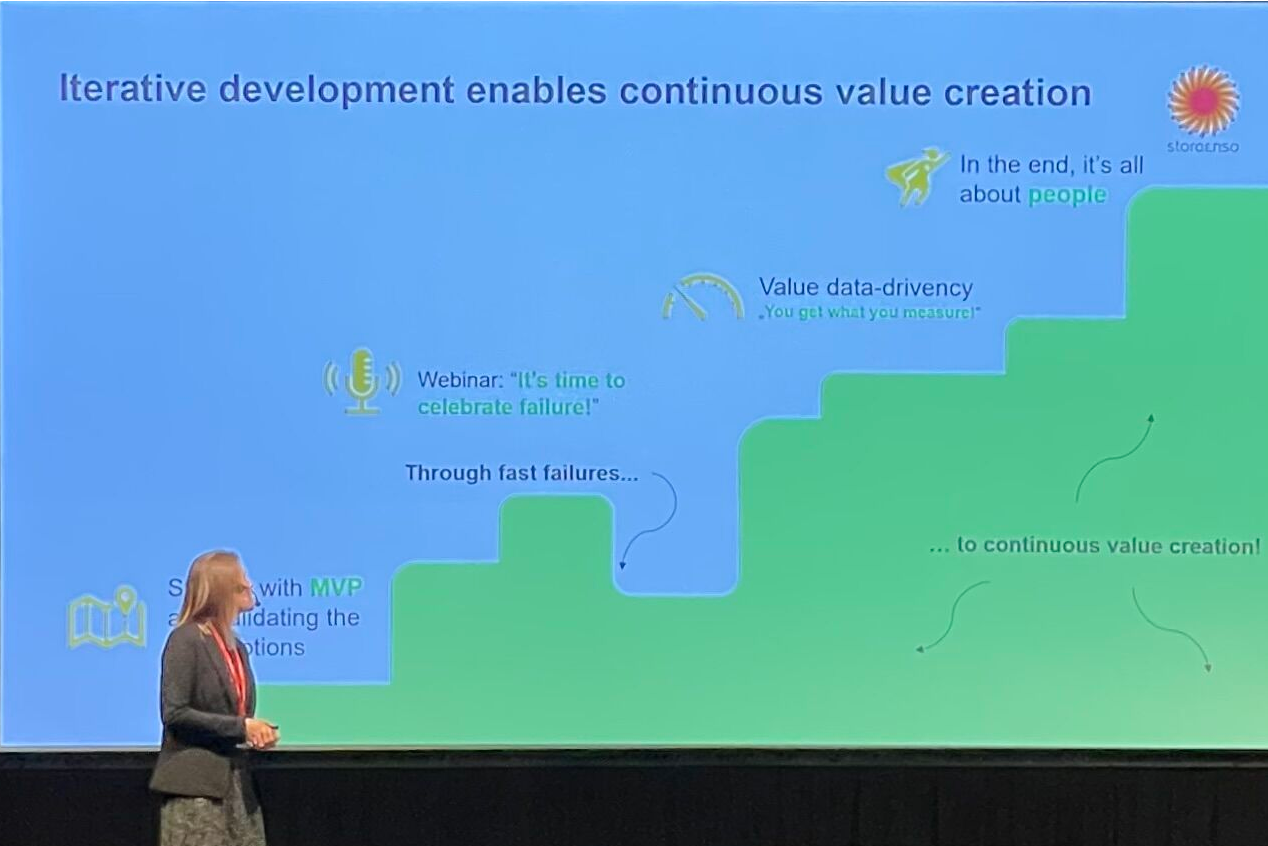
Their Digi Fund process is a fast process to quickly go from idea to concept, to POC and to pilot, the left side of the funnel. After a successful pilot, an implementation process starts small and scales up.
There were so many positive takeaways from this session. Start with an MVP (Minimal Viable Product) to create value from the start. Next, celebrate failure when it happens, as this is the moment you learn. Finally, continue to create measurable value created by people – the picture below says it all.
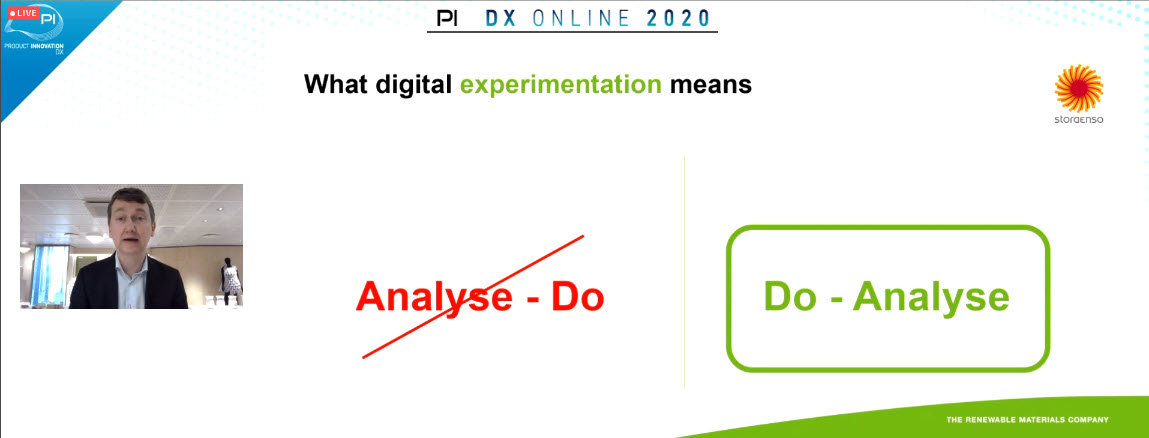 It was the second time I was impressed by Stora Enso’s innovative approach. During the PI PLMX 2020 London, Samuli Savo, Chief Digital Officer at Stora Enso, gave us insights into their innovation process. At that time, the focus was a little bit more on open innovation with startups. See my post: The weekend after PI PLMx London 2020. An interesting approach for other businesses to make their digital transformation business-driven and fun for the people
A day-one summary
There was Kyle Hall, who talked about MoSSEC and the importance of this standard in a connected enterprise. MoSSEC (Modelling and Simulation information in a collaborative Systems Engineering Context) is the published ISO standard (ISO 10303-243) for improving the decision-making process for complex products. Standards are a regular topic for this conference, more about MoSSEC here.
There was Robert Rencher, Sr. Systems Engineer, Associate Technical Fellow at Boeing, talking about the progress that the A&D action group is making related to Digital Thread, Digital Twins. Sometimes asking more questions than answers as they try to make sense of the marketing definition and what it means for their businesses. You can find their latest report here.
There was Samrat Chatterjee, Business Process Manager PLM at the ABB Process Automation division. Their businesses are already quite data-driven; however, by embedding PLM into the organization’s fabric, they aim to improve effectiveness, manage a broad portfolio, and be more modular and efficient.
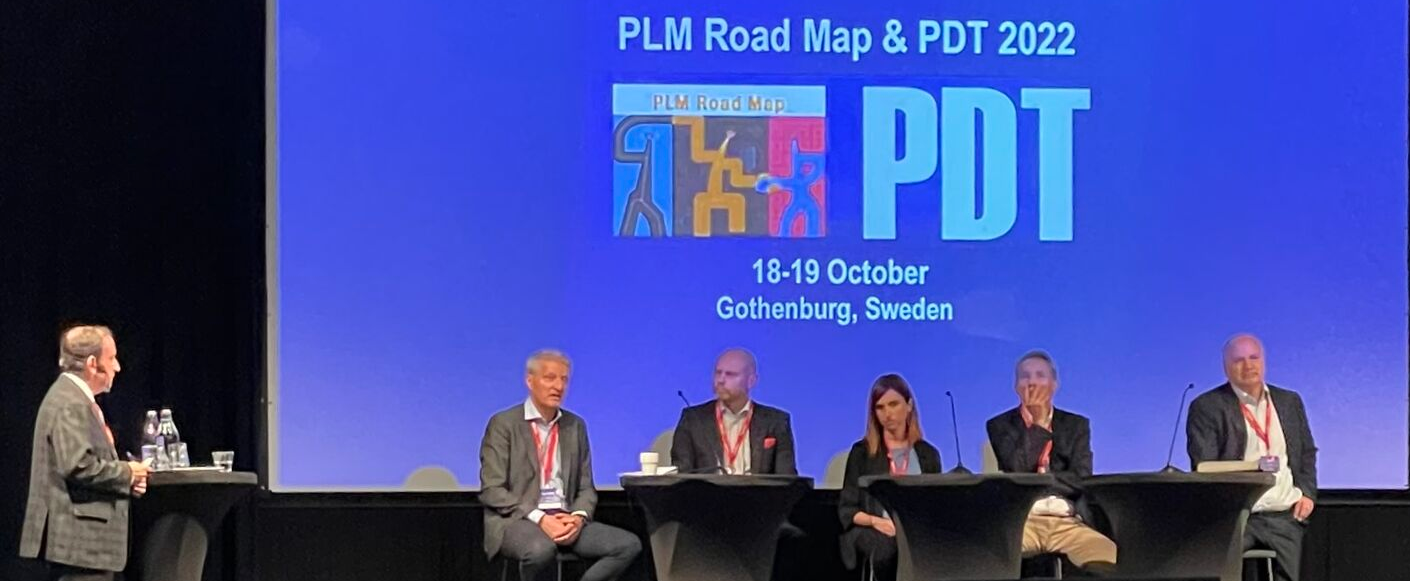
The day was closed with a CEO Spotlight, Peter Bilello. This time the CEOs were not coming from the big PLM vendors but from complementary companies with their unique value in the PLM domain. Henrik Reif Andersen, co-founder of Configit; Dr. Mattias Johansson, CEO of Eurostep; Helena Gutierrez, co-founder of Share PLM; Javier Garcia, CEO of The Reuse Company and Karl Wachtel, CEO, XPLM discussed their various perspectives on the PLM domain.
Conclusion
Already so much to say; sorry, I reached the 1500 words target; you should have been there. Combined with the networking dinner after day one, it was a great start to the conference. Are you curious about day 2 – stay tuned, and your curiosity will be rewarded.
 Thanks to Ewa Hutmacher, Sumanth Madala and Ashish Kulkarni, who shared their pictures of the event on LinkedIn. Clicking on their names will lead you to the relevant posts.

 July and August are the quiet summer months here in Europe when companies slow down to allow people to recharge themselves.
However, the speed and hectic are not the same overall, nor is the recharging time. I will be entering a six-week thinking break, assembling thoughts to explore after the summer break. Here are some topics – and you may note – they are all connected.
The MBOM discussion
 Although my German is not as good as my English, I got intrigued by a post from Prof. Dr. Jörg W. Fischer.
He claims there is no meaning to the MBOM and, therefore, the “expensive” PLM concept of the MBOM has to disappear – read the original post here.
Jörg claims there are three reasons why the MBOM why we should not speak about the MBOM – here are the google translated quotes – and I left out some details to keep a place for the thoughts – not the answer yet:
- The MBOM as the structure for deriving the assembly drawings. No BOM! (here, I fully agree)
- The structure that comes out as a result when planning the assembly. Again, no BOM. (here, I tend to agree – however, we could extend this structure to an MBOM)
- The MBOM as the classic parts list in the ERP, the one with which the MRP run is performed. Is that an MBOM? Until recently, I thought so. But it isn’t. So again, no MBOM. (here, I tend to agree – however, we could extend this structure to an MBOM)
 The topic on LinkedIn here initiated an interesting sharing of viewpoints. I am quite aligned with Martin Eigner’s comment. It is a pity that this type of discussion is hidden in a LinkedIn environment and in the German language. It would be great to discuss such a topic at a PLM conference. For example, the CIMdata PLM roadmap conference had several Multiview BOM discussions coming from Aerospace and Defense action groups.
Perhaps comparing these two viewpoints – preferably in English – could lead to a better understanding for all of us. Now communication language and system dependencies might blur the methodology discussion.
 Cheryl Peck (CIMdata PLM Roadmap organizer)/ Jörg W. Fischer, are you open to this suggestion? BOM discussions have always been popular.
PLM Roadmap & PDT 2022
 The good news is the upcoming PLM Roadmap & PDT 2022 event is scheduled as an in-person event on the 18th and 19th of October in Gothenburg, Sweden. Let’s hope no new corona-variant will destroy this plan. I am confident to be there as the Swedish COVID-19 approach has kept society open as much as possible.
Therefore, I am collecting my topics to discuss and preparing my luggage and presentation to be there.
The theme of the conference: Digital Transformation and PLM – a call for PLM Professionals to redefine and re-position the benefits and value of PLM, is close to my experience.
 New PLM paradigms are coming up, while at the same time, we are working on solidifying existing concepts, like the Multiview BOM. The PDT part of the conference always brought interesting sessions related to sustainability and, often, the circular economy.
I am curious to see the final agenda. Hakan Karden already gave us some insights into why it is good to be curious – read it here.
Sustainability
 Talking and learning about sustainability at PDT Europe is not a luxury. In particular, we experienced an unforeseen heatwave in western Europe, reminding us that the climate is not slowing down. More the contrary, rapid climate change caused by human influence becomes more and more visible.
Unfortunately, the people that suffer from droughts, bushfires, and famine are not the ones that can be held responsible for these effects. It is a global crisis, and the strongest shoulders must carry the weight to address these issues.
 In that context, we had an internal meeting with the PLM Global Green Alliance core team members to plan our activities for the rest of the year.
Besides interviews with PLM vendors and technology solution providers, we want to create opportunities for PGGA members to discuss PLM technology, methodology or change topics of interest, moderated by one of our core team members.
One of our observations is that awareness of the need for a more sustainable society exists. In polls all around the world, the majority of people mention their concerns.
 However, where to start? What does matter, and how to influence companies as individuals? We also need to learn what is real and what is greenwashing. Therefore we want to schedule open discussions with PGGA members (are you already a member?) to share knowledge and thoughts about a topic. More about the agenda after the summer break.
Discussions & Podcasts
 While I remain open for discussions and those who contacted me with a direct message on LinkedIn will acknowledge there is always a follow-up.
Whenever I have time – most of the time, I target Fridays for ad-hoc discussions – I am happy to schedule a zoom session to learn and discuss a particular topic without obligations. It will be a discussion, not a consult.
During Covid-lockdowns, I learned to appreciate podcasts. While making the daily walk through the same environment, the entertainment came from listening to an interesting podcast.
 I learned a lot about history, mysteries, and human behavior. Of course, I was also looking for PLM-related podcasts. Of course, the major vendors found their way to podcasts too. However, I think they are often too slick, only highlighting a vision and not enough discussing what really happens in the field.
Starting a PLM-related podcast, and I want to highlight three of them
The Share PLM podcast, with 11 episodes, started promising in 2020. After a first start, it becomes difficult to deliver continuous new content.
Currently, I am talking with the Share PLM team to see how we can build this continuity and extend the content. There are so many interesting persons in our network that have valuable opinions about PLM to share. More after the summer
 The Peer Check podcast from CoLab is not a typical PLM podcast. More a focus on what engineering leaders should know. They started in 2022 and have already published ten episodes. I am in the process of listening to all of them, and I found them very refreshing.
This week I was happy to join Adam Keating, founder of CoLab, in a discussion related to Systems of Record and Systems of Engagement. More new after the summer.
 The Change Troubleshooter podcast from Nina Dar, with already 34 episodes, is a podcast not focusing on PLM purely. Although Nina has a background in coaching PLM implementations, her episodes are around A Human Approach to Innovation and Change. You can imagine it is quite aligned with my area of interest.
In particular, Nina and I are having some side discussions about sustainability and (the lack of) human behavior to address climate change. You might hear more from Nina through our PGGA community.
More podcasts?
I am curious to learn if similar podcasts exist to the topics I mentioned in this post. If so, provide a link in the comments. With enough feedback, I will publish a top-ten list this year’s end.
Conclusion
In a society that seems to behave as if everything is black and white, to be solved by a tweet, we need people that can build a colorful opinion. Conferences, discussions and podcasts can help you remain curious and learn. As it must be extremely boring if you know already everything.
Have a great summertime.
In my previous posts dedicated to PLM education, I shared my PLM bookshelf, spoke with Peter Bilello from CIMdata about their education program and talked with Helena Gutierrez from SharePLM about their education mission.
In that last post, I promised this post will be dedicated to PLM education before s**t hits the fan. This statement came from my conversation with John Stark when we discussed where proper PLM education starts (before it hits the fan).
John is a well-known author of many books. You might have read my post about his book: Products2019: A project to map and blueprint the flow and management of products across the product lifecycle: Ideation; Definition; Realisation; Support of Use; Retirement and Recycling. A book with a very long title reflecting the complexity of a PLM environment.

John is also a long-time PLM consultant known in the early PLM community for his 2PLM e-zine. The 2PLM e-zine was an information letter he published between 1998 and 2017 before blogging and social interaction, updating everyone in the PLM community with the latest news. You probably were subscribed to this e-zine if you are my age.
So, let’s learn something more from John Stark
John Stark
 John, first of all, thanks for this conversation. We have known each other for a long time. First of all, can you briefly introduce yourself and explain where your passion for PLM comes from?
 The starting point for my PLM journey was that I was involved in developing a CAD system. But by the 1990s, I had moved on to being a consultant. I worked with companies in different industry sectors, with very different products.
I worked on application and business process issues at different product lifecycle stages – Ideation; Definition; Realization; Support of Use; Retirement and Recycling.
 However, there was no name for the field I was working in at that time. So, I decided to call it Product Lifecycle Management and came up with the following definition:
‘PLM is the business activity of managing, in the most effective way, a company’s products all the way across their lifecycles; from the very first idea for a product, all the way through until it is retired and disposed of’.
PLM is the management system for a company’s products. It doesn’t just manage one of its products. It manages all of its parts and products and the product portfolio in an integrated way.’
I put that definition at the beginning of a book, ‘Product Lifecycle Management: Paradigm for 21st Century Product Realization’, published in 2004 and has since become the most cited book about PLM. I included my view of the five phases of the product lifecycle
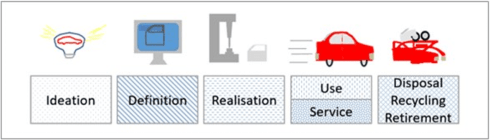
and created the PLM Grid to show how everything (products, applications, product data, processes, people, etc.) fits together in PLM.

From about 2012, I started giving a blended course, The Basics of PLM, with the PLM Institute in Geneva.

As for the passion, I see PLM as important for Mankind. The planet’s 7 billion inhabitants all rely on products of various types, and the great majority would benefit from faster, easier access to better products. So PLM is a win-win for us all.
That’s interesting. I also had a nice definition picture I used in my early days. x
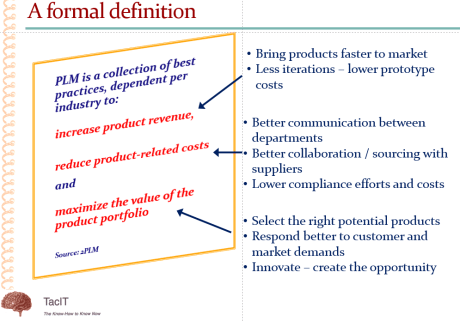
PI London 2011
and I had my view of the (disconnected) lifecycle.
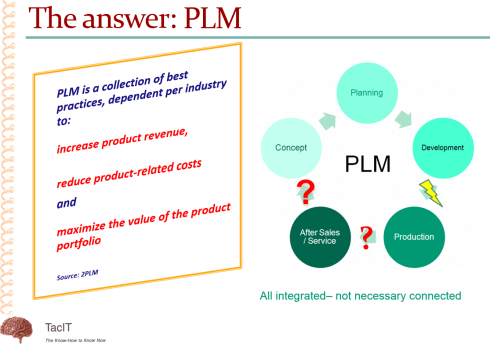
PI Apparel London 2014
The education journey
 John, as you have been active in PLM education for more than twenty years, do you feel that PLM Education and Training has changed.
 PLM has only existed for about twenty years. Initially, it was so new that there was just one approach to PLM education and training, but that’s changed a lot.
Now there are specific programs for each of the different types of people interested or involved with PLM. So, for example, now there are specific courses for students, PLM application vendor personnel, PLM Managers, PLM users, PLM system integrators, and so on. Each of these groups has a different need for knowledge and skills, so they need different courses.
 Another big change has been in the technologies used to support PLM Education and Training. Twenty years ago, the course was usually a deck of PowerPoint slides and an overhead projector. The students were in the same room as the instructor.
These days, courses are often online and use various educational apps to help course participants learn.
Who should be educated?
Having read several of your books, they are very structured and academic. Therefore, they will never be read by people at the C-level of an organization. Who are you targeting with your books, and why?
Initially, I wasn’t targeting anybody. I was just making my knowledge available. But as time went by, I found that my books were mainly used in further education and ongoing education courses.
So now, I focus on a readership of students in such organizations. For example, I’ve adapted some books to have 15 chapters to fit within a 15-week course.
 Students make up a good readership because they want to learn to pass their exams. In addition, and it’s a worldwide market, the books are used in courses in more than twenty countries. Also, these courses are sufficiently long, maybe 150 hours, for the students to learn in-depth about PLM. That’s not possible with the type of very short PLM training courses that many companies provide for their employees.
PLM education
Looking at publicly available PLM education, what do you think we can do better to get PLM out of the framing of an engineering solution and become a point of discussion at the C-level
Even today, PLM is discussed at C-level in some companies. But in general, the answer is to provide more education about PLM. Unfortunately, that will take time, as PLM remains very low profile for most people.
 For example, I’m not aware of a university with a Chair of Product Lifecycle Management. But then, PLM is only 20 years old, that’s very young.
It often takes two generations for new approaches and technologies to become widely accepted in the industry.
So another possibility would be for leading vendors of PLM applications to make the courses they offer about PLM available to a wider audience.
A career with PLM?
Educating students is a must, and like you and me, there are a lot of institutions that have specialized PLM courses. However, I also noticed a PLM expert at C-level in an organization is an exception; most of the time, people with a financial background get promoted. So, is PLM bad for your career?
No, people can have a good career in PLM, especially if they keep learning. There are many good master’s courses if they want to learn more outside the PLM area. I’ve seen people with a PLM background become a CIO or a CEO of a company with thousands of employees. And others who start their own companies, for example, PLM consulting or PLM training. And others become PLM Coaches.
PLM and Digital Transformation
A question I ask in every discussion. What is the impact of digital transformation on your area of expertise? In this case, how do you see PLM Education and Training looking in 2042, twenty years in the future?
I don’t see digital transformation really changing the concept of PLM over the next twenty years. In 2042, PLM will still be the business activity of managing a company’s products all the way across their lifecycles.
So, PLM isn’t going to disappear because of digital transformation.
 On the other hand, the technologies and techniques of PLM Education and Training are likely to change – just as they have over the last twenty years. And I would expect to see some Chairs of Product Lifecycle Management in universities, with more students learning about PLM. And better PLM training courses available in companies.
I see digital transformation making it possible to have an entire connected lifecycle without a lot of overhead.

Digital Transformation – platforms working together
Want to learn more?
My default closing question is always about giving the readers pointers to more relevant information. Maybe an overkill looking at your oeuvre as a writer. Still, the question is, where can readers from this blog learn more?
x
Three suggestions:
x
- Roger Tempest’s PLMIG
- The IFIP International Conference on Product Lifecycle Management
- Business Value of PLM Curriculum Webinar
What I learned
 By talking with John and learning his opinion, I see the academic approach to define PLM as a more scientific definition, creating a space for the PLM professional.
We had some Blog /LinkedIn interaction related to PLM: Should PLM become a Profession? In the past (2017).
When I search on LinkedIn, I find 87.000 persons with the “PLM Consultant” tag. From those, I know in my direct network, I am aware there is a great variety of skills these PLM Consultants have. However, I believe it is too late to establish the PLM Professional role definition.
 John’s focus is on providing students and others interested in PLM a broad fundamental knowledge to get into business. In their day-to-day jobs, these people will benefit from knowing the bigger context and understanding the complexity of PLM.
This is also illustrated in Product2019, where the focus is on the experience – company culture and politics.
Due to the diversity of PLM, we will never be able to define the PLM professional job role compared to the Configuration Manager. Two disciplines are crucial and needed for a sustainable, profitable enterprise.
Conclusion
In this post, we explored a third dimension of PLM Education, focusing on a foundational approach, targeting in particular students to get educated on all the aspects of PLM. John is not the only publisher of educational books. I have several others in my network who have described PLM in their wording and often in their language. Unfortunately, there is no central point of reference, and I believe we are too late for that due to the tremendous variety in PLM.
Next week I will talk with a Learning & Development leader from a company providing PLM consultancy – let’s learn how they enable their employees to support their customers.
 Jos Voskuil's Weblog
Interesting reflection, Jos. In my experience, the situation you describe is very recognizable. At the company where I work, sustainability…
[…] (The following post from PLM Green Global Alliance cofounder Jos Voskuil first appeared in his European PLM-focused blog HERE.) […]
[…] recent discussions in the PLM ecosystem, including PSC Transition Technologies (EcoPLM), CIMPA PLM services (LCA), and the Design for…
Jos, all interesting and relevant. There are additional elements to be mentioned and Ontologies seem to be one of the…
Jos, as usual, you've provided a buffet of "food for thought". Where do you see AI being trained by a…