
You are currently browsing the category archive for the ‘Change’ category.
 Last week I listened to a Dutch podcast that gave me an unexpected inspiration. The podcast “Zo Simpel is het Niet” (“It is not that simple “in English) is a podcast with a focus on economic topics and trends, not at all about PLM, sometimes a little about the effects of digital transformation and AI is more and more mentioned.
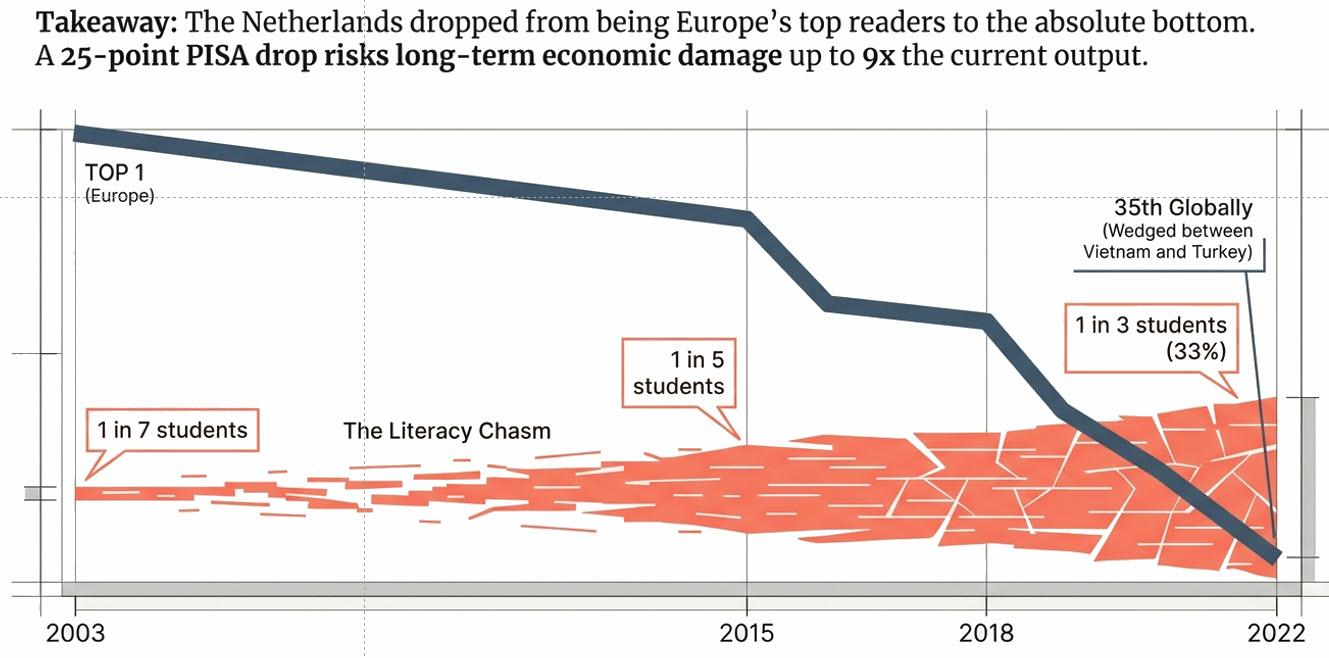
The episode I listened to was about the decline of literacy in the Netherlands. The conclusion is based on research discussed from the PISA test from the OECD. Learn more about the OECD and PISA test here on this Wiki page.
I asked Notebook LM to make an English slide deck from the podcast – You can download the deck HERE.
The conclusion: We are in a free fall in the Netherlands (image below) and likely in other countries too, because we are reading less, writing less, and consequently thinking less deeply.
Social media was identified as one of the root causes. Short-form content, the endless scroll, the dopamine loop of likes and shares — it is all rewiring how we process information – short-term, quick results without building deeper skills.
 And then the connection between social media and the drop in literacy and science skills hit me. We are doing the same thing at the moment with AI!
Third Way of Thinking
 In my posts, I sometimes refer to Daniel Kahneman’s book and his research: Thinking Fast and Slow, as this is for me a foundational theory for understanding human behavior.
Kahneman describes our brain as a combination of System 1, which is the fast, intuitive brain (low energy), and System 2, which is the slow, deliberative one (burns energy). As humans, we avoid using energy when thinking, although nowadays, outside our brains, we are hooked to fossil energy 😉.
Next, I read a research from Steven Shaw and Gideon Nave, from The Wharton School of the University of Pennsylvania, that indicated that AI is going to have an additional impact on our behavior as humanity.
Their paper Thinking—Fast, Slow, and Artificial: How AI is Reshaping Human Reasoning and the Rise of Cognitive Surrender introduces System 3 as artificial cognition. External, automated, data-driven reasoning that lives not in your brain but in the cloud.
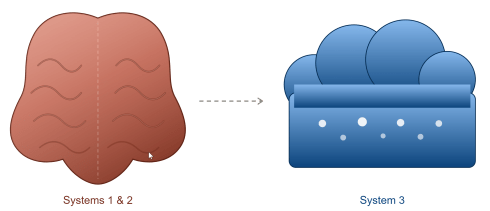
 Their central finding is something they call “cognitive surrender” – access to AI made people more confident, regardless of whether the AI was right or wrong. An enforcement of the Dunning-Kruger effect?
The most vulnerable are people with higher trust in AI, lower need for cognition, and lower fluid intelligence, who showed the greatest cognitive surrender. The least critical thinkers delegate most, and then feel most certain about the result.
Benedict Smith, my True Intelligence friend, pointed to the same pattern in his post: When the Graph talks back. Read it and think!

Both their conclusions made me even more worried, combined with the results of the Dutch literacy developments – are we all racing downhill?
 I believe our brain is a muscle. Like any muscle, it needs resistance to stay strong. You do not become a better cyclist by riding an eBike everywhere — the motor does the work, and your legs lose the real strength needed when you are without your bike. The same applies to cognitive effort.
We Have Been Here Before
 It is not the first time a transformative technology arrived with enormous promise and created a deeply unequal outcome. The Industrial Revolution reduced most workers to resources while a few became extraordinarily wealthy.
John D. Rockefeller (oil & railroad industries), Andrew Carnegie (steel industry), J.P. Morgan (financing the new industries) and Cornelius Vanderbilt (shipping and railroads) as examples.
These industry leaders did not care so much about humans, and it took roughly a hundred years — and the rise of labour unions — to begin correcting that imbalance.
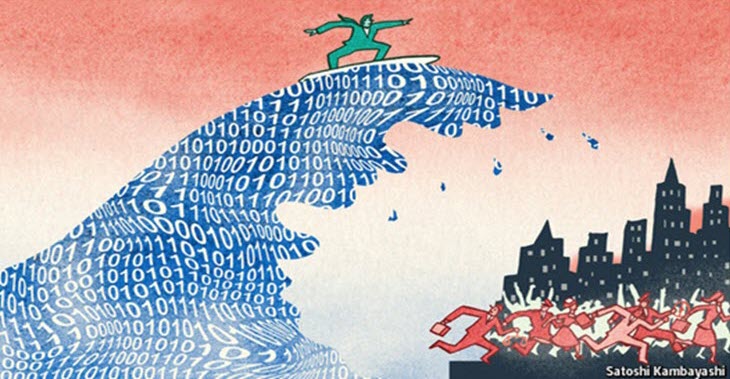 The AI revolution is moving much faster! And if history teaches us anything, it is that working more efficiently with new tools does not automatically raise your value. The more companies invest in AI solutions, the more pressure there will be to develop your individual skills.
Efficiency without insight is a commodity.
 My friend Helena Guitierrez wrote this weekend this supporting post: Preparing for AI Adoption
What does it mean for Product Lifecycle Management?
Purposefully, I wrote Product Lifecycle Management to focus on the strategy, and not an all-around capable PLM system, as PLM systems have never quite delivered on their original promise.
 The PLM vendors benefited from selling the dream, the consultants benefited from its complexity and the users, initially engineers and later more stakeholders in the product lifecycle, often suffered under rigid processes and complex systems. As the systems were designed to store information. User-friendlyness was not a priority.
Will AI, being layered on top of PLM and other enterprise systems, be the solution for these underperforming systems?
Oleg Shilovitsky believes in that, as you can read in his recent post: PLM’s OpenClaw Moment: How AI Agents Will Break Closed Systems
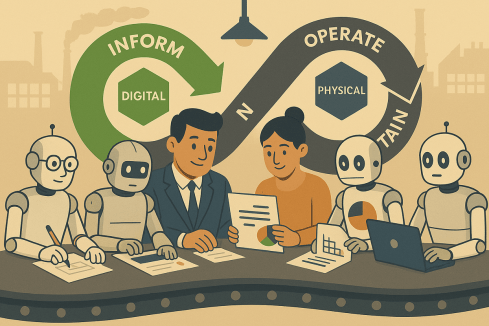
The risk is that we repeat the same pattern. AI will be positioned as the solution to problems actually caused by poor implementation and insufficient investment in the human side of change.
There is an interesting discussion ongoing about the future of PLM infrastructures, well described recently by Rainer Mewaldt in his post: What would a 𝗣𝗟𝗠 𝘀𝘆𝘀𝘁𝗲𝗺 look like if it were 𝗱𝗲𝘀𝗶𝗴𝗻𝗲𝗱 𝗳𝗼𝗿 𝗔𝗜 𝗳𝗿𝗼𝗺 𝘁𝗵𝗲 𝗴𝗿𝗼𝘂𝗻𝗱 𝘂𝗽?
The principles are there, like 10 years ago, before AI became hyped, when we discussed digital transformation as moving from a coordinated infrastructure to a coordinated and connected infrastructure, with a mix of Systems of Record and Systems of Engagement.
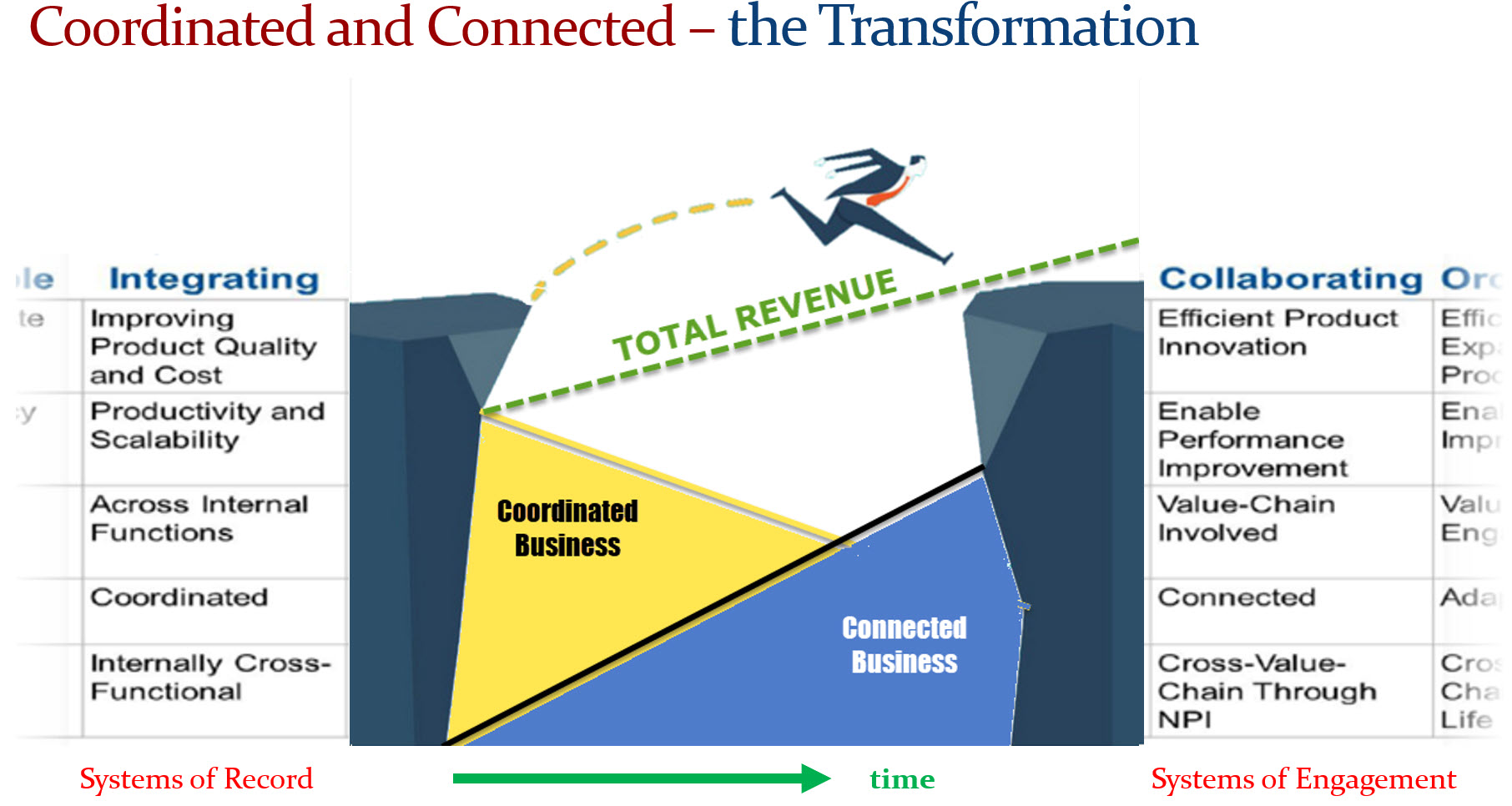
I have not seen much progress with the customers I have been working with in the past five to ten years. The change did not seriously happen due to the need for new ways of working, different people skills and organizational change.
Will it happen now with the AI-wave? A question Ilan Madjar also asked this weekend.
What should we – companies and individuals – actually do?
As an approach, the res earch from Wharton suggests that using rewards (incentives) and providing feedback can help people stay mentally engaged and avoid disengaging or losing motivation.
In other words, these strategies can combat the tendency to mentally “check out” or stop trying.
When participants were rewarded for accuracy and received immediate feedback, their override rates on faulty AI roughly doubled.
This observation means we should design AI-assisted workflows so that people remain accountable for outcomes and receive clear feedback when AI-assisted decisions go wrong. Work to do for startups and existing PLM vendors to develop the best combination of agents and content.
BUT: do not let the AI absorb the accountability while the human takes the credit – System 3!
Companies are in an uncomfortable situation. Before AI became the focus for improving businesses, the most heard statement was:
“Our employees are our assets – they create the value of our company,”
And this is one of the reasons that HR departments exist. Although not all HR departments are there for the employees – their role is to balance the HUMAN RESOURCES in a company – we are still talking about resources.
With AI, the new statement might be
“Our AI-supported employees are our assets, where part of the asset value comes from the AI tools used”.
This raises the question of who will remain as the AI-supported employee. We already see that entry-level jobs in any type of business get replaced by AI, creating stress on the job market. This, combined with the observed reduced mastery of deep-skills in math, reading and science, as described in the PISA research earlier shared in this post, puts a generation at risk.
Like the winners of the Industrial Revolution, the winners of the AI revolution do not care about humans – they care about profits.
 As individuals, we need to keep on training our brain-muscles without AI where the muscle matters. As the Dutch podcast mentioned: write your first draft before asking Claude to improve it, think through a problem before asking ChatGPT to solve it, and read a book of 100 pages.
In PLM, judgment and contextual reasoning are the core of what people need to do. You should protect the practice of doing that work yourself. Use AI to accelerate and refine, not to replace the effort that builds competence.
Invest in yourself to remain independent. Read broadly — actually read, not skim AI summaries. The people who will remain valuable in an AI-saturated world are not the ones who prompt best, but the ones who can evaluate, challenge, and contextualise what AI produces.
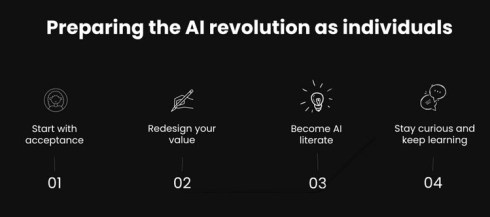
And with that, I want to come back to the post from Helena Guitierrez that I mentioned before, where she focused on what we can do as individuals.
 Helena is one of the founders of Share PLM, a company with the purpose: BUILDING A HUMAN-CENTERED DIGITAL FUTURE, as is written on their website. We both believe that in order to enjoy the AI revolution, we have to invest in ourselves. The above image illustrates steps to take- click on the image for the full post.
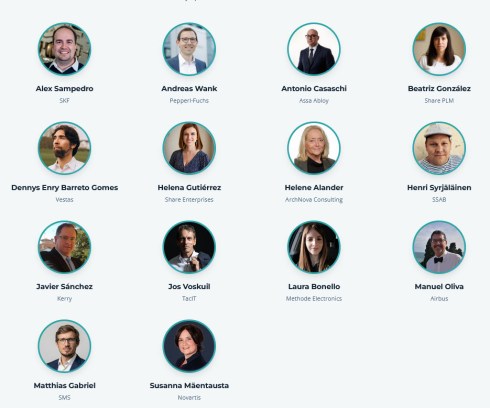
Talking about the human-centered digital future, have a look at the agenda of the upcoming Share PLM Summit on 19-20 May in Jerez de la Frontera (Spain) – our sessions and discussions will, of course, be based on PLM and AI experiences, with the focus on what it means for humans – it will not be a technology conference.
Conclusion
The Wharton researchers close with a question worth “What happens when our judgments are shaped by minds not our own?” Their answer so far: we become more confident, less accurate when the AI is wrong, and largely unaware of the difference – a big risk.
The challenge is not artificial intelligence. The challenge is whether we will remain genuinely intelligent in the presence of it – take care of yourself!
What do you think? I am looking forward to your comments and feedback.
Recently, I have been reading some interesting posts beyond all the technical discussions related to PLM and AI. Is PLM becoming obsolete? Are we heading to a new type of infrastructure based on MCP agents? Are these agents an example of new ways of collaboration?
Collaboration – it pops up everywhere!

Here is a quote from the article that triggered me:
The 𝐧𝐮𝐦𝐛𝐞𝐫 𝐨𝐧𝐞 𝐫𝐞𝐚𝐬𝐨𝐧 organizations deploy MBSE is not simulation or architecture development. It is 𝐞𝐧𝐡𝐚𝐧𝐜𝐞𝐝 𝐜𝐨𝐥𝐥𝐚𝐛𝐨𝐫𝐚𝐭𝐢𝐨𝐧 𝐚𝐧𝐝 𝐜𝐨𝐦𝐦𝐮𝐧𝐢𝐜𝐚𝐭𝐢𝐨𝐧 — at 67%. But here is the uncomfortable part.
Only 24% reported actually achieving collaboration as a business outcome. That is a 43-point gap between intent and result. Traceability is even worse — 48% deploy MBSE for it, 9% say they have realized it.
What if the problem is not that MBSE fails to deliver collaboration — but that most organizations 𝐧𝐞𝐯𝐞𝐫 𝐝𝐞𝐟𝐢𝐧𝐞 𝐰𝐡𝐚𝐭 𝐛𝐞𝐭𝐭𝐞𝐫 𝐜𝐨𝐥𝐥𝐚𝐛𝐨𝐫𝐚𝐭𝐢𝐨𝐧 𝐥𝐨𝐨𝐤𝐬 𝐥𝐢𝐤𝐞 in measurable terms?
Chad Jackson’s article aligns with many other discussions I had with companies related to PLM (and MBSE) – itinspired me to focus this time on collaboration.
How do we measure collaboration?
 My 2015 blog post has the same title: How do you measure collaboration? The post was written at a time when PLM collaboration had to compete with ERP execution stories. Often, engineering collaboration was considered an inefficient process to be fixed in the future, according to some ERP vendors.
 ERP always had a strong voice at the management level—boxes on an org chart, reporting lines, clear ownership and KPIs flowing upward. You could see how the company was performing.
From the management side, accountability flows downward. The architecture of the organization mirrors the architecture of the product, and the architecture of the product mirrors the architecture of the organization.
We have known this for decades; it is Conway’s Law. Yet we are still surprised when silos emerge exactly where we designed them.
The Management Dilemma
 In many of my engagements, the company’s management often struggles to understand the value of collaboration because there is no direct line between collaboration and immediate performance. Revenue can be measured. Cycle times can be measured. Defects can be measured. Even employee turnover can be measured.
But collaboration? What is the KPI?
It is a fair question. If something cannot be quantified, it becomes subjective and depends on gut feelings. And if it cannot be tied directly to quarterly results, it often becomes optional.
 The problem is not that collaboration has no impact on performance – look at the introduction of email in companies. Did your company make a business case for that?
Still, it improved collaboration a lot, and sometimes it became a burden with all the CC-messages and epistles exchanged.
Collaboration has an impact, deeply and systematically. But its impact is indirect, delayed, and distributed. It reduces friction, can improve shared understanding and prevent expensive rework.
 The return on investment on collaboration is real, but it does not show up as a clean, linear metric.
For a hierarchical and linearly structured organization, horizontal collaboration is often hard to “sell.”
Back to Conway’s Law
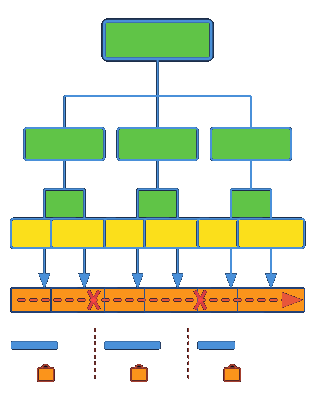 Organizational structure shapes communication patterns. Communication patterns shape systems.
If your organization is vertical, your product will be vertical. If your incentives are local, your decisions will be local. If your teams are isolated, your solutions will be fragmented.
You cannot expect horizontal behavior from a vertically optimized structure without friction.
Disconnected collaboration initiatives fail because they try to overlay horizontal tools on top of vertical incentives.
Attempts like a new collaboration platform or using shared workspace technology to incentivize collaboration are examples of this approach.
But the underlying structure remains untouched. People are still measured on local performance. Budgets are still allocated per department. Promotions still reward vertical success.
First question to ask in your company: Who is responsible for your PLM/collaboration infrastructure for non-transactional information?
Most likely, it is in the IT or Engineering silo, rarely on a higher organizational level.
And then we are surprised when collaboration stalls?
The Myth of the Tool
Whenever collaboration becomes a pain, people look for IT tools as a cure.
 “We need better platforms.”
“We need integrated systems.”
and now:
“We need AI – the AI agents will do the collaboration for us.”
Tools matter, but they are amplifiers. They amplify existing behavior. They do not create it. While finalizing this article, I saw this post from Dr. Sebastian Wernicke coming in, containing this quote:
Agents are software. Maturity is culture. And culture, inconveniently, doesn’t come with an install package.
If trust is low, a collaboration platform becomes a battlefield. If incentives are misaligned, shared dashboards become weapons. If fear dominates, transparency becomes a threat.
Collaboration is not a software problem. It is a human problem. Which brings us to something that is rarely discussed in boardrooms: the intrinsic motivation of its employees.
The Limbic Brain Is Always There
Beneath the rational layer of strategy and planning sits something older: the limbic system. The part of us that cares about belonging, safety, recognition, autonomy, and purpose.
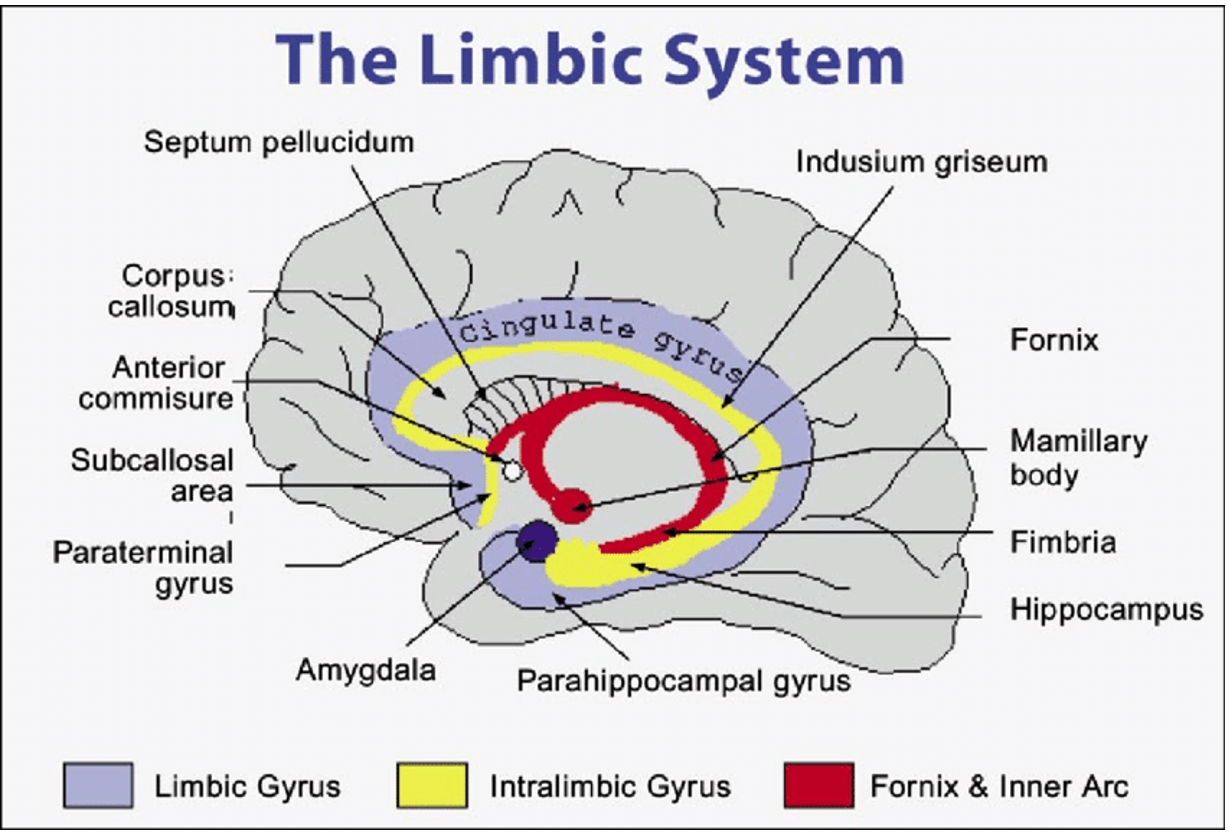
Collaboration thrives when the limbic brain’s needs are met. It collapses when they are threatened.
- If people feel unsafe, they protect information!
- If they feel undervalued, they withdraw effort!
- If they feel controlled, they resist alignment!
You cannot mandate collaboration if the emotional system of the organization is defensive.
The question is not “How do we force collaboration?”
The question is “How do we create conditions where collaboration feels natural?”
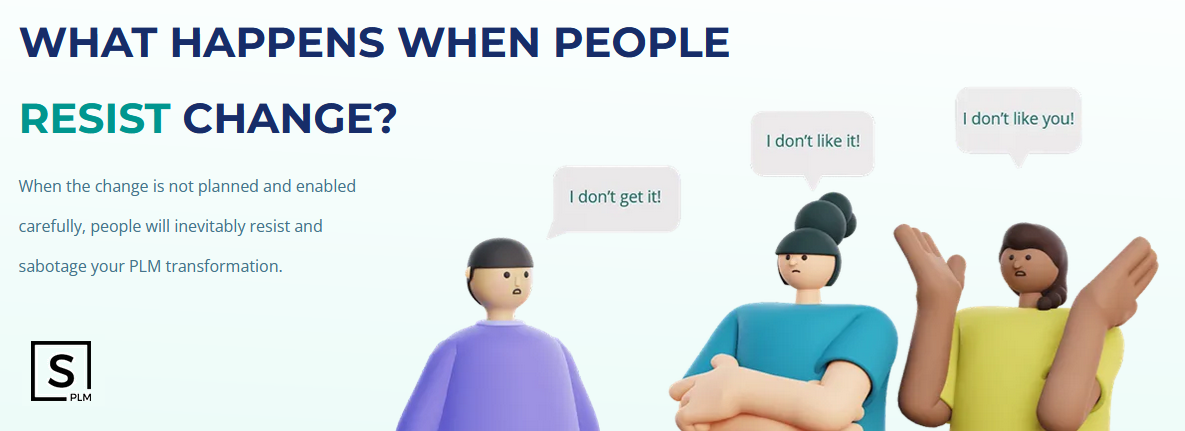
And that requires leaders to connect to the human, not just to the role or an artificial intelligence solution. They should be inspired by this iconic image from Share PLM:
Besides a difficult-to-quantify ROI, there is another reason why collaboration struggles to gain executive traction: it rarely creates immediate success.
It prevents future failure, and we humans in general do not prioritize prevention, thinking of our environmental, financial and potential even health behavior. Where prevention has the lowest cost, most of the time, fixing the damage lies in our nature.
 For companies, it is easier to celebrate the hero who fixes a late-stage integration disaster than the quiet team that prevented it months earlier through cross-functional dialogue.
For me, the firefighters are the biggest challenge to successfully implementing a PLM infrastructure. The image to the left comes from a 2014 presentation when discussing potential resistance to a successful PLM implementation.
In vertical systems, firefighting is visible. Prevention is silent and therefore collaboration activities feel like a cost center rather than a strategic lever.
Where to Push, Where to Invest?
 If you cannot directly measure collaboration, where should you push? Not in tools alone, slogans or one-off workshops. Invest in shared experiences.
When people meet outside their vertical silos, something subtle shifts. They see faces instead of functions. They understand constraints instead of assuming incompetence. They replace narratives with conversations.
 Note: shared experiences are not the same as planned online webmeetings that became popular during and after COVID. They have a rigid regime of collaboration enforcement, back-to-back in many companies, most of the time lacking the typical “coffee machine” experiences.
Also, when looking at events where people share experiences, there is a difference between a traditional vertical PLM/CM/IT/ERP conference where specialists focus on one discipline and on the other side, a human-centric conference, where humans share their experiences in an organization.
The Share PLM Summit in May last year was an eye-opener for me. Starting from the human perspective brought a lot of energy and willingness to discuss various insights – collaboration at its best.
Events, summits, workshops—when done well—create human connection. They remind participants that behind every deliverable sits a person trying to do meaningful work.
The focus on the human perspective is not soft. It is strategic because collaboration is not primarily about information exchange. It is about relationship quality and trust.
The Real Question
 The question is not whether collaboration is valuable. The question is whether we are willing to adjust our vertical incentives to make it possible.
Because collaboration is not free, it requires time. It requires emotional energy. It requires psychological safety. It sometimes requires giving up local control for global benefit.
In systems terms, it requires shifting from local optimization to whole-system optimization.
That is uncomfortable.
But if our products are complex, interconnected, and rapidly evolving—as most are today—then vertical thinking alone is no longer sufficient. The world has become horizontal, even if our org charts have not.
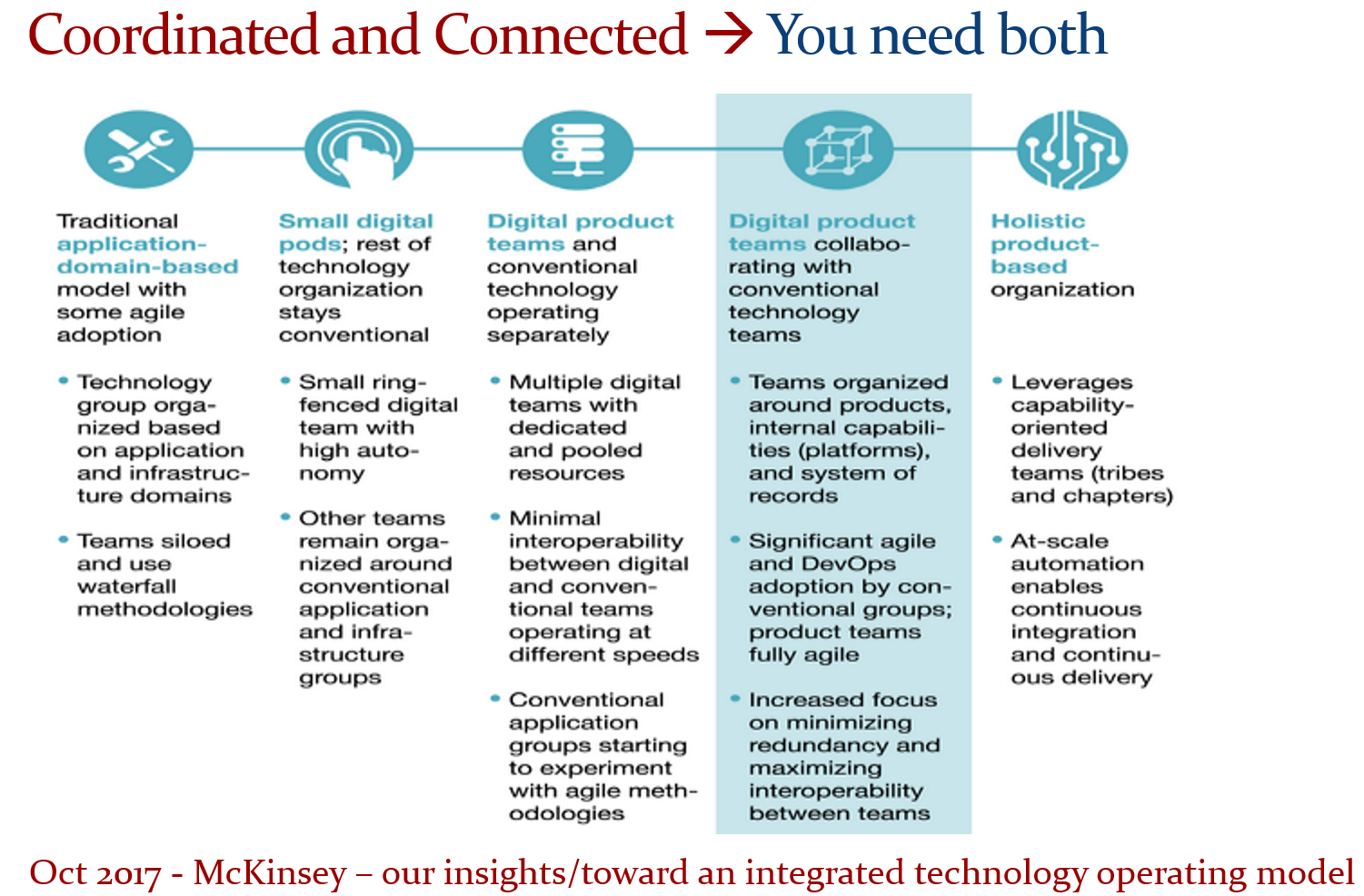
And perhaps the real challenge is not how to measure collaboration, but how to design organizations where collaboration is no longer something we need to sell at all. An article from McKinsey might inspire you here for this transition – for me, it did: Toward an integrated technology operating model.
Beyond AI
While everyone talks and writes about AI, I do not believe AI will solve the collaboration issue. For sure, AI collaboration with agents will increase personal and organizational effectiveness, but it never touches our limbic brain, the irreplaceable part that makes us typical humans and unique.
There will always be a need for that, unless we become numb and addicted to the AI environments. There are various studies popping up on how AI “untrains” our brain muscles, reduces patience and deep thinking. Finding a new human balance is crucial.
Conclusion
Triggered by Chad Jackson’s post about MBSE and collaboration, I took the time to deep-dive into the aspects of collaboration in the PLM domain. How do you manage collaboration?
Come and share your experiences at the upcoming Share PLM 2026 summit from 19-20 May in Jerez. The title of my keynote: Are Humans Still Resources? Agentic AI and the Future of Work and PLM.
 This blog post is especially written for our PLM Global Green Alliance LinkedIn members — a message from a “boomer” to the next generation of PLM enthusiasts.
If you belong to that next generation, please read until the end and share your thoughts.
With last week’s announcement from the US government, no longer treating greenhouse gas emissions as a threat to the planet or climate.
We see a push to remove regulations that limit companies from continuing or expanding business without considering the broader consequences for other countries and future generations.
It feels like a short-term, greedy decision, largely influenced by those who benefit from fossil-carbon economies. Decisions like this make the energy transition harder, because the path of least resistance is always the easiest to follow.
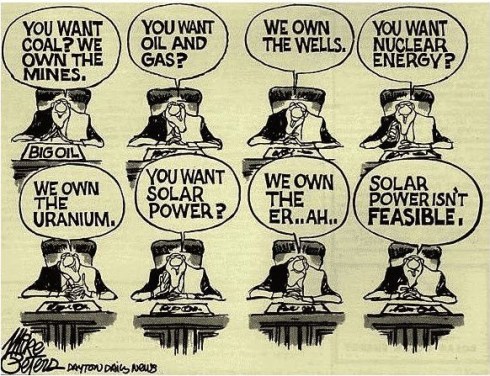
Transitions are never simple. But when science is ignored, data is removed, and opinions replace facts, we are no longer supporting a transition — we are actively working against it.
My Story
 When I started working in the PLM domain in 1999, climate change already existed in the background of society. The 1972 Limits to Growth report by the Club of Rome had created waves long before, encouraging some people to rethink business and lifestyle choices.
For me, however, it stayed outside my daily focus. I was at the beginning of my career, excited about the new challenges.
And important to notice that connecting to the internet with a 28k modem was the standard, a world without social media constantly reminding us of global issues.
 I enjoyed my role as the “Flying Dutchman,” travelling around the world to support PLM implementations and discussions. Flying was simply part of the job. Real communication meant being in the same room; early phone and video calls were expensive, awkward, and often ineffective. PLM was — and still is — a human business.
Back then, the effects of carbon emissions and global warming felt distant, almost abstract. Only around 2014 did the conversation become more mainstream for me, helped by social media, before algorithms and bots began driving polarization.
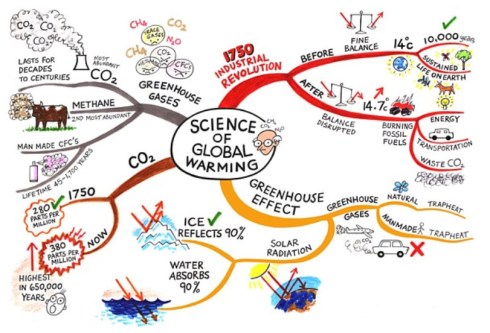
In 2015, while writing about PLM and global warming, I realized something that still resonates today: even when we understand change is needed, we often stick to familiar habits, because investments in the future rarely deliver immediate ROI for ourselves or our shareholders.
The PLM Green Global Alliance

When Rich McFall approached me in 2019 with the idea of creating an alliance where people and companies could share ideas and experiences around sustainability in the PLM domain, I was immediately interested — for two reasons.
- First, there was a certain sense of responsibility related to my past activities as the Flying Dutchman. Not guilt — life is about learning and gaining insight — but awareness that I needed to change, even if the past could not be changed.
- Second, and more importantly, the PLM Green Global Alliance offered a way to contribute. It gave me a reason to act — for personal peace of mind and for future generations. Not only for my children or grandchildren, but for all those who will share this planet with them.
In the first years of the PGGA, we saw strong engagement from younger professionals. Over time, however, we noticed that career priorities often came first — which is understandable.
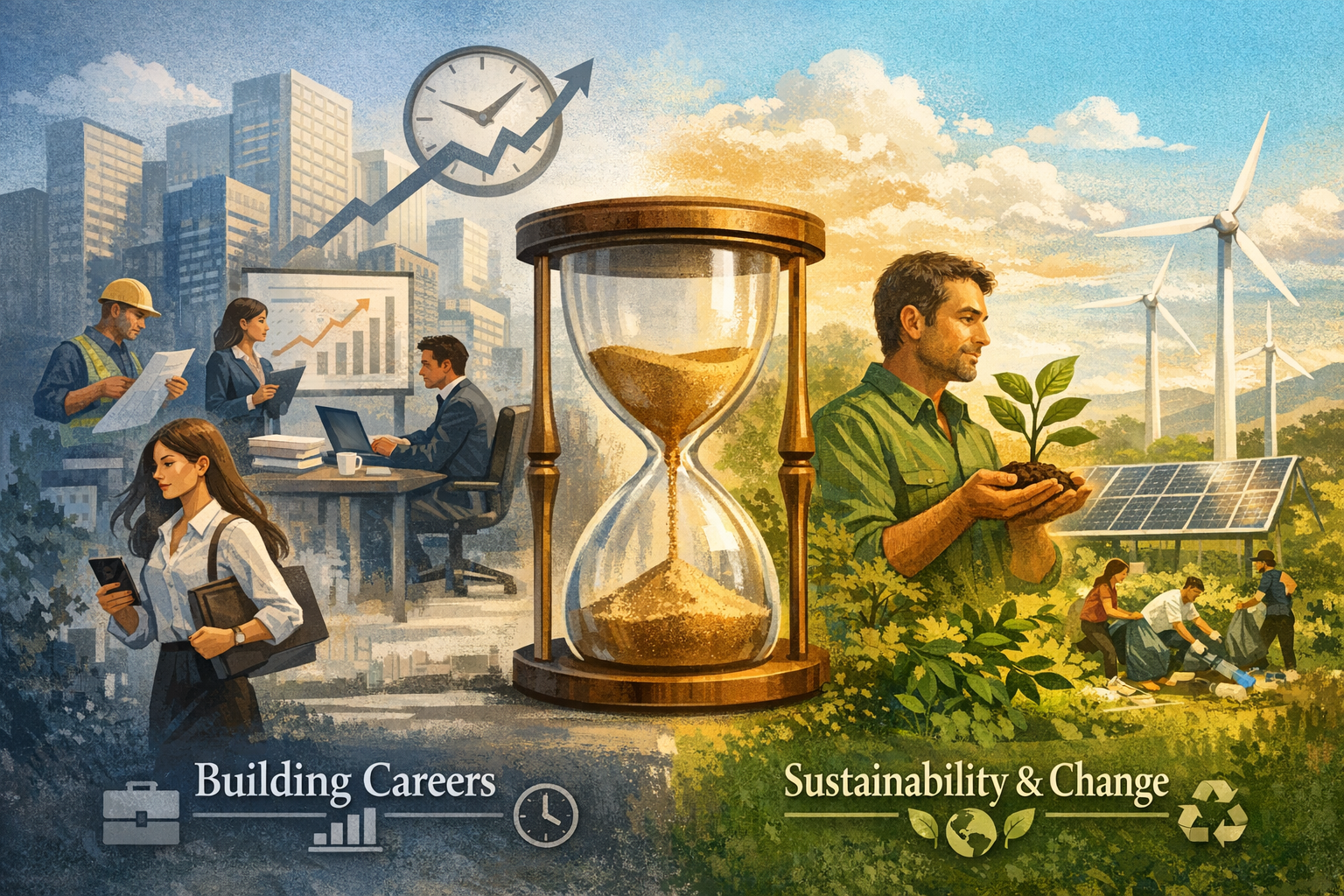
Like me at the start of my career, many focus first on building their future. Career and sustainability can coexist, but investing extra time in long-term change is not easy when daily responsibilities already demand so much.
Your Chance to Work on the Future
 The real challenge lies with those willing to go the extra mile — staying focused on today’s business while also investing energy in the long-term future.
At the same time, I understand that not everyone is in a position to speak out or dedicate time to sustainability initiatives. Circumstances differ. For many, current responsibilities leave little space for additional commitments.
Still, for those willing to join us, we have two requests to better understand your expectations.
Two weeks ago, I connected with our 40 newest members of the PLM Green Global Alliance. We are now close to 1,600 members — up from around 1,500 in September 2025, as mentioned in Working on the Long Term.
That post was a gentle call to action. Seeing our PGGA membership continue to grow is encouraging — and naturally raises a question:
1. What motivates people to join the PGGA LinkedIn group?
So far, only a small number of the recent new members have completed a survey that was especially sent to them to explore changing priorities. Due to the low response, we extended the invitation to all members. We are curious about your expectations — and quietly hopeful about your involvement.
If you haven’t filled in the survey yet, please click here and share your feedback. The survey is anonymous unless you choose to leave your details for follow-up. We will share the results in approximately 2 weeks from now.
2. Design for Sustainability – your contribution?
Last year, Erik Rieger and Matthew Sullivan launched a new workgroup within the PLM Green Global Alliance focused on Design for Sustainability. While the initial energy was strong, changes in personal priorities meant the team could not continue at the pace they hoped. Since many new members have joined since last May, we decided to relaunch the initiative.
If you are interested in contributing to the revival of Design for Sustainability, please take five minutes to complete the short survey. Your input will help shape the direction of the DfS working group and frame future discussions.
Note: If you are worried about clicking on the links for the survey, you can always contact us directly (in private) to share your ambition
Conclusion
The outside world often pushes us to focus only on daily business. In some places, there is even active pressure to avoid long-term sustainability investments. Remember that pressure often comes from those invested in keeping the current system unchanged.
If you care about the future — your generation and those that follow — stay engaged. Small actions by millions of people can create meaningful change.
We look forward to your input and participation.
— says the boomer who still cares 😉

 December is the last month when daylight is getting shorter in the Netherlands, and with the end of the year approaching, this is the time to reflect on 2025.
For me, it has been an interesting year, and I hope it has been similar for you. I started 2025 with this post: My 2025 focus, sharing the topics that would drive my primary intentions—a quick walk through some of these topics and what to reflect on what I have learned.
Fewer blog posts
 It was already clear that AI-generated content was going to drown the blogging space. The result: Original content became less and less visible, and a self-reinforcing amount of general messages reduced further excitement.
As I have no commercial drive to be visible, I will continue to write posts only when relevant to personal situations or ideas, with the intention of being shared and discussed with the readers of my posts – approximate 26 / year.
 Therefore, if you are still interested in content that has not been generated with AI, I recommend subscribing to my blog and interacting directly with me through the comments, either on LinkedIn or via a direct message.
More podcast recordings
 Together with the Share PLM podcast team, Beatriz Gonzales and Maria Morris, we enjoyed talking with a large variety of people active in PLM, all having their personal stories related to PLM to share—each episode ending with an experience to share and a desired takeaway for the listeners. We did it with great pleasure and learned from each episode.
You can find all the recordings from 2025 (Season 3) here.
In Season 4, we want to add the C-level perspective to our PLM and People podcast discussions.
#DataCentric or #PeopleCentric ?
 It was PeopleCentric first at the beginning of the year, with the Share PLM Summit in Jerez and DataCentric in the second half of the year, with activities connected to the PLM Roadmap/PDT Europe conference in Paris.
In case you missed the excitement and lessons learned, here they are:
- The weekend after the Share PLM Summit 2025
- A week after Shaping the Future of PLM – No time to lose!
- A very long week after PLM Roadmap / PDT Europe 2025
Both topics will become even more critical due to the impact of AI tools on our day-to-day work.
Sustainability?
 Already an uncomfortable term for some of us at the beginning of 2025, it has become one of the best-kept secrets of 2025. Where traditional countries and companies revert to their short-term bad habits – optimize shareholders value, there are also forward-looking enterprises that are actively rephrasing their sustainable strategies as risk mitigation strategies with the awareness that adaptation is inevitable. Better start early than too late – not a typical human strategy.
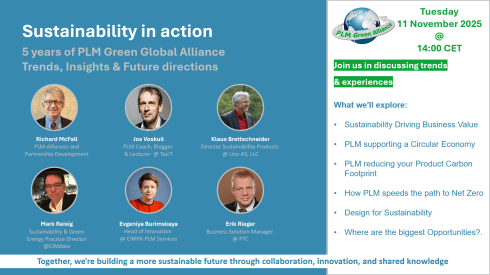
In case you are interested, I recommend you read and listen to:
And now it is time to discuss AI.
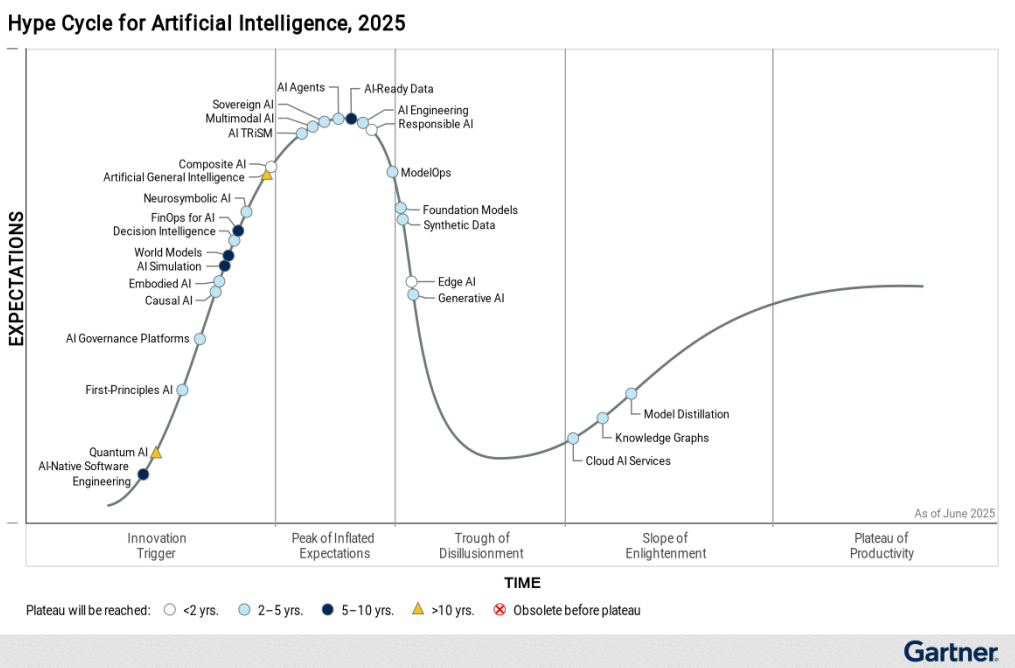 With all the investments and marketing related to AI, it is unavoidable to neglect it. For sure, it is a hype, but I believe that we are into something revolutionary for society, like the impact of the industrial revolution on our society 150 years ago.
However, there are also the same symptoms of the .com-hype 25 years ago.
 Who are going to be the winners? Currently, the hardware, datacenter and energy providers, not the AI-solution providers. But this can change.
Let’s look into some of the potential benefits.
Individual efficiency?
 Many of the current AI tools allow individuals to perform better at first sight. Suddenly, someone who could not write understandable (email) messages, draw images or create structured presentations now has a better connection with others—the question to ask is whether these improved efficiencies will also result in business benefits for an organization.
 Looking back at the introduction of email with Lotus Notes, for example, email repositories became information siloes and did not really improve the intellectual behavior of people.
Later, Microsoft took over the dominant role as the office software provider with enhanced search and storage capabilities, but still, most of the individual knowledge remained hidden or inaccurate as it missed the proper context.
 As a result of this, some companies tried to reduce the usage of individual emails and work more and more in communities with a specific context. Also, due to COVID and improved connectivity, this led to the success of Teams. And now with Copilot embedded in the Microsoft suite, I am curious to learn what companies perceive as measurable business benefits.
The chatbot?
 For many companies, the chatbot is a way to reduce the number of people active in customer relations, either sales or services. I believe that, combined with the usage of LLMs, an improvement in customer service can be achieved. Or at least the perception, as so far I do not recall any interaction with a chatbot to be specific enough to solve my problem.
The risks with AI?
 Now I may sound like a boomer who started focusing on knowledge management 25 years ago – exploring tacit knowledge.
Tacit knowledge is the knowledge a real expert has by combining different areas of expertise and understanding what makes sense.
Could tacit knowledge be replaced by an external model that gives you all the (correct?) answers?
In verifiable situations, we know when the model is hallucinating – but what if the scope is beyond our understanding? Would we still rely on AI, and could AI be manipulated in ways that we lose touch with the real facts?
Already, the first research papers are coming out warning of reduced human cognitive performance, e.g., this paper: Beware of Metacognitive Laziness: Effects of Generative Artificial Intelligence on Learning, Motivation, Processes, and Performance.
Combined with laziness (a typical human behavior – system 1), these results made me think of a statement made by Sean Illing:
“People love the truth, but they hate facts.”
A statement highly relevant to what we see happening now with social media – we do not think or research deep enough anymore, we select the facts that we like and consider them our truth.
What happens in our PLM domain?
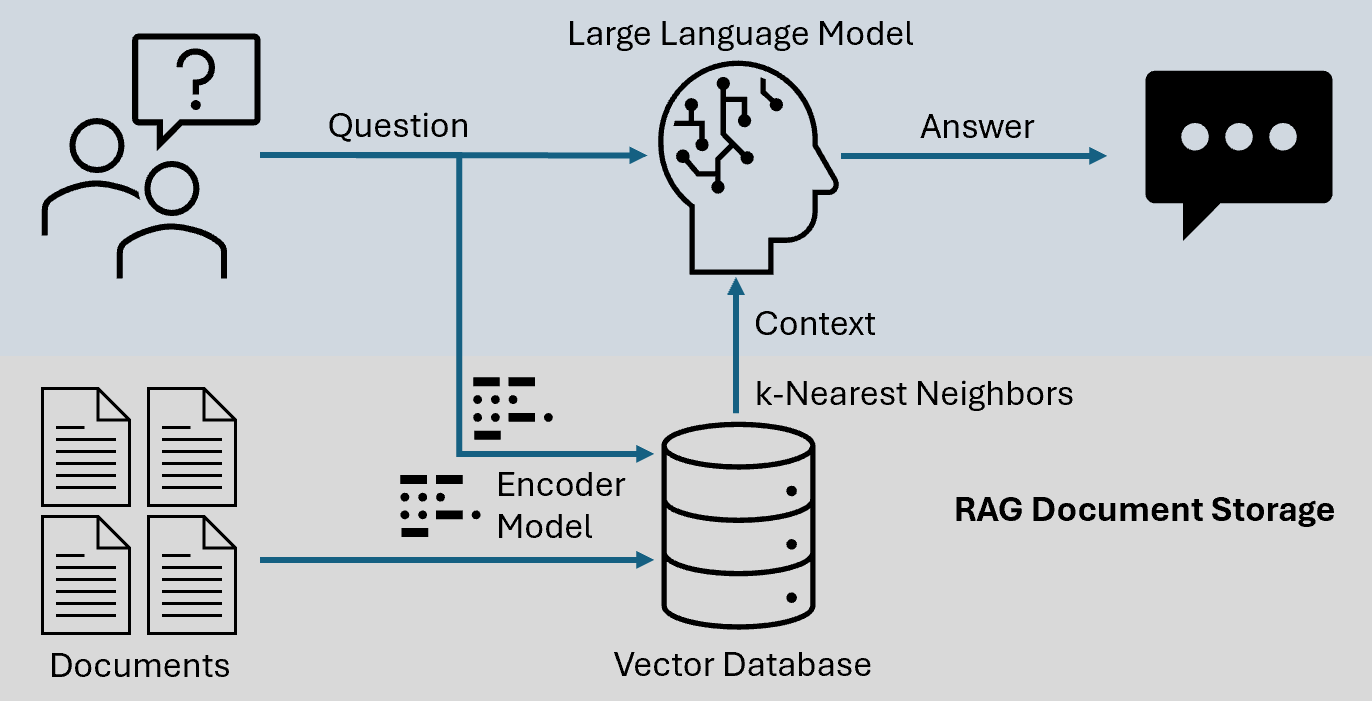 In the PLM domain, companies are indeed reluctant to use LLMs directly, where some of them use RAG (Retrieval-Augmented Generation) to feed the LLM with a relevant context.
Still, the answers require human interpretation, as you cannot avoid hallucinations in your product lifecycle management processes.
As long as the results are based on inconsistent data sources that lack the relevant context, the answers are of low quality.
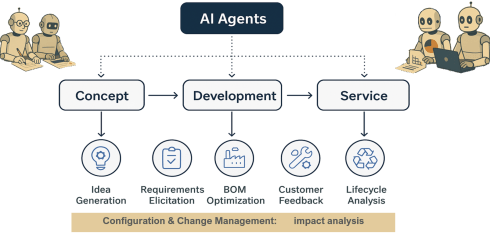
Meanwhile, every vendor in the PLM space is now offering AI-agents, most of the time within their own portfolio space. The ultimate dream is polygot agents (who are buying them / who are developing them) that can work together and create a new type of agility beyond traditional workflows. An interesting article in this context comes from Oleg Shilovitsky: Why Does PLM Need Task Re-Engineering Before It Can Have AI?
Still, these potential “quick” fixes create a risk for companies in the long term. Buying AI tools does not fix the foundation that is based on legacy.
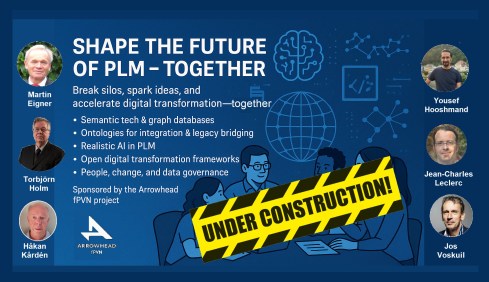
In particular, related to the Shape the Future of PLM – Together workshop in Paris on Nov 4th, the consensus was that companies need to invest in understanding and implementing domain-specific ontologies and semantic models to provide a data-driven infrastructure that allows AI to make accurate decisions or valid recommendations.
You can read the summary of the event and recommendations here: Accelerating the Future of PLM & ALM on the ArrowHead’s website.
You can also read this post from Ole Olesen-Bagneux: Why will 2026 be the year of the ontologist?
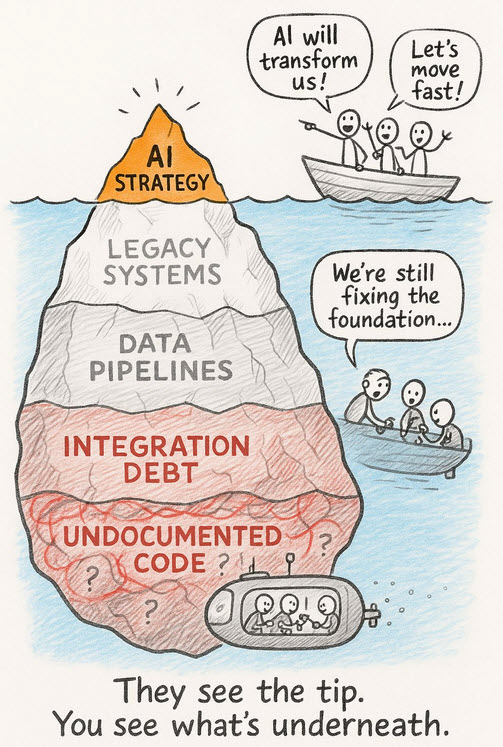 Although the topics in the workshop might look “too advanced” for your company, they are crucial to transform into a long-term, sustainable, data-driven, model-based, and AI-supported enterprise.
Somewhere, you have to cross the chasm from documents to data in context.
Being busy is not an excuse, as you can also read in Thomas Nys’s LinkedIn post: Your Engineers spend 40 % of their time maintaining yesterday’s shortcuts. And you’re wondering why your AI initiative isn’t moving faster. I loved the image.
Human Resources?
The AI revolution will have an impact on society, and it is up to us individuals how well we adapt.
 Remember, the first 50 – 100 years of the Industrial Revolution made only a few people extremely rich. James Watt, the Rothschild family, Andrew Carnegie, John D. Rockefeller, Cornelius Vanderbilt, J.P. Morgan, Alfred Krupp and the Schneider family became so rich due to ownership of factories and machinery, the control of raw materials (coal, iron, oil), the use of new technology (steam power, mechanization) combined with access to cheap labor and weak labor laws and limited competition early on.
Most humans moved into urbanized areas to become nothing but cheap resources, even children. And remember, many of us are still human resources!
A new conspiracy?
 In 2016, Ida Auken’s lecture at the WEF created traction during COVID among people who believed in conspiracies. Her story focused on a more circular economy with respect for the Earth’s resources. The story was framed into the message:
“In the future, you will own nothing and be happy.”
The conspiracy theorist believed all their possessions would be taken away by the elite in the long term.
I want to conclude with a new message for these conspiracy theorists active on X or other discussion fora:
“In the future, you will know nothing, and you won’t be aware enough to care.”
Conclusion
2026 is going to be an interesting year, where we cannot allow ourselves to sit still and watch what is happening. Active participation is more challenging but also more rewarding than being a consumer. In May 2026, I hope to meet some of you at the Share PLM Summit in Jerez and share the human side, followed by the PDM Roadmap/PDT Europe conference in Q4 in Gothenburg, where we will catch up on the technical and data side.
I am wishing you all a wise and happy/healthy 2026


 Last week, I wrote about the first day of the crowded PLM Roadmap/PDT Europe conference.
You can still read my post here in case you missed it: A very long week after PLM Roadmap / PDT Europe 2025
 My conclusion from that post was that day 1 was a challenging day if you are a newbie in the domain of PLM and data-driven practices. We discussed and learned about relevant standards that support a digital enterprise, as well as the need for ontologies and semantic models to give data meaning and serve as a foundation for potential AI tools and use cases.
This post will focus on the other aspects of product lifecycle management – the evolving methodologies and the human side.
Note: I try to avoid the abbreviation PLM, as many of us in the field associate PLM with a system, where, for me, the system is more of an IT solution, where the strategy and practices are best named as product lifecycle management.
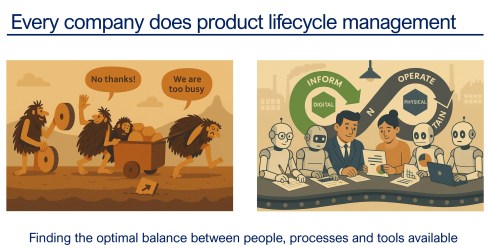
And as a reminder, I used the image above in other conversations. Every company does product lifecycle management; only the number of people, their processes, or their tools might differ. As Peter Billelo mentioned in his opening speech, the products are why the company exists.
Unlocking Efficiency with Model-Based Definition
 Day 2 started energetically with Dennys Gomes‘ keynote, which introduced model-based definition (MBD) at Vestas, a world-leading OEM for wind turbines.
Personally, I consider MBD as one of the stepping stones to learning and mastering a model-based enterprise, although do not be confused by the term “model”. In MBD, we use the 3D CAD model as the source to manage and support a data-driven connection among engineering, manufacturing, and suppliers. The business benefits are clear, as reported by companies that follow this approach.
However, it also involves changes in technology, methodology, skills, and even contractual relations.
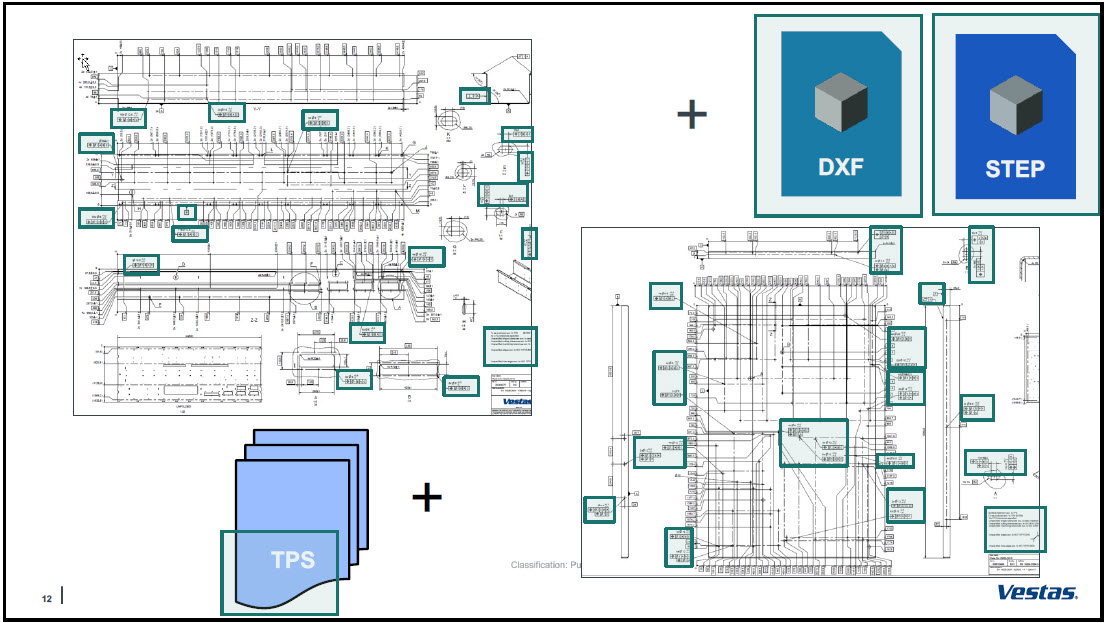
Dennys started sharing the analysis they conducted on the amount of information in current manufacturing drawings. The image below shows that only the green marker information was used, so the time and effort spent creating the drawings were wasted.
It was an opportunity to explore model-based definition, and the team ran several pilots to learn how to handle MBD, improve their skills, methodologies, and tool usage. As mentioned before, it is a profound change to move from coordinated to connected ways of working; it does not happen by simply installing a new tool.
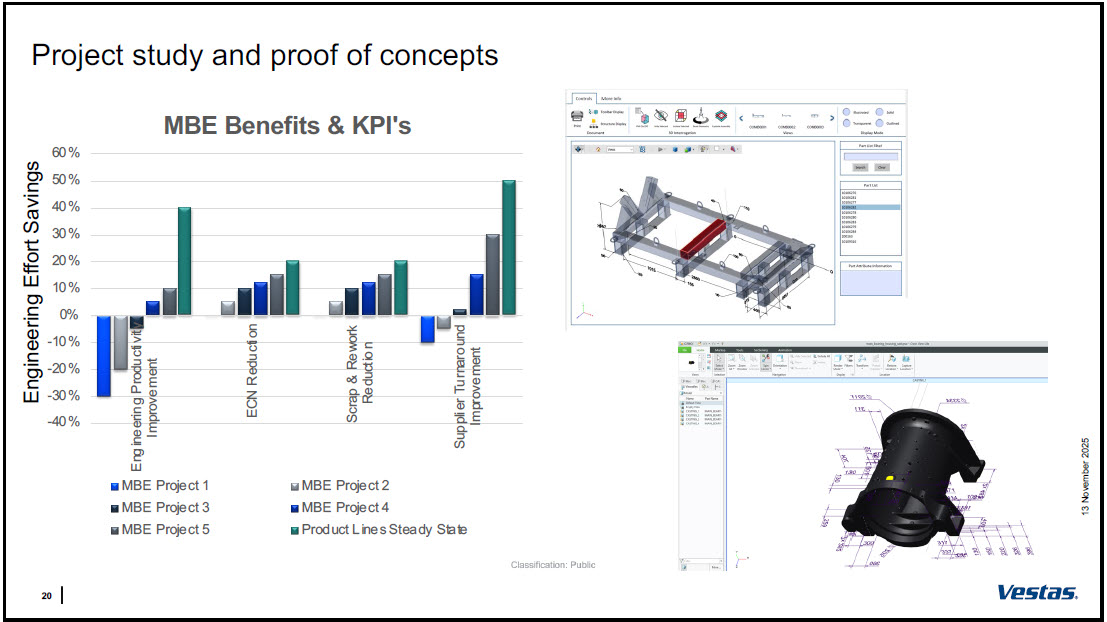
The image above shows the learning phases and the ultimate benefits accomplished. Besides moving to a model-based definition of the information, Dennys mentioned they used the opportunity to simplify and automate the generation of the information.
Vestas is on a clear path, and it is interesting to see their ambition in the MBD roadmap below.
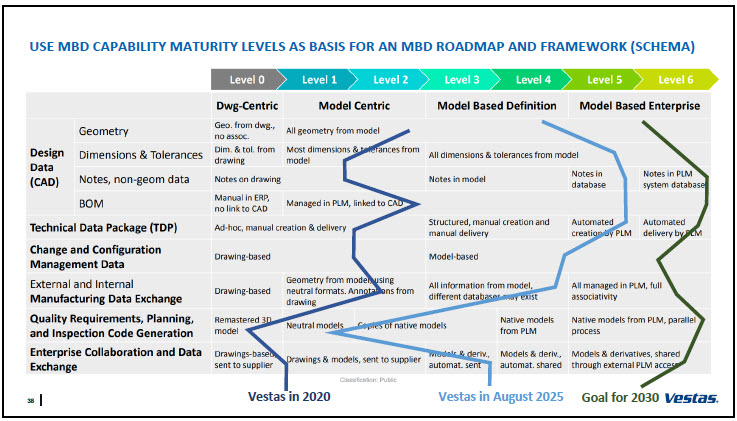
An inspirational story, hopefully motivating other companies to make this first step to a model-based enterprise. Perhaps difficult at the beginning from the people’s perspective, but as a business, it is a profitable and required direction.
Bridging The Gap Between IT and Business
 It was a great pleasure to listen again to Peter Vind from Siemens Energy, who first explained to the audience how to position the role of an enterprise architect in a company compared to society. He mentioned he has to deal with the unicorns at the C-level, who, like politicians in a city, sometimes have the most “innovative” ideas – can they be realized?
To answer these questions, Peter is referring to the Business Capability Model (BCM) he uses as an Enterprise Architect.
Business Capabilities define ‘what’ a company needs to do to execute its strategy, are structured into logical clusters, and should be the foundation for the enterprise, on which both IT and business can come to a common approach.
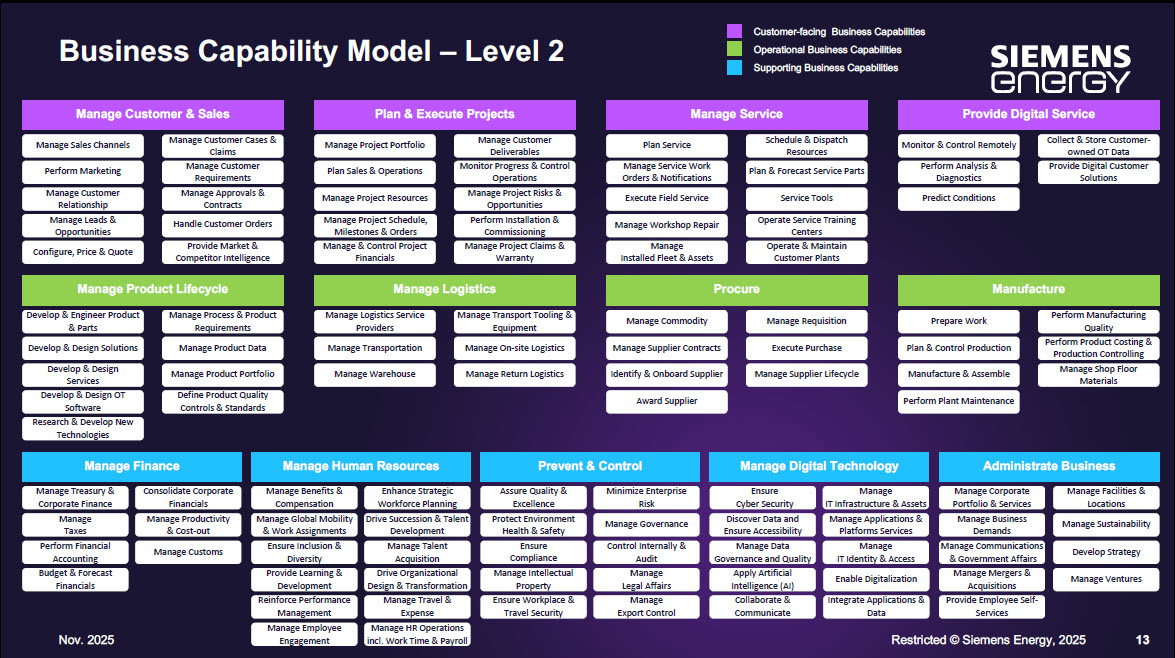
The detailed image above is worth studying if you are interested in the levels and the mappings of the capabilities. The BCM approach was beneficial when the company became disconnected from Siemens AG, enabling it to rationalize its application portfolio.
Next, Peter zoomed in on some of the examples of how a BCM and structured application portfolio management can help to rationalize the AI hype/demand – where is it applicable, where does AI have impact – and as he illustrated, it is not that simple. With the BCM, you have a base for further analysis.
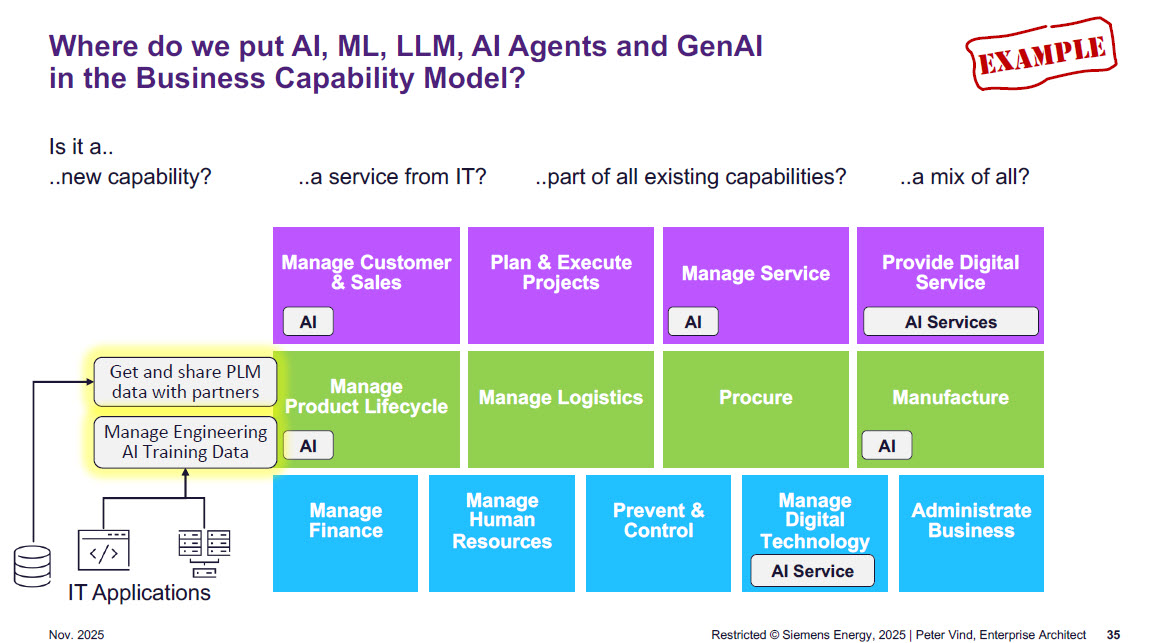
Other future-relevant topics he shared included how to address the introduction of the digital product passport and how the BCM methodology supports the shift in business models toward a modern “Power-as-a-Service” model.
He concludes that having a Business Capability Model gives you a stable foundation for managing your enterprise architecture now and into the future. The BCM complements other methodologies that connect business strategy to (IT) execution. See also my 2024 post: Don’t use the P** word! – 5 lessons learned.
Holistic PLM in Action.
 or companies struggling with their digital transformation in the PLM domain, Andreas Wank, Head of Smart Innovation at Pepperl+Fuchs SE, shared his journey so far. All the essential aspects of such a transformation were mentioned. Pepperl+Fuchs has a portfolio of approximately 15,000 products that combine hardware and software.
It started with the WHY. With such a massive portfolio, business innovation is under pressure without a PLM infrastructure. Too many changes, fragmented data, no single source of truth, and siloed ways of working lead to much rework, errors, and iterations that keep the company busy while missing the global value drivers.
Next, the journey!
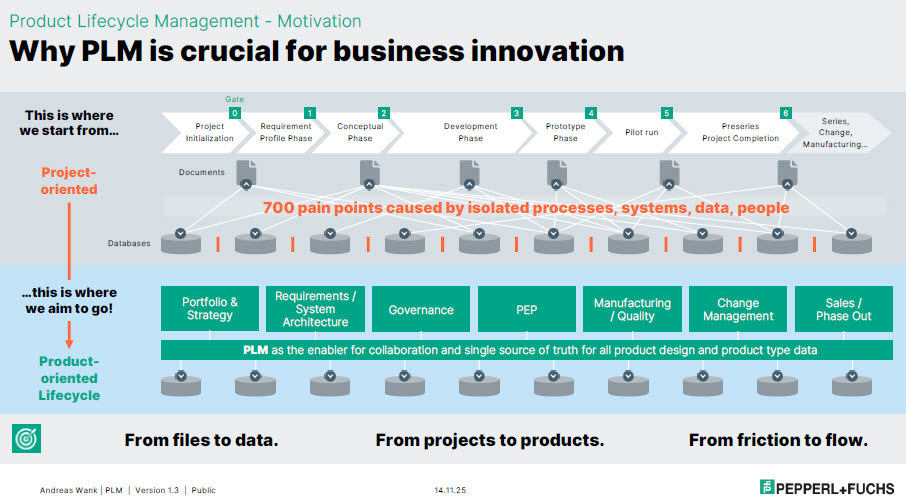
The above image is an excellent way to communicate the why, what, and how to a broader audience. All the main messages are in the image, which helps people align with them.
The first phase of the project, creating digital continuity, is also an excellent example of digital transformation in traditional document-driven enterprises. From files to data align with the From Coordinated To Connected theme.
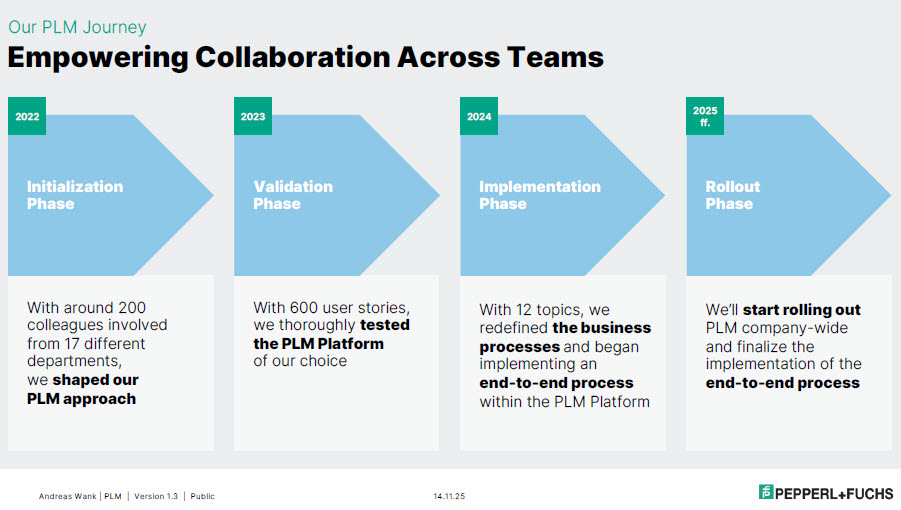
Next, the focus was to describe these new ways of working with all stakeholders involved before starting the selection and implementation of PLM tools. This approach is so crucial, as one of my big lessons learned from the past is: “Never start a PLM implementation in R&D.”
If you start in R&D, the priority shifts away from the easy flow of data between all stakeholders; it becomes an R&D System that others will have to live with.
You never get a second, first impression!
Pepperl+Fuchs spends a long time validating its PLM selection – something you might only see in privately owned companies that are not driven by shareholder demands, but take the time to prepare and understand their next move.
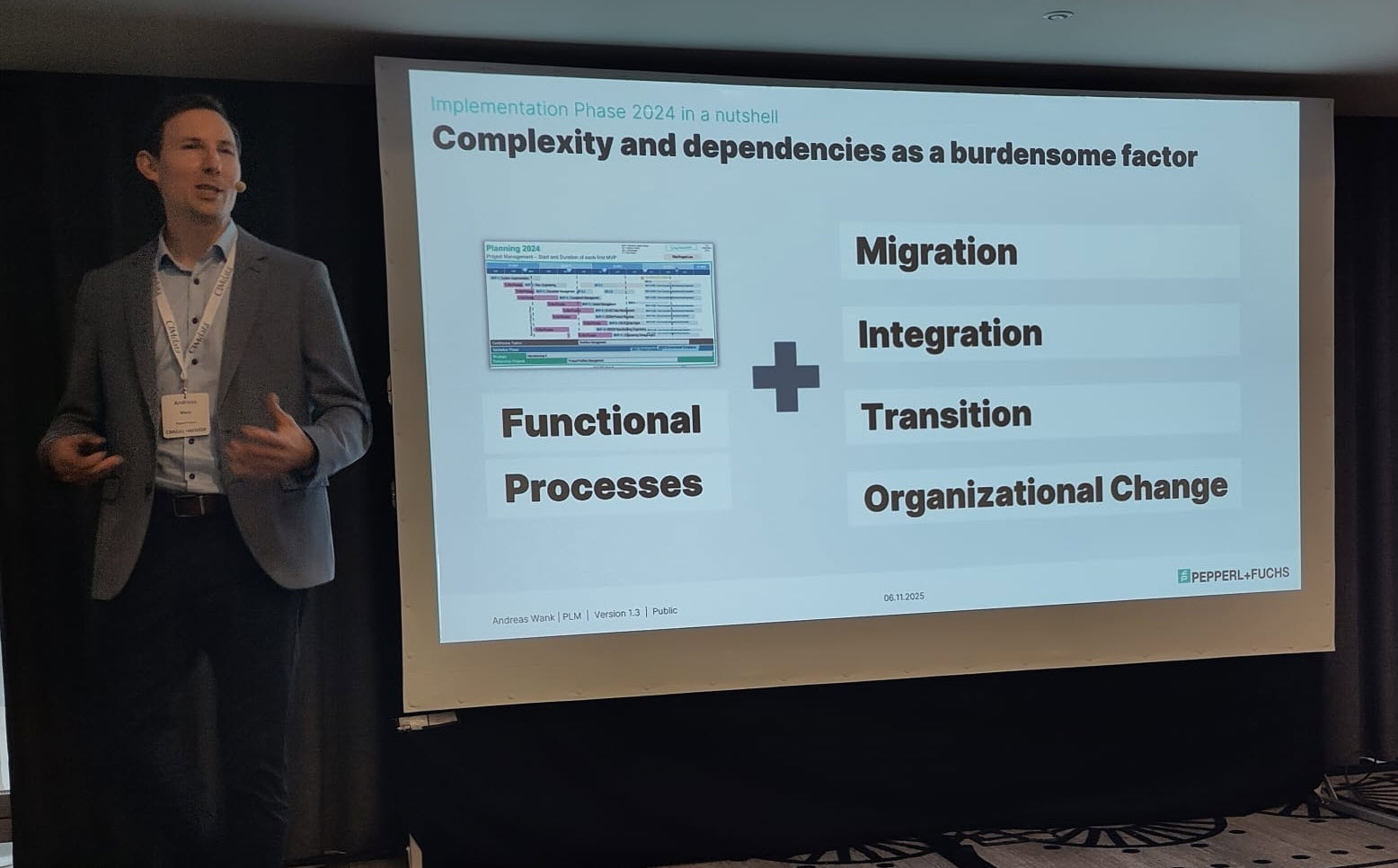
As Andreas also explained, it is not only about the functional processes. As the image shows, migration (often the elephant in the room) and integration with the other enterprise systems also need to be considered. And all of this is combined with managing the transition and the necessary organizational change.
Andreas shared some best practices illustrating the focus on the transition and human aspects. They have implemented a regular survey to measure the PLM mood in the company. And when the mood went radical down on Sept 24, from 4.1 to 2.8 on a scale of 1 to 5, it was time to act.
They used one week at a separate location, where 30 of his colleagues worked on the reported issues in one room, leading to 70 decisions that week. And the result was measurable, as shown in the image below.
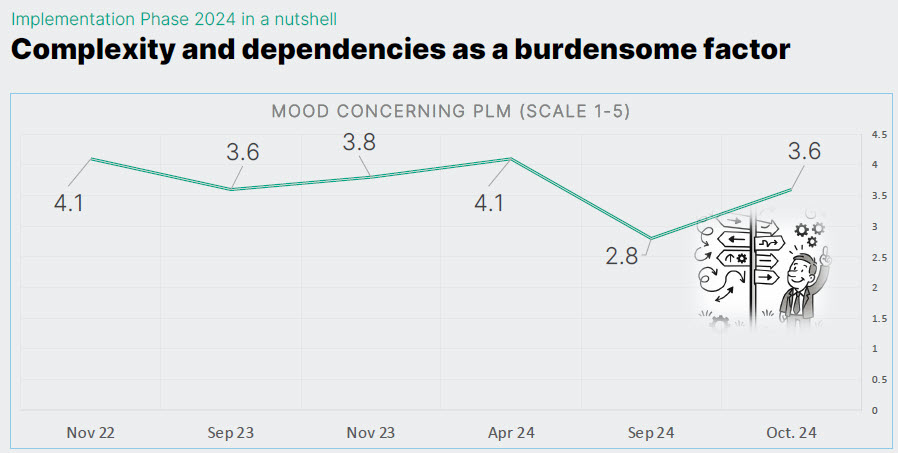
Andreas’s story was such a perfect fit for the discussions we have in the Share PLM podcast series that we asked him to tell it in more detail, also for those who have missed it. Subscribe and stay tuned for the podcast, coming soon.
Trust, Small Changes, and Transformation.
 Ashwath Sooriyanarayanan and Sofia Lindgren, both active at the corporate level in the PLM domain at Assa Abloy, came with an interesting story about their PLM lessons learned.
To understand their story, it is essential to comprehend Assa Abloy as a special company, as the image below explains. With over 1000 sites, 200 production facilities, and, last year, on average every two weeks, a new acquisition, it is hard to standardize the company, driven by a corporate organization.
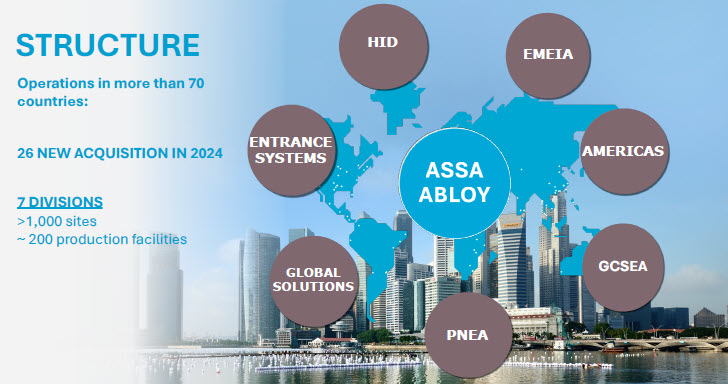
However, this was precisely what Assa Abloy has been trying to do over the past few years. Working towards a single PLM system, with generic processes for all, spending a lot of time integrating and migrating data from the different entities became a mission impossible.
To increase user acceptance, they fell into the trap of customizing the system ever more to meet many user demands. A dead end, as many other companies have probably experienced similarly.
And then they came with a strategic shift. Instead of holding on to the past and the money invested in technology, they shifted to the human side.
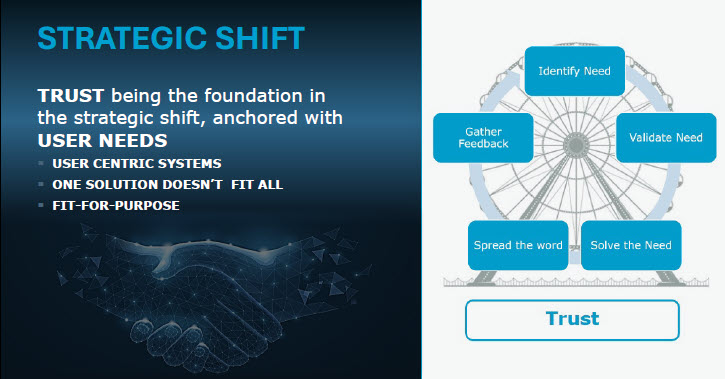
The PLM group became a trusted organisation supporting the individual entities. Instead of telling them what to do (Top-Down), they talked with the local business and provided standardized PLM knowledge and capabilities where needed (Bottom-Up).
This “modular” approach made the PLM group the trusted partner of the individual business. A unique approach, making us realize that the human aspect remains part of implementing PLM
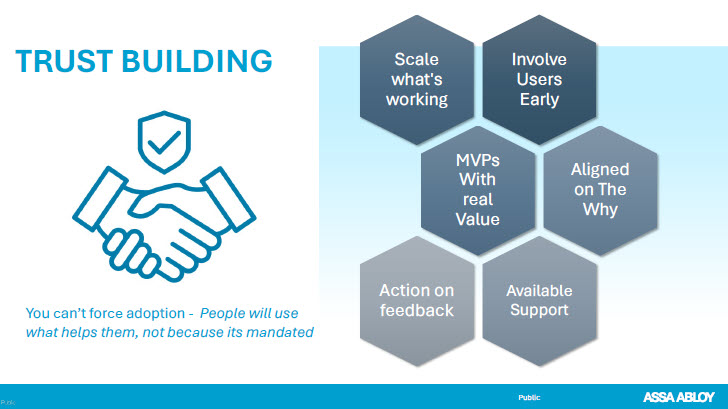
Humans cannot be transformed
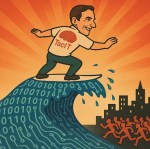 Given the length of this blog post, I will not spend too much text on my closing presentation at the conference. After a technical start on DAY 1, we gradually moved to broader, human-related topics in the latter part.
You can find my presentation here on SlideShare as usual, and perhaps the best summary from my session was given in this post from Paul Comis. Enjoy his conclusion.
Conclusion
Two and a half intensive days in Paris again at the PLM Roadmap / PDT Europe conference, where some of the crucial aspects of PLM were shared in detail. The value of the conference lies in the stories and discussions with the participants. Only slides do not provide enough education. You need to be curious and active to discover the best perspective.

For those celebrating: Wishing you a wonderful Thanksgiving!
 Last week we celebrated World Ozone Day on September 16 again. Forty years ago, many nations united to protect the ozone layer through science and action.
For those who missed the excitement, it started with a historic environmental agreement: the Montreal Protocol on Substances that Deplete the Ozone Layer.
What has happened?
 In the 1970s and 1980s, scientists discovered that CFCs from refrigerators, sprays, and foams were damaging the ozone layer. In 1985, the “ozone hole” over Antarctica was confirmed. Also, the ozone layer at the Arctic side showed signs of depletion.
As a result of these findings, the Montreal Protocol was adopted on September 16, 1987. It is a global treaty signed by virtually all countries concerning the rapid elimination of substances that deplete the ozone layer.
Countermeasures are slowly restoring the ozone layer, making the treaty a success story.
What were the reasons for success?
 Although scientists engaged in a discussion about the scientific evidence, there were no significant economic forces behind the scenes influencing the scientific research.
The lack of substantial financial dependencies, combined with the absence of social media and Duning-Kruger experts, led to the belief that human influence on the Earth’s atmosphere could be stopped.
And probably an even more important fact, the depletion of the ozone layer was at the poles, making, in particular, the richer countries more vulnerable to the effects.
Where most attention focused on the hole above the South Pole, affecting New Zealand and Australia, the thinner layer at the North Pole was making Canada, the US, and Northern Europe vulnerable.
What have we learned?
- Switching from CFCs was a minor inconvenience for consumers. Now we all accept the current solutions.
- There was enough consensus in science when the majority of scientists agreed. In addition, there were no undermining forces with financial stakes in CFCs. Science was leading.
- Today, science struggles as stakeholders sponsor research to protect their interests. In addition, social media is used to recruit supporters in a polarized environment (the side effect of social media)
- Ultimately, after 40 years, the hole in the Ozone layer gets smaller and smaller and hopefully becomes normal. We keep on working on the long term.
The PLM Green Global Alliance
 When Rich McFall approached me at the end of 2019 to start the PLM Green Global Alliance together, there was a kind of consensus that we human beings both influence the planet’s climate and its natural resources.
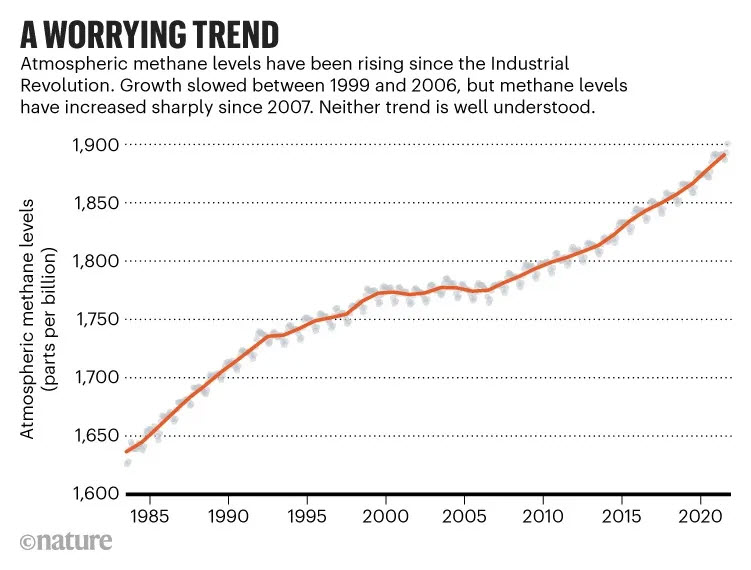 Where Rich focused on the causes and consequences of climate change due to human-generated greenhouse gas emissions (GHG) from products and processes, my additional focus was broader, encompassing Sustainability in the context of where PLM practices could have an impact.
Our idea was to bring people together to address these issues by sharing thoughts and practices or enabling discussions in the context of PLM-related technologies.

Can we develop more eco-friendly products, and what are the conditions required?
Meanwhile, six years later, a lot has happened for better and for worse. Here is a set of observations
The PLM Green Global Alliance continues to grow.
Currently, we have over 1,500 registered members in our LinkedIn group.
Historically, most members came from Europe and then the US; now, India is catching up and approaching the number of US members.
This trend suggests that the focus of the alliance should shift slightly and seek more contributors from Asian countries.
 We look forward to having Asian representatives in our PLM Green Global Alliance to gain a deeper understanding and engage in discussions about global issues.
Please feel free to contact us if you are interested in joining the core team. It might be a challenge to have group meetings that accommodate all time zones, but the planet is still relatively small compared to the universe – nothing is impossible.
The tools are there ..
In PLM, we often discuss people, processes, and then the tools. Here, we can confirm that, through our work and discussions with major PLM vendors, they are all providing tools and, in some cases, embedded practices to support a more sustainable product development process.
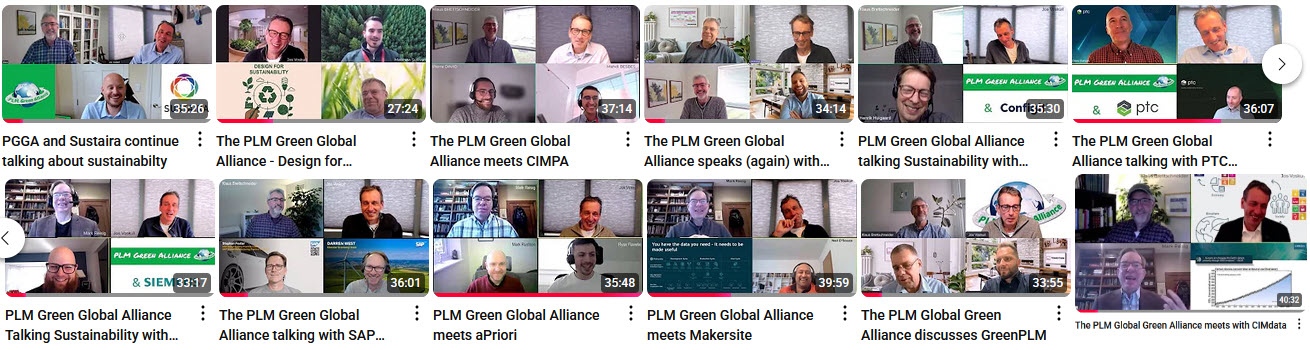
Have a look at our YouTube channel: The PLM Green Global Alliance channel.
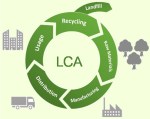 The tools for generative design, life cycle assessment, and, of course, digital twins for the various lifecycle phases can help companies to develop and manufacture more sustainable products.
However, as mentioned, the tools will only be practical when the people have the mandate and when the processes are transformed into data-driven ones.
The need for a data-driven approach
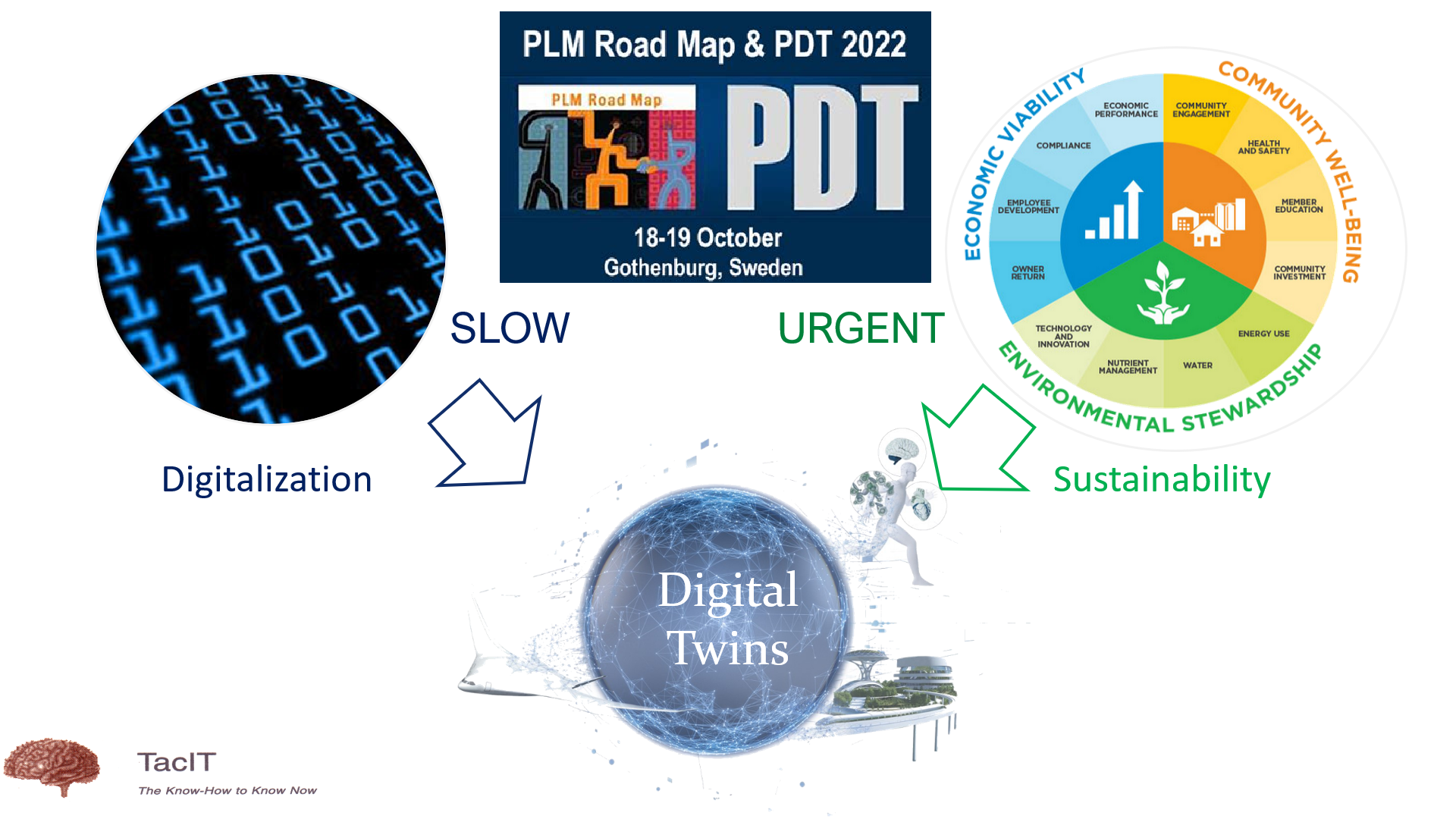 Two years ago, during the PLM Roadmap/PDT Europe conference in Gothenburg, I had already mentioned that Sustainability might prompt companies to invest more time and effort in achieving a digital transformation in their PLM domain.
Compliance with regulations can be challenging when you still need to collect data from various sources with a lot of “guesstimate”. Greenhouse gas reporting, ESG reporting, and the upcoming Digital Product Passport can only be done efficiently if data is directly accessible without requiring people to collect it.
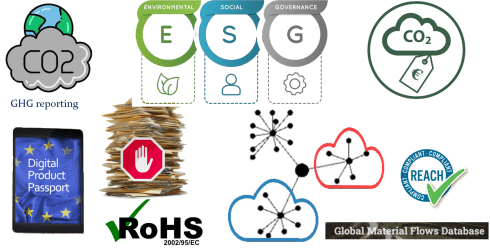
Unfortunately, in my recent discussions with companies, particularly management, they are not seeking a fundamental digital transformation from a document-driven approach to a data-driven and model-based approach.
 Part of this challenge is the lack of education among top management, who are primarily focused on efficiency gains rather than adopting new approaches or mitigating risk.
The other challenge is that, as most companies lag behind on this topic, they do not feel the pressure of competition and do not want to take the risk of being first.
I will discuss this last topic in my upcoming PLM blog
It is about the people!
 However, first and foremost, the most critical factor in driving sustainability within organizations is the people. Where companies are challenged in creating a green image, including the introduction of the Chief Sustainability Officer (CSO), there has always been resistance from existing business leaders, who prioritize money and profitability.
The global shift towards right-wing capitalism and efforts to remove regulations supporting sustainability are currently impacting these efforts. The term “Sustainability” has become negatively connoted, similar to “PLM” (Product Lifecycle Management – Don’t mention the P** word), and there is a need to reframe discussions at the management level to focus on risk mitigation and business strategies.
Where politicians might avoid a long-term vision, there are examples of companies like Ørsted, Pacific Gas & Electric, Maersk, the Holcim group, BlackRock, IKEA and more that are adopting sustainable practices as a risk mitigation strategy for the future and securing their companies’ long-term existence.
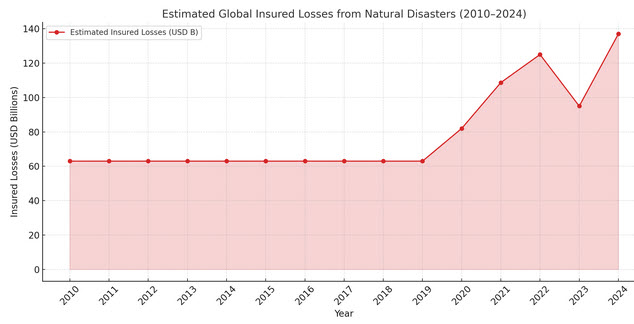
An interesting game changer for both businesses and behavior might be the rising costs of insurance against natural disasters. As the graph shows, the estimated global insured losses due to natural disasters over the last 15 years have increased significantly, starting in 2019. In the richer countries, the governments might be pushed to provide financial help after a disaster, but this will also have a (taxpayer) limit.
We are the people!
 There is a lot we can do as a PLM Green Global Community. Have you read CIMdata’s commentary, written by our Sustainability & Energy core team member Mark Reisig – read the full article here: How PLM is Decarbonizing Automotive Transport—Amid Political Uncertainty, addressing the importance of modern digital PLM to support digital twin, digital thread and digital product passport implementations.
 Or the paper from our core team member, LCA specialist Klaus Brettschneider, with the title The Sustainability Thread – Rethinking the digital thread to drive sustainability performance and green R&D, again stressing the importance of extending the digital thread to include sustainability metrics, enabling companies to design, produce, and operate products more efficiently while reducing environmental impact and supporting green R&D.
 Additionally, there are the monthly ESG newsletters from Vincent De La Mar of Sustaira, as well as the recent interview with Vincent, in which PGGA and Sustaira continue to discuss sustainability. Sustaira helps companies with a sustainability reporting platform on top of their existing enterprise systems. A first step that is needed to understand where measures have an impact.
 A regular guest at our discussions, Dave Duncan, Head of Sustainability at PTC, who published this year a very comprehensive, free-to-download book: Product Sustainability for Dummies. We also had a great discussion about the Product Service System, a mandatory business model for sustainable business.
 And recently, we saw the kick-off for the Design for Sustainability workgroup, organised by Erik Reiger and Matthew Sullivan. They are in the process of establishing this workgroup, where there will be more discussion and information exchanged between the workgroup members about the people and process angle (Erik‘s focus) and the tools and technology dimension (Matthew‘s focus)
 The post concludes with Rich McFall, who, in 2018, observed that there was so little organized action fighting climate change and started to motivate people to launch the PLM Green Global Alliance. It was his initiative to bring people together and raise awareness about the fact that, as a PLM community, we can help one another and start making a difference. Rich helped us a lot in setting up the website and ensuring that we have regular updates and a persistent storage of the information generated.
Working on the long term
We are still in the awareness phase and are seeing progress in the field. There is more to come and share, and we need your help. Working on the long term in a hectic day-to-day environment can be a challenge. However, in the end, if each of us helps our business and social ecosystem move towards a more sustainable economy and planet, we are moving in the right direction. It will take time, but we have an undeniable mission. Join and help us!
After a summer holiday in the south of Greece, it is time to resume my activities. The south of Crete is largely an analogue environment, far from any digital hype.
 Tempted by LinkedIn posts, I noticed the summer was full of memories, with Martin Eigner sharing 40 years of PLM experience, Oleg Shilovitsky sharing 30 years of PDM Evolution, and Michael Finochario publishing posts on PLM vendors, CAD kernels, and more.
So where do I stand? While digesting all these historical experiences, I reflected on what we can learn from them and what we didn’t learn from them.
It started with technology.
 From 1990 to 1999, I worked with mid-market companies, where data management was the most significant challenge. The introduction of MS Windows made data management more user-friendly, evolving from drawing management systems with version and status management capabilities.
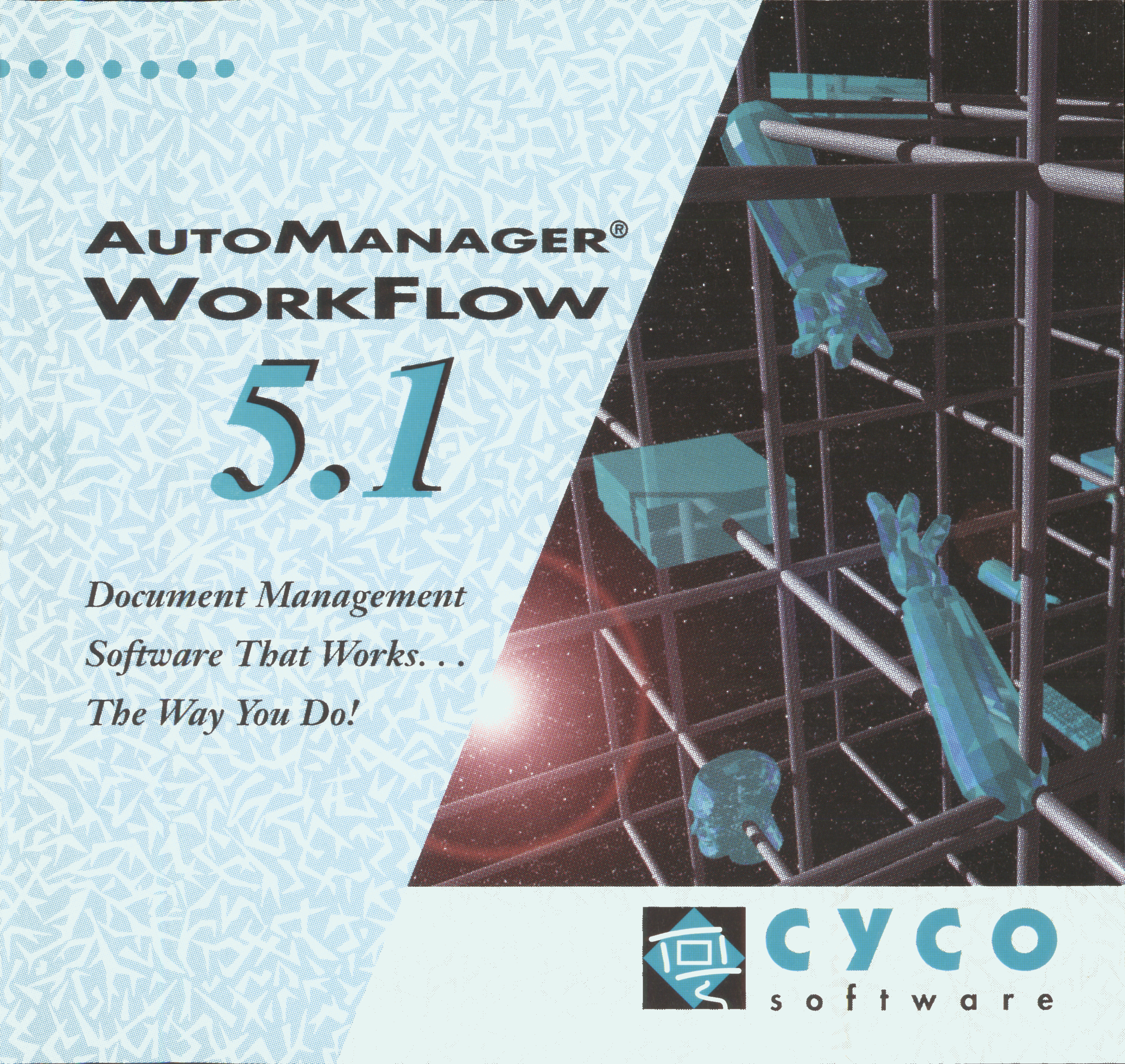
Who remembers Automanager Workflow from Cyco, before SmarTeam came on the market?
For that reason, in the early days, PDM was an IT job. As the PDM system primarily dealt with engineering data, it was relatively easy to implement as an organizational change process. We transitioned from analogue to electronic in the department.
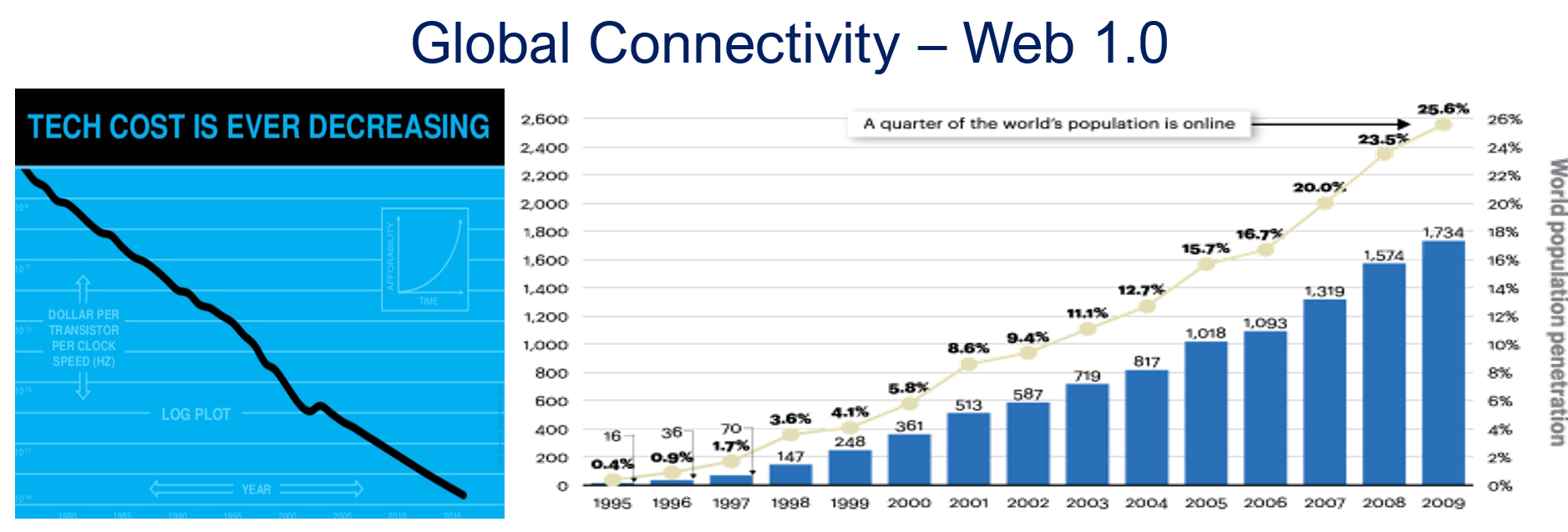
Connecting with other systems, particularly ERP, was a serious IT job and a financial challenge. Connecting with other systems, particularly ERP, was a serious IT job and a financial challenge. The rapid decline of IT components, combined with the rapid growth of global connectivity, has created new opportunities for collaboration.
As part of the Dassault/IBM/SmarTeam organization, I explained and taught these new capabilities worldwide.
 In 2008, my VirtualDutchman blog and coaching journey began, evolving from explanations of technology to modern methodologies, which led to organizational change and expectation management – skills not traditionally associated with IT.
Then came digital transformation
With growing connectivity, smartphones and Web 2.0 technology have led to more PLM-like discussions. PLM vendors expanded their scope and developed capabilities beyond mechanical engineering.
 The expansion of capabilities was also the moment when the confusion about the term PLM reached its peak: a PLM strategy or a PLM system?
At the time, they were largely considered the same in discussions and advertisements..
Meanwhile, digital transformation was occurring at the marketing and sales levels – companies invested in direct communication with their customers through the web.
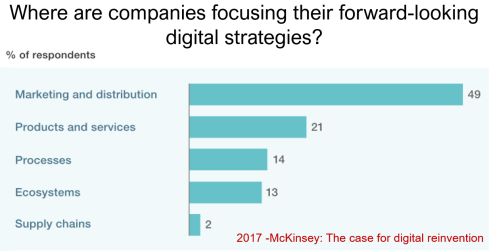
Meanwhile, the internal ways of working for R&D, engineering, and manufacturing did not change significantly. Still, they were following linear processes, and despite the existence of 3D CAD, the 2D drawing remained the primary carrier of legal information between engineering, manufacturing, and suppliers.
Note: the option where the most benefits could be achieved – connected supply chains – had the lowest focus in 2017 – something that would change with COVID-19.
Fundamental digital transformation in the PLM domain occurred gradually. ARAS came with its overlay approach (the platform), connecting various disciplines and enterprise systems. In contrast, Dassault Systèmes introduced its 3DEXPERIENCE platform, utilizing its own software brands as platform components.
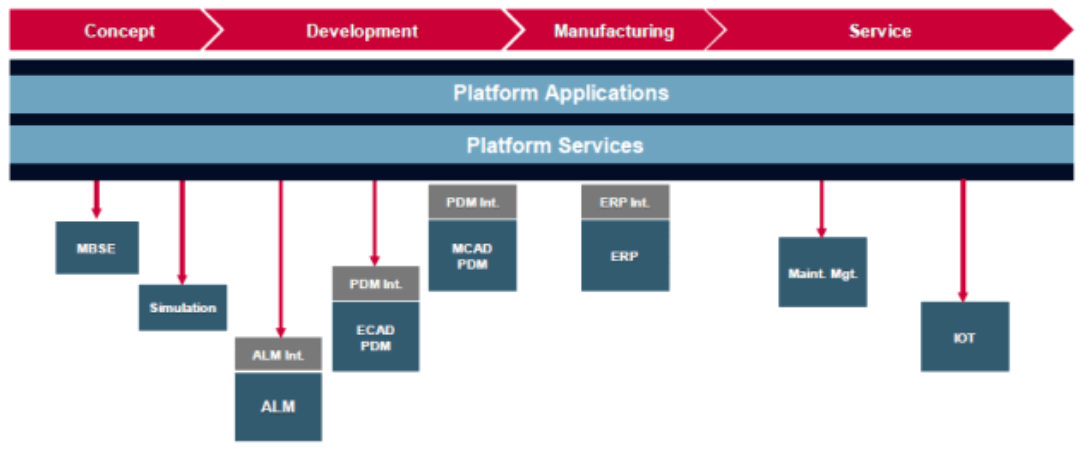
The Aras overlay approach
Most PLM vendors rapidly countered Aras’ overlay approach with their low-code offerings based on Mendix, ThingWorx or Netvibes, to enable data flows beyond the traditional PDM scope. The Coordinated Digital Thread was born.
The good news is that PLM has now clearly become a strategy based on a federated system infrastructure. The single PLM system no longer exists, although many of us still use the term’ PLM system’ to refer to the main component of a PLM infrastructure – the System of Record.
Moving to a federated PLM infrastructure is already a challenge for companies, not because of the available technology, but first of all because of the legacy data and, closely related to that, legacy processes and people skills.
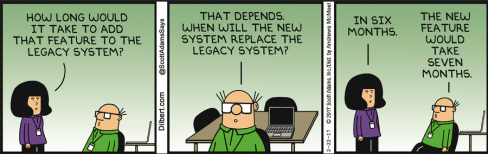
Legacy is creating the inertia, not technology!
Next came the cloud – SaaS
 With the availability of cloud solutions that support real-time interactions between stakeholders, either within an enterprise or in a value chain, a new paradigm has emerged: the connected enterprise.
A connected enterprise no longer needs interfaces to transfer data from one system to another.
Instead, with apps and dashboards, combined data from different online sources is presented in a single, user-friendly working environment – A combination of the Systems of Record with the new environments – the Systems of Engagement.
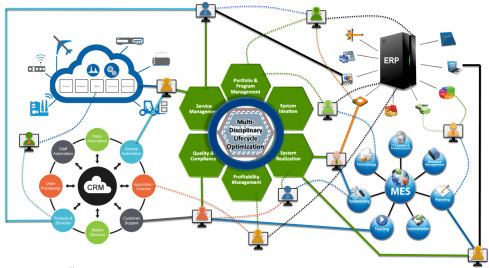
The technology used to create dashboards and apps is based on modern data-driven technologies and principles (ontologies, graph databases, and the semantic web). The Connected Digital Thread was born.
However, legacy systems play an essential role again, as some systems of engagement can be implemented in a complementary manner to the systems of record, allowing companies to work within an integrated technology model.
People will work in a particular mode, either coordinated or connected, but organizations can operate in both modes simultaneously. A story I have been sharing a lot – it is not about migrations but about an evolutionary approach towards an integrated technology model.
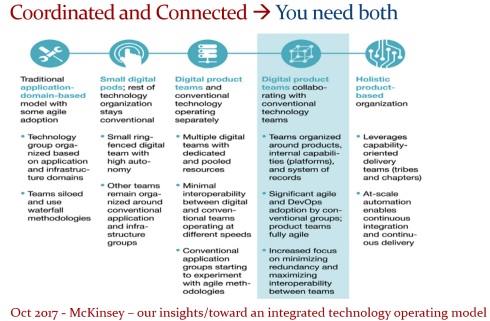
At this point, it becomes essential that business objectives drive the implementation of a PLM infrastructure. Of course, you hear me say we should start from the business; however, the big difference now is that a company should coordinate the technologies, systems, and tools it acquires to avoid isolated islands of information.
Follow Yousef Hooshmand‘s 5 + 1 business transformation steps.

 An open SaaS infrastructure enables a company to let data flow almost in real-time. There is a lot of discussion related to data quality and governance, and if you have missed it, please read these three articles I created together with Rob Feronne, the product Digital PLuMber:
- Data Quality and Data Governance – A hype? (part 1)
- Data Quality and Data Governance – the WHY and HOW (part 2)

- Building the Future: Data Quality and Governance in the Digital Age (part 3)
There are some great insights in this dialogue and the associated LinkedIn comments.
Despite the increasing availability of technology, it is the legacy of people, processes, and culture that is hindering progress.
Rob Feronne had a shocking lightbulb moment 😲 in our discussion about the future of PLM, where the participants – see below – answered a question related to the importance of technology in our PLM domain – shocking also for me.
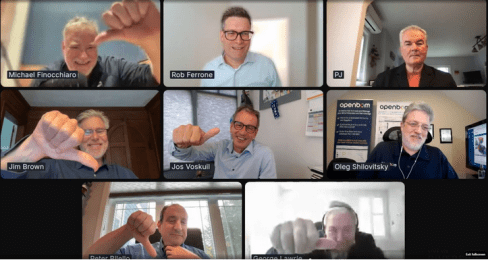
My thumb was up because modern technology matters! The question inspired Oleg Shilovitsky to write a whole blog post on this topic. If you’re truly shocked, read his post, where I agree with the content; the question is too simple to answer with a thumbs up/down.
 As technology has become more accessible than before, you no longer need an IT department to establish a PLM infrastructure. And then indeed, the people and process side needs and deserves much more attention..
And now there is AI
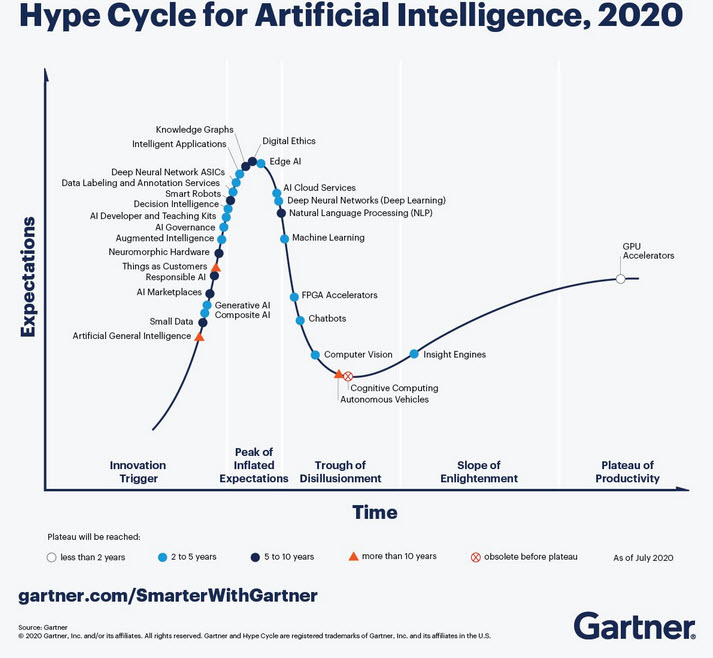 If you haven’t read anything about AI recently, you must be living in an isolated location. Regardless of the business discussions you are following, it is all about the potential of AI.
Although AI is not a new concept, the fact that various AI capabilities have now reached the end-user level is what drives the hype. Currently, I believe we are at the peak of the hype.
Last week, I participated in an interesting discussion in the series: The Future of PLM moderated by Michael Finochario, this time talking with the analysts. Click on the link to see Michael’s excellent summary and access to the recording of the event.

It was an interesting discussion for a little more than an hour, and the majority of our discussion was about the potential impact of AI on businesses. First, the impact AI can have on the traditional work of an analyst and next, the effects on the PLM domain.
 I believe we agreed that AI at this moment is mainly providing higher user efficiency and performance, very much aligned with the interesting research I have been reading in the MIT NANDA report with the title The GenAI Divide: STATE OF AI IN BUSINESS 2025
The report’s interesting findings included high adoption of tools but low transformation. Despite significant investment in Generative AI (GenAI), most organizations are not achieving meaningful business transformation.
- 95% of organizations report zero return on GenAI investments.
- Only 5% of integrated AI pilots generate millions in value.
- 80% of organizations have explored or piloted tools like ChatGPT, but these primarily enhance individual productivity.
- 60% of organizations evaluated enterprise-grade systems, but only 20% reached the pilot stage, and just 5% reached production.
- Key barriers include brittle workflows, a lack of contextual learning, and operational misalignment.
Therefore, the question is – Is current AI the next bubble?
In 2014, I wrote about the lack of digital transformation in the PLM domain, and two images (below) from a report by The Economist could be used again. The report can be found here: The Onrushing Wave.
Click on the image to read the 2013 predictions.
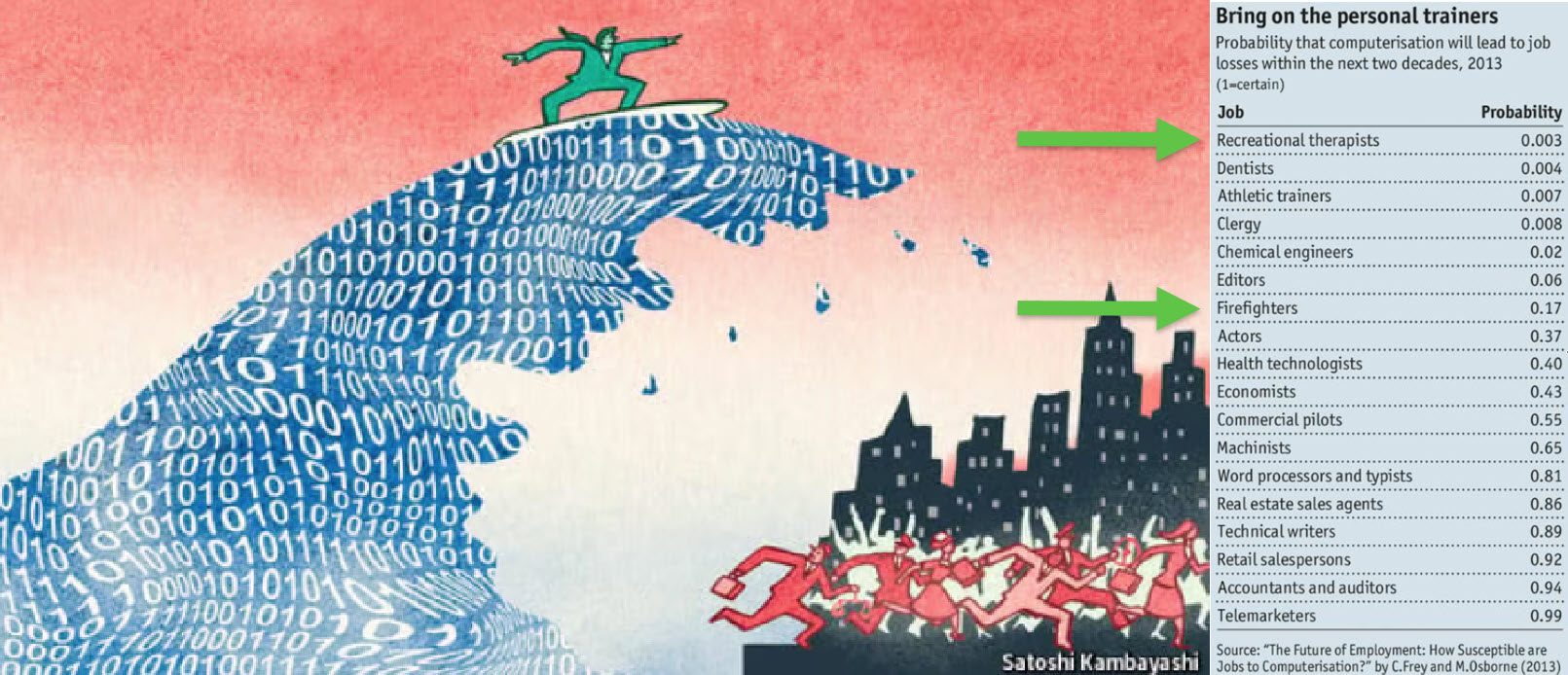
I realized that my current job, as a recreational therapist and firefighter at the time, was not at risk, and that some of the predictions from 10 years ago had become a reality. Who is still bothered by telemarketers or retail salespersons?
However, many of the AI symptoms mentioned in the MIT NANDA report are similar to the hype surrounding digital transformation.
The only reservation I have now – will it take a decade before we understand and demonstrate the value of AI, or are we accelerating?
In this context, the upcoming PLM Roadmap/PDT Europe conference on 5 – 6 November will be interesting, as here we will discuss reality.
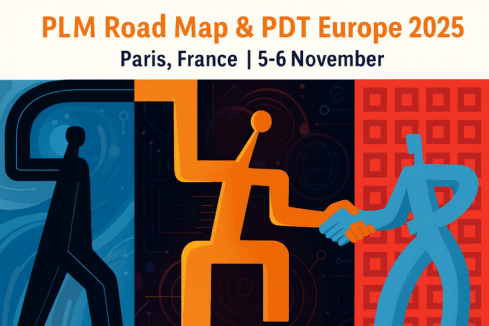
For a few of you interested in more, there is the day before the conference, a (free) workshop where we will discuss with some thought leaders and experts from various companies how the future of PLM could look like – based on standards, AI tools and more. Click on the image below the conclusion.
Conclusion
The summertime was a nice moment to reflect, inspired by others in my network. What is clear is that there is a shift from technology towards people and change. The rapid expansion of AI tools, along with connected technologies, has created an overwhelming array of possibilities. Now it is time for business leadership to understand them and utilize them for significant business improvement, where the fear is that substantial change will always be slowed down by organizational inertia.
In the past three weeks, between some short holidays, I had a discussion with Rob Ferrone, who you might know as
“The original product Data PLuMber”.
Our discussion resulted in this concluding post and these two previous posts:
If you haven’t read them before, please take a moment to review them, to understand the flow of our dialogue and to get a full, holistic view of the WHY, WHAT and HOW of data quality and data governance.
A foundation required for any type of modern digital enterprise, with or without AI.
A first feedback round
 Rob, I was curious whether there were any interesting comments from the readers that enhanced your understanding. For me, Benedict Smith’s point in the discussion thread was an interesting one.
From this reaction, I like to quote:
To suggest it’s merely a lack of discipline is to ignore the evidence. We have some of the most disciplined engineers in the world. The problem isn’t the people; it’s the architecture they are forced to inhabit.
My contention is that we have been trying to solve a reasoning problem with record-keeping tools. We need to stop just polishing the records and start architecting for the reasoning. The “what” will only ever be consistently correct when the “why” finally has a home. 😎
Here, I realized that the challenge is not only about moving From Coordinated to Coordinated and Connected, but also that our existing record-keeping mindset drives the old way of thinking about data. In the long term, this will be a dead end.
What did you notice?
Jos, indeed, Benedict’s point is great to have in mind for the future and in addition, I also liked the comment from Yousef Hooshmand, where he explains that a data-driven approach with a much higher data granularity automatically leads to a higher quality – I would quote Yousef:
The current landscapes are largely application-centric and not data-centric, so data is often treated as a second or even third-class citizen.
In contrast, a modern federated and semantic architecture is inherently data-centric. This shift naturally leads to better data quality with significantly less overhead. Just as important, data ownership becomes clearly defined and aligned with business responsibilities.
Take “weight” as a simple example: we often deal with “Target Weight,” “Calculated Weight,” and “Measured Weight.” In a federated, semantic setup, these attributes reside in the systems where their respective data owners (typically the business users) work daily, and are semantically linked in the background.
I believe the interesting part of this discussion is that people are thinking about data-driven concepts as a foundation for the paradigm, shifting from systems of record/systems of engagement to systems of reasoning. Additionally, I see how Yousef applies a data-centric approach in his current enterprise, laying the foundation for systems of reasoning.
What’s next?
Rob, your recommendations do not include a transformation, but rather an evolution to become better and more efficient – the typical work of a Product PLuMber, I would say. How about redesigning the way we work?
Bold visions and ideas are essential catalysts for transformations, but I’ve found that the execution of significant, strategic initiatives is often the failure mode.
One of my favourite quotes is:
“A complex system that works is invariably found to have evolved from a simple system that worked.”
John Gall, Systemantics (1975)
For example, I advocate this approach when establishing Digital Threads.
 It’s easy to imagine a Digital Thread, but building one that’s sustainable and delivers measurable value is a far more formidable challenge.
Therefore, my take on Digital Thread as a Service is not about a plug-and-play Digital Thread, but the Service of creating valuable Digital Threads.
You achieve the solution by first making the Thread work and progressively ‘leaving a trail of construction’.
The caveat is that this can’t happen in isolation; it must be aligned with a data strategy, a set of principles, and a roadmap that are grounded in the organization’s strategic business imperatives.
Your answer relates a lot to Steef Klein’s comment when he discussed: “Industry 4.0: Define your Digital Thread ML-related roadmap – Carefully select your digital innovation steps.” You can read Steef’s full comment here: Your architectural Industry 4.0 future)
First, I liked the example value cases presented by Steef. They’re a reminder that all these technology-enabled strategies, whether PLM, Digital Thread, or otherwise, are just means to an end. That end is usually growth or financial performance (and hopefully, one day, people too).
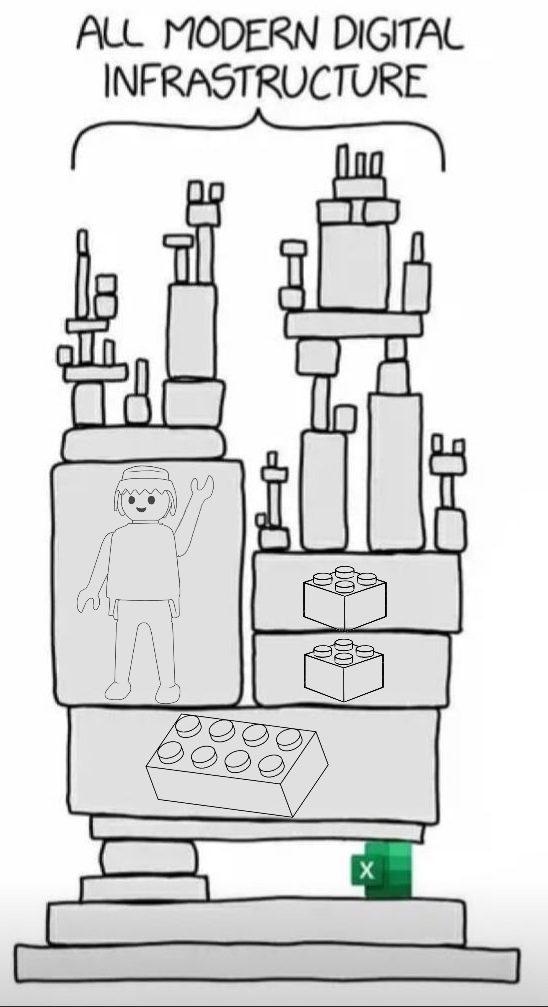 It is a bit like Lego, however. You can’t build imaginative but robust solutions unless there is underlying compatibility and interoperability.
It would be a wobbly castle made from a mix of Playmobil, Duplo, Lego and wood blocks (you can tell I have been doing childcare this summer – click on the image to see the details).
As the lines blur between products, services, and even companies themselves, effective collaboration increasingly depends on a shared data language, one that can be understood not just by people, but by the microservices and machines driving automation across ecosystems.
Discussing the future?
 I think that for those interested in this discussion, I would like to point to the upcoming PLM Roadmap/PDT Europe 2025 conference on November 5th and 6th in Paris, where some of the thought leaders in these concepts will be presenting or attending. The detailed agenda is expected to be published after the summer holidays.
However, this conference also created the opportunity to have a pre-conference workshop, where Håkan Kårdén and I wanted to have an interactive discussion with some of these thought leaders and practitioners from the field.
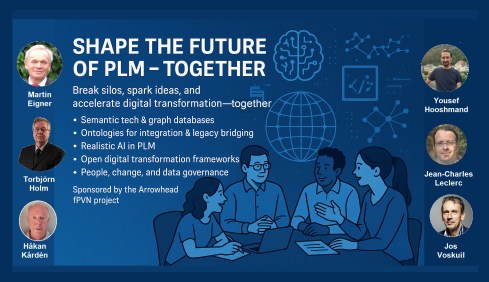
 Sponsored by the Arrowhead fPVN project, we were able to book a room at the conference venue in the afternoon of November 4th. You can find the announcement and more details of the workshop here in Hakan’s post:. Shape the Future of PLM – Together.
Last year at the PLM Roadmap PDT Europe conference in Gothenburg, I saw a presentation of the Arrowhead fPVN project. You can read more here: The long week after the PLM Roadmap/PDT Europe 2024 conference.
And, as you can see from the acknowledged participants below, we want to discuss and understand more concepts and their applications – and for sure, the application of AI concepts will be part of the discussion.
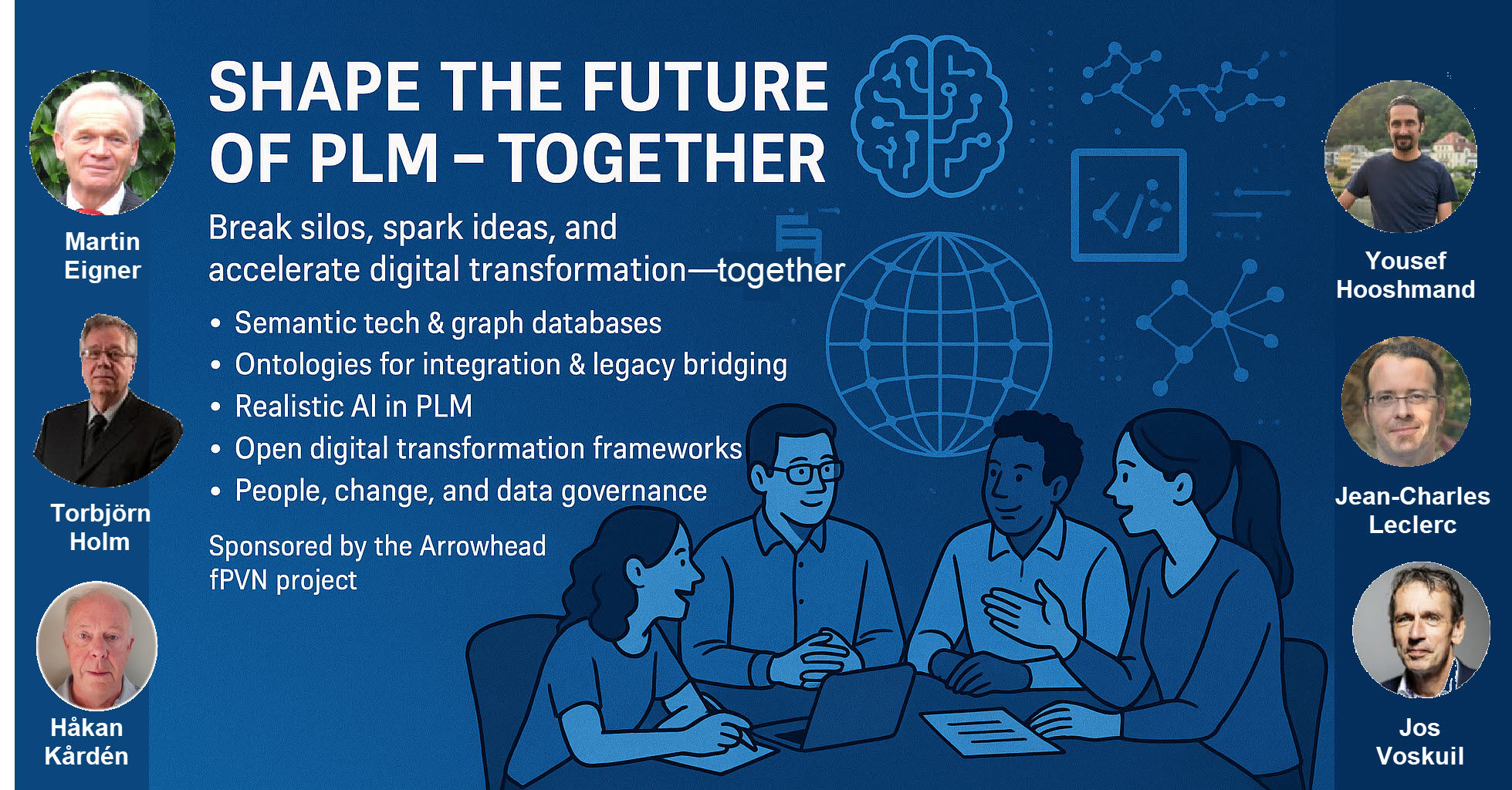
 Mark the date and this workshop in your agenda if you are able and willing to contribute. After the summer holidays, we will develop a more detailed agenda about the concepts to be discussed. Stay tuned to our LinkedIn feed at the end of August/beginning of September.
And the people?
Rob, we just came from a human-centric PLM conference in Jerez – the Share PLM 2025 summit – where are the humans in this data-driven world?
You can’t have a data-driven strategy in isolation. A business operating system comprises the coordinated interaction of people, processes, systems, and data, aligned to the lifecycle of products and services. Strategies should be defined at each layer, for instance, whether the system landscape is federated or monolithic, with each strategy reinforcing and aligning with the broader operating system vision.
In terms of the people layer, a data strategy is only as good as the people who shape, feed, and use it. Systems don’t generate clean data; people do. If users aren’t trained, motivated, or measured on quality, the strategy falls apart.
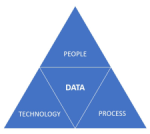 Data needs to be an integral, essential and valuable part of the product or service. Individuals become both consumers and producers of data, expected to input clean data, interpret dashboards, and act on insights. In a business where people collaborate across boundaries, ask questions, and share insight, data becomes a competitive asset.
There are risks; however, a system-driven approach can clash with local flexibility/agility.
People who previously operated on instinct or informal processes may now need to justify actions with data. And if the data is poor or the outputs feel misaligned, people will quickly disengage, reverting to offline workarounds or intuition.
 Here it is critical that leaders truly believe in the value and set the tone, and because it rare to have everyone in the business care about the data as passionately as they do about the prime function of their unique role (e.g. designer);
therefore there needs to be product data professionals in the mix – people who care, notice what’s wrong, and know how to fix it across silos.
Conclusion
- Our discussions on data quality and governance revealed a crucial insight: this is not a technical journey, but a human one. While the industry is shifting from systems of record to systems of reasoning, many organizations are still trapped in record-keeping mindsets and fragmented architectures. Better tools alone won’t fix the issue—we need better ownership, strategy, and engagement.
- True data quality isn’t about being perfect; it’s about the right maturity, at the right time, for the right decisions. Governance, too, isn’t a checkbox—it’s a foundation for trust and continuity. The transition to a data-centric way of working is evolutionary, not revolutionary—requiring people who understand the business, care about the data, and can work across silos.
The takeaway? Start small, build value early, and align people, processes, and systems under a shared strategy. And if you’re serious about your company’s data, join the dialogue in Paris this November.
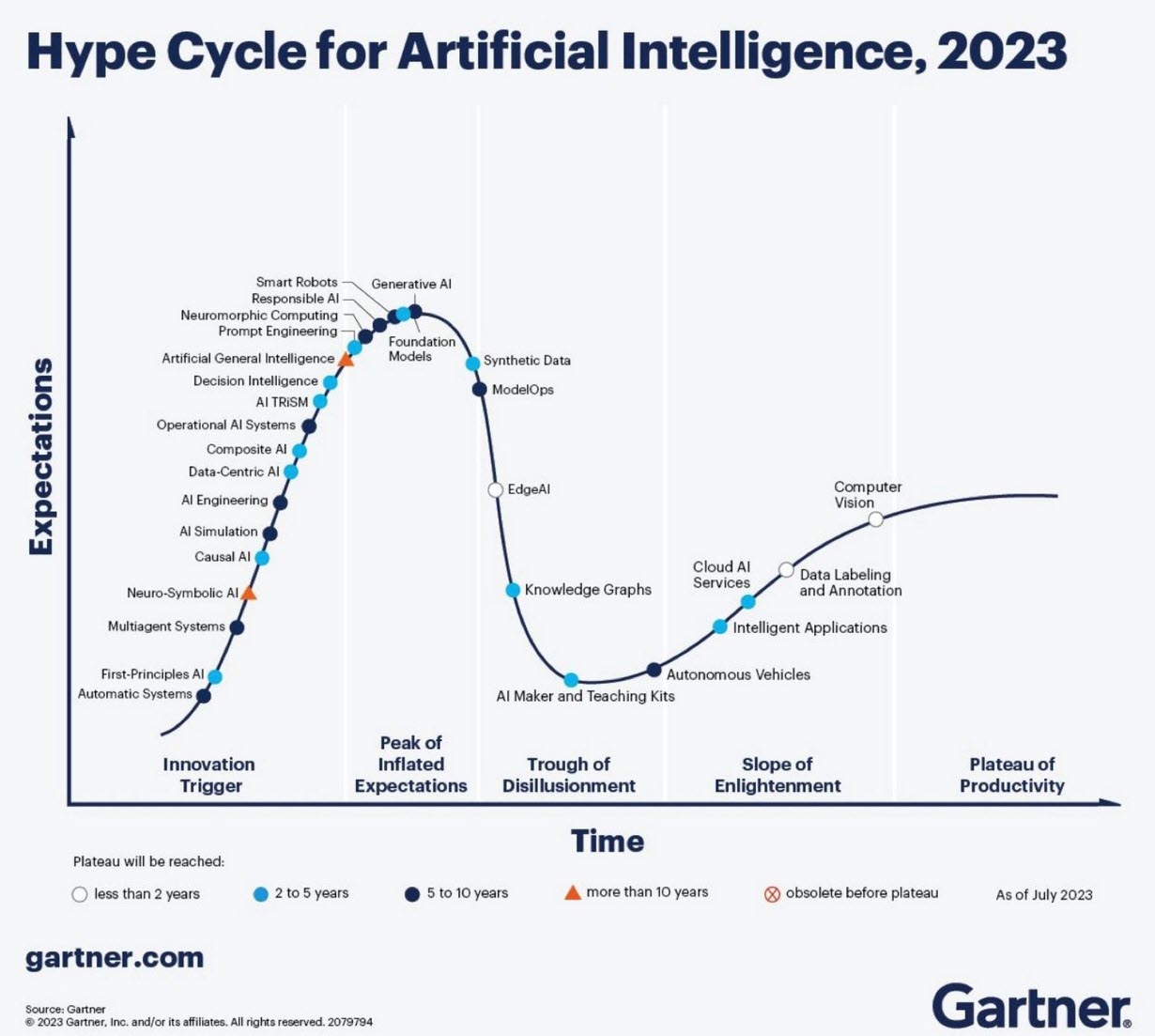
Where are you on the AI hype cycle ?
 In my first discussion with Rob Ferrone, the original Product Data PLuMber, we discussed the necessary foundation for implementing a Digital Thread or leveraging AI capabilities beyond the hype. This is important because all these concepts require data quality and data governance as essential elements.
If you missed part 1, here is the link: Data Quality and Data Governance – A hype?
 Rob, did you receive any feedback related to part 1? I spoke with a company that emphasized the importance of data quality; however, they were more interested in applying plasters, as they consider a broader approach too disruptive to their current business. Do you see similar situations?
 Honestly, not much feedback. Data Governance isn’t as sexy or exciting as discussions on Designing, Engineering, Manufacturing, or PLM Technology. HOWEVER, as the saying goes, all roads lead to Rome, and all Digital Engineering discussions ultimately lead to data.
Cristina Jimenez Pavo’s comment illustrates that the question is in the air.:
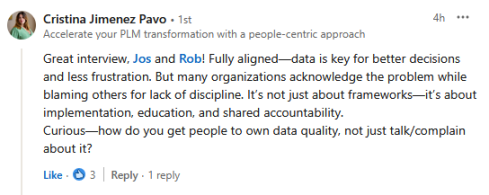
Everyone knows that it should be better; high-performing businesses have good data governance, but most people don’t know how to systematically and sustainably improve their data quality. It’s hard and not glamorous (for most), so people tend to focus on buying new systems, which they believe will magically resolve their underlying issues.
Data governance as a strategy
Thanks for the clarification. I imagine it is similar to Configuration Management, i.e., with different needs per industry. I have seen ISO 8000 in the aerospace industry, but it has not spread further to other businesses. What about data governance as a strategy, similar to CM?
That’s a great idea. Do you mind if I steal it?
If you ask any PLM or ERP vendor, they’ll claim to have a master product data governance template for every industry. While the core principles—ownership, control, quality, traceability, and change management, as in Configuration Management—are consistent, their application must vary based on the industry context, data types, and business priorities.
 Designing effective data governance involves tailoring foundational elements, including data stewardship, standards, lineage, metadata, glossaries, and quality rules. These elements must reflect the realities of operations, striking a balance between trade-offs such as speed versus rigor or openness versus control.
The challenge is that both configuration management (CM) and data governance often suffer from a perception problem, being viewed as abstract or compliance-heavy. In truth, they must be practical, embedded in daily workflows, and treated as dynamic systems central to business operations, rather than static documents.
Think of it like the difference between stepping on a scale versus using a smartwatch that tracks your weight, heart rate, and activity, schedules workouts, suggests meals, and aligns with your goals.
Governance should function the same way:
responsive, integrated, and outcome-driven.
Who is responsible for data quality?
I have seen companies simplifying data quality as an enhancement step for everyone in the organization, like a “You have to be more accurate” message, similar perhaps to configuration management. Here we touch people and organizational change. How do you make improving data quality happen beyond the wish?
In most companies, managing product data is a responsibility shared among all employees. But increasingly complex systems and processes are not designed around people, making the work challenging, unpleasant, and often poorly executed.
I like to quote Larry English – The Father of Information Quality:
“Information producers will create information only to the quality level for which they are trained, measured and held accountable.”
A common reaction is to add data “police” or transactional administrators, who unintentionally create more noise or burden those generating the data.
The real solution lies in embedding capable, proactive individuals throughout the product lifecycle who care about data quality as much as others care about the product itself – it was the topic I discussed at the 2025 Share PLM summit in Jerez – Rob Ferrone – Bill O-Materials also presented in part 1 of our discussion.
These data professionals collaborate closely with designers, engineers, procurement, manufacturing, supply chain, maintenance, and repair teams. They take ownership of data quality in systems, without relieving engineers of their responsibility for the accuracy of source data.
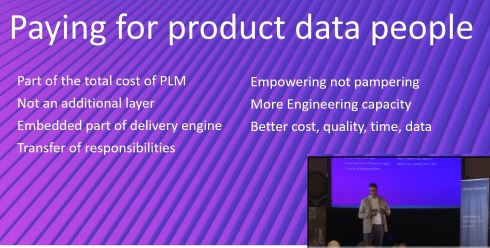
Some data, like component weight, is best owned by engineers, while others—such as BoM structure—may be better managed by system specialists. The emphasis should be on giving data professionals precise requirements and the authority to deliver.
They not only understand what good data looks like in their domain but also appreciate the needs of adjacent teams. This results in improved data quality across the business, not just within silos. They also work with IT and process teams to manage system changes and lead continuous improvement efforts.
The real challenge is finding leaders with the vision and drive to implement this approach.

The costs or benefits associated with good or poor data quality
At the peak of interest in being data-driven, large consulting firms published numerous studies and analyses, proving that data-driven companies achieve better results than their data-averse competitors. Have you seen situations where the business case for improving “product data” quality has led to noticeable business benefits, and if so, in what range? Double digit, single digit?
Improving data quality in isolation delivers limited value. Data quality is a means to an end. To realise real benefits, you must not only know how to improve it, but also how to utilise high-quality data in conjunction with other levers to drive improved business outcomes.
I built a company whose premise was that good-quality product data flowing efficiently throughout the business delivered dividends due to improved business performance. We grew because we delivered results that outweighed our fees.

Last year’s turnover was €35M, so even with a conservatively estimated average in-year ROI of 3:1, the company delivered over € 100 M of cost savings or additional revenue per year to clients, with the majority of these benefits being sustainable.
There is also the potential to unlock new value and business models through data-driven innovation.
For example, connecting disparate product data sources into a unified view and taking steps to sustainably improve data quality enables faster, more accurate, and easier collaboration between OEMs, fleet operators, spare parts providers, workshops, and product users, which leads to a new value proposition around minimizing painful operational downtime.
AI and Data Quality
Currently, we are seeing numerous concepts emerge where AI, particularly AI agents, can be highly valuable for PLM. However, we also know that in legacy environments, the overall quality of data is poor. How do you envision AI supporting PLM processes, and where should you start? Or has it already started?
It’s like mining for rare elements—sifting through massive amounts of legacy data to find the diamonds. Is it worth the effort, especially when diamonds can now be manufactured? AI certainly makes the task faster and easier. Interestingly, Elon Musk recently announced plans to use AI to rewrite legacy data and create a new, high-quality knowledge base. This suggests a potential market for trusted, validated, and industry-specific legacy training data.
Will OEMs sell it as valuable IP, or will it be made open source like Tesla’s patents?
 AI also offers enormous potential for data quality and governance. From live monitoring to proactive guidance, adopting this approach will become a much easier business strategy. One can imagine AI forming the core of a company’s Digital Thread—no longer requiring rigidly hardwired systems and data flows, but instead intelligently comparing team data and flagging misalignments.
That said, data alignment remains complex, as discrepancies can be valid depending on context.
A practical starting point?
Data Quality as a Service. My former company, Quick Release, is piloting an AI-enabled service focused on EBoM to MBoM alignment. It combines a data quality platform with expert knowledge, collecting metadata from PLM, ERP, MES, and other systems to map engineering data models.
 Experts define quality rules (completeness, consistency, relationship integrity), and AI enables automated anomaly detection. Initially, humans triage issues, but over time, as trust in AI grows, more of the process can be automated. Eventually, no oversight may be needed; alerts could be sent directly to those empowered to act, whether human or AI.
Summary
We hope the discussions in parts 1 and 2 helped you understand where to begin. It doesn’t need to stay theoretical or feel unachievable.
- The first step is simple: recognise product data as an asset that powers performance, not just admin.
Then treat it accordingly. - You don’t need a 5-year roadmap or a board-approved strategy before you begin. Start by identifying the product data that supports your most critical workflows, the stuff that breaks things when it’s wrong or missing. Work out what “good enough” looks like for that data at each phase of the lifecycle.
Then look around your business: who owns it, who touches it, and who cares when it fails? - From there, establish the roles, rules, and routines that help this data improve over time, even if it’s manual and messy to begin with. Add tooling where it helps.
- Use quality KPIs that reflect the business, not the system. Focus your governance efforts where there’s friction, waste, or rework.
- And where are you already getting value? Lock it in. Scale what works.
Conclusion
It’s not about perfection or policies; it’s about momentum and value. Data quality is a lever. Data governance is how you pull it.
Just start pulling- and then get serious with your AI applications!
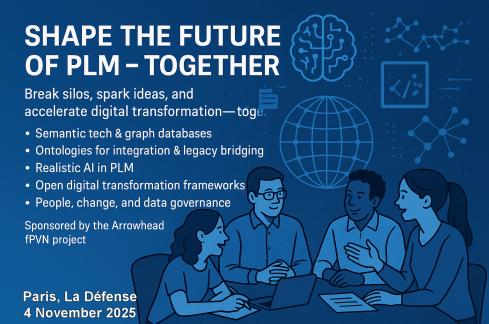
Are you attending the PLM Roadmap/PDT Europe 2025 conference on
November 5th & 6th in Paris, La Defense?
There is an opportunity to discuss the future of PLM in a workshop before the event.
More information will be shared soon; please mark November 4th in the afternoon on your agenda.
 In recent months, I’ve noticed a decline in momentum around sustainability discussions, both in my professional network and personal life. With current global crises—like the Middle East conflict and the erosion of democratic institutions—dominating our attention, long-term topics like sustainability seem to have taken a back seat.
But don’t stop reading yet—there is good news, though we’ll start with the bad.
The Convenient Truth
 Human behavior is primarily emotional. A lesson valuable in the PLM domain and discussed during the Share PLM summit. As SharePLM notes in their change management approach, we rely on our “gator brain”—our limbic system – call it System 1 and System 2 or Thinking Fast and Slow. Faced with uncomfortable truths, we often seek out comforting alternatives.
The film Don’t Look Up humorously captures this tendency. It mirrors real-life responses to climate change: “CO₂ levels were high before, so it’s nothing new.” Yet the data tells a different story. For 800,000 years, CO₂ ranged between 170–300 ppm. Today’s level is ~420 ppm—an unprecedented spike in just 150 years as illustrated below.
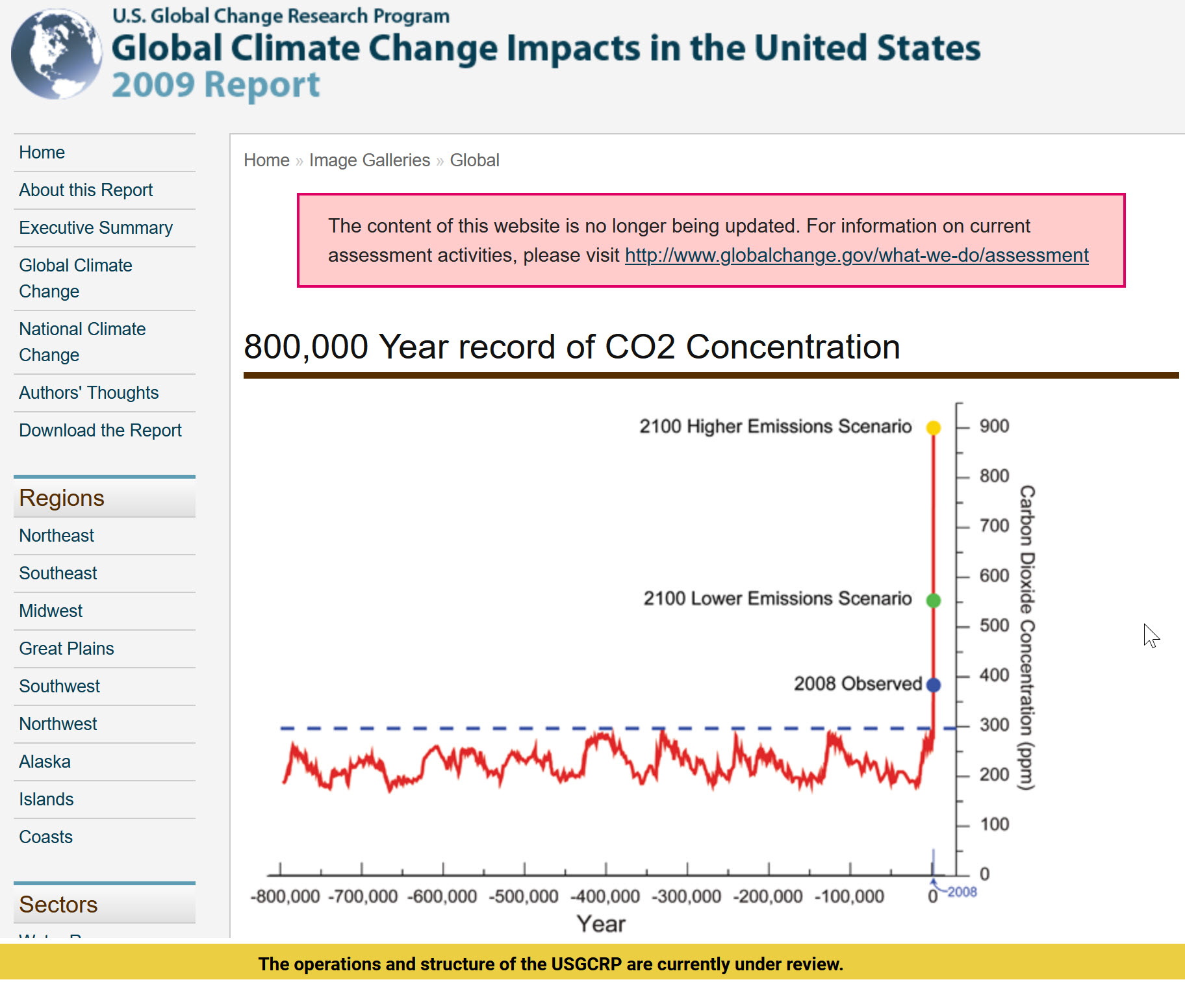
Frustratingly, some of this scientific data is no longer prominently published. The narrative has become inconvenient, particularly for the fossil fuel industry.
Persistent Myths
Then there is the pseudo-scientific claim that fossil fuels are infinite because the Earth’s core continually generates them. The Abiogenic Petroleum Origin theory is a fringe theory, sometimes revived from old Soviet science, and lacks credible evidence. See image below
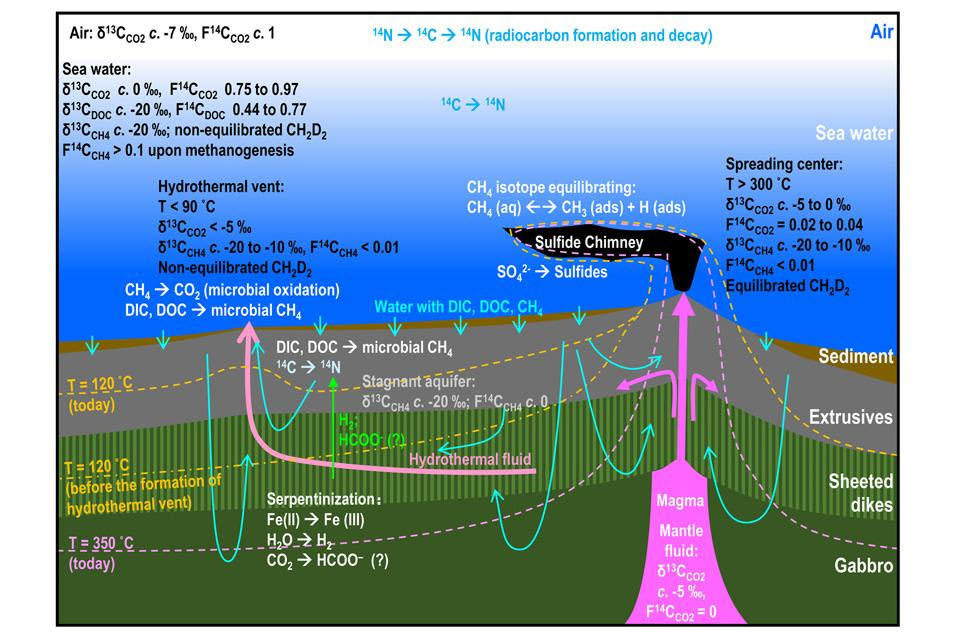
Oil remains a finite, biologically sourced resource. Yet such myths persist, often supported by overly complex jargon designed to impress rather than inform.
The Dissonance of Daily Life
A young couple casually mentioned flying to the Canary Islands for a weekend at a recent birthday party. When someone objected on climate grounds, they simply replied, “But the climate is so nice there!”

“Great climate on the Canary Islands”
This reflects a common divide among young people—some are deeply concerned about the climate, while many prioritize enjoying life now. And that’s understandable. The sustainability transition is hard because it challenges our comfort, habits, and current economic models.
The Cost of Transition
 Companies now face regulatory pressure such as CSRD (Corporate Sustainability Reporting Directive), DPP (Digital Product Passport), ESG, and more, especially when selling in or to the European market. These shifts aren’t usually driven by passion but by obligation. Transitioning to sustainable business models comes at a cost—learning curves and overheads that don’t align with most corporations’ short-term, profit-driven strategies.
However, we have also seen how long-term visions can be crushed by shareholder demands:
- Xerox (1970s–1980s) pioneered GUI, the mouse, and Ethernet, but failed to commercialize them. Apple and Microsoft reaped the benefits instead.
- General Electric under Jeff Immelt tried to pivot to renewables and tech-driven industries. Shareholders, frustrated by slow returns, dismantled many initiatives.
-
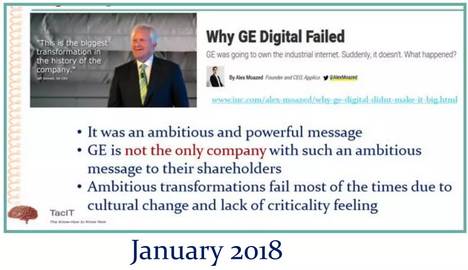
My presentation at the 2019 PLM Roadmap / PDT Europe conference – click on the image to get access through SlideShare.
- Despite ambitious sustainability goals, Siemens faced similar investor pressure, leading to spin-offs like Siemens Energy and Gamesa.
The lesson?
Transforming a business sustainably requires vision, compelling leadership, and patience—qualities often at odds with quarterly profit expectations. I explored these tensions again in my presentation at the PLM Roadmap/PDT Europe 2024 conference, read more here: Model-Based: The Digital Twin.
 I noticed discomfort in smaller, closed-company sessions, some attendees said, “We’re far from that vision. ”
My response: “That’s okay. Sustainability is a generational journey, but it must start now”.
Signs of Hope
Now for the good news. In our recent PGGA (PLM Green Global Alliance) meeting, we asked: “Are we tired?” Surprisingly, the mood was optimistic.
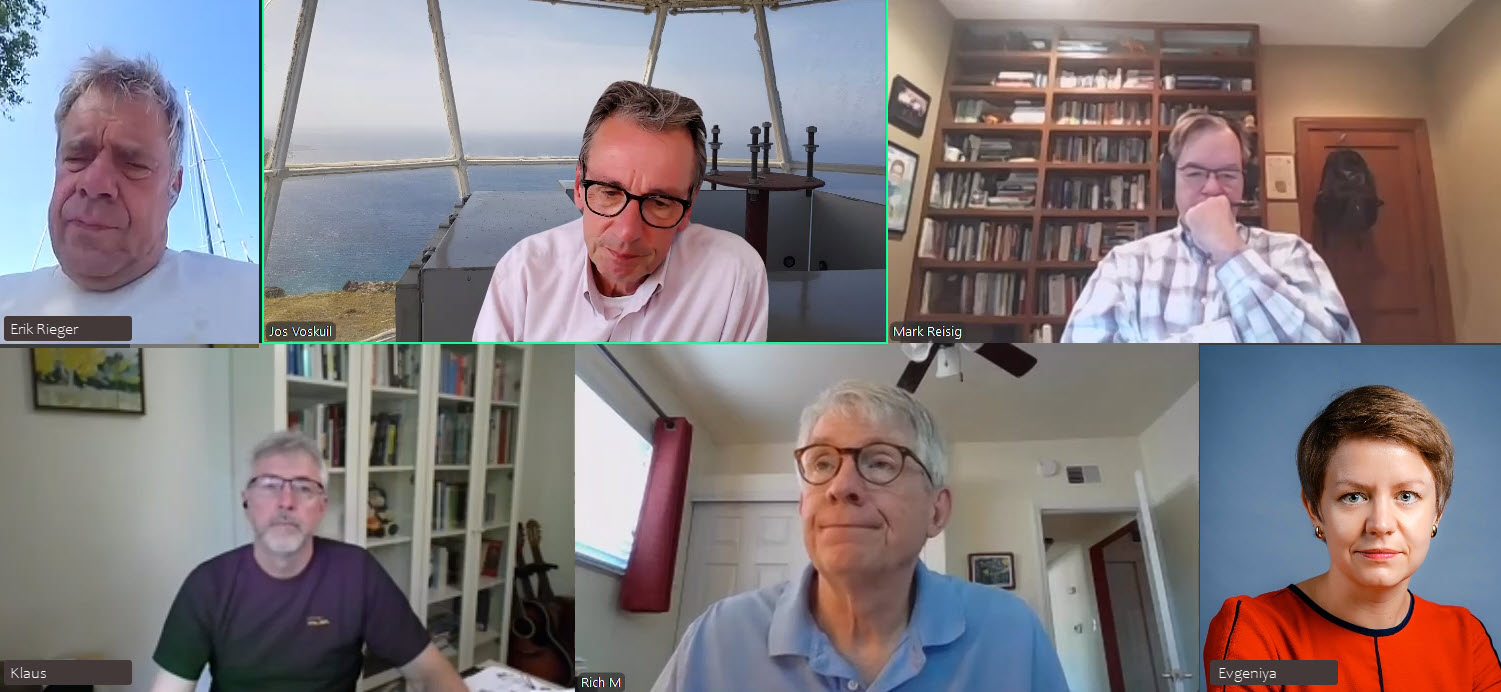
Our PGGA core team meeting on June 20th
Yes, some companies are downscaling their green initiatives or engaging in superficial greenwashing. But other developments give hope:
- China is now the global leader in clean energy investments, responsible for ~37% of the world’s total. In 2023 alone, it installed over 216 GW of solar PV—more than the rest of the world combined—and leads in wind power too. With over 1,400 GW of renewable capacity, China demonstrates that a centralized strategy can overcome investor hesitation.
- Long-term-focused companies like Iberdrola (Spain), Ørsted (Denmark), Tesla (US), BYD, and CATL (China) continue to invest heavily in EVs and batteries—critical to our shared future.
A Call to Engineers: Design for Sustainability
We may be small at the PLM Green Global Alliance, but we’re committed to educating and supporting the Product Lifecycle Management (PLM) community on sustainability.
That’s why I’m excited to announce the launch of our Design for Sustainability initiative on June 25th.
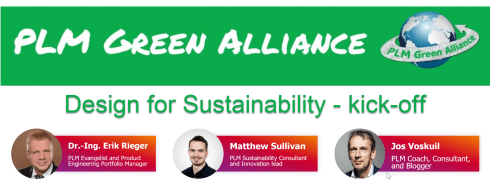
Led by Eric Rieger and Matthew Sullivan, this initiative will bring together engineers to collaborate and explore sustainable design practices. Whether or not you can attend live, we encourage everyone to engage with the recording afterward.
Conclusion
Sustainability might not dominate headlines today. In fact, there’s a rising tide of misinformation, offering people a “convenient truth” that avoids hard choices. But our work remains urgent. Building a livable planet for future generations requires long-term vision and commitment, even when it is difficult or unpopular.
So, are you tired—or ready to shape the future?
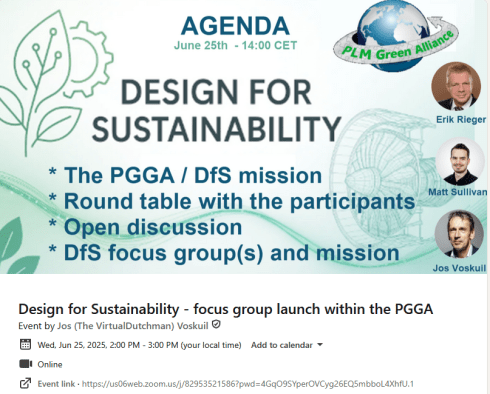
 Jos Voskuil's Weblog
Interesting reflection, Jos. In my experience, the situation you describe is very recognizable. At the company where I work, sustainability…
[…] (The following post from PLM Green Global Alliance cofounder Jos Voskuil first appeared in his European PLM-focused blog HERE.) […]
[…] recent discussions in the PLM ecosystem, including PSC Transition Technologies (EcoPLM), CIMPA PLM services (LCA), and the Design for…
Jos, all interesting and relevant. There are additional elements to be mentioned and Ontologies seem to be one of the…
Jos, as usual, you've provided a buffet of "food for thought". Where do you see AI being trained by a…