
You are currently browsing the category archive for the ‘collaboration’ category.
 During my summer break, I have been thinking about why companies struggle to start a digital transformation and how businesses keep going, struggling to change.
I ended up with Conway’s Law as a demonstration of the biggest inhibitor to digital transformation in companies.
But before that, I need to make two basic statements that form the basis of my plea.
1. PLM is a strategy
 When we mention PLM without the word system, we should think of it as a strategy supported by connected, federated systems.
Most of the time, when I hear people talk about PLM, it sounds like they are talking about their PLM system. A core system needed to implement a Product Lifecycle Management strategy.
For me, PLM (Product Lifecycle Management) starts with the core business processes a company needs to implement to remain a long-term (sustainable) product or solutions provider. More on the solution provider dimension later.

Every company that sells products has a product lifecycle management strategy – see the image above.
When a company focuses only on product data, I am tempted to call it PDM (Product Data Management), which can still support different disciplines.
For me, PLM is the operational environment that helps companies manage their products/solutions throughout the product lifecycle, which means it is influenced by sales, R&D, engineering, manufacturing, service and, increasingly, regulations.
This broad scope makes it clear to me that no single PLM system can effectively support all these demands while providing a user-friendly interface. Even if you are SAP or one of the three major PLM vendors.
To remember:
PLM (Product Lifecycle Management) is a strategy supported by a federated infrastructure, where a PLM or PDM system/platform can be one of the main components.
2. Conway’s Law
 If you have read my blog posts before, you might have come across Conway’s Law; although it is not a real law, more a description of a phenomenon, it’s largely true. Compare it to Moore’s Law or Murphy’s Law.
Let’s start with THE LAW:
Conway’s Law is an observation about how organizations design systems, formulated by computer scientist Melvin Conway in 1967:
“Any organization that designs a system… will inevitably produce a design whose structure is a copy of the organization’s communication structure.”
Conway meant that the organizational architecture of what you build tends to mirror the shape of the team that builds it. If you have a siloed organisation with Sales, R&D, Manufacturing and Service, you will build processes and install systems to support those siloes.
The reason: People can only design what they can communicate about. Coordination across team boundaries is harder than coordination within a team, so design decisions cluster along organisational boundaries.
This observation makes what I often call the COORDINATED approach, the approach companies are following and feel comfortable with – image below:

People can work in their silos, then share information in a linear, document-driven process when requested and needed. Sometimes it is not a document but a Bill of Materials. Handling the BOM is a great example of Conway’s Law that still exists.
An example: The PDM(PLM) – ERP integration
One topic that keeps our community busy is PDM-ERP integration, or, in a more advanced setting, PLM-ERP integration, especially when you consider the MBOM.


A recent debate can be found here: Turbulent times in PLM: The EBOM-MBOM chain is shaking, AI is rattling everything.
Without going into the debate, as there are many dimensions in the PLM domain, the first question to ask is: WHY DO WE PERCEIVE IT AS DIFFICULT?
 Let’s have a look through Conway’s eyes.
- Two silos need to collaborate: engineering on one side and manufacturing preparation, purchasing and manufacturing on the other. Each side has its favorite system, and that’s where the problem starts.
- Instead of analyzing the preferred process, the focus shifts to how to get data into my preferred system easily and reliably. Instead of People, Processes, Data and Tools, it becomes a Tools, Data and Process discussion. People are not considered anymore.
 This approach can lead to ludicrous situations, where an engineer has to request a part number when designing a new product, or, in another case, use a temporary part number until the part is mature enough to be registered in ERP, according to the ERP standard. These are real examples I encountered.
 Historically, SAP drove these scenarios, as its material master message and MDM approach were built around a single connected manufacturing environment.
For SAP, the bridge to engineering is built through custom solutions at the CAD level (CIDEON) or EBOM level, e.g., ECTR (DSC).
Technology has never limited a fluent PDM-ERP interaction, as long as you start at the process level before touching the systems.
I have written many posts around this topic in the past too. Here are a few of them:
2026: The BOM revisited – what are the challenges
2023: The rise and fall of the BOM
2020: Learning from the past
 For me, the discussion is closed; many companies already know the theory and best practices from the past or for their current operations. But will they work on a better future?
The future and Conway’s Law
 In my network, many PLM experts, like Prof. Jörg Fischer or Martin Eigner, can describe an ideal future approach to product lifecycle management. But Oleg Shilovitsky, Benedict Smith, Doug Macdonald and many other voices also describe a potential future, often inspired by an additional graph database layer, sometimes better supported by an ontology. The whole idea is that such an environment is a needed foundation for agent AI.
For example, I like the concept Martin Eigner expresses in the technical architecture. On paper (or slide), the concept looks explainable, though the details are missing.
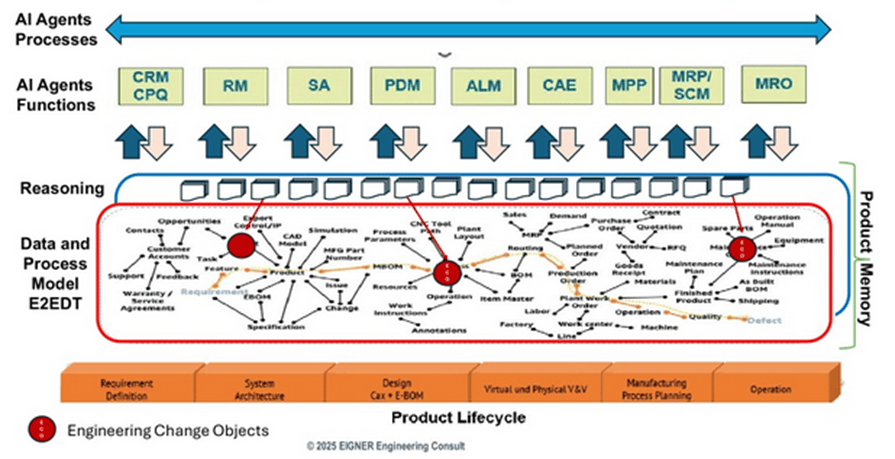
And of course all the PLM software vendors have similar offerings related to the concept above – the only question to ask yourself as an enterprise is:
“Who owns the data and who owns the knowledge – be aware of a lock-in”
At the upcoming PLM Roadmap & PDT Europe conference in Gothenburg on November 4th & 5th, we will learn about and discuss interesting future concepts, including the application of agentic AI.

Here, I am curious about the following sessions I saw in the agenda:
- Key Findings in the Arrowhead fPVN Project – A Knowledge Graph-Based Digital Twin for Semantic Lifecycle Interoperability
- AI in PLM – Balancing Innovation with Stable Enterprise Architecture
- Digital Threads for Digital Agents & Collaboration: Connecting ALM, Mechanics, E/E, Software and Production
- Ontology-based Data Governance and Enterprise Data Modelling: Standards, AI Readiness and Governance Processes for PLM Data Management, a “Data Town Plan” Approach
- Practical AI Transformation in Enterprise PLM
 Of course, there are more interesting presentations to watch and discussions to have, so if you are interested in a potential technical future, join us in Gothenburg; there are still places left; last year the conference sold out.
How to escape from Conway?
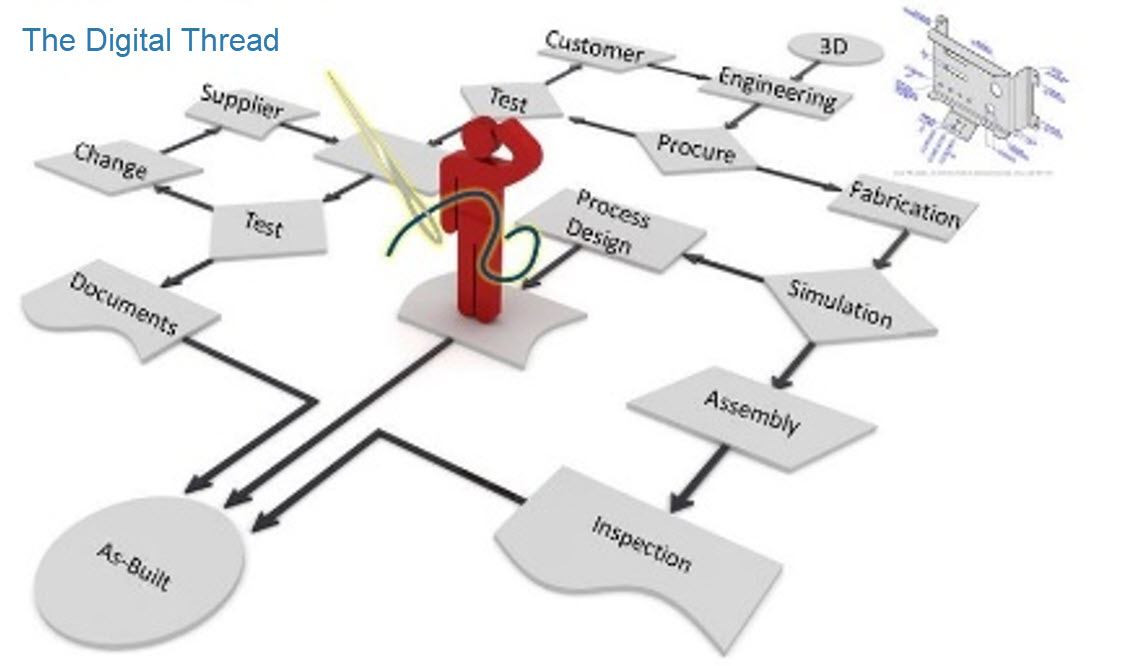 The digital thread is one of those topics that appeared even before AI and has now become a theme companies should implement, supported by their software vendors and system integrators. In many boardrooms, the term “Digital Thread” is mentioned to address the lack of end-to-end visibility in the company, finally enabling full traceability.
However, more important, I believe, is the horizontal business thread, where disciplines work together in real time. Technology and, for sure, AI agents can facilitate this approach; however, as long as every silo in the organisation is optimized for its own performance (Conway’s Law again), no horizontal business thread will emerge.
 I wrote about this topic in June, addressing the mood in the field at the time: The Human Thread, breaking the (PLM) blame game, where I look into the alerting messages that PLM is failing, already with Conway behind the scenes.
I don’t believe Product Lifecycle Management is failing; businesses are failing to transform their organisations, which will lead to new, better operating models.
Too many future strategies are built on an existing siloed organisation, blocking the potential change needed.
 A great book to read in this context is Reshuffle by Sangeet Paul Choudary; he describes the fundamental business changes required to break Conway’s trap.
The challenge is that you cannot delegate this job to middle management; top management needs to understand and execute it once they have mastered the potential strategy.
I consider this one of my major topics for the coming years: educating and coaching organisations to escape Conway’s Law and fully benefit from an AI-supported digital transformation.
Conclusion
This time, a short conclusion – Conway is the elephant in the room – what do you think?

 In nearly twenty years of coaching PLM implementations, I’ve noticed something striking: these projects often mirror politics—not just in complexity, but in the blame game that follows when things go wrong.
When something goes wrong, people rarely see it as an opportunity to solve the issue together. They look for someone to blame instead.
That happens in politics and in Product Lifecycle Management. I wrote about it in 2019, The PLM Blame Game—and most of those observations still hold—although the emphasis has shifted.
But what if the real issue isn’t the system or the technology? What if it’s the human connections—or lack thereof—that determine success?
Political systems/ PLM approaches
In democracies, everyone debates priorities, but progress is slow. Stakeholders defend their own interests, consultants favor preferred solutions, and vendors promise the moon. Long-term plans such as digital transformation often stall.
The result is familiar: each leadership change resets ambitions, leaving users with mixed messages and less commitment – sounds familiar in PLM?.

From: Communication charts around the world
Then there are the autocracies, where a single dominant view determines the path. Usually, that view comes not from the CEO but from the CFO or CIO. These leaders often have a limited understanding of product lifecycle management and instead rely on trusted networks.
That is why some companies choose SAP because “all enterprises run on SAP” or Teamcenter because “everyone in automotive uses Teamcenter.” Strategic consultants reinforce the same pattern with their own preferred solutions.
The result: Surface-level alignment, but resistance beneath the surface—another familiar PLM scenario.

From: Communication charts around the world – 2014 China
In smaller companies, a populist version often appears. Without a strong strategic layer, the loudest voices from vendors and implementers shape the company’s view. That is the riskiest setup because vision and strategy are effectively outsourced. Early in my career, I often heard:
“You know solution XYZ, so tell us what to do.”
The result is predictable: no one in the company feels a true sense of ownership of the business outcome – the type of situations I have been mediating the most.

Of course, the analogy is imperfect. Countries usually lack competition, so citizens cannot simply switch. Still, it is a useful way to frame what happens in PLM.
They – not us – are the problem!
 In the past, debates focused on who was to blame for project problems, often blaming the stakeholder who was not at the table.
Vendors and implementers blamed customers, vendors and customers blamed implementers, and implementers blamed vendors. My role in PLM mediations was to get everyone into the same room.
 But one issue always remained:
Blaming the customer is difficult when the customer is assumed to be right – They are paying the bill and not always with pleasure.
Why 70 % of PLM implementations fail – or not?
 For decades, we have heard horror stories about failed PLM implementations, each supposedly explained by one simple cause.
Depending on who tells the story, the culprit is the software, the company culture, poor user involvement, or unrealistic ambitions without a budget or understanding.
But the truth is more nuanced: many of these implementations did not actually fail completely.
People react strongly to the word failure because no one wants to be associated with it.

Yet, in software, ‘failing fast’ is often celebrated—it’s a way to adapt early. PLM is slowly catching on, with the rise of Minimum Viable Product (MVP) approaches. Instead of waiting for a ‘perfect’ big-bang rollout, companies now start with a working foundation and iterate as needs emerge.”
 That only works if the company owns its vision and strategy. An MVP approach also demands end-to-end stakeholder involvement, because everyone contributes to the solution. At the same time, our limbic brain works against us: it pushes us to protect what we know and react strongly to change.
That reaction shows up in PLM projects too. The loudest critics get the most attention, which makes it easy to conclude a program failed—even when it is working for most people who have adapted to the change.
And now, a new trend has emerged:
PLM systems are failing!
Now, a new claim is gaining traction: PLM systems themselves are failing. With the rise of AI, traditional vendors are being blamed for failing to provide the right infrastructure or opportunities for AI-enabled capabilities.

After years of success built on legacy platforms, vendors now face growing pressure from opinion leaders calling for change.
 Martin Eigner has made this point in several posts:
- Why We’re “Optimizing” Problems We Created Ourselves
- 50 % failure rate is not an accident
- My vision for the next 5 years
 Oleg Shilovitsky has made similar arguments:
- Did We Solve PLM, or Just Learn How to Describe It?
- Who can replace the big three PLM and why that may be the wrong question in the Age of AI?
- Is Product Memory Just a New Name for PLM?
 Prof. Dr. Jörg W. Fischer wrote:
- Will we ever solve PLM? We did, but AI has taken over.
- Digitalization has failed to deliver on its central promise! Why?
 Doug Macdonald wrote about the shortcomings of Legacy PLM, which most companies imagine/practice:
- The shortcomings of Legacy PLM
- Could you manage the development of a toothbrush in a Legacy PLM system
I agree with much of this critique, for sure, if you still consider PLM a system rather than a product lifecycle management strategy implemented through a federated infrastructure of systems.
 The posts I referred to highlight real problems from the past and suggest that new insights and AI might help us build better businesses. The question is whether that promise will be fulfilled.
Creating the human thread
 AI could help businesses break through organizational silos by pulling together information across functions.
That would make concepts such as the digital thread and digital twin easier to implement without relying on dedicated interfaces.
This shift creates both opportunity and risk.
If AI reduces the need for siloed optimization, traditional middle-management roles will change. The key question is whether companies are willing to rethink their structures or stay constrained by Conway’s Law.
It could also make many methodology debates less important.

Today, we as consultants often promote methodologies shaped by our own experience or vendor narratives. The long-running eBOM–mBOM debate is a good example. Across industries and platforms, the answer is often more straightforward than the discussion suggests.
As AI absorbs more collective knowledge, the role of PLM experts and consultants will shift. At the Share PLM Summit in Jerez, we discussed what should come next: a stronger focus on human connection.
 That is why I use the term human thread: the network of relationships that connects people across the business. Michael Finochario (Fino) touches on the same shift in his post on the changing balance between humans and technology, in his review of my session in Jerez.
Others are moving in the same direction. This week, Helene Älander shared a post that makes a similar point.
Helene’s post and the related discussion suggest a growing belief that transformation depends less on technology alone and more on human connection and motivation inside the company.
A quote from Helene’s post, and I recommend reading the full post and thread.
One lesson has stayed with me ever since:
Transformation rarely fails because of technology. It slows down when the distance between executive ambition and middle-management reality becomes too large.
For now, I call this the need for the human thread. A successful transformation starts with an end-to-end human connection across the business, with people treating that connection as a shared priority.
Because people are intrinsically motivated by a human connection.
The human thread requires a new approach, new forms of workshops and learning sessions where leaders, managers, and employees work together on the desired business flow.
Helene Älander points in this direction, and Share PLM supports it through initiatives such as Share The Nest.
Also this year at the Share PLM Summit in Jerez, Andreas Wank described how Pepperl+Fuchs made a breakthrough by bringing people together. As Fino in his review post quoted:
No one on the team wanted to make a decision because every decision affected someone else. So they put 30 people in one room for a week and forced them to make decisions. Not perfect decisions. Working hypotheses. That was a critical insight: In PLM, waiting for perfect certainty kills momentum.
The year before, at the 2025 Share PLM Summit, Andrea Järvrén already shared a similar lesson, describing how Tetra Pak used design sprints to advance its PLM work by prioritizing human interaction.
It is an unstoppable trend – the human thread popping up in more and more conversations.
Conclusion
The time for blaming systems, technology, and methodology should fade into the background. Companies need to focus on building business flow through the human thread—the human connections that drive commitment, motivation, and change.
So, here is the question: Are we ready to stop blaming systems and start building the human thread? Or will we keep repeating the same patterns, just with fancier technology?

Recently, I have been reading some interesting posts beyond all the technical discussions related to PLM and AI. Is PLM becoming obsolete? Are we heading to a new type of infrastructure based on MCP agents? Are these agents an example of new ways of collaboration?
Collaboration – it pops up everywhere!

Here is a quote from the article that triggered me:
The 𝐧𝐮𝐦𝐛𝐞𝐫 𝐨𝐧𝐞 𝐫𝐞𝐚𝐬𝐨𝐧 organizations deploy MBSE is not simulation or architecture development. It is 𝐞𝐧𝐡𝐚𝐧𝐜𝐞𝐝 𝐜𝐨𝐥𝐥𝐚𝐛𝐨𝐫𝐚𝐭𝐢𝐨𝐧 𝐚𝐧𝐝 𝐜𝐨𝐦𝐦𝐮𝐧𝐢𝐜𝐚𝐭𝐢𝐨𝐧 — at 67%. But here is the uncomfortable part.
Only 24% reported actually achieving collaboration as a business outcome. That is a 43-point gap between intent and result. Traceability is even worse — 48% deploy MBSE for it, 9% say they have realized it.
What if the problem is not that MBSE fails to deliver collaboration — but that most organizations 𝐧𝐞𝐯𝐞𝐫 𝐝𝐞𝐟𝐢𝐧𝐞 𝐰𝐡𝐚𝐭 𝐛𝐞𝐭𝐭𝐞𝐫 𝐜𝐨𝐥𝐥𝐚𝐛𝐨𝐫𝐚𝐭𝐢𝐨𝐧 𝐥𝐨𝐨𝐤𝐬 𝐥𝐢𝐤𝐞 in measurable terms?
Chad Jackson’s article aligns with many other discussions I had with companies related to PLM (and MBSE) – itinspired me to focus this time on collaboration.
How do we measure collaboration?
 My 2015 blog post has the same title: How do you measure collaboration? The post was written at a time when PLM collaboration had to compete with ERP execution stories. Often, engineering collaboration was considered an inefficient process to be fixed in the future, according to some ERP vendors.
 ERP always had a strong voice at the management level—boxes on an org chart, reporting lines, clear ownership and KPIs flowing upward. You could see how the company was performing.
From the management side, accountability flows downward. The architecture of the organization mirrors the architecture of the product, and the architecture of the product mirrors the architecture of the organization.
We have known this for decades; it is Conway’s Law. Yet we are still surprised when silos emerge exactly where we designed them.
The Management Dilemma
 In many of my engagements, the company’s management often struggles to understand the value of collaboration because there is no direct line between collaboration and immediate performance. Revenue can be measured. Cycle times can be measured. Defects can be measured. Even employee turnover can be measured.
But collaboration? What is the KPI?
It is a fair question. If something cannot be quantified, it becomes subjective and depends on gut feelings. And if it cannot be tied directly to quarterly results, it often becomes optional.
 The problem is not that collaboration has no impact on performance – look at the introduction of email in companies. Did your company make a business case for that?
Still, it improved collaboration a lot, and sometimes it became a burden with all the CC-messages and epistles exchanged.
Collaboration has an impact, deeply and systematically. But its impact is indirect, delayed, and distributed. It reduces friction, can improve shared understanding and prevent expensive rework.
 The return on investment on collaboration is real, but it does not show up as a clean, linear metric.
For a hierarchical and linearly structured organization, horizontal collaboration is often hard to “sell.”
Back to Conway’s Law
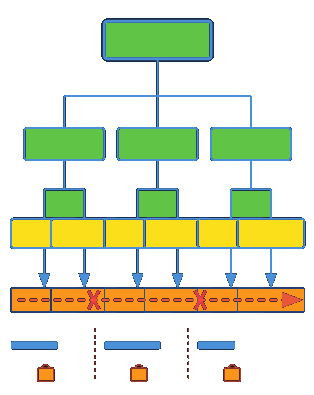 Organizational structure shapes communication patterns. Communication patterns shape systems.
If your organization is vertical, your product will be vertical. If your incentives are local, your decisions will be local. If your teams are isolated, your solutions will be fragmented.
You cannot expect horizontal behavior from a vertically optimized structure without friction.
Disconnected collaboration initiatives fail because they try to overlay horizontal tools on top of vertical incentives.
Attempts like a new collaboration platform or using shared workspace technology to incentivize collaboration are examples of this approach.
But the underlying structure remains untouched. People are still measured on local performance. Budgets are still allocated per department. Promotions still reward vertical success.
 First question to ask in your company: Who is responsible for your PLM/collaboration infrastructure for non-transactional information?
Most likely, it is in the IT or Engineering silo, rarely on a higher organizational level.
And then we are surprised when collaboration stalls?
The Myth of the Tool
Whenever collaboration becomes a pain, people look for IT tools as a cure.
 “We need better platforms.”
“We need integrated systems.”
and now:
“We need AI – the AI agents will do the collaboration for us.”
Tools matter, but they are amplifiers. They amplify existing behavior. They do not create it. While finalizing this article, I saw this post from Dr. Sebastian Wernicke coming in, containing this quote:
Agents are software. Maturity is culture. And culture, inconveniently, doesn’t come with an install package.
If trust is low, a collaboration platform becomes a battlefield. If incentives are misaligned, shared dashboards become weapons. If fear dominates, transparency becomes a threat.
Collaboration is not a software problem. It is a human problem. Which brings us to something that is rarely discussed in boardrooms: the intrinsic motivation of its employees.
The Limbic Brain Is Always There
Beneath the rational layer of strategy and planning sits something older: the limbic system. The part of us that cares about belonging, safety, recognition, autonomy, and purpose.
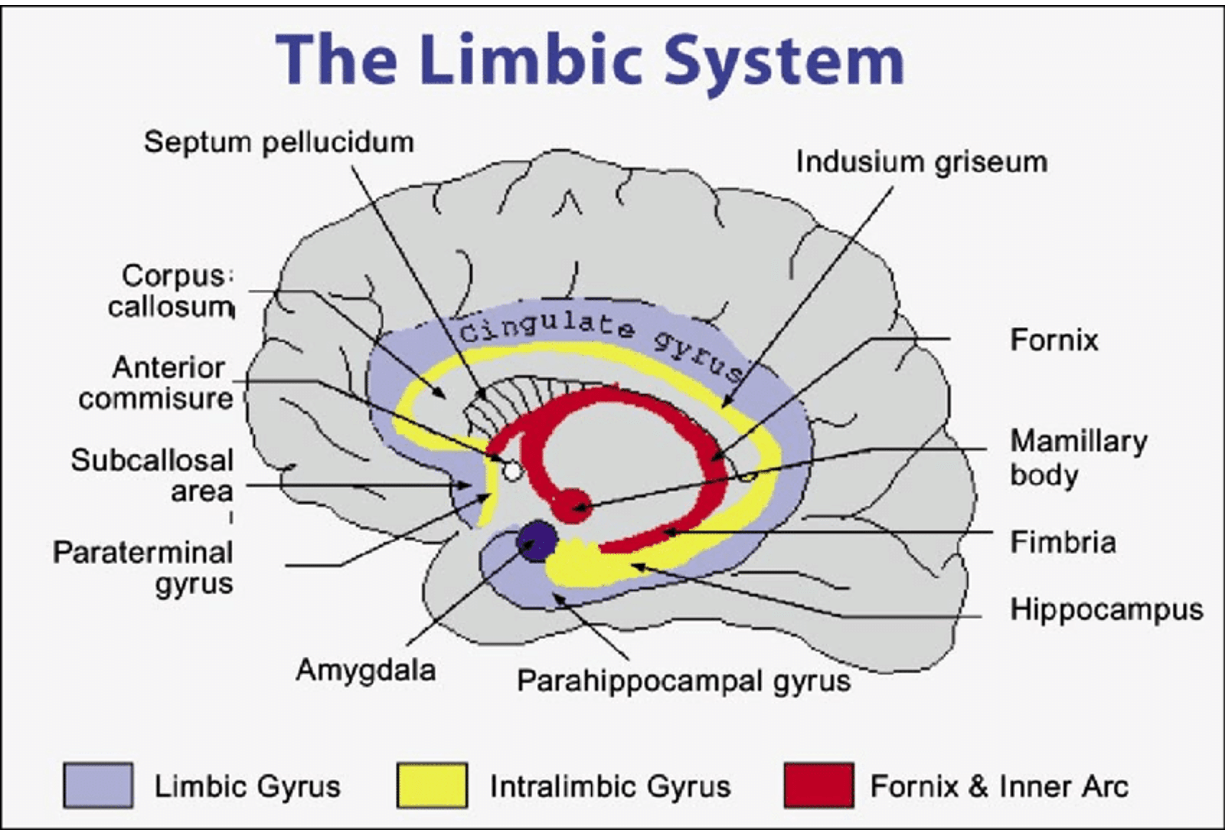
Collaboration thrives when the limbic brain’s needs are met. It collapses when they are threatened.
- If people feel unsafe, they protect information!
- If they feel undervalued, they withdraw effort!
- If they feel controlled, they resist alignment!
You cannot mandate collaboration if the emotional system of the organization is defensive.
The question is not “How do we force collaboration?”
The question is “How do we create conditions where collaboration feels natural?”
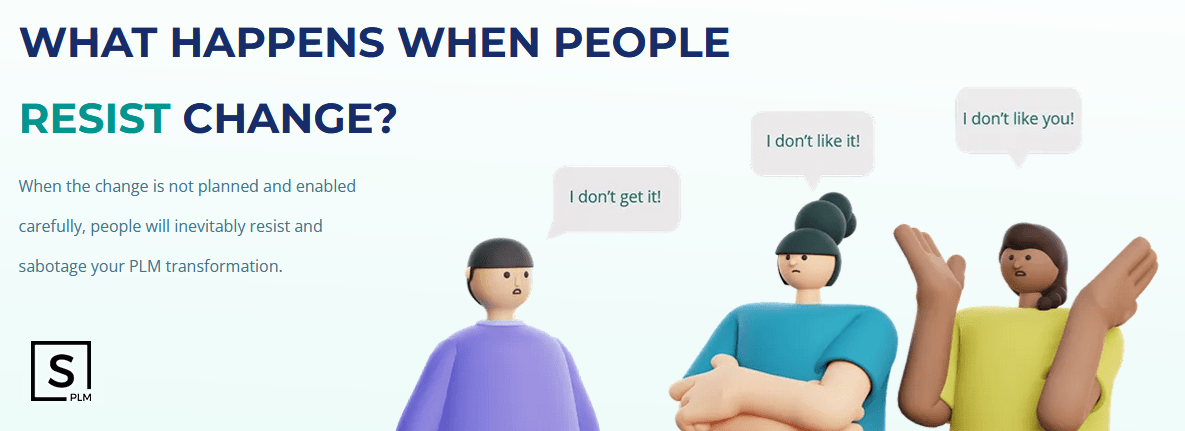
And that requires leaders to connect to the human, not just to the role or an artificial intelligence solution. They should be inspired by this iconic image from Share PLM:
Besides a difficult-to-quantify ROI, there is another reason why collaboration struggles to gain executive traction: it rarely creates immediate success.
It prevents future failure, and we humans in general do not prioritize prevention, thinking of our environmental, financial and potential even health behavior. Where prevention has the lowest cost, most of the time, fixing the damage lies in our nature.
 For companies, it is easier to celebrate the hero who fixes a late-stage integration disaster than the quiet team that prevented it months earlier through cross-functional dialogue.
For me, the firefighters are the biggest challenge to successfully implementing a PLM infrastructure. The image to the left comes from a 2014 presentation when discussing potential resistance to a successful PLM implementation.
In vertical systems, firefighting is visible. Prevention is silent and therefore collaboration activities feel like a cost center rather than a strategic lever.
Where to Push, Where to Invest?
 If you cannot directly measure collaboration, where should you push? Not in tools alone, slogans or one-off workshops. Invest in shared experiences.
When people meet outside their vertical silos, something subtle shifts. They see faces instead of functions. They understand constraints instead of assuming incompetence. They replace narratives with conversations.
 Note: shared experiences are not the same as planned online webmeetings that became popular during and after COVID. They have a rigid regime of collaboration enforcement, back-to-back in many companies, most of the time lacking the typical “coffee machine” experiences.
Also, when looking at events where people share experiences, there is a difference between a traditional vertical PLM/CM/IT/ERP conference where specialists focus on one discipline and on the other side, a human-centric conference, where humans share their experiences in an organization.
The Share PLM Summit in May last year was an eye-opener for me. Starting from the human perspective brought a lot of energy and willingness to discuss various insights – collaboration at its best.
Events, summits, workshops—when done well—create human connection. They remind participants that behind every deliverable sits a person trying to do meaningful work.
The focus on the human perspective is not soft. It is strategic because collaboration is not primarily about information exchange. It is about relationship quality and trust.
The Real Question
 The question is not whether collaboration is valuable. The question is whether we are willing to adjust our vertical incentives to make it possible.
Because collaboration is not free, it requires time. It requires emotional energy. It requires psychological safety. It sometimes requires giving up local control for global benefit.
In systems terms, it requires shifting from local optimization to whole-system optimization.
That is uncomfortable.
But if our products are complex, interconnected, and rapidly evolving—as most are today—then vertical thinking alone is no longer sufficient. The world has become horizontal, even if our org charts have not.
And perhaps the real challenge is not how to measure collaboration, but how to design organizations where collaboration is no longer something we need to sell at all. An article from McKinsey might inspire you here for this transition – for me, it did: Toward an integrated technology operating model.

Beyond AI
While everyone talks and writes about AI, I do not believe AI will solve the collaboration issue. For sure, AI collaboration with agents will increase personal and organizational effectiveness, but it never touches our limbic brain, the irreplaceable part that makes us typical humans and unique.
There will always be a need for that, unless we become numb and addicted to the AI environments. There are various studies popping up on how AI “untrains” our brain muscles, reduces patience and deep thinking. Finding a new human balance is crucial.
Conclusion
Triggered by Chad Jackson’s post about MBSE and collaboration, I took the time to deep-dive into the aspects of collaboration in the PLM domain. How do you manage collaboration?
Come and share your experiences at the upcoming Share PLM 2026 summit from 19-20 May in Jerez. The title of my keynote: Are Humans Still Resources? Agentic AI and the Future of Work and PLM.

I think that it doesn't take a lot of imagination today to at least create some non-vendor-specific tooling. Build it…
Effective collaboration in product lifecycle management can help teams connect different functions and reduce gaps between development stages. I find…
Hi Jos, Knowing your background in methodology and education, I wanted to share a longer article with you: “What is…
Interesting reflection, Jos. In my experience, the situation you describe is very recognizable. At the company where I work, sustainability…
[…] (The following post from PLM Green Global Alliance cofounder Jos Voskuil first appeared in his European PLM-focused blog HERE.) […]