
You are currently browsing the category archive for the ‘Change’ category.
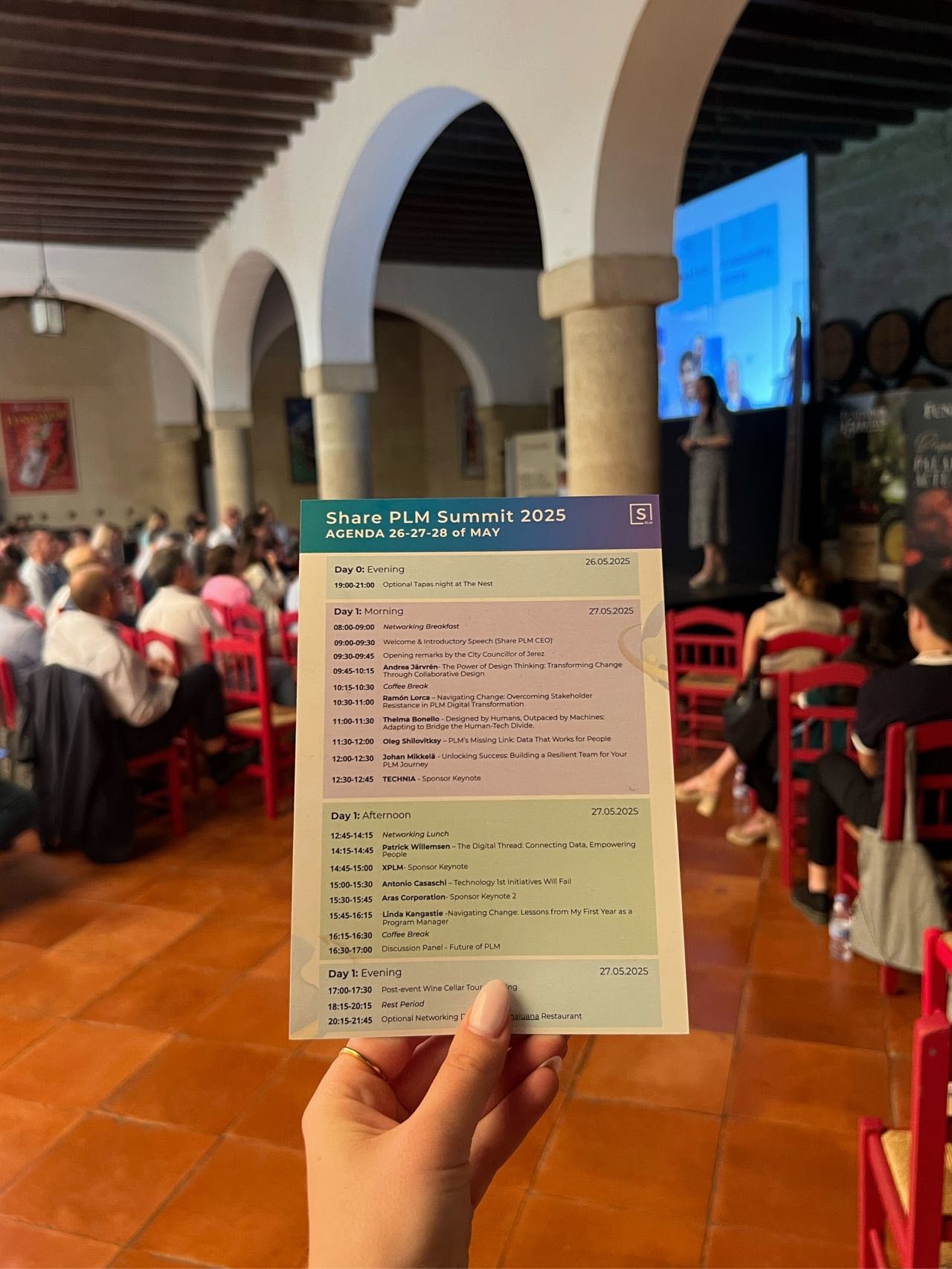 Wow, what a tremendous amount of impressions to digest when traveling back from Jerez de la Frontera, where Share PLM held its first PLM conference. You might have seen the energy from the messages on LinkedIn, as this conference had a new and unique daring starting point: Starting from human-led transformations.
Look what Jens Chemnitz, Linda Kangastie, Martin Eigner, Jakob Äsell or Oleg Shilovitsky had to say.
For over twenty years, I have attended all kinds of PLM events, either vendor-neutral or from specific vendors. None of these conferences created so many connections between the attendees and the human side of PLM implementation.
We can present perfect PLM concepts, architectures and methodologies, but the crucial success factor is the people—they can make or break a transformative project.
Here are some of the first highlights for those who missed the event and feel sorry they missed the vibe. I might follow up in a second post with more details. And sorry for the reduced quality—I am still enjoying Spain and refuse to use AI to generate this human-centric content.
The scenery
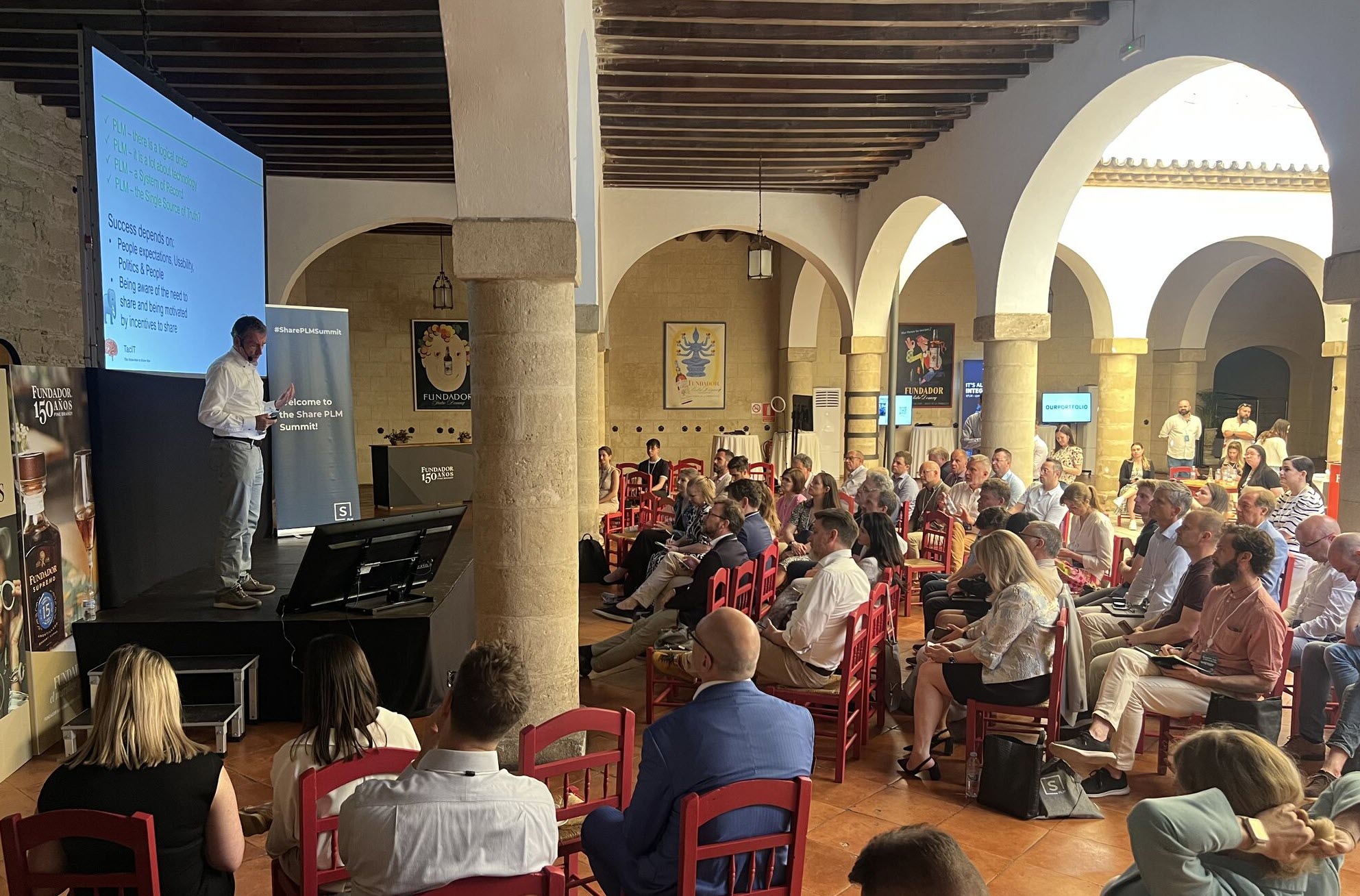
Approximately 75 people have been attending the event in a historic bodega, Bodegas Fundador, in the historic center of Jerez. It is not a typical place for PLM experts, but an excellent place for humans with an Andalusian atmosphere. It was great to see companies like Razorleaf, Technia, Aras, XPLM and QCM sponsor the event, confirming their commitment. You cannot start a conference from scratch alone.
The next great differentiator was the diversity of the audience. Almost 50 % of the attendees were women, all working on the human side of PLM.
 Another brilliant idea was to have the summit breakfast in the back of the stage area, so before the conference days started, you could mingle and mix with the people instead of having a lonely breakfast in your hotel.
Now, let’s go into some of the highlights; there were more.
A warm welcome from Share PLM
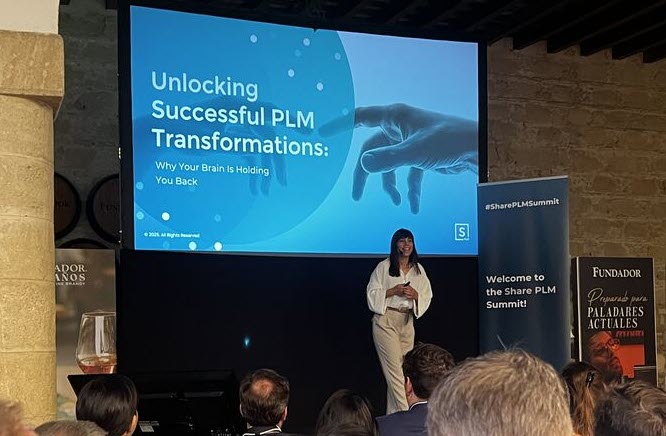
Beatriz Gonzalez, CEO and co-founder of Share PLM, kicked off the conference, explaining the importance of human-led transformations and organizational change management and sharing some of their best practices that have led to success for their customers.
You might have seen this famous image in the past, explaining why you must address people’s emotions.

Working with Design Sprints?
Have you ever heard of design sprints as a methodology for problem-solving within your company? If not, you should read the book by Jake Knapp- Creator of Design Sprint.
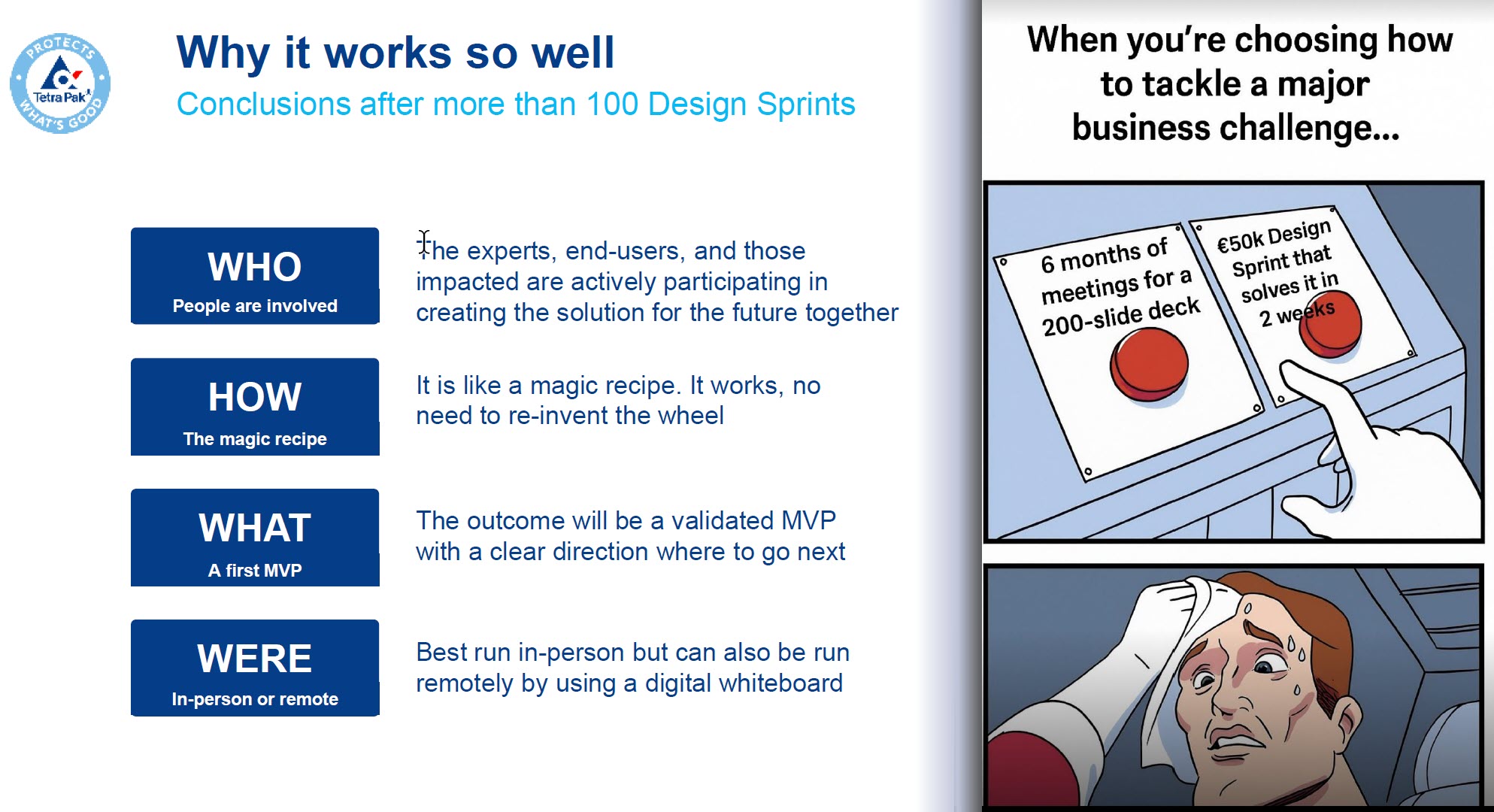
 Andrea Järvén, program manager at Tetra Pak and closely working with the PLM team, recommended this to us. She explained how Tetra Pak successfully used design sprints to implement changes. You would use design sprints when development cycles run too looong, Teams lose enthusiasm and focus, work is fragmented, and the challenges are too complex.
Instead of a big waterfall project, you run many small design sprints with the relevant stakeholders per sprint, coming step by step closer to the desired outcome.
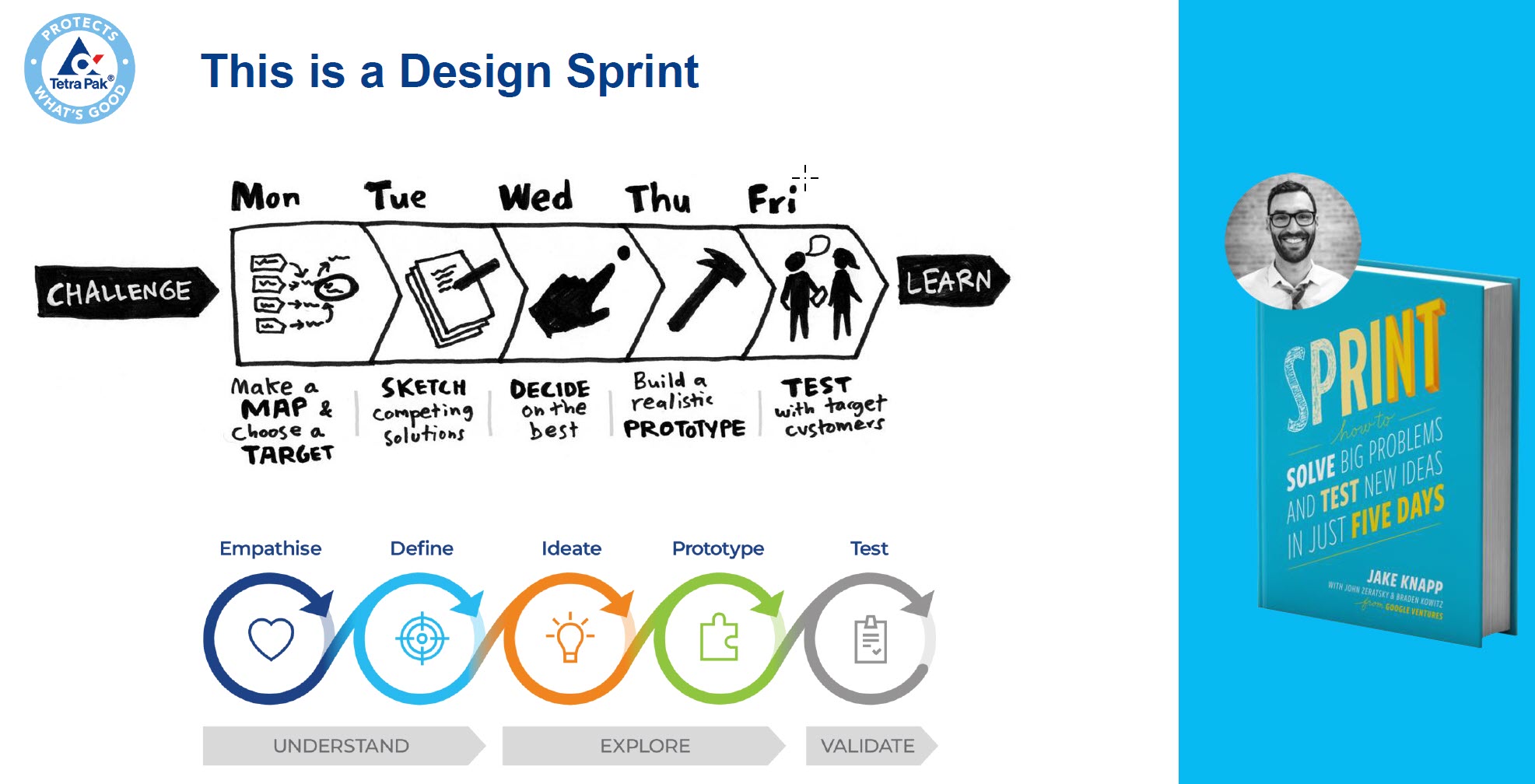
The sprints are short – five days of the full commitment of a team targeting a business challenge, where every day has a dedicated goal, as you can see from the image above.
It was an eye-opener, and I am eager to learn where this methodology can be used in the PLM projects I contribute.
Unlocking Success: Building a Resilient Team for Your PLM Journey
 Johan Mikkelä from FLSmidth shared a great story about the skills, capacities, and mindset needed for a PLM transformational project.
Johan brought up several topics to consider when implementing a PLM project based on his experiences.
One statement that resonated well with the audience of this conference was:
The more diversified your team is, the faster you can adapt to changes.
He mentioned that PLM projects feel like a marathon, and I believe it is true when you talk about a single project.
However, instead of a marathon, we should approach PLM activities as a never-ending project, but a pleasant journey that is not about reaching a finish but about step-by-step enjoying, observing, and changing a little direction when needed.
Strategic Shift of Focus – a human-centric perspective
 Besides great storytelling, Antonio Casaschi‘s PLM learning journey at Assa Abloy was a perfect example of why PLM theory and reality often do not match. With much energy and experience, he came to Assa Abloy to work on the PLM strategy.
He started his PLM strategies top-down, trying to rationalize the PLM infrastructure within Assa Abloy with a historically bad perception of a big Teamcenter implementation from the past. Antonio and his team were the enemies disrupting the day-to-day life of the 200+ companies under the umbrella of Assa Abloy.
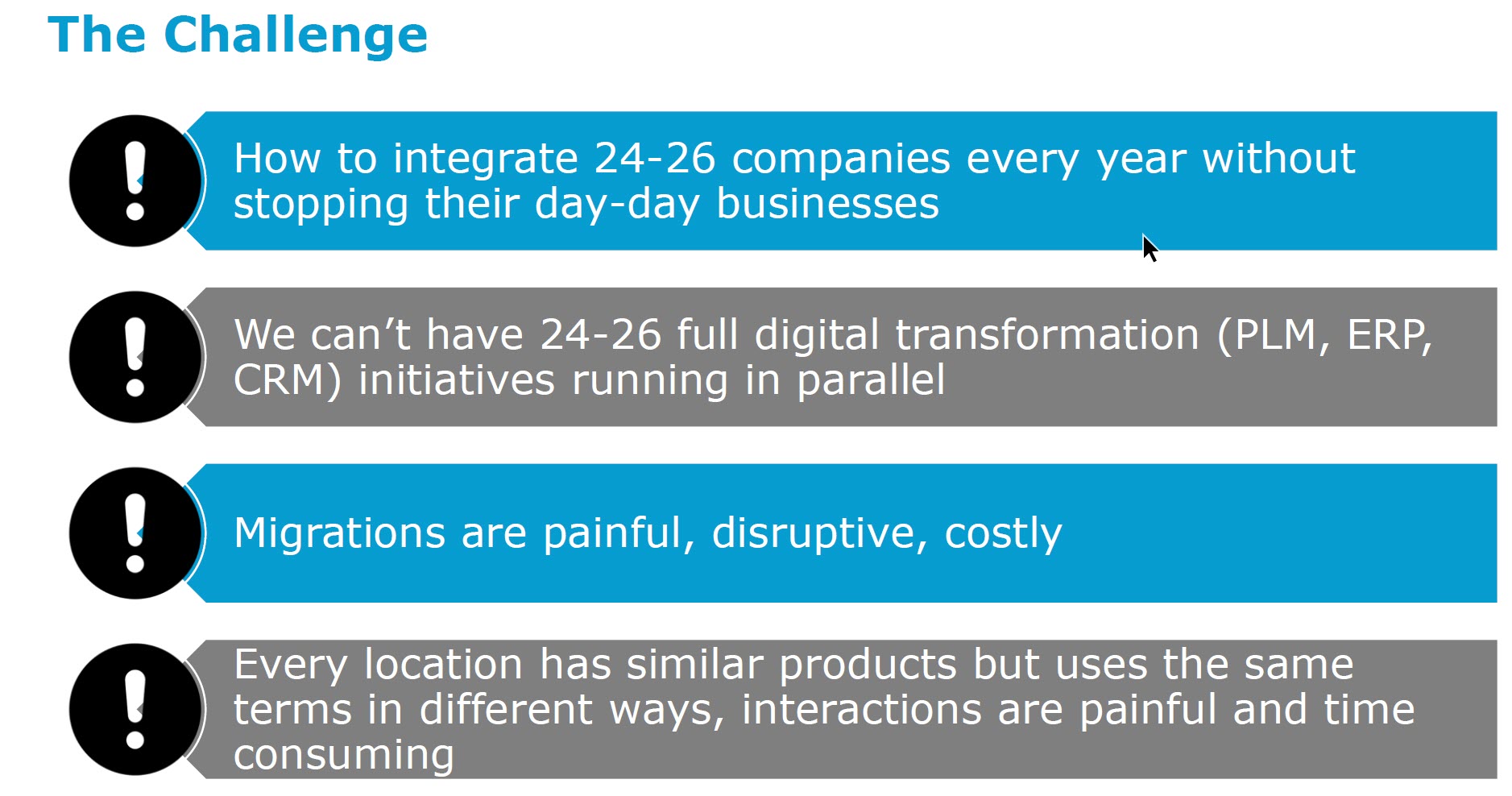
A logical lesson learned here is that aiming top-down for a common PLM strategy is impossible in a company that acquires another six new companies per quarter.
His final strategy is a bottom-up strategy, where he and the team listen to and work with the end-users in the native environments. They have become trusted advisors now as they have broad PLM experience but focus on current user pains. With the proper interaction, his team of trusted advisors can help each of the individual companies move towards a more efficient and future-focused infrastructure at their own pace.
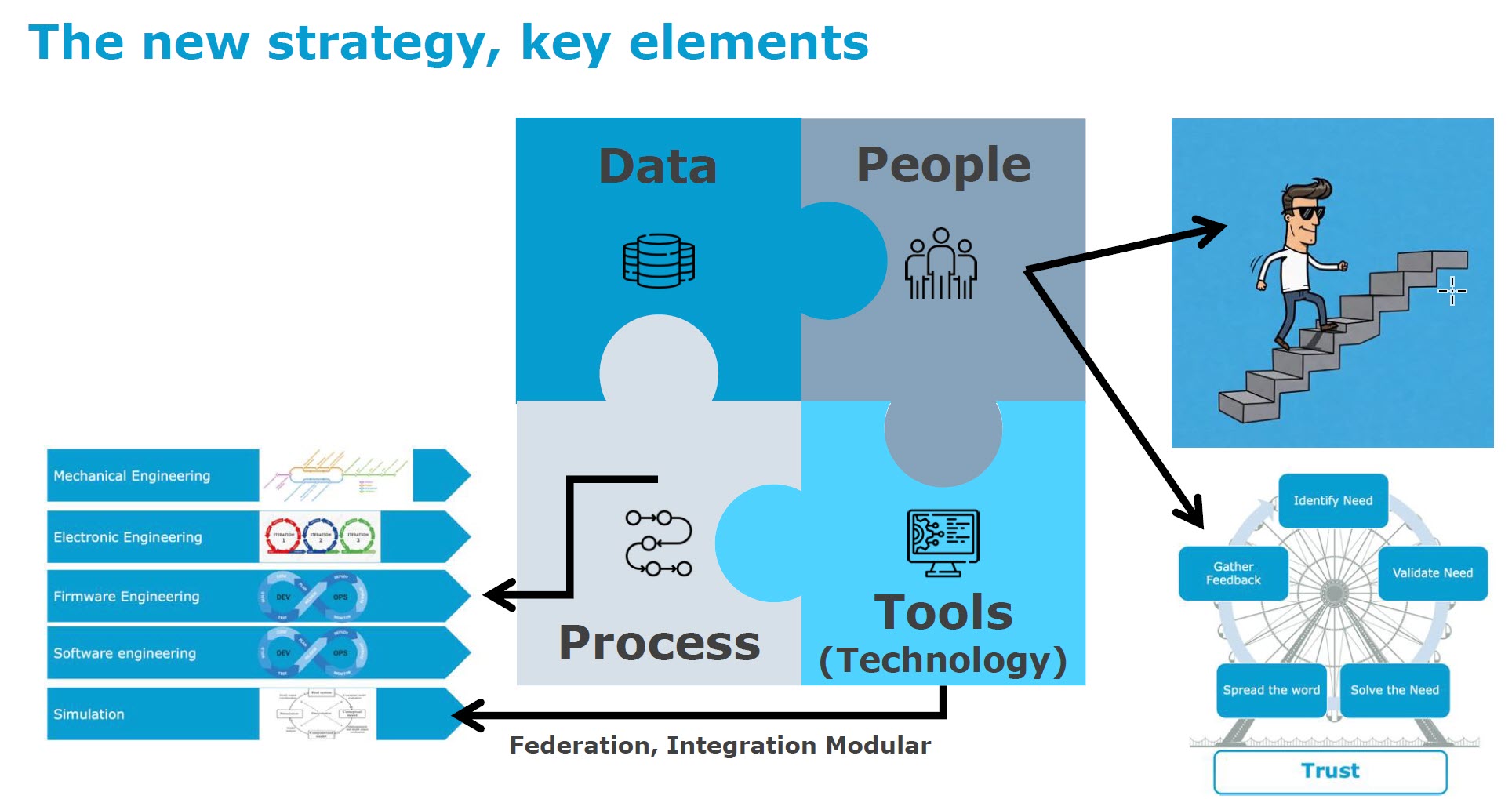
The great lessons I learned from Antonio are:
- If your plan does not work out, be open to failure. Learn from your failures and aim for the next success.
- Human relations—I trust you, understand you, and know what to do—are crucial in such a complex company landscape.
Navigating Change: Lessons from My First Year as a Program Manager
 Linda Kangastie from Valmet Technologies Oy in Finland shared her experiences within the company, from being a PLM key user to now being a PLM program manager for the PAP Digi Roadmap, containing PLM, sales tools, installed base, digitalization, process harmonization and change management, business transformation—a considerable scope.
The recommendations she gave should be a checklist for most PLM projects – if you are missing one of them, ask yourself what you are missing:
- THE ROADMAP and THE BIG PICTURE – is your project supported by a vision and a related roadmap of milestones to achieve?
- Biggest Buy-in comes with money! – The importance of a proper business case describing the value of the PLM activities and working with use cases demonstrating the value.
- Identify the correct people in the organization – the people that help you win, find sparring partners in your organization and make sure you have a common language.
- Repetition – taking time to educate, learn new concepts and have informal discussions with people –is a continuous process.
As you can see, there is no discussion about technology– it is about business and people.
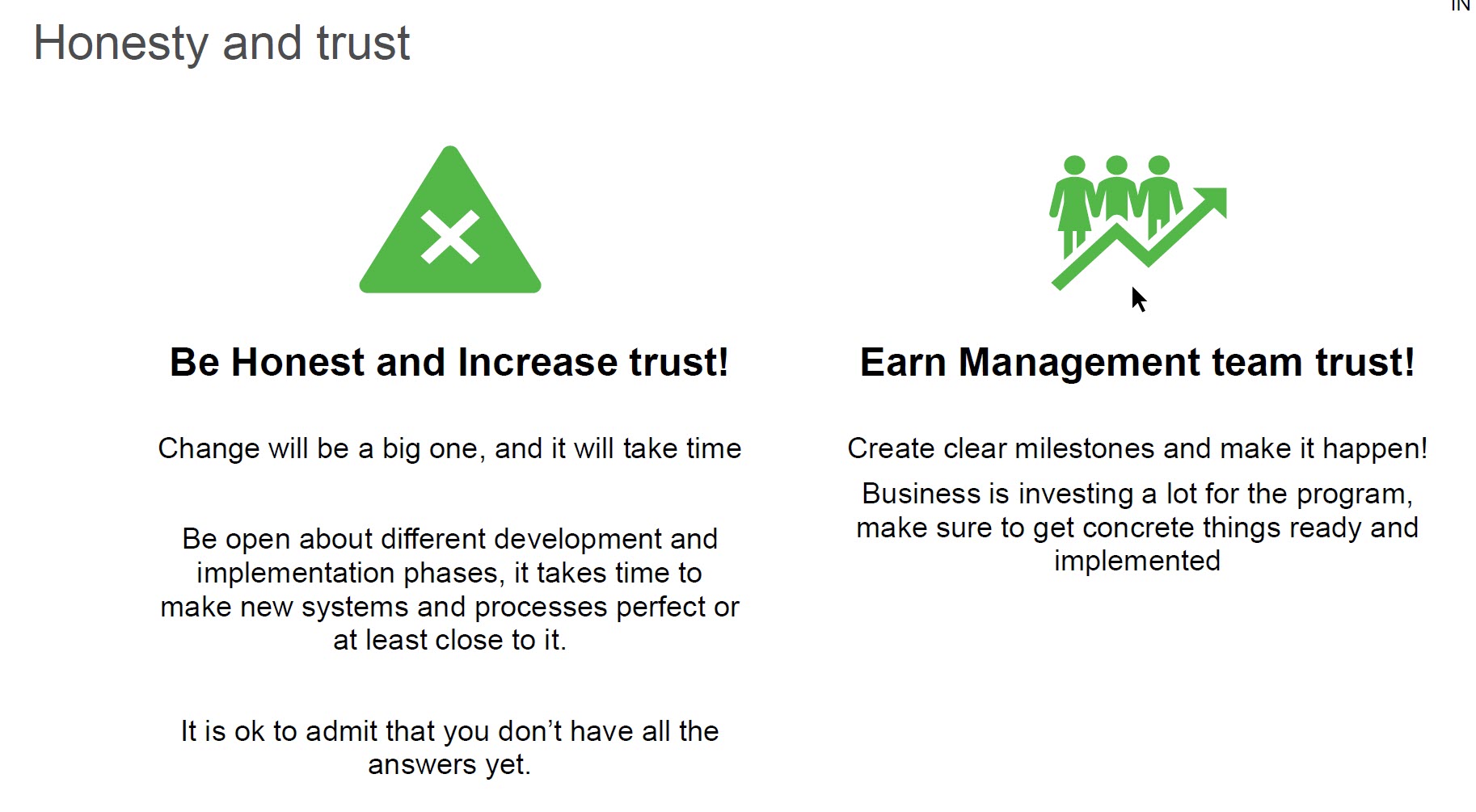
To conclude, other speakers mentioned this topic too; it is about being honest and increasing trust.
The Future Is Human: Leading with Soul in a World of AI
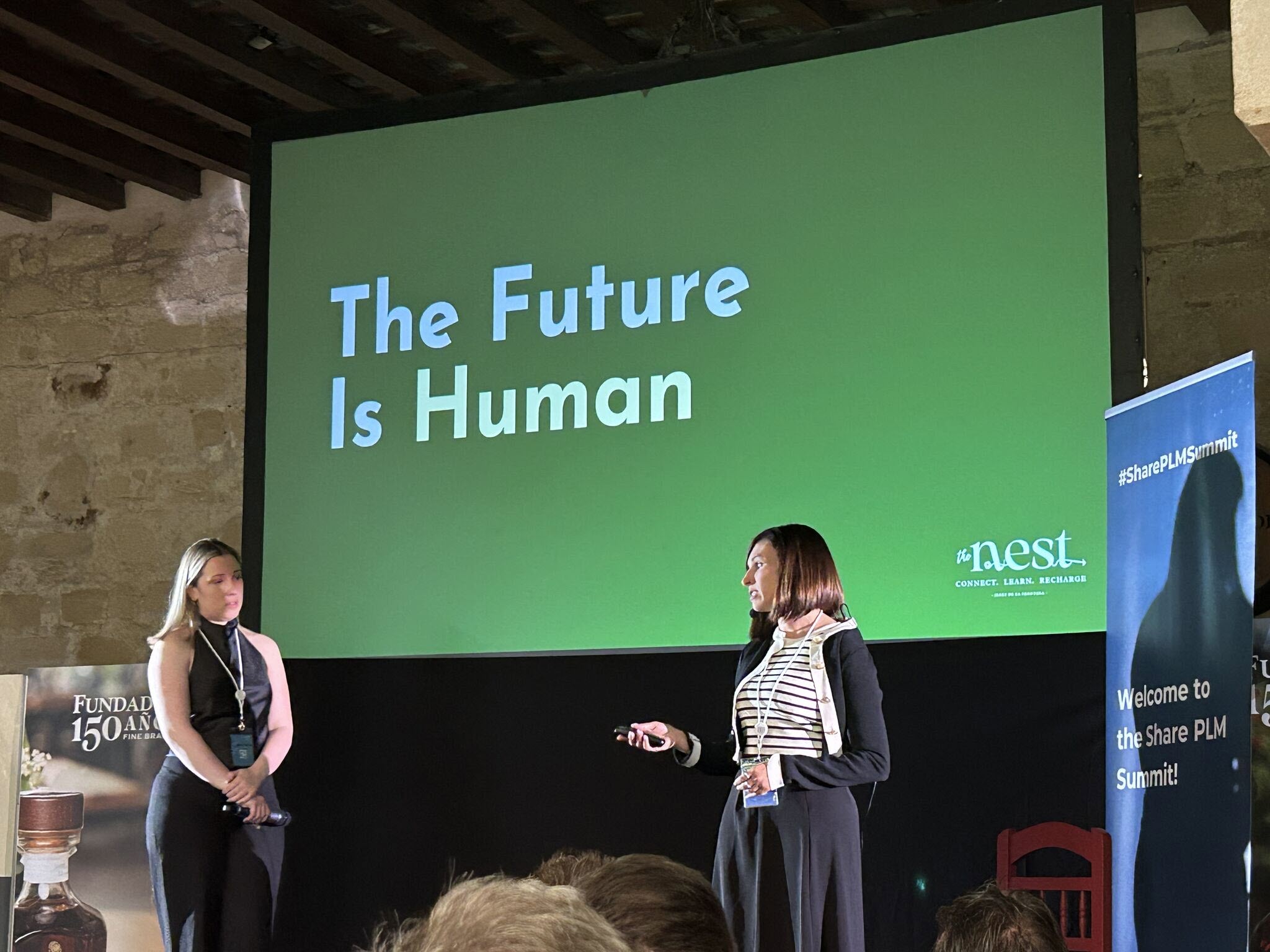 Helena Guitierez‘s keynote on day two was the one that touched me the most as she shared her optimistic vision of the future where AI will allow us to be so more efficient in using our time, combined, of course, with new ways of working and behaviors.
As an example, she demonstrated she had taken an academic paper from Martin Eigner, and by using an AI tool, the German paper was transformed into an English learning course, including quizzes. And all of this with ½ day compared to the 3 to 4 days it would take the Share PLM team for that.
With the time we save for non-value-added work, we should not remain addicted to passive entertainment behind a flat screen. There is the opportunity to restore human and social interactions in person in areas and places where we want to satisfy our human curiosity.
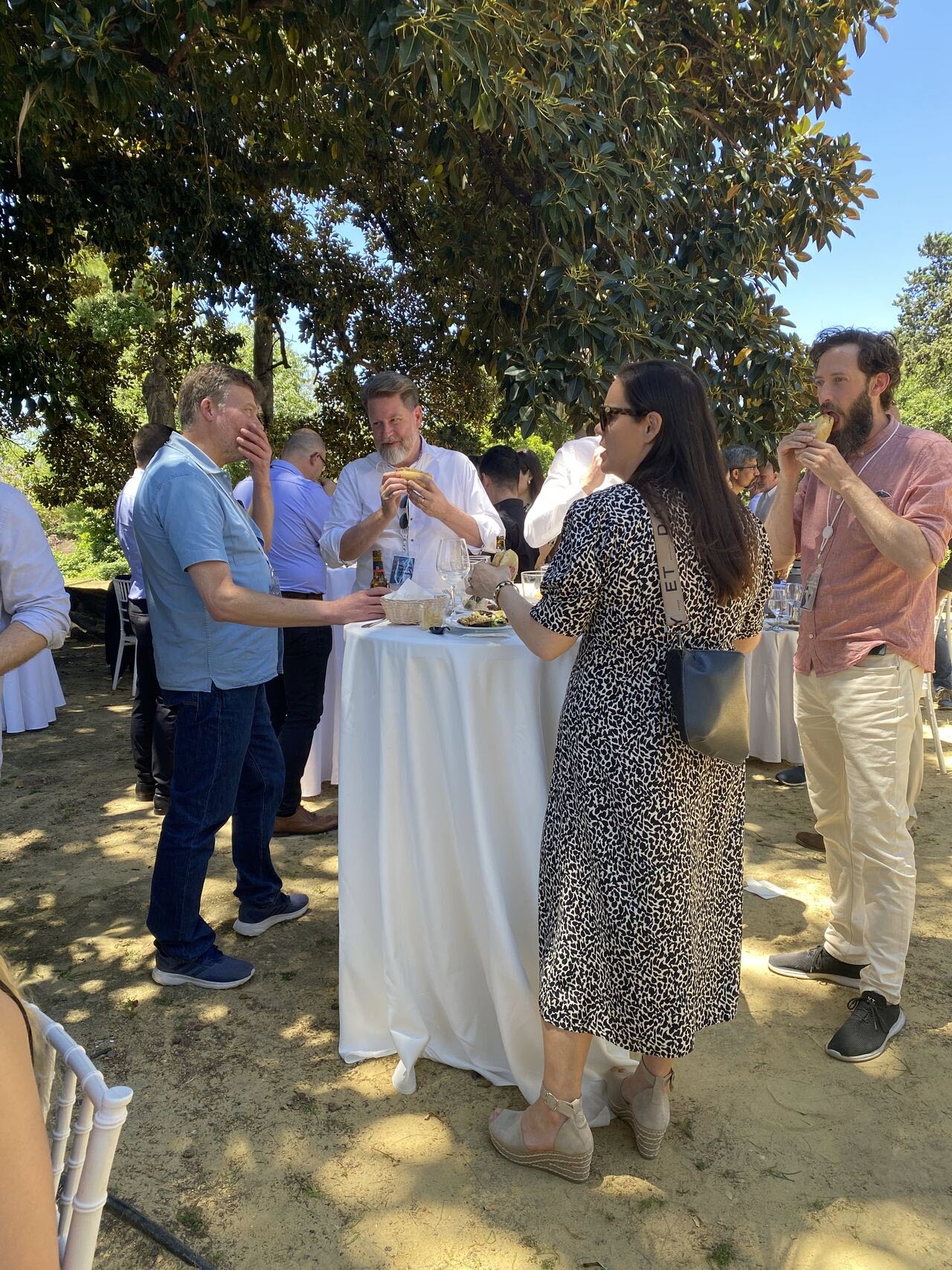 I agree with her optimism. During Corona and the introduction of teams and Zoom sessions, I saw people become resources who popped up at designated times behind a flat screen.
The real human world was gone, with people talking in the corridors at the coffee machine. These are places where social interactions and innovation happen. Coffee stimulates our human brain; we are social beings, not resources.
Death on the Shop Floor: A PLM Murder Mystery
Rob Ferrone‘s theatre play was an original way of explaining and showing that everyone in the company does their best. The product was found dead, and Andrea Järvén alias Angie Neering, Oleg Shilovitsky alias Per Chasing, Patrick Willemsen alias Manny Facturing, Linda Kangastie alias Gannt Chartman and Antonio Casaschi alias Archie Tect were either pleaded guilty by the public jury or not guilty, mainly on the audience’s prejudices.
You can watch the play here, thanks to Michael Finocchiaro :
According to Rob, the absolute need to solve these problems that allow products to die is the missing discipline of product data people, who care for the flow, speed, and quality of product data. Rob gave some examples of his experience with Quick Release project he had worked with.
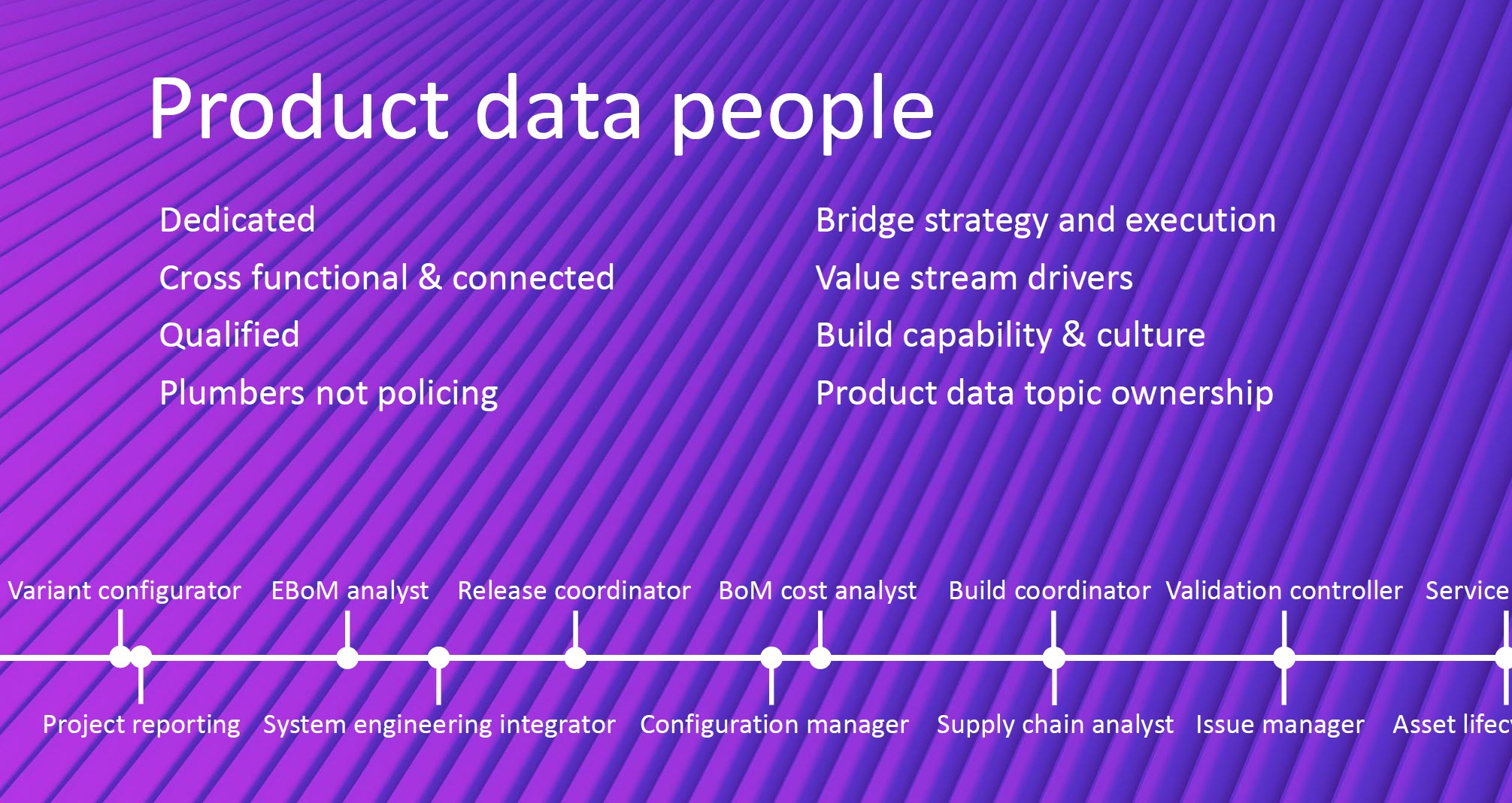
My learnings from this presentation are that you can make PLM stories fun, but even more important, instead of focusing on data quality by pushing each individual to be more accurate—it seems easy to push, but we know the quality; you should implement a workforce with this responsibility. The ROI for these people is clear.
 Note: I believe that once companies become more mature in working with data-driven tools and processes, AI will slowly take over the role of these product data people.
Conclusion
I greatly respect Helena Guitierez and the Share PLM team. I appreciate how they demonstrated that organizing a human-centric PLM summit brings much more excitement than traditional technology—or industry-focused PLM conferences. Starting from the human side of the transformation, the audience was much more diverse and connected.
Closing the conference with a fantastic flamenco performance was perhaps another excellent demonstration of the human-centric approach. The raw performance, a combination of dance, music, and passion, went straight into the heart of the audience – this is how PLM should be (not every day)
There is so much more to share. Meanwhile, you can read more highlights through Michal Finocchiaro’s overview channel here.
 First, an important announcement. In the last two weeks, I have finalized preparations for the upcoming Share PLM Summit in Jerez on 27-28 May. With the Share PLM team, we have been working on a non-typical PLM agenda. Share PLM, like me, focuses on organizational change management and the HOW of PLM implementations; there will be more emphasis on the people side.
Often, PLM implementations are either IT-driven or business-driven to implement a need, and yes, there are people who need to work with it as the closing topic. Time and budget are spent on technology and process definitions, and people get trained. Often, only train the trainer, as there is no more budget or time to let the organization adapt, and rapid ROI is expected.
 This approach neglects that PLM implementations are enablers for business transformation. Instead of doing things slightly more efficiently, significant gains can be made by doing things differently, starting with the people and their optimal new way of working, and then providing the best tools.
The conference aims to start with the people, sharing human-related experiences and enabling networking between people – not only about the industry practices (there will be sessions and discussions on this topic too).
 If you are curious about the details, listen to the podcast recording we published last week to understand the difference – click on the image on the left.
And if you are interested and have the opportunity, join us and meet some great thought leaders and others with this shared interest.
Why is modern PLM a dream?
 If you are connected to the LinkedIn posts in my PLM feed, you might have the impression that everyone is gearing up for modern PLM. Articles often created with AI support spark vivid discussions. Before diving into them with my perspective, I want to set the scene by explaining what I mean by modern PLM and traditional PLM.
Traditional PLM
Traditional PLM is often associated with implementing a PLM system, mainly serving engineering. Downstream engineering data usage is usually pushed manually or through interfaces to other enterprise systems, like ERP, MES and service systems.
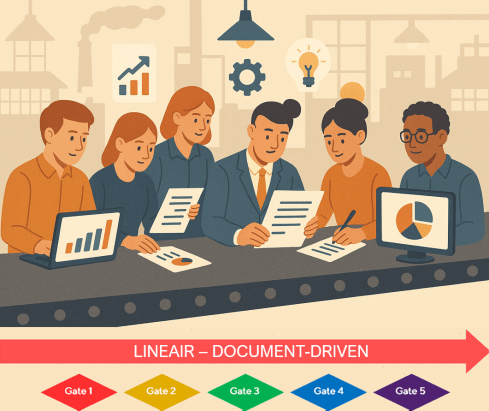
Traditional PLM is closely connected to the coordinated way of working: a linear process based on passing documents (drawings) and datasets (BOMs). Historically, CAD integrations have been the most significant characteristic of these systems.
 The coordinated approach fits people working within their authoring tools and, through integrations, sharing data. The PLM system becomes a system of record, and working in a system of record is not designed to be user-friendly.
Unfortunately, most PLM implementations in the field are based on this approach and are sometimes characterized as advanced PDM.
You recognize traditional PLM thinking when people talk about the single source of truth.
Modern PLM
 When I talk about modern PLM, it is no longer about a single system. Modern PLM starts from a business strategy implemented by a data-driven infrastructure. The strategy part remains a challenge at the board level: how do you translate PLM capabilities into business benefits – the WHY?
More on this challenge will be discussed later, as in our PLM community, most discussions are IT-driven: architectures, ontologies, and technologies – the WHAT.
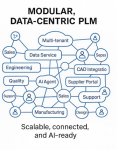 For the WHAT, there seems to be a consensus that modern PLM is based on a federated
I think this article from Oleg Shilovitsky, “Rethinking PLM: Is It Time to Move Beyond the Monolith?“ AND the discussion thread in this post is a must-read. I will not quote the content here again.
After reading Oleg’s post and the comments, come back here
The reason for this approach: It is a perfect example of the connected approach. Instead of collecting all the information inside one post (book ?), the information can be accessed by following digital threads. It also illustrates that in a connected environment, you do not own the data; the data comes from accountable people.
Building such a modern infrastructure is challenging when your company depends mainly on its legacy—the people, processes and systems. Where to change, how to change and when to change are questions that should be answered at the top and require a vision and evolutionary implementation strategy.
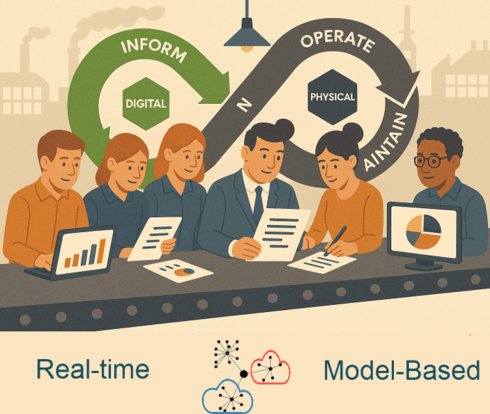
A company should build a layer of connected data on top of the coordinated infrastructure to support users in their new business roles. Implementing a digital twin has significant business benefits if the twin is used to connect with real-time stakeholders from both the virtual and physical worlds.
 But there is more than digital threads with real-time data. On top of this infrastructure, a company can run all kinds of modeling tools, automation and analytics. I noticed that in our PLM community, we might focus too much on the data and not enough on the importance of combining it with a model-based business approach. For more details, read my recent post: Model-based: the elephant in the room.
Again, there are no quotes from the article; you know how to dive deeper into the connected topic.
 Despite the considerable legacy pressure there are already companies implementing a coordinated and connected approach. An excellent description of a potential approach comes from Yousef Hooshmand‘s paper: From a Monolithic PLM Landscape to a Federated Domain and Data Mesh.
You might recognize modern PLM thinking when people talk about the nearest source of truth and the single source of change.
Is Intelligent PLM the next step?
 So far in this article, I have not mentioned AI as the solution to all our challenges. I see an analogy here with the introduction of the smartphone. 2008 was the moment that platforms were introduced, mainly for consumers. Airbnb, Uber, Amazon, Spotify, and Netflix have appeared and disrupted the traditional ways of selling products and services.
The advantage of these platforms is that they are all created data-driven, not suffering from legacy issues.
 In our PLM domain, it took more than 10 years for platforms to become a topic of discussion for businesses. The 2015 PLM Roadmap/PDT conference was the first step in discussing the Product Innovation Platform – see my The Weekend after PDT 2015 post.
At that time, Peter Bilello shared the CIMdata perspective, Marc Halpern (Gartner) showed my favorite positioning slide (below), and Martin Eigner presented, according to my notes, this digital trend in PLM in his session:” What becomes different for PLM/SysLM?”
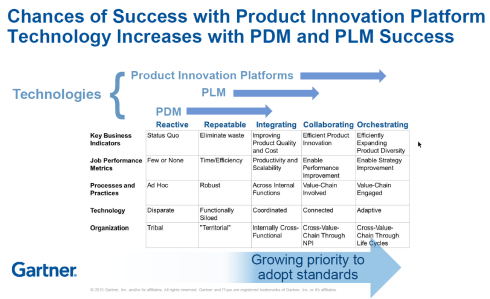
2015 Marc Halpern – the Product Innovation Platform (PIP)
While concepts started to become clearer, businesses mainly remained the same. The coordinated approach is the most convenient, as you do not need to reshape your organization. And then came the LLMs that changed everything.
Suddenly, it became possible for organizations to unlock knowledge hidden in their company and make it accessible to people.
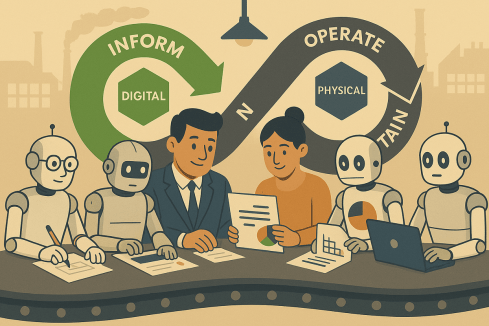
Without drastically changing the organization, companies could now improve people’s performance and output (theoretically); therefore, it became a topic of interest for management. One big challenge for reaping the benefits is the quality of the data and information accessed.
 I will not dive deeper into this topic today, as Benedict Smith, in his article Intelligent PLM – CFO’s 2025 Vision, did all the work, and I am very much aligned with his statements. It is a long read (7000 words) and a great starting point for discovering the aspects of Intelligent PLM and the connection to the CFO.
You might recognize intelligent PLM thinking when people and AI agents talk about the most likely truth.
Conclusion
Are you interested in these topics and their meaning for your business and career? Join me at the Share PLM conference, where I will discuss “The dilemma: Humans cannot transform—help them!” Time to work on your dreams!
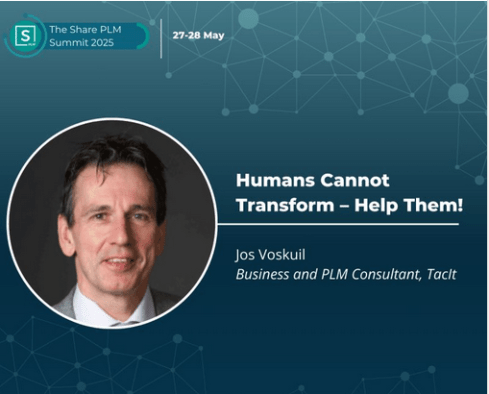
Join us to discuss the (Intelligent) PLM dream
 In the last two weeks, I have had mixed discussions related to PLM, where I realized the two different ways people can look at PLM. Are implementing PLM capabilities driven by a cost-benefit analysis and a business case? Or is implementing PLM capabilities driven by strategy providing business value for a company?
Most companies I am working with focus on the first option – there needs to be a business case.
 This observation is a pleasant passageway into a broader discussion started by Rob Ferrone recently with his article Money for nothing and PLM for free. He explains the PDM cost of doing business, which goes beyond the software’s cost. Often, companies consider the other expenses inescapable.
 At the same time, Benedict Smith wrote some visionary posts about the potential power of an AI-driven PLM strategy, the most recent article being PLM augmentation – Panning for Gold.
It is a visionary article about what is possible in the PLM space (if there was no legacy ☹), based on Robust Reasoning and how you could even start with LLM Augmentation for PLM “Micro-Tasks.
Interestingly, the articles from both Rob and Benedict were supported by AI-generated images – I believe this is the future: Creating an AI image of the message you have in mind.
When you have digested their articles, it is time to dive deeper into the different perspectives of value and costs for PLM.
From a system to a strategy
 The biggest obstacle I have discovered is that people relate PLM to a system or, even worse, to an engineering tool. This 20-year-old misunderstanding probably comes from the fact that in the past, implementing PLM was more an IT activity – providing the best support for engineers and their data – than a business-driven set of capabilities needed to support the product lifecycle.
The System approach
Traditional organizations are siloed, and initially, PLM always had the challenge of supporting product information shared throughout the whole lifecycle, where there was no conventional focus per discipline to invest in sharing – every discipline has its P&L – and sharing comes with a cost.
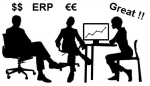 At the management level, the financial data coming from the ERP system drives the business. ERP systems are transactional and can provide real-time data about the company’s performance. C-level management wants to be sure they can see what is happening, so there is a massive focus on implementing the best ERP system.
In some cases, I noticed that the investment in ERP was twenty times more than the PLM investment.
 Why would you invest in PLM? Although the ERP engine will slow down without proper PLM, the complexity of PLM compared to ERP is a reason for management to look at the costs, as the PLM benefits are hard to grasp and depend on so much more than just execution.
See also my old 2015 article: How do you measure collaboration?
As I mentioned, the Cost of Non-Quality, too many iterations, time lost by searching, material scrap, manufacturing delays or customer complaints – often are considered inescapable parts of doing business (like everyone else) – it happens all the time..
The strategy approach
 It is clear that when we accept the modern definition of PLM, we should be considering product lifecycle management as the management of the product lifecycle (as Patrick Hillberg says eloquently in our Share PLM podcast – see the image at the bottom of this post, too).
When you implement a strategy, it is evident that there should be a long(er) term vision behind it, which can be challenging for companies. Also, please read my previous article: The importance of a (PLM) vision.
 I cannot believe that, although perhaps not fully understood, the importance of a data-driven approach will be discussed at many strategic board meetings. A data-driven approach is needed to implement a digital thread as the foundation for enhanced business models based on digital twins and to ensure data quality and governance supporting AI initiatives.
It is a process I have been preaching: From Coordinated to Coordinated and Connected.
We can be sure that at the board level, strategy discussions should be about value creation, not about reducing costs or avoiding risks as the future strategy.
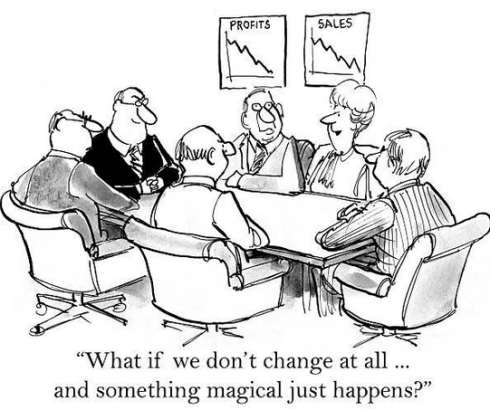
Understanding the (PLM) value
The biggest challenge for companies is to understand how to modernize their PLM infrastructure to bring value.
* Step 1 is obvious. Stop considering PLM as a system with capabilities, but investigate how you transform your infrastructure from a collection of systems and (document) interfaces towards a federated infrastructure of connected tools.
Note: the paradigm shift from a Single Source of Truth (in my system) towards a Nearest Source of Truth and a Single Source of Change.
* Step 2 is education. A data-driven approach creates new opportunities and impacts how companies should run their business. Different skills are needed, and other organizational structures are required, from disciplines working in siloes to hybrid organizations where people can work in domain-driven environments (the Systems of Record) and product-centric teams (the System of Engagement). AI tools and capabilities will likely create an effortless flow of information within the enterprise.
* Step 3 is building a compelling story to implement the vision. Implementing new ways of working based on new technical capabilities requires also organizational change. If your organization keeps working similarly, you might gain some percentage of efficiency improvements.
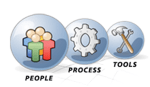 The real benefits come from doing things differently, and technology allows you to do it differently. However, this requires people to work differently, too, and this is the most common mistake in transformational projects.
Companies understand the WHY and WHAT but leave the HOW to the middle management.
 People are squeezed into an ideal performance without taking them on the journey. For that reason, it is essential to build a compelling story that motivates individuals to join the transformation. Assisting companies in building compelling story lines is one of the areas where I specialize.
Feel free to contact me to explore the opportunity for your business.
It is not the technology!
With the upcoming availability of AI tools, implementing a PLM strategy will no longer depend on how IT understands the technology, the systems and the interfaces needed.

As Yousef Hooshmand‘s above image describes, a federated infrastructure of connected (SaaS) solutions will enable companies to focus on accurate data (priority #1) and people creating and using accurate data (priority #1). As you can see, people and data in modern PLM are the highest priority.
Therefore, I look forward to participating in the upcoming Share PLM Summit on 27-28 May in Jerez.
It will be a breakthrough – where traditional PLM conferences focus on technology and best practices. This conference will focus on how we can involve and motivate people. Regardless of which industry you are active in, it is a universal topic for any company that wants to transform.
Conclusion
Returning to this article’s introduction, modern PLM is an opportunity to transform the business and make it future-proof. It needs to be done for sure now or in the near future. Therefore PLM initiatives should be considered from the value point first instead of focusing on the costs. How well are you connected to your management’s vision to make PLM a value discussion?
Enjoy the podcast – several topics discuss relate to this post.
In my business ecosystem, I have seen a lot of discussions about technical and architectural topics since last year that are closely connected to the topic of artificial intelligence. We are discussing architectures and solutions that will make our business extremely effective. The discussion is mostly software vendor-driven as vendors usually do not have to deal with the legacy, and they can imagine focusing on the ultimate result.
Legacy (people, skills, processes and data) is the mean inhibitor for fast forward in such situations, as I wrote in my previous post: Data, Processes and AI.
However, there are also less visible discussions about business efficiency – methodology and business models – and future sustainability.
 These discussions are more challenging to follow as you need a broader and long-term vision, as implementing solutions/changes takes much longer than buying tools.
This time, I want to revisit the discussion on modularity and the need for business efficiency and sustainability.
Modularity – what is it?
 Modularity is a design principle that breaks a system into smaller, independent, and interchangeable components, or modules, that function together as a whole. Each module performs a specific task and can be developed, tested, and maintained separately, improving flexibility and scalability.
Modularity is a best practice in software development. Although modular thinking takes a higher initial effort, the advantages are enormous for reuse, flexibility, optimization, or adding new functionality. And as software code has no material cost or scrap, modular software solutions excel in delivery and maintenance.
 In the hardware world, this is different. Often, companies have a history of delivering a specific (hardware) solution, and the product has been improved by adding features and options where the top products remain the company’s flagships.
Modularity enables easy upgrades and replacements in hardware and engineering, reducing costs and complexity. As I work mainly with manufacturing companies in my network, I will focus on modularity in the hardware world.
Modularity – the business goal
How often have you heard that a business aims to transition from Engineering to Order (ETO) to Configure/Build to Order (BTO) or Assemble to Order (ATO)? Companies often believe that the starting point of implementing a PLM system is enough, as it will help identify commonalities in product variations, therefore leading to more modular products.
 The primary targeted business benefits often include reduced R&D time and cost but also reduced risk due to component reuse and reuse of experience. However, the ultimate goal for CTO/ATO companies is to minimize R&D involvement in their sales and delivery process.
More options can be offered to potential customers without spending more time on engineering.
 Four years ago, I discussed modularity with Björn Eriksson and Daniel Strandhammar, who wrote “The Modular Way” during the COVID-19 pandemic. I liked the book because it is excellent for understanding the broader scope of modularity along with marketing, sales, and long-term strategy. Each business type has its modularity benefits.
I had a follow-up discussion with panelists active in modularization and later with Daniel Strandhammar about the book’s content in this blog post: PLM and Modularity.
Next, I got involved with the North European Modularity Network (NEM) group, a group of Scandinavian companies that share modularization experiences and build common knowledge.
 Historically, modularization has been a popular topic in North Europe, and meanwhile, the group is expanding beyond Scandinavia. Participants in the group focus on education-sharing strategies rather than tools.
The 2023 biannual meeting I attended hosted by Vestas in Ringkobing was an eye-opener for me.
We should work more integrated, not only on the topic of Modularity and PLM but also on a third important topic: Sustainability in the context of the Circular Economy.
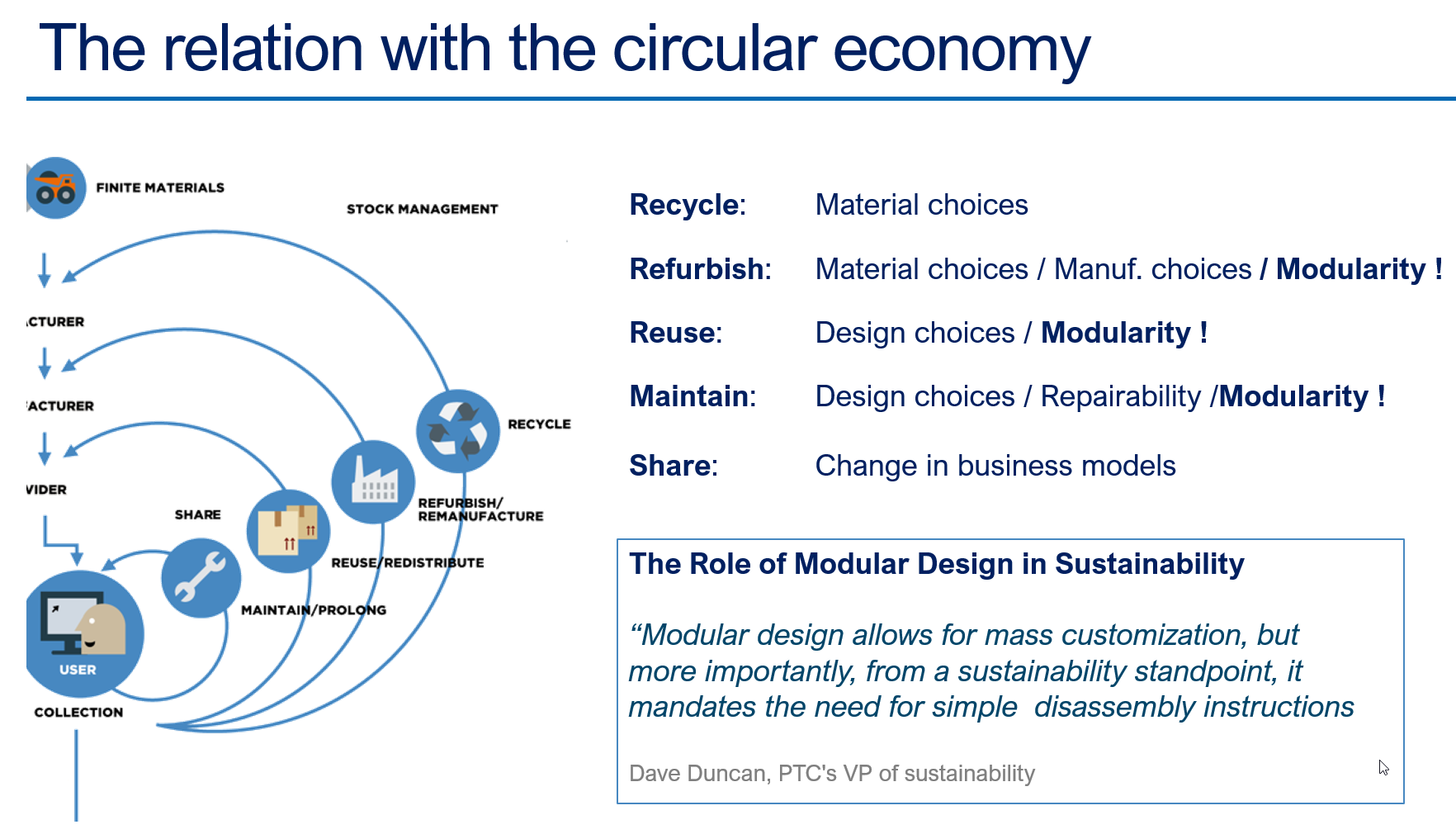
You can review my impression of the event and presentation in my post: “The week after North European Modularity (NEM)“
That post concludes that Modularity, like PLM, is a strategy rather than an R&D mission. Integrating modularity topics into PLM conferences or Circular Economy events would facilitate mutual learning and collaboration.
Modularity and Sustainability
 The PLM Green Global Alliance started in 2020 initially had few members. However, after significant natural disasters and the announcement of regulations related to the European Green Deal, sustainability became a management priority. Greenwashing was no longer sufficient.
One key topic discussed in the PLM Green Global Alliance is the circular economy moderated by CIMPA PLM services. The circular economy is crucial as our current consumption of Earth’s resources is unsustainable.
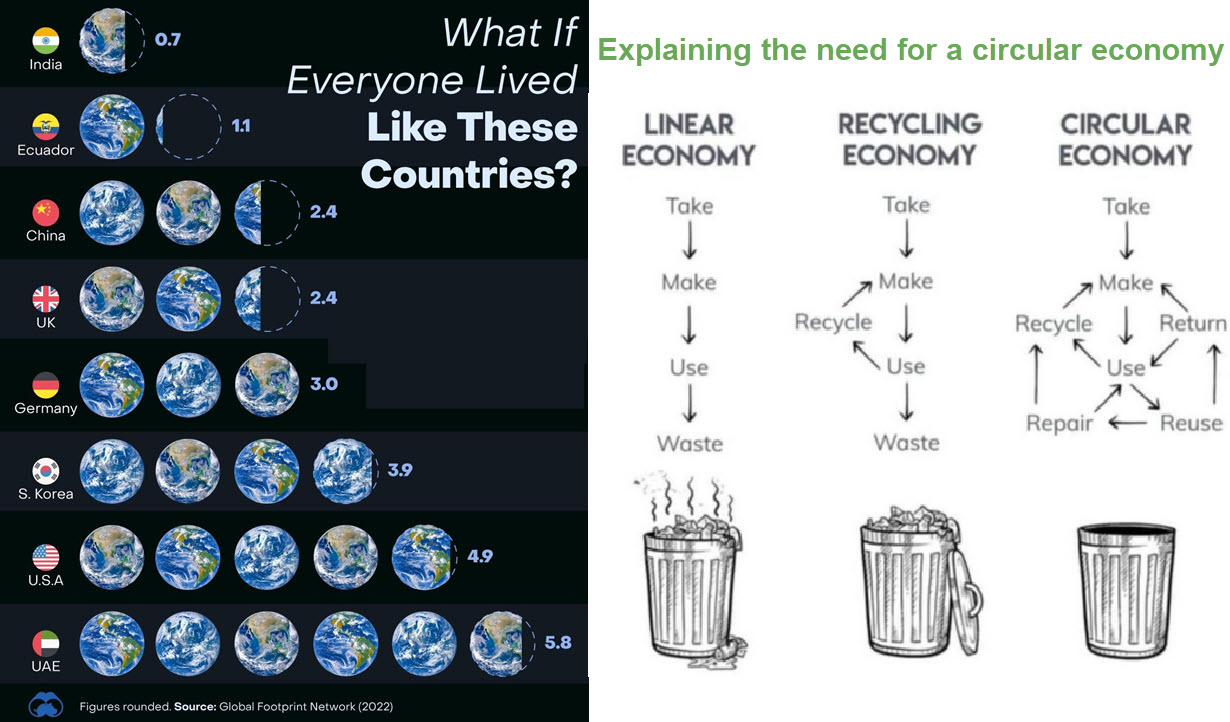
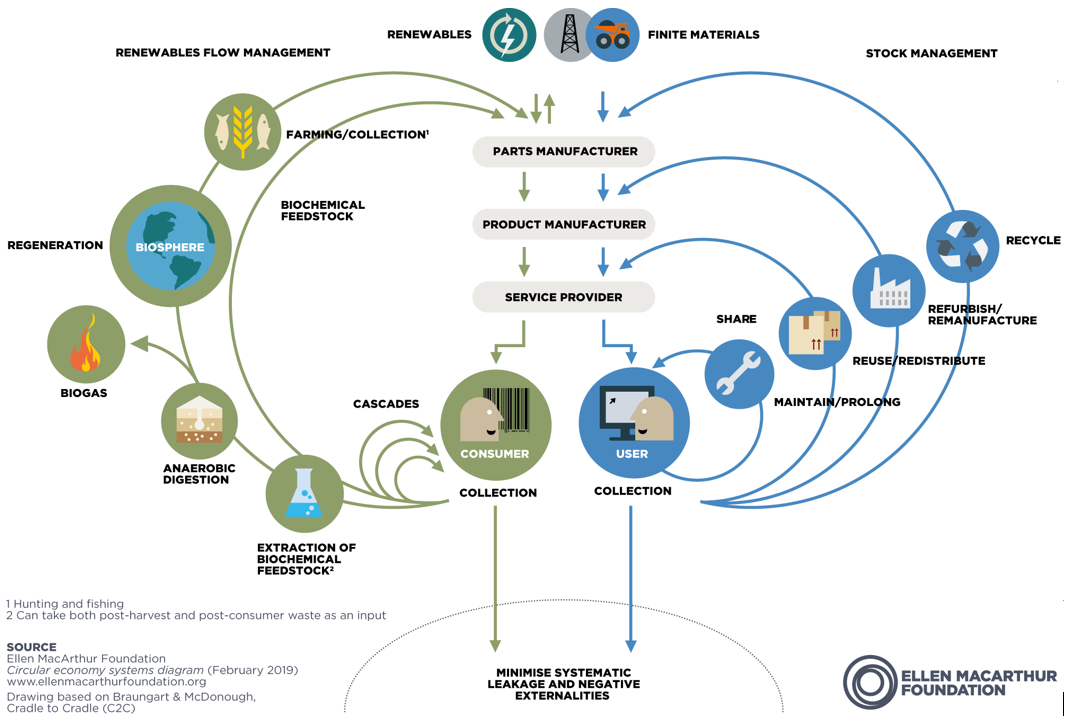
The well-known butterfly diagram from the Ellen MacArthur Foundation below, illustrates the higher complexity of a circular economy, both for the renewables (left) and the hardware (right)
In a circular economy, modularity is essential. The SHARE loop focuses on a Product Service Model, where companies provide services based on products used by different users. This approach requires a new business model, customer experience, and durable hardware. After Black Friday last year, I wrote about this transition: The Product Service System and a Circular Economy.
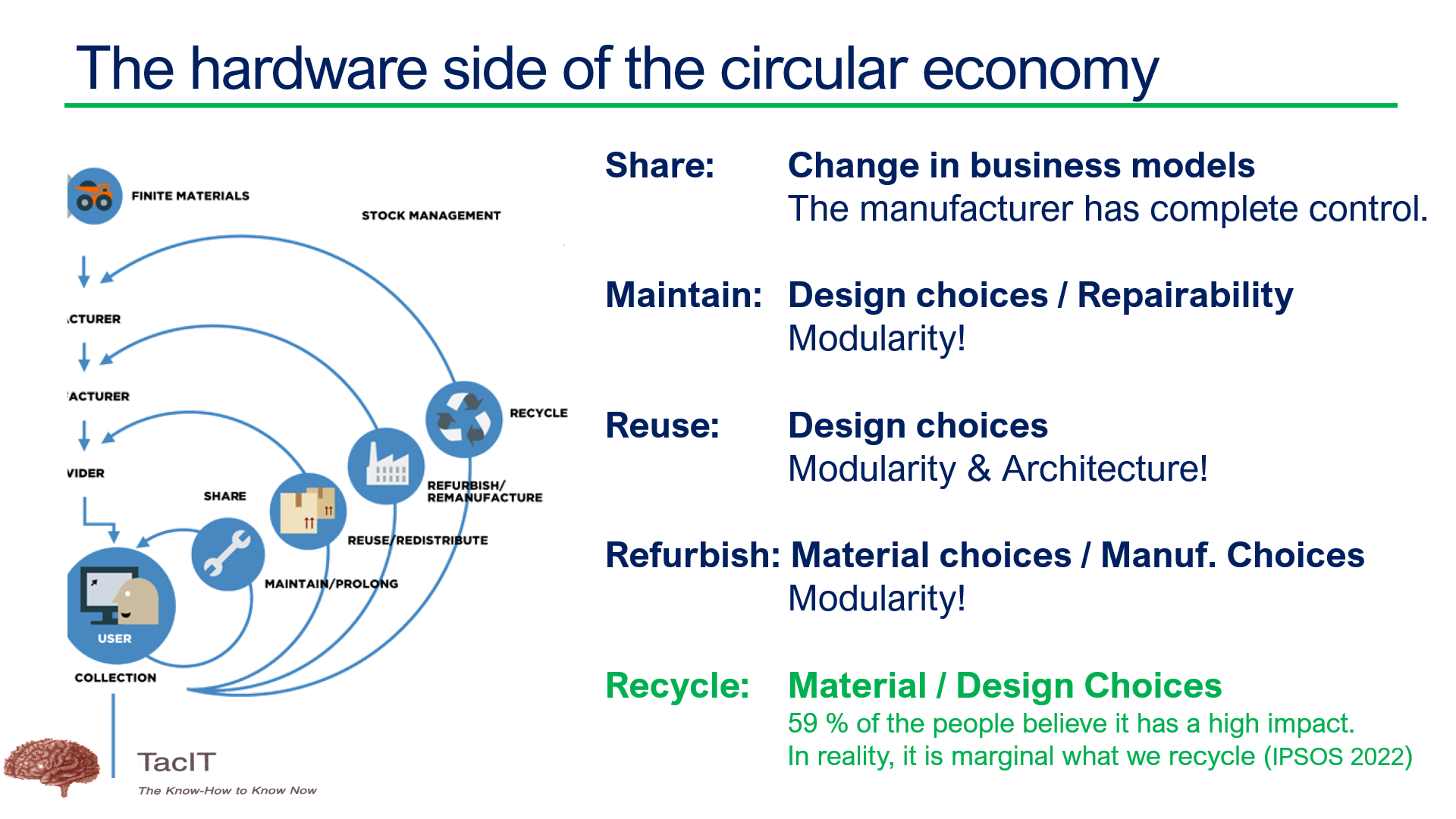
Modularity is vital in the MAINTAIN/PROLONG loop. Modular products can be upgraded without replacing the entire product, and modules are easier to repair. An example is Fairphone from the Netherlands, where users can repair and upgrade their smartphones, contributing to sustainability.
In the REUSE/REMANUFACTURE loop, modularity allows for reusing hardware parts when electronics or software components are upgraded. This approach reduces waste and supports sustainability.
The REFURBISH/REMANUFACTURE loop also benefits from modularity, though to a lesser extent. This loop helps preserve scarce materials, such as batteries, reducing the need for resource extraction from places like the moon, Mars, or Greenland.
A call for action
 If you reached this point of the article, my question is now to reflect on your business or company. Modularity is, for many companies, a dream (or vision) and will become, for most companies, a must to provide a sustainable business.
Modularity does not depend on PLM technology, as famous companies like Scania, Electrolux and Vestas have shown (in my reference network).
Where is your company and its business offerings?
 IMPORTANT:
If you aim to implement modularity to support the concepts of the Circular Economy, make sure you do it in a data-driven, model-based environment – here, technology counts.
Conclusion
Don’t miss the focus on the potential relevance of modularity for your company. Modularity improves business and sustainability, AND it touches all enterprise stakeholders. Technology alone will not save the business. Your thoughts?
Do you want to learn more about implementing PLM at an ETO space company?
Listen to our latest podcast: OHB’s Digital Evolution: Transforming Aerospace PLM with Lucía Núñez Núñez
 First, I wish you all a prosperous 2025 and hope you will take the time to digest information beyond headlines.
Taking time to digest information is my number one principle now, which means you will see fewer blog posts from my side and potentially more podcast recordings.
My theme for 2025 : “It is all about people, data,
a sustainable business and a smooth digital transformation”.
Fewer blog posts
Fewer blog posts, as although AI might be a blessing for content writers, it becomes as exciting as Wikipedia pages. Here, I think differently than Oleg Shilovitsky, whose posts brought innovative thoughts to our PLM community – “Just my thoughts”.
 Now Oleg endorses AI, as you can read in his post: PLM in 2025: A new chapter of blogging transformation. I asked ChatGPT to summarize my post in 50 words, and this is the answer I got – it saves you reading the rest:
The author’s 2025 focus emphasizes digesting information deeply, reducing blog posts, and increasing podcast recordings exploring real-life PLM applications. They stress balancing people and data-centric strategies, sustainable digital transformation, AI’s transformative role, and forward-looking concepts like Fusion Strategy. Success requires prioritizing business needs, people, and accurate data to harness AI’s potential.
Summarizing blog posts with AI saves you time. Thinking about AI-generated content, I understand that when you work in marketing, you want to create visibility for your brand or offer.
Do we need a blogging transformation? I am used to browsing through marketing content and then looking for the reality beyond it – facts and figures. Now it will be harder to discover innovative thoughts in this AI-generated domain.
Am I old fashioned? Time will tell.
More podcast recordings
 As I wrote in a recent post, “PLM in real life and Gen AI“, I believe we can learn much from exploring real-life examples. You can always find the theory somewhere and many of the articles make sense and address common points. Some random examples:
- Top 4 Reasons Why PLM Implementations Fail
- 13 Common PLM Implementation Problems And How to Avoid Them
- 10 steps to a Successful PLM implementation
- 11 Essential Product Lifecycle Management Best Practices for Success
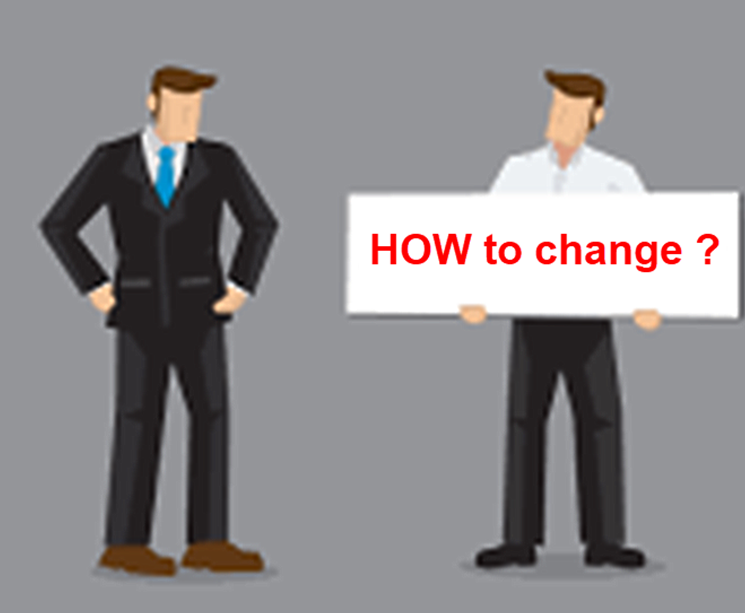 Similar recommendations exist for topics like ERP, MES, CRM or Digital Transformation (one of the most hyped terms).
They all describe WHAT to do or not to do. The challenge however is: HOW to apply this knowledge in your unique environment, considering people, skills, politics and culture.
With the focus on the HOW, I worked with Helena Gutierrez last year on the Share PLM podcast series 2. In this series, we interviewed successful individuals from various organizations to explore HOW they approached PLM within their companies. Our goal was to gain insights from their experiences, particularly those moments when things didn’t go as planned, as these are often the most valuable learning opportunities.
 I am excited to announce that the podcast will continue this year with Series 3! Joining me this season will be Beatriz Gonzales, Share PLM’s co-founder and new CEO. For Series 3, we’ve decided to broaden the scope of our interviews. In addition to featuring professionals working within companies, we’ll also speak with external experts, such as coaches and implementation partners, who support organizations in their PLM journey.
Our goal is to uncover not only best practices from these experts but also insights into emerging “next practices.”
Stay tuned for series 3!
#datacentric or #peoplecentric ?
The title of the paragraph covers topics from the previous paragraphs and it was also the theme from a recent post shared through LinkedIn from Lionel Grealou: Driving Transformation: Data or People First?
We all agree here that it is not either one or the other, and as the discussion related to the post further clarifies, it is about a business strategy that leads to both of these aspects.
This is the challenge with strategies. A strategy can be excellent – on paper – the success comes from the execution.
This discussion reminds me of the lecture Yousef Hooshmand gave at the PLM platform in the Netherlands last year – two of his images that could cover the whole debate:
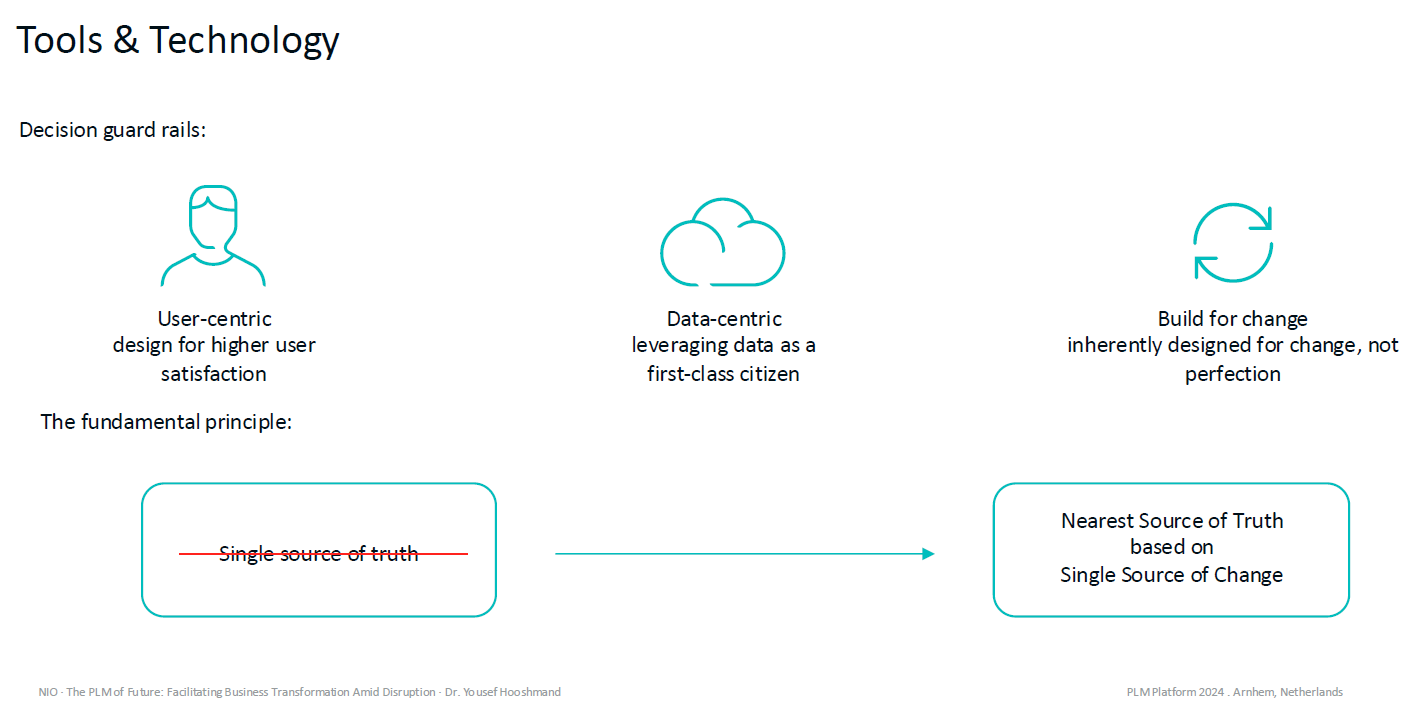
Whatever you implement starts from the user experience, giving the data-centric approach the highest priority and designing the solution for change, meaning avoiding embedded hard-coded ways of working.
 While companies strive to standardize processes to provide efficiency and traceability, the processes should be reconfigurable or adaptable when needed, reconfigured on reliable data sources.
Jan Bosch shared this last thought too in his Digital Reflection #5: Cog in the Machine. My favorite quote from this refection
“However, in a world where change is accelerating, we need to organize ourselves in ways that make it easy to incorporate change and not ulcer-inducing hard. How do we get there?”
Of course, before we reach tools and technology, the other image Yousef Hooshmand shared below gives a guiding principle that I believe everyone should follow in their context.

It starts with having a C-level long-term commitment when you want to perform a business transformation, and then, in an MVP approach, you start from the business, which will ultimately lead you to the tools and technologies.
 The challenge seen in this discussion is that:
most manufacturing companies are still too focused on investing in what they are good at now and do not explore the future enough.
This behavior is why Industry 4.0 is still far from being implemented, and the current German manufacturing industry is in a crisis.
It requires an organization that understands the big picture and has a (fusion) strategy.
Fusion Strategy ?
 Is the Fusion Strategy the next step, as Steef Klein often mentions in our PLM discussions? The Fusion Strategy, introduced by world-renowned innovation guru Vijay Govindarajan (The Three Box Solution) and digital strategy expert Venkat Venkatraman (Fusion Strategy), offers a roadmap that will help industrial companies combine what they do best – creating physical products – with what digital technology companies do best – capturing and analyzing data through algorithms and AI.
 It is a topic I want to explore this year and see how to connect it to companies in my ecosystem. It is an unknown phenomenon as most of them struggle with a data-driven foundation and skills and focus on the right AI applications.
The End of SaaS?
 A potential interesting trend als related to AI I want to clarify further is the modern enterprise architecture . Over the past two years, we have seen a growing understanding that we should not think in systems connected through interfaces but towards a digitally connected infrastructure where APIs, low-code platforms or standardized interfaces will be responsible for real-time collaboration.
I wrote about these concepts in my PLM Roadmap / PDT Europe review. Look at the section: R-evolutionizing PLM and ERP and Heliple. At that time, I shared the picture below, which illustrates the digital enterprise.
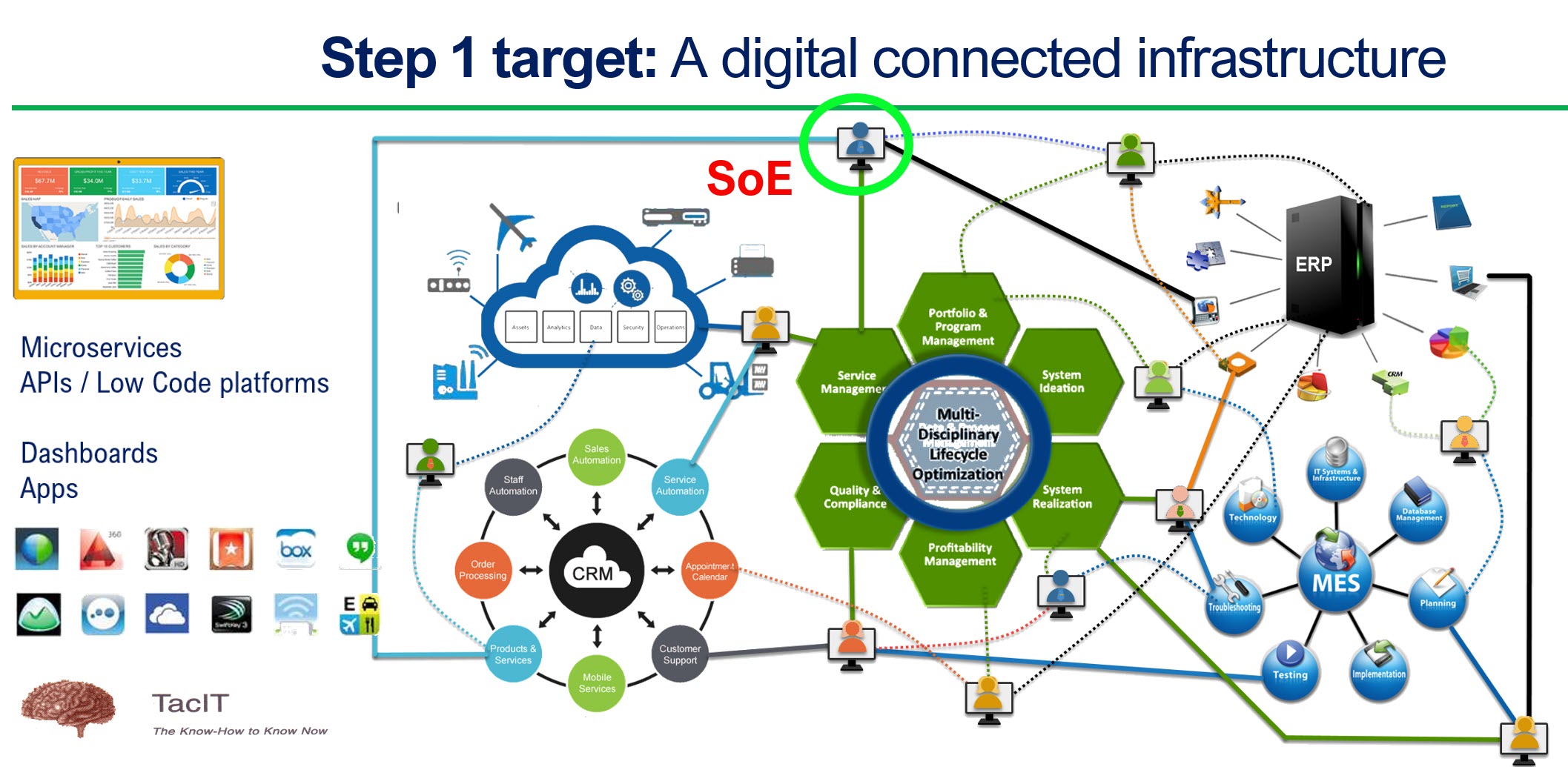
The five depicted platforms in the image ( IIoT, CRM, PLM, ERP, MES) are not necessarily a single system. They can be an ecosystem of applications and services providing capabilities in that domain. In modern ways of thinking, each platform could be built upon a SaaS portfolio, ensuring optimal and scalable collaboration based on the company’s needs.
Implementing such an enterprise based on a combination of SaaS offerings might be a strategy for companies to eliminate IT overhead.
However, known forward-thinking experts like Vijay Govindarajan and Venkat Venkatraman with their Fusion Strategy. Also, Satya Nadella, CEO of Microsoft, imagines instead of connected platforms a future with an AI layer taking care of the context of the information – the Microsoft Copilot message. Some of his statements:
This transformation is poised to disrupt traditional tools and workflows, paving the way for a new generation of applications.
The business logic is all going to these AI agents. They’re not going to discriminate between what the backend is — they’ll update multiple databases, and all the logic will be in the AI tier.
Software as a Business Weapon?
Interesting thoughts to follow and to combine with this Forbes article, The End Of The SaaS Era: Rethinking Software’s Role In Business by Josipa Majic Predin. She introduces the New Paradigm: Software as a Business Weapon.
Quote:
Instead of focusing solely on selling software subscriptions, innovative companies are using software to enhance and transform existing businesses. The goal is to leverage technology to make certain businesses significantly more valuable, efficient, and competitive.
This approach involves developing software that can improve the operations of “real world” businesses by 20-30% or more. By creating such powerful tools, technology companies can position themselves to acquire or partner with the businesses they’ve enhanced, thereby capturing a larger share of the value they’ve created.
It is interesting to see these thoughts popping up, usually 10 to 20 years ahead before companies adopt them. However, I believe with AI’s unleashed power, this is where we should be active and learn. It is an exciting area where terms like eBOM or mBOM sound hackneyed.
Sustainability?
As a PLM Green Global Alliance member, I will continue to explore topics related to PLM and how they can serve Sustainability. They are connected as the image from the 2022 PLM Roadmap/PDT Europe indicates:
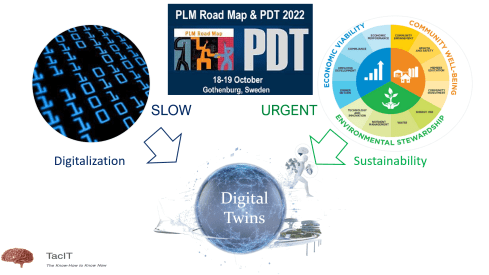
I will keep on focusing on separate areas within my PGGA network.
Conclusion
I believe 2025 will be the year to focus on understanding the practical applications of AI. Amid the hype and noise, there lies significant potential to re-imagine our PLM landscape and vision. However, success begins with prioritizing the business, empowering people, and ensuring accurate data.
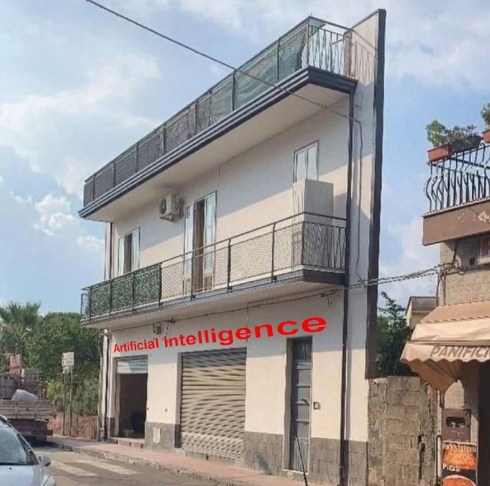
 This year, I will celebrate 25 years since I started my company, TacIT, to focus on knowledge management. However, quickly, I was back in the domain of engineering data management, which became a broader topic, which we now call PLM.
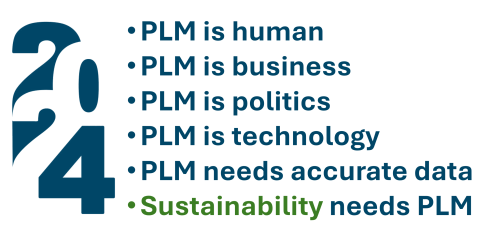
Looking back, there have been significant changes in these 25 years, from systems to strategy, for documents to data, from linear to iterative. However, in this post, I want to look at my 2024 observations to see where we can progress. This brings me to the first observation.
PLM is human
Despite many academic and marketing arguments describing WHAT and WHY companies need specific business or software capabilities, there is, above all, the need for people to be personally inspired and connected. We want to belong to a successful group of people, teams and companies because we are humans, not resources.
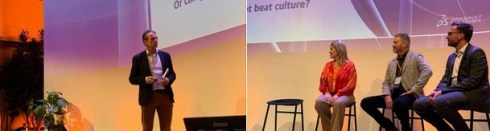
It is all about people, which was also the title of my session during the March 2024 3DEXPERIENCE User Conference in Eindhoven (NL). I led a panel discussion on the importance of people with Dr. Cara Antoine, Daniel Schöpf, and Florens Wolters, each of whom actively led transformational initiatives within their companies.
 Through Dr. Cara Antoine, e at Capgemini and a key voice for women in tech, I learned about her book Make It Personal. The book inspired me and motivated me to continue using a human-centric approach. Give this book to your leadership and read it yourself. It is practical, easy to read, and encouraging
Recently, in my post “PLM in real life and Gen AI“, I shared insights related to PLM blogs and Gen AI – original content is becoming increasingly the same, and the human touch is disappearing, while generating more and longer blogs.
 I propose keeping Gen AI-generated text for the boring part of PLM and exploring the human side of PLM engagements in blogs. What does this mean? In the post, I also shared the highlights of the Series 2 podcast I did together with Helena Gutierrez from Share PLM. Every recording had its unique human touch and knowledge.
We are now in full preparation for Series 3—let us know who your hero is and who should be our guest in 2025!
PLM is business
One of the most significant changes I noticed in my PLM-related projects was that many of the activities connected the PLM activities to the company’s business objectives. Not surprisingly, it was mostly a bottom-up activity, explaining to the upper management that a modern, data-driven PLM strategy is crucial to achieving business or sustainability goals.
I wrote two long posts about these experiences. The first one,” PLM – business first,” zooms in on the changing mindset that PLM is not an engineering system anymore but part of a digital infrastructure that supports companies in achieving their business goals. The image below from Dr. Yousef Hooshmand is one of my favorites in this context. The 5 + 1 steps, where the extra step is crucial: Long Executive Commitment.
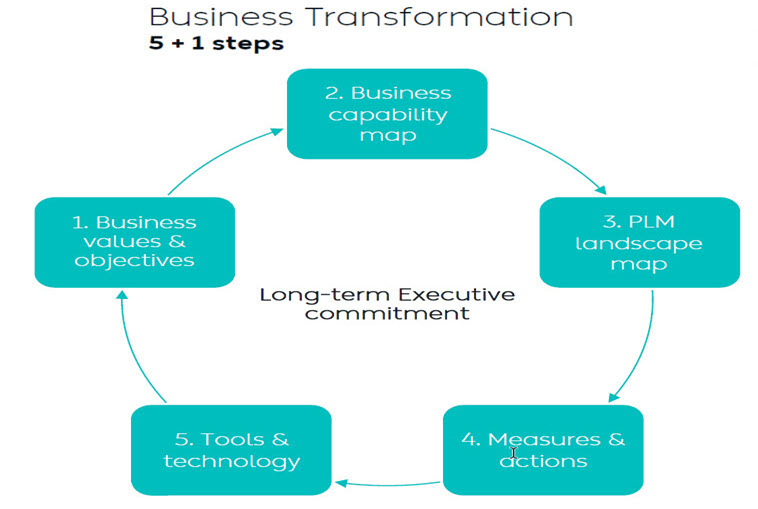
So, to get an executive commitment, you need to explain and address business challenges.
Executive commitment and participation can be achieved through a Benefits Dependency Network approach, as illustrated in this webinar I did with the Heliple-2 team, where we were justifying the business needs for Federated PLM. More about the Federated PLM part in the next paragraph.

Another point to consider is that when the PLM team is part of the IT organization (the costs side), they have a big challenge in leading or even participating in business discussions. In this context, read (again) Jan Bosch’s post: Structure Eats Strategy.
 The second post, more recent, summarized the experiences I had with several customer engagements. The title says it all: “Don’t use the P**-word! – 5 lessons learned“, with an overlap in content with the first post.
Conclusion: A successful PLM strategy starts with the business and needs storytelling to align all stakeholders with a shared vision or goal.
PLM is technology
This year has seen the maturation of PLM technology concepts. We are moving away from a monolithic PLM system and exploring federated and connected infrastructures, preferably a mix of Systems of Record (the old PLMs/ERPs) and Systems of Engagement (the new ways of domain collaboration). The Heliple project manifests such an approach, where the vertical layers are Systems of Record, and the horizontal modules could be Systems of Engagement.
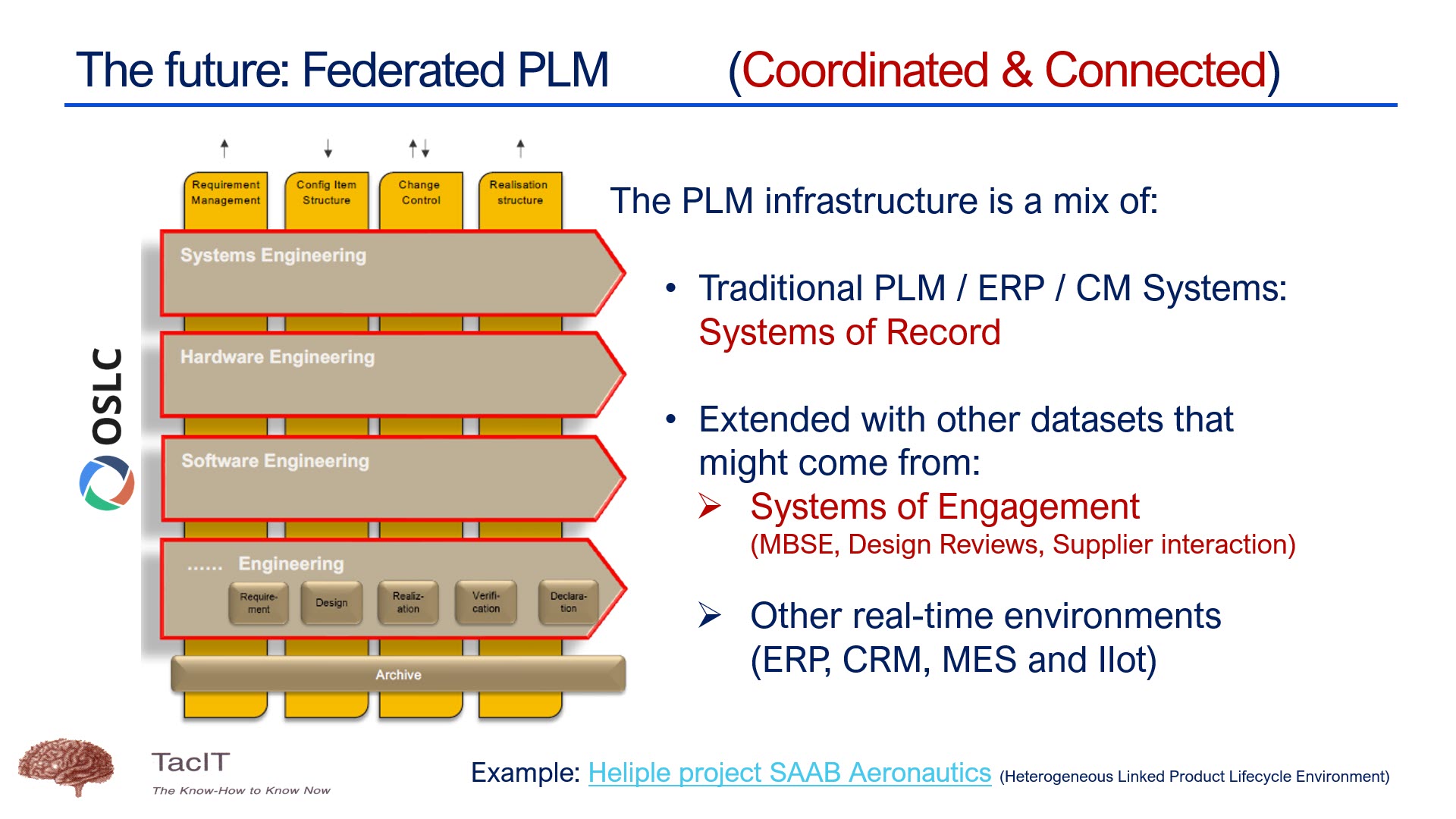
I had several discussions with typical System of Engagement vendors, like Colab (“Where traditional PLM fails”) and Partful (“Connected Digital Thread for Lower and Mid-market OEMs“), but I also had broader discussions during the PLM Roadmap PDT Europe conference – see: R-evolutionizing PLM and ERP and Heliple.
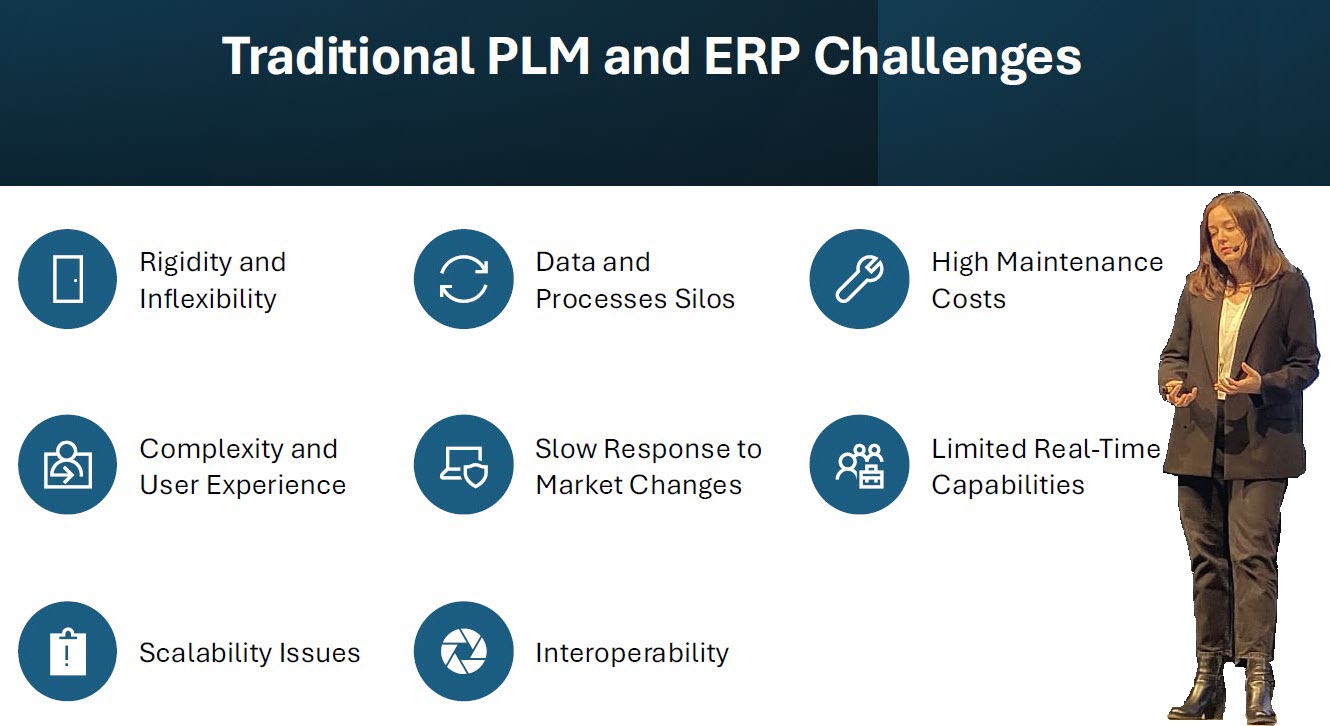
 I also follow Dr. Jorg Fischer, who lectures about digital transformation concepts in the manufacturing business domain. Unfortunately, for a broader audience, Jörg published a lot in German, and typically, his references for PLM and ERP are based on SAP and Teamcenter. His blog posts are always interesting to follow – have a look at his recent blog in English: 7 keys to solve PLM & ERP.
 Of course, Oleg Shilovitsky’s impressive and continuous flow of posts related to modern PLM concepts is amazing—just browse through his Beyond PLM home page to read about the actual topics happening in his PLM ecosystem or for example, read about modern technology concepts in this recent OpenBOM article.
Conceptually, we are making progress. As a commonality, all future concepts focus on data, not so much on managing documents—and here comes the focus on data.
PLM needs accurate data
In a data-driven environment, apps or systems will use a collection of datasets to provide a user with a working environment, either a dashboard or an interactive real-time environment. Below is my AI (Artist Impression) of a digital enterprise.
Of course, it seems logical; the data must be accurate as you no longer have control over access to the data in a data-driven environment. You can be accountable for the data; others can consume the data you created without checking its accuracy by your guidance.
Therefore, data governance and an excellent enterprise architecture are crucial to support the new paradigm:
The nearest source of truth supported by a single source of change
Quote: Yousef Hoohmand
Forget the Single Source of Truth idea, a previous century paradigm.
With data comes Artificial intelligence and algorithms that can play an essential role in your business, providing solutions or insights that support decision-making.
In 2024, most of us have been exploring the benefits of ChatGPT and Generative AI. You can describe examples of where AI could assist in every aspect of the product lifecycle. I saw great examples from Eaton, Ocado, and others at the PLM Roadmap/PDT Europe conference.
See my review here: A long week after the PLM Roadmap / PDT Europe conference.
Still, before benefiting from AI in your organization, it remains essential that the AI runs on top of accurate data.
Sustainability needs (digital) PLM
 This paragraph is the only reverse dependency towards PLM and probably the one that is less in people’s minds, perhaps because PLM is already complex enough. In 2024, with the PLM Green Global Alliance, we had good conversations with PLM-related software vendors or service partners (aPriori, Configit, Makersite, PTC, SAP, Siemens and Transition Technologies PSC) where we discussed their solutions and how they are used in the field by companies.
We discovered here that most activities are driven by regulations, like ESG reporting, the new CSRD directive for Europe and the implementation of the Digital Product Passport. What is clear from all these activities is that companies need to have a data-driven PLM infrastructure to connect product data to environmental impacts, like carbon emissions equivalents.
Besides complying with regulations, I have been discussing the topic of Product-As-A-Service, or the Product Service System, this year, with excellent feedback from Dave Duncan. You can find a link to his speech: Improving Product Sustainability – PTC with PGGA.
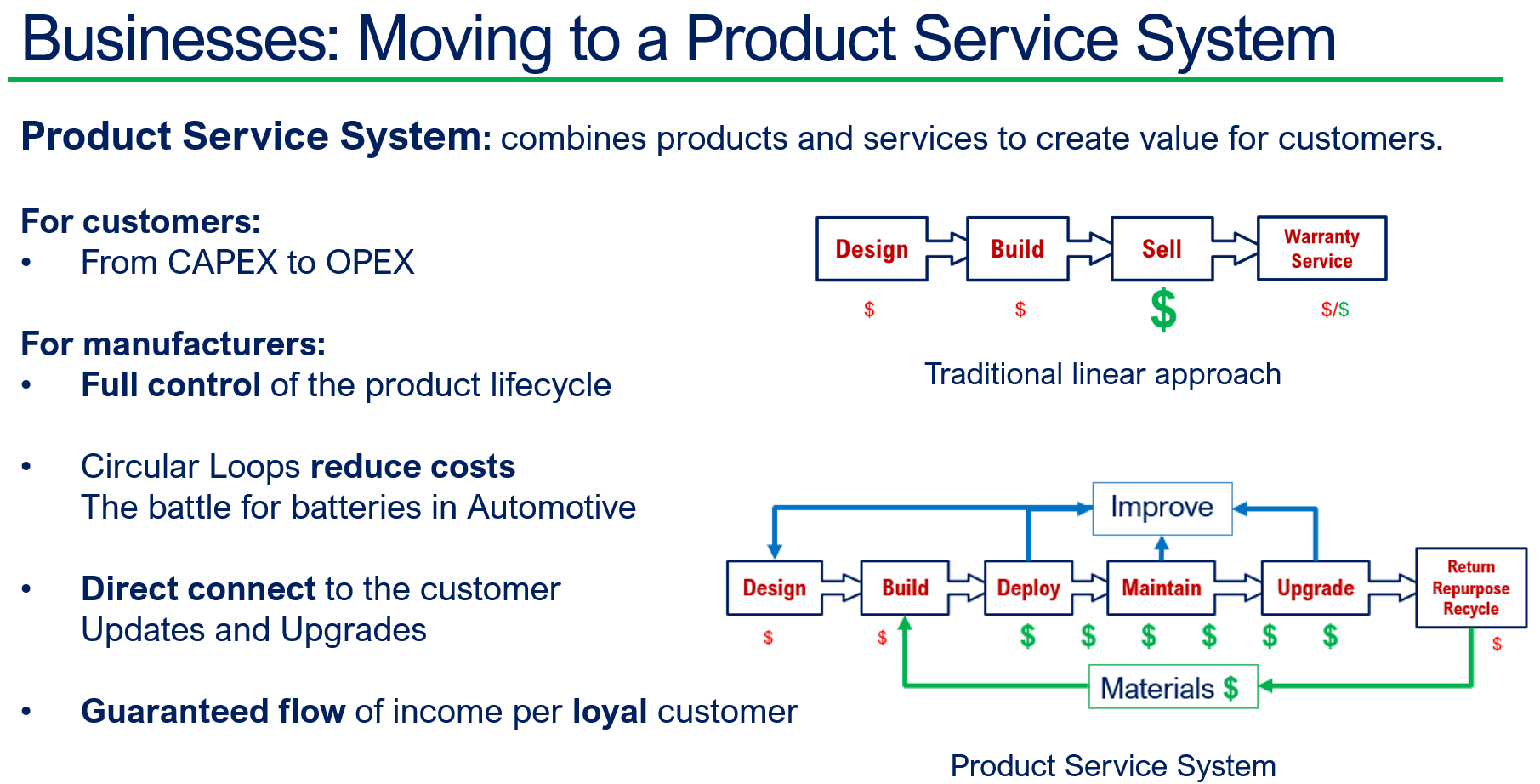
Also, during the PLM Roadmap / PDT Europe conference, I discussed this topic, explaining that achieving a circular economy is a long-term vision, and the starting point is to establish a connected infrastructure within your organizations and with your customers/users in the field.
 Sustainability should be on everyone’s agenda. From the interactions on LinkedIn, you can see that we prefer to discuss terms like PDM/PLM or eBOM/mBOM in the PLM domain. Very few connect PLM to sustainability.
Sustainability is a long-term mission; however, as we have seen from long-term missions, they can be overwhelmed by the day’s madness and short-term needs.
PLM is Politics
You might not expect this paragraph in my log, as most PLM discussions are about the WHAT and the WHY of a PLM solution or infrastructure. However, the most challenging part of PLM is the HOW, and this is the area that I am still focused on.
In the early days of mediating mainly in SmarTeam implementations, it became clear that the technology was not the issue. A crisis was often due to a lack of (technical) skills or methodology and misplaced expectations.
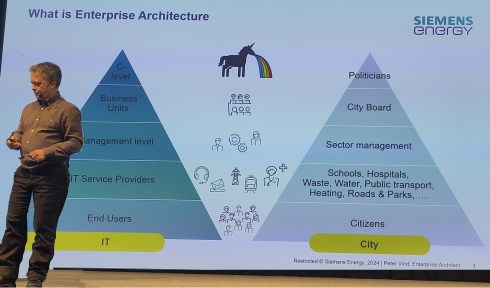
Unicorns & HIPPOs in an enterprise (Peter Vind)
When the way out became clear, politics often started. Sometimes, there was the HIPPO (HIghest Paid Person’s Opinion) in the company, as Peter Vind explained, or there was the blame game, which I described in my 2019 “The PLM blame game post”.
What makes it even more difficult is that people’s opinions in PLM discussions are often influenced by their friendly relations or history with a particular vendor or implementer from the past, which troubles a proper solution path.
These aspects are challenging to discuss, and nobody wants to discuss them openly. A company (and a country) must promote curiosity instead of adhering to mainstream thinking and working methods. In our latest Share PLM podcast, Brian Berger, a VP at Metso, mentions the importance of diversity within an organization.
“It is a constant element of working in a global business, and the importance cannot be overstated.”
This observation should make us think again when we want to simplify everything and dim the colors.
Conclusion
Initially, I thought this would be a shorter post, but again, it became a long read – therefore, perhaps ideal when closing 2024 and looking forward to activities and focus for 2025. Use this time to read books and educate yourself beyond the social media posts (even my blogs are limited 😉)
In addition, I noticed the build-up of this post was unconsciously influenced by Martijn Dullaart‘s series of messages titled “Configuration Management is ……”. Thanks, Martijn, for your continuous contributions to our joint passion – a digital enterprise where PLM and CM flawlessly interact based on methodology and accurate data.
 Congratulations if you have shown you can resist the psychological and emotional pressure and did not purchase anything in the context of Black Friday. However, we must not forget that another big part of the world cannot afford this behavior, as they do not have the means to do so – ultimate Black Friday might be their dream and a fast track to more enormous challenges.
The difference between our societies, all living on the same planet, is illustrated in the image below, illustrating the unfairness of this situation

What the image also shows is a warning that we all have to act, as step by step, we will reach planet boundaries for resources.
 Or we need more planets, and I understand a brilliant guy is already working on it. Let’s go to Mars and enjoy life there.
For those generations staying on this planet, there is only one option: we need to change our economy of unlimited growth and reconsider how we use our natural resources.
The circular economy?
You are probably familiar with the butterfly diagram from the Ellen MacArthur Foundation, where we see the linear process: Take-Make-Use-Waste in the middle.
This approach should be replaced by more advanced regeneration loops on the left side and the five R’s on the right: Reduce, Repair, Reuse, Refurbish and Recycle as the ultimate goal is the minimum leakage of Earth resources.
Closely related to the Circular Economy concept is the complementary Cradle-To-Cradle design approach. In this case, while designing our products, we also consider the end of life of a product as the start for other products to be created based on the materials used.
The CE butterfly diagram’s right side is where product design plays a significant role and where we, as a PLM community, should be active. Each loop has its own characteristics, and the SHARE loop is the one I focused on during the recent PLM Roadmap / PDT Europe conference in Gothenburg.
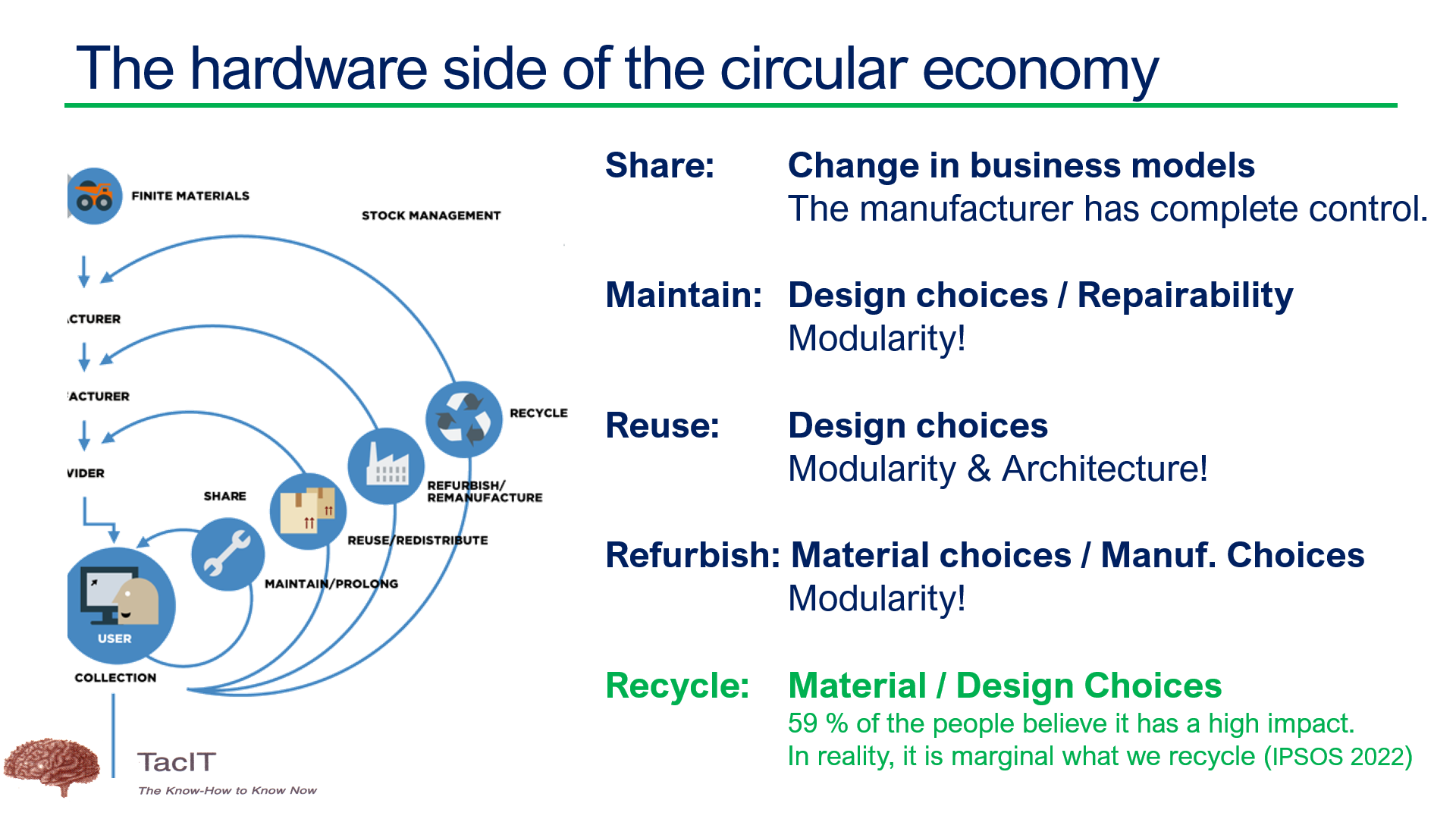
As you can see, the Maintain, Reuse, Refurbish and Recycle loops depend on product design strategies, in particular, modularity and, of course, depending on material choices.
It is important to note that the recycle loop is the most overestimated loop, where we might contribute to recycling (glass, paper, plastic) in our daily lives; however, other materials, like composites often with embedded electronics, have a much more significant impact.
Watch the funny meme in this post: “We did everything we could– we brought our own bags.”
 The title of my presentation was: Products as a Service – The Ultimate Sustainable Economy?
You can find my presentation on SlideShare here.
Let’s focus on the remainder of the presentation’s topic: Product As A Service.
The Product Service System
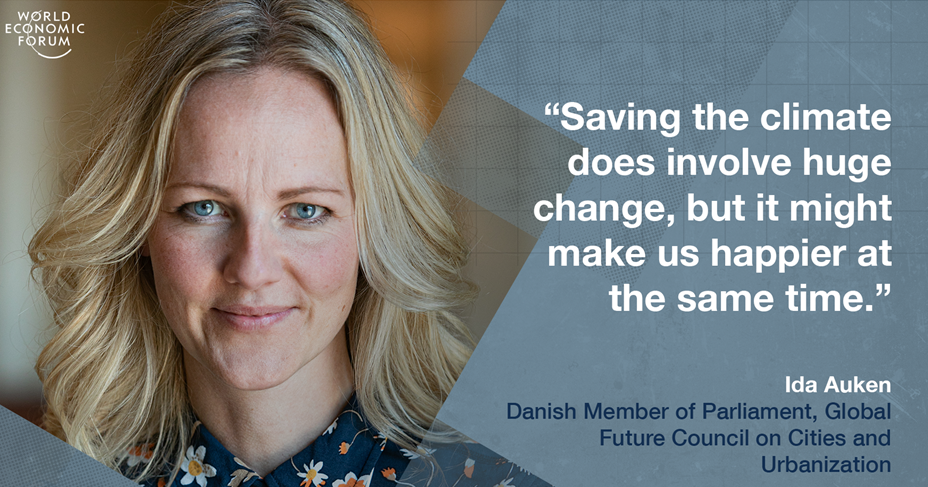 Where Product As A Service might be the ultimate dream for an almost wasteless society, Ida Auken, a Danish member of the parliament, gave a thought-provoking lecture in that context at the 2016 World Economic Forum. Her lecture was summarized afterward as
“In the future, you will own nothing and be happy.”
A theme also picked up by conspiracy thinkers during the COVID pandemic, claiming “they” are making us economic slaves and consumers. With Black Friday in mind, I do not think there is a conspiracy; it is the opposite.
Closer to implementing everywhere Product as a Service for our whole economy, we might be going into Product Service Systems.
As the image shows, a product service system is a combination of providing a product with related services to create value for the customer.
In the ultimate format, the manufacturer owns the products and provides the services, keeping full control of the performance and materials during the product lifecycle. The benefits for the customer are that they pay only for the usage of the product and, therefore, do not need to invest upfront in the solution (CAPEX), but they only pay when using the solution (OPEX).
 A great example of this concept is Spotify or other streaming services. You do not pay for the disc/box anymore; you pay for the usage, and the model is a win-win for consumers (many titles) and producers (massive reach).
Although the Product Service System will probably reach consumers later, the most significant potential is currently in the B2B business model, e.g., transportation as a service and special equipment usage as a service. Examples are popping up in various industries.
 My presentation focused on three steps that manufacturing companies need to consider now and in the future when moving to a Product Service System.
Step 1: Get (digital) connected to your Product and customer
A foundational step companies must take is to create a digital infrastructure to support all stakeholders in the product service offering. Currently, many companies have a siloed approach where each discipline Marketing/Sales, R&D, Engineering, Manufacturing and Sales will have their own systems.
Digital Transformation in the PLM domain is needed here – where are you on this level?
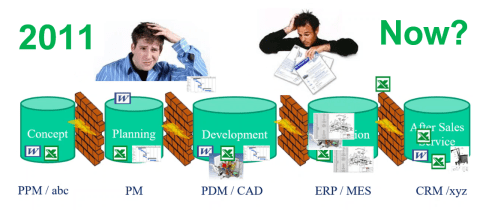
But it is not only the technical silos that impede the end-to-end visibility of information. If there are no business targets to create and maintain the end-to-end information sharing, you can not expect it to happen.
Therefore, companies should invest in the digitalization of their ways of working, implementing an end-to-end digital thread AND changing their linear New Product Development process into a customer-driven DevOp approach. The PTC image below shows the way to imagine a end-to-end connected environment
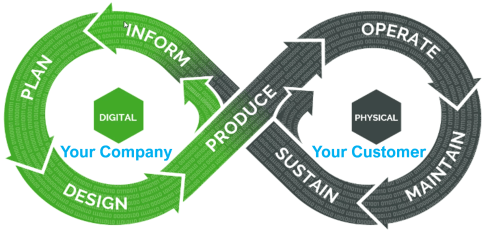
In a Product Service System, the customer is the solution user, and the solution provider is responsible for the uptime and improvement of the solution over time.
 As an upcoming bonus and a must, companies need to use AI to run their Product Service System as it will improve customer knowledge and trends. Don’t forget that AI (and Digital Twins) runs best on reliable data.
Step 2 From Product to Experience
A Product Service System is not business as usual by providing products with some additional services. Besides concepts such as Digital Thread and Digital Twins of the solution, there is also the need to change the company’s business model.
In the old way, customers buy the product; in the Product Service System, the customer becomes a user. We should align the company and business to become user-centric and keep the user inspired by the experience of the Product Service System.
In this context, there are two interesting articles to read:
- Jan Bosch: From Agile to Radical: Business Model
- Chris Seiler: How to escape the vicious circle in times of transformation?
The change in business model means that companies should think about a circular customer journey.
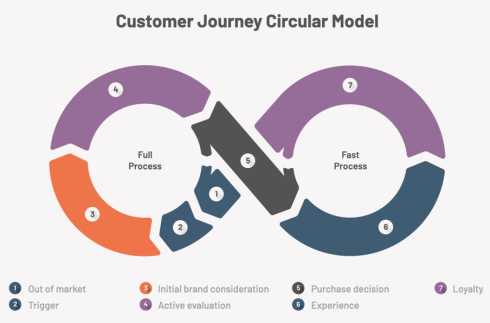
As the company will remain the product owner, it is crucial to understand what happens when the customers stop using the service or how to ensure maintenance and upgrades.
In addition, to keep the customer satisfied, it remains vital to discover the customer KPIs and how additional services could potentially improve the relationship. Again, AI can help find relationships that are not yet digitally established.
 Step 2: From product to experience can already significantly impact organizations. The traditional salesperson’s role will disappear and be replaced by excellence in marketing, services and product management.
This will not happen quickly as, besides the vision, there needs to be an evolutionary path to the new business model.
Therefore, companies must analyze their portfolio and start experimenting with a small product, converting it into a product service system. Starting simple allows companies to learn and be prepared for scaling up.
A Product Service System also influences a company’s cash flow as revenue streams will change.
 When scaling up slowly, the company might be able to finance this transition themselves. Another option, already happening, is for a third party to finance the Product Service System – think about car leasing, power by the hour, or some industrial equipment vendors.
Step 3 Towards a doughnut economy?
The last step is probably a giant step or even a journey. An economic mindset shift is needed from the ever-growing linear economy towards an economy flourishing for everyone within economic, environmental and social boundaries.
Unlimited growth is the biggest misconception on a planet reaching its borders. Either we need more planets, or we need to adjust our society.
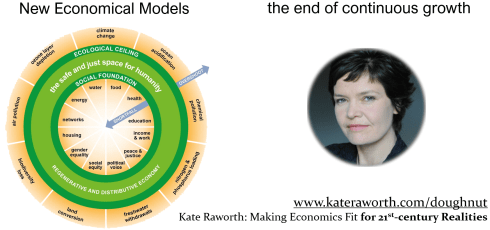
In that context, I read the book “The Doughnut Economy” by Kate Raworth, a recognized thought leader who explains how a future economic model can flourish, including a circular economy, and you will be happy.
 But we must abandon the old business models and habits – there will be a lot of resistance to change before people are forced to change. This change can take generations as the outside world will not change without a reason, and the established ones will fight for their privileges.
It is a logical process where people and boundaries will learn to find a new balance. Will it be in a Doughnut Economy, or did we overlook some bright other concepts?
Conclusion
The week after Black Friday and hopefully the month after all the Christmas presents, it is time to formulate your good intentions for 2025. As humans, we should consume less; as companies, we should direct our future to a sustainable future by exploring the potential of the Product Service System and beyond.

 Recently, I noticed I reduced my blogging activities as many topics have already been discussed and repeatably published without new content.
With the upcoming of Gen AI and ChatGPT, I believe my PLM feeds are flooded by AI-generated blog posts.
The ChatGPT option
 Most companies are not frontrunners in using extremely modern PLM concepts, so you can type risk-free questions and get common-sense answers.
I just tried these five questions:
- Why do we need an MBOM in PLM, and which industries benefit the most?
- What is the difference between a PLM system and a PLM strategy?
- Why do so many PLM projects fail?
- Why do so many ERP projects fail?
- What are the changes and benefits of a model-based approach to product lifecycle management?
Note: Questions 3 and 4 have almost similar causes and impacts, although slightly different, which is to be expected given the scope of the domain.
All these questions provided enough information for a blog post based on the answer. This illustrates that if you are writing about what are current best practices in the field – stop writing – the knowledge is there.
PLM in the real life
Recently, I had several discussions about which skills a PLM expert should have or which topics a PLM project should address.
PLM for the individual
 For the individual, there are often certifications to obtain. Roger Tempest has been fighting for PLM professional recognition through certification – a challenge due to the broad scope and possibilities. Read more about Roger’s work in this post: PLM is complex (and we have to accept it?)
PLM vendors and system integrators often certify their staff or resellers to guarantee the quality of their solution delivery. Potential topics will be missed as they do not fulfill the vendor’s or integrator’s business purpose.
Asking ChatGPT about the required skills for a PLM expert, these were the top 5 answers:
- Technical skills
- Domain Knowledge
- Analytical and Problem-Solving Skills
- Interpersonal and Management Skills
- Strategic Thinking
 It was interesting to see the order proposed by ChatGPT. Fist the tools (technology), then the processes (domain knowledge / analytical thinking), and last the people and business (strategy and interpersonal and management skills) It is hard to find individuals with all these skills in a single person.
Although we want people to be that broad in their skills, job offerings are mainly looking for the expert in one domain, be it strategy, communication, industry or technology. To get an impression of the skills read my PLM and Education concluding blog post.
Now, let’s see what it means for an organization.
PLM for the organization
In this area, one of the most consistent frameworks I have seen over time is CIMdata‘s Critical Dozen. Although they refer less to skills and more to trends and enablers, a company should invest in – educate people & build skills – to support a successful digital transformation in the PLM domain.
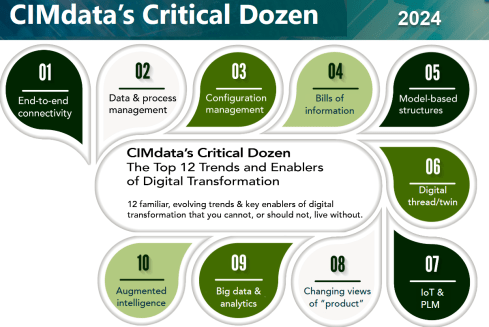
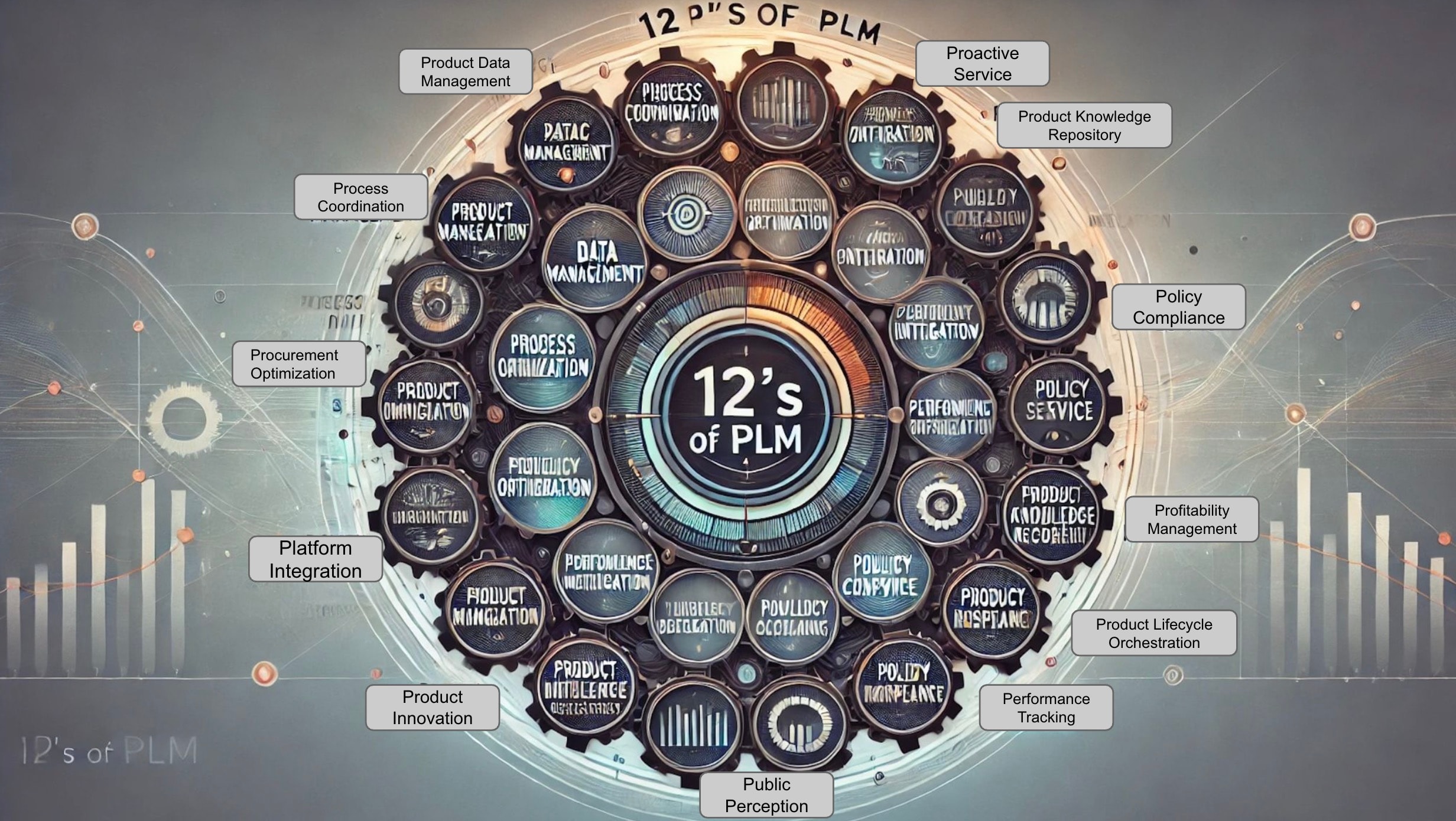 Oleg Shilovitsky’s recent blog post, The 12 “P” s of PLM Explained by Role: How to Make PLM More Than Just a Buzzword describes in an AI manner the various aspects of the term PLM, using 12 P**-words, reacting to Lionel Grealou’ s post: Making PLM Great Again
The challenge I see with these types of posts is: “OK, what to do now? Where to start?”
I believe where to start at the first place is a commonly agreed topic.
Everything starts from having a purpose and a vision. And this vision should be supported by a motivating story about the WHY that inspires everyone.
It is teamwork to define such a strategy, communicate it through a compelling story and make it personal. An excellent book to read is Make it personal from Dr. Cara Antoine – click on the image to discover the content and find my review why I believe this book is so compelling.
An important reason why we have to make transformations personal is because we are dealing first of all with human beings. And human beings are driven by emotions first even before ratio kicks in. We see it everywhere and unfortunately also in politics.
The HOW from real-life
 This question cannot be answered by external PLM vendors, consultants or system integrators. Forget the Out-of-the-Box templates or the industry best practices (from the past), but start from your company’s culture and vision, introducing step-by-step new technologies, ways of working and business models to move towards the company’s vision target.
Building the HOW is not an easy journey, and to illustrate the variety of skills needed to be successful, I worked with Share PLM on their Series 2 podcast. You can find the complete overview here. There is one more to come to conclude this year.
 Our focus was to speak only with PLM experts from the field, understanding their day-to-day challenges with a focus on HOW they did it and WHAT they learned.
And this is what we learned:
Unveiling FLSmidth’s Industrial Equipment PLM Transformation: From Projects to Products
 It was our first episode of Series 2, and we spoke with Johan Mikkelä, Head of the PLM Solution Architecture at FLSmidth.
FLSmidth provides the global mining and cement industries with equipment and services, which is very much an ETO business moving towards CTO.
We discussed their Industrial Equipment PLM Transformation and the impact it has made.
Start With People: ABB’s Engineering Approach to Digital Transformation
 We spoke with Issam Darraj, who shared his thoughts on human-centric digitalization. Issam talks us through ABB’s engineering perspective on driving transformation and discusses the importance of focusing on your people. Our favorite quote:
To grow, you need to focus on your people. If your people are happy, you will automatically grow. If your people are unhappy, they will leave you or work against you.
Enabling change: Exploring the human side of digital transformations
 We spoke with Antonio Casaschi as he shared his thoughts on the human side of digital transformation. When discussing the PLM expert, he agrees it is difficult. Our favorite part here:
“I see a PLM expert as someone with a lot of experience in organizational change management. Of course, maybe people with a different background can see a PLM expert with someone with a lot of knowledge of how you develop products, all the best practices around products, etc. We first need to agree on what a PLM expert is, and then we can agree on how you become an expert in such a domain.”
Revolutionizing PLM: Insights from Yousef Hooshmand
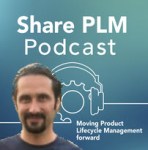 With Dr. Yousef Hooshmand, writer of the paper: From a Monolithic PLM Landscape to a Federated Domain and
Data Mesh, with over 15 years of experience in the PLM domain, currently PLM Lead at NIO, we discussed the complexity of digital transformation in the PLM domain and How to deal with legacy, meanwhile implementing a user-centric, data-driven future.
My favorite quote: The End of Single Source of Truth, now it is about The nearest Source of Truth and Single Source of Change.
Steadfast Consistency: Delving into Configuration Management with Martijn Dullaart
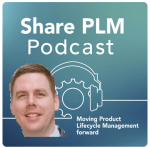 Martijn Dullaart, who is the man behind the blog MDUX: The Future of CM and author of the book The Essential Guide to Part Re-Identification: Unleash the Power of Interchangeability and Traceability, has been active both in the PLM and CM domain and with Martijn the similarities and differences between PLM and CM and why organizations need to be educated on the topic of CM
The ROI of Digitalization: A Deep Dive into Business Value with Susanna Maëntausta
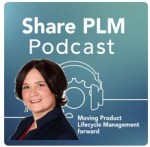 With Susanna Maëntausta, we discussed how to implement PLM in non-traditional manufacturing industries, such as the chemical and pharmaceutical industries.
Susanna teaches us to ensure PLM projects are value-driven, connecting business objectives and KPIs to the implementation and execution steps in the field. Susanna is highly skilled in connecting people at any level of the organization.
Narratives of Change: Grundfos Transformation Tales with Björn Axling
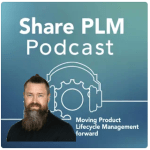 As Head of PLM and part of the Group Innovation management team at Grundfos, Bjorn Axling aims to drive a Group-wide, cross-functional transformation into more innovative, more efficient, and data-driven ways of working through the product lifecycle from ideation to end-of-life.
In this episode, you will learn all the various aspects that come together when leading such a transformation in terms of culture, people, communication, and modern technology.
The Next Lane: Marel and the Digital Product Highway with Roger Kabo
 With Roger Kabo, we discussed the steps needed to replace a legacy PLM environment and be open to a modern, federated, and data-driven future.
Step 1: Start with the end in mind. Every successful business starts with a clear and compelling vision. Your vision should be specific, inspiring, and something your team can rally behind.
Next, build on value and do it step by step.
How do you manage technology and data when you have a diverse product portfolio?
 We talked with Jim van Oss, the former CIO of Moog Inc., for a deep dive into the fascinating world of technology transformations.
Key Takeaway: Evolving technology requires a clear strategy!
Jim underscores the importance of having a north star to guide your technological advancements, ensuring you remain focused and adaptable in an ever-changing landscape.
Diverse Products, Unified Systems: MBSE Insights with Max Gravel from Moog
 We discussed the future of the Model-Based approaches with Max Gravel – MBD at Gulfstream and MBSE at Moog.
Max Gravel, Manager of Model-Based Engineering at Moog Inc., who is also active in modern CM, emphasizes that understanding your company’s goals with MBD is crucial.
There’s no one-size-fits-all solution: it’s about tailoring the strategy to drive real value for your business. The tools are available, but the key lies in addressing the right questions and focusing on what matters most. A great, motivating story containing all the aspects of digital transformation in the PLM domain/
Customer-First PLM: Insights on Digital Transformation and Leadership
 With Helene Arlander, who has been involved in big transformation projects in the telecom industry. Starting from a complex legacy environment, implementing new data-driven approaches. We discussed the importance of managing product portfolios end-to-end and the leadership strategies needed for engaging people in charge.
We also discussed the role of AI in shaping the future of PLM and the importance of vision, diverse skill sets, and teamwork in transformations.
Conclusion
I believe the time of traditional blogging is over – current PLM concepts and issues can be easily queried by using ChatGPT-like solutions. The fundamental understanding of what you can do now comes from learning and listening to people, not as fast as a TikTok video or Insta message. For me, a podcast is a comfortable method of holistic learning.
Let us know what you think and who should be in Season 3
And for my friends in the United States – Happy Thanksgiving and think about the day after ……..
Recently, I attended several events related to the various aspects of product lifecycle management; most of them were tool-centric, explaining the benefits and values of their products.
 In parallel, I am working with several companies, assisting their PLM teams to make their plans understood by the upper management, which has always been my mission in the past.
However, nowadays, people working in the business are feeling more and more challenged and pained by not acting adequately to the upcoming business demands.
The image below has been shown so many times, and every time, the context becomes more relevant.
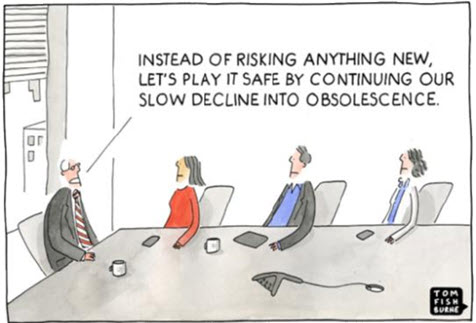
Too often, an evolutionary mindset with small steps is considered instead of looking toward the future and reasoning back for what needs to be done.
Let me share some experiences and potential solutions.
Don’t use the P** word!
 The title of this post is one of the most essential points to consider. By using the term PLM, the discussion is most of the time framed in a debate related to the purchase or installation of a system, the PLM system, which is an engineering tool.
PLM vendors, like Dassault Systèmes and Siemens, have recognized this, and the word PLM is no longer on their home pages.
They are now delivering experiences or digital industries software.
Other companies, such as PTC and Aras, broadened the discussion by naming other domains, such as manufacturing and services, all connected through a digital thread.
 The challenge for all these software vendors is why a company would consider buying their products. A growing issue for them is also why would they like to change their existing PLM system to another one, as there is so much legacy.
For all of these vendors, success can come if champions inside the targeted company understand the technology and can translate its needs into their daily work.
 Here, we meet the internal PLM team, which is motivated by the technology and wants to spread the message to the organization. Often, with no or limited success, as the value and the context they are considering are not understood or felt as urgent.
Lesson 1:
Don’t use the word PLM in your management messaging.
In some of the current projects I have seen, people talk about the digital highway or a digital infrastructure to take this hurdle. For example, listen to the SharePLM podcast with Roger Kabo from Marel, who talks about their vision and digital product highway.
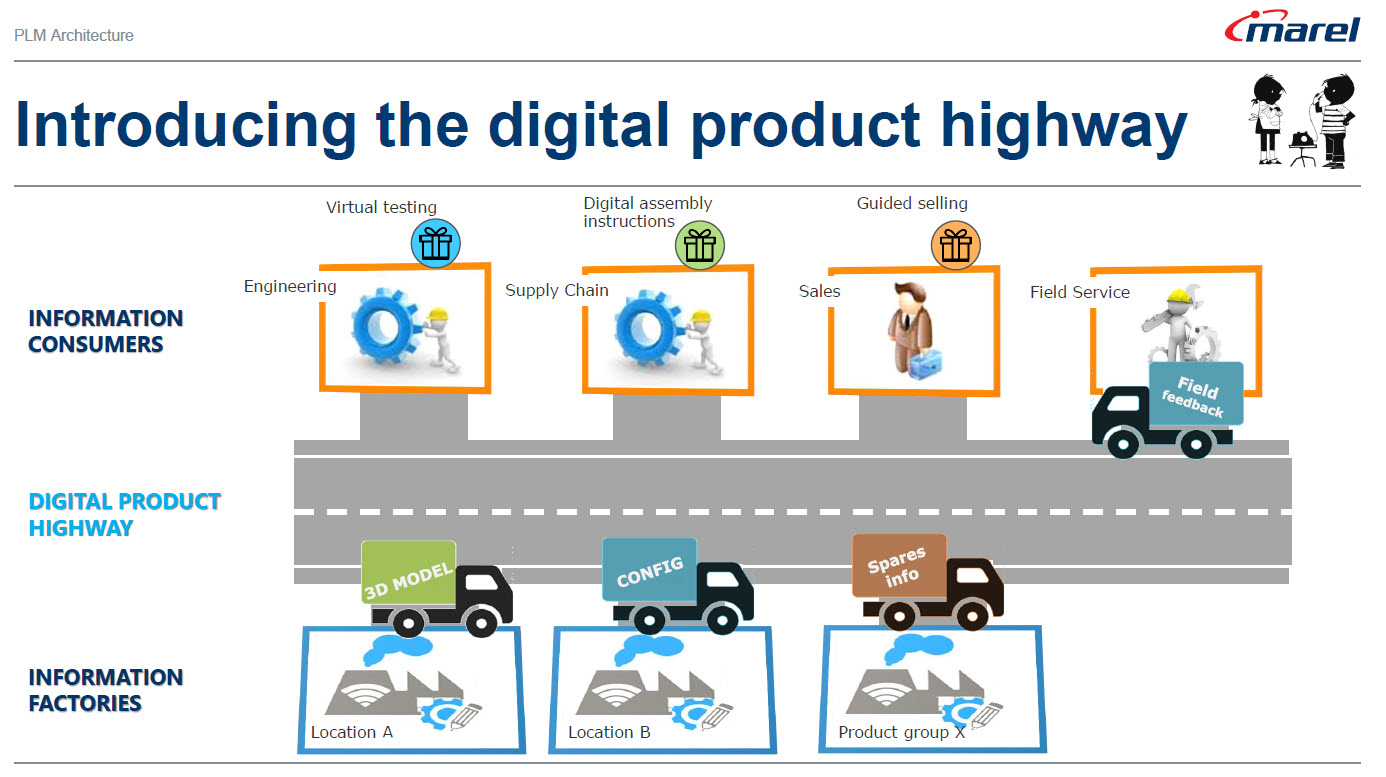
The Marel digital product highway
As soon as you use the word PLM, most people think about a (costly) system, as this is how PLM is framed. Engineering, like IT, is often considered a cost center, as money is made by manufacturing and selling products.
According to experts (CIMdata/Gartner), Product Lifecycle Management is considered a strategic approach. However, the majority of people talk about a PLM system. Of course, vendors and system integrators will speak about their PLM offerings.
To avoid this framing, first of all, try to explain what you want to establish for the business. The terms Digital Product Highway or Digital Infrastructure, for example, avoid thinking in systems.
Lesson 2:
Don’t tell your management why they need to reward your project – they should tell you what they need.
This might seem like a bit of strange advice; however, you have to realize that most of the time, people do not talk about the details at the management level. At the management level, there are strategies and business objectives, and you will only get attention when your proposal addresses the business needs. At the management level, there should be an understanding of the business need and its potential value for the organization. Next, analyzing the business changes and required tools will lead to an understanding of what value the PLM team can bring.
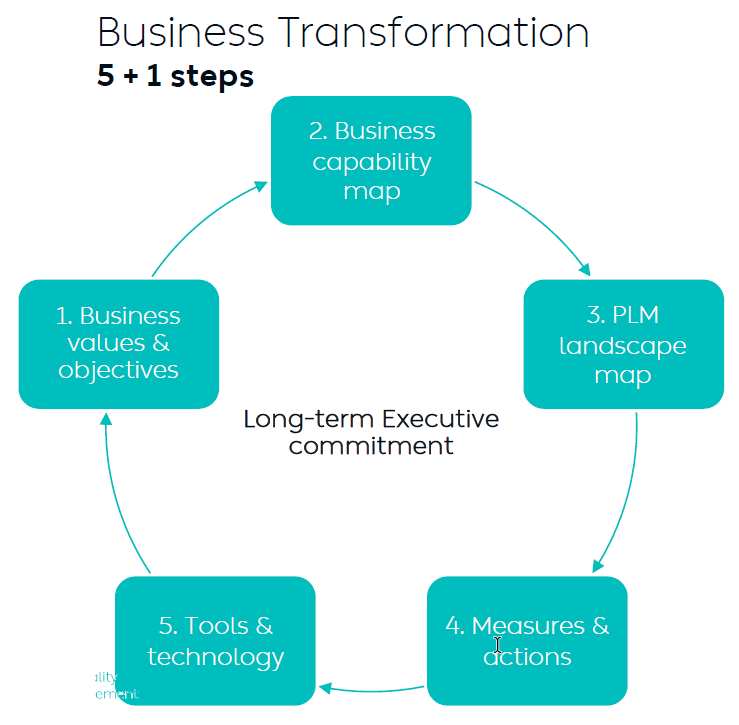
Yousef Hooshmand’s 5 + 1 approach illustrates this perfectly. It is crucial to note that long-term executive commitment is needed to have a serious project, and therefore, the connection to their business objective is vital.
Therefore, if you can connect your project to the business objectives of someone in management, you have the opportunity to get executive sponsorship. A crucial advice you hear all the time when discussing successful PLM projects.
Lesson 3:
Alignment must come from within the organization.
Last week, at the 20th anniversary of the Dutch PLM platform, Yousef Hooshmand gave the keynote speech starting with the images below:
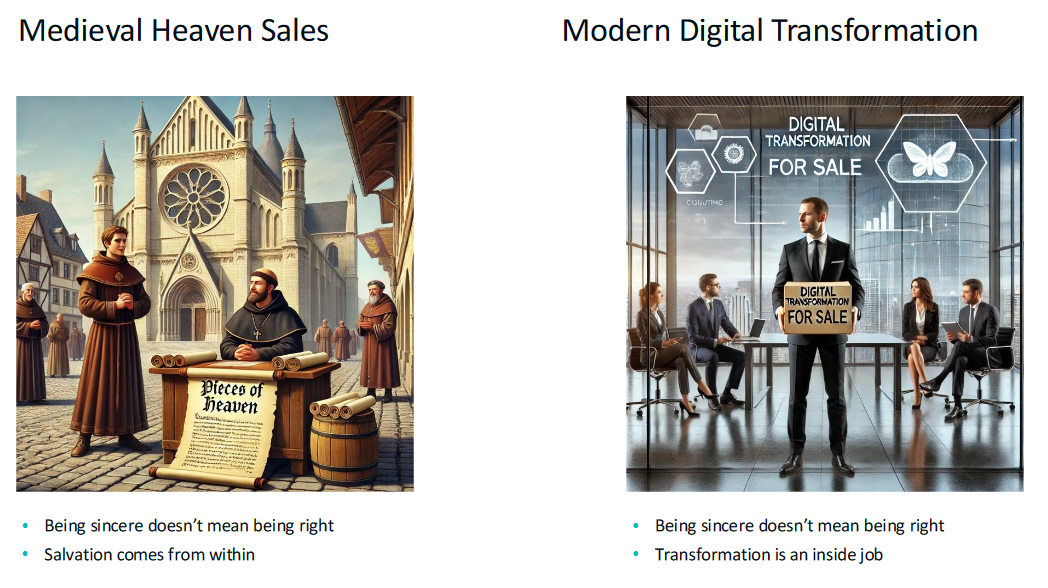
On the left side, we see the medieval Catholic church sincerely selling salvation through indulgences, where the legend says Luther bought the hell, demonstrating salvation comes from inside, not from external activities – read the legend here.
 On the right side, we see the Digital Transformation expert sincerely selling digital transformation to companies. According to LinkedIn, there are about 1.170.000 people with the term Digital Transformation in their profile.
As Yousef mentioned, the intentions of these people can be sincere, but also, here, the transformation must come from inside (the company).
When I work with companies, I use the Benefits Dependency Network methodology to create a storyboard for the company. The BDN network then serves as a base for creating storylines that help people in the organization have a connected view starting from their perspective.
Companies might hire strategic consultancy firms to help them formulate their long-term strategy. This can be very helpful where, in the best case, the consultancy firm educates the company, but the company should decide on the direction.
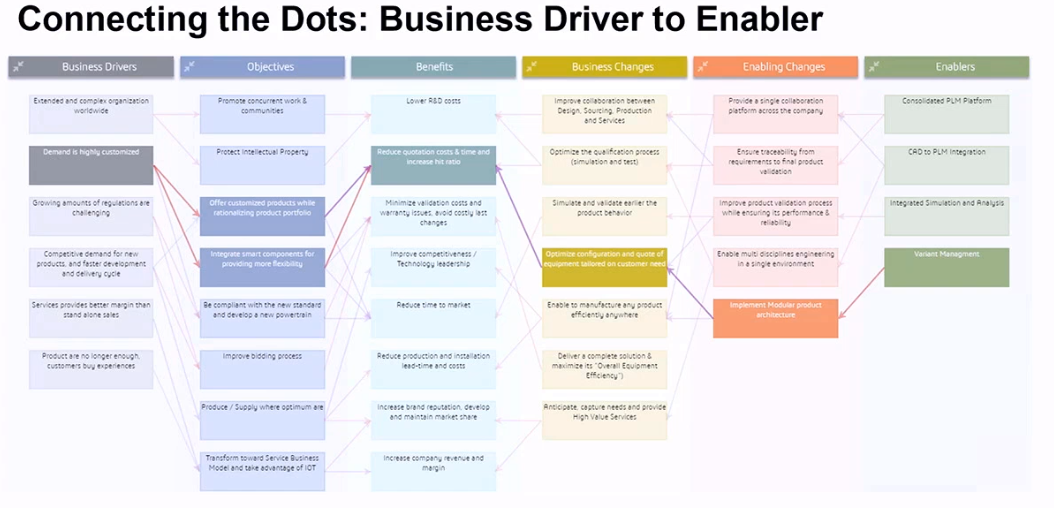
In an older blog post, I wrote about this methodology, presented by Johannes Storvik at the Technia Innovation forum, and how it defines a value-driven implementation.
Dassault Systèmes and its partners use this methodology in their Value Engagement process, which is tuned to their solution portfolio.
You can also watch the webinar Federated PLM Webinar 5 – The Business Case for the Federated PLM, in which I explained the methodology used.
Lesson 4:
PLM is a business need not an IT service
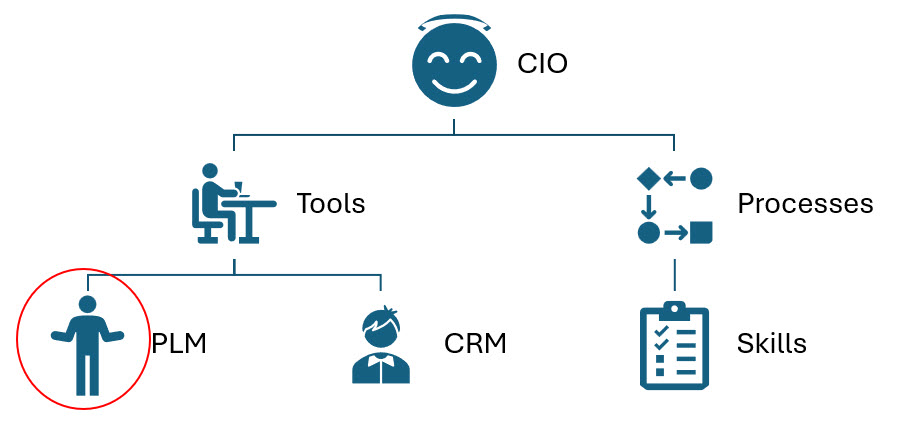 This lesson is essential for those who believe that PLM is still a system or an IT service. In some companies, I have seen that the (understaffed) PLM team is part of a larger IT organization. In this type of organization, the PLM team, as part of IT, is purely considered a cost center that is available to support the demand from the business.
The business usually focuses on incremental and economic profitability, less on transformational ways of working.
In this context, it is relevant to read Chris Seiler’s post: How to escape the vicious circle in times of transformation? Where he reflects on his 2002 MBA study, which is still valid for many big corporate organizations.
It is a long read, but it is gratifying if you are interested. It shows that PLM concepts should be discussed and executed at the business level. Of course, I read the article with my PLM-twisted brain.
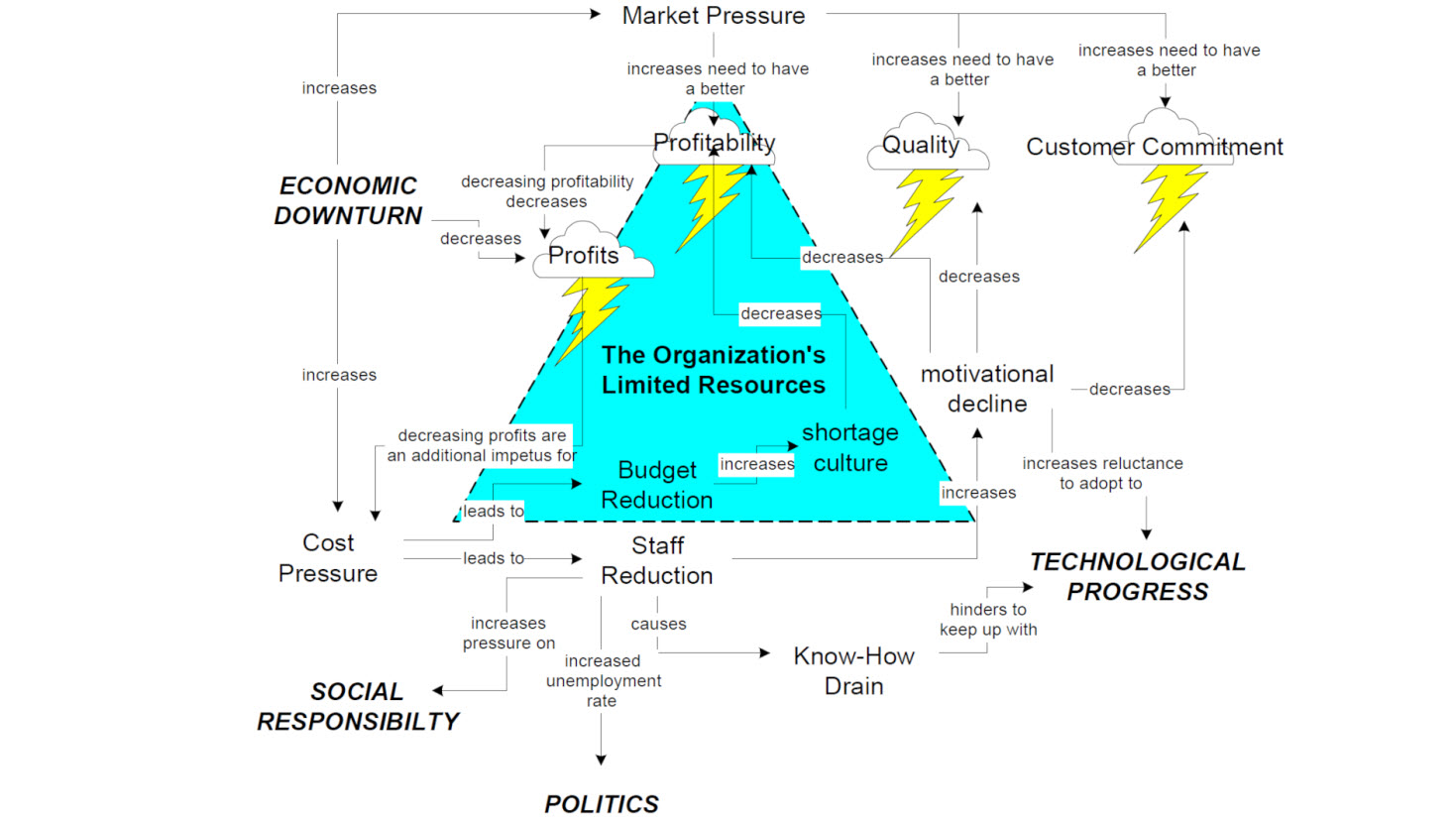
A Pessimistic Scenario of External Driving Forces and Their Internal Interrelations (Christ Seiler)
The image above from Chris’s post could be a starting point for a Benefits-Dependent Network diagram, expanded with Objectives, Business Changes and Benefits to fight this vicious downturn.
As PLM is no longer a system but a business strategy, the PLM team should be integrated into the business potential overlooked by the CIO or CDO, as a CEO is usually not able to give this long-term executive commitment.
Lesson 5:
Educate yourselves and your management
The last lesson is crucial, as due to improving technologies like AI and, earlier, the concepts of the digital twin, traditional ways of coordinated working will become inefficient and redundant.
However, before jumping on these new technologies, everyone, at every level in the organization, should be aware of:
WHY will this be relevant for our business? Is it to cut costs – being more efficient as fewer humans are in the process? Is it to be able to comply with new upcoming (sustainability) regulations? Is it because the aging workforce leaves a knowledge gap?
WHAT will our business need in the next 5 to 10 years? Are there new ways of working that we want to introduce, but we lack the technology and the tools? Do we have skills in-house? Remember, digital transformation must come from the inside.
HOW are we going to adapt our business? Can we do it in a learning mode, as the end target is not clear yet—the MVP (Minimum Viable Product) approach? Are we moving from selling products to providing a Product Service System?
My lesson: Get inspired by the software vendors who will show you what might be possible. Get educated on the topic and understand what it would mean for your organization. Start from the people and the business needs before jumping on the tools.
 In the upcoming PLM Roadmap/PDT Europe conference on 23-24 October, we will be meeting again with a group of P** experts to discuss our experiences and progress in this domain. I will give a lecture here about what it takes to move to a sustainable economy based on a Product-as-a-service concept.
If you want to learn more – join us – here is the link to the agenda.
Conclusion
I hope you enjoyed reading a blog post not generated by ChatGPT, although I am using bullet points. With the overflow of information, it remains crucial to keep a holistic overview. I hope that with this post, I have helped the P** teams in their mission, and I look forward to learning from your experiences in this domain.
 I have not been writing much new content recently as I feel that from the conceptual side, so much has already been said and written. A way to confuse people is to overload them with information. We see it in our daily lives and our PLM domain.
With so much information, people become apathetic, and you will hear only the loudest and most straightforward solutions.
One desire may be that we should go back to the past when everything was easier to understand—are you sure about that?
This attitude has often led to companies doing nothing, not taking any risks, and just providing plasters and stitches when things become painful. Strategic decision-making is the key to avoiding this trap.
I just read this article in the Guardian: The German problem? It is an analog country in a digital world.
The article also describes the lessons learned from the UK (quote):
Britain was the dominant economic power in the 19th century on the back of the technologies of the first Industrial Revolution and found it hard to break with the old ways even when it should have been obvious that its coal and textile industries were in long-term decline.
As a result, Britain lagged behind its competitors. One of these was Germany, which excelled in advanced manufacturing and precision engineering.
Many technology concepts originated from Germany in the past and even now we are talking about Industrie 4.0 and Catena-X as advanced concepts. But are they implemented? Did companies change their culture and ways of working required for a connected and digital enterprise?
Technology is not the issue.
The current PLM concepts, which discuss a federated PLM infrastructure based on connected data, have become increasingly stable.
Perhaps people are using different terminologies and focusing on specific aspects of a business; however, all these (technical) discussions talk about similar business concepts:
- Prof. Dr. Jorg W. Fischer, managing partner at Steinbeis – Reshape Information Management (STZ-RIM), writes a lot about a modern data-driven infrastructure, mainly in the context of PLM and ERP. His recent article: The Freeway from PLM to ERP.
- Oleg Shilovitsky, CEO of OpenBOM, has a never-ending flow of information about data and infrastructure concepts and an understandable focus on BOMs. One of his recent articles, PLM 2030: Challenges and Opportunities of Data Lifecycle Management
- Matthias Ahrens, enterprise architect at Forvia / Hella, often shares interesting concepts related to enterprise architecture relevant to PLM. His latest share: Think PLM beyond a chain of tools!
- Dr. Yousef Hooshmand, PLM lead at NIO, shared his academic white paper and experiences at Daimler and NIO through various presentations. His publication can be found here: From a Monolithic PLM Landscape to a Federated Domain and Data Mesh.
- Erik Herzog, technical fellow at SAAB Aeronautics, has been active for the past two years, sharing the concept of federated PLM applied in the Heliple project. His latest publication post: Heliple Federated PLM at the INCOSE International Symposium in Dublin
Several more people are sharing their knowledge and experience in the domain of modern PLM concepts, and you will see that technology is not the issue. The hype of AI may become an issue.
From IT focus to Business focus
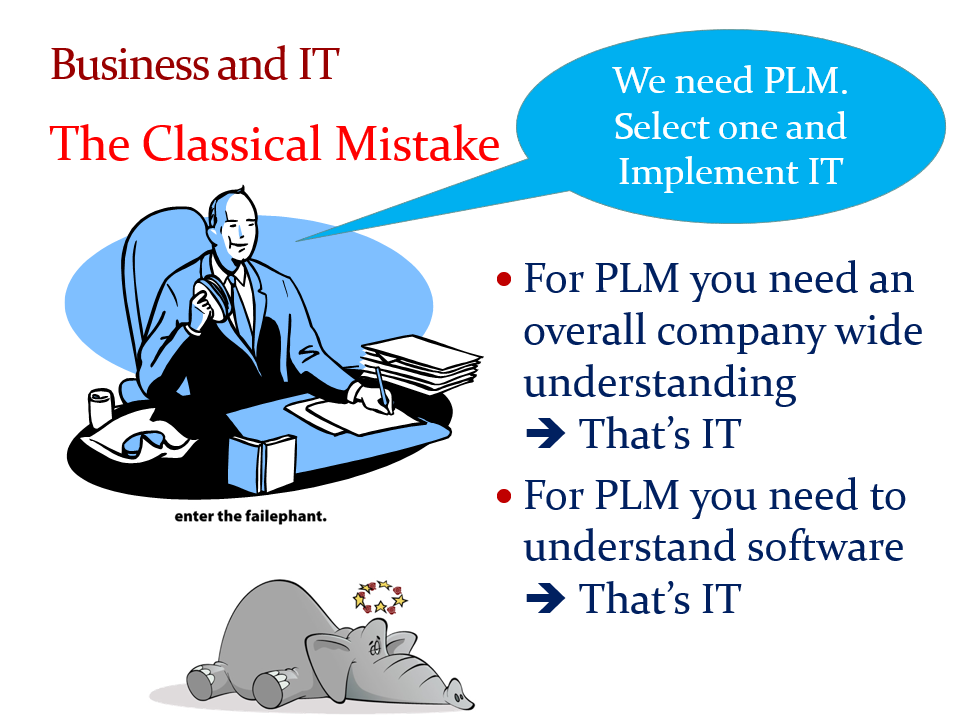 One issue I observed at several companies I worked with is that the PLM’s responsibility is inside the IT organization – click on the image to get the mindset.
This situation is a historical one, as in the traditional PLM mode, the focus was on the on-premise installation and maintenance of a PLM system. Topics like stability, performance and security are typical IT topics.
IT departments have often been considered cost centers, and their primary purpose is to keep costs low.
Does the slogan ONE CAD, ONE PLM or ONE ERP resonate in your company?
 It is all a result of trying to standardize a company’s tools. It is not deficient in a coordinated enterprise where information is exchanged in documents and BOMs. Although I wrote in 2011 about the tension between business and IT in my post “PLM and IT—love/hate relation?”
Now, modern PLM is about a connected infrastructure where accurate data is the #1 priority.
Most of the new processes will be implemented in value streams, where the data is created in SaaS solutions running in the cloud. In such environments, business should be leading, and of course, where needed, IT should support the overall architecture concepts.
In this context, I recommend an older but still valid article: The Changing Role of IT: From Gatekeeper to Business Partner.
This changing role for IT should come in parallel to the changing role for the PLM team. The PLM team needs to first focus on enabling the new types of businesses and value streams, not on features and capabilities. This change in focus means they become part of the value creation teams instead of a cost center.
From successful PLM implementations, I have seen that the team directly reported to the CEO, CTO or CIO, no longer as a subdivision of the larger IT organization.
Where is your PLM team?
Is it a cost center or a value-creation engine?
The role of business leaders
As mentioned before, with a PLM team reporting to the business, communication should transition from discussing technology and capabilities to focusing on business value.
I recently wrote about this need for a change in attitude in my post: PLM business first. The recommended flow is nicely represented in the section “Starting from the business.”
Image: Yousef Hooshmand.
Business leaders must realize that a change is needed due to upcoming regulations, like ESG and CSRD reporting, the Digital Product Passport and the need for product Life Cycle Analysis (LCA), which is more than just a change of tools.
I have often referred to the diagram created by Mark Halpern from Gartner in 2015. Below you can see and adjusted diagram for 2024 including AI.
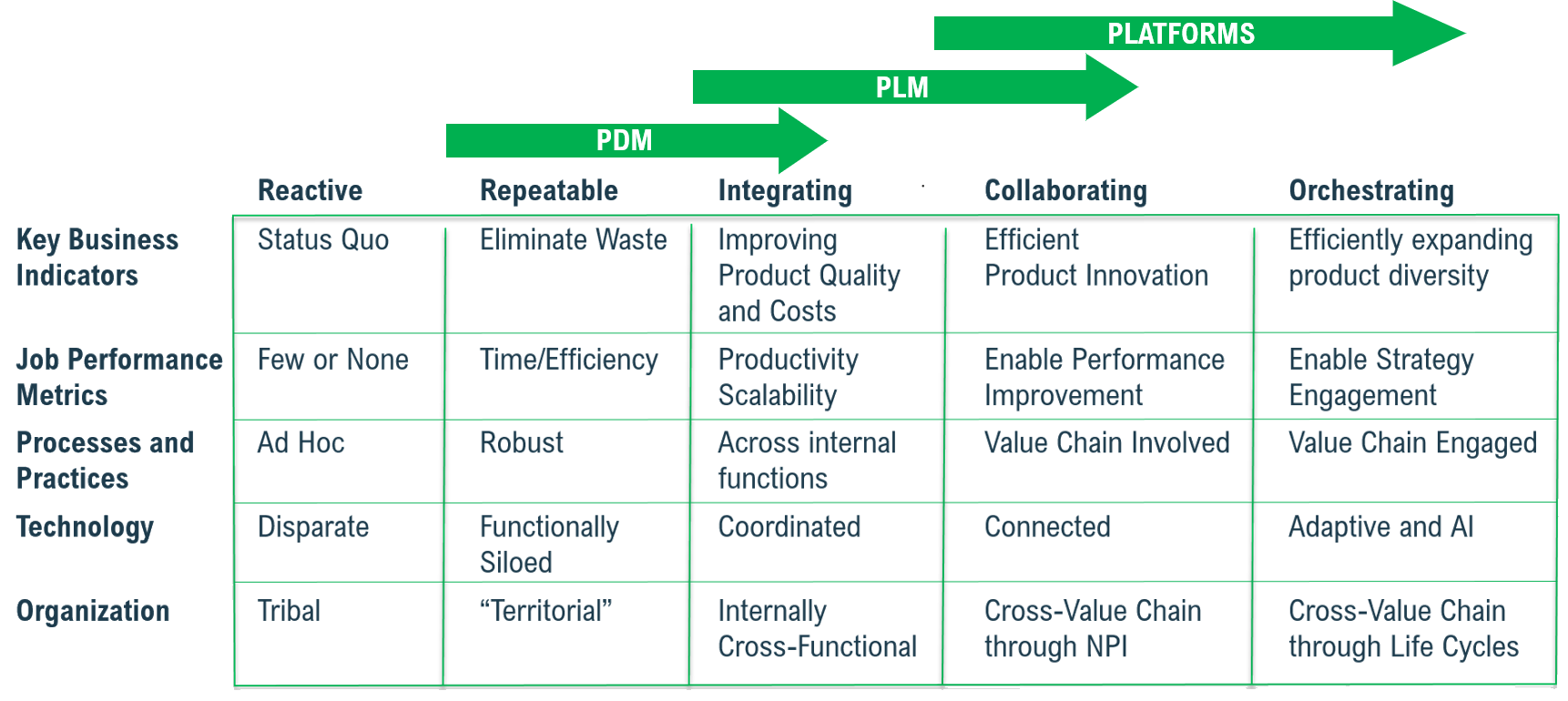
It looks like we are moving from Coordinated technology toward Connected technology. This seems easy to frame. However, my experience discussing this step in the past four to five years has led to the following four lessons learned:
- It is not a transition from Coordinated to Connected.
At this step, a company has to start in a hybrid mode – there will always remain Coordinated ways of working connected to Connected ways of working. This is the current discussion related to Federated PLM and the introduction of the terms System of Record (traditional systems / supporting linear ways of working) and Systems of Engagement (connected environments targeting real-time collaboration in their value chain) - It is not a matter of buying or deploying new tools.
Digital transformation is a change in ways of working and the skills needed. In traditional environments, where people work in a coordinated approach, they can work in their discipline and deliver when needed. People working in the connected approach have different skills. They work data-driven in a multidisciplinary mode. These ways of working require modern skills. Companies that are investing in new tools often hesitate to change their organization, which leads to frustration and failure. - There is no blueprint for your company.
Digital transformation in a company is a learning process, and therefore, the idea of a digital transformation project is a utopia. It will be a learning journey where you have to start small with a Minimum Viable Product approach. Proof of Concepts is a waste of time as they do not commit to implementing the solution. - The time is now!
The role of management is to secure the company’s future, which means having a long-term vision. And as it is a learning journey, the time is now to invest and learn using connected technology to be connected to coordinated technology. Can you avoid waiting to learn?
I have shared the image below several times as it is one of the best blueprints for describing the needed business transition. It originates from a McKinsey article that does not explicitly refer to PLM, again demonstrating it is first about a business strategy.
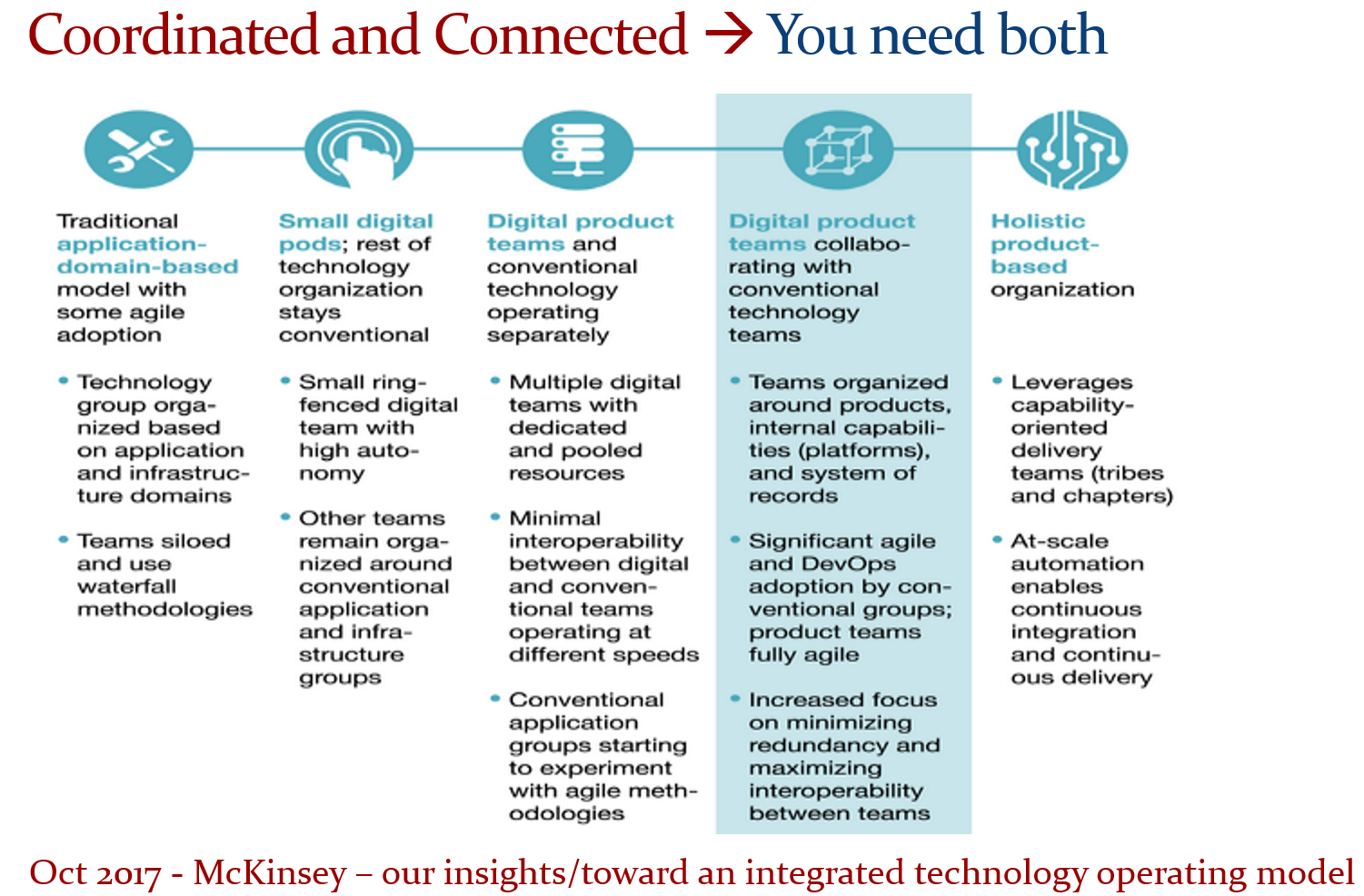
It is up to the management to master this process and apply it to their business in a timely manner. If not, the company and all its employees will be at risk for a sustainable business. Here, the word Sustainable has a double meaning – for the company and its employees/shareholders and the outside world – the planet.
Want to learn and discuss more?
Currently, I am preparing my session for the upcoming PLM Roadmap/PDT Europe conference on 23 and 24 October in Gothenburg. As I mentioned in previous years, this conference is my preferred event of the year as it is vendor-independent, and all participants are active in the various phases of a PLM implementation.

If you want to attend the conference, look here for the agenda and registration. I look forward to discussing modern PLM and its relation to sustainability with you. More in my upcoming posts till the conference.
Conclusion
Digital transformation in the PLM domain is going slow in many companies as it is complex. It is not an easy next step, as companies have to deal with different types of processes and skills. Therefore, a different organizational structure is needed. A decision to start with a different business structure always begins at the management level, driven by business goals. The technology is there—waiting for the business to lead.
 Jos Voskuil's Weblog
Interesting reflection, Jos. In my experience, the situation you describe is very recognizable. At the company where I work, sustainability…
[…] (The following post from PLM Green Global Alliance cofounder Jos Voskuil first appeared in his European PLM-focused blog HERE.) […]
[…] recent discussions in the PLM ecosystem, including PSC Transition Technologies (EcoPLM), CIMPA PLM services (LCA), and the Design for…
Jos, all interesting and relevant. There are additional elements to be mentioned and Ontologies seem to be one of the…
Jos, as usual, you've provided a buffet of "food for thought". Where do you see AI being trained by a…