
You are currently browsing the category archive for the ‘PLM’ category.
 Most times in this PLM and Sustainability series, Klaus Brettschneider and Jos Voskuil from the PLM Green Global Alliance core team speak with PLM related vendors or service partners.
This year we have been speaking with Transition Technologies PSC, Configit, aPriori, Makersite and the PLM Vendors PTC, Siemens and SAP.
Where the first group of companies provided complementary software offerings to support sustainability – “the fourth dimension”– the PLM vendors focused more on the solutions within their portfolio.
This time we spoke with , CIMPA PLM services, a company supporting their customers with PLM and Sustainability challenges, offering an end-to-end support.
What makes them special is that they are also core partner of the PLM Global Green Alliance, where they moderate the Circular Economy theme – read their introduction here: PLM and Circular Economy.
CIMPA PLM services
 We spoke with Pierre DAVID and Mahdi BESBES from CIMPA PLM services. Pierre is an environmental engineer and Mahdi is a consulting manager focusing on parts/components traceability in the context of sustainability and a circular economy. Many of the activities described by Pierre and Mahdi were related to the aerospace industry.
We had an enjoyable and in-depth discussion of sustainability, as the aerospace industry is well-advanced in traceability during the upstream design processes. Good digital traceability is an excellent foundation to extend for sustainability purposes.
CSRD, LCA, DPP, AI and more
A bunch of abbreviations you will have to learn. We went through the need for a data-driven PLM infrastructure to support sustainability initiatives, like Life Cycle Assessments and more. We zoomed in on the current Corporate Sustainability Reporting Directive(CSRD) highlighting the challenges with the CSRD guidelines and how to connect the strategy (why we do the CSRD) to its execution (providing reports and KPIs that make sense to individuals).
In addition, we discussed the importance of using the proper methodology and databases for lifecycle assessments. Looking forward, we discussed the potential of AI and the value of the Digital Product Passport for products in service.
Enjoy the 37 minutes discussion and you are always welcome to comment or start a discussion with us.
What we learned
- Sustainability initiatives are quite mature in the aerospace industry and thanks to its nature of traceability, this industry is leading in methodology and best practices.
- The various challenges with the CSRD directive – standardization, strategy and execution.
- The importance of the right databases when performing lifecycle analysis.
- CIMPA is working on how AI can be used for assessing environmental impacts and the value of the Digital Product Passport for products in service to extend its traceability
Want to learn more?
Here are some links related to the topics discussed in our meeting:
- CIMPA’s theme page on the PLM Green website: PLM and Circular Economy
- CIMPA’s commitments towards A sustainable, human and guiding approach
- Sopra Steria, CIMPA’s parent company: INSIDE #8 magazine
Conclusion
The discussion was insightful, given the advanced environment in which CIMPA consultants operate compared to other manufacturing industries. Our dialogue offered valuable lessons in the aerospace industry, that others can draw on to advance and better understand their sustainability initiatives
 This year, I will celebrate 25 years since I started my company, TacIT, to focus on knowledge management. However, quickly, I was back in the domain of engineering data management, which became a broader topic, which we now call PLM.
Looking back, there have been significant changes in these 25 years, from systems to strategy, for documents to data, from linear to iterative. However, in this post, I want to look at my 2024 observations to see where we can progress. This brings me to the first observation.
PLM is human
Despite many academic and marketing arguments describing WHAT and WHY companies need specific business or software capabilities, there is, above all, the need for people to be personally inspired and connected. We want to belong to a successful group of people, teams and companies because we are humans, not resources.
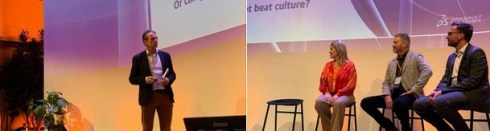
It is all about people, which was also the title of my session during the March 2024 3DEXPERIENCE User Conference in Eindhoven (NL). I led a panel discussion on the importance of people with Dr. Cara Antoine, Daniel Schöpf, and Florens Wolters, each of whom actively led transformational initiatives within their companies.
 Through Dr. Cara Antoine, e at Capgemini and a key voice for women in tech, I learned about her book Make It Personal. The book inspired me and motivated me to continue using a human-centric approach. Give this book to your leadership and read it yourself. It is practical, easy to read, and encouraging
Recently, in my post “PLM in real life and Gen AI“, I shared insights related to PLM blogs and Gen AI – original content is becoming increasingly the same, and the human touch is disappearing, while generating more and longer blogs.
 I propose keeping Gen AI-generated text for the boring part of PLM and exploring the human side of PLM engagements in blogs. What does this mean? In the post, I also shared the highlights of the Series 2 podcast I did together with Helena Gutierrez from Share PLM. Every recording had its unique human touch and knowledge.
We are now in full preparation for Series 3—let us know who your hero is and who should be our guest in 2025!
PLM is business
One of the most significant changes I noticed in my PLM-related projects was that many of the activities connected the PLM activities to the company’s business objectives. Not surprisingly, it was mostly a bottom-up activity, explaining to the upper management that a modern, data-driven PLM strategy is crucial to achieving business or sustainability goals.
I wrote two long posts about these experiences. The first one,” PLM – business first,” zooms in on the changing mindset that PLM is not an engineering system anymore but part of a digital infrastructure that supports companies in achieving their business goals. The image below from Dr. Yousef Hooshmand is one of my favorites in this context. The 5 + 1 steps, where the extra step is crucial: Long Executive Commitment.
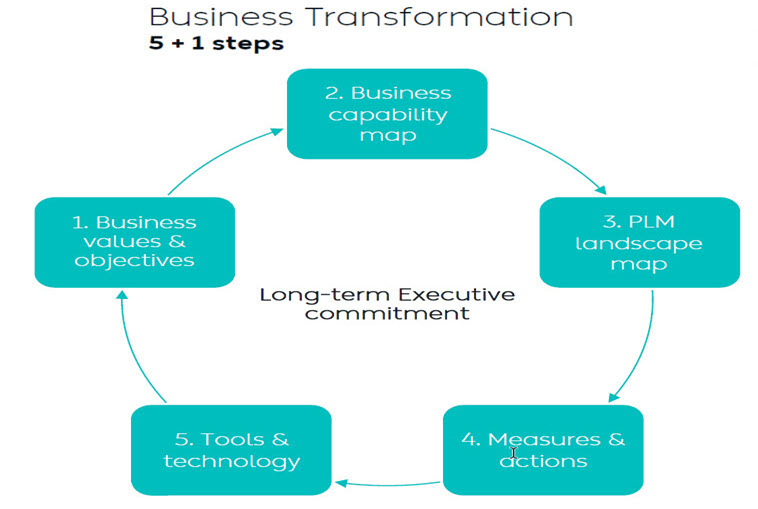
So, to get an executive commitment, you need to explain and address business challenges.
Executive commitment and participation can be achieved through a Benefits Dependency Network approach, as illustrated in this webinar I did with the Heliple-2 team, where we were justifying the business needs for Federated PLM. More about the Federated PLM part in the next paragraph.

Another point to consider is that when the PLM team is part of the IT organization (the costs side), they have a big challenge in leading or even participating in business discussions. In this context, read (again) Jan Bosch’s post: Structure Eats Strategy.
 The second post, more recent, summarized the experiences I had with several customer engagements. The title says it all: “Don’t use the P**-word! – 5 lessons learned“, with an overlap in content with the first post.
Conclusion: A successful PLM strategy starts with the business and needs storytelling to align all stakeholders with a shared vision or goal.
PLM is technology
This year has seen the maturation of PLM technology concepts. We are moving away from a monolithic PLM system and exploring federated and connected infrastructures, preferably a mix of Systems of Record (the old PLMs/ERPs) and Systems of Engagement (the new ways of domain collaboration). The Heliple project manifests such an approach, where the vertical layers are Systems of Record, and the horizontal modules could be Systems of Engagement.
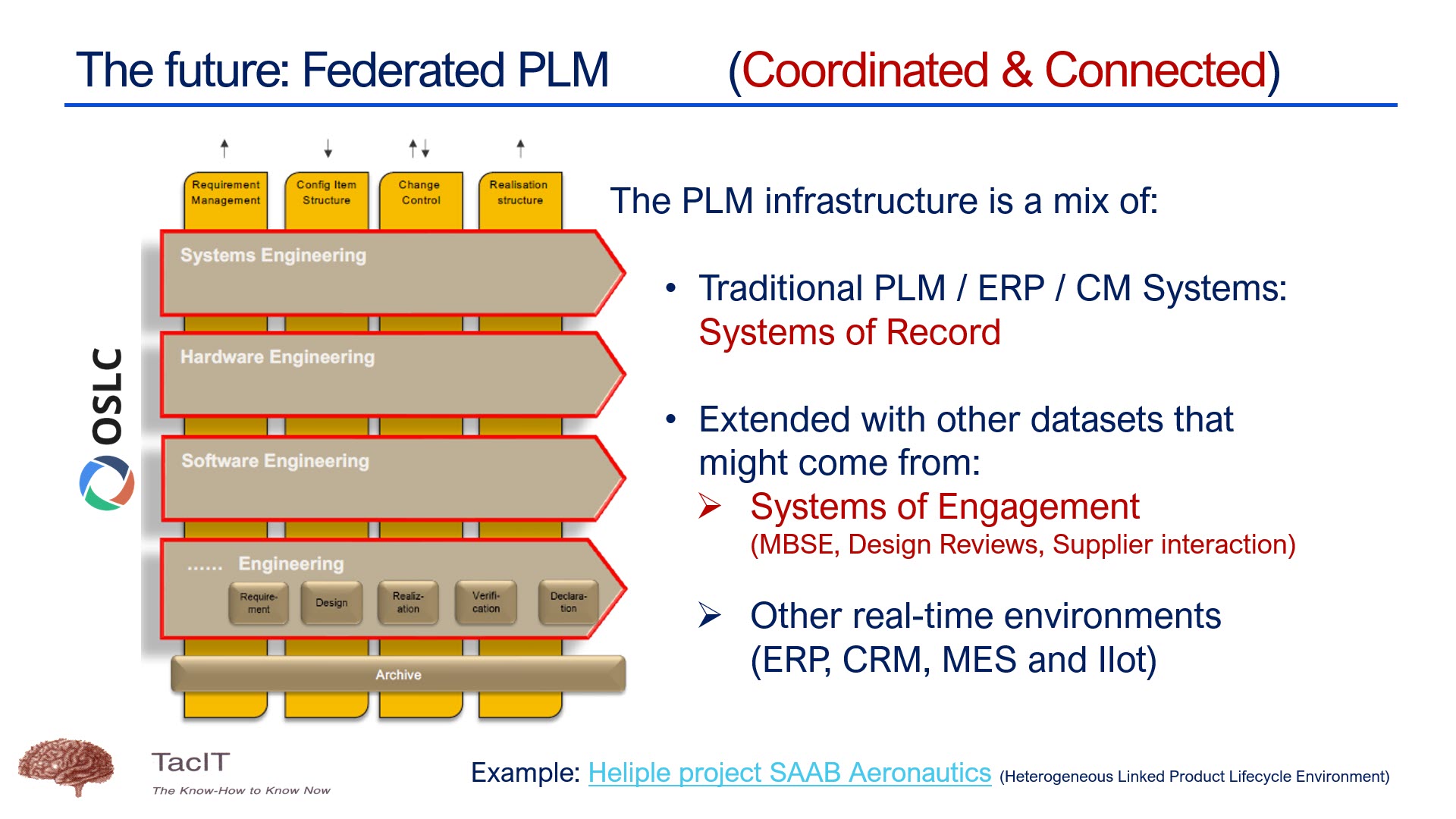
I had several discussions with typical System of Engagement vendors, like Colab (“Where traditional PLM fails”) and Partful (“Connected Digital Thread for Lower and Mid-market OEMs“), but I also had broader discussions during the PLM Roadmap PDT Europe conference – see: R-evolutionizing PLM and ERP and Heliple.
 I also follow Dr. Jorg Fischer, who lectures about digital transformation concepts in the manufacturing business domain. Unfortunately, for a broader audience, Jörg published a lot in German, and typically, his references for PLM and ERP are based on SAP and Teamcenter. His blog posts are always interesting to follow – have a look at his recent blog in English: 7 keys to solve PLM & ERP.
 Of course, Oleg Shilovitsky’s impressive and continuous flow of posts related to modern PLM concepts is amazing—just browse through his Beyond PLM home page to read about the actual topics happening in his PLM ecosystem or for example, read about modern technology concepts in this recent OpenBOM article.
Conceptually, we are making progress. As a commonality, all future concepts focus on data, not so much on managing documents—and here comes the focus on data.
PLM needs accurate data
In a data-driven environment, apps or systems will use a collection of datasets to provide a user with a working environment, either a dashboard or an interactive real-time environment. Below is my AI (Artist Impression) of a digital enterprise.
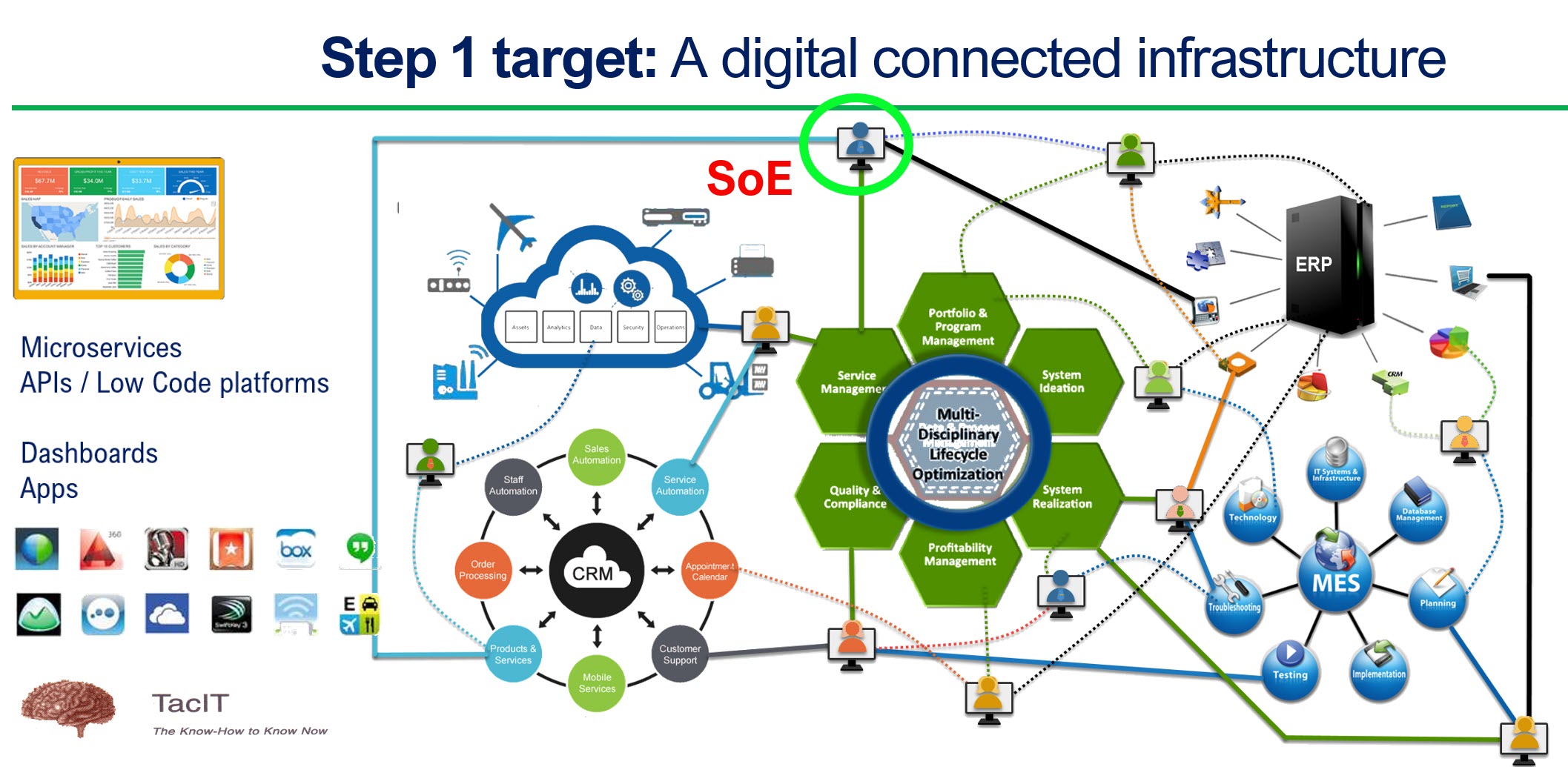
Of course, it seems logical; the data must be accurate as you no longer have control over access to the data in a data-driven environment. You can be accountable for the data; others can consume the data you created without checking its accuracy by your guidance.
Therefore, data governance and an excellent enterprise architecture are crucial to support the new paradigm:
The nearest source of truth supported by a single source of change
Quote: Yousef Hoohmand
Forget the Single Source of Truth idea, a previous century paradigm.
With data comes Artificial intelligence and algorithms that can play an essential role in your business, providing solutions or insights that support decision-making.
 In 2024, most of us have been exploring the benefits of ChatGPT and Generative AI. You can describe examples of where AI could assist in every aspect of the product lifecycle. I saw great examples from Eaton, Ocado, and others at the PLM Roadmap/PDT Europe conference.
See my review here: A long week after the PLM Roadmap / PDT Europe conference.
Still, before benefiting from AI in your organization, it remains essential that the AI runs on top of accurate data.
Sustainability needs (digital) PLM
 This paragraph is the only reverse dependency towards PLM and probably the one that is less in people’s minds, perhaps because PLM is already complex enough. In 2024, with the PLM Green Global Alliance, we had good conversations with PLM-related software vendors or service partners (aPriori, Configit, Makersite, PTC, SAP, Siemens and Transition Technologies PSC) where we discussed their solutions and how they are used in the field by companies.
We discovered here that most activities are driven by regulations, like ESG reporting, the new CSRD directive for Europe and the implementation of the Digital Product Passport. What is clear from all these activities is that companies need to have a data-driven PLM infrastructure to connect product data to environmental impacts, like carbon emissions equivalents.
Besides complying with regulations, I have been discussing the topic of Product-As-A-Service, or the Product Service System, this year, with excellent feedback from Dave Duncan. You can find a link to his speech: Improving Product Sustainability – PTC with PGGA.
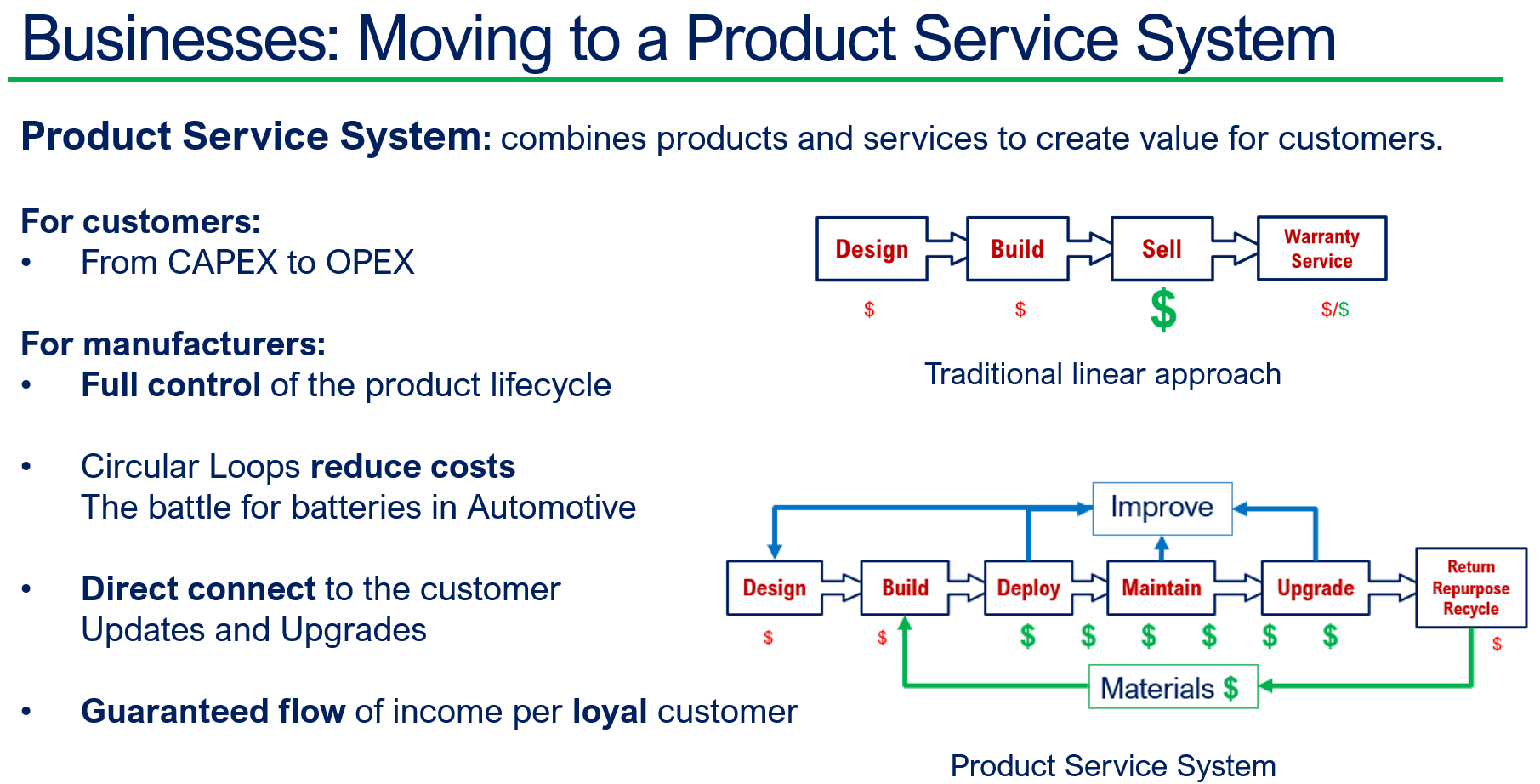
Also, during the PLM Roadmap / PDT Europe conference, I discussed this topic, explaining that achieving a circular economy is a long-term vision, and the starting point is to establish a connected infrastructure within your organizations and with your customers/users in the field.
 Sustainability should be on everyone’s agenda. From the interactions on LinkedIn, you can see that we prefer to discuss terms like PDM/PLM or eBOM/mBOM in the PLM domain. Very few connect PLM to sustainability.
Sustainability is a long-term mission; however, as we have seen from long-term missions, they can be overwhelmed by the day’s madness and short-term needs.
PLM is Politics
You might not expect this paragraph in my log, as most PLM discussions are about the WHAT and the WHY of a PLM solution or infrastructure. However, the most challenging part of PLM is the HOW, and this is the area that I am still focused on.
In the early days of mediating mainly in SmarTeam implementations, it became clear that the technology was not the issue. A crisis was often due to a lack of (technical) skills or methodology and misplaced expectations.
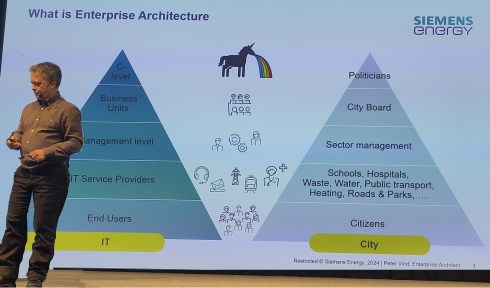
Unicorns & HIPPOs in an enterprise (Peter Vind)
When the way out became clear, politics often started. Sometimes, there was the HIPPO (HIghest Paid Person’s Opinion) in the company, as Peter Vind explained, or there was the blame game, which I described in my 2019 “The PLM blame game post”.
What makes it even more difficult is that people’s opinions in PLM discussions are often influenced by their friendly relations or history with a particular vendor or implementer from the past, which troubles a proper solution path.
These aspects are challenging to discuss, and nobody wants to discuss them openly. A company (and a country) must promote curiosity instead of adhering to mainstream thinking and working methods. In our latest Share PLM podcast, Brian Berger, a VP at Metso, mentions the importance of diversity within an organization.
“It is a constant element of working in a global business, and the importance cannot be overstated.”
This observation should make us think again when we want to simplify everything and dim the colors.
Conclusion
Initially, I thought this would be a shorter post, but again, it became a long read – therefore, perhaps ideal when closing 2024 and looking forward to activities and focus for 2025. Use this time to read books and educate yourself beyond the social media posts (even my blogs are limited 😉)
In addition, I noticed the build-up of this post was unconsciously influenced by Martijn Dullaart‘s series of messages titled “Configuration Management is ……”. Thanks, Martijn, for your continuous contributions to our joint passion – a digital enterprise where PLM and CM flawlessly interact based on methodology and accurate data.
 Congratulations if you have shown you can resist the psychological and emotional pressure and did not purchase anything in the context of Black Friday. However, we must not forget that another big part of the world cannot afford this behavior, as they do not have the means to do so – ultimate Black Friday might be their dream and a fast track to more enormous challenges.
The difference between our societies, all living on the same planet, is illustrated in the image below, illustrating the unfairness of this situation

What the image also shows is a warning that we all have to act, as step by step, we will reach planet boundaries for resources.
 Or we need more planets, and I understand a brilliant guy is already working on it. Let’s go to Mars and enjoy life there.
For those generations staying on this planet, there is only one option: we need to change our economy of unlimited growth and reconsider how we use our natural resources.
The circular economy?
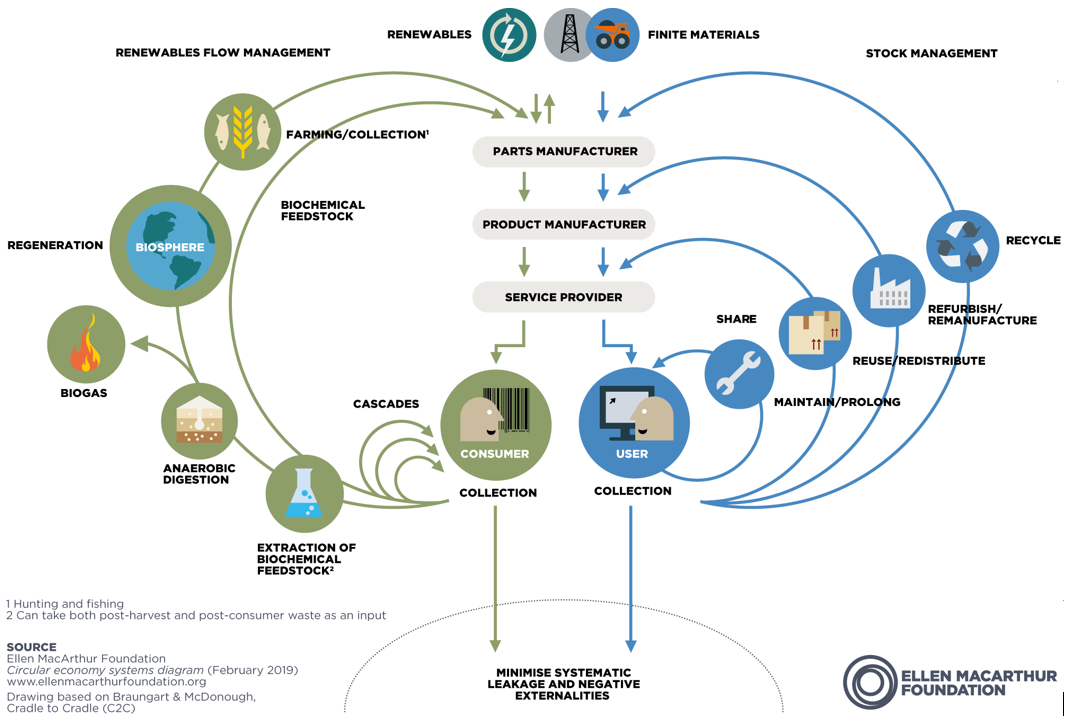
You are probably familiar with the butterfly diagram from the Ellen MacArthur Foundation, where we see the linear process: Take-Make-Use-Waste in the middle.
This approach should be replaced by more advanced regeneration loops on the left side and the five R’s on the right: Reduce, Repair, Reuse, Refurbish and Recycle as the ultimate goal is the minimum leakage of Earth resources.
Closely related to the Circular Economy concept is the complementary Cradle-To-Cradle design approach. In this case, while designing our products, we also consider the end of life of a product as the start for other products to be created based on the materials used.
The CE butterfly diagram’s right side is where product design plays a significant role and where we, as a PLM community, should be active. Each loop has its own characteristics, and the SHARE loop is the one I focused on during the recent PLM Roadmap / PDT Europe conference in Gothenburg.
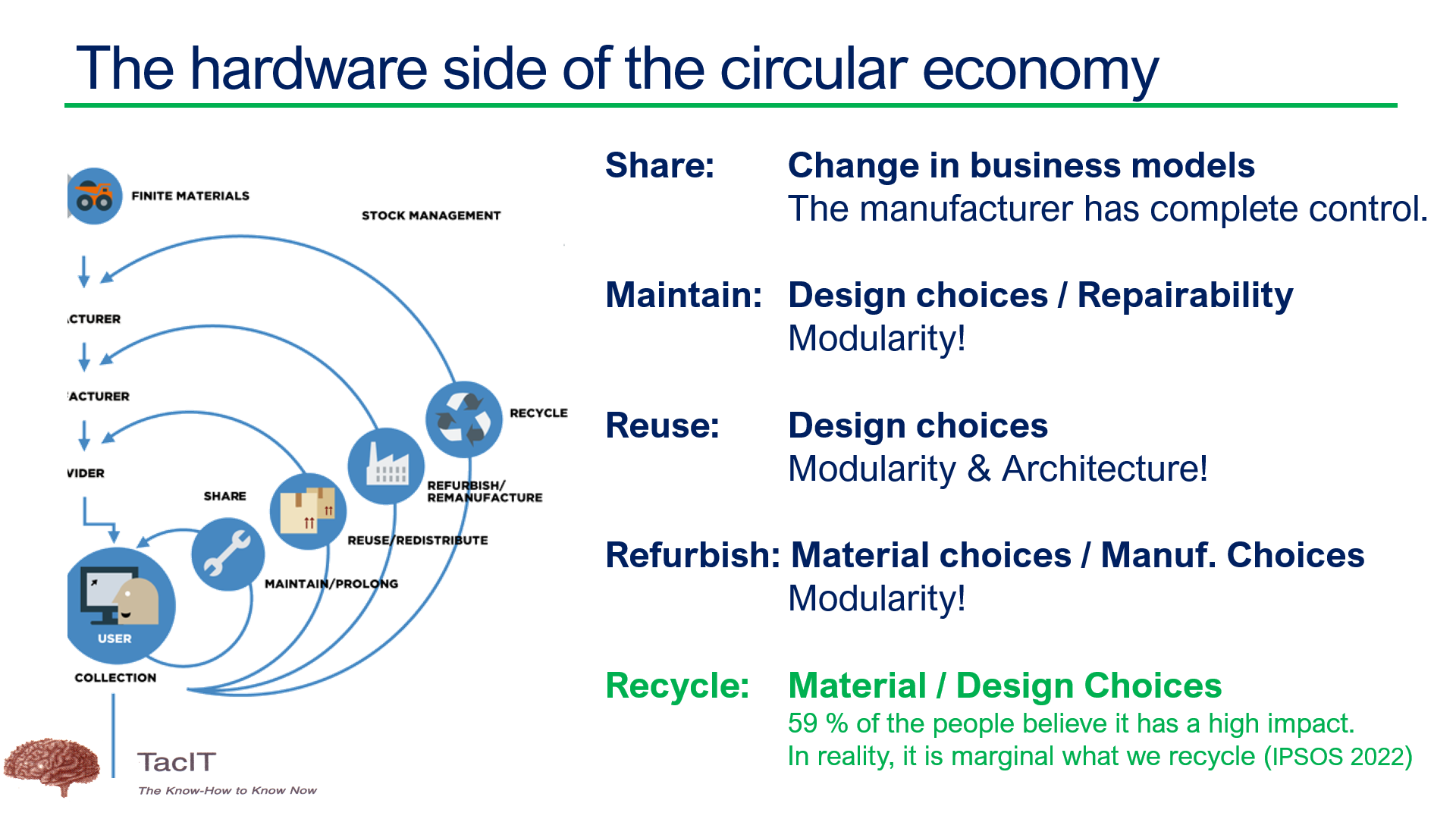
As you can see, the Maintain, Reuse, Refurbish and Recycle loops depend on product design strategies, in particular, modularity and, of course, depending on material choices.
 It is important to note that the recycle loop is the most overestimated loop, where we might contribute to recycling (glass, paper, plastic) in our daily lives; however, other materials, like composites often with embedded electronics, have a much more significant impact.
Watch the funny meme in this post: “We did everything we could– we brought our own bags.”
 The title of my presentation was: Products as a Service – The Ultimate Sustainable Economy?
You can find my presentation on SlideShare here.
Let’s focus on the remainder of the presentation’s topic: Product As A Service.
The Product Service System
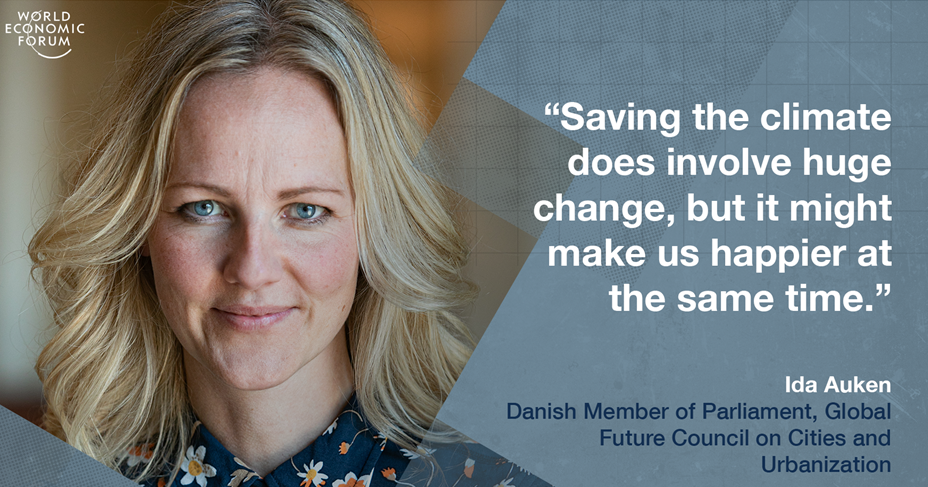 Where Product As A Service might be the ultimate dream for an almost wasteless society, Ida Auken, a Danish member of the parliament, gave a thought-provoking lecture in that context at the 2016 World Economic Forum. Her lecture was summarized afterward as
“In the future, you will own nothing and be happy.”
A theme also picked up by conspiracy thinkers during the COVID pandemic, claiming “they” are making us economic slaves and consumers. With Black Friday in mind, I do not think there is a conspiracy; it is the opposite.
Closer to implementing everywhere Product as a Service for our whole economy, we might be going into Product Service Systems.
As the image shows, a product service system is a combination of providing a product with related services to create value for the customer.
In the ultimate format, the manufacturer owns the products and provides the services, keeping full control of the performance and materials during the product lifecycle. The benefits for the customer are that they pay only for the usage of the product and, therefore, do not need to invest upfront in the solution (CAPEX), but they only pay when using the solution (OPEX).
 A great example of this concept is Spotify or other streaming services. You do not pay for the disc/box anymore; you pay for the usage, and the model is a win-win for consumers (many titles) and producers (massive reach).
Although the Product Service System will probably reach consumers later, the most significant potential is currently in the B2B business model, e.g., transportation as a service and special equipment usage as a service. Examples are popping up in various industries.
 My presentation focused on three steps that manufacturing companies need to consider now and in the future when moving to a Product Service System.
Step 1: Get (digital) connected to your Product and customer
A foundational step companies must take is to create a digital infrastructure to support all stakeholders in the product service offering. Currently, many companies have a siloed approach where each discipline Marketing/Sales, R&D, Engineering, Manufacturing and Sales will have their own systems.
Digital Transformation in the PLM domain is needed here – where are you on this level?
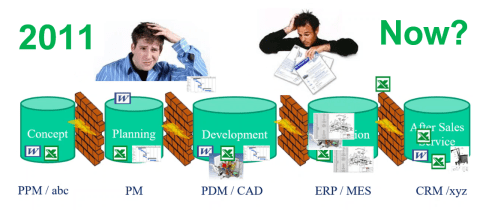
But it is not only the technical silos that impede the end-to-end visibility of information. If there are no business targets to create and maintain the end-to-end information sharing, you can not expect it to happen.
Therefore, companies should invest in the digitalization of their ways of working, implementing an end-to-end digital thread AND changing their linear New Product Development process into a customer-driven DevOp approach. The PTC image below shows the way to imagine a end-to-end connected environment
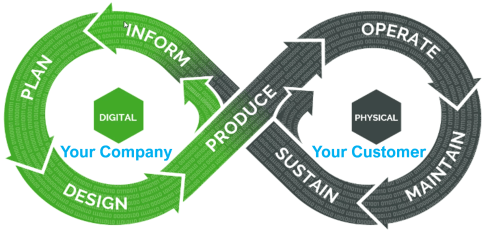
In a Product Service System, the customer is the solution user, and the solution provider is responsible for the uptime and improvement of the solution over time.
 As an upcoming bonus and a must, companies need to use AI to run their Product Service System as it will improve customer knowledge and trends. Don’t forget that AI (and Digital Twins) runs best on reliable data.
Step 2 From Product to Experience
A Product Service System is not business as usual by providing products with some additional services. Besides concepts such as Digital Thread and Digital Twins of the solution, there is also the need to change the company’s business model.
In the old way, customers buy the product; in the Product Service System, the customer becomes a user. We should align the company and business to become user-centric and keep the user inspired by the experience of the Product Service System.
In this context, there are two interesting articles to read:
- Jan Bosch: From Agile to Radical: Business Model
- Chris Seiler: How to escape the vicious circle in times of transformation?
The change in business model means that companies should think about a circular customer journey.
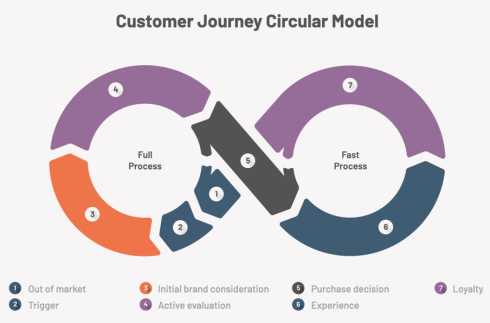
As the company will remain the product owner, it is crucial to understand what happens when the customers stop using the service or how to ensure maintenance and upgrades.
In addition, to keep the customer satisfied, it remains vital to discover the customer KPIs and how additional services could potentially improve the relationship. Again, AI can help find relationships that are not yet digitally established.
 Step 2: From product to experience can already significantly impact organizations. The traditional salesperson’s role will disappear and be replaced by excellence in marketing, services and product management.
This will not happen quickly as, besides the vision, there needs to be an evolutionary path to the new business model.
Therefore, companies must analyze their portfolio and start experimenting with a small product, converting it into a product service system. Starting simple allows companies to learn and be prepared for scaling up.
A Product Service System also influences a company’s cash flow as revenue streams will change.
 When scaling up slowly, the company might be able to finance this transition themselves. Another option, already happening, is for a third party to finance the Product Service System – think about car leasing, power by the hour, or some industrial equipment vendors.
Step 3 Towards a doughnut economy?
The last step is probably a giant step or even a journey. An economic mindset shift is needed from the ever-growing linear economy towards an economy flourishing for everyone within economic, environmental and social boundaries.
Unlimited growth is the biggest misconception on a planet reaching its borders. Either we need more planets, or we need to adjust our society.
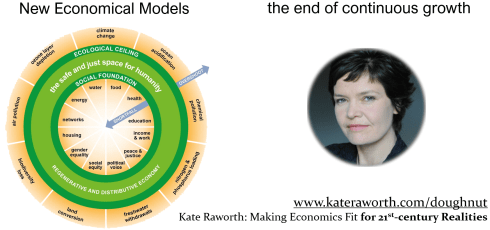
In that context, I read the book “The Doughnut Economy” by Kate Raworth, a recognized thought leader who explains how a future economic model can flourish, including a circular economy, and you will be happy.
 But we must abandon the old business models and habits – there will be a lot of resistance to change before people are forced to change. This change can take generations as the outside world will not change without a reason, and the established ones will fight for their privileges.
It is a logical process where people and boundaries will learn to find a new balance. Will it be in a Doughnut Economy, or did we overlook some bright other concepts?
Conclusion
The week after Black Friday and hopefully the month after all the Christmas presents, it is time to formulate your good intentions for 2025. As humans, we should consume less; as companies, we should direct our future to a sustainable future by exploring the potential of the Product Service System and beyond.

 Recently, I noticed I reduced my blogging activities as many topics have already been discussed and repeatably published without new content.
With the upcoming of Gen AI and ChatGPT, I believe my PLM feeds are flooded by AI-generated blog posts.
The ChatGPT option
 Most companies are not frontrunners in using extremely modern PLM concepts, so you can type risk-free questions and get common-sense answers.
I just tried these five questions:
- Why do we need an MBOM in PLM, and which industries benefit the most?
- What is the difference between a PLM system and a PLM strategy?
- Why do so many PLM projects fail?
- Why do so many ERP projects fail?
- What are the changes and benefits of a model-based approach to product lifecycle management?
 Note: Questions 3 and 4 have almost similar causes and impacts, although slightly different, which is to be expected given the scope of the domain.
All these questions provided enough information for a blog post based on the answer. This illustrates that if you are writing about what are current best practices in the field – stop writing – the knowledge is there.
PLM in the real life
Recently, I had several discussions about which skills a PLM expert should have or which topics a PLM project should address.
PLM for the individual
 For the individual, there are often certifications to obtain. Roger Tempest has been fighting for PLM professional recognition through certification – a challenge due to the broad scope and possibilities. Read more about Roger’s work in this post: PLM is complex (and we have to accept it?)
PLM vendors and system integrators often certify their staff or resellers to guarantee the quality of their solution delivery. Potential topics will be missed as they do not fulfill the vendor’s or integrator’s business purpose.
Asking ChatGPT about the required skills for a PLM expert, these were the top 5 answers:
- Technical skills
- Domain Knowledge
- Analytical and Problem-Solving Skills
- Interpersonal and Management Skills
- Strategic Thinking
 It was interesting to see the order proposed by ChatGPT. Fist the tools (technology), then the processes (domain knowledge / analytical thinking), and last the people and business (strategy and interpersonal and management skills) It is hard to find individuals with all these skills in a single person.
Although we want people to be that broad in their skills, job offerings are mainly looking for the expert in one domain, be it strategy, communication, industry or technology. To get an impression of the skills read my PLM and Education concluding blog post.
Now, let’s see what it means for an organization.
PLM for the organization
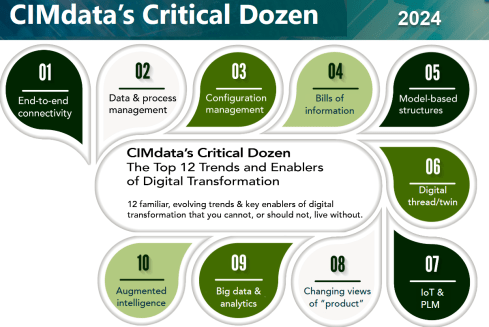
In this area, one of the most consistent frameworks I have seen over time is CIMdata‘s Critical Dozen. Although they refer less to skills and more to trends and enablers, a company should invest in – educate people & build skills – to support a successful digital transformation in the PLM domain.
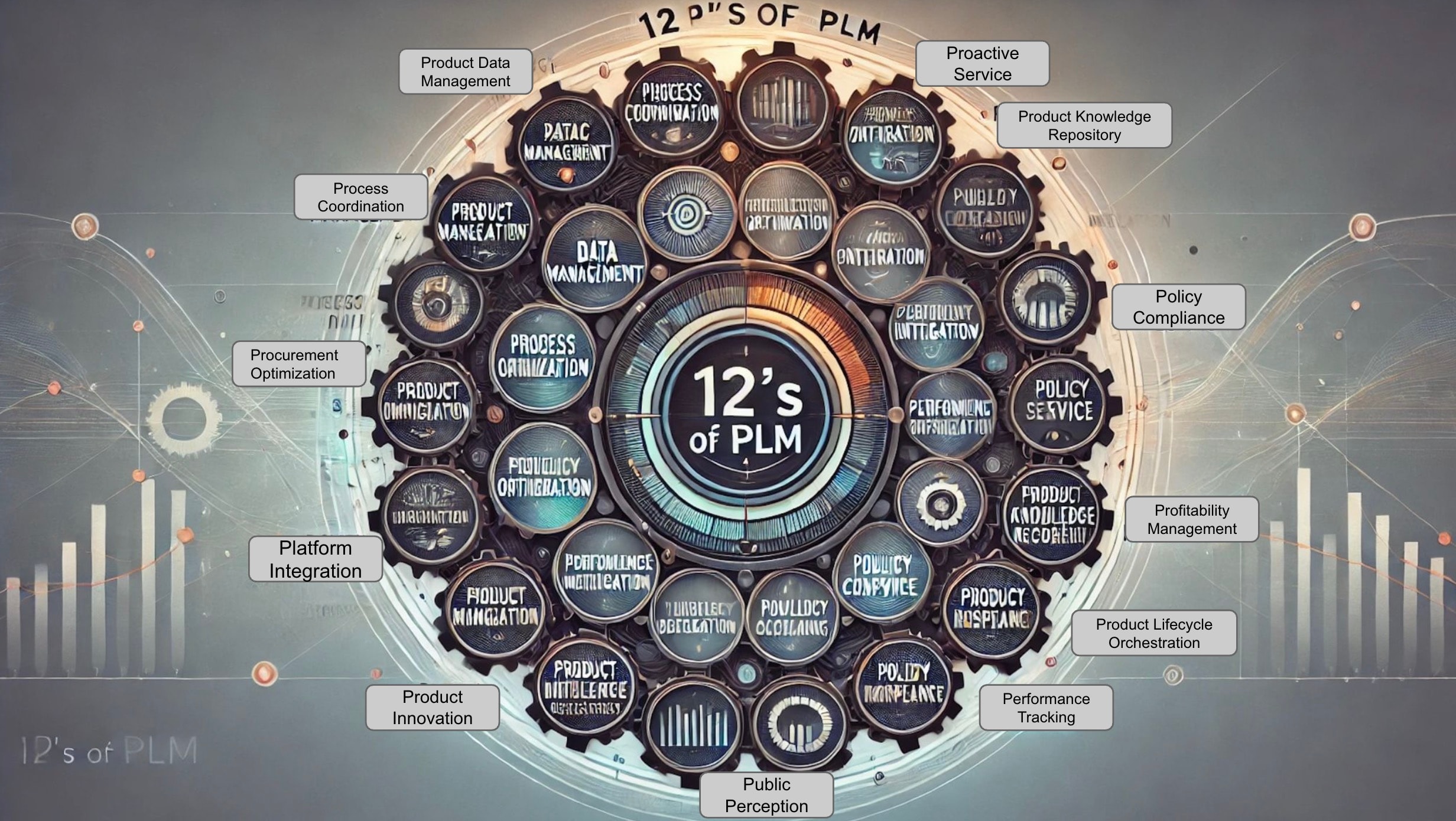 Oleg Shilovitsky’s recent blog post, The 12 “P” s of PLM Explained by Role: How to Make PLM More Than Just a Buzzword describes in an AI manner the various aspects of the term PLM, using 12 P**-words, reacting to Lionel Grealou’ s post: Making PLM Great Again
The challenge I see with these types of posts is: “OK, what to do now? Where to start?”
I believe where to start at the first place is a commonly agreed topic.
Everything starts from having a purpose and a vision. And this vision should be supported by a motivating story about the WHY that inspires everyone.
It is teamwork to define such a strategy, communicate it through a compelling story and make it personal. An excellent book to read is Make it personal from Dr. Cara Antoine – click on the image to discover the content and find my review why I believe this book is so compelling.
An important reason why we have to make transformations personal is because we are dealing first of all with human beings. And human beings are driven by emotions first even before ratio kicks in. We see it everywhere and unfortunately also in politics.
The HOW from real-life
 This question cannot be answered by external PLM vendors, consultants or system integrators. Forget the Out-of-the-Box templates or the industry best practices (from the past), but start from your company’s culture and vision, introducing step-by-step new technologies, ways of working and business models to move towards the company’s vision target.
Building the HOW is not an easy journey, and to illustrate the variety of skills needed to be successful, I worked with Share PLM on their Series 2 podcast. You can find the complete overview here. There is one more to come to conclude this year.
 Our focus was to speak only with PLM experts from the field, understanding their day-to-day challenges with a focus on HOW they did it and WHAT they learned.
And this is what we learned:
Unveiling FLSmidth’s Industrial Equipment PLM Transformation: From Projects to Products
 It was our first episode of Series 2, and we spoke with Johan Mikkelä, Head of the PLM Solution Architecture at FLSmidth.
FLSmidth provides the global mining and cement industries with equipment and services, which is very much an ETO business moving towards CTO.
We discussed their Industrial Equipment PLM Transformation and the impact it has made.
Start With People: ABB’s Engineering Approach to Digital Transformation
 We spoke with Issam Darraj, who shared his thoughts on human-centric digitalization. Issam talks us through ABB’s engineering perspective on driving transformation and discusses the importance of focusing on your people. Our favorite quote:
To grow, you need to focus on your people. If your people are happy, you will automatically grow. If your people are unhappy, they will leave you or work against you.
Enabling change: Exploring the human side of digital transformations
 We spoke with Antonio Casaschi as he shared his thoughts on the human side of digital transformation. When discussing the PLM expert, he agrees it is difficult. Our favorite part here:
“I see a PLM expert as someone with a lot of experience in organizational change management. Of course, maybe people with a different background can see a PLM expert with someone with a lot of knowledge of how you develop products, all the best practices around products, etc. We first need to agree on what a PLM expert is, and then we can agree on how you become an expert in such a domain.”
Revolutionizing PLM: Insights from Yousef Hooshmand
 With Dr. Yousef Hooshmand, writer of the paper: From a Monolithic PLM Landscape to a Federated Domain and
Data Mesh, with over 15 years of experience in the PLM domain, currently PLM Lead at NIO, we discussed the complexity of digital transformation in the PLM domain and How to deal with legacy, meanwhile implementing a user-centric, data-driven future.
My favorite quote: The End of Single Source of Truth, now it is about The nearest Source of Truth and Single Source of Change.
Steadfast Consistency: Delving into Configuration Management with Martijn Dullaart
 Martijn Dullaart, who is the man behind the blog MDUX: The Future of CM and author of the book The Essential Guide to Part Re-Identification: Unleash the Power of Interchangeability and Traceability, has been active both in the PLM and CM domain and with Martijn the similarities and differences between PLM and CM and why organizations need to be educated on the topic of CM
The ROI of Digitalization: A Deep Dive into Business Value with Susanna Maëntausta
 With Susanna Maëntausta, we discussed how to implement PLM in non-traditional manufacturing industries, such as the chemical and pharmaceutical industries.
Susanna teaches us to ensure PLM projects are value-driven, connecting business objectives and KPIs to the implementation and execution steps in the field. Susanna is highly skilled in connecting people at any level of the organization.
Narratives of Change: Grundfos Transformation Tales with Björn Axling
 As Head of PLM and part of the Group Innovation management team at Grundfos, Bjorn Axling aims to drive a Group-wide, cross-functional transformation into more innovative, more efficient, and data-driven ways of working through the product lifecycle from ideation to end-of-life.
In this episode, you will learn all the various aspects that come together when leading such a transformation in terms of culture, people, communication, and modern technology.
The Next Lane: Marel and the Digital Product Highway with Roger Kabo
 With Roger Kabo, we discussed the steps needed to replace a legacy PLM environment and be open to a modern, federated, and data-driven future.
Step 1: Start with the end in mind. Every successful business starts with a clear and compelling vision. Your vision should be specific, inspiring, and something your team can rally behind.
Next, build on value and do it step by step.
How do you manage technology and data when you have a diverse product portfolio?
 We talked with Jim van Oss, the former CIO of Moog Inc., for a deep dive into the fascinating world of technology transformations.
Key Takeaway: Evolving technology requires a clear strategy!
Jim underscores the importance of having a north star to guide your technological advancements, ensuring you remain focused and adaptable in an ever-changing landscape.
Diverse Products, Unified Systems: MBSE Insights with Max Gravel from Moog
 We discussed the future of the Model-Based approaches with Max Gravel – MBD at Gulfstream and MBSE at Moog.
Max Gravel, Manager of Model-Based Engineering at Moog Inc., who is also active in modern CM, emphasizes that understanding your company’s goals with MBD is crucial.
There’s no one-size-fits-all solution: it’s about tailoring the strategy to drive real value for your business. The tools are available, but the key lies in addressing the right questions and focusing on what matters most. A great, motivating story containing all the aspects of digital transformation in the PLM domain/
Customer-First PLM: Insights on Digital Transformation and Leadership
 With Helene Arlander, who has been involved in big transformation projects in the telecom industry. Starting from a complex legacy environment, implementing new data-driven approaches. We discussed the importance of managing product portfolios end-to-end and the leadership strategies needed for engaging people in charge.
We also discussed the role of AI in shaping the future of PLM and the importance of vision, diverse skill sets, and teamwork in transformations.
Conclusion
I believe the time of traditional blogging is over – current PLM concepts and issues can be easily queried by using ChatGPT-like solutions. The fundamental understanding of what you can do now comes from learning and listening to people, not as fast as a TikTok video or Insta message. For me, a podcast is a comfortable method of holistic learning.
Let us know what you think and who should be in Season 3
And for my friends in the United States – Happy Thanksgiving and think about the day after ……..
 Due to other activities, I could not immediately share the second part of the review related to the PLM Roadmap / PDT Europe conference, held on 23-24 October in Gothenburg. You can read my first post, mainly about Day 1, here: The weekend after PLM Roadmap/PDT Europe 2024.
There were several interesting sessions which I will not mention here as I want to focus on forward-looking topics with a mix of (federated) data-driven PLM environments and the applicability of AI, staying around 1500 words.
R-evolutionizing PLM and ERP and Heliple
Cristina Paniagua from the Luleå University of Technology closed the first day of the conference, giving us food for thought to discuss over dinner. Her session, describing the Arrowhead fPTN project, fitted nicely with the concepts of the Federated PLM Heliple project presented by Erik Herzog also on Day 2.
They are both research products related to the future state of a digital enterprise. Therefore, it makes sense to treat them together.
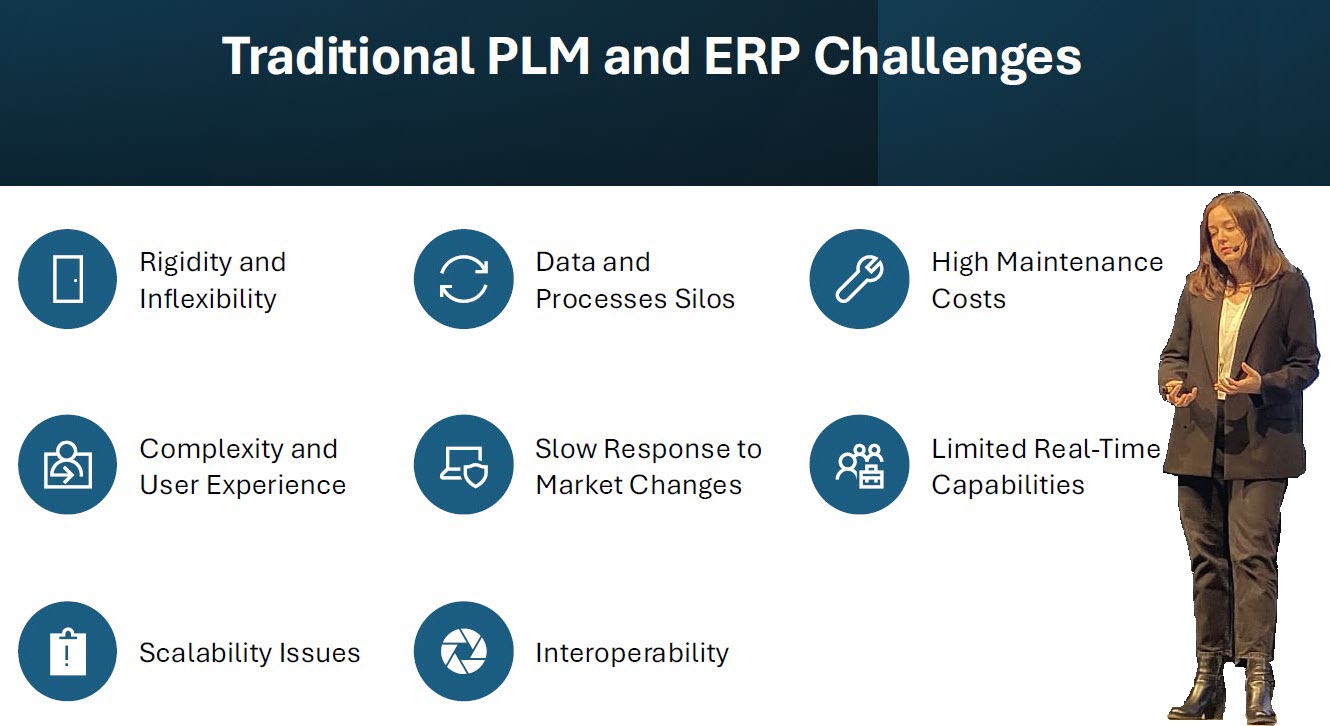
Cristina’s session started with sharing the challenges of traditional PLM and ERP systems:
These statements align with the drivers of the Heliple project. The PLM and ERP systems—Systems of Record—provide baselines and traceability. However, Systems of Record have not historically been designed to support real-time collaboration or to create an attractive user experience.

The Heliple project focuses on connecting various modules—the horizontal bars—for systems engineering, hardware engineering, etc., as real-time collaboration environments that can be highly customized and replaceable if needed. The Heliple project explored the usage of OSLC to connect these modules, the Systems of Engagement, with the Systems of Record.
 By using Lynxwork as a low-code wrapper to develop the OSLC connections and map them to the needed business scenarios, the team concluded that this approach is affordable for businesses.
Now, the Heliple team is aiming to expand their research with industry scale validation through the Demoiple project (Validate that the Heliple-2 technology can be implemented and accredited in Saab Aeronautics’ operational IT) combined with the Nextiple project, where they will investigate the role of heterogeneous information models/ontologies for heterogeneous analysis.
If you are interested in participating in Nextiple, don’t hesitate to contact Erik Herzog.
 Christina’s Arrowhead flexible Production Value Network(fPVN) project aims to provide autonomous and evolvable information interoperability through machine-interpretable content for fPVN stakeholders. In less academic words, building a digital data-driven infrastructure.
The resulting technology is projected to impact manufacturing productivity and flexibility substantially.
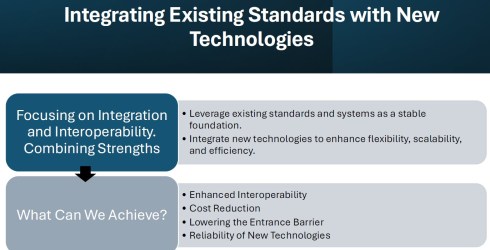
The exciting starting point of the Arrowhead project is that it wants to use existing standards and systems as a foundation and, on top of that, create a business and user-oriented layer, using modern technologies such as micro-services to support real-time processing and semantic technologies, ontologies, system modeling, and AI for data translations and learning—a much broader and ambitious scope than the Heliple project.
 I believe that in our PLM domain, this resonates with actual discussions you will find on LinkedIn, too. @Oleg Shilovitsky, @Dr. Yousef Hooshmand, @Prof. Dr. Jörg W. Fischer and Martin Eigner are a few of them steering these discussions. I consider it a perfect match for one of the images I shared about the future the digital enterprise.
Potentially, there are five platforms with their own internal ways of working, a mix of systems of record and systems of engagement, supported by an overlay of several Systems of Engagement environments.
 I previously described these dedicated environments, e.g., OpenBOM, Colab, Partful, and Authentise. These solutions could also be dedicated apps supporting a specific ecosystem role.
See below my artist’s impression of how a Service Engineer would work in its app connected to CRM, PLM and ERP platform datasets:
The exciting part of the Arrowhead fPVN project is that it wants to explore the interactions between systems and user roles based on existing mature standards instead of leaving the connections to software developers.
Christina mentioned some of these standards below:
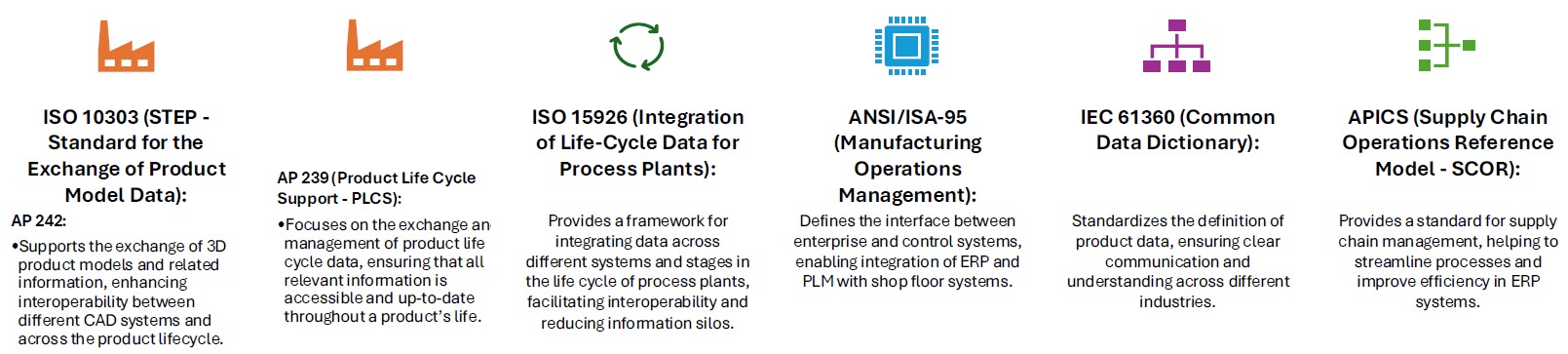
I greatly support this approach as, historically, much knowledge and effort has been put into developing standards to support interoperability. Maybe not in real-time, but the embedded knowledge in these standards will speed up the broader usage. Therefore, I concur with the concluding slide:
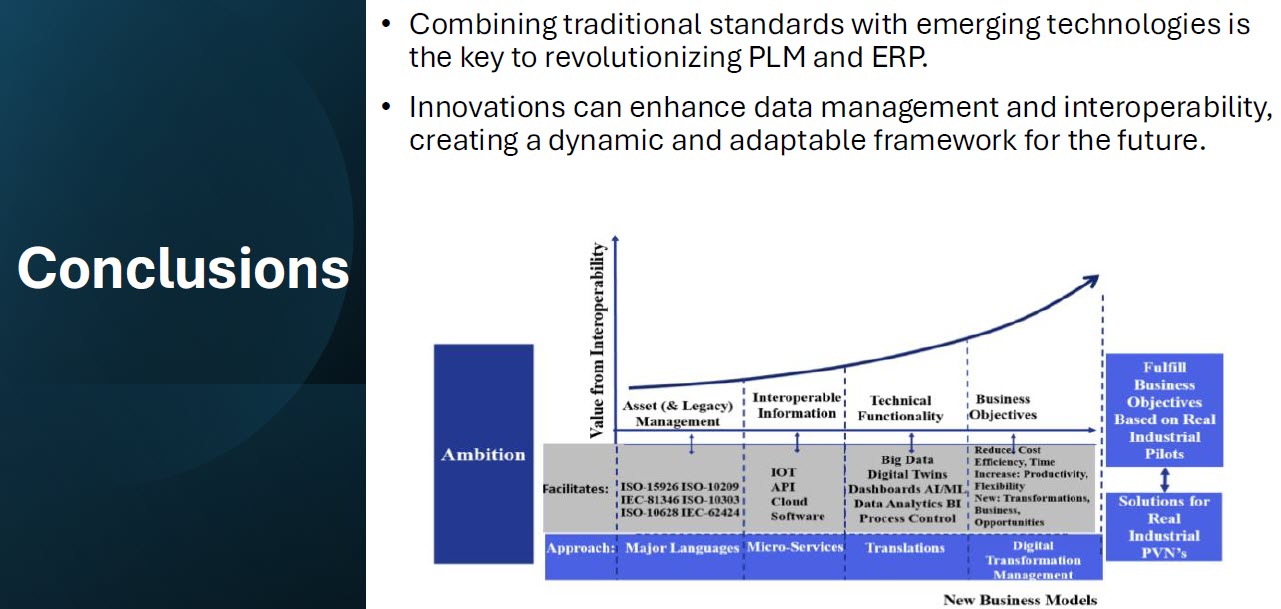
A final comment: Industrial users must push for these standards if they do not want a future vendor lock-in. Vendors will do what the majority of their customers ask for but will also keep their customers’ data in proprietary formats to prevent them from switching to another system.
Accelerated Product Development Enabled by Digitalization
 The keynote session on Day 2, delivered by Uyiosa Abusomwan, Ph.D., Senior Global Technology Manager – Digital Engineering at Eaton, was a visionary story about the future of engineering.
With its broad range of products, Eaton is exploring new, innovative ways to accelerate product design by modeling the design process and applying AI to narrow design decisions and customer-specific engineering work. The picture below shows the areas of attention needed to model the design processes. Uyiosa mentioned the significant beneficial results that have already been reached.

Together with generative design, Eaton works towards modern digital engineering processes built on models and knowledge. His session was complementary to the Heliple and Arrowhead story. To reach such a contemporary design engineering environment, it must be data-driven and built upon open PLM and software components to fully use AI and automation.
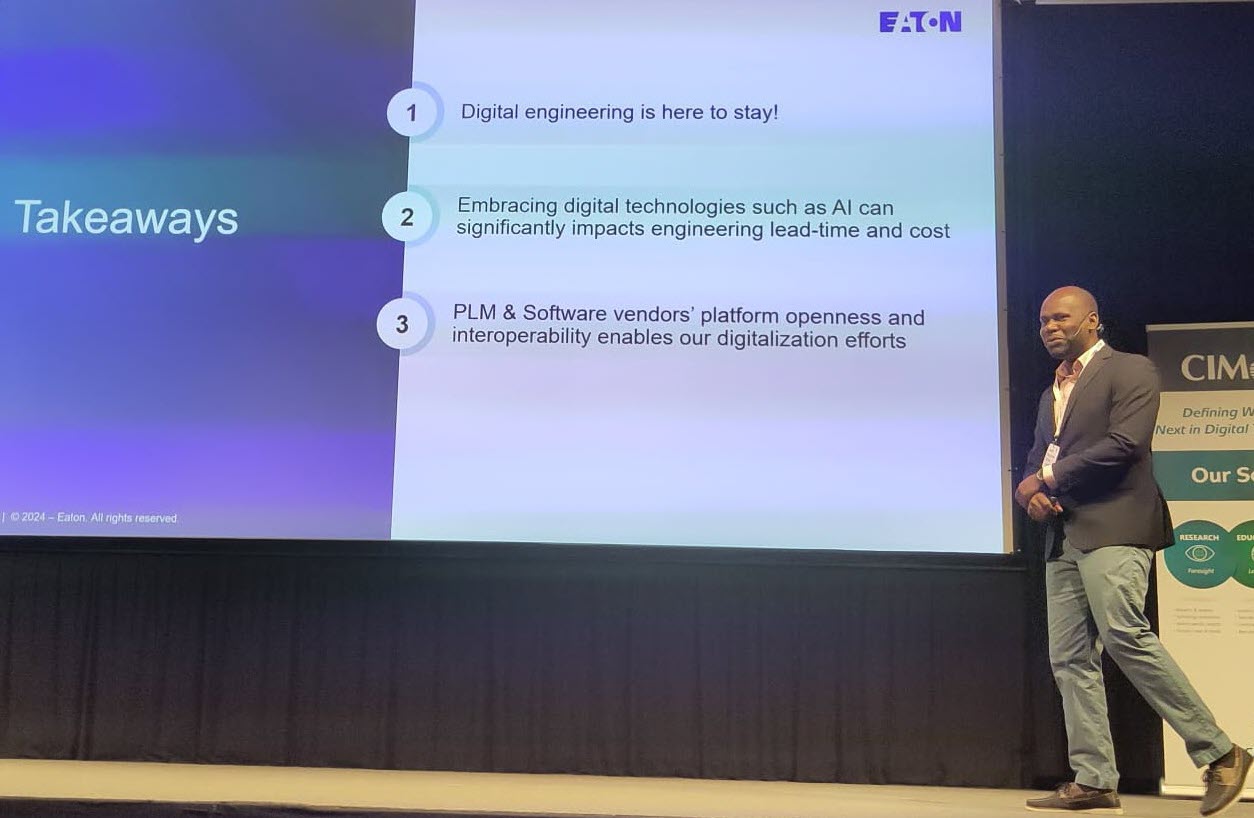
Next Gen” Life Cycle Management in Next-Gen Nuclear Power and LTO Legacy Plants
Kent Freeland‘s presentation was a trip into memory land when he discussed the issues with Long Term Operations of legacy nuclear plants.
 I spent several years in Ringhals (Sweden) discussing and piloting the setup of a PLM front-end next to the MRO (Maintenance Repair Overhaul) system. As nuclear plants developed in the sixties, they required a longer than anticipated lifecycle, with access to the right design and operational data; maintenance and upgrade changes in the plant needed to be planned and controlled. The design data is often lacking; it resides at the EPC or has been stored in a document management system with limited retrieval capabilities.
See also my 2019 post: How PLM, ALM, and BIM converge thanks to the digital twin.
Kent described these experienced challenges – we must have worked in parallel universes – that now, for the future, we need a digitally connected infrastructure for both plant design and maintenance artifacts, as envisioned below:
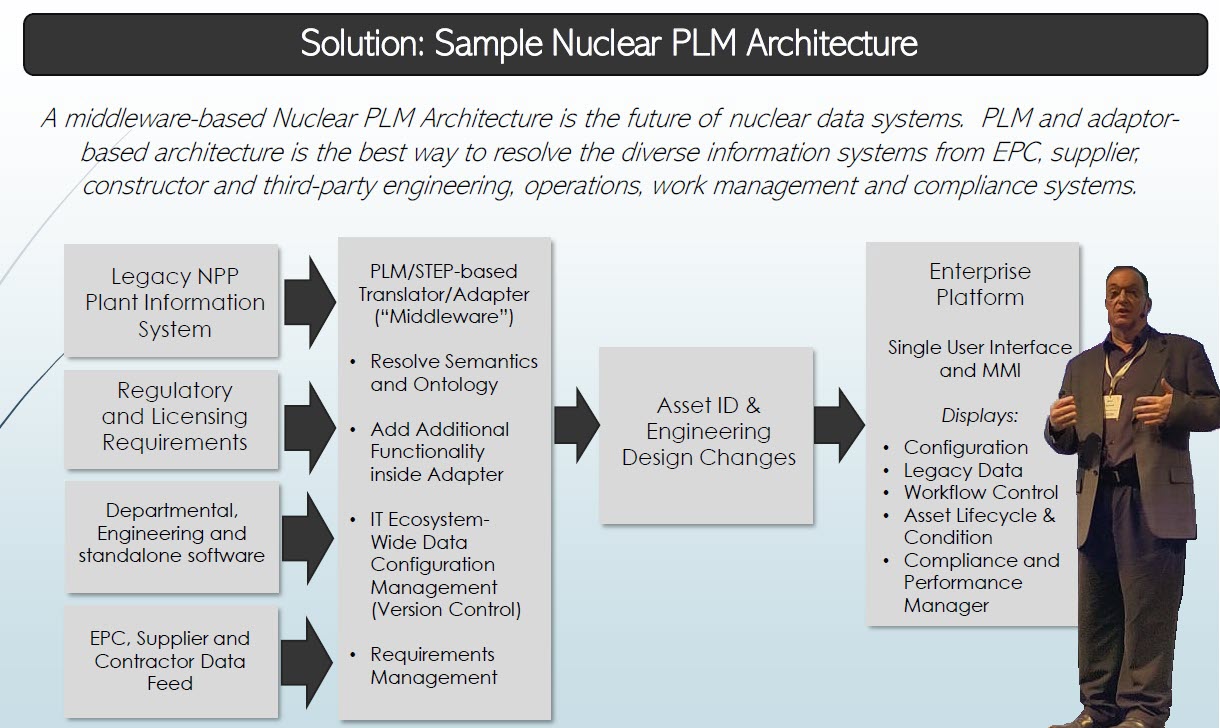
 The solution reminded me of a lecture I saw at the PI PLMx 2019 conference, where the Swedish ESS facility demonstrated its Asset Lifecycle Data Management solution based on the 3DEXPERIENCE platform.
You can still find the presentation here: Henrik Lindblad Ola Nanzell ESS – Enabling Predictive Maintenance Through PLM & IIOT.
Also, Kent focused on the relevant standards to support a “Single Source of Truth” concept, where I would say after all the federated PLM discussions, I would go for:
“The nearest source of truth and a single source of Change”
assuming this makes more sense in a digitally connected enterprise.
Why do you need to be SMART when contracting for information?
 Rob Bodington‘s presentation was complementary to Kent Freeland’s presentation. Ron, a technical fellow at Eurostep, described the challenge of information acquisition when working with large assets that require access to the correct data once the asset is in operation. The large asset could be a nuclear plant or an aircraft carrier.
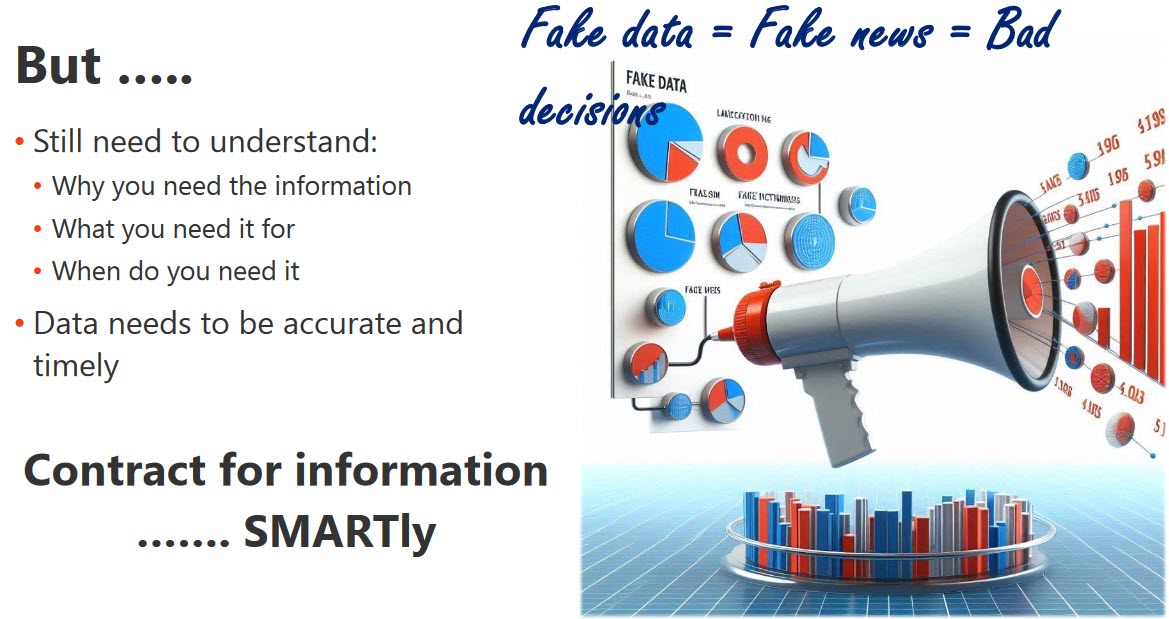
In the ideal world, the asset owner wants to have a digital twin of the asset fed by different data sources through a digital thread. Of course, this environment will only be reliable when accurate data is used and presented.
Getting accurate data starts with the information acquisition process, and Rob explained that this needed to be done SMARTly – see the image below:
 Rob zoomed in on the SMART keywords and the challenge the various standards provide to make the information SMARTly accessible, like the ISO 10303 / PLCS standard, the CFIHOS exchange standard and more. And then there is the ISO 8000 standard about data quality.
Click on the image to get smart.
Rob believes that AI might be the silver bullet as it might help understand the data quality, ontology and context of the data and even improve contracting, generating data clauses for contracting….
And there was a lot of AI ….
 There was a dazzling presentation from Gary Langridge, engineering manager at Ocado, explaining their Ocado Smart Platform (OSP), which leverages AI, robotics, and automation to tackle the challenges of online grocery and allow their clients to excel in performance and customer responsiveness.
There was a significant AI component in his presentation, and if you are tired of reading, watch this video
But here was more AI – from the 25 sessions in this conference, 19 of them mentioned the potential or usage of AI somewhere in their speech – this is more than 75 %!
There was a dedicated closing panel discussion related to the real business value of Artificial Intelligence in the PLM domain, moderated by Peter Bilello and answered by selected speakers from the conference, Sandeep Natu (CIMdata), Lars Fossum (SAP), Diana Goenage (Dassault Systemes) and Uyiosa Abusomwan (Eaton).
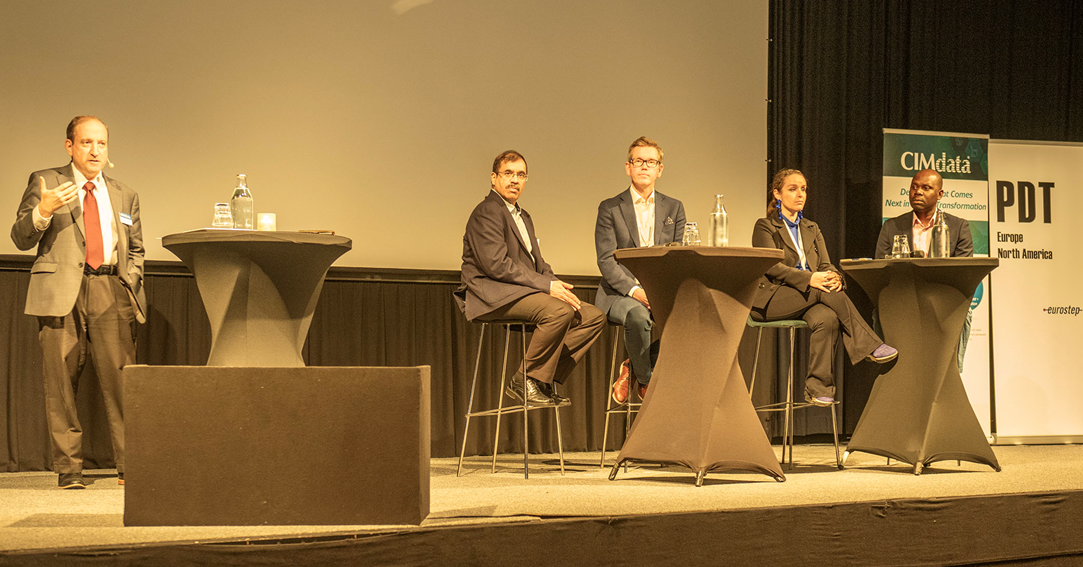
The discussion was realistic and helpful for the audience. It is clear that to reap the benefits, companies must explore the technology and use it to create valuable business scenarios. One could argue that many AI tools are already available, but the challenge remains that they have to run on reliable data. The data foundation is crucial for a successful outcome.
 An interesting point in the discussion was the statement from Diane Goenage, who repeatedly warned that using LLM-based solutions has an environmental impact due to the amount of energy they consume.
We have a similar debate in the Netherlands – do we want the wind energy consumed by data centers (the big tech companies with a minimum workforce in the Netherlands), or should the Dutch citizens benefit from renewable energy resources?
Conclusion
There were even more interesting presentations during these two days, and you might have noticed that I did not advertise my content. This is because I have already reached 1600 words, but I also want to spend more time on the content separately.
It was about PLM and Sustainability, a topic often covered in this conference. Unfortunately, only 25 % of the presentations touched on sustainability, and AI over-hypes the topic.
Hopefully, it is not a sign of the time?
 I am sharing another follow-up interview about PLM and Sustainability with a software vendor or implementer. Last year, in November 2023, Klaus Brettschneider and Jos Voskuil from the PLM Green Global Alliance core team spoke with Transition Technologies PSC about their GreenPLM offering and their first experiences in the field.
As we noticed with most first interviews, sustainability was a topic of discussion in the PLM domain, but it was still in the early discovery phases for all of us.
 Last week, we spoke again with Erik Rieger and Rafał Witkowski, both working for Transition Technologies PSC, a global IT solution integrator in the PLM world known for their PTC implementation services. The exciting part of this discussion is that system integrators are usually more directly connected to their customers in the field and, therefore, can be the source of understanding of what is happening.
ecoPLM and more
Where Erik is a and he is a long term PLM expert and Rafal is the PLM Practice Lead for Industrial Sustainability. In the interview below they shared their experiences with a first implementation pilot in the field, the value of their _ecoPLM offering in the context of the broader PTC portfolio. And of course we discussed topics closely related to these points and put them into a broader context of sustainably.
Enjoy the 34 minutes discussion and you are always welcome to comment or start a discussion with us.
The slides shown in this presentation and some more can be downloaded HERE.
What I learned
- The GreenPLM offering has changed its name into ecoPLM as TT PSC customers are focusing on developing sustainable products, with currently supporting designer to understand the carbon footprint of their products.
- They are actually in a MVP approach with a Tier 1 automotive supplier to validate and improve their solution and more customers are adding Design for Sustainability to their objective, besides Time to Market, Quality and Cost.
- Erik will provide a keynote speech at the Green PLM conference on November 14th in Berlin – The conference is targeting a German speaking audience although the papers are in English. You can still register and find more info here
- TT PSC is one of the partners completing the PTC sustainability offering and working close with their product management.
- A customer quote: “Sustainability makes PLM sexy again”
Want to learn more?
Here are some links related to the topics discussed in our meeting:
- YouTube: ecoPLM: your roadmap for eco-friendly product development
- ecoPLM – a sustainable product development website
- YouTube: Win the Net-Zero Race with PLM (and PTC)
Conclusions
We are making great progress in the support to design and deliver more sustainable products – sustainability goes beyond marketing as Rafal Witkowski mentioned – the journey has started. What do you see in your company?
Next week – week 46 – more news from Day 2 from the #plmroadmappdt conference
It was a great pleasure to attend my favorite vendor-neutral PLM conference this year in Gothenburg—approximately 150 attendees, where most have expertise in the PLM domain.
We had the opportunity to learn new trends, discuss reality, and meet our peers.
The theme of the conference was:Value Drivers for Digitalization of the Product Lifecycle, a topic I have been discussing in my recent blog posts, as we need help and educate companies to understand the importance of digitalization for their business.
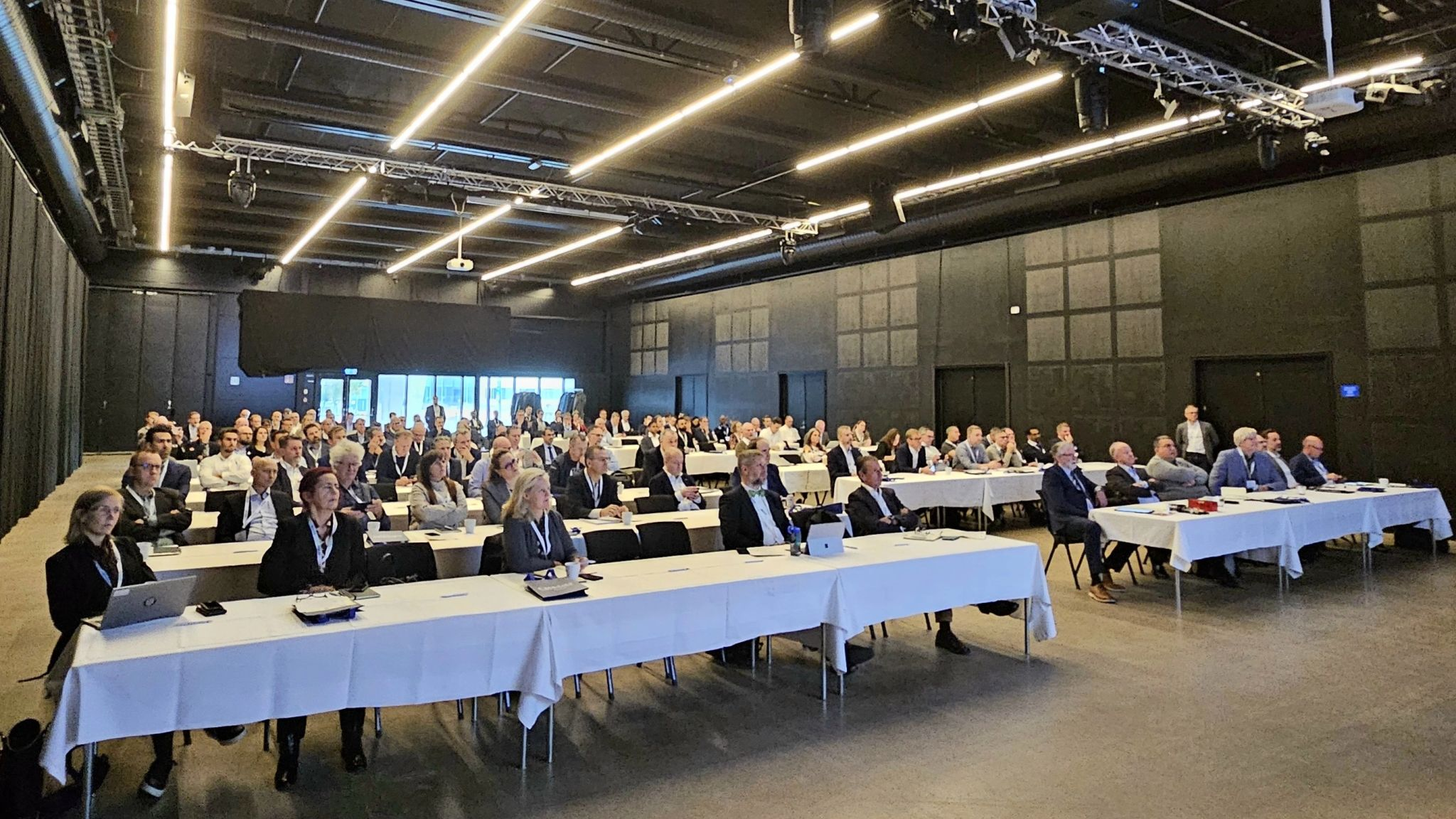 The two-day conference covered various lectures – view the agenda here – and of course the topic of AI was part of half of the lectures, giving the attendees a touch of reality.
In this first post, I will cover the main highlight of Day 1.
Value Drivers for Digitalization of the Product Lifecycle
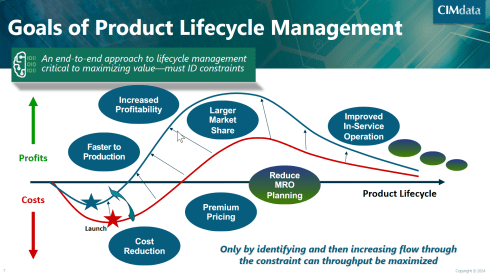
 As usual, the conference started with Peter Bilello, president & CEO of CIMdata, stressing again that when implementing a PLM strategy, the maximum result comes from a holistic approach, meaning look at the big picture, don’t just focus on one topic.
It was interesting to see again the classic graph (below) explaining the benefits of the end-to-end approach – I believe it is still valid for most companies; however, as I shared in my session the next day, implementing concepts of a Products Service System will require more a DevOp type of graph (more next week).
Next, Peter went through the CIMdata’s critical dozen with some updates. You can look at the updated 2024 image here.
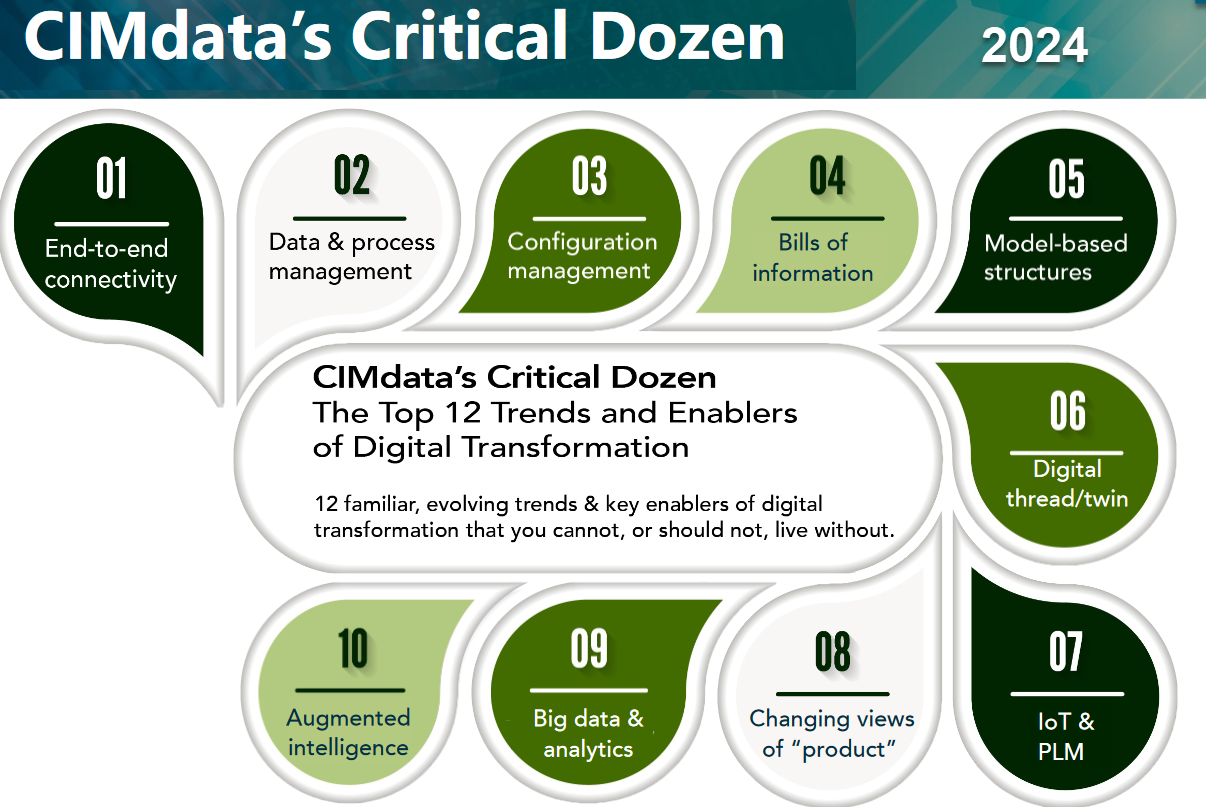 Some of the changes: Digital Thread and Digital Twin are merged– as Digital Twins do not run on documents. And instead of focusing on Artificial Intelligence only, CIMdata introduced Augmented Intelligence as we should also consider solutions that augment human activities, not just replace them.
Peter also shared the results of a recent PLM survey where companies were asked about their main motivation for PLM investments. I found the result a little discouraging for several reasons:
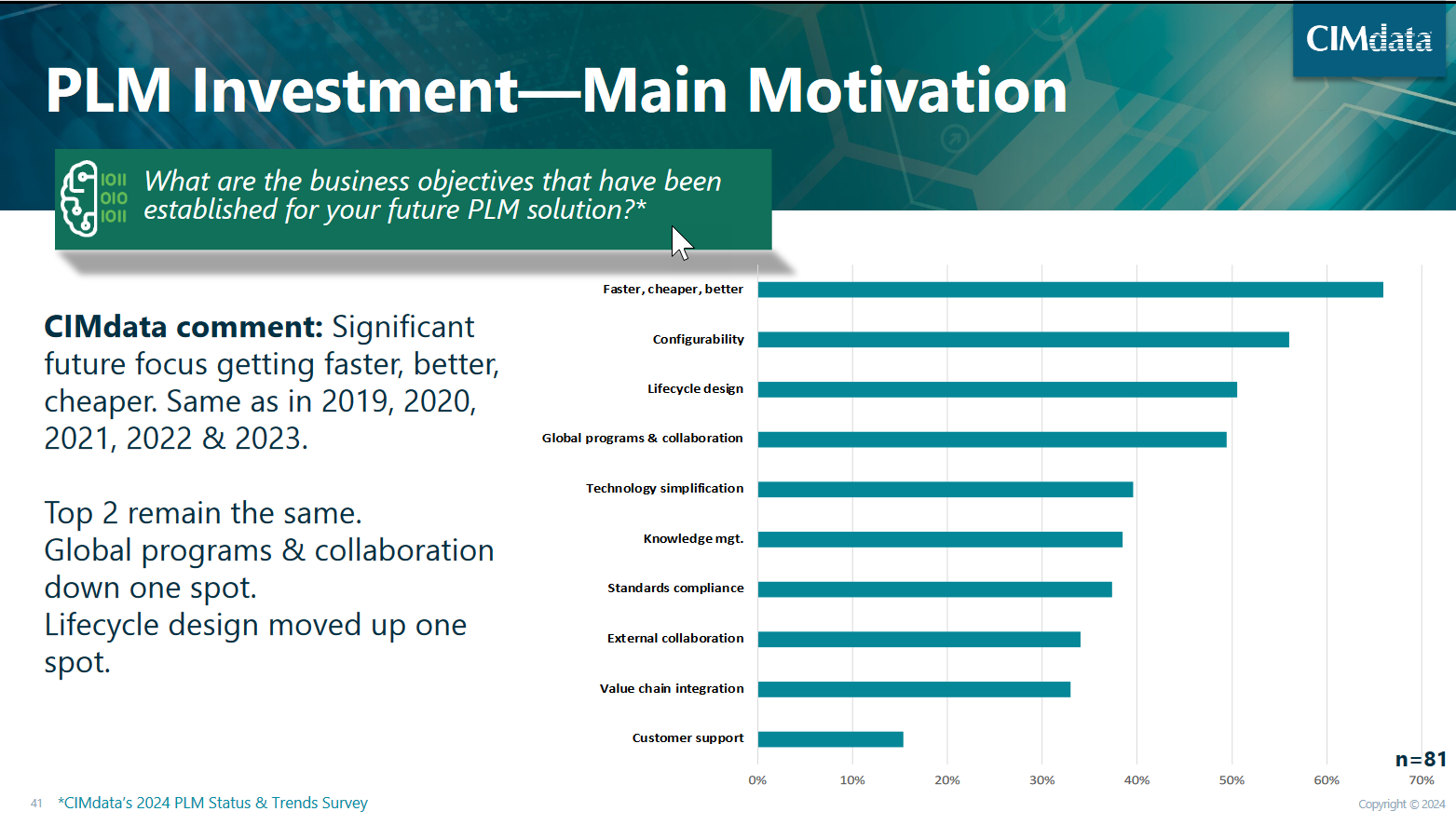
The number one topic is still faster, cheaper and better – almost 65 % of the respondents see this as their priority. This number one topic illustrates that Sustainability has not reached the level of urgency, and perhaps the topic can be found in standards compliance.
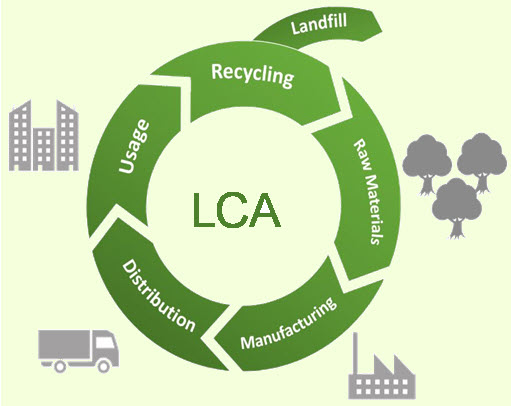 Many of the companies with Sustainability in their mission should understand that a digital PLM infrastructure is the foundation for most initiatives, like Lifecycle Analysis (LCA). Sustainability is more than part of standards compliance, if it was mentioned anyway.
The second disappointing observation for the understanding of PLM is that customer support is mentioned only by 15 % of the companies. Again, connecting your products to your customers is the first step to a DevOp approach, and you need to be able to optimize your product offering to what the customer really wants.
Digital Transformation of the Value Chain in Pharma
The second keynote was from Anders Romare, Chief Digital and Information Officer at Novo Nordisk. Anders has been participating in the PDT conference in the past. See my 2016 PLM Roadmap/PDT Europe post, where Anders presented on behalf of Airbus: Digital Transformation through an e2e PLM backbone.
Anders started by sharing some of the main characteristics of the companies he has been working for. Volvo, Airbus and now Novo Nordisk. It is interesting to compare these characteristics as they say a lot about the industry’s focus. See below:
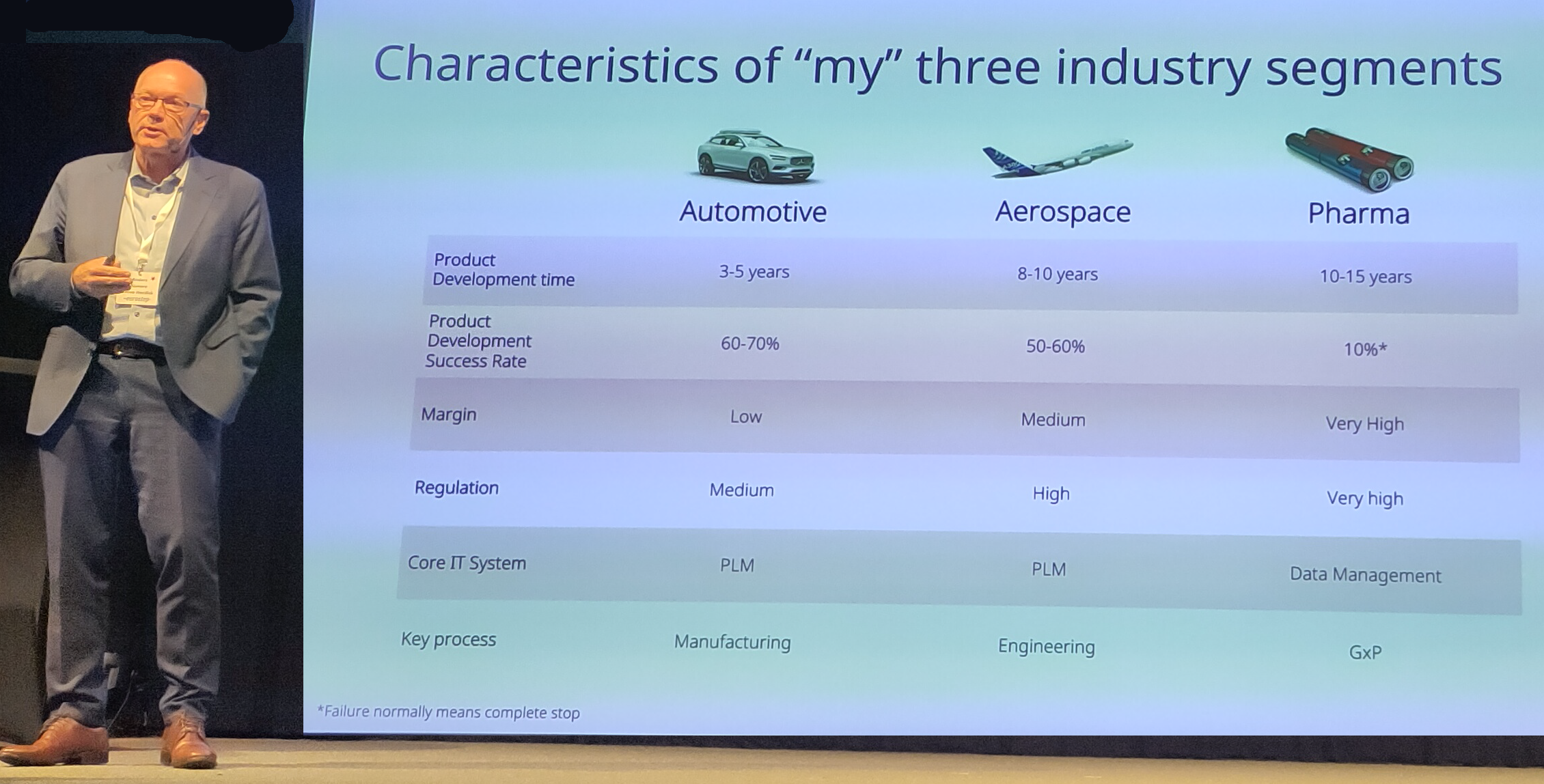
Anders is now responsible for digital transformation in Novo Nordisk, which is a challenge in a heavily regulated industry.
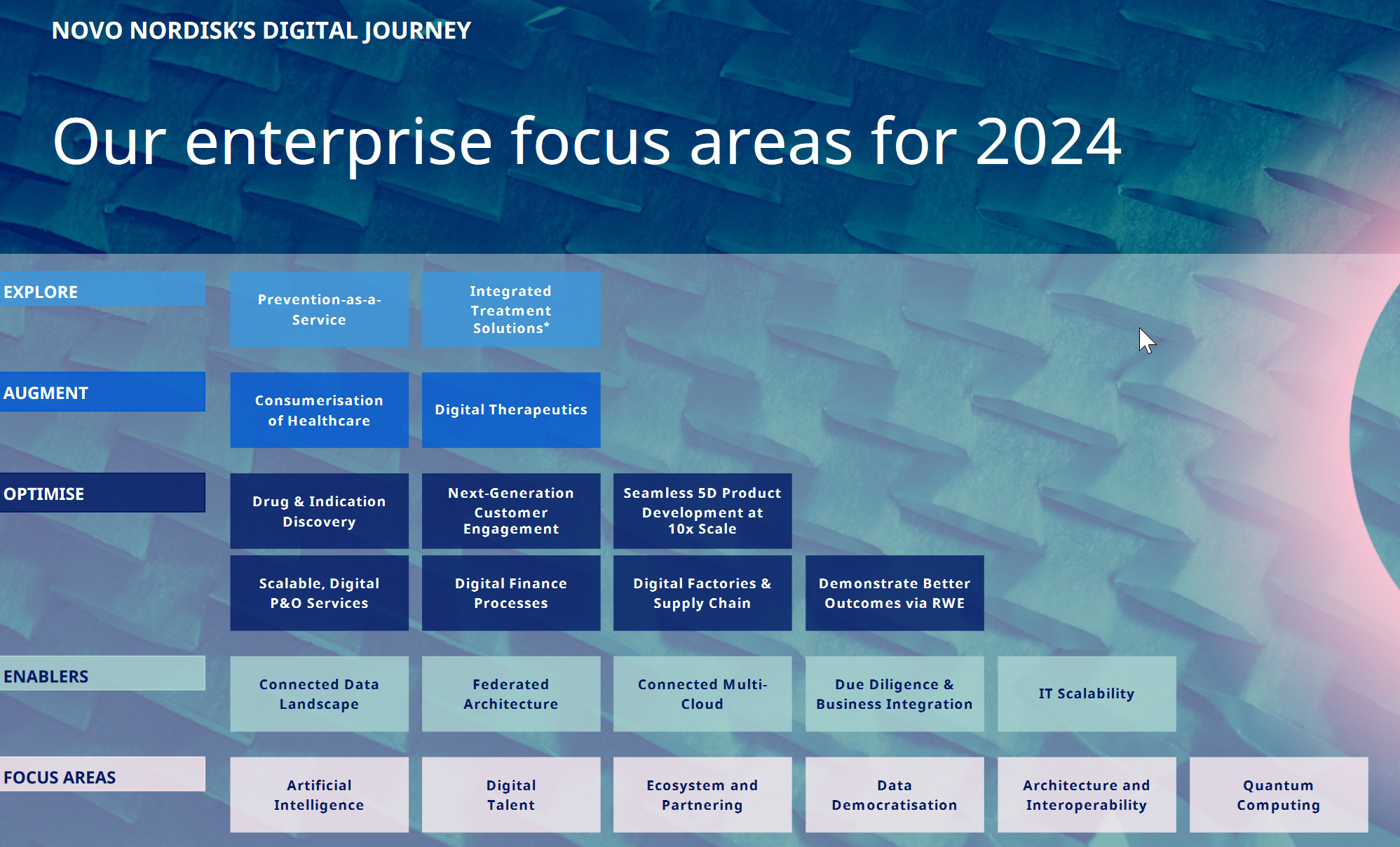 One of the focus areas for Novo Nordisk in 2024 is also Artificial Intelligence, as you can see from the image to the left (click on it for the details).
As many others in this conference, Anders mentioned AI can only be applicable when it runs on top of accurate data.
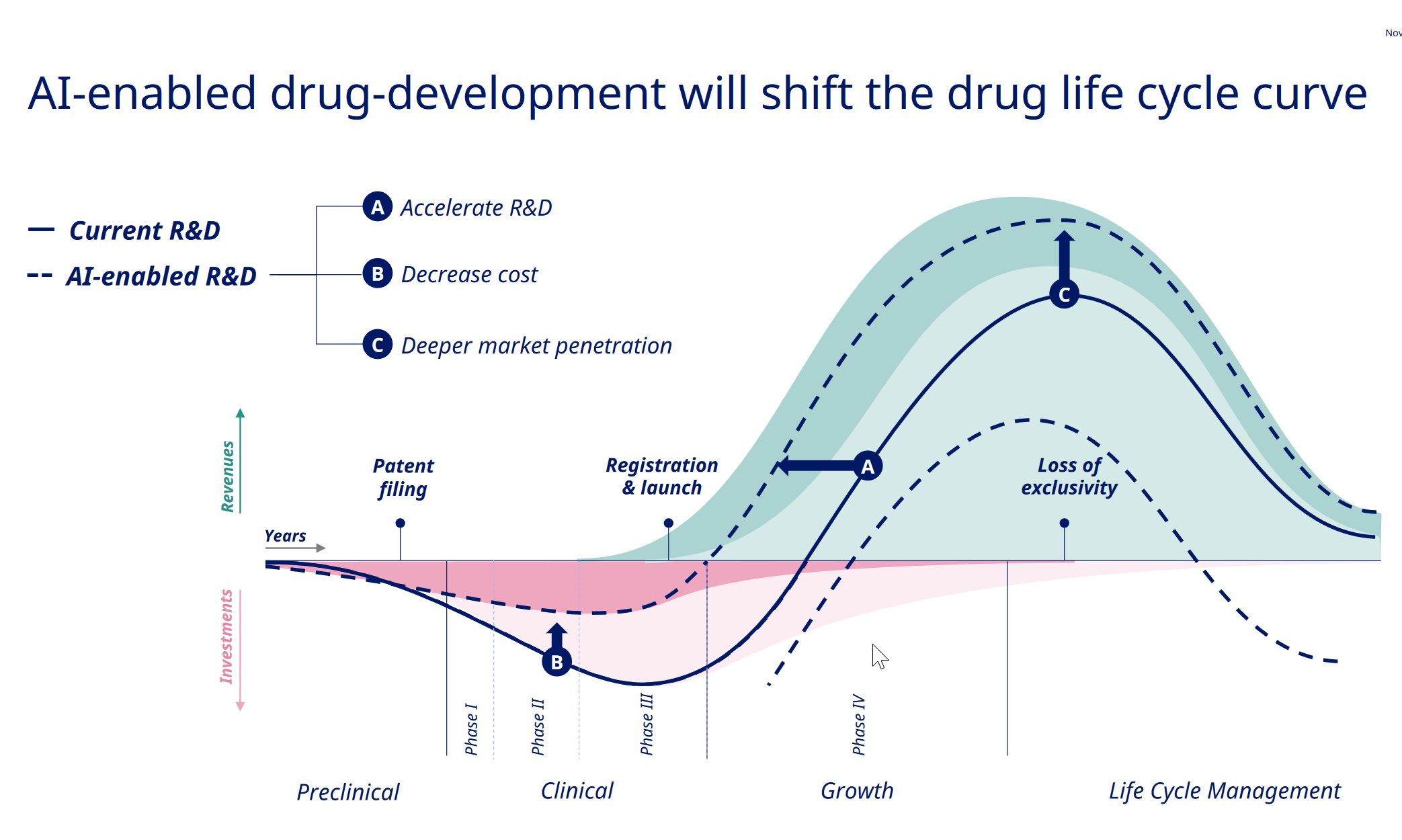
Understanding the potential of AI, they identified 59 areas where AI can create value for the business, and it is interesting to compare the traditional PLM curve Peter shared in his session with the potential AI-enabled drug-development curve as presented by Anders below:
Next, Anders shared some of the example cases of this exploration, and if you are interested in the details, visit their tech.life site.
When talking about the engineering framing of PLM, it was interesting to learn from Anders, who had a long history in PLM before Novo Nordisk, when he replied to a question from the audience that he would never talk about PLM at the management level. It’s very much aligned with my Don’t mention the P** word post.
A Strategy for the Management of Large Enterprise PLM Platforms
One of the highlights for me on Day 1 was Jorgen Dahl‘s presentation. Jorgen, a senior PLM director at GE Aerospace, shared their story towards a single PLM approach needed due to changes in businesses. And addressing the need for a digital thread also comes with an increased need for uptime.
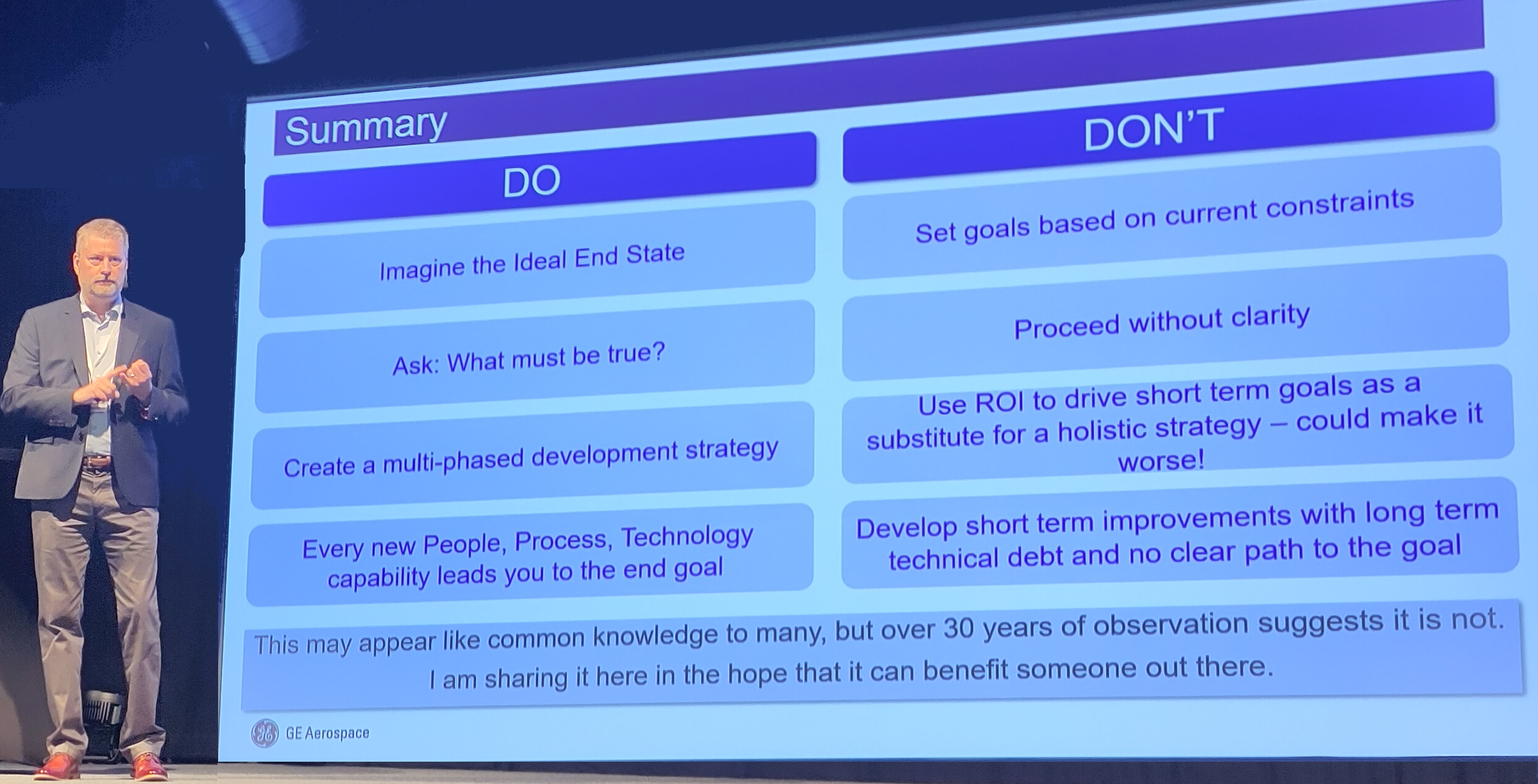
I like his strategy to execution approach, as shown in the image below, as it contains the most important topics. The business vision and understanding, the imagination of the end status and What must be True?
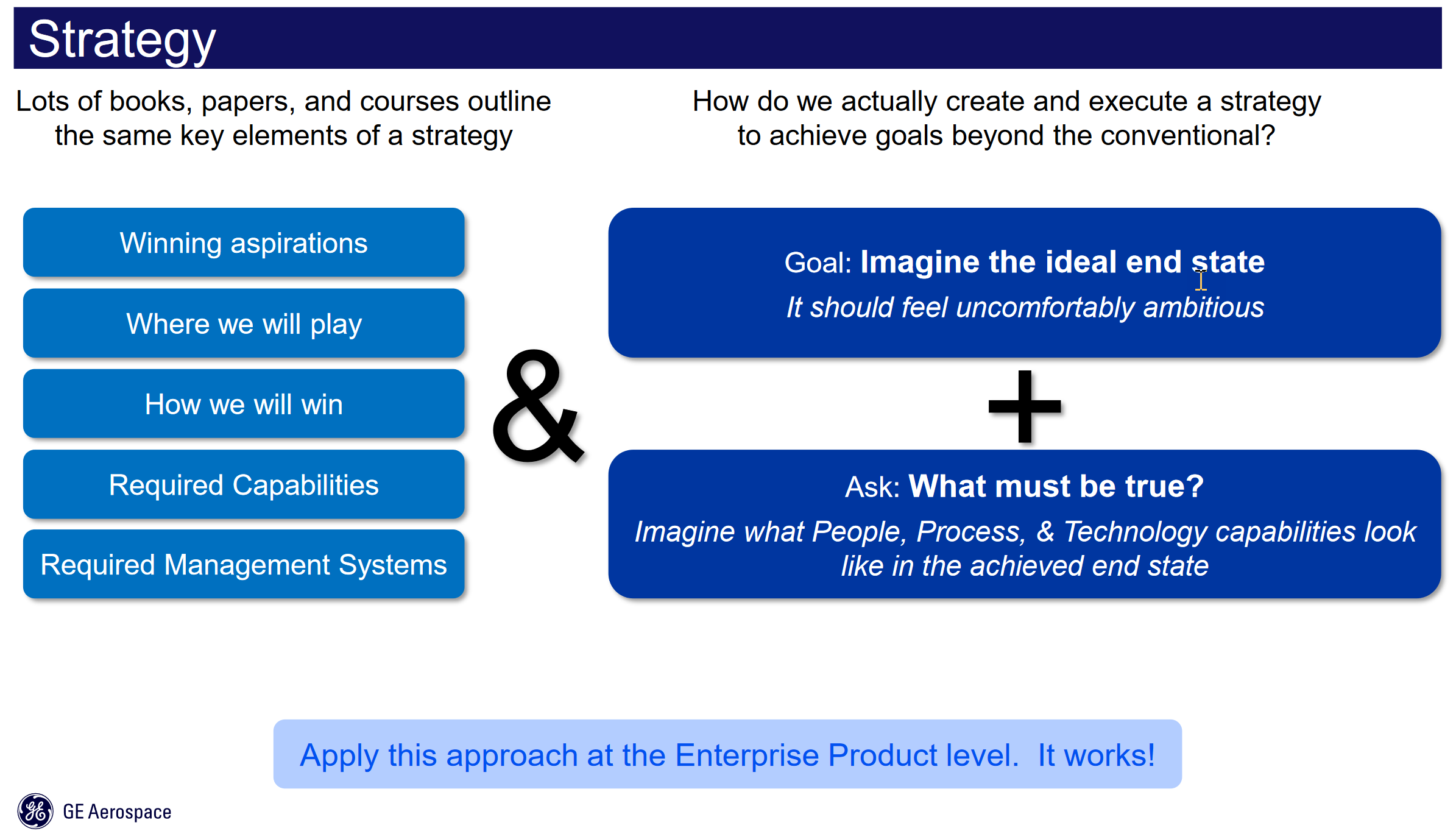
In my experience, the three blocks are iteratively connected. When describing the strategy, you might not be able to identify the required capabilities and management systems yet.
But then, when you start to imagine the ideal end state, you will have to consider them. And for companies, it is essential to be ambitious – or, as Jorgen stated, uncomfortable ambitious. Go for the 75 % to almost 100 % to be true. Also, asking What must be True is an excellent way to allow people to be involved and creatively explore the next steps.
Note: This approach does not provide all the details, as it will be a multiyear journey of learning and adjusting towards the future. Therefore, the strategy must be aligned with the culture to avoid continuous top-down governance of the details. In that context, Jorgen stated:
“Culture is what happens when you leave the room.”
It is a more positive statement than the famous Peter Drucker’s quote: “Culture eats strategy for breakfast.”
Jorgen’s concluding slide mentions potential common knowledge, although I believe the way Jorgen used the right easy-to-digest points will be helpful for all organizations to step back, look at their initiatives, and compare where they can improve.
How a Business Capability Model and Application Portfolio Management Support Through Changing Times
Peter Vind‘s presentation was nicely connected to the presentation from Jorgen Dahl. Peter, who is an enterprise architect at Siemens Energy, started by explaining where the enterprise architect fits in an organization and comparing it to a city.
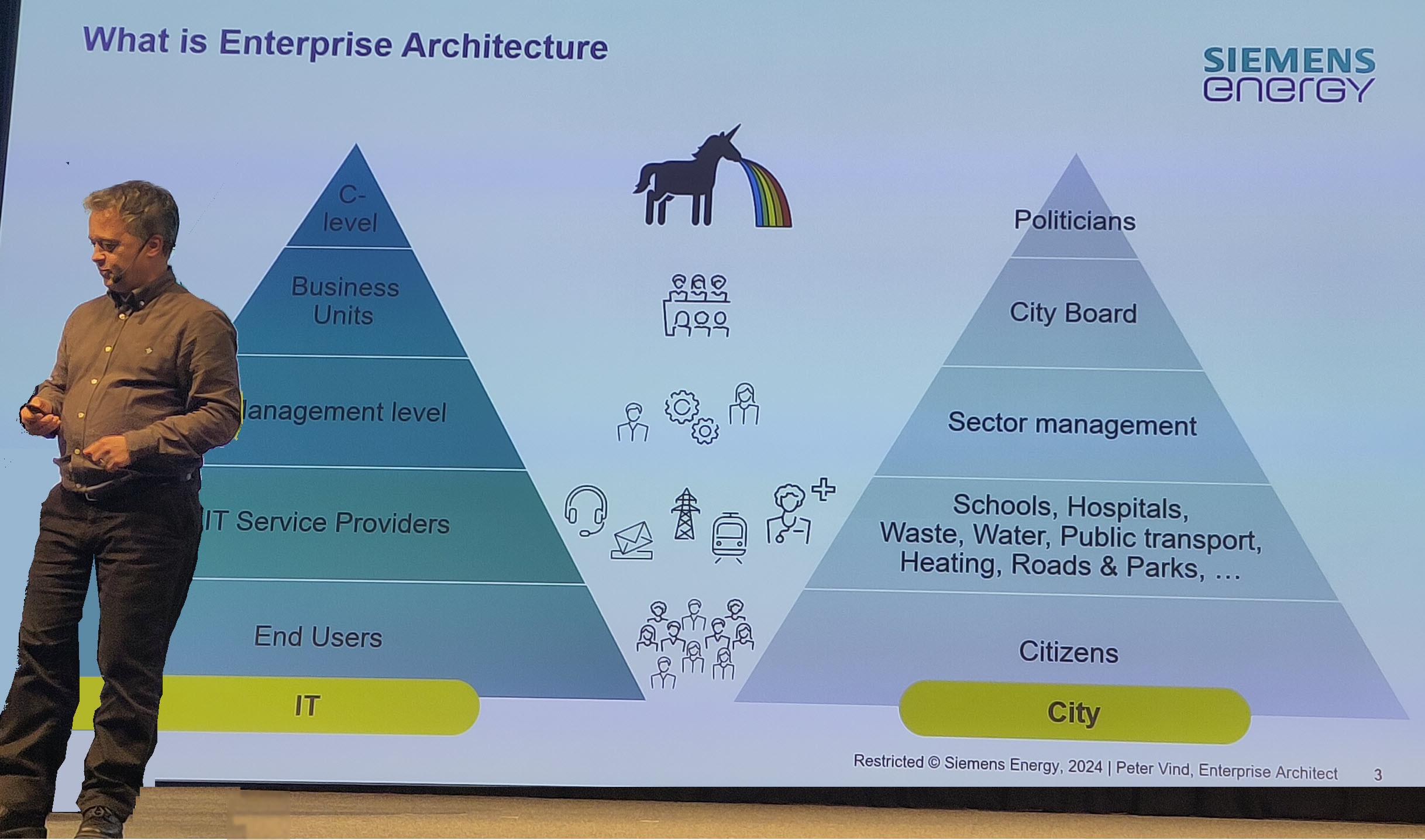
In his entertaining session, he mentioned he has to deal with the unicorns at the C-level, who, like politicians in a city, sometimes have the most “innovative” ideas – can they be realized?
Peter explained how they used Business Capability Modeling when Siemens Energy went through various business stages. First, the carve-out from Siemens AG and later the merger with Siemens Gamesa. Their challenge is to understand which capabilities remain, which are new or overlapping, both during the carve-out and merging process.
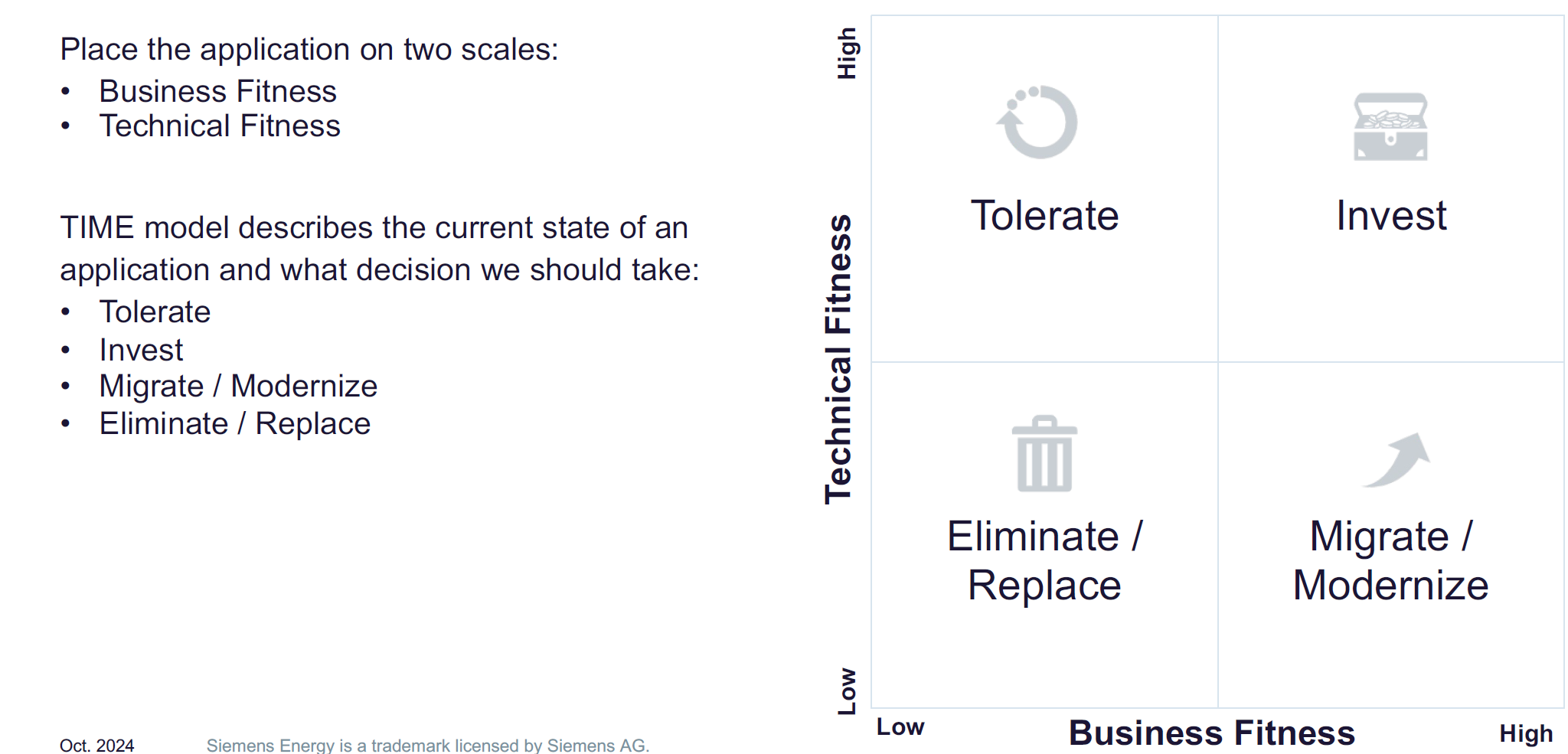
TIME explained
The business capability modeling leads to a classification of the applications used at different levels of the organization, such as customer-facing, operational, or supporting business capabilities.
Next, for the lifecycle of the applications, the TIME approach was used, meaning that each application was mapped to business fitness and technical fitness. Click on the diagram to see the details.
The result could look like the mapping shown below – a comprehensive overview of where the action is
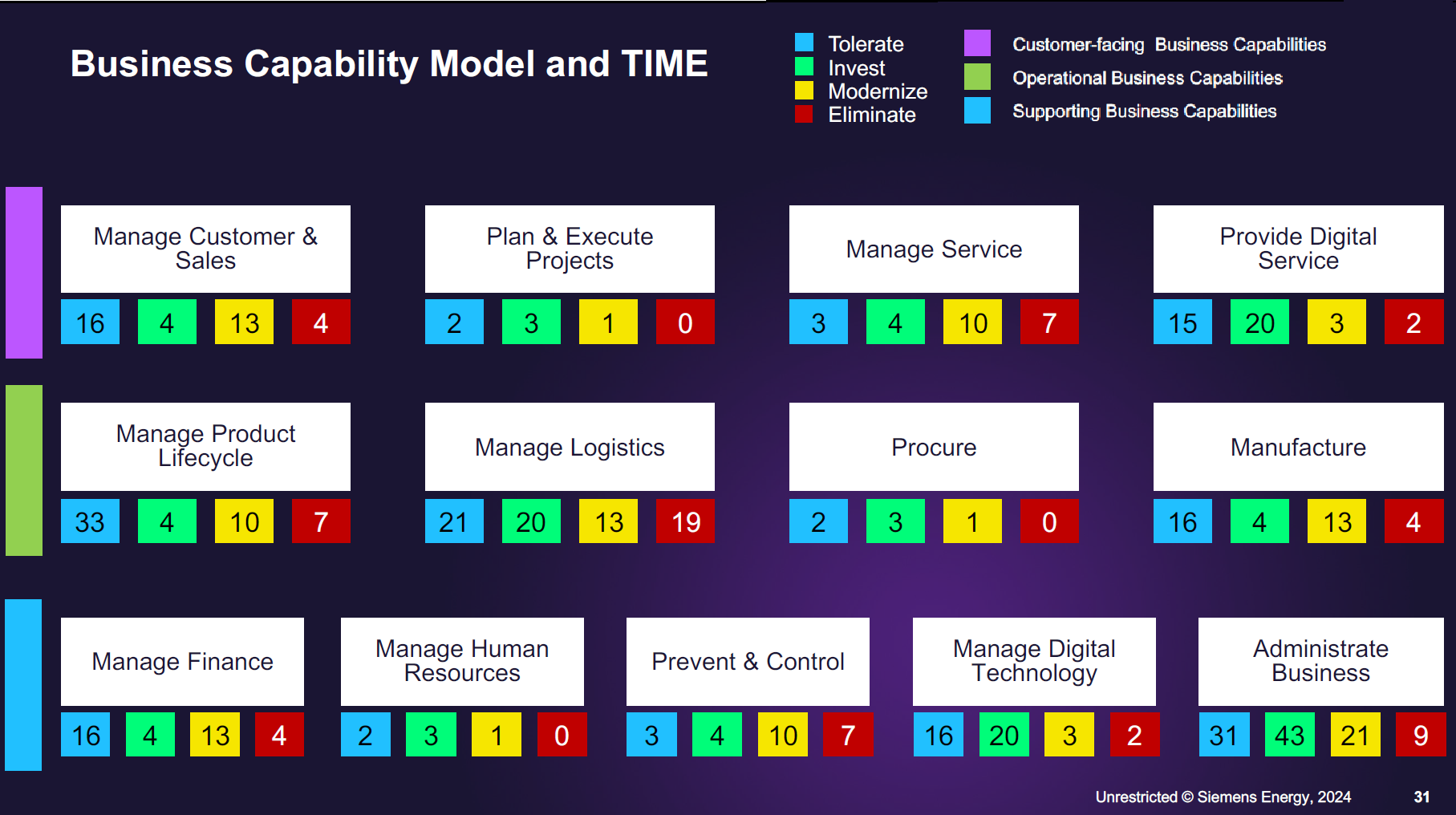
It is a rational approach; however, Peter mentioned that we also should be aware of the HIPPOs in an organization. If there is a HiPPO (Highest Paid Person’s Opinion) in play, you might face a political battle too.
It was a great educational session illustrating the need for an Enterprise Architect, the value of business capabilities modeling and the TIME concept.
And some more …
There were several other exciting presentations during day 1; however, as not all presentations are publicly available, I cannot discuss them in detail; I just looked at my notes.
Driving Trade Compliance and Efficiency
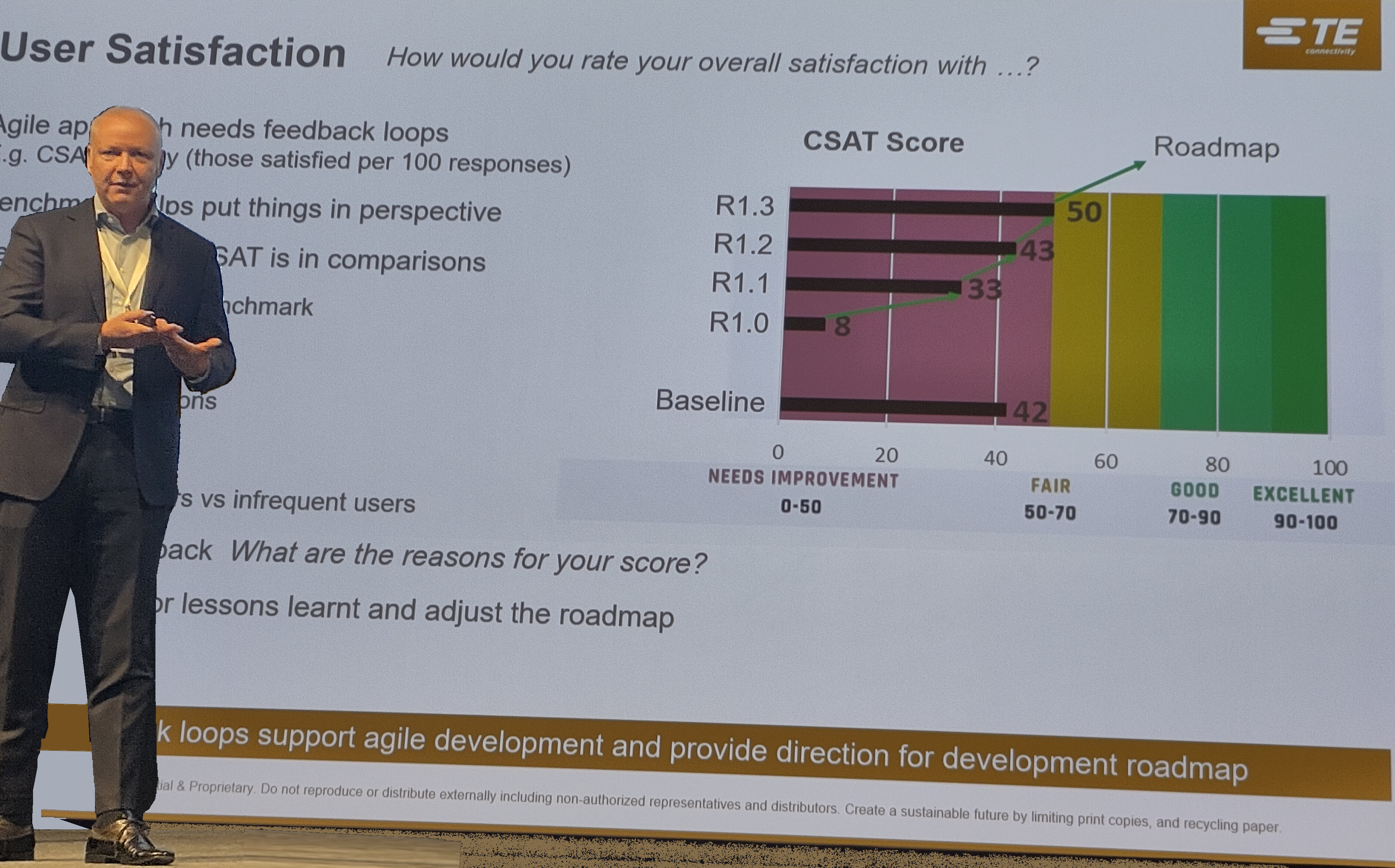 Peter Sandeck, Director of Project Management at TE Connectivity shared what they did to motivate engineers to endorse their Jurisdiction and Classification Assessment (JCA) process. Peter showed how, through a Minimal Viable Product (MVP) approach and listening to the end-users, they reached a higher Customer Satisfaction (CSAT) score after several iterations of the solution developed for the JCA process.
This approach is an excellent example of an agile method in which engineers are involved. My remaining question is still – are the same engineers in the short term also pushed to make lifecycle assessments? More work; however, I believe if you make it personal, the same MVP approach could work again.
Value of Model-Based Product Architecture
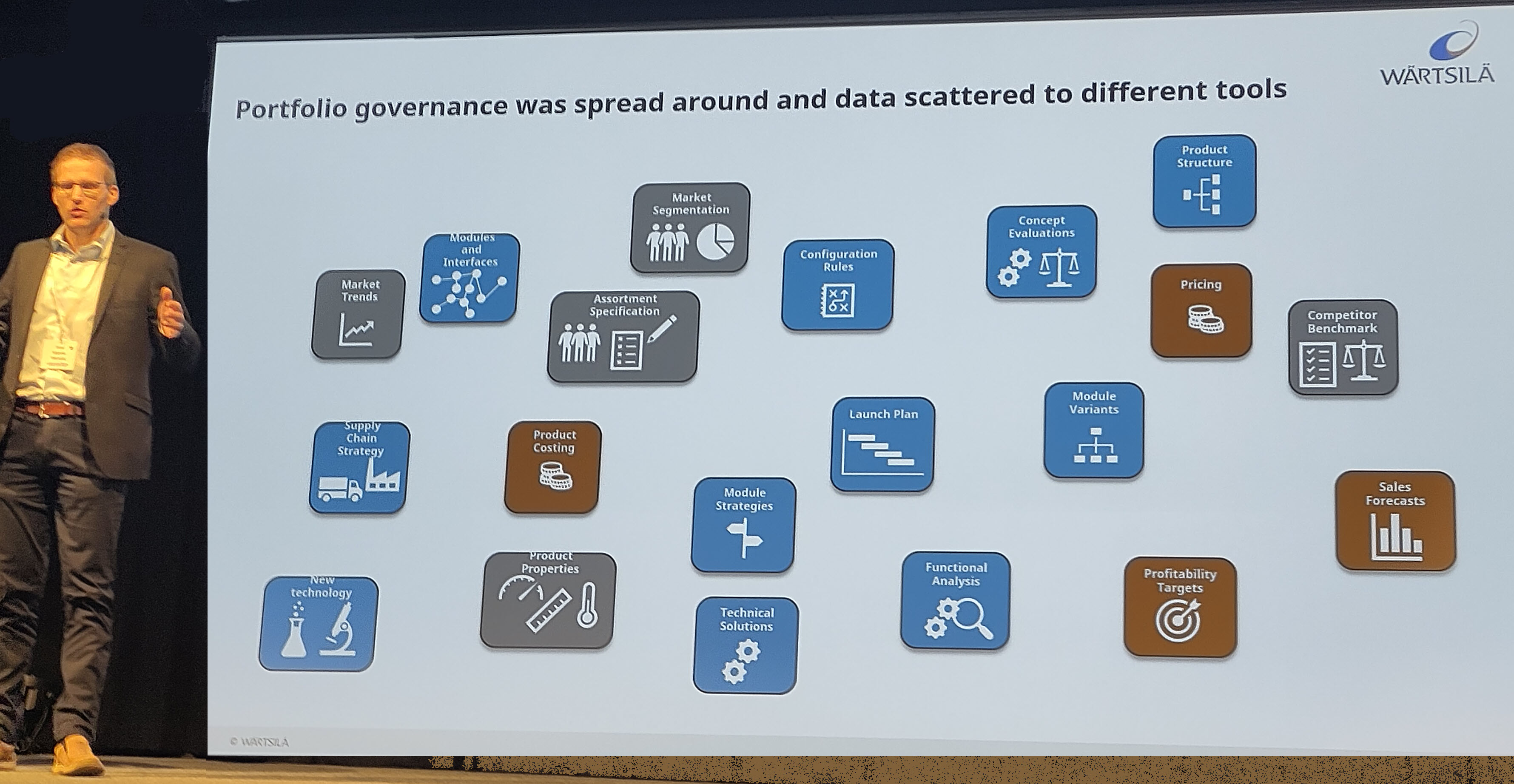 Jussi Sippola, Chief Expert, Product Architecture Management & Modularity at Wärtsilä, presented an excellent story related to the advantages of a more modular product architecture. Where historically, products were delivered based on customer requirements through the order fulfillment process, now there is in parallel the portfolio management process, defining the platform of modules, features and options.
Jussi mentioned that they were able to reduce the number of parts by 50 % while still maintaining the same level of customer capabilities. In addition, thanks to modularity, they were able to reduce the production lead time by 40 % – essential numbers if you want to remain competitive.
Conclusion
Day 1 was a day where we learned a lot as an audience, and in addition, the networking time and dinner in the evening were precious for me and, I assume, also for many of the participants. In my next post, we will see more about new ways of working, the AI dream and Sustainability.
Listen and Learn more from PLM Experts in the field
Recently, I attended several events related to the various aspects of product lifecycle management; most of them were tool-centric, explaining the benefits and values of their products.
 In parallel, I am working with several companies, assisting their PLM teams to make their plans understood by the upper management, which has always been my mission in the past.
However, nowadays, people working in the business are feeling more and more challenged and pained by not acting adequately to the upcoming business demands.
The image below has been shown so many times, and every time, the context becomes more relevant.
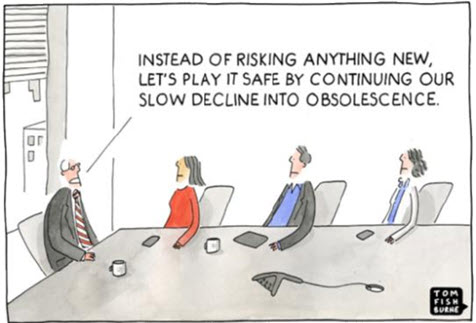
Too often, an evolutionary mindset with small steps is considered instead of looking toward the future and reasoning back for what needs to be done.
Let me share some experiences and potential solutions.
Don’t use the P** word!
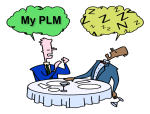 The title of this post is one of the most essential points to consider. By using the term PLM, the discussion is most of the time framed in a debate related to the purchase or installation of a system, the PLM system, which is an engineering tool.
PLM vendors, like Dassault Systèmes and Siemens, have recognized this, and the word PLM is no longer on their home pages.
They are now delivering experiences or digital industries software.
Other companies, such as PTC and Aras, broadened the discussion by naming other domains, such as manufacturing and services, all connected through a digital thread.
 The challenge for all these software vendors is why a company would consider buying their products. A growing issue for them is also why would they like to change their existing PLM system to another one, as there is so much legacy.
For all of these vendors, success can come if champions inside the targeted company understand the technology and can translate its needs into their daily work.
 Here, we meet the internal PLM team, which is motivated by the technology and wants to spread the message to the organization. Often, with no or limited success, as the value and the context they are considering are not understood or felt as urgent.
Lesson 1:
Don’t use the word PLM in your management messaging.
In some of the current projects I have seen, people talk about the digital highway or a digital infrastructure to take this hurdle. For example, listen to the SharePLM podcast with Roger Kabo from Marel, who talks about their vision and digital product highway.
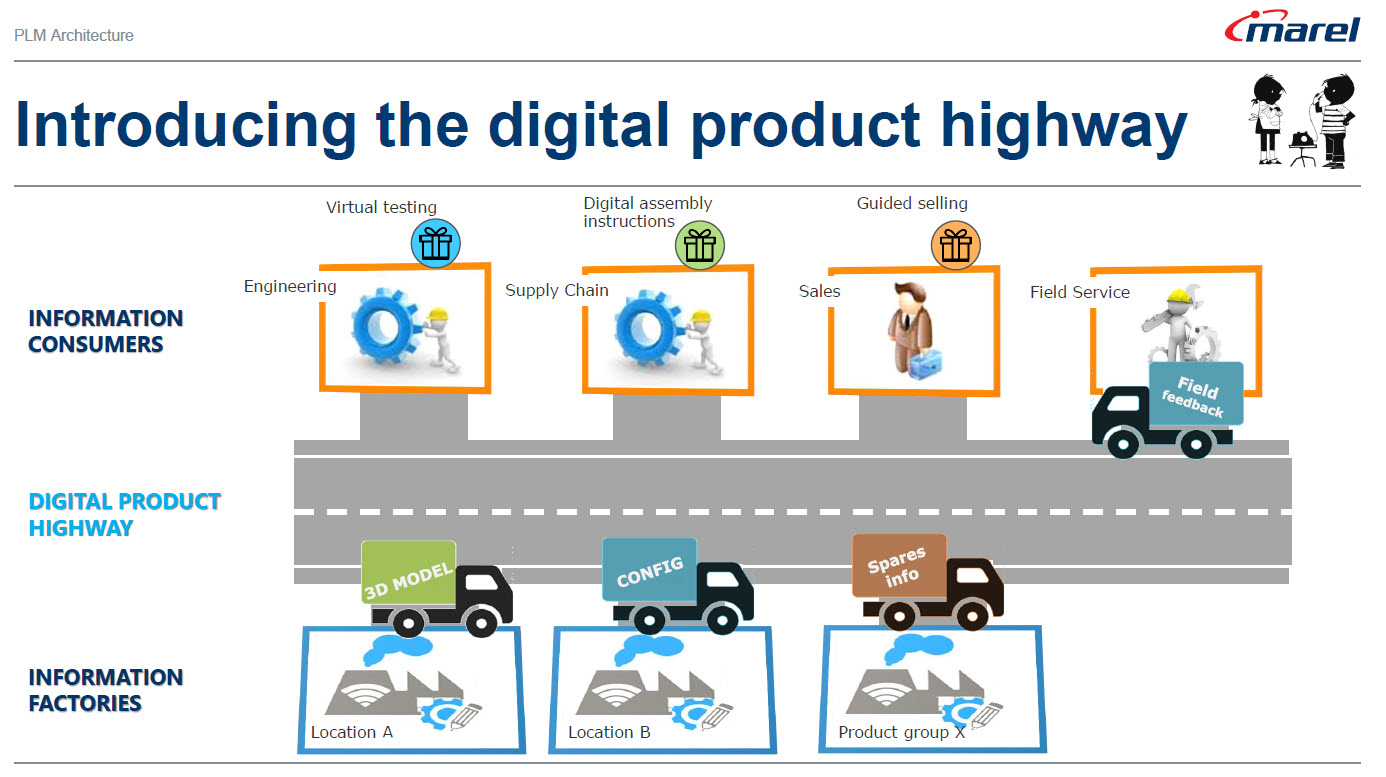
The Marel digital product highway
As soon as you use the word PLM, most people think about a (costly) system, as this is how PLM is framed. Engineering, like IT, is often considered a cost center, as money is made by manufacturing and selling products.
According to experts (CIMdata/Gartner), Product Lifecycle Management is considered a strategic approach. However, the majority of people talk about a PLM system. Of course, vendors and system integrators will speak about their PLM offerings.
To avoid this framing, first of all, try to explain what you want to establish for the business. The terms Digital Product Highway or Digital Infrastructure, for example, avoid thinking in systems.
Lesson 2:
Don’t tell your management why they need to reward your project – they should tell you what they need.
This might seem like a bit of strange advice; however, you have to realize that most of the time, people do not talk about the details at the management level. At the management level, there are strategies and business objectives, and you will only get attention when your proposal addresses the business needs. At the management level, there should be an understanding of the business need and its potential value for the organization. Next, analyzing the business changes and required tools will lead to an understanding of what value the PLM team can bring.
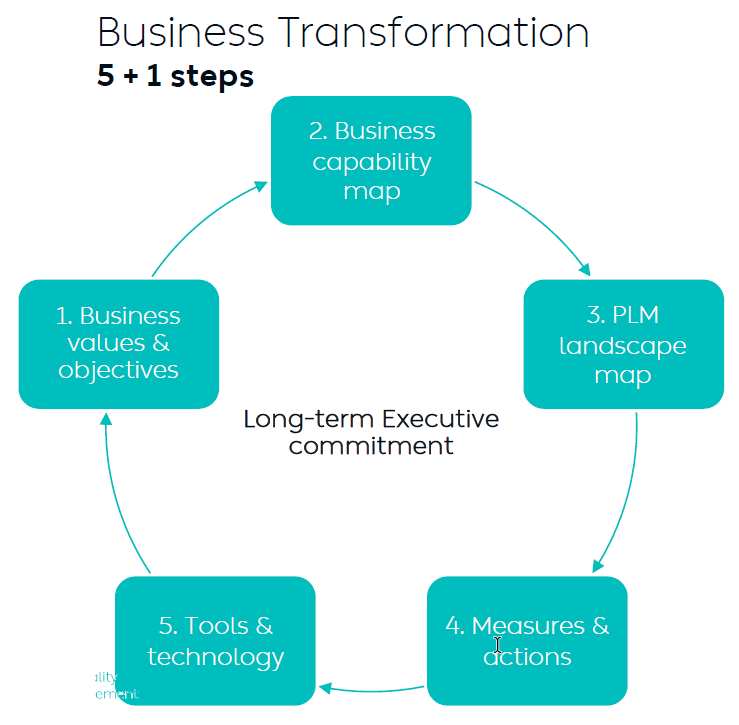
Yousef Hooshmand’s 5 + 1 approach illustrates this perfectly. It is crucial to note that long-term executive commitment is needed to have a serious project, and therefore, the connection to their business objective is vital.
Therefore, if you can connect your project to the business objectives of someone in management, you have the opportunity to get executive sponsorship. A crucial advice you hear all the time when discussing successful PLM projects.
Lesson 3:
Alignment must come from within the organization.
Last week, at the 20th anniversary of the Dutch PLM platform, Yousef Hooshmand gave the keynote speech starting with the images below:
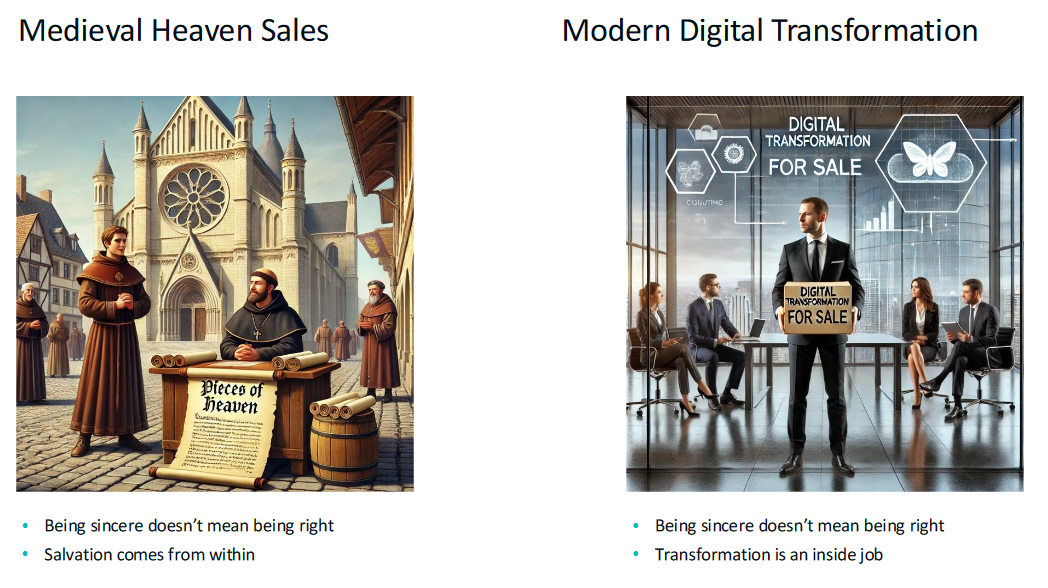
On the left side, we see the medieval Catholic church sincerely selling salvation through indulgences, where the legend says Luther bought the hell, demonstrating salvation comes from inside, not from external activities – read the legend here.
 On the right side, we see the Digital Transformation expert sincerely selling digital transformation to companies. According to LinkedIn, there are about 1.170.000 people with the term Digital Transformation in their profile.
As Yousef mentioned, the intentions of these people can be sincere, but also, here, the transformation must come from inside (the company).
When I work with companies, I use the Benefits Dependency Network methodology to create a storyboard for the company. The BDN network then serves as a base for creating storylines that help people in the organization have a connected view starting from their perspective.
Companies might hire strategic consultancy firms to help them formulate their long-term strategy. This can be very helpful where, in the best case, the consultancy firm educates the company, but the company should decide on the direction.
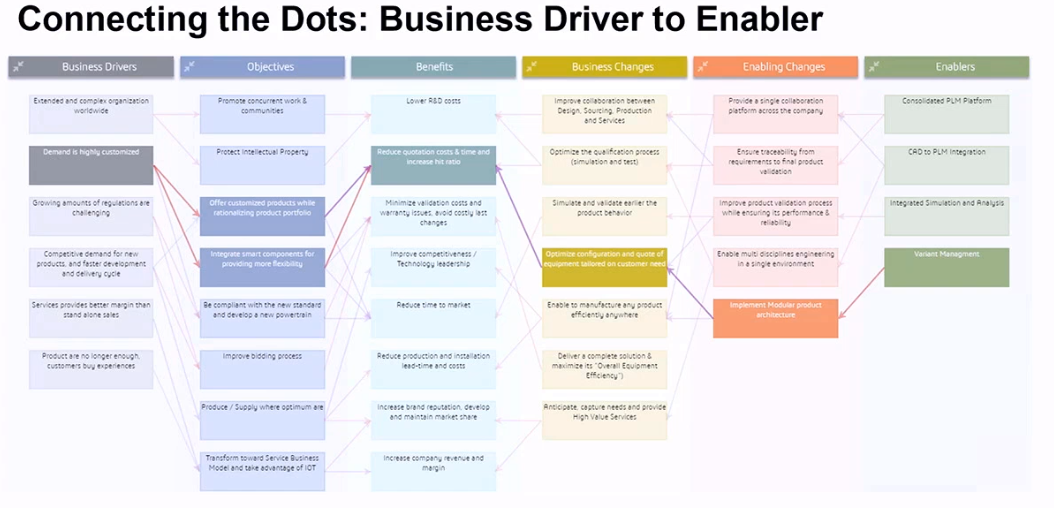
In an older blog post, I wrote about this methodology, presented by Johannes Storvik at the Technia Innovation forum, and how it defines a value-driven implementation.
Dassault Systèmes and its partners use this methodology in their Value Engagement process, which is tuned to their solution portfolio.
You can also watch the webinar Federated PLM Webinar 5 – The Business Case for the Federated PLM, in which I explained the methodology used.
Lesson 4:
PLM is a business need not an IT service
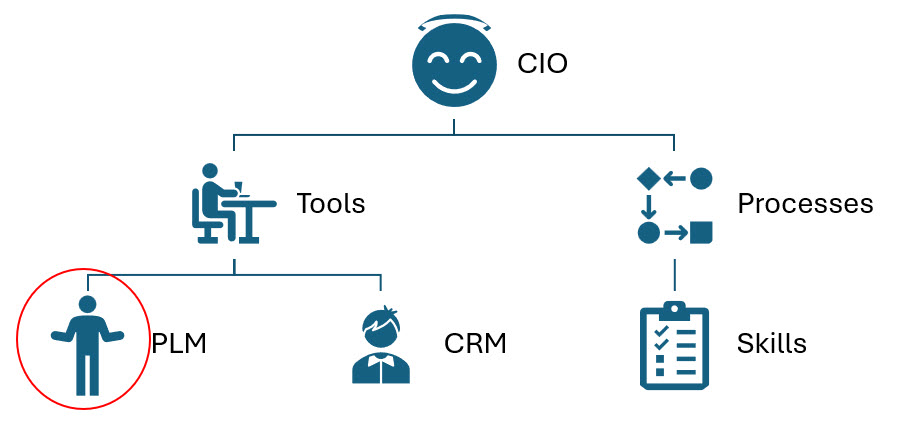 This lesson is essential for those who believe that PLM is still a system or an IT service. In some companies, I have seen that the (understaffed) PLM team is part of a larger IT organization. In this type of organization, the PLM team, as part of IT, is purely considered a cost center that is available to support the demand from the business.
The business usually focuses on incremental and economic profitability, less on transformational ways of working.
In this context, it is relevant to read Chris Seiler’s post: How to escape the vicious circle in times of transformation? Where he reflects on his 2002 MBA study, which is still valid for many big corporate organizations.
It is a long read, but it is gratifying if you are interested. It shows that PLM concepts should be discussed and executed at the business level. Of course, I read the article with my PLM-twisted brain.
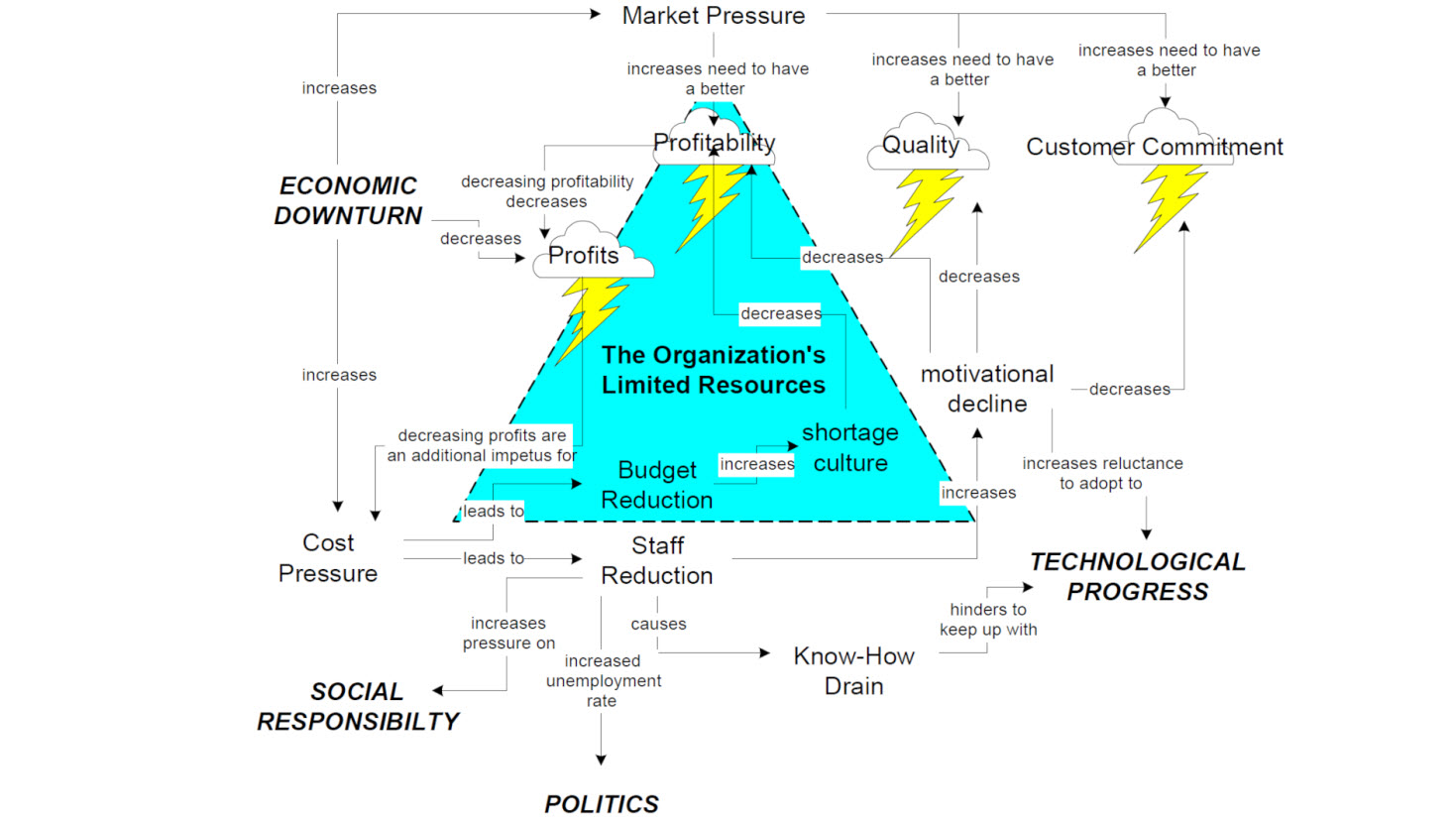
A Pessimistic Scenario of External Driving Forces and Their Internal Interrelations (Christ Seiler)
The image above from Chris’s post could be a starting point for a Benefits-Dependent Network diagram, expanded with Objectives, Business Changes and Benefits to fight this vicious downturn.
As PLM is no longer a system but a business strategy, the PLM team should be integrated into the business potential overlooked by the CIO or CDO, as a CEO is usually not able to give this long-term executive commitment.
Lesson 5:
Educate yourselves and your management
The last lesson is crucial, as due to improving technologies like AI and, earlier, the concepts of the digital twin, traditional ways of coordinated working will become inefficient and redundant.
However, before jumping on these new technologies, everyone, at every level in the organization, should be aware of:
WHY will this be relevant for our business? Is it to cut costs – being more efficient as fewer humans are in the process? Is it to be able to comply with new upcoming (sustainability) regulations? Is it because the aging workforce leaves a knowledge gap?
WHAT will our business need in the next 5 to 10 years? Are there new ways of working that we want to introduce, but we lack the technology and the tools? Do we have skills in-house? Remember, digital transformation must come from the inside.
HOW are we going to adapt our business? Can we do it in a learning mode, as the end target is not clear yet—the MVP (Minimum Viable Product) approach? Are we moving from selling products to providing a Product Service System?
My lesson: Get inspired by the software vendors who will show you what might be possible. Get educated on the topic and understand what it would mean for your organization. Start from the people and the business needs before jumping on the tools.
In the upcoming PLM Roadmap/PDT Europe conference on 23-24 October, we will be meeting again with a group of P** experts to discuss our experiences and progress in this domain. I will give a lecture here about what it takes to move to a sustainable economy based on a Product-as-a-service concept.
If you want to learn more – join us – here is the link to the agenda.
Conclusion
I hope you enjoyed reading a blog post not generated by ChatGPT, although I am using bullet points. With the overflow of information, it remains crucial to keep a holistic overview. I hope that with this post, I have helped the P** teams in their mission, and I look forward to learning from your experiences in this domain.
 This is a guest post from one of our active members of the PLM Green Global Alliance, Roger L. Franz.
Roger is supporting industry inquiries on regulated substances, sustainable product design and life cycle management, including carbon footprint.
He is a recognized authority on supply chain reporting for compliance with worldwide regulations. Roger brings decades of experience with engineering tools and enterprise IT systems.
Introduction.
More than just unsightly “plastic pollution,” the volume of consumer plastics and lack of closed-loop recovery have created a significant micro- and nano-plastics problem. These invisible plastic particles are found around the world, including in animal and human tissues.
For several reasons, including a much smaller volume of plastic used in electrotechnical products compared to consumer plastics and the generally longer life of hardware compared to the rapid turnover of consumer goods and packaging, the microplastics problem is not typically tagged as a major electronics problem- or at least not yet. Now is the time to be proactive.
 The United Nations Environment Programme has posted summaries of recent discussions on using life cycle assessment (LCA) to address the global problem of plastic pollution. These Life Cycle Initiative areas relate to plastic products, chemicals of concern in plastic products, and plastic product design. The documents are about possible approaches to managing plastics with recommendations but are not detailed prescriptions, methods, or regulations.
While the studies did not specifically mention electrotechnical products, this industry will need to accelerate focus on engineering design tools and engineering plastics choices to avoid significantly adding on to the consumer plastic product problems.
Within the UNEP product design discussion, the section on “General considerations on possible approaches to product design, focusing on recyclability and reusability” included the following important point, which bears repeating: Product design approaches should include eco-design and circularity principles.
Product design approaches should include
eco-design and circularity principles.
But what does this mean? In the following discussion, we hope to break these approaches down into more tangible design choices. Even within the electrotechnical product category, there are many product variations, so no claim is made here to cover all of them.
Options for lower carbon footprint plastics already exist to some extent. Except for packaging, electronic components and products are typically made with engineering resins rather than the common consumer plastic “recycling arrow” types. Alternative types of lower carbon footprint engineering resins may be available to use rather than others with higher carbon footprints.
Many plastic manufacturers are currently conducting LCA to quantify the cradle-to-gate carbon footprint of their materials. Different polymer types have inherent differences in carbon footprint due to their different monomeric starting materials and manufacturing processes.
 For many plastics, these flows are detailed by Plastics Europe. Polycarbonate, ABS, and several Polyamides, for example, are included. What is missing in these publicly available sources, as well as LCA inventory databases themselves, are many other engineering plastics; for example, while consumer PET is widely modeled, PBT (Polybutylene terephthalate) is not. These are just some of the data gaps that need to be resolved.
More sustainable feedstock is a good option since a given end polymer may be made from different monomeric chemicals, so the more sustainable plastic performs exactly like its classic version because it is the same. One of the growing alternatives includes feedstocks based on renewable, bio-based sources.
 These need some evaluation, again using LCA, to ensure they are free of downsides like increased water use, eutrophication, and chemical pollution due to the use of herbicides, pesticides, fertilizers, and so on. Marketing claims of being a “green material” will need backup data! For guidelines on acceptable environmental benefits claims, refer to the US FTC Green Guides.
Reducing the amount of plastic by design is not only a good practice for sustainability, it also saves money. Some designs using parts with enough material to be modeled using generative design may be able to reduce the amount of material while reducing material usage and weight. Reducing factory scrap from injection molding processes leaving sprues in runners and use of captive regrind are other good options.
Choosing manufacturers using renewable fuels– and even benefits like reduction of water use during processing- is another area of choice for sustainability. Local sourcing is also a way to reduce the overall carbon footprint of a material by reducing the contribution of transportation.
Identify large plastic parts. Historical guidelines on eco-design have actually been around for years.
 One good example is the ECMA 341 Standard, “Environmental Design Considerations for ICT & CE Products (4th Edition / December 2010), which says, “All plastic parts weighing 25 g or more and with a flat area of 200 mm2 or more are marked with the type of polymer, copolymer, polymer blends or alloys in conformance with ISO 11469.” This practice enables the identification of plastic types of large parts, while in practice, the ability to sort becomes less useful when a variety of goods are mixed in a production recycling facility. Success here depends either on manual sorting or more sophisticated methods like infrared spectroscopy to be effective. Some equipment recyclers have such capability.
Keep it clean. More useful guidance from ECMA 341 is to avoid the following: non-recyclable composites; coatings and surface finishes on plastic parts; adhesive-backed stickers or foams on plastic parts; if stickers are required, they should be separable; and metal inserts in plastic parts unless easily removable with common tools. These are common sense from a clean recycling stream perspective and should not be difficult to implement.
Closing the end-of-life loop. Recycling is imperfect, and as far as this author has seen, is rarely in place for engineering plastics.
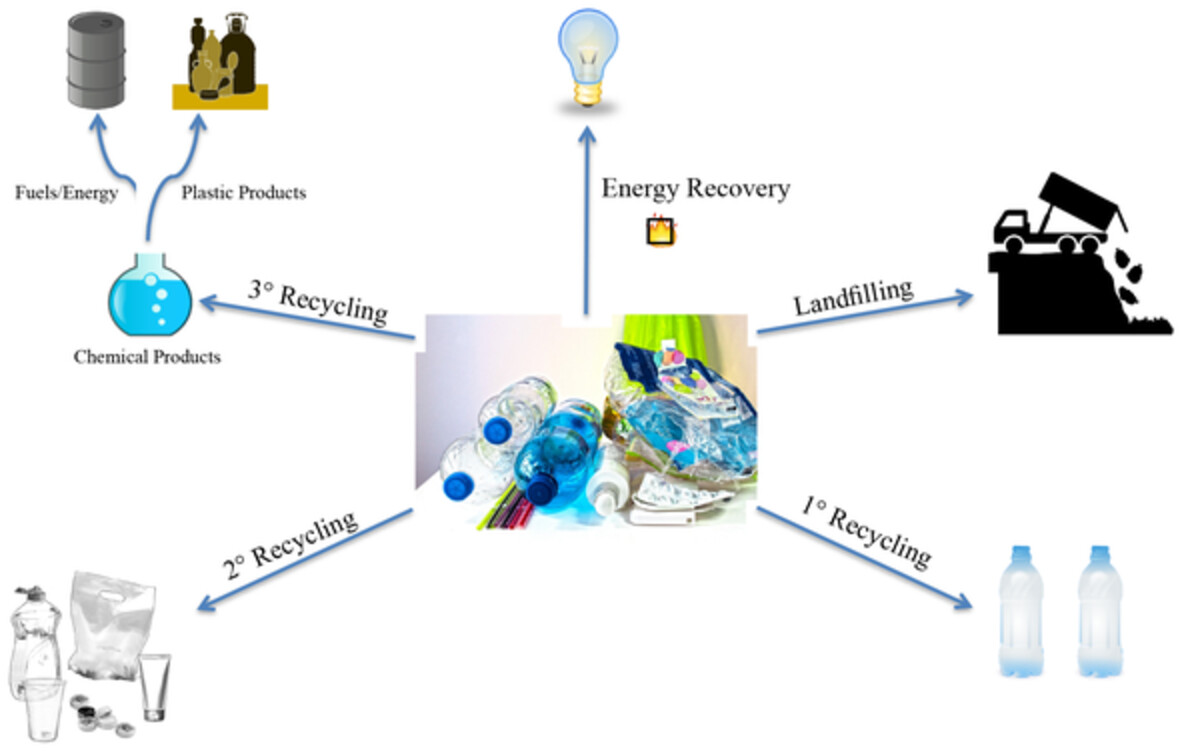 Processes under development to decompose plastics back to new monomer feedstocks, called chemical recycling or tertiary recycling. This approach is achieving some success with a limited number of materials, mostly for high-volume consumer plastics rather than engineering types.
LCA is needed to validate that achieving plastic circularity this way with the necessary processing energy and chemicals will have a net environmental benefit. The obvious problem with all approaches is that plastics were never designed for the environment in the first place.
Selecting More Sustainable Additives is another area where product engineers have some choices. There are thousands of possible additives used in plastic, usually specified for a given grade and end application. These include flame retardants, processing aids, fillers, colorants, ultraviolet stabilizers, plasticizers for flexibility, and so on and on. While these choices are primarily the responsibility of the resin manufacturer, pressure from regulators and industry demand can influence the use of more sustainable additives.
Whenever possible, new products should avoid regulated substances by design, which may include Substances of Very High Concern (SVHC) as defined by the European Chemicals Agency (ECHA) and, more recently, polyfluorinated substances called PFAS. This is easier said than done but definitely belongs on the checklist of ecodesign considerations.
Besides plastics? While the present discussion is about plastics, choices of using altogether different materials may be possible in some cases.
 High-volume hardware is probably unable to use alternative materials like wood, glass, bamboo, etc. Historically, though, until the rise of both solid-state and plastic technology in the 1950s, radios and televisions featured wooden cases and consoles. Miniaturization in the solid-state era brought in mostly plastic housings. One recent example that the author worked on was an audio teleconferencing system that featured either oak or walnut to blend with the executive conference room.
While the intent was not specifically to avoid using plastic, it is an interesting example to think outside the plastic box. Wood avoids many of the issues with plastics, but of course, the plastics in the circuitry content remain to be addressed.
Other large household electrical/electronic goods are likely to use recyclable steel and/or stainless steel cabinets. And if you consider an automobile to be an electronic product, these metals come into play in high volume in automobile shredder residue. Using metal rather than plastic housings may be possible for some products; for example, aluminum may be used for personal communications and IT devices, bringing a tradeoff between initial cost and the potential advantage of aluminum being more highly recyclable for use in new equipment than any plastic.
Only LCA can quantify the tradeoffs. We should also mention toys, which increasingly incorporate some electronics and use colored plastics extensively.
New material technology. One of the many emerging material technologies is Engineered Wood. The cited research hardly suggests that a wood-based material could be a drop-in, for example, injection molded thermoplastics, but the possibility is most intriguing. However, just having a material of natural origins is not automatically a panacea for replacing plastics. Quite the contrary, significant cautions remain; for example,
“Chemical and thermal modifications are usually applied to adapt the wood structure and impart necessary functionalities. Most of these treatments use substantial amounts of chemicals, energy, and water. They also innocently incorporate unwanted chemically bonded structures into the wood and generate a large amount of waste products which are harmful to the environment. This brings a dilemma where an entirely sustainable and green material is converted to a non-environmentally friendly material”
(El Akban et. al, Green Chemistry, 2021).
For now, the point is that reconsidering classical synthetic polymers in the light of more natural and renewable materials may have an interesting future.
Modularity. The ease of disassembly into “modules” is often listed as an eco-design practice that improves circularity, but the present author is skeptical about providing practical details. More specific guidance requires each manufacturer to know how its products can be disassembled at their end of life and where such disassembly would lead in terms of reuse, remanufacturing, or material recovery. In the context of plastics, a large plastic housing that can be easily disassembled into a single clean material is more likely to be sent to a recycler rather than reused as a “module” in other products.
It is unfortunate that software tools to make early design choices for disassembly began to be developed 25 years ago but have gone by the wayside since. The author had personal experience with such a “Green Design Advisor” tool that modeled a product assembly from its raw materials and showed how disassembly into environmentally and economically viable recovery fractions could be optimized.
One example that is probably still true today is that an epoxy circuit board and its components would be a “module” to be submitted to size a reduction, separation, and metal recovery process. Such a tool could also model the choice of a plastic housing vs. a metal alloy and the impacts of circular recovery of the material choices. Disassembly modeling tools for product designers is an area that needs significant development now, while software using artificial intelligence (AI) claims to be the answer. We shall see.
In conclusion, it must be recognized that most plastics were never designed for the environment in the first place. While there is currently no 100% perfect alternative, engineers do have options to improve the life cycle sustainability of tomorrow’s products.
- Select lower PCF plastics and avoid regulated additives.
- Reduce the amount of plastics if possible and keep larger parts free of different materials.
- Consider materials other than plastics.
- Be aware of new developments in both sources of plastic and end-of-life options.
Roger L. Franz / RogerLFranz@gmail.com – Sept. 2024
 I have not been writing much new content recently as I feel that from the conceptual side, so much has already been said and written. A way to confuse people is to overload them with information. We see it in our daily lives and our PLM domain.
With so much information, people become apathetic, and you will hear only the loudest and most straightforward solutions.
One desire may be that we should go back to the past when everything was easier to understand—are you sure about that?
This attitude has often led to companies doing nothing, not taking any risks, and just providing plasters and stitches when things become painful. Strategic decision-making is the key to avoiding this trap.
I just read this article in the Guardian: The German problem? It is an analog country in a digital world.
The article also describes the lessons learned from the UK (quote):
Britain was the dominant economic power in the 19th century on the back of the technologies of the first Industrial Revolution and found it hard to break with the old ways even when it should have been obvious that its coal and textile industries were in long-term decline.
As a result, Britain lagged behind its competitors. One of these was Germany, which excelled in advanced manufacturing and precision engineering.
Many technology concepts originated from Germany in the past and even now we are talking about Industrie 4.0 and Catena-X as advanced concepts. But are they implemented? Did companies change their culture and ways of working required for a connected and digital enterprise?
Technology is not the issue.
The current PLM concepts, which discuss a federated PLM infrastructure based on connected data, have become increasingly stable.
Perhaps people are using different terminologies and focusing on specific aspects of a business; however, all these (technical) discussions talk about similar business concepts:
- Prof. Dr. Jorg W. Fischer, managing partner at Steinbeis – Reshape Information Management (STZ-RIM), writes a lot about a modern data-driven infrastructure, mainly in the context of PLM and ERP. His recent article: The Freeway from PLM to ERP.
- Oleg Shilovitsky, CEO of OpenBOM, has a never-ending flow of information about data and infrastructure concepts and an understandable focus on BOMs. One of his recent articles, PLM 2030: Challenges and Opportunities of Data Lifecycle Management
- Matthias Ahrens, enterprise architect at Forvia / Hella, often shares interesting concepts related to enterprise architecture relevant to PLM. His latest share: Think PLM beyond a chain of tools!
- Dr. Yousef Hooshmand, PLM lead at NIO, shared his academic white paper and experiences at Daimler and NIO through various presentations. His publication can be found here: From a Monolithic PLM Landscape to a Federated Domain and Data Mesh.
- Erik Herzog, technical fellow at SAAB Aeronautics, has been active for the past two years, sharing the concept of federated PLM applied in the Heliple project. His latest publication post: Heliple Federated PLM at the INCOSE International Symposium in Dublin
Several more people are sharing their knowledge and experience in the domain of modern PLM concepts, and you will see that technology is not the issue. The hype of AI may become an issue.
From IT focus to Business focus
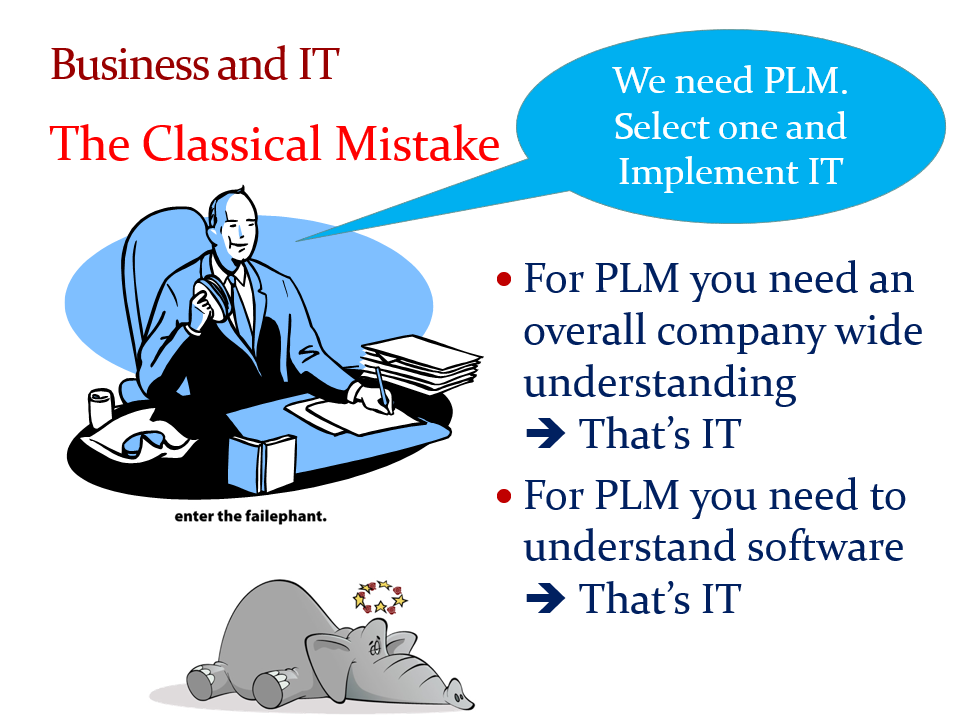 One issue I observed at several companies I worked with is that the PLM’s responsibility is inside the IT organization – click on the image to get the mindset.
This situation is a historical one, as in the traditional PLM mode, the focus was on the on-premise installation and maintenance of a PLM system. Topics like stability, performance and security are typical IT topics.
IT departments have often been considered cost centers, and their primary purpose is to keep costs low.
Does the slogan ONE CAD, ONE PLM or ONE ERP resonate in your company?
 It is all a result of trying to standardize a company’s tools. It is not deficient in a coordinated enterprise where information is exchanged in documents and BOMs. Although I wrote in 2011 about the tension between business and IT in my post “PLM and IT—love/hate relation?”
Now, modern PLM is about a connected infrastructure where accurate data is the #1 priority.
Most of the new processes will be implemented in value streams, where the data is created in SaaS solutions running in the cloud. In such environments, business should be leading, and of course, where needed, IT should support the overall architecture concepts.
In this context, I recommend an older but still valid article: The Changing Role of IT: From Gatekeeper to Business Partner.
This changing role for IT should come in parallel to the changing role for the PLM team. The PLM team needs to first focus on enabling the new types of businesses and value streams, not on features and capabilities. This change in focus means they become part of the value creation teams instead of a cost center.
From successful PLM implementations, I have seen that the team directly reported to the CEO, CTO or CIO, no longer as a subdivision of the larger IT organization.
Where is your PLM team?
Is it a cost center or a value-creation engine?
The role of business leaders
As mentioned before, with a PLM team reporting to the business, communication should transition from discussing technology and capabilities to focusing on business value.
I recently wrote about this need for a change in attitude in my post: PLM business first. The recommended flow is nicely represented in the section “Starting from the business.”
Image: Yousef Hooshmand.
Business leaders must realize that a change is needed due to upcoming regulations, like ESG and CSRD reporting, the Digital Product Passport and the need for product Life Cycle Analysis (LCA), which is more than just a change of tools.
I have often referred to the diagram created by Mark Halpern from Gartner in 2015. Below you can see and adjusted diagram for 2024 including AI.
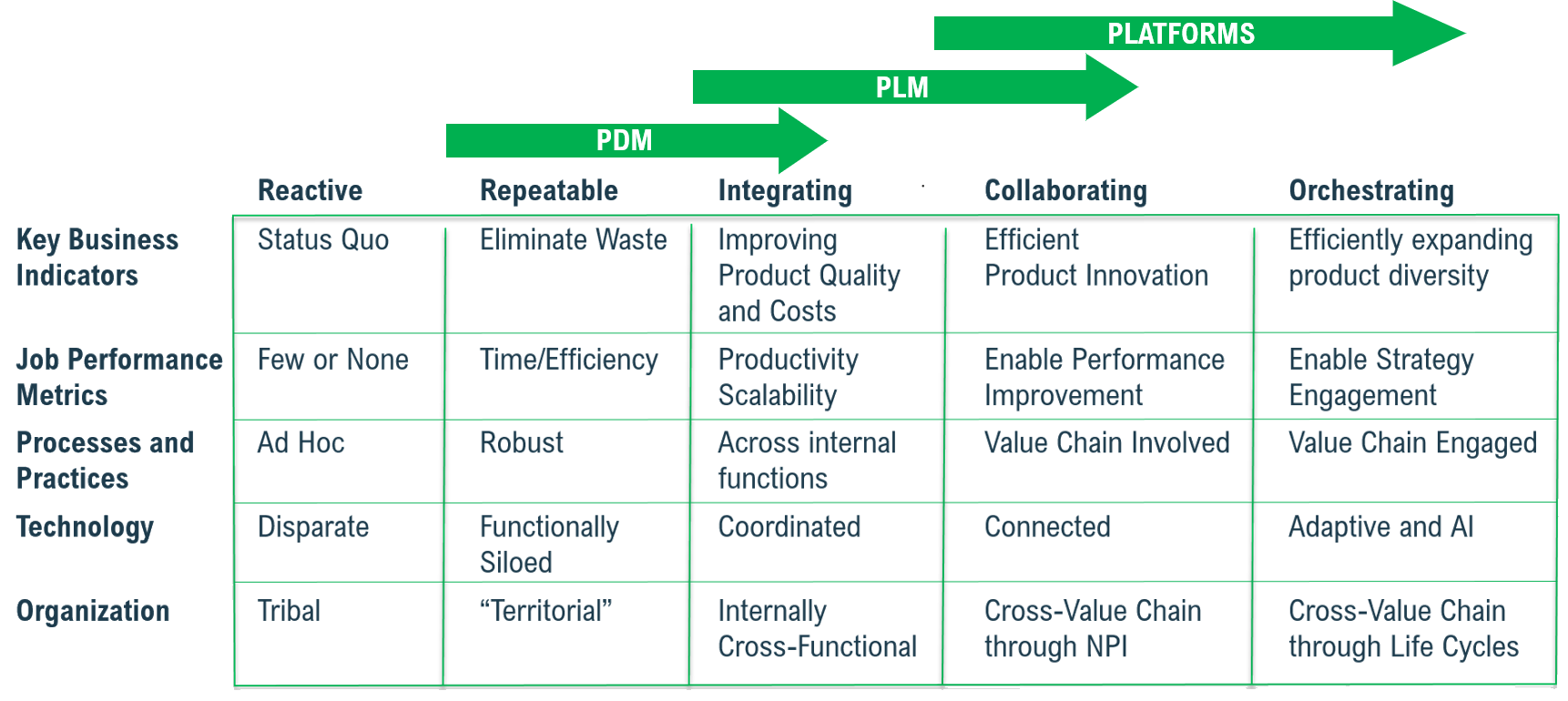
It looks like we are moving from Coordinated technology toward Connected technology. This seems easy to frame. However, my experience discussing this step in the past four to five years has led to the following four lessons learned:
- It is not a transition from Coordinated to Connected.
At this step, a company has to start in a hybrid mode – there will always remain Coordinated ways of working connected to Connected ways of working. This is the current discussion related to Federated PLM and the introduction of the terms System of Record (traditional systems / supporting linear ways of working) and Systems of Engagement (connected environments targeting real-time collaboration in their value chain) - It is not a matter of buying or deploying new tools.
Digital transformation is a change in ways of working and the skills needed. In traditional environments, where people work in a coordinated approach, they can work in their discipline and deliver when needed. People working in the connected approach have different skills. They work data-driven in a multidisciplinary mode. These ways of working require modern skills. Companies that are investing in new tools often hesitate to change their organization, which leads to frustration and failure. - There is no blueprint for your company.
Digital transformation in a company is a learning process, and therefore, the idea of a digital transformation project is a utopia. It will be a learning journey where you have to start small with a Minimum Viable Product approach. Proof of Concepts is a waste of time as they do not commit to implementing the solution. - The time is now!
The role of management is to secure the company’s future, which means having a long-term vision. And as it is a learning journey, the time is now to invest and learn using connected technology to be connected to coordinated technology. Can you avoid waiting to learn?
I have shared the image below several times as it is one of the best blueprints for describing the needed business transition. It originates from a McKinsey article that does not explicitly refer to PLM, again demonstrating it is first about a business strategy.
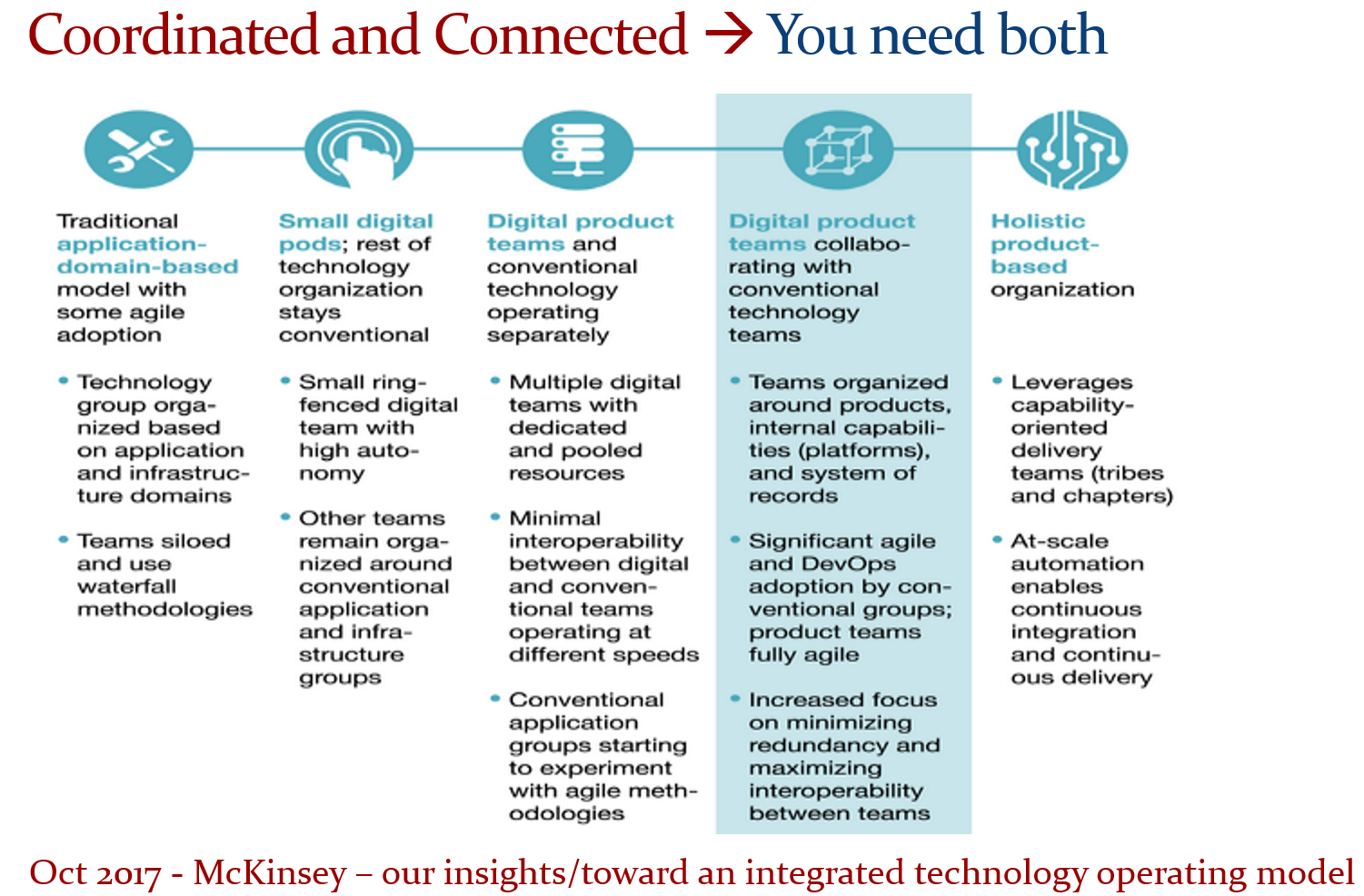
It is up to the management to master this process and apply it to their business in a timely manner. If not, the company and all its employees will be at risk for a sustainable business. Here, the word Sustainable has a double meaning – for the company and its employees/shareholders and the outside world – the planet.
Want to learn and discuss more?
Currently, I am preparing my session for the upcoming PLM Roadmap/PDT Europe conference on 23 and 24 October in Gothenburg. As I mentioned in previous years, this conference is my preferred event of the year as it is vendor-independent, and all participants are active in the various phases of a PLM implementation.

If you want to attend the conference, look here for the agenda and registration. I look forward to discussing modern PLM and its relation to sustainability with you. More in my upcoming posts till the conference.
Conclusion
Digital transformation in the PLM domain is going slow in many companies as it is complex. It is not an easy next step, as companies have to deal with different types of processes and skills. Therefore, a different organizational structure is needed. A decision to start with a different business structure always begins at the management level, driven by business goals. The technology is there—waiting for the business to lead.
 Jos Voskuil's Weblog
Interesting reflection, Jos. In my experience, the situation you describe is very recognizable. At the company where I work, sustainability…
[…] (The following post from PLM Green Global Alliance cofounder Jos Voskuil first appeared in his European PLM-focused blog HERE.) […]
[…] recent discussions in the PLM ecosystem, including PSC Transition Technologies (EcoPLM), CIMPA PLM services (LCA), and the Design for…
Jos, all interesting and relevant. There are additional elements to be mentioned and Ontologies seem to be one of the…
Jos, as usual, you've provided a buffet of "food for thought". Where do you see AI being trained by a…