
You are currently browsing the category archive for the ‘Data centric’ category.
 As a genuine Dutchman, I was able to spend time last month in the Netherlands, and I attended two interesting events: BIMOpen2015, where I was invited to speak about what BIM could learn from PLM (see Dutch review here) and the second event: Where engineering meets supply chain organized by two startup companies located in Yes!Delft an incubator place working close to the technical university of Delft (Dutch announcement here)
Two different worlds and I realized later, they potential have the same future. So let’s see what happened.
BIMopen 2015
 BIMopen 2015 had the theme: From Design to Operations and the idea of the conference was to bring together construction companies (the builders) and the facility managers (the operators) and discuss the business value they see from BIM.
First I have to mention that BIM is a confusing TLA like PLM. So many interpretations of what BIM means. For me, when I talk about BIM I mean Building Information Management. In a narrower meaning, BIM is often considered as a Building Information Model – a model that contains all multidisciplinary information. The last definition does not deal with typical lifecycle operations, like change management, planning, and execution.
The BIMopen conference started with Ellen Joyce Dijkema from BDO consultants who addressed the cost of failure and the concepts of lean. Thinking. The high cost of failure is known and accepted in the construction industry, where at the end of the year profitability can be 1 % of turnover (with a margin of +/- 3 % – so being profitable is hard).
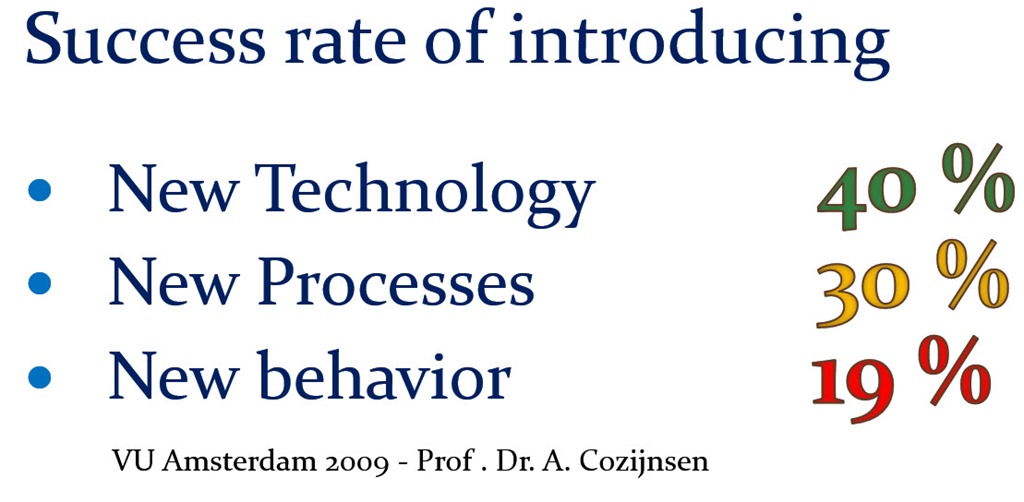
Lean thinking requires a cultural change, which according to Ellen Joyce is an enormous challenge, where according to a study done by Prof Dr. A. Cozijnsen there is only 19 % of chance this will be successful, compared to 40 % chance of success for new technology and 30 % of chance for new work processes.
It is clear changing culture is difficult and in the construction industry it might be even harder. I had the feeling a large part of the audience did not grasp the opportunity or could find a way to apply it to their own world.
My presentation about what BIM could learn from PLM was similar. Construction companies have to spend more time on upfront thinking instead of fixing it later (costly). In addition thinking about the whole lifecycle of a construction, also in operations can bring substantial revenue for the owner or operator of a construction. Where traditional manufacturing companies take the entire lifecycle into account, this is still not understood in the construction industry.
This point was illustrated by the fact that there was only one person in the audience with the primary interest to learn what BIM could contribute to his job as facility manager and half-way the conference he still was not convinced BIM had any value for him.

A significant challenge for the construction industry is that there is no end-to-end ownership of data, therefore having a single company responsible for all the relevant and needed data does not exist. Ownership of data can result in legal responsibility at the end (if you know what to ask for) and in a risk shifting business like the construction industry companies try to avoid responsibility for anything that is not directly related to the primary activities.
Some larger companies during the conference like Ballast Nedam and HFB talked about the need to have a centralized database to collect all the data related to a construction (project). They were building these systems themselves, probably because they were not aware of PLM systems or did not see through the first complexity of a PLM system, therefore deciding a standard system will not be enough.
 I believe this is short-term thinking as with a custom system you can get quick results and user acceptance (it works the way the user is asking for) however custom systems have always been a blockage for the future after 10-15 years as they are developed with a mindset from that time.
If you want to know, learn more about my thoughts have a look at 2014 the year the construction industry did not discover PLM. I will write a new post at the end of the year with some positive trends. Construction companies start to realize the benefits of a centralized data-driven environment instead of shifting documents and risks.
The cloud might be an option they are looking for. Which brings me to the second event.
Engineering meets Supply Chain
This was more an interactive workshop / conference where two startups KE-Works and TradeCloud illustrated the individual value of their solution and how it could work in an integrated way. I had been in touch with KE-Works before because they are an example of the future trend, platform-thinking. Instead of having one (or two) large enterprise system(s), the future is about connecting data-centric services, where most of them can run in the cloud for scalability and performance.
KE-Works provides a real-time workflow for engineering teams based on knowledge rules. Their solution runs in the cloud but connects to systems used by their customers. One of their clients Fokker Elmo explained how they want to speed up their delivery process by investing in a knowledge library using KE-works knowledge rules (an approach the construction industry could apply too)

In general if you look at what KE-works does, it is complementary to what PLM-systems or platforms do. They add the rules for the flow of data, where PLM-systems are more static and depend on predefined processes.
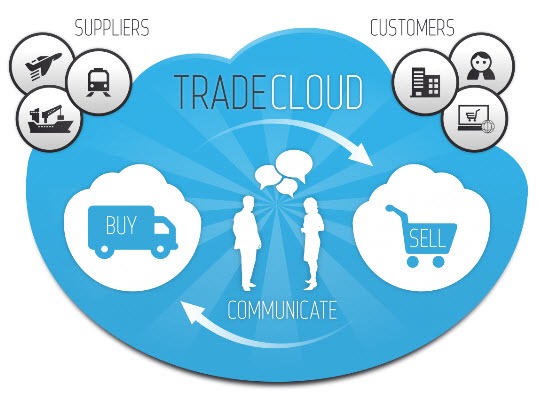 TradeCloud provides a real-time platform for the supply chain connecting purchasing and vendors through a data-driven approach instead of exchanging files and emails. TradeCloud again is another example of a collection of dedicated services, targeting, in this case, the bottom of the market. TradeCloud connects to the purchaser’s ERP and can also connect to the vendor’s system through web services.
The CADAC group, a large Dutch Autodesk solution provided also showed their web-services based solution connecting Autodesk Vault with TradeCloud to make sure the right drawings are available. The name of their solution, the “Cadac Organice Vault TradeCloud Adapter” is more complicated than the solution itself.
 What I saw that afternoon was three solutions providers connected using the cloud and web services to support a part of a company’s business flow. I could imagine that adding services from other companies like OnShape (CAD in the cloud), Kimonex (BOM Management for product design in the cloud) and probably 20 more candidates can already build and deliver a simplified business flow in an organization without having a single, large enterprise system in place that connects all.
The Future
 I believe this is the future and potential a breakthrough for the construction industry. As the connections between the stakeholders can vary per project, having a configurable combination of business services supported by a cloud infrastructure enables an efficient flow of data.
As a PLM expert, you might think all these startups with their solutions are not good enough for the real world of PLM. And currently they are not – I agree. However disruption always comes unnoticed. I wrote about it in 2012 (The Innovators Dilemma and PLM)
Conclusion
Innovation happens when you meet people, observe and associate in areas outside your day-to-day business. For me, these two events connected some of the dots for the future. What do you think? Will a business process based on connected services become the future?
Sometimes we have to study careful to see patterns have a look here what is possible according to some scientists (click on the picture for the article)

 This is a post I published on LinkedIn on July 28th related to a discussion around Excel and PLM usage and usability.
Reposted for my blog subscribers.
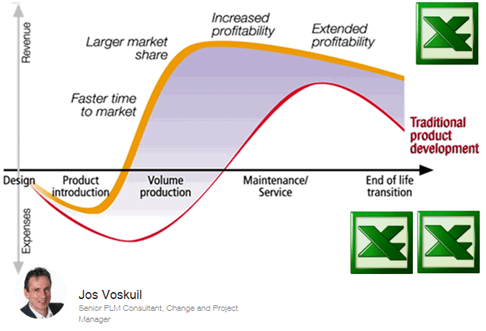
This post is written in the context of two posts that recently caught my attention. One post from Lionel Grealou – comparing PLM and Excel collaboration and reaction on this post and its comments by Oleg Shilovitsky – PLM Need for speed.
Both posts discuss the difference between Excel (easy to use / easy to deploy ) and a PLM system (complex to use / complicated deployment). And when you read both posts you would believe that it is mainly deployment and usability that are blocking PLM systems to be used instead of Excel.
Then I realized this cannot be the case. If usability and deployment were blocking issues for an enterprise system, how would it be possible that the most infamous system for usability, SAP, it one of the top-selling enterprise applications. Probably SAP is the best-selling enterprise application. In addition, I have never heard about any company mentioning SAP is easy to deploy. So what is the difference?
I assume if Excel had existed in its current state in the early days of MRP, people might be tempted to use Excel for some ERP functions. However they would soon realize that Excel is error prone and when you buy the wrong materials or when make errors in your resource scheduling, soon you would try to solve it in a more secure way. Using an ERP system.
ERP systems have never been sold to the users for their usability. It is more that the management is looking for guarantees that the execution process is under control. Minimize the potential for errors and try to automate all activities as much as possible. As the production process is directly linked to finance, it is crucial to have it under control. Goodbye usability, safety first.
Why is this approach not accepted for PLM?
Why do we talk about usability?
First of all, the roots for PLM come from the engineering department (PDM) and, therefore, their primary data management system was not considered an enterprise system. And when you implement a system for a department, discussions will be at the user level. So user acceptance became necessary for PDM and PLM.
But this is not the main reason. Innovation, Product Development, Sales Engineering, Engineering are all iterative activities. In contrary to ERP, there is no linear process defined how to develop the ultimate product the first time right. Although this believe existed in the nineties by an ERP country manager that I met that time. He told me
“Engineers are resources that do not want to be managed, but we will get them.”
An absurd statement I hope you agree. However, the thoughts behind this statement are correct. How do you make sure product development is done in the most efficient manner?
If you look at large enterprises in the aerospace or automotive industry, they implemented PLM, which for sure was not user-friendly. Why did they implement PLM? As they did not want to fix the errors, an Excel-like implementation would bring.
Using Excel has a lot of hidden costs. How to make sure you work with the right version as multiple copies exist? How do you know if the Excel does not contain any type indicating wrong parts? You will learn this only once it is too late. How do you understand the related information to the Excel (CAD files, specifications, etc., etc.)? All lead to a lot of extra manual work depending on the accuracy and discipline of every employee in the company. Large enterprises do not want to be dependent on individual skills.
Large enterprise have shown that it is not about usability in the first place if you wish to control the data. Like for ERP systems, they are aware of the need for PLM with reduced usability above being (fl)Exel with all its related inconvenience.
I believe when there is a discussion about PLM or Excel, we have not reached the needed conceptual level to implement PLM. PLM is about sharing data and breaking down silos. Sharing allows better and faster collaboration, maintaining quality, and this is what companies want to achieve. Therefore the title: How do you measure collaboration. This is the process you wish to optimize, and I suspect that when you would compare user-friendly collaboration with Excel with less user-friendly PLM, you might discover PLM is more efficient.
Therefore stop comparing Excel and PLM. It is all about enabling collaboration and changing people to work together (the biggest challenge – more than usability).
Conclusion: Once we have agreed on that concept, PLM value is about collaboration, there is always to hope to enhance usability. Even SAP is working on that – it is an enterprise software issue.
 In my previous post describing the various facets of the EBOM, I mentioned several times classification as an important topic related to the PLM data model. Classification is crucial to support people to reuse information and, in addition, there are business processes that are only relevant for a particular class of information, so it is not only related to search/reuse support.
In 2008, I wrote a post about classification, you can read it here. Meanwhile, the world has moved on, and I believe more modern classification methods exist.
Why classification ?
 First of all classification is used to structure information and to support retrieval of the information at a later moment, either for reuse or for reference later in the product lifecycle. Related to reuse, companies can save significant money when parts are reused. It is not only the design time or sourcing time that is reduced. Additional benefits are lower risks for errors (fewer discoveries), reduced process and approval time (human overhead), reduced stock (if applicable), and more volume discount (if applicable) and reduced End-Of-Life handling.
An interesting discussion about reuse started by Joe Barkai can also be found on LinkedIn here, including interesting comments
Classification can also be used to control access to certain information (mainly document classification), or classification can be used to make sure certain processes are followed, e.g. export control, hazardous materials, budget approvals, etc. Although I will speak mainly about part classification in this post, classification can be used for any type of information in the PLM data model.
Classification standards
 Depending on the industry you are working in, there are various classification standards for parts. When I worked in the German-speaking countries (the DACH-länder) the most discussed classification at that time was DIN4000 (Sachmerkmal-liste), a must have standard for many of the small and medium sized manufacturing companies. The DIN 4000 standard had a predefined part hierarchy and did not describe the necessary properties per class. I haven’t met a similar standard in other countries at that time.
Another very generic classification I have seen are the UNSPC standard, again a hierarchical classification supporting everything in the universe but no definition of attributes.
 Other classification standards like ISO13399, RosettaNET, ISO15926 and IFC exist to support collaboration and/or the supply chain. When you want to exchange data with other disciplines or partners. The advantage of a standard definition (with attributes) is that you can exchange data with less human processing (saving labor costs and time – the benefit of a digital enterprise).
I will not go deeper into the various standards here as I am not the expert for all the standards. Every industry has its own classification standards, a hierarchical standard, and if more advanced the hierarchy is also supported by attributes related to each class. But let´s go into the data model part.
Classification and data model
 The first lesson I learned when implementing PLM was that you should not build your classification hard-coded into the PLM, data model. When working with SmarTeam is was very easy to define part classes and attributes to inherit. Some customers had more than 300 classes represented in their data model just for parts. You can imagine that it looks nice in a demo. However when it comes to reality, a hard-coded classification becomes a pain in the model. (left image, one of the bad examples from the past)
1 – First of all, classification should be dynamic, easy to extend.
2 – The second problem however with a hard-coded classification was that once a part is defined for the first time the information object has a fixed class. Later changes need a lot of work (relinking of information / approval processes for the new information).
3 – Finally, the third point against a hard-coded classification is that it is likely that parts will be classified according to different classifications at the same time. The image bellow shows such a multiple classification.
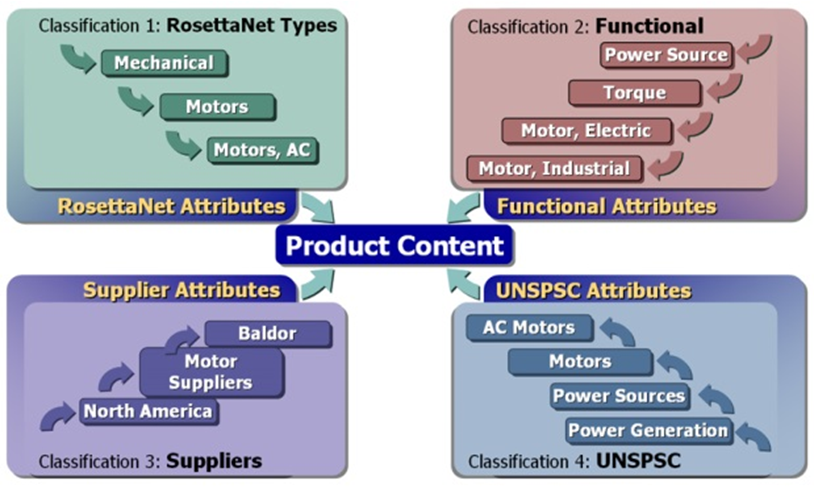
So the best approach is to have a generic part definition in your data model and perhaps a few subtypes. Companies tend to differentiate still between hardware (mechanical / electrical) parts and software parts.
Next a part should be assigned at least to one class, and the assignment to this class would bring more attributes to the part. Most of the PLM systems that support classification have the ability to navigate through a class hierarchy and find similar parts.
When parts are relevant for ERP they might belong to a manufacturing parts class, which add particular attributes required for a smooth PLM – ERP link. Manufacturing part types can be used as templates for ERP to be completed.
This concept is also shared by Ed Lopategui as commented to my earlier post about EBOM Part types. Ed states:
Think part of the challenge moving forward is we’ve always handled these as parts under different methodologies, which requires specific data structures for each, etc. The next gen take on all this needs to be more malleable perhaps. So there are just parts. Be they service or make/buy or some combination – say a long lead functional standard part and they would acquire the properties, synchronizations, and behaviors accordingly. People have trouble picking the right bucket, and sometimes the buckets change. Let the infrastructure do the work. That would help the burden of multiple transitions, where CAD BOM to EBOM to MBOM to SBOM eventually ends up in a chain of confusion.
I fully agree with his statement and consider this as the future trend of modern PLM: Shared data that will be enriched by different usage through the lifecycle.
Why don’t we classify all data in PLM?
There are two challenges for classification in general.
- The first one is that the value of classification only becomes visible in the long-term, and I have seen several young companies that were only focusing on engineering. No metadata in the file properties, no part-centric data management structure and several years later they face the lack of visibility what has been done in the past. Only if one of the engineers remembers a similar situation, there is a chance of reuse.
- The second challenge is that through a merger or acquisition suddenly the company has to manage two classifications. If the data model was clean (no hard-coded subclasses) there is hope to merge the information together. Otherwise, it might become a painful activity to discover similarities.
SO THINK AHEAD EVEN IF YOU DO NOT SEE THE NEED NOW !
Modern search based applications
There are ways to improve classification and reuse by using search-based application which can index archives and try to find similarity in properties / attributes. Again if the engineers never filled the properties in the CAD model, there is little to nothing to recover as I experienced in a customer situation. My PLM US peer, Dick Bourke, wrote several articles about search-based applications and classification for engineering.com, which are interesting to read if you want to learn more: Useful Search Applications for Finding Engineering Data
So much to discuss on this topic, however I reached my 1000 words again 
Conclusion
Classification brings benefits for reuse and discovery of information although benefits are long-term. Think long-term too when you define classifications. Keep the data model simple and add attributes groups to parts based on functional classifications. This enables a data-driven PLM implementation where the power is in the attributes not longer in the part number. In the future, search-based applications will offer a quick start to classify and structure data.
 Someone notified me that not everyone subscribed to my blog necessary will read my posts on LinkedIn. Therefore I will repost the upcoming weeks some of my more business oriented posts from LinkedIn here too. This post was from July 3rd and an introduction to all the methodology post I am currently publishing.

The importance of a (PLM) data model
 What makes it so hard to implement PLM in a correct manner and why is this often a mission impossible? I have been asking myself this question the past ten years again and again. For sure a lot has to do with the culture and legacy every organization has. Imagine if a company could start from scratch with PLM. How would they implement PLM nowadays?
My conclusion for both situations is that it all leads to a correct (PLM) data model, allowing companies to store their data in an object-oriented manner. In this way reflecting the behavior the information objects have and the way they mature through their information lifecycle. If you making compromises here, it has an effect on your implementation, the way processes are supported out-of-the-box by a PLM system or how information can be shared with other enterprise systems, in particular, ERP. PLM is written between parenthesis as I believe in the future we do not talk PLM or ERP separate anymore – we will talk business.
Let me illustrate this academic statement.
A mid-market example
 When I worked with SmarTeam in the nineties, the system was designed more as a PDM system than a PLM system. The principal objects were Projects, Documents, and Items. The Documents had a sub-grouping in Office documents and CAD documents. And the system had a single lifecycle which was very basic and designed for documents. Thanks to the flexibility of the system you could quickly implement a satisfactory environment for the engineering department. Problems (and customizations) came when you wanted to connect the data to the other departments in the company.
The sales and marketing department defines and sells products. Products were not part of the initial data model, so people misused the Project object for that. To connect to manufacturing a BOM (Bill of Material) was needed. As the connected 3D CAD system generated a structure while saving the assemblies, people start to consider this structure as the EBOM. This might work if your projects are mechanical only.
However, a Document is not the same as a Part. A Document has a complete different behavior as a Part. Documents have continuous iterations, with a check-in/checkout mechanism, where the Part definition remains unchanged and gets meanwhile a higher maturity.
The correct approach is to have the EBOM Part structure, where Part connect to the Documents. And yes, Documents can also have a structure, but it is not a BOM. SmarTeam implemented this around 2004. Meanwhile, a lot of companies had implemented their custom solution for EBOM by customization not matching this approach. This created a first level of legacy.
When SmarTeam implemented Part behavior, it became possible to create a multidisciplinary EBOM, and the next logical step was, of course, to connect the data to the ERP system. At that time, most implementations have been pushing the EBOM to the ERP system and let it live there further. ERP was the enterprise tool, SmarTeam the engineering tool. The information became disconnected in an IT-manner. Applying changes and defining a manufacturing BOM was done manually in the ERP system and could be done by (experienced) people that do not make mistakes.
Next challenge comes when you want to automate the connection to ERP. In that case, it became apparent that the EBOM and MBOM should reside in the same system. (See old and still actual post with comments here: Where is the MBOM) In one system to manage changes and to be able to implement these changes quickly without too much human intervention. And as the EBOM is usually created in the PLM system, the (commercial/emotional) PLM-ERP battle started. “Who owns the part definition”, “Who owns the MBOM definition” became the topic of many PLM implementations. The real questions should be: “Who is responsible for which attributes of the Part ?” and “Who is responsible for which part of the MBOM definition ?” as data should be shared not owned.
The SmarTeam evolution shows how a changing scope and an incomplete/incorrect data model leads to costly rework when aligning to the mainstream. And this is happening with many implementation and other PLM systems. In particular when the path is to grow from PDM to PLM. An important question remains what is going to be mainstream in the future. More on that in my conclusion.
A complex enterprise example
In the recent years, I have been involved in several PLM discussions with large enterprises. These enterprises suffer from their legacy. Often the original data management was not defined in an object-oriented manner, and the implementation has been expanding with connected and disconnected systems like a big spaghetti bowl.
The main message most of the time is:
“Don’t touch the systems it as it works for us”.
The underlying message is;
“We would love to change to a modern approach, but we understand it will be a painful exercise and how will it impact profitability and execution of our company”
The challenge these companies have is that it extremely hard to imagine the potential to-be situation and how it is affected by the legacy. In a project that I participated several years ago the company was migrating from a mainframe database towards a standard object-oriented (PLM) data model. The biggest pain was in mapping data towards the object-oriented data model. As the original mainframe database had all kind of tables with flags and mixed Part & Document data, it was almost impossible to make a 100 % conversion. The other challenge was that knowledge of the old system had vaporized. The result at the end was a customized PLM data model, closer to current reality, still containing legacy “tricks” to assure compatibility.
All these enterprises at a particular time have to go through such a painful exercise. When is the best moment? When business is booming, nobody wants to slow-down. When business is in a lower gear, costs and investments are minimized to keep the old engine running efficiently. I believe the latter would be the best moment to invest in making the transition if you believe your business will still exist in 10 years from now.
Back to the data model.
Businesses should have today a high-level object-oriented data model, describing the main information objects and their behavior in your organization. The term Master Data Management is related to this. How many companies have the time and skills to implement a future-oriented data model? And the data model must stay flexible for the future.
 Compare it to your brain, which also stores information by its behavior and by learning the brain understands what it logically related. The internal data model gets enriched while we learn.
Once you have a business data model, you are able to implement processes on top of it. Processes can change over time, therefore, avoid hard-coding specific processes in your enterprise systems. Like the brain, we can change our behavior (applying new processes) still it will be based on the data model stored inside our brain.
Conclusion:
A lot of enterprise PLM implementations are in a challenging situation due to legacy or incomplete understanding and availability of an enterprise data model. Therefore cross-department implementations and connecting others systems are considered as a battle between systems and their proprietary capabilities.

The future will be based on business platforms and realizing this take years – imagine openness and usage of data standards. An interesting conference to attend in the near future for this purpose is the PDT2015 conference in Stockholm.
Meanwhile I also learned that a one-day Master Data Management workshop will be held before the PDT2015 conference starts on the 12th of October. A good opportunity to deep-dive for three days !

Two weeks ago I got this message from WordPress, reminding me that I started blogging about PLM on May 22nd in 2008. During some of my spare time during weekends, I began to read my old posts again and started to fix links that have been disappearing.
Initially when I started blogging, I wanted to educate mid-market companies about PLM. A sentence with a lot of ambiguities. How do you define the mid-market and how do you define PLM are already a good start for a boring discussion. And as I do not want to go into a discussion, here are my “definitions”
Warning: This is a long post, full of generalizations and a conclusion.
PLM and Mid-market
The mid-market companies can be characterized as having a low-level of staff for IT and strategic thinking. Mid-market companies are do-ers and most of the time they are good in their domain based on their IP and flexibility to deliver this to their customer base. I did not meet mid-market companies with a 5-year and beyond business vision. Mid-market companies buy systems. They bought an ERP system 25-30 years ago (the biggest trauma at that time). They renewed their ERP system for the Y2K problem/fear and they switched from drawing board towards a 2D CAD system. Later they bought a 3D CAD system, introducing the need for a PDM system to manage all data.
PLM is for me a vision, a business approach supported by an IT-infrastructure that allows companies to share and discover and connect product related information through the whole lifecycle. PLM enables companies to react earlier and better in the go-to-market process. Better by involving customer inputs and experience from the start in the concept and design phases. Earlier thanks to sharing and involving other disciplines/suppliers before crucial decisions are made, reducing the amount of iterations and the higher costs of late changes.
 Seven years ago I believed that a packaged solution, combined with a pre-configured environment and standard processes would be the answer for mid-market companies. The same thought currently PLM vendors have with a cloud-based solution. Take it, us it as it is and enjoy.
Here I have changed my opinion in the past seven years. Mid-market companies consider PLM as a more complex extension of PDM and still consider ERP (and what comes with that system) as the primary system in the enterprise. PLM in mid-market companies is often seen as an engineering tool.
LESSON 1 for me:
The benefits of PLM are not well-understood by the mid-market
To read more:
PLM for the mid-market – mission impossible?
PLM for the SMB – a process or culture change ?
Culture change in a mid-sized company – a management responsibility
Mid-market PLM – what did I learn in 2009 ?
Implementing PLM is a change not a tool
Who decides for PLM in a mid-market company ?
More on: Who decides for PLM in a mid-market company ?
Globalization and Education
 In the past seven years, globalization became an important factor for all type of companies. Companies started offshoring labor intensive work to low-labor-cost countries introducing the need for sharing product data outside their local and controlled premises. Also, acquisitions by larger enterprises and by some of the dominant mid-market companies, these acquisitions introduced a new area of rethinking. Acquisitions introduced discussions about: what are real best practices for our organization? How can we remain flexible, meanwhile adapt and converge our business processes to be future ready?
Here I saw two major trends in the mid-market:
Lack of (PLM) Education
 To understand and implement the value of PLM, you need to have skills and understanding of more than just a vendor-specific PLM system. You need to understand the basics of change processes (Engineering Change Request, Engineering Change Order, Manufacturing Change Order and more). And you need to understand the characteristics of a CAD document structure, a (multidisciplinary) EBOM, the MBOM (generic and/or plant specific) and the related Bill of Processes. This education does not exist in many countries and people are (mis-)guided by their PLM/ERP vendor, explaining why their system is the only system that can do the job.
Interesting enough the most read posts on my blog are about the MBOM, the ETO, BTO and CTO processes. This illustrates there is a need for a proper, vendor-independent and global accepted terminology for PLM
Some educational posts:
Bill of Materials for Dummies – ETO ranked #1
ECR/ECO for Dummies ranked #2
BOM for Dummies – CTO ranked #4
BOM for Dummies: BOM and CAD ranked #7
BOM for Dummies – BTO
Where does PLM start beyond document management ?
The dominance of ERP
 As ERP systems were introduced long before PLM (and PDM), these systems are often considered by the management of a mid-market company as the core. All the other tools should be (preferably) seen as an extension of ERP and if possible, let´s implement ERP vendor´s functionality to support PLM – the Swiss knife approach – one tool for everything. This approach is understandable as at the board level there are no PLM discussions. Companies want to keep their “Let´s do it”-spirit and not reshuffle or reorganize their company, according to modern insights of sharing. Strangely enough, you see in many businesses the initiative to standardize on a single ERP system first, instead of standardizing on a single PLM approach first. PLM can bring the global benefits of product portfolio management and IP-sharing, where ERP is much more about local execution.
LESSON 2:
PLM is not understood at the board level, still considered as a tool
Some post related to PLM and ERP
Where is the MBOM ? ranked #3
Connecting PLM and ERP (post 1) – (post 2) – (post 3) ranked #8
PLM and ERP – the culture change
5 reasons not to implement PLM – Reason #3 We already have an ERP system
The human factor
 A lot of the reasons why PLM has the challenge to become successful have to do with its broad scope. PLM has an unclear definition and most important, PLM forces people to share data and work outside their comfort zones. Nobody likes to share by default. Sharing makes day-to-day life more complicated, sharing might create visibility on what you actually contribute or fix. In many of my posts, I described these issues from various viewpoints: the human brain, the innovators dilemma, the way the older generation (my generation) is raised and used to work. Combined with the fact that many initial PLM/PDM implementations have created so many legacies, the need to change has become a risk. In the discussion and selection of PLM I have seen many times that in the end a company decides to keep the old status quo (with new tools) instead of really having the guts to move toward the future. Often this was a result of investors not understanding (and willing to see) the long term benefits of PLM.
LESSON 3:
PLM requires a long-term vision and understanding, which most of the time does not fit current executive understanding (lack of education/time to educate) and priority (shareholders)
Many recent posts are about the human factor:
The Innovator´s dilemma and PLM
Our brain blocks PLM acceptance
How to get users excited or more committed to a new PLM system?
The digital transformation
 The final and most significant upcoming change is the fact that we are entering a complete new era: From linear and predictable towards fast and iterative, meaning that classical ways we push products to the market will become obsolete. The traditional approach was based on lessons learned from mechanical products after the second world-war. Now through globalization and the importance of embedded software in our products, companies need to deliver and adapt products faster than the classical delivery process as their customers have higher expectations and a much larger range to choose from. The result from this global competitiveness is that companies will change from delivering products towards a more-and-more customer related business model (continuous upgrades/services). This requires companies to revisit their business and organization, which will be extremely difficult. Business wise and human change require new IT concepts – platform? / cloud services? / Big data?
Older enterprises, mid-market and large enterprises will be extremely challenged to make this change in the upcoming 10 years. It will be a matter of survival and I believe the Innovator´s Dilemma applies here the most.
LESSON 4:
The digital transformation is apparent as a trend for young companies and strategic consultants. This message is not yet understood at the board level of many businesses.
Some recent post related to this fast upcoming trend:
From a linear world to fast and circular ?
Did you notice PLM is changing?
Documents or Intelligent Data ?
The difference between files and data-oriented – a tutorial (part 1) – (part 2) – (part 3)
PLM and/or SLM? – (part 1) – (part 2)
Breaking down the silos with data
ROI (Return On Investment)
 I also wrote about ROI – a difficult topic to address as in most discussions related to ROI, companies are talking about the costs of the implementation, not about the tremendous larger impact a new business approach or model can have, once enabled through PLM. Most PLM ROI discussions are related to efficiency and quality gains, which are significant and relevant. However these benefits are relative small and not comparable with the ability to change your business (model) to become more customer centric and stay in business.
Some of the ROI posts:
To PLM or Not to PLM – measuring the planning phase ranked #5
Free PLM Software does not help companies ranked #6
PLM selection–additional thoughts
PLM Selection: Proof Of Concept observations
Where is my PLM Return On Investment (ROI) ?
Conclusion
A (too) long post this time however perhaps a good post to mark 7 years of blogging and use it as a reference for the topics I briefly touched here. PLM has many aspects. You can do the further reading through the links.
From the statistics it is clear that the education part scores the best – see rankings. For future post, let me know by creating a comment what you are looking for in this blog: PLM Mid-Market, Education, PLM and ERP, Business Change, ROI, Digitalization, or …??
Also I have to remain customer centric – thanks for reading and providing your feedback
Above Image courtesy of the marketoonist.com – Tom Fishburne
Image related to digital transformation: The Economist – the onrushing wave
 Three weeks ago there was the Product Innovation conference in Düsseldorf. In my earlier post (here) I described what I experienced during this event. Now, after all the information is somehow digested, here a more high-level post, describing the visible change in business and how it relates to PLM. Trying to describe this change in non-academic wording but in images. Therefore, I described the upcoming change in the title: from linear to circular and fast.
Let me explain this image step by step
In the middle of the previous century, we were thinking linear in education and in business. Everything had a predictable path and manufacturing companies were pushing their products to the market. First local, later in time, more global. Still the delivery process was pretty linear:

This linear approach is reflected in how organizations are structured, how they are aligned to the different steps of the product development and manufacturing process. Below a slide I used at the end of the nineties to describe the situation and the pain; lack of visibility what happens overall.
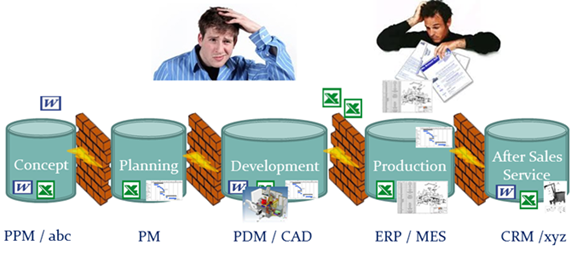
It is discouraging to see that this situation still exists in many companies.
At the end of the nineties, early 2000, PLM was introduced, conceptually managing the whole lifecycle. In reality, it was mainly a more tight connection between design and manufacturing preparation, pushing data into ERP. The main purpose was managing the collaboration between different design disciplines and dispersed teams.
Jim Brown (Tech-Clarity) wrote at that time a white paper, which is still valid for many businesses, describing the complementary roles of PLM and ERP. See the picture below:
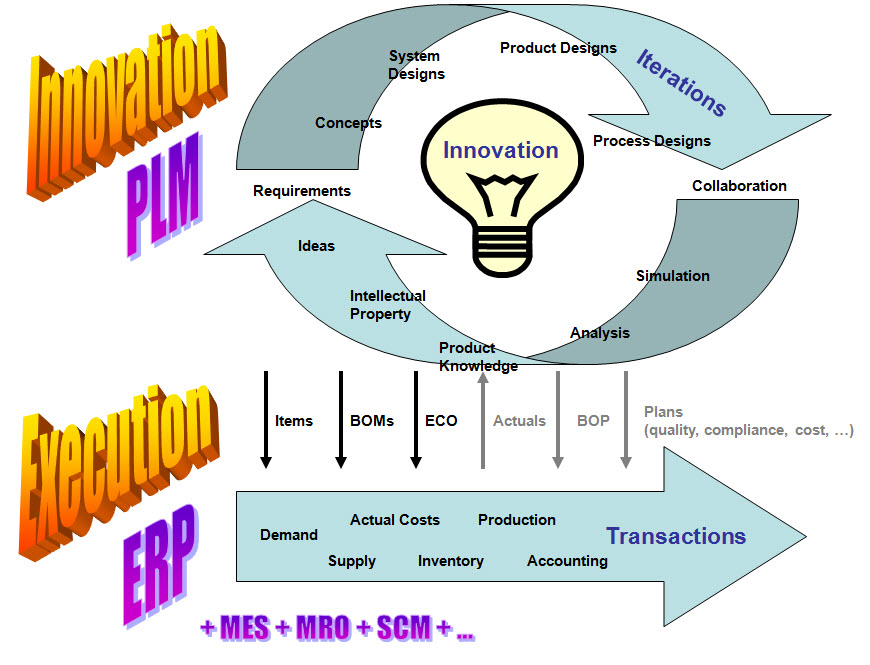
Jim introduced the circle and the arrow. PLM: a circle with iterations, interacting with ERP: the arrow for execution. Here visual it became already clear an arrow does not have the same behavior as a circle. The 100 % linearity in business was gone.
Let´s have a closer look at the PLM circle
This is how PLM is deployed in most organizations:
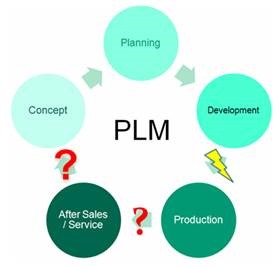 Due to the implementation of siloed systems for PDM, ERP, SCM and more, the flow of information is disconnected when moving from the design domain to the execution domain.
Information is pushed in the ERP system as disconnected information, no longer managed and connected to its design intent.
Next, the ERP system is most of the time not well-equipped for managing after sales and services content. Another disconnect comes up.
Yes, spare parts could be ordered through ERP, but issues appearing at the customer base are not stored in ERP, often stored in a separate system again (if stored beyond email).
The result is that when working in the concept phase, there is no information available for R&D to have a good understanding of how the market or customers work with their product. So how good will it be? Check in your company how well your R&D is connected with the field?
And then the change started …
This could have stayed reality for a long time if there were not a huge business change upcoming. The world becomes digital and connected. As a result, local inefficiencies or regional underperformance will be replaced by better-performing companies. The Darwin principle. And most likely the better performing companies are coming from the emerging markets as there they do not suffer from the historical processes and “knowledge of the past”. They can step into the digital world much faster.
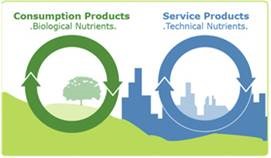 In parallel with these fast growing emerging markets, we discovered that we have to reconsider the ways we use our natural resources to guarantee a future for next generations. Instead of spilling resources to deliver our products, there is a need to reuse materials and resources, introducing a new circle: the circular economy.
The circular economy can have an impact on how companies bring products to the market. Instead of buying products (CAPEX) more and more organizations (and modern people) start using products or services in a rental model (OPEX). No capital investment anymore, pay as you go for usage or capacity.
 This, however, has an impact how traditional companies are organized – you need to be connected to your customers or you are out of business – a commodity.
The digital and connected world can have a huge impact on the products or services available in the near future. You are probably familiar with the buzz around “The Internet of Things” or “Smart and Connected”.
No longer are products depending on mechanical behavior only, more and more products are relying on electrical components with adaptive behavior through software. Devices that connect with their environment report back information to the manufacturer. This allows companies to understand what happens with their products in the field and how to react on that.
Remember the first PLM circle?
Now we can create continuity of data !
 Combine the circular economy, the digital and connected world and you will discover everything can go much faster. A crucial inhibitor is how companies can reorganize themselves around this faster changing, circular approach. Companies need to understand and react to market trends in the fastest and adequate way. The future will be probably about lower volumes of the same products, higher variability towards the market and most likely more and more combining products with services (the Experience Model). This requires a flexible organization and most likely a new business model which will differ from the sequential, hierarchical organizations that we know at this moment.
The future business model ?
The flexibility in products and services will more and more come from embedded software or supported by software services. Software services will be more and more cloud based, to avoid IT-complexity and give scalability.
Software development and integration with products and services are already a challenge for classical mechanical companies. They are struggling to transform their mechanical-oriented design process towards support for software. In the long-term, the software design process could become the primary process, which would mean a change from (sequential – streamlined) lean towards (iterative – SCRUM) agile.
Once again, we see the linear process becoming challenged by the circular iterations.
This might be the end of lean organizations, potentially having to mix with agile conepts..
 If it was a coincidence or not, I cannot judge, however during the PI Conference I learned about W.L. Gore & Associates, with their unique business model supporting this more dynamic future. No need to have a massive organization re-org to align the business, as the business is all the time aligning itself through its employees.
Last weekend, I discovered Semco Partners in the newspaper and I am sure there are more companies organizing themselves to become reactive instead of linear – for sure in high-tech world.
Conclusion:
Linearity is disappearing in business, it is all about reactive, multidisciplinary teams within organizations in order to support customers and their fast changing demands.
Fast reactions need new business organizations models (flexible, non-hierarchical) and new IT-support models (business information platforms – no longer PLM/ERP system thinking)
What do you think ? The end of linear ?
I have talked enough about platforms recently. Still if you want to read more about it:
Cimdata: Business strategy and platformization position paper
Engineering.com: Prod. Innovation Platform PlugnPlay in next generation PLM
Gartner: Product Innovation Platforms
VirtualDutchman: Platform, Backbone, Service Bus or BI
 This is the fifth year that marketkey organized their vendor-independent conference in Europe around Product Innovation, where PLM is the major cornerstone. Approximate 100 companies attended this conference coming from various industries. As there were most of the time two till four parallel tracks (program here), it will still take time for me to digest all the content. However here a first impression and a comparison to what has changed since the PI Conference in 2014 – you can read my review from that conference here.
First of all the keynote speeches for this conference were excellent and were a good foundation for attendees to discuss and open their mind. Secondly I felt that this conference was actually dealing with the imminent shift from classic, centralized businesses towards the data-centric approach to connectivity of information coming from anyone / anything connected. Naturally the Internet of Everything (IoE) and the Internet of Things (IoT) were part of the discussion combined with changing business models: moving from delivering products toward offering services (CAPEX versus OPEX).
Some of the highlights here:
 The first keynote speaker was Carlo Rati Director, MIT Senseable Lab. He illustrated through various experiments and examples how being connected through devices we can change and improve our world: tagging waste, mobile phone activity in a city and the Copenhagen Wheel. His main conclusion (not a surprise): For innovation there is a need to change collaboration. Instead of staying within the company / discipline boundaries solving problems through collaboration between different disciplines will lead to different thinking. How is your company dealing with innovation?
 The second session I attended was John Housego from W.L. Gore and Associates who explained the company’s model for continuous growth and innovation. The company’s future is not based on management but based on leadership of people working in teams in a flat organization. Every employee is an associate, directly involved and challenged to define the company’s future. Have a read about the company’s background here on Wikipedia.
Although the company is 50 years old, I realized that their cultural model is a perfect match with the future of many businesses. More and more companies need to be lean and flexible and support direct contact between the field, customers, market and experts inside the company. Implementing a modern PLM platform should be “a piece of cake” if the technology exists, as W.L. Gore’s associates will not block the change if they understand the value. No silos to break down.
 My presentation “The Challenge of PLM Upgrades as We See the Rules of Business Change” was based around two themes (perpetual software ? / seamless upgrades ?) and from there look towards the future what to expect in business. When we look back, we see that every 10 years there is a major technology change, which makes the past incompatible to upgrade. Now we are dreaming that cloud-based solutions are the future to guarantee seamless upgrades (let’s wait 10 years). To my opinion companies should not consider a PLM upgrade at this moment.
The changes in business models, people behavior and skills plus technology change, will enable companies to move towards a data-centric approach. Companies need to break with the past (a linear, mechanical-design-based, product development approach) and redesign a platform for the future (a business-innovation platform based on the data). In my upcoming blog post(s) I will give more background on this statement.


Trond Zimmerman from the Volvo Group Truck explained the challenges and solution concept they experienced as they are currently implementing answering the challenge of working in a joint venture with Dongfeng Commercial Vehicles. As in a joined venture you want to optimize sharing of common parts, still you cannot expect a single PLM solution for the total joint venture. For that reason, Volvo Group Truck is implementing Share-A-Space from Eurostep to have a controlled collaboration layer between the two joint venture partners.
This is, to my opinion, one of the examples of future PLM practices, where data will not be stored in a single monolithic system, but data will be connected through information layers and services. The case is similar to what has been presented last year at Product Innovation 2014 where Eurostep and Siemens Industrial Turbomachinery implemented a similar layer on top of their PDM environment to enable controlled sharing with their suppliers.
 David Rowan from wired.co.uk closed the day with his keynote: Understanding the New Rules of Product Innovation. He touched the same topic as John Housego from W.L. Gore somehow: it is all about democratization. Instead of hierarchy we are moving to network-based activities. And this approach has a huge impact on businesses. David’s message: Prepare for constant change. Where in the past we lived in a “linear” century, change according to Moore’s law, we are entering now an exponential century where change is going faster and faster. Besides examples of the Internet of Thing, David also gave some examples of the Internet of Stupid Things. He showed a quote from Steve Balmer stating that nobody would pay $ 500 for a phone (Apple). The risk he made is that by claiming some of these stupid inventions might lead to a quote in the future. I think the challenge is always to stay open-minded without judging as at the end the market will decide.
PLM and ERP
 I spent the evening networking with a lot of people, most of them excited about the future capabilities that have been presented. In parallel, the discussion was also about the conservative behavior of many companies. Topics that are already for ten years under discussion – how to deal and connect PLM and ERP, where is the MBOM, what are the roles of PLM and ERP for an organization, are still thankful topics for a discussion, showing where most companies now are with their business understanding.
In parallel to a product innovation conference apparently there is still a need to agree on basic PLM concepts from the previous century.
 The second day opened with an excellent keynote speech from Dirk Schlesinger from Cisco. He talked about the Internet of Everything and provided examples of the main components of IoE: Connectivity, Sensors, Platform, Analytics, and Mobility. In particular the example of Connectivity was demonstrating the future benefits modern PLM platforms can bring. Dirk talked about a project with Dundee Mining where everything in the mine was tagged with RFI devices (people, equipment, vehicles, and resources) and the whole mine was equipped with Wi-Fi.
Based on this approach the execution and planning of what happened was done in their HQ through a virtual environment, giving planners immediate visibility of what happens and allowing them to decide on real data. This is exactly the message I have posted in my recent blog posts.
The most fascinating part were the reported results. This project is ongoing now for 3 years and the first year they achieved a production increase of 30 %. Now they are aiming for this year for a 400 % production increase and a 250 % efficiency increase. These are the numbers to imagine when you implement a digital strategy. It is no longer any more about making our classical processes more efficient, it is about everyone connected and everyone collaborates.
 Marc Halpern from Gartner gave an good presentation connecting the hype of the Internet of Things with the world of PLM again, talking about Product Innovation Platforms. Marc also touched on the (needed) upcoming change in engineering processes. More and more we will develop complex products, which need system thinking. Systems of Systems to handle this complexity, As Marc stated: “Product, process, culture is based on electro-mechanical products where the future trend is all about software.” We should reconsider our Bill of Materials (mechanical) and think probably more about a Bill of Features (software). Much of Marc’s presentation contained the same elements as I discussed in my PDT2014 blog post from October last year.
 I was happy to see Jenni Ala-Mantila presenting the usage of PLM system for Skanska Oy. Skanska is one of the largest construction companies operating global. See one of their beautiful corporate videos here. I always have been an advocate to use PLM practices and PLM infrastructure to enhance, in particular, the data-continuity in a business where people work in silos with separate tools. There are so many benefits to gain by having an end-to-end visibility of the project and its related data. Jenni’s presentation was confirming this.
By implementing a PLM backbone with a focus on project management, supplier collaboration and risk management, she confirmed that PLM has contributed significant to their Five Zero – vision: Zero loss-making projects, Zero Environmental incidents, Zero Accidents, Zero Ethical breaches and Zero Defects. Skanska is really a visionary company although it was frustrating to learn that there was still a need to build a SharePoint connection with their PLM environment. The future of data-centric has not reached everyone in the organization yet.
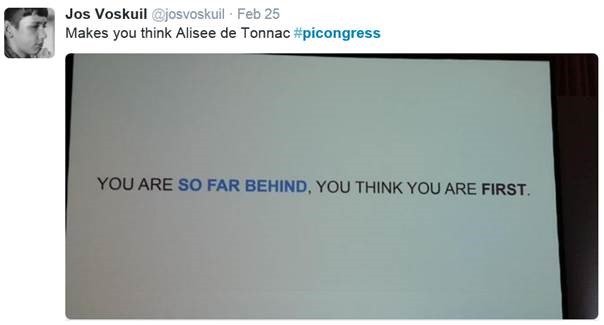
The last two sessions of the conference, a panel discussion “Why is Process Innovation Challenging & What can be done about it” plus the final keynote “Sourcing Growth where Growth Takes Place” had some commonality which I expressed in some twitter quotes:


Conclusion
Where last year I had the impression that the PLM world was somehow in a static mode, not so much news in 2014. It became clear in this 2015 conference that the change towards new business paradigms is really happening and at a faster pace than expected. From mechanical development processes to software processes, from linear towards continuous changes. Moe to come this year
 This time I would like to receive some feedback from my readers as I believe the topic I am discussing here might be similar to a PLM / ERP discussion – a discussion between religions. I have preached the past two years a more data-centric approach for PLM, instead of file management and related tot this data-centric approach, the concept of a PLM platform / Business Platform – CIMdata/ Innovation Platform – Gartner becomes clear.
What´s the issue?
As I wrote in my earlier post (random PLM future thoughts), I realized that talking about platforms is not that straight-forward when meeting companies with their history and terminology. Some claim they are already using a business platform, others have no clue what makes a platform different from a their current PLM implementation ? Therefore I will summarize the different approaches I have seen in my network and give a non-academic opinion as a base for discussion. Looking forward to your opinion.
The platform approach
My definition of a PLM platform:
- A central repository of data based on a core data model. Information is stored as data in a unique way
- On top of this repository, applications can run, using a subset of the overall data elements, proving dedicated functionality and user interface to a particular user / role
- Access to the platform is provided through web-technology. Storage could be on the cloud.
- External applications and data can be connected through an open (standardized?) API embedded or federated
- The PLM platform can be a collection of services and functionality coming from various vendors / suppliers – the app store concept
- The platform approach is THE DREAM for business, being flexible to combine and edit data in any desired context in dedicated apps / environments
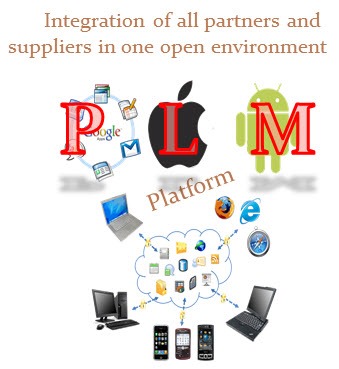 In the PLM world, Dassault Systems with their 3DExperience approach is following this trend although here you might argue about the ease of use to add external apps to this platform – is it open ? Aras and Autodesk might also claim they have a PLM platform, where you might question the same and if the depth of the data model and the provided solutions on top of the data model are mature enough. Finally also SAP can be considered as a platform, but I would not name it a PLM platform at this moment in time. An important question for me would be: How can achieve openness of a PLM platform?
Your thoughts?
The PLM backbone approach
My definition of a PLM backbone:
- The core PLM functionality is provided by a single, proprietary PLM system
- Additional functionality that is not part of the core development (acquisitions) is connected to the backbone through proprietary interfaces
- External authoring tools are linked to the backbone through integrations or interfaces which could be developed by third parties
- External system can interface to the PLM backbone through open interfaces
- The PLM backbone is THE DREAM for engineering, as historically this was the domain where PLM started to be implemented
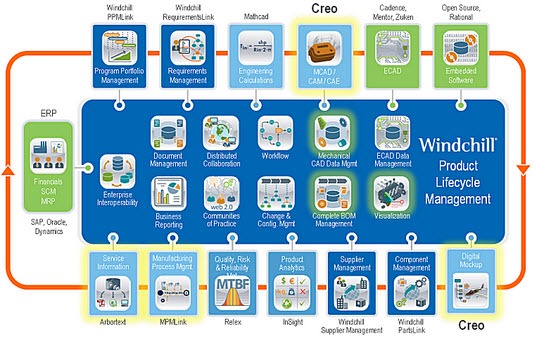 I would consider Siemens and PTC (see picture) the best examples of a PLM backbone approach with their PLM portfolio. Teamcenter and Windchill are both rich PLM systems further connected to several systems, covering the product lifecycle. I am not expert enough to state that the same conclusion is valid for Oracle´s Agile, where I believe the backbone is bigger than the PLM system. What do you think ? Will these PLM vendors also move to a platform approach? And what will be the platform?
The Service Bus approach
My understanding of the Service Bus (I am not an IT-expert):
- Service Bus has a standardized interface to request for data or to post data that needs to be stored in other systems
- The Service Bus approach reduces the amount of (custom) interfaces between systems by requiring standardized inputs and outputs per system
- Providing a user with information that is not entirely available in a single system, the service bus needs to acquire the data from other systems, which might not give a high-performance as expected by business people
- The Service Bus is the IT DREAM as it simplifies the complexity for IT to manage point-to-point solutions between systems and makes an upgrade strategy easier to support.
 From a very high-level view, the service bus approach has some similarities to a platform. The service bus concept allows business to select the systems they like the most (provided they connect to the service bus) – Image property of IBM.com
The main difference would be the persistence of information, where is the real data stored? I came across the service bus approach more often in the past, where the target was most of the time to integrate the PDM functionality (PLM as an enterprise solution was never in scope here).
For the Service Bus approach, I am curious to learn its relevance for future PLM implementations as the challenge would be to provide any user in the company with the relevant information in context. Is the service bus going to be replaced by the platform? Who would be the major players here?
The Business Intelligence approach
This method I discovered in project-centric companies (Oil & Gas companies, EPCs, Construction companies) but strangely enough also at some manufacturing companies, where I would assume integration of systems would bring large benefits.
- Each type of information is managed only in one single system avoiding interfaces or duplication of data.
- Only where needed, data will be pushed from one system to other systems
- Business Intelligence applications extract information from the relevant system and present this in context to the user, giving him/her a better of understanding
- Business users will work have to work in multiple systems to complete their tasks
- The BI approach is the ULTIMATE IT DREAM as it simplifies their works dramatically and shuts down business demands.
 I have seen an example where IT dictated that for document management we use product ABC (well-known Content Management system). Next for internal documents we use SharePoint. For CAD, we use product PQR as much as possible (heavily adapted) or AutoCAD 2D (to support the minimum). For ERP, the standard system is XYZ (a famous ERP system – you do not lose your job by selecting them) and of course everyone uses Excel as a common interface of information between people.
It was impossible in this company to have a business view on the solution landscape. As you can imagine, this company’s margins are not (yet) under pressure as their industry is very conservative.
What do you think?
Is the future for PLM in platforms? If Yes, what about openness? Who are the candidates to offer such a platform? Or will lack of industry standards and openness block wider adoption? If No, will there be a massive PLM system in the future, connected to other enterprise systems (ERP/CRM)? Or will PLM be implemented as a collection of smaller systems communicating through an enterprise service bus?
I am looking forward discussing the topic here and soon during the upcoming Product Innovation conference in Düsseldorf

 Currently, I am preparing my sessions for the upcoming Product Innovation conference in Düsseldorf. See: www.picongress.com. My first session will be about PLM upgrades and how to deal with them for the future. It is a challenging topic as some PLM vendors claim using their product, there will be no upgrade problems and cloud-based solutions also provide seamless upgrades in the future.
Don’t cheer to early when you see this kind of messages. I had the chance to look back the past twenty years what happened with PLM and tried to look forward to the upcoming ten years what might happen.
In addition, this lead to some interesting thoughts that I will share in detail during the conference. I will come back to this topic in this blog after the conference. Here some unstructured thoughts that passed my mind recently when preparing this session.
Not every upgrade is the same!
 First there was an interesting blog post from Ed Lopategui from E(E) with the title There is No Upgrade, where he addresses the difference between consumer software and enterprise software. Where consumer software will be used by millions and tested through long Alfa and beta cycles, PLM software often comes to the market in what you could consider a beta stage with limited testing.
Most PLM vendors invest a lot of their revenue in providing new functionality and technology based on their high-end customer demands. They do not have the time and budget to invest in the details of the solution; for this reason PLM solutions will remain a kind of framework.
In addition, when a solution is not 100 % complete there will be an adaptation from the customer, making upgrades later, not 100 percent guaranteed or compatible. More details on PLM Upgrades after the conference, let’s look into the near future.
The Future of PLM resides in Brussels!
 Some weeks ago I was positively amused by some messages coming from Roger Tempest (PLM Interest Group) related to the future of PLM. Roger claims the PLM industry is effectively rudderless. For that Roger announces the Launch Meeting for the PLM International Research Foundation,
“simple because such a platform does not yet exist.”
I checked if perhaps an ERP International Research Foundation existed, but I only found references to SAP, so what makes the PLM International Research Foundation unique ?
According to Roger, the reason behind this initiative is the lack of clear targets for PLM. I quote:
The lack of detailed thought means that many future possibilities for PLM are just not being considered; and the lack of collective thought means that even the current initiatives to improve PLM remain fragmented and ineffective
As I mentioned in the previous paragraph, PLM vendors are in a kind of rat race to keep up with market demands, rapidly changing business, meanwhile building on their core technology. Not an easy game, as they cannot start from scratch, but for sure, and here I agree, they do not optimize their portfolio.
Who can and will take part in such a research forum?
 PLM vendors will lean back, as their mission is to be competitive in business, not necessarily constrained by PLM guidelines.
This is the same for companies implementing PLM systems. They are looking for solutions in the market that improve their businesses. This might be a PLM system, but perhaps other components bring even a higher value. Is ALM or SLM part of PLM, for example? This is a challenge as who defined what PLM is and where are the boundaries ?
This leaves the activity to the academics for sure they will have the most advanced and futuristic vision of what is possible conceptually. From my observations, the main challenges currently with PLM are that even the vendors are ten years ahead in their capabilities compared to what most companies are asking for. For the academic approach, I still have to think about Monty Python’s sketch related to soccer. See below
Sorry for the generalization, I believe we should not focus on what is PLM and how PLM should be defined. What we now call PLM is entirely different from what we called PLM 10 years ago, see my last year´s post PLM is changing. I think the future should focus how we are going to deal with business platforms, which contain PLM facets.
The PLM future
 Interesting enough we are on the brink of a new business paradigm due to globalization and digitization as you might have read from my recent posts. There are analysts, consultancy firms and research foundations all describing this challenging future.
Have a look at this post from Verdi Ogewell’s article at Engineering.com: Product Innovation Platform: Plug’n’play next generation PLM. The post is a summary of the platform discussion during the PDT 2014 conference, which I consider as one of the best conferences if you want to go into the details. See also my post: The weekend after PDT 2014.
The future is about innovation and/or business platforms where data is available based on a federated approach, not necessary based on a single, monolithic PLM platform.
Focusing on standardization and openness of such a platform is for me the central mission we have.
Remember: Openness is a right, not a privilege.
Let PLM vendors and other application providers develop their optimized services for individual business scenarios that will remove the borders of system thinking. Academic support will be needed to solve interoperability and openness required for initiatives like Industry 4.0 and IDC´s third platform.
I am looking forward to interesting discussions at the upcoming
PI conference but also with peers in my network.
The future is challenging and will it still be named PLM?
Your thoughts?
 A PLM-twisted mind never rests. Not even during these Xmas seasonal holidays, when everything else comes to rest. The dark Christmas days, here in the Netherlands, are the days to share with your family and with others who need your support. For a short time, we focus on being kind, charity and what matters for humanity.
Back to our purpose you might say. This year Pope Francis brought this message very aptly to his cardinals – read it here if you have not heard about it yet.
Next my PLM-twisted mind started ringing all kind of Xmas bells. The pope is talking about PLM! Instead of focusing on your business silo, your personal kingdom, we have to focus on what is the original purpose of our company, not of the individual person. Forget politics, back to the mission !
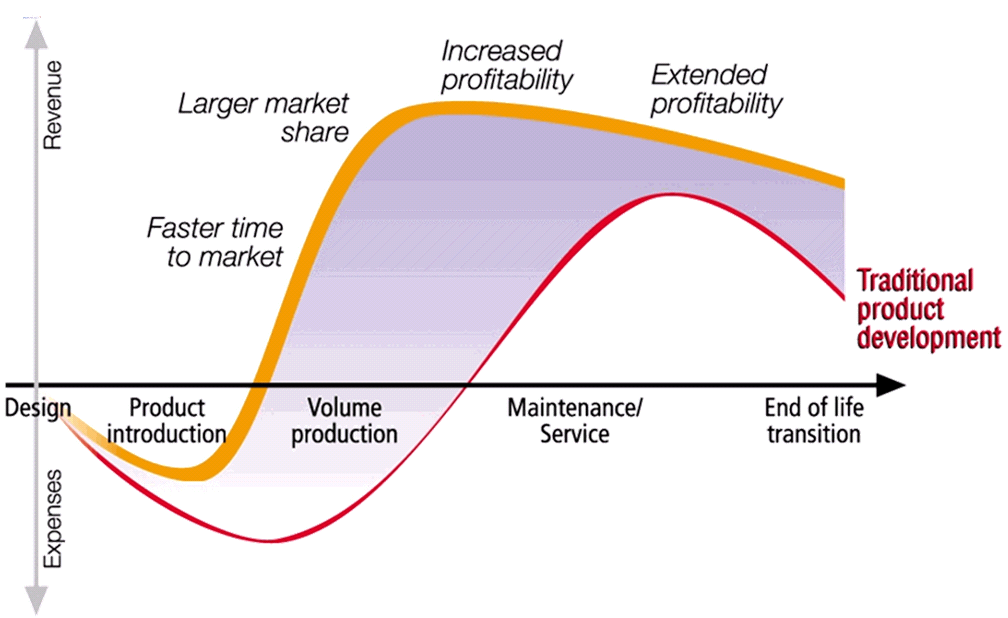
Then I realized there is a paradox within PLM. PLM is a must-have or must-do in a capitalistic world as through PLM companies can become be more competitive than others, win market share and become the market leader.
Nothing social. It is the base for survival in this global world. When your company is not funded by the government, you have to be competitive to survive. Your business needs to make enough money to keep on innovating and stay in business. This is why companies need PLM..
 The paradox however is that effective PLM implementations are all based on the concept of sharing. Sharing data in the early ideation phases, through crowd-sourcing, open innovation, internal sharing with partners and potential customers. Next the development, delivery and maintenance phases of the lifecycle are all performing in an ideal way if information is shared and flowing across the value chain without being locked in silos. The current hype of IoT (Internet of Things) is about sharing data.
So to be a successful, profitable company, inside your business you need to go back to the roots of sharing (data). Interesting paradox isn’t it?
Therefore, I wish you all to have a PLM Pope in your company who will explain the mission and break down the holy houses. You need a PLM pope in your company to make sure it gets implemented successful.
I wish you all a happy and successful 2015
with a lot of sharing
p.s. Should I see a shrink for my PLM-twisted brain?
 Jos Voskuil's Weblog
Hi Jos, Knowing your background in methodology and education, I wanted to share a longer article with you: “What is…
Interesting reflection, Jos. In my experience, the situation you describe is very recognizable. At the company where I work, sustainability…
[…] (The following post from PLM Green Global Alliance cofounder Jos Voskuil first appeared in his European PLM-focused blog HERE.) […]
[…] recent discussions in the PLM ecosystem, including PSC Transition Technologies (EcoPLM), CIMPA PLM services (LCA), and the Design for…
Jos, all interesting and relevant. There are additional elements to be mentioned and Ontologies seem to be one of the…