
 Summer holidays are upcoming. Time to look back and reflect on what happened so far. As a strong believer that a more data-driven PLM is required to support modern customer-focused business models, I have tried to explain this message to many individuals around Europe with mixed success.
Compared to a year ago the notion of a new PLM approach, digital and data-driven, has been resonating more and more. Two years ago I presented at the Product Innovation conference in Berlin a session with the title: Did you notice PLM is changing ? The feedback at that time was that it was a beautiful story, probably happening in the far future. Last year in Düsseldorf ( my review here), the digital trend (s) became clearer. And this year in Munich (my review here), people mentioned upcoming changes were unavoidable, in particular in the relation with IoT, how it could drastically change existing business models.
 For me, the enjoyable thing of the PI Conferences is that they give a snapshot of what people care the most in the context of their product development and in particular PLM. When you are busy in day-to-day business, everything seems to move slowly forward. However, by looking back, I must admit the pace of change has increased dramatically, not the same pace as it was five or ten years ago.
Something is happening, and it happens fast !
And here I want to encourage my readers to step back for a moment from day-to-day business and look around what is happening, in business and in the world. It is all related !
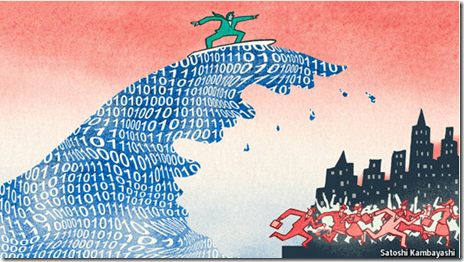
 Jobs are disappearing in the middle class due to automation and direct connectivity with customers creates new types of businesses. Old jobs will never come back, not even when you close your border. And this is what worries many societies. This global, connected world has created a new way of doing business, challenging old and traditional businesses (and people) as their models become obsolete.
The primary reaction is trying to close the discomfort outside. Let´s act as if it never happened and just switch back to the good life in the previous century or centuries.
To be honest, it is all about the discomfort this new world brings to us. This new world requires new skills, in particular, more personal skills to develop continuously, learn and adapt for the future. Closing your mind and thought for the future, by hanging in the past, only brings you further away from the future and create more discomfort.
Are you talking PLM ?
Yes, the previous section was very generic, however also valid for PLM. Modern enterprises are changing the way they are going to do business and PLM is a crucial part of that total picture. Jeff Immelt, CEO of GE, explains in a discussion with Microsoft´s CEO Satya Nadella what it takes for an organization to be ready for the future. He does not talk about PLM, he talks about the need for people to be different in attitude and responsibilities – it is a business transformation – people first. Have a look here:
And although Jeff does not mention PLM, the changing digital business paradigm will affect all classical system, PLM, ERP, CRM. And your PLM vision and plans should anticipate for such a business transformation. Implementing PLM now in the same way is has been done for 10 years in the past, with the processes from the past in mind might make your company even more rigid than before. See my recent blog post: The value of PLM at the C-level.
Take this thought into consideration during your holidays. Can you be comfortable in this world by keep on hanging on the past or should you consider an uncomfortable, but crucial change the way your company will remain (flexible) in future business?
My holiday this year will be in my ultimate comfort zone at the beach. Reading books, no internet, discussing with friends what moves us. Two weeks to charge the batteries for this exciting, rapidly changing world of business (and PLM). I look forward coming back with some of my findings in my upcoming blogs.

Getting in and out of your comfort zone happens everywhere. Read this HBR article with a lot of similarities: If You’re Not Outside Your Comfort Zone, You Won’t Learn Anything
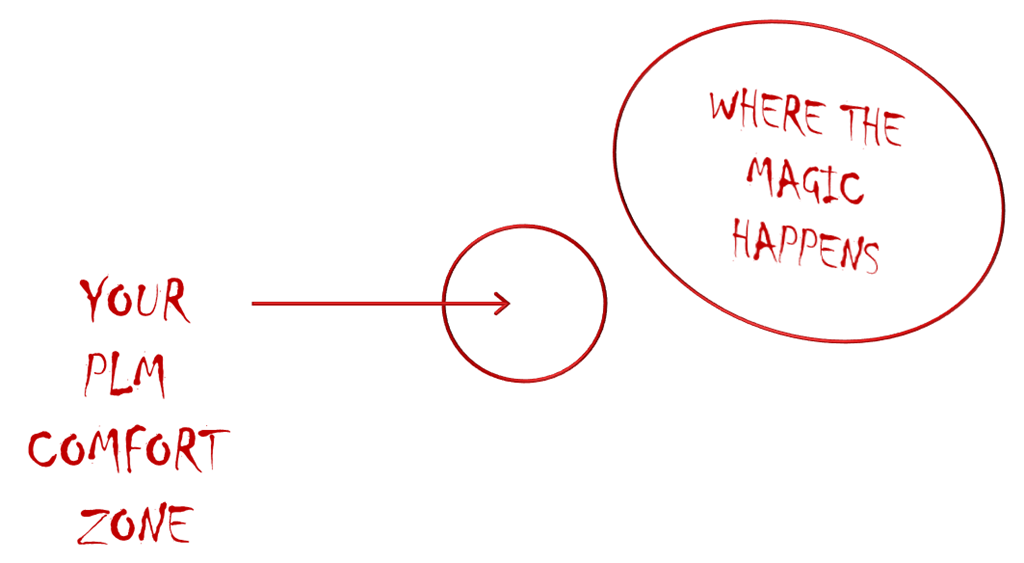
See you soon in the PLM (dis)comfort zone



 Where to focus first depends very much on your company´s core business process. Companies with an Engineering To Order (ETO) process will focus on delivering a single product to their customer and most of the time the product is becoming more like a system, interacting with the outside world.
 In a Configure To Order (CTO) business model you do not spend time for engineering anymore. All options and variants are defined and now the focus is on efficient manufacturing. The trend for CTO companies is that they have to deliver more and more variants in a faster and more demanding global market. Here the connectivity between engineering data and manufacturing data becomes one of the cornerstones of digital PLM. Digital PLM needs to make sure that all relevant data for execution (ERP and MES) is flowing through the organization without reformatting or reworking the data.


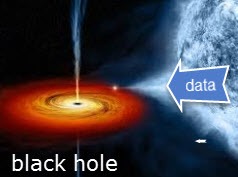
 One of the companies I am working with were only focusing on individual outputs, either in their drawings (yes, the 3D Model was not leading yet) or/and in their Excels (sounds familiar ? ). When we started implementing a PLM backbone, it became apparent during the discovery phase we could not use any advanced search tools to have quick wins by aggregating data for better understanding of the information we discovered. Drawings and Models did not contain any (file) properties. Therefore, the only way to understand information was by knowing its (file) name and potential its directory. Of course, the same file could be in multiple directories and as there were almost no properties, how to know what belongs to what item ?















 Jos Voskuil's Weblog
[…] (The following post from PLM Green Global Alliance cofounder Jos Voskuil first appeared in his European PLM-focused blog HERE.) […]
[…] recent discussions in the PLM ecosystem, including PSC Transition Technologies (EcoPLM), CIMPA PLM services (LCA), and the Design for…
Jos, all interesting and relevant. There are additional elements to be mentioned and Ontologies seem to be one of the…
Jos, as usual, you've provided a buffet of "food for thought". Where do you see AI being trained by a…
Hi Jos. Thanks for getting back to posting! Is is an interesting and ongoing struggle, federation vs one vendor approach.…