
You are currently browsing the tag archive for the ‘Circular Economy’ tag.
In my business ecosystem, I have seen a lot of discussions about technical and architectural topics since last year that are closely connected to the topic of artificial intelligence. We are discussing architectures and solutions that will make our business extremely effective. The discussion is mostly software vendor-driven as vendors usually do not have to deal with the legacy, and they can imagine focusing on the ultimate result.
Legacy (people, skills, processes and data) is the mean inhibitor for fast forward in such situations, as I wrote in my previous post: Data, Processes and AI.
However, there are also less visible discussions about business efficiency – methodology and business models – and future sustainability.
 These discussions are more challenging to follow as you need a broader and long-term vision, as implementing solutions/changes takes much longer than buying tools.
This time, I want to revisit the discussion on modularity and the need for business efficiency and sustainability.
Modularity – what is it?
 Modularity is a design principle that breaks a system into smaller, independent, and interchangeable components, or modules, that function together as a whole. Each module performs a specific task and can be developed, tested, and maintained separately, improving flexibility and scalability.
Modularity is a best practice in software development. Although modular thinking takes a higher initial effort, the advantages are enormous for reuse, flexibility, optimization, or adding new functionality. And as software code has no material cost or scrap, modular software solutions excel in delivery and maintenance.
 In the hardware world, this is different. Often, companies have a history of delivering a specific (hardware) solution, and the product has been improved by adding features and options where the top products remain the company’s flagships.
Modularity enables easy upgrades and replacements in hardware and engineering, reducing costs and complexity. As I work mainly with manufacturing companies in my network, I will focus on modularity in the hardware world.
Modularity – the business goal
How often have you heard that a business aims to transition from Engineering to Order (ETO) to Configure/Build to Order (BTO) or Assemble to Order (ATO)? Companies often believe that the starting point of implementing a PLM system is enough, as it will help identify commonalities in product variations, therefore leading to more modular products.
 The primary targeted business benefits often include reduced R&D time and cost but also reduced risk due to component reuse and reuse of experience. However, the ultimate goal for CTO/ATO companies is to minimize R&D involvement in their sales and delivery process.
More options can be offered to potential customers without spending more time on engineering.
 Four years ago, I discussed modularity with Björn Eriksson and Daniel Strandhammar, who wrote “The Modular Way” during the COVID-19 pandemic. I liked the book because it is excellent for understanding the broader scope of modularity along with marketing, sales, and long-term strategy. Each business type has its modularity benefits.
I had a follow-up discussion with panelists active in modularization and later with Daniel Strandhammar about the book’s content in this blog post: PLM and Modularity.
Next, I got involved with the North European Modularity Network (NEM) group, a group of Scandinavian companies that share modularization experiences and build common knowledge.
 Historically, modularization has been a popular topic in North Europe, and meanwhile, the group is expanding beyond Scandinavia. Participants in the group focus on education-sharing strategies rather than tools.
The 2023 biannual meeting I attended hosted by Vestas in Ringkobing was an eye-opener for me.
We should work more integrated, not only on the topic of Modularity and PLM but also on a third important topic: Sustainability in the context of the Circular Economy.
You can review my impression of the event and presentation in my post: “The week after North European Modularity (NEM)“
 That post concludes that Modularity, like PLM, is a strategy rather than an R&D mission. Integrating modularity topics into PLM conferences or Circular Economy events would facilitate mutual learning and collaboration.
Modularity and Sustainability
 The PLM Green Global Alliance started in 2020 initially had few members. However, after significant natural disasters and the announcement of regulations related to the European Green Deal, sustainability became a management priority. Greenwashing was no longer sufficient.
One key topic discussed in the PLM Green Global Alliance is the circular economy moderated by CIMPA PLM services. The circular economy is crucial as our current consumption of Earth’s resources is unsustainable.
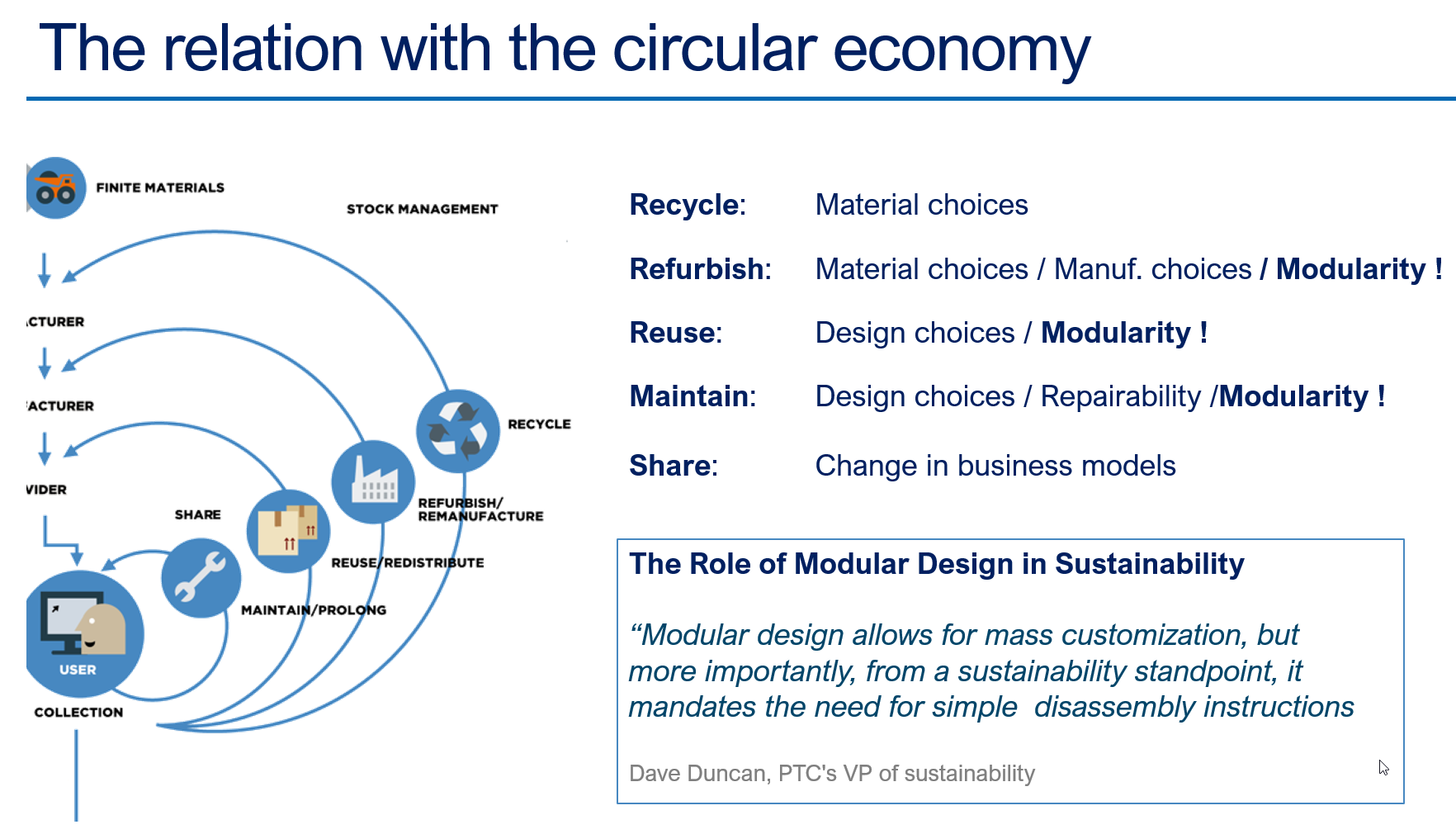
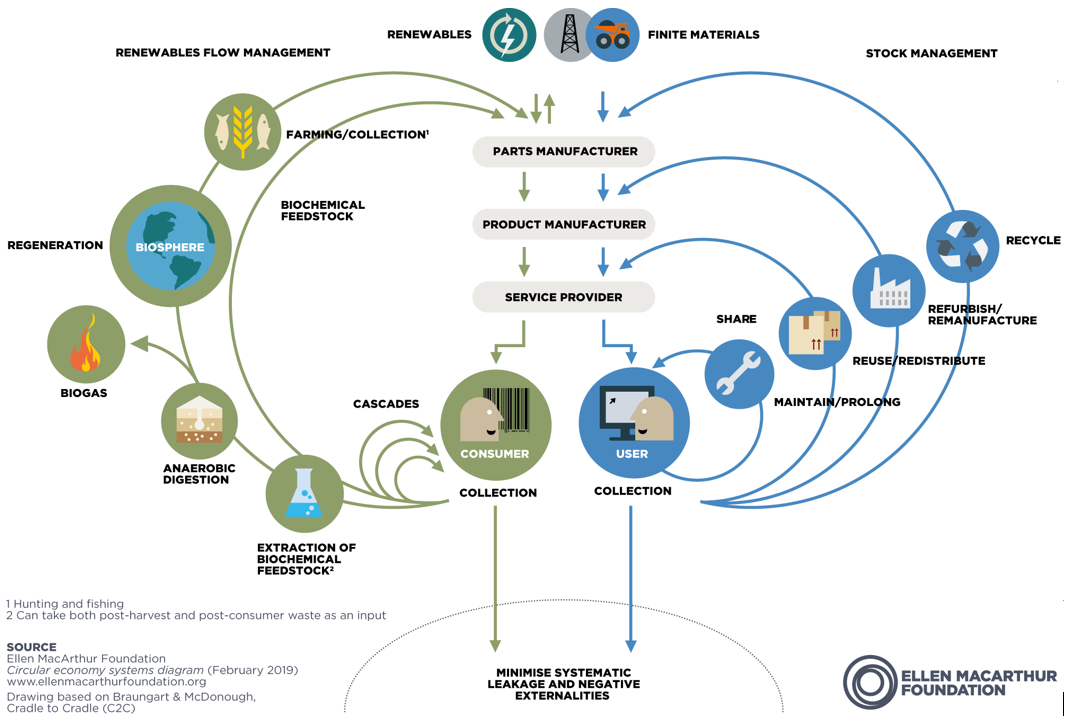
The well-known butterfly diagram from the Ellen MacArthur Foundation below, illustrates the higher complexity of a circular economy, both for the renewables (left) and the hardware (right)
In a circular economy, modularity is essential. The SHARE loop focuses on a Product Service Model, where companies provide services based on products used by different users. This approach requires a new business model, customer experience, and durable hardware. After Black Friday last year, I wrote about this transition: The Product Service System and a Circular Economy.
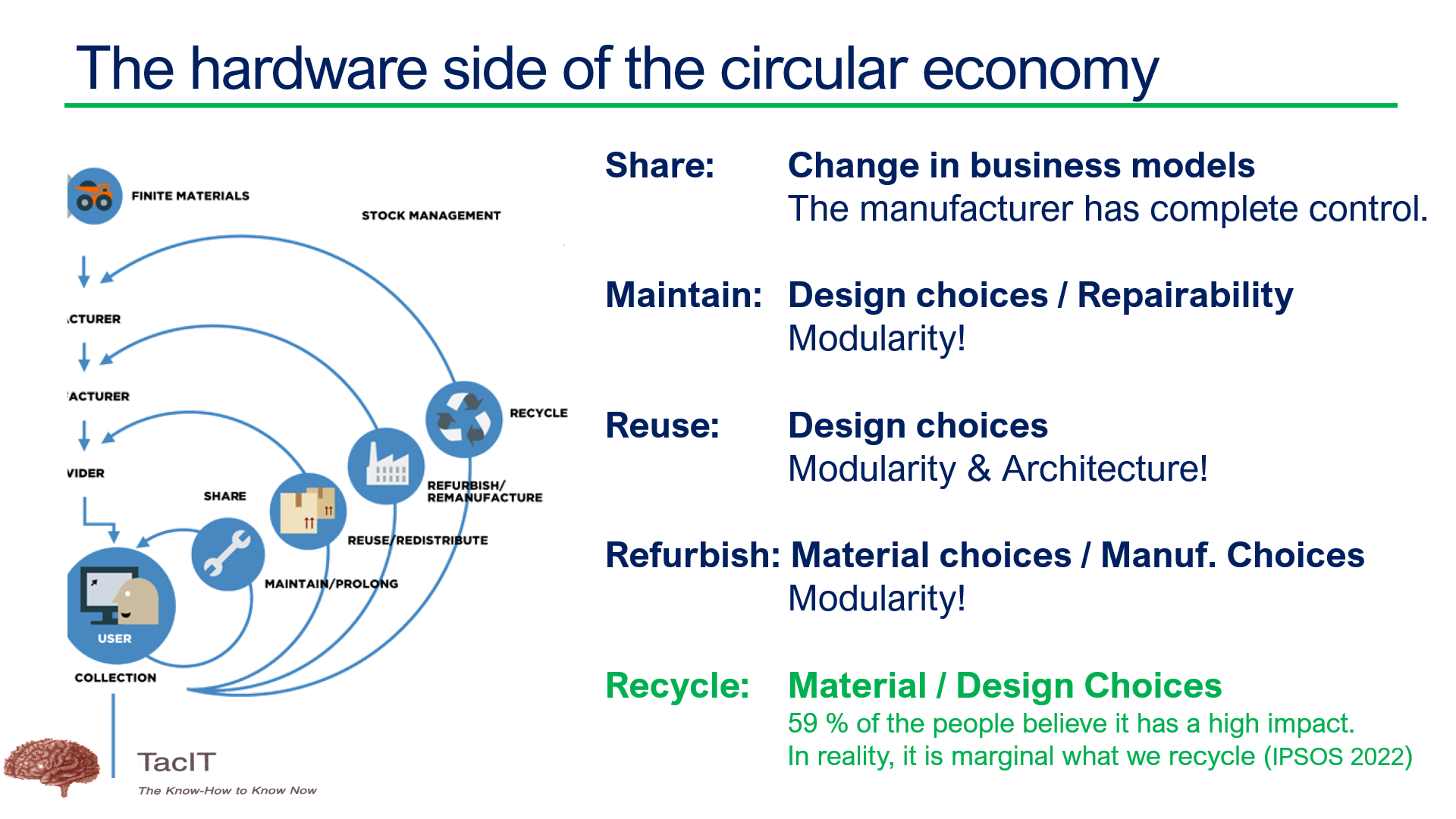
Modularity is vital in the MAINTAIN/PROLONG loop. Modular products can be upgraded without replacing the entire product, and modules are easier to repair. An example is Fairphone from the Netherlands, where users can repair and upgrade their smartphones, contributing to sustainability.
In the REUSE/REMANUFACTURE loop, modularity allows for reusing hardware parts when electronics or software components are upgraded. This approach reduces waste and supports sustainability.
The REFURBISH/REMANUFACTURE loop also benefits from modularity, though to a lesser extent. This loop helps preserve scarce materials, such as batteries, reducing the need for resource extraction from places like the moon, Mars, or Greenland.
A call for action
 If you reached this point of the article, my question is now to reflect on your business or company. Modularity is, for many companies, a dream (or vision) and will become, for most companies, a must to provide a sustainable business.
Modularity does not depend on PLM technology, as famous companies like Scania, Electrolux and Vestas have shown (in my reference network).
Where is your company and its business offerings?
 IMPORTANT:
If you aim to implement modularity to support the concepts of the Circular Economy, make sure you do it in a data-driven, model-based environment – here, technology counts.
Conclusion
Don’t miss the focus on the potential relevance of modularity for your company. Modularity improves business and sustainability, AND it touches all enterprise stakeholders. Technology alone will not save the business. Your thoughts?
Do you want to learn more about implementing PLM at an ETO space company?
Listen to our latest podcast: OHB’s Digital Evolution: Transforming Aerospace PLM with Lucía Núñez Núñez
 Congratulations if you have shown you can resist the psychological and emotional pressure and did not purchase anything in the context of Black Friday. However, we must not forget that another big part of the world cannot afford this behavior, as they do not have the means to do so – ultimate Black Friday might be their dream and a fast track to more enormous challenges.
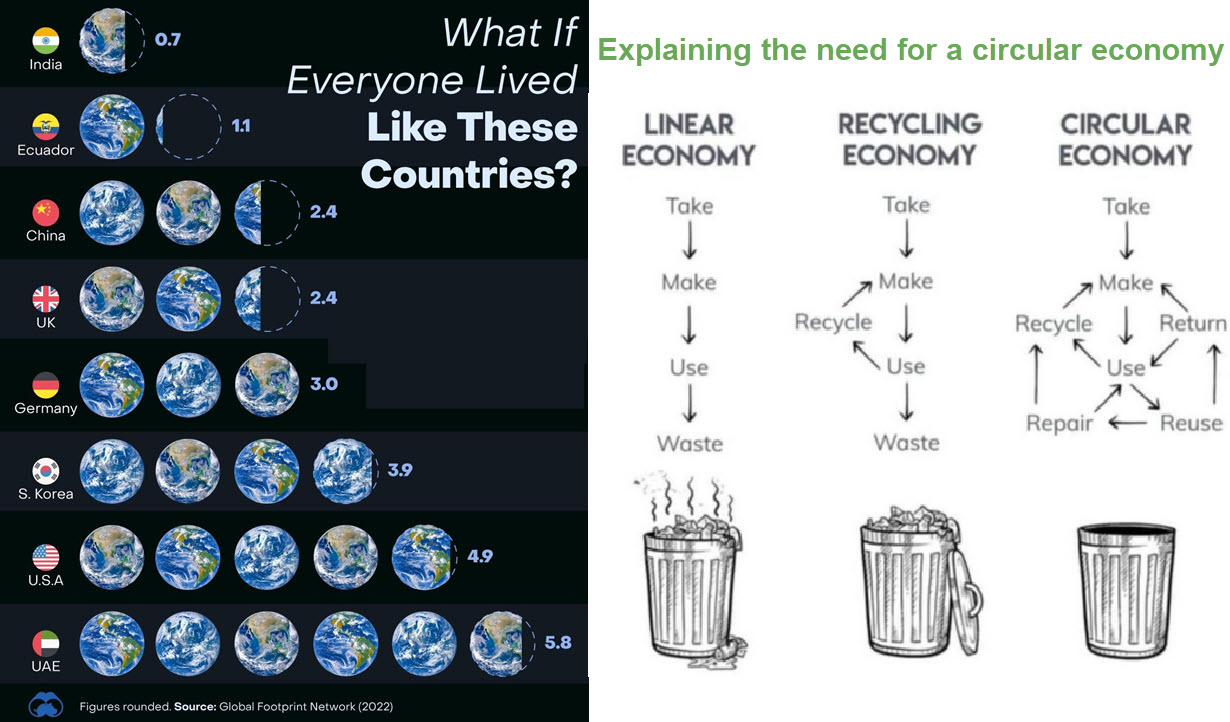
The difference between our societies, all living on the same planet, is illustrated in the image below, illustrating the unfairness of this situation
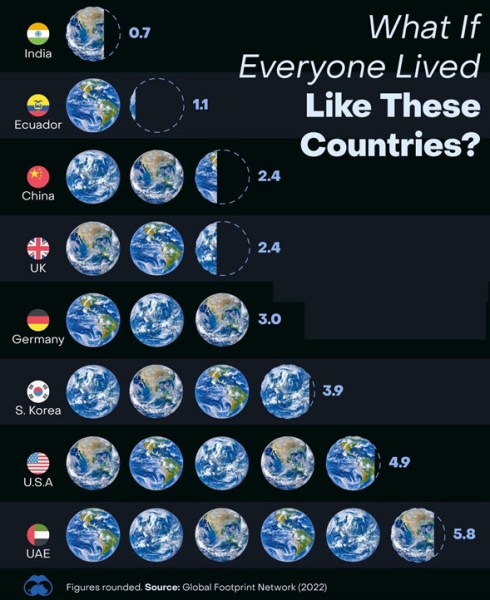
What the image also shows is a warning that we all have to act, as step by step, we will reach planet boundaries for resources.
 Or we need more planets, and I understand a brilliant guy is already working on it. Let’s go to Mars and enjoy life there.
For those generations staying on this planet, there is only one option: we need to change our economy of unlimited growth and reconsider how we use our natural resources.
The circular economy?
You are probably familiar with the butterfly diagram from the Ellen MacArthur Foundation, where we see the linear process: Take-Make-Use-Waste in the middle.
This approach should be replaced by more advanced regeneration loops on the left side and the five R’s on the right: Reduce, Repair, Reuse, Refurbish and Recycle as the ultimate goal is the minimum leakage of Earth resources.
Closely related to the Circular Economy concept is the complementary Cradle-To-Cradle design approach. In this case, while designing our products, we also consider the end of life of a product as the start for other products to be created based on the materials used.
The CE butterfly diagram’s right side is where product design plays a significant role and where we, as a PLM community, should be active. Each loop has its own characteristics, and the SHARE loop is the one I focused on during the recent PLM Roadmap / PDT Europe conference in Gothenburg.
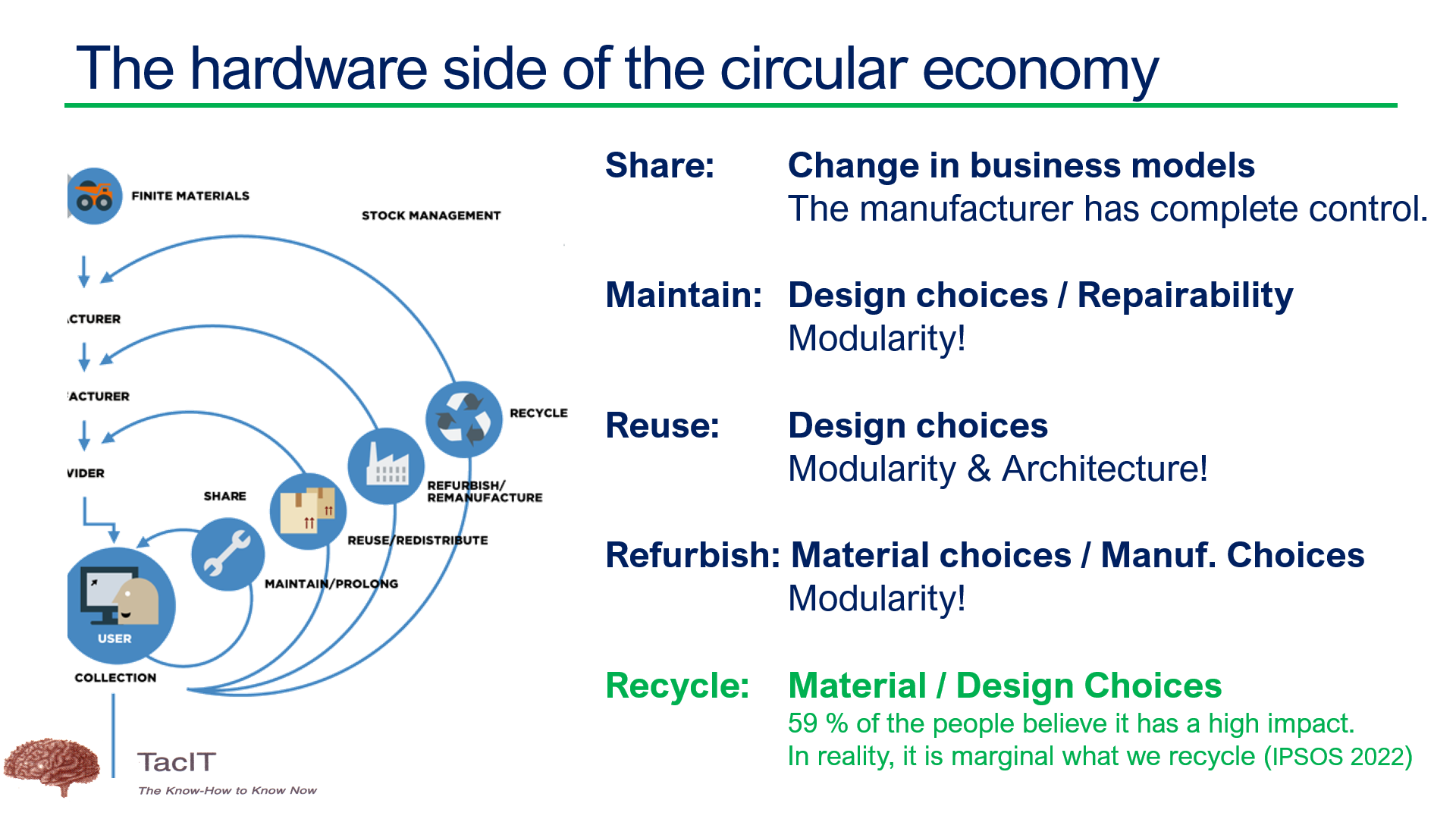
As you can see, the Maintain, Reuse, Refurbish and Recycle loops depend on product design strategies, in particular, modularity and, of course, depending on material choices.
 It is important to note that the recycle loop is the most overestimated loop, where we might contribute to recycling (glass, paper, plastic) in our daily lives; however, other materials, like composites often with embedded electronics, have a much more significant impact.
Watch the funny meme in this post: “We did everything we could– we brought our own bags.”
 The title of my presentation was: Products as a Service – The Ultimate Sustainable Economy?
You can find my presentation on SlideShare here.
Let’s focus on the remainder of the presentation’s topic: Product As A Service.
The Product Service System
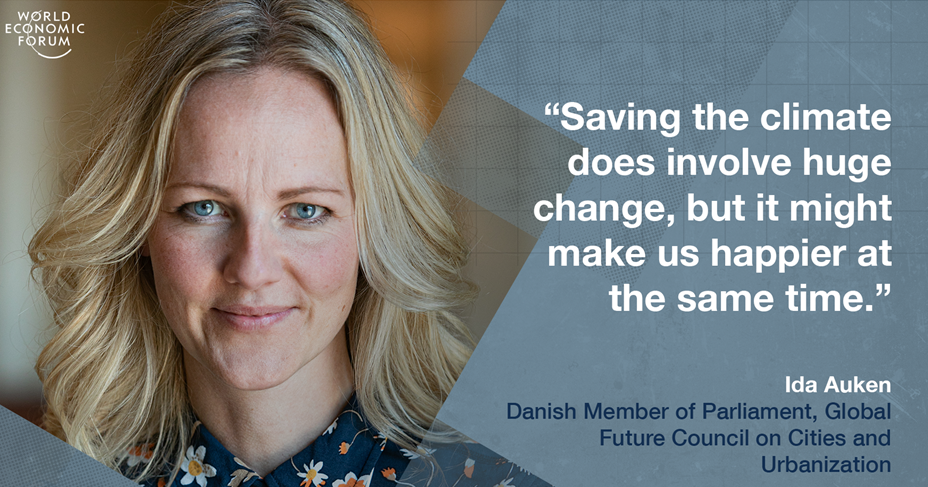 Where Product As A Service might be the ultimate dream for an almost wasteless society, Ida Auken, a Danish member of the parliament, gave a thought-provoking lecture in that context at the 2016 World Economic Forum. Her lecture was summarized afterward as
“In the future, you will own nothing and be happy.”
A theme also picked up by conspiracy thinkers during the COVID pandemic, claiming “they” are making us economic slaves and consumers. With Black Friday in mind, I do not think there is a conspiracy; it is the opposite.
Closer to implementing everywhere Product as a Service for our whole economy, we might be going into Product Service Systems.
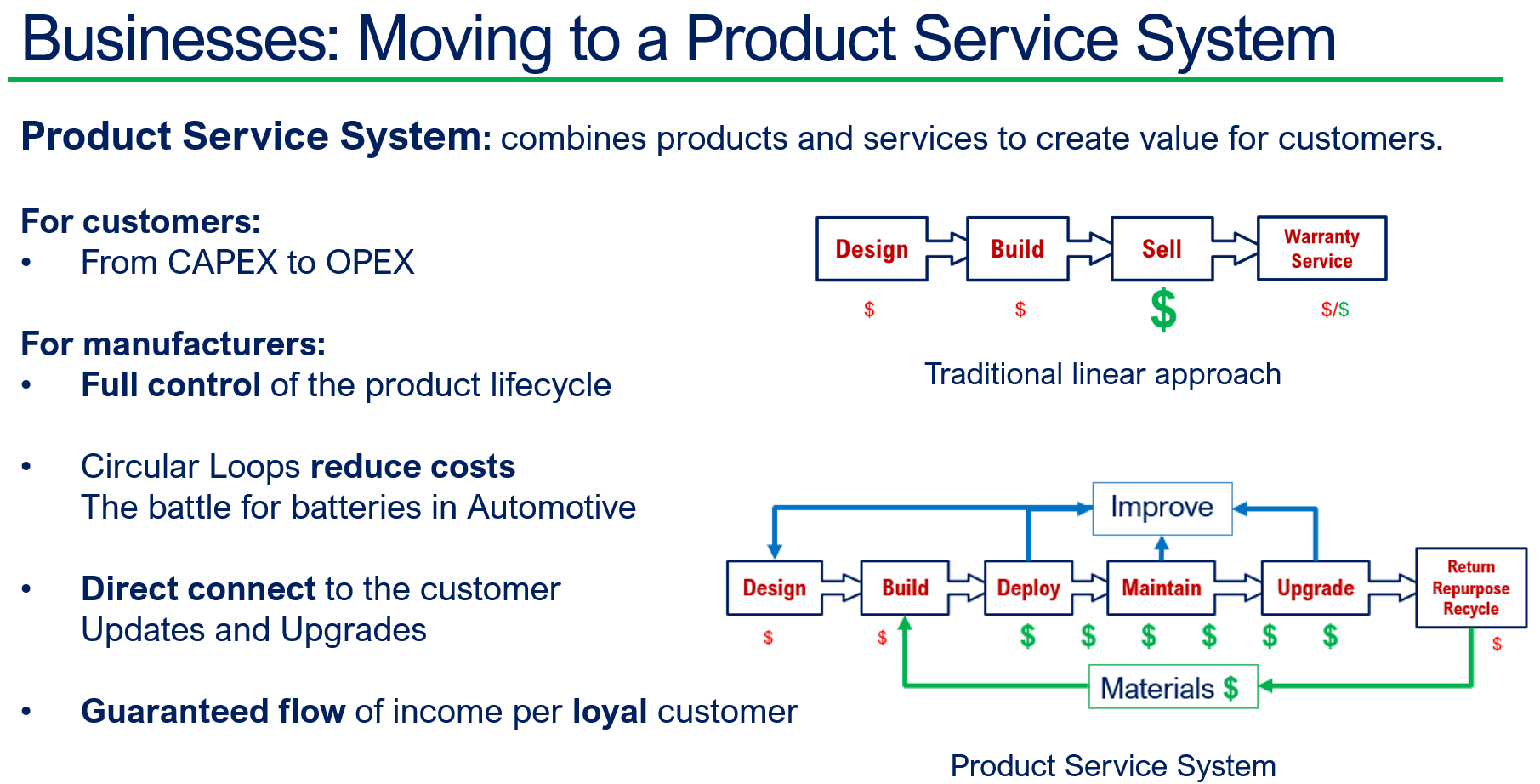
As the image shows, a product service system is a combination of providing a product with related services to create value for the customer.
In the ultimate format, the manufacturer owns the products and provides the services, keeping full control of the performance and materials during the product lifecycle. The benefits for the customer are that they pay only for the usage of the product and, therefore, do not need to invest upfront in the solution (CAPEX), but they only pay when using the solution (OPEX).
 A great example of this concept is Spotify or other streaming services. You do not pay for the disc/box anymore; you pay for the usage, and the model is a win-win for consumers (many titles) and producers (massive reach).
Although the Product Service System will probably reach consumers later, the most significant potential is currently in the B2B business model, e.g., transportation as a service and special equipment usage as a service. Examples are popping up in various industries.
 My presentation focused on three steps that manufacturing companies need to consider now and in the future when moving to a Product Service System.
Step 1: Get (digital) connected to your Product and customer
A foundational step companies must take is to create a digital infrastructure to support all stakeholders in the product service offering. Currently, many companies have a siloed approach where each discipline Marketing/Sales, R&D, Engineering, Manufacturing and Sales will have their own systems.
Digital Transformation in the PLM domain is needed here – where are you on this level?
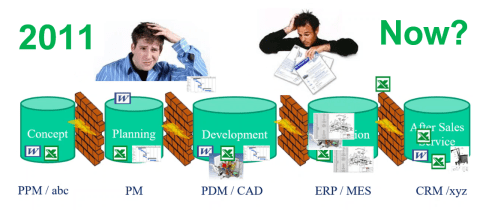
But it is not only the technical silos that impede the end-to-end visibility of information. If there are no business targets to create and maintain the end-to-end information sharing, you can not expect it to happen.
Therefore, companies should invest in the digitalization of their ways of working, implementing an end-to-end digital thread AND changing their linear New Product Development process into a customer-driven DevOp approach. The PTC image below shows the way to imagine a end-to-end connected environment
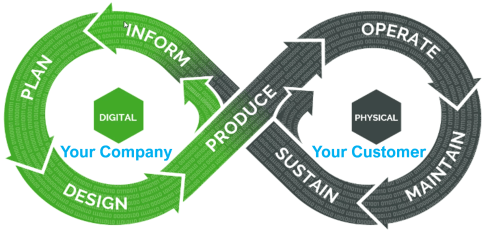
In a Product Service System, the customer is the solution user, and the solution provider is responsible for the uptime and improvement of the solution over time.
 As an upcoming bonus and a must, companies need to use AI to run their Product Service System as it will improve customer knowledge and trends. Don’t forget that AI (and Digital Twins) runs best on reliable data.
Step 2 From Product to Experience
A Product Service System is not business as usual by providing products with some additional services. Besides concepts such as Digital Thread and Digital Twins of the solution, there is also the need to change the company’s business model.
 In the old way, customers buy the product; in the Product Service System, the customer becomes a user. We should align the company and business to become user-centric and keep the user inspired by the experience of the Product Service System.
In this context, there are two interesting articles to read:
- Jan Bosch: From Agile to Radical: Business Model
- Chris Seiler: How to escape the vicious circle in times of transformation?
The change in business model means that companies should think about a circular customer journey.
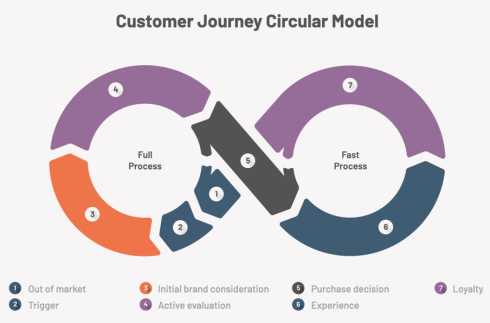
As the company will remain the product owner, it is crucial to understand what happens when the customers stop using the service or how to ensure maintenance and upgrades.
In addition, to keep the customer satisfied, it remains vital to discover the customer KPIs and how additional services could potentially improve the relationship. Again, AI can help find relationships that are not yet digitally established.
 Step 2: From product to experience can already significantly impact organizations. The traditional salesperson’s role will disappear and be replaced by excellence in marketing, services and product management.
This will not happen quickly as, besides the vision, there needs to be an evolutionary path to the new business model.
Therefore, companies must analyze their portfolio and start experimenting with a small product, converting it into a product service system. Starting simple allows companies to learn and be prepared for scaling up.
A Product Service System also influences a company’s cash flow as revenue streams will change.
 When scaling up slowly, the company might be able to finance this transition themselves. Another option, already happening, is for a third party to finance the Product Service System – think about car leasing, power by the hour, or some industrial equipment vendors.
Step 3 Towards a doughnut economy?
The last step is probably a giant step or even a journey. An economic mindset shift is needed from the ever-growing linear economy towards an economy flourishing for everyone within economic, environmental and social boundaries.
Unlimited growth is the biggest misconception on a planet reaching its borders. Either we need more planets, or we need to adjust our society.
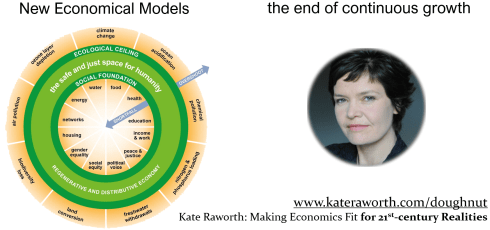
In that context, I read the book “The Doughnut Economy” by Kate Raworth, a recognized thought leader who explains how a future economic model can flourish, including a circular economy, and you will be happy.
 But we must abandon the old business models and habits – there will be a lot of resistance to change before people are forced to change. This change can take generations as the outside world will not change without a reason, and the established ones will fight for their privileges.
It is a logical process where people and boundaries will learn to find a new balance. Will it be in a Doughnut Economy, or did we overlook some bright other concepts?
Conclusion
The week after Black Friday and hopefully the month after all the Christmas presents, it is time to formulate your good intentions for 2025. As humans, we should consume less; as companies, we should direct our future to a sustainable future by exploring the potential of the Product Service System and beyond.

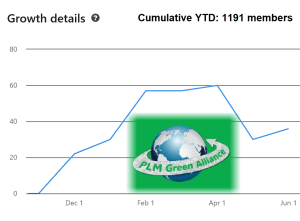 I am happy to see that the number of members of our PLM Green Global Alliance on LinkedIn has been growing fast recently.
Early this year, we reached 1000 members; now, as of this post, we have almost 1200 members in our LinkedIn group—a growth of 20 % in less than half a year!
Each member of the #plmgreen alliance has a unique story and reason for joining.
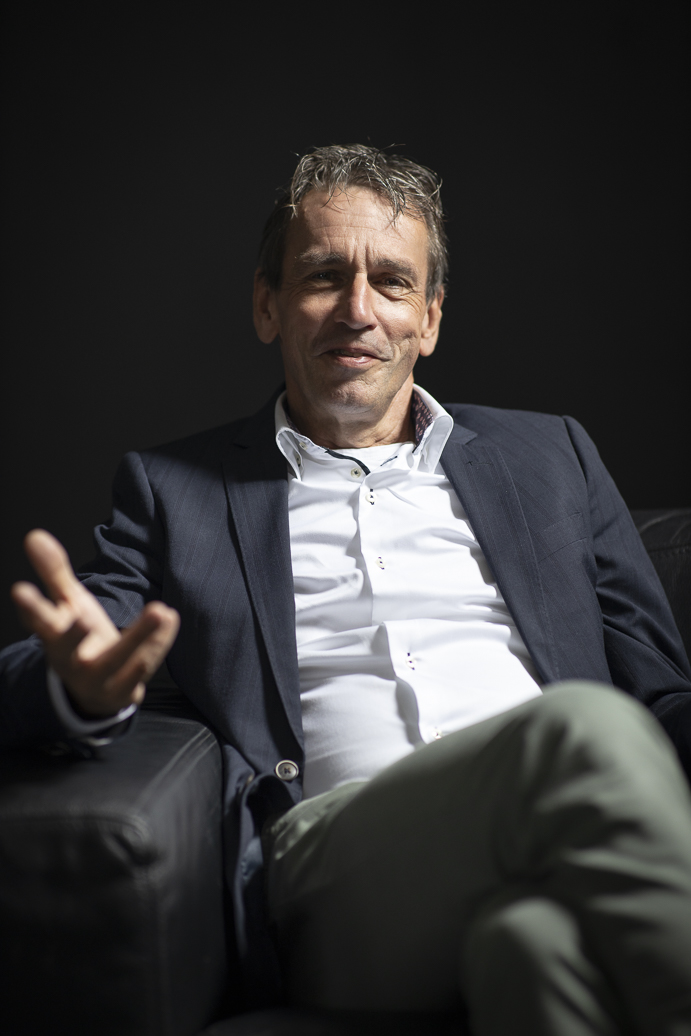 I’m genuinely interested in learning more about your motivation. To kick off this conversation, I am sharing my journey, and I am eager to hear your thoughts, comments, and suggestions.
Being aware this is again a long read, but I encourage you to read the article till the end.
Reading a 1500-word post was a 20th-century skill that helped people understand things with their nuances.
Let’s not lose this skill in the 21st century!
How it all started
 Rich McFall reached out to me in late 2019, seeking individuals who shared our vision of establishing a platform for discussion and collaboration on green PLM. He was drawn to my 2015 blog post, ‘PLM and Global Warming,’ which I wrote six months before the famous Paris Agreement.
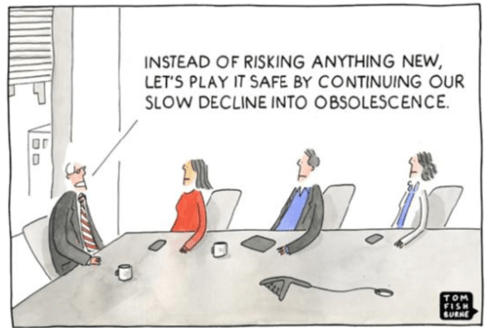
In my 2015 blog post, I drew a parallel between the slow response to digital transformation in the PLM domain and our collective inaction against climate change.
Despite the growing awareness of human-caused greenhouse gas emissions, there needed to be more urgency. This post was a call to action, not just for digital transformation in the PLM domain, but for our planet’s future. The cartoon below illustrates this mindset:
Both Rich and I felt that, when possible, we should use our energy and PLM-related skills to bring together a community of people who would take Climate Change and Sustainability seriously.
 Rich’s focus was primarily on Climate Change and Greenhouse Gas emissions. – a hot topic in the US, where my passion and interest were related to Sustainability and the Circular Economy – two overlapping topics with a different impact, both parts of the UN Sustainable Development Goals (SDG) as formulated and adopted by all United Nations Member States in 2015.
“Climate change creates fear and polarization, whereas the Circular Economy is more of a long-term concept, more complex to grasp, or implement, however crucial for the future of the planet.”
The start in 2020
 When we started in early 2020, a few people were interested in contributing to the alliance—their names are at the bottom of this post. After several internal Zoom meetings, we decided to focus on different Green areas.
The themes are available here: PLM Green Themes, i.e., Sustainability, the Circular Economy, Climate Change, Green Energy and Life Cycle Assessment.
 In the beginning, the alliance was a small group of enthusiastic people supported by approximately 100 members in our LinkedIn group. As an organization of volunteers, we struggled with allocating time and resources to get the needed attention. In 2020, climate change and Sustainability were still niche topics in the PLM domain, and our audience was still small.
Our interactive medium was the LinkedIn group, where comments and likes were easily shared. Our PLM Green Global Alliance website would be the place where we consolidate information—a challenging approach for us with limited skills and budget.
Starting the interviews in 2022
In 2022, we started interviewing PLM-related software vendors. Together with Klaus Brettschneider and, more recently, Mark Reisig, we were happy to discover what the major players in our PLM ecosystem were doing regarding Sustainability.
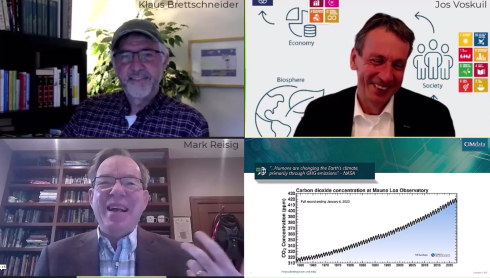
We spoke with SAP (Feb 2022 – Circular Economy), Autodesk (March 2020 – empowering engineers), Dassault Systemes (May 2022 – company targets & Virtual Twin), Sustaira (Sept 2022 – Connecting the dots – ESG reporting) and Aras (Oct 2022 – the need for a digital thread)
2023 – A year of transition
Besides the software vendors, consultancy firms started to address the need for more sustainable product development and understanding of what to do, and we spoke with CIMdata (April 2023 – the importance of sustainable business models) and Transition Technologies PSC (October 2023 – their GreenPLM offering on top of the PTC PLM suite)
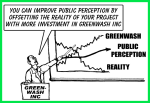 However, as a PLM Green Global Alliance, we discovered that more and more companies were considering moving away from greenwashing and toward implementing actual measures, some of them driven by upcoming regulations and country initiatives.
It was also a significant year for the PLM Green Global Alliance, as besides receiving increasingly encouraging messages, both CIMdata and CIMPA joined the alliance as moderators.
 CIMdata, well known for its PLM consultancy and market analysis, started an additional consultancy practice related to PLM and Sustainability.
Mark Reisig, their lead consultant, joined us on the themes of Sustainability and Energy, also given his previous work career in that field.
 CIMPA, a European PLM consultancy services company with roots in the aerospace industry, decided to support the alliance on the theme of the circular economy. Patrice Quencez and his team lead and moderate this activity.
Green in 2024 – what can we do?
Fear or Optimism? Fast and Slow!
 One of the negative characteristics of the human mind is that we only want to act if it is indispensable. The brain’s evolutionary characteristic is to use the maximum amount of energy when there is a dangerous situation that forces us to act.
There is enough proof for this theory, and it is the main reason why we continue bad habits. The best book to recommend is Thinking Fast and Slow by Daniel Kahneman.
Ask yourself:
- Should you study for the whole year or just before the exams?
- Would you start smoking knowing it is likely killing you in the long term?
- Would you save money for later, as then you might need it?
- Would you spend hours/days mastering a topic, or would you be an expert on social media with some easy facts and statistics?
- Would you act against climate change and overconsumption, knowing the reasons?
All the above questions illustrate that the majority of us (me too – there are no saints anymore) think fast, and media and marketing organizations know our weaknesses.
 The result: we only get attention when there is a message of fear
An explanation of why good news channels have no subscribers, whereas bad/fake news and polarising messages create an emotion to act.
In our PLM Green Alliance Group, Rich started with a monthly news digest related to Climate change. In the beginning, it felt like only bad news and the climate changes and disasters were showing us the urgency to handle. Read the last Climate Change Chronicles here.
Bad news and fear might paralyze people. You might think the topic is too big for me to handle; therefore, let’s do nothing. Do you remember the diagram below?
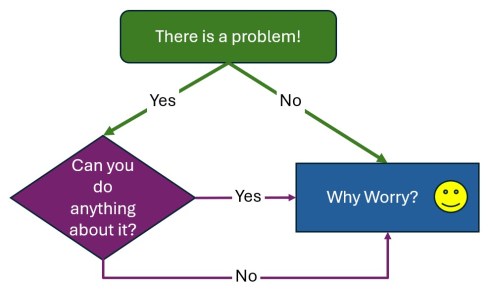
Fortunately, many people believe that something needs to be done.
 A recent UNDP survey shows that 80 percent of people globally want more decisive government climate action. Read the news here, and if you are interested in how your country compares to the rest of the world, check it here.
The good news is that the majority supports measures; the bad news is that the minority is the most vocal and influential by having the means and motives not to change the current status quo. And they have been organizing themselves for years.
Therefore, there is some optimism – we need to organize!
Looking back, particularly over the last 1½ years, there are reasons for optimism. Progress might not go as fast as desired, but if you are open to action and your newsfeed algorithm is also switched to positive, you will find encouraging messages.
For example, follow Assaad Razouk; his posts are often encouraging – not creating rage.
Read the monthly ESG Newsletters published by Vincent de la Mar from Sustaira and discover the positive trend. You can find his latest May newsletter here as an example: Sustainability & ESG Insights May ’24: Biden’s carbon market plans & how to get back on track to Paris Targets.
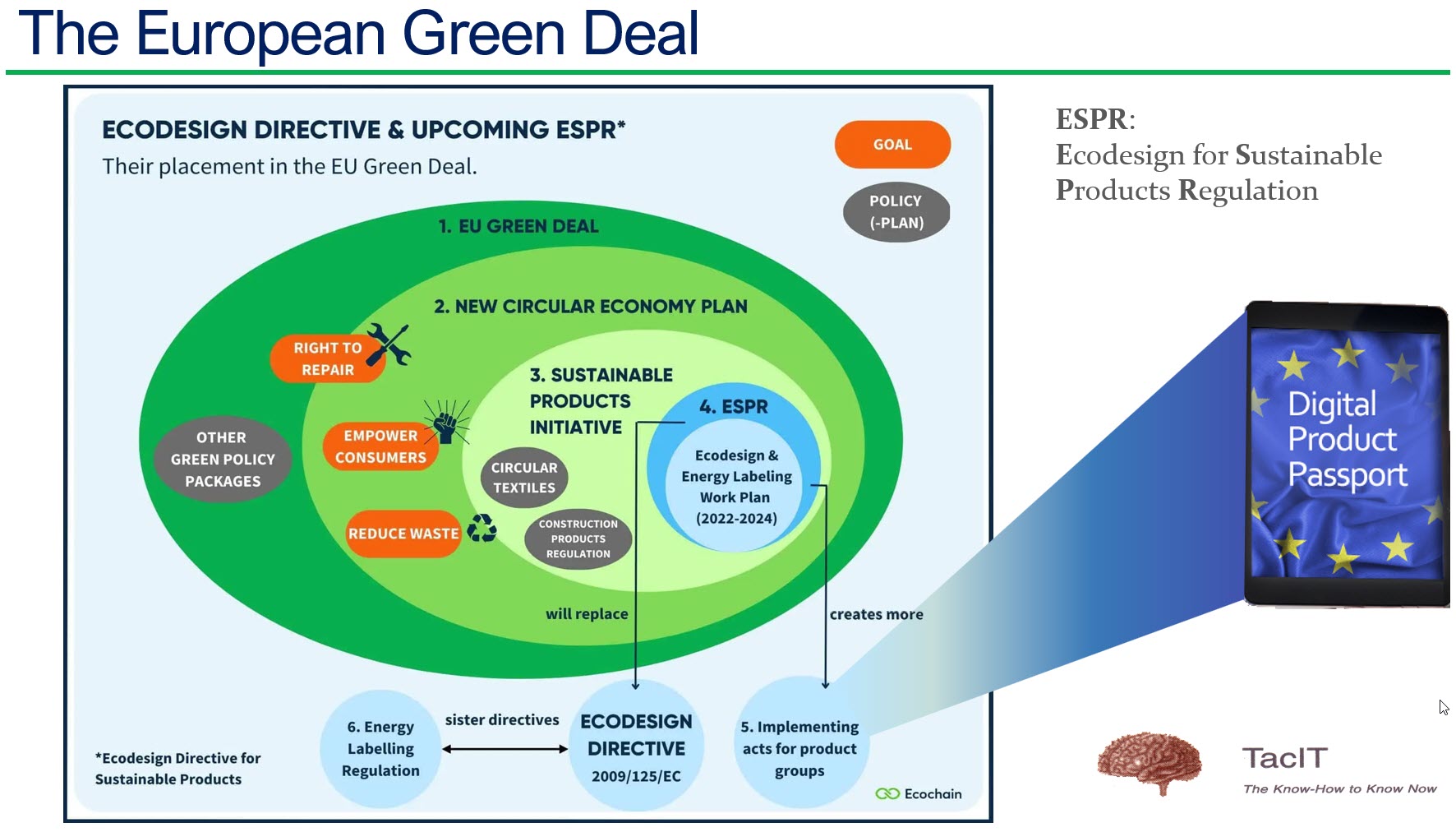
Following the progress within Europe – after the European Green Deal with all its aspects, recently, the Nature Restoration Law was signed, pushing companies to use more generative resources. The Nature Restoration Law and the European Green Deal are regulations pushing for a more circular economy as both the left side (regenerative) and right side (hardware) of the famous butterfly are addressed.
Conclusion
We are making progress, and I hope this post makes you realize that you need to worry about climate change and the Sustainability of our planet. My passion, and the passion of all the people listed below, is to support a movement and not to be silent.
Now, I am asking you to share your story. Which topics do we need to address first? Can you share examples or facts that illustrate—that with 1200 members, we should not be part of the silent majority but become a respected voice?
We’d like to express our exceptional gratitude to all those who supported us or are still supporting us at any stage of our PLM Green Global Alliance. Feel motivated to join this group of the non-silent majority.
In an alfabetical order: Xavier Adam, Zoe Bezpalko, Tom Boudeville, Klaus Brettschneider, Nina Dar, Stephane Declee, Dave Duncan, Stephan Fester, Bjorn Fidjeland, Ryan Flavelle, Matthias Fohrer, Roger L. Franz, Lionel Grealou, Jon den Hartog, Patrick Hilberg, Yousef Hooshmand, Hannes Lindfred, Ilan Madjar, Vincent de la Mar, James Norman, Rich McFall, Frank Popielas, Patrice Quencez, Mark Reisig, Audrey Reyniers, Erik Rieger, Ryan Rochelle, Mark Rushton, Neil D’Souza, Jonathan Thery, Oleg Shilovitsky, Florence Verzelen, Darren West ,Patrick Willemsen, Rafał Witkowski, Morgan Zimmermann.
Our recent interviews this year with aPriori and SAP were with companies that had less of a focus on the traditional product design process and more of a focus on the (circular) manufacturing process. In these interviews the importance of working with connected data was discussed in a shared (digital) thread.
This time, we, Mark Reisig and Jos Voskuil, were excited to talk with Siemens, not only a well-known PLM vendor but also a manufacturer of products and, therefore, having a close understanding of what is needed and can be achieved with their software solutions.
Siemens
 As Siemens is such a broad enterprise; we were happy to speak with Ryan R. Rochelle, who focuses on Sustainable Production, Sustainable Manufacturing and Sustainable Industry within Siemens . In the interview we discussed the importance of digital twins and the feedback loops between design and manufacturing. Despite some flaws in the network connection, we are happy to share an informative interview.
Enjoy listening and watching the next 33 minutes, talking with Ryan Rochelle.
You can download the images shown during the interview HERE
What I have learned
- Like all PLM vendors in this domain, Siemens talks about the importance of a circular economy and the need for digital threads and digital twins, confirming the need for all of us to invest in the digitization of the product lifecycle.

- Siemens is in a unique position as both the industrial user and software provider of its PLM suite, therefore having a unique feedback loop on the usability and applicability of its software in its industry.
- In the area of sustainability, they learn from both customers and internal customers. They are customer zero. Here, they observe shifting in engineering activities to the left” to optimize processes, supply chain and manufacturing earlier . (<<PGGA>>: which aligns with our aPriori and Makersite interviews).
- Siemens, SiGreen’s solution is an example of this unique position, being be able to track the carbon footprint of products across the supply chain.

Want to learn more
- There is the Siemens Sustainable industries website
- How the Digital Enterprise helps attain sustainability
- The Journey to a Sustainability Lighthouse awarded by the World Economic Forum
Conclusion
We have been discussing the relationship between PLM and sustainability with relevant software vendors for over two years now. As we saw initially in 2022, a few companies were exploring the possibilities.
Now, with further regulations and advanced software capabilities, companies are starting to implement new capabilities to make their product development process and products more sustainable. Siemens, as a software provider and an industrial user of its tools, is leading this journey—is it time for your company to step up, too?
Last week, I have been participating in the biannual NEM network meeting, this time hosted by Vestas in Ringkøbing (Denmark).
NEM (North European Modularization) is a network for industrial companies with a shared passion and drive for modular products and solutions.
NEM’s primary goal is to advance modular strategies by fostering collaboration, motivation, and mutual support among its diverse members.
 During this two-day conference, there were approximately 80 attendees from around 15 companies, all with a serious interest and experience in modularity. The conference reminded me of the CIMdata Roadmap/PDT conferences, where most of the time a core group of experts meet to share their experiences and struggles.
The discussions are so much different compared to a generic PLM or software vendor conference where you only hear (marketing) success stories.
Modularity
 When talking about modularity, many people will have Lego in mind, as with the Lego bricks, you can build all kinds of products without the need for special building blocks. In general, this is the concept of modularity.
With modularity, a company tries to reduce the amount of custom-made designs by dividing a product into modules with strict interfaces. Modularity aims to offer a wider variety of products to the customer – but configure these from a narrower assortment of modules to streamline manufacturing, sourcing and service. Modularity allows managing changes and new functionality within the modules without managing a new product.
 From ETO (Engineering To Order) to BTO (Build To Order) or even CTO (Configure to Order) is a statement often heard when companies are investing in a new PLM system. The idea is that with the CTO model, you reduce the engineering costs and risks for new orders.
With modularity, you can address more variants and options without investing in additional engineering efforts.
How the PLM system supports modularity is an often-heard question. How do you manage in the best way options and variants? The main issue here is that modularity is often considered an R&D effort – R&D must build the modular architecture. An R&D-only focus is a common mistake in the field similar to PLM. Both
 PLM and Modularity suffer from the framing that it is about R&D and their tools, whereas in reality, PLM and Modularity are strategies concerning all departments in an enterprise, from sales & marketing, engineering, and manufacturing to customer service.
PLM and Modularity
In 2021, I discussed the topic of Modularity with Björn Eriksson & Daniel Strandhammar, who had written during the COVID-19 pandemic their easy-to-read book: The Modular Way. In a blog post, PLM and Modularity, I discussed with Daniel the touchpoints with PLM. A little later, we had a Zoom discussion with Bjorn and Daniel, together with some of the readers of the book. You can find the info still here: The Modular Way – a follow-up discussion.
What was clear to me at that time is that, in particular, Sweden is a leading country when it comes to Modularity. Companies like Scania, Electrolux are known for their product modularity.
For me it was great to learn the Vestas modularization journey. For sure the Scandinavian region sets the tone. And in addition, there are LEGO and IKEA, also famous Scandinavian companies, but with other modularity concepts.
 The exciting part of the conference was that all the significant modularity players were present. Hosted by Vestas and with a keynote speech from Leif Östling, a former CEO of Scania, all the ingredients were there for an excellent conference.
The NEM network
The conference started with Christian Eskildsen, CEO of the NEM organization, who has a long history of leading modularity at Electrolux. The NEM is not only a facilitator for modularity. They also conduct training, certification sessions, and coaching on various levels, as shown below.

Christian mentioned that there are around 400 followers on the NEM LinkedIn group. I can recommend this LinkedIn group as the group shares their activities here.
At this moment, you can find here the results of Workstream 7 – The Cost of Complexity.
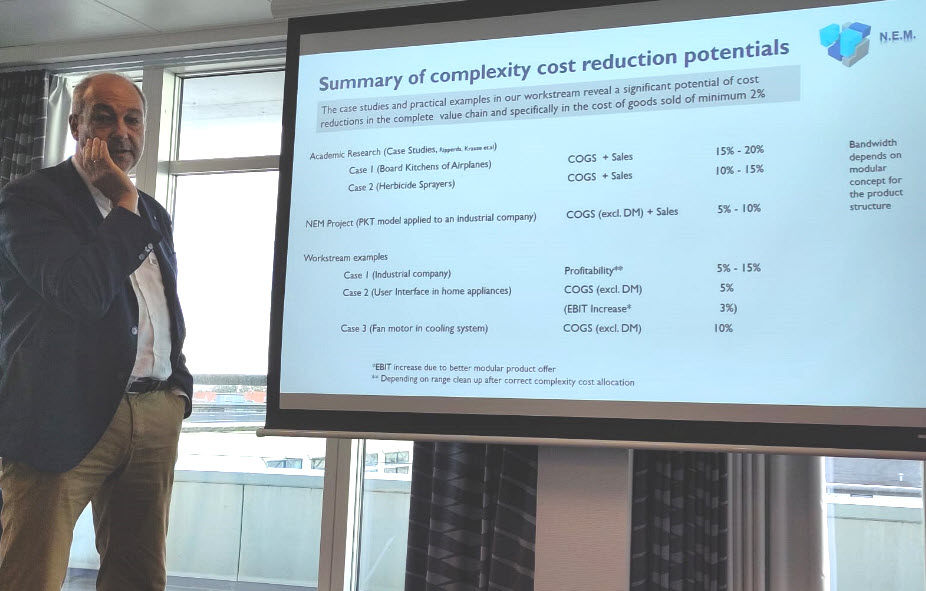
Peter Greiner, NEM member, presented the details of this result during the conference on day 2. The conclusion of the workstream team was a preliminary estimate suggesting a minimum cost reduction of 2-5% in terms of the Cost Of Goods Sold (COGS) on top of traditional modularization savings. These estimates are based on real-world cases.
Understanding that the benefits are related to the COGS with a high contribution of the actual material costs, a 2 – 5 % range is significant. There is the intention to dig deeper into this topic.
 Besides these workstreams, there are also other workstreams running or finished. The ones that interest me in the sustainability context are Workstream 1 Modular & Circular and Workstream 10 Modular PLM (Digital Thread).
The NEM network has an active group of members, making it an exciting network to follow and contribute as modularity is part of a sustainable future. More on this statement later.
Vestas
 The main part of day one was organized by our host, Vestas. Jens Demtröder, Chief Engineer at Vestas for the Modular Turbine Architecture and NEM board member, first introduced the business scope, complexity, and later the future challenges that Vestas is dealing with.
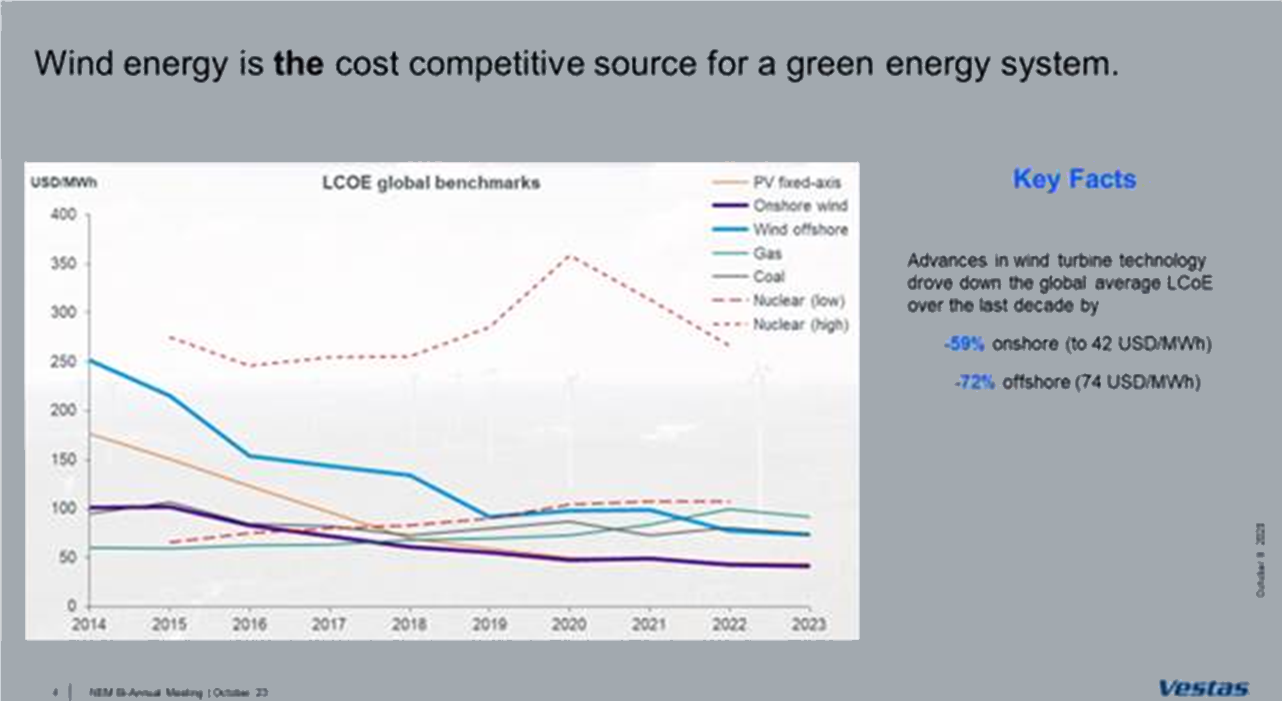
First, wind energy is the best cost-competitive source for a green energy system, as the image shows when taking the full environmental impact into the equation. As the image below shows
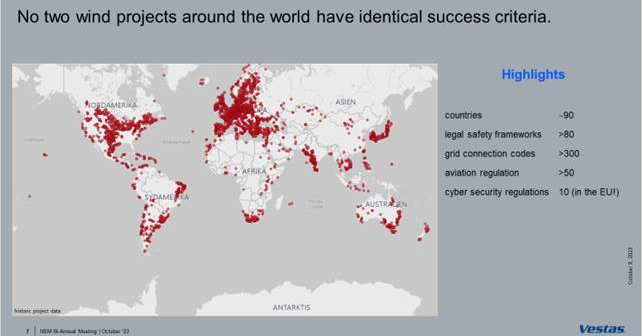
From the outside, wind turbines all look the same; perhaps a difference between on-shore and off-shore? No way! There is a substantial evolution in the size and control of the wind turbine, and even more importantly, as the image shows, each country has its own regulations to certify a wind turbine. Vestas has to comply with 80+ different local regulations, and for that reason, modularity is vital to manage all the different demands efficiently.
A big challenge for the future will be the transport and installation of wind turbines.
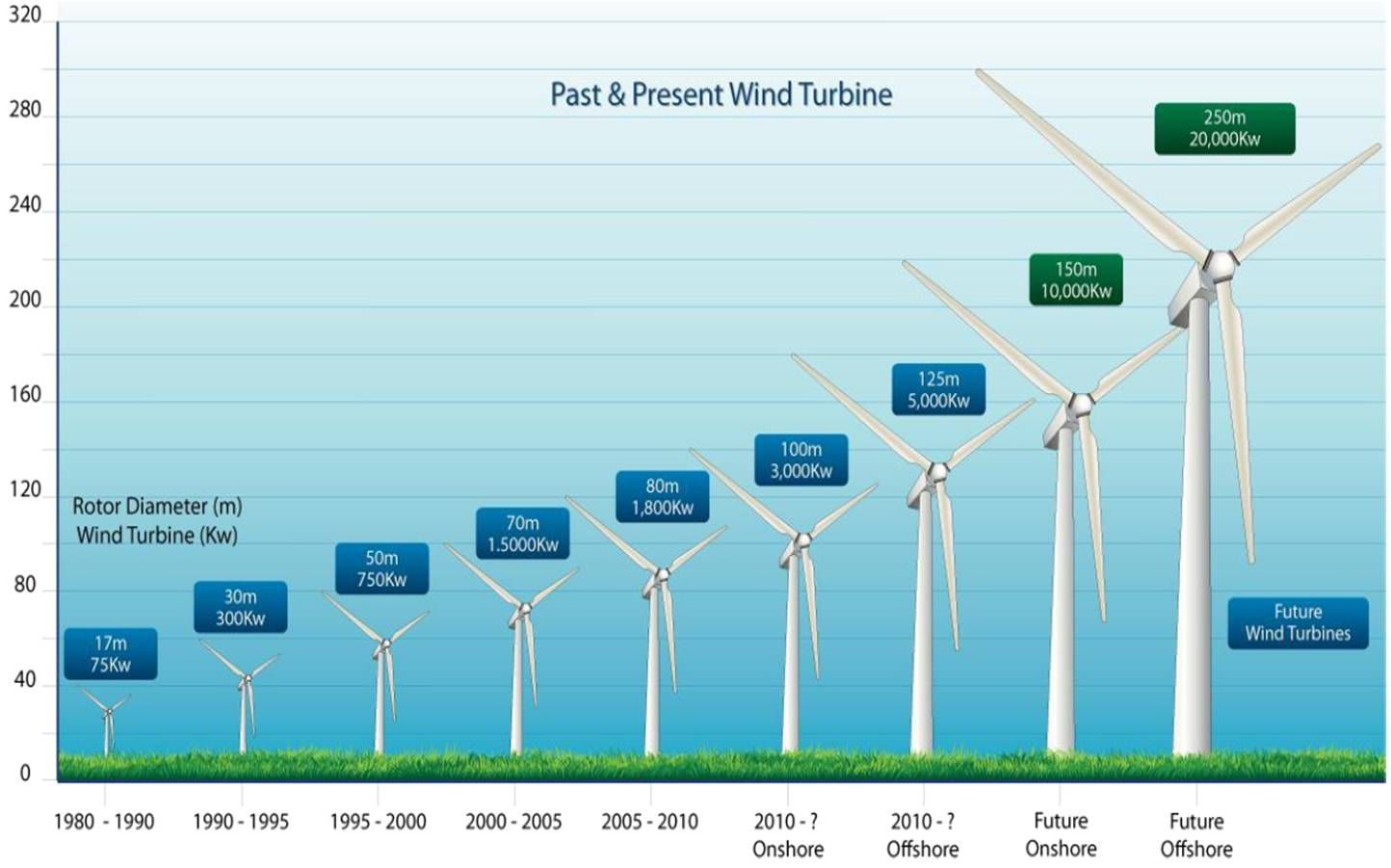 The components become so big that they need to be assembled on-site, requiring new constraints on the structure to be solved.
As the image to the left, rotor sizes up to 250 m are expected and what about the transport of the nacelle itself?
Click on this link to get an impression.
The audience also participated in a (windy) walk through the manufacturing site to get an impression of the processes & components – an impression below.
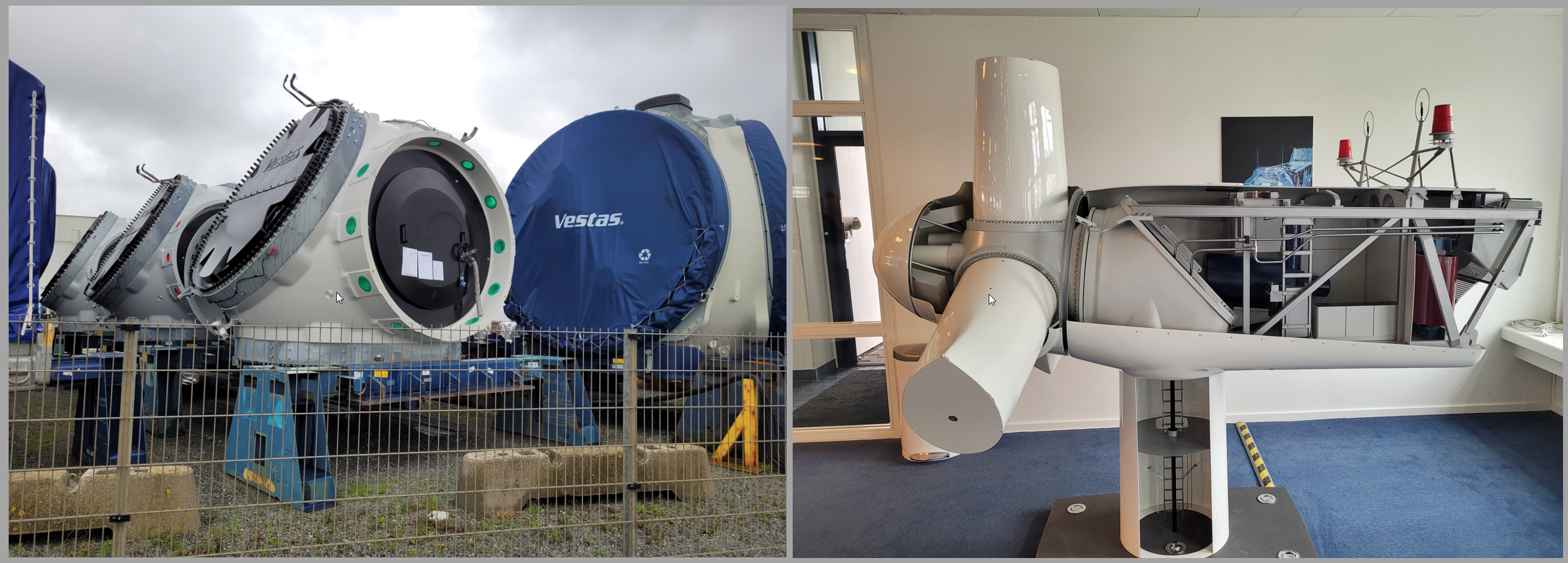
Processes, organization and governance
Karl Axel Petursson, Senior Specialist in Architecture and Roadmap, gave insights into the processes, organization and governance needed for the modularity approach at Vestas.
The modularization efforts are always a balance between strategy and execution, where often execution wins. The focus on execution is a claim that I recognize when discussing modularity with the companies I am coaching.
Vestas also created an organization related to the functions it provides, being a follower of Conway’s law, as the image below shows:
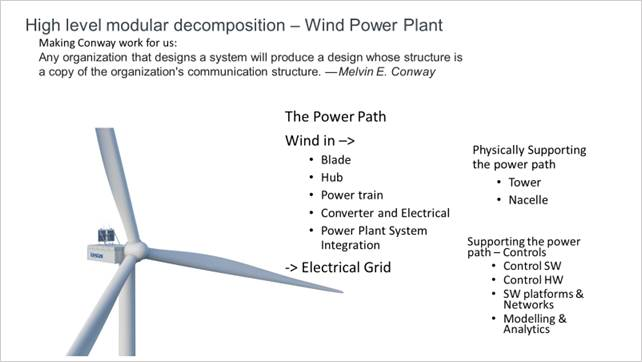
With modularity, you will also realize that the modular architecture must rely on stable interfaces between the modules based on clear market needs.
Besides an organizational structure, often more and more a matrix organization, there are also additional roles to set up and maintain a modular approach. As the image below indicates, to integrate all the functions, there are various roles in Vestas, some specialized and some more holistic:

These roles are crucial when implementing and maintaining modularity in your organization. It is not just the job of a clever R&D team.
Just a clever R&D is a misconception I have often discovered in the field. Buying one or more tools that support modularity and then let brilliant engineers do the work. And this is a challenge. Engineers often do not like to be constrained by modular constraints when designing a new capability or feature.
For this reason Vestas has established an Organization Change Management initiative called Modular Minds to make engineers flourish in the organization.
Modular Minds
Madhuri Srinivasan Systems Engineering specialist and Hanh Le Business Transformation leader both at Vestas, presented their approach to the 2020 must-win battle for Modularisation, aiming with various means, like blogs, podcasts, etc., to educate the organization and create Modular Minds for all Vestas employees.

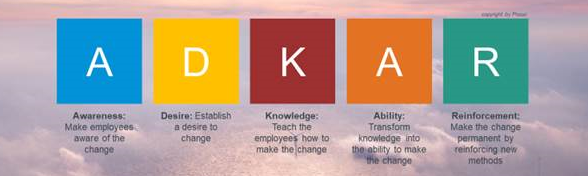 The team is applying the ADKAR model from Prosci to support this change. As you can see from the (clickable) image to the left, ADKAR is the abbreviation of Awareness, Desire, Knowledge, Ability and Reinforcement.
The ADKAR model focuses on driving change at the individual level and achieving organizational results. It is great to see such an approach applied to Modularity, and it would also be valuable in the domain of PLM, as I discussed with Share PLM in my network.
Scania
 The 1 ½ hour keynote speech from Leif Östling supported by Karl-Johan Linghede was more of an interactive discussion with the audience than a speech. Leif took us to the origins of Scania, their collaboration in the beginning with learning the Toyota Way. – customer first, respect for people and focus on quality. And initial research and development together with Modular Management resulting in the MFD-methodology.
It led to the understanding that:
- The #1 cost driver is the amount of parts you need to manage,
- The #2 crucial point is to have standardized interfaces and keep the flexibility inside the module
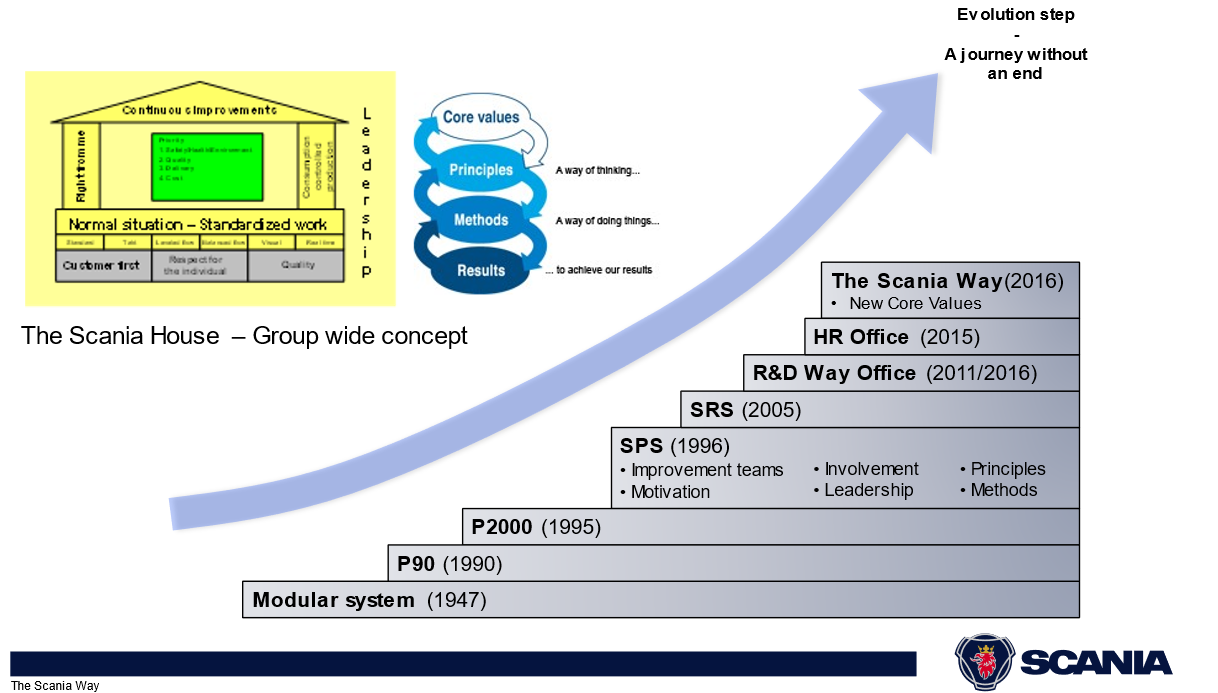
The Scania way
With Ericsson, Scania yearly on partnered to work on the connected vehicle. If you are my age, you will remember connectivity at that time was not easy. The connected vehicle was the first step of what we now would call a digital twin
An interesting topic discussed was that Scania has approximately 25 interfaces at Change Level 1. This is a C-level/Executive discussion to approve potential interface changes. This level shows the commitment of the organization to keep modularity operational.
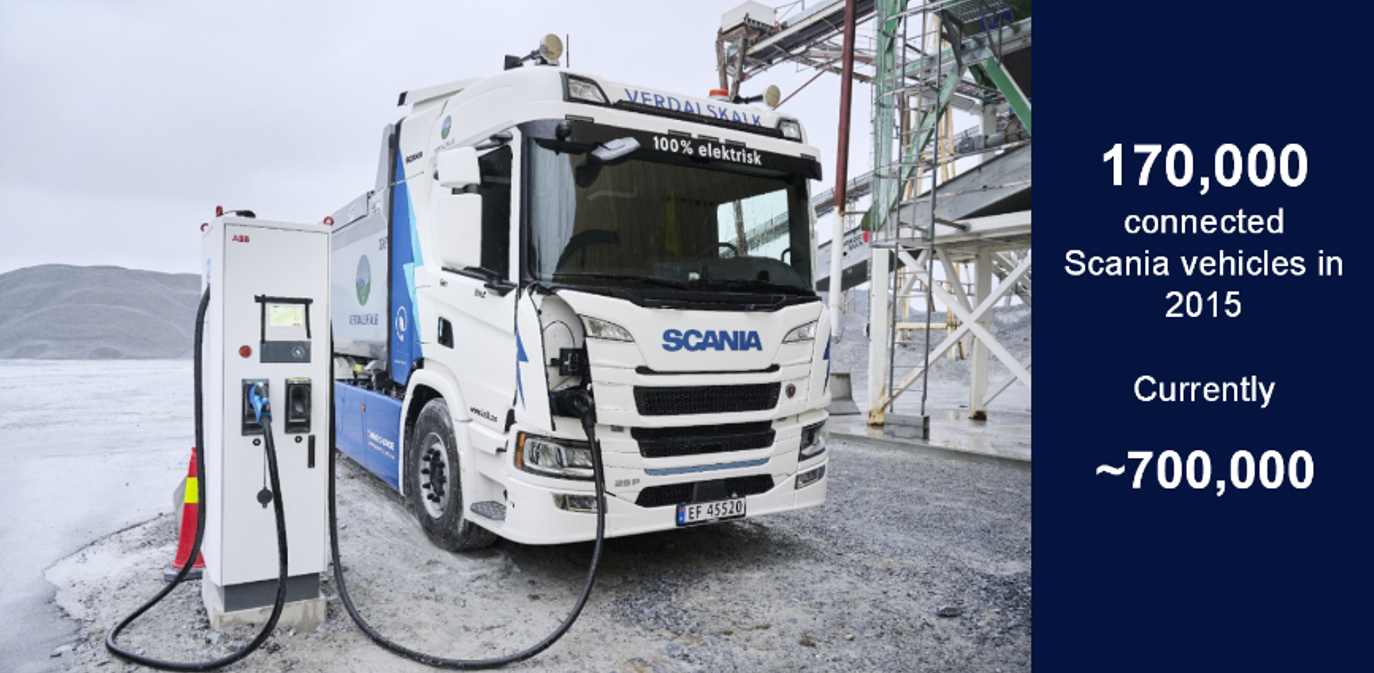 Another benefit mentioned was that the move to electrification of the vehicle was not such a significant change as in many automotive companies. Thanks to the modular structure and the well-defined interfaces, creating an electric truck was not a complete change of the truck design.
The session with Leif and Karl-Johan could have easily taken longer, giving the interesting question-and-answer dialogue with the curious audience. It was a great learning moment.
Digitization, Sustainability & Modularization
As a PLM person from the PLM Green Global Alliance, I was allowed to give a speech about the winning combination of Digitization, Sustainability and Modularization. You might have seen my PLM and Sustainability blog post recently; now, a zoom-in on the circular economy and modularity is included.
In this conference, I also focused on Modularity, when implemented based on model-based and data-driven approaches, which is a crucial component of the circular economy (image below) and the lifecycle analysis per module when defined as model-based (Digital Twin).
My entire presentation on SlideShare: Digitization, Sustainability & Modularization.
Conclusion
It was the first time I attended a conference focused on modularity purely, and I realized we are all fighting the same battle. Like the fact that PLM is a strategy and not an engineering system, modularity faces the same challenge. It is a strategy and not an R&D mission. It would be great to see modularity becoming a part of PLM conferences or Circular Economy events as there is so much to learn from each other – and we need them all.

Are you interested in the future of PLM and the meaning of Digital Threads.?
Click on the image to see the agenda and join us for 2 days of discussion & learning.
 During May and June, I wrote a guest chapter for the next edition of John Stark’s book Product Lifecycle Management (Volume 2): The Devil is in the Details.
The book is considered a standard in the academic world when studying aspects of PLM.
Looking into the table of contents through the above link, it shows that understanding PLM in its full scope is broad. I wrote about it recently: PLM is Complex (and we have to accept it?), and Roger Tempest and others are still fighting to get the job as PLM Professional recognized Associate Yourself With Professional PLM.
To make the scope broader, John invited me to write a chapter about PLM and Sustainability, which is an actual topic in many organizations. As sustainability is my dedicated topic in the PLM Global Green Alliance (PGGA) core team, I was happy to accept this challenge.
This activity is challenging because writing a chapter on a current topic might make it outdated soon. For the same reason, I never wanted to write a PLM book as I wrote in my 2014 post: Did you notice PLM is changing?
 The book, with the additional chapter, will be available later this year. I want to share with you in this post the topics I addressed in this chapter. Perhaps relevant for your organization or personal interests. Also, I am looking forward to learning if I missed any topics.
Introduction
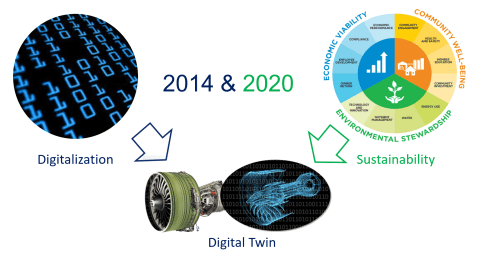
The chapter starts with defining the context. PLM is considered a strategy supported by a connected IT infrastructure, and for the definition of sustainability, I refer to the relevant SDGs as described on our PGGA theme page: PLM and Sustainability
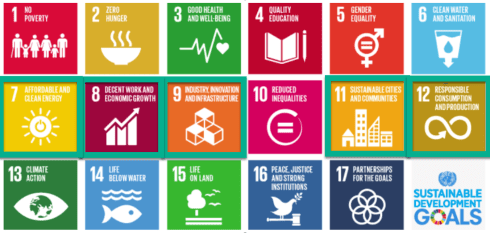
Next, I discuss two major concepts indissoluble connected with sustainability.
The Circular Economy
On a planet with limited resources and still a growing consumption of raw materials, we need to follow the concepts of the circular economy in our businesses and lives. The circular economy section addresses mainly the hardware side of the butterfly as, here, PLM practices have the most significant impact.
The circular economy requires collaboration among various stakeholders, including businesses, governments and consumers. It involves rethinking production processes and establishing new consumption patterns. Policies and regulations will push for circular economy patterns, as seen in the following paragraphs.
Systems Thinking
A significant change in bringing products to the market will be the need to change how we look at our development processes. Historically, many of these processes were linear and only focused on time to market, cost and quality. Now, we have to look into other dimensions, like environmental impact, usage and impact on the planet. As I wrote in the past Systems Thinking – a must-have skill in the 21st century?
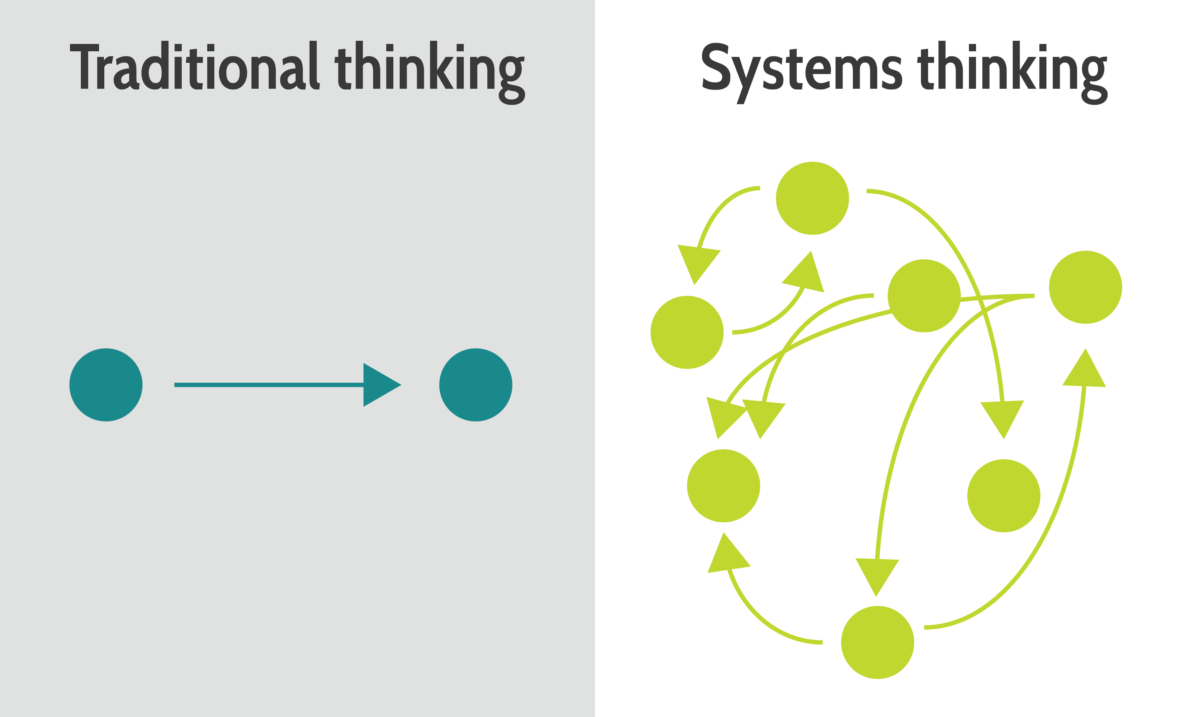
Systems Thinking is a cognitive approach that emphasizes understanding complex problems by considering interconnections, feedback loops, and emergent properties. It provides a holistic perspective and explores multiple viewpoints.
Systems Thinking guides problem-solving and decision-making and requires you to treat a solution with a mindset of a system interacting with other systems.
Regulations
More sustainable products and services will be driven primarily by existing and upcoming regulations. In this section, I refer to the success of the CFC (ChloroFluorCarbon) emission reduction, leading to slowly fixing the hole in the Ozon layer. Current regulations like WEEE, RoHS and REACH are already relevant for many companies, and compliance with these regulations is a good exercise for more stringent regulations related to Carbon emissions and upcoming related to the Digital Product Passport.
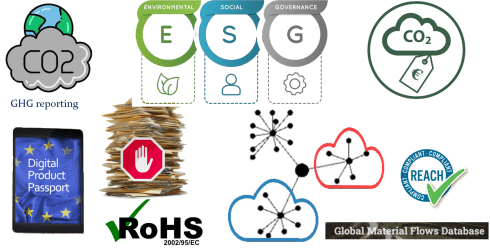
Making regulatory compliance a part of the concept phase ensures no late changes are needed to become compliant, saving time and costs. In addition, making regulatory compliance as much as possible with a data-driven approach reduces the overhead required to prove regulatory compliance. Both topics are part of a PLM strategy.
 In this context, see Lionel Grealou’s article 5 Brand Value Benefits at the Intersection of Sustainability and Product Compliance. The article has also been shared in our PGGA LinkedIn group.
Business
On the business side, the Greenhouse Gas Protocol is explained. How companies will have to report their Scope 1 and Scope 2 emissions and, ultimately, Scope 3 – see the image below for the details.
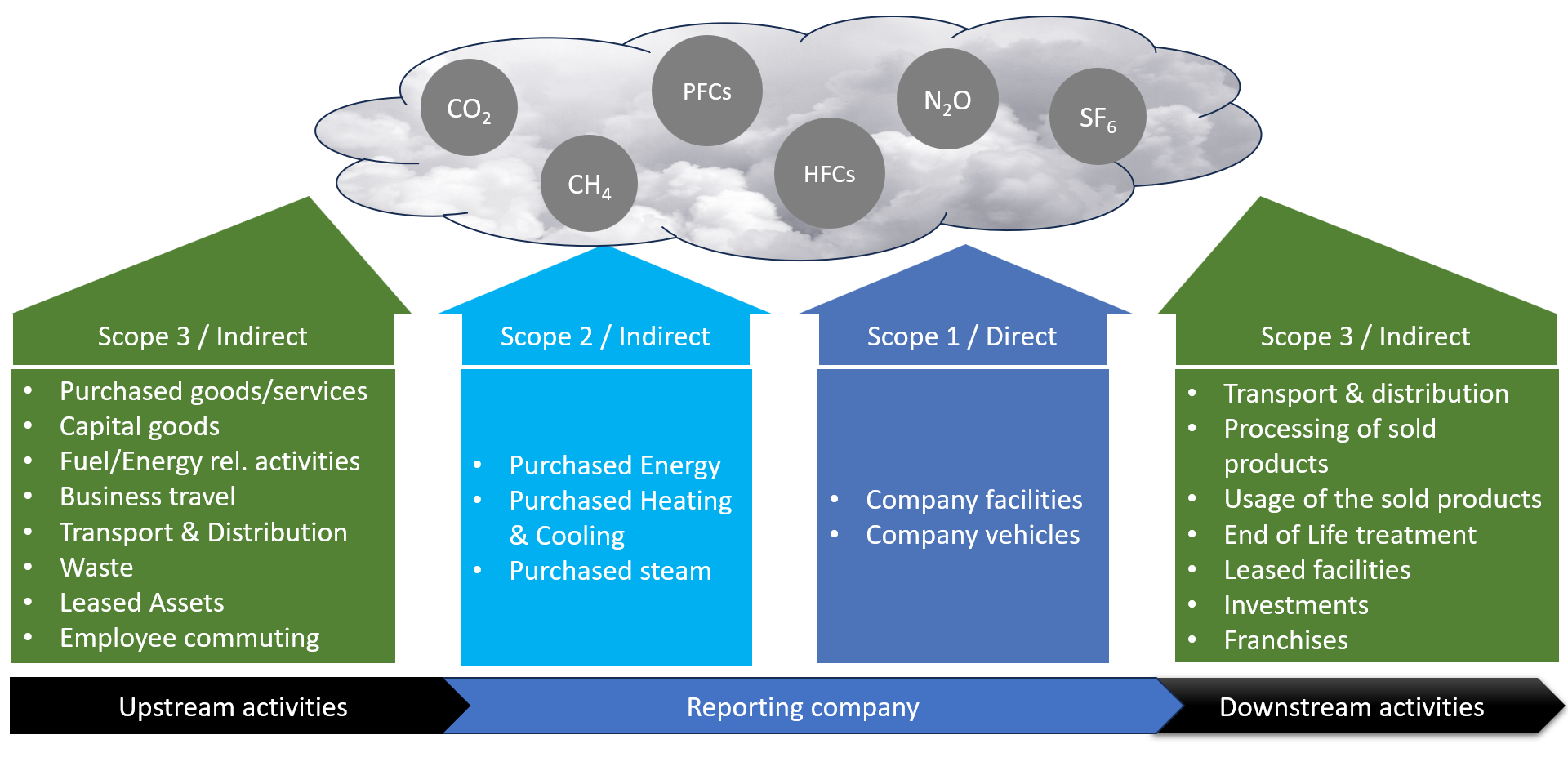
GHG reporting will support companies, investors and consumers to decide where to prioritize and put their money.
Ultimately, companies have to be profitable to survive in their business. The ESG framework is relevant in this context as it will allow investors to put their money not only based on short-term gains (as expected) but also on Environmental or Social parameters. There are a lot of discussions related to the ESG framework, as you might have read in Vincent de la Mar’s monthly newsletter, Sustainability & ESG Insights, which is also published in our PGGA group – a link below..

Besides ESG guidelines, there is also the drive by governments and consumers to push for a Product as a Service economy. Instead of owning products, consumers would pay for the usage of these products.
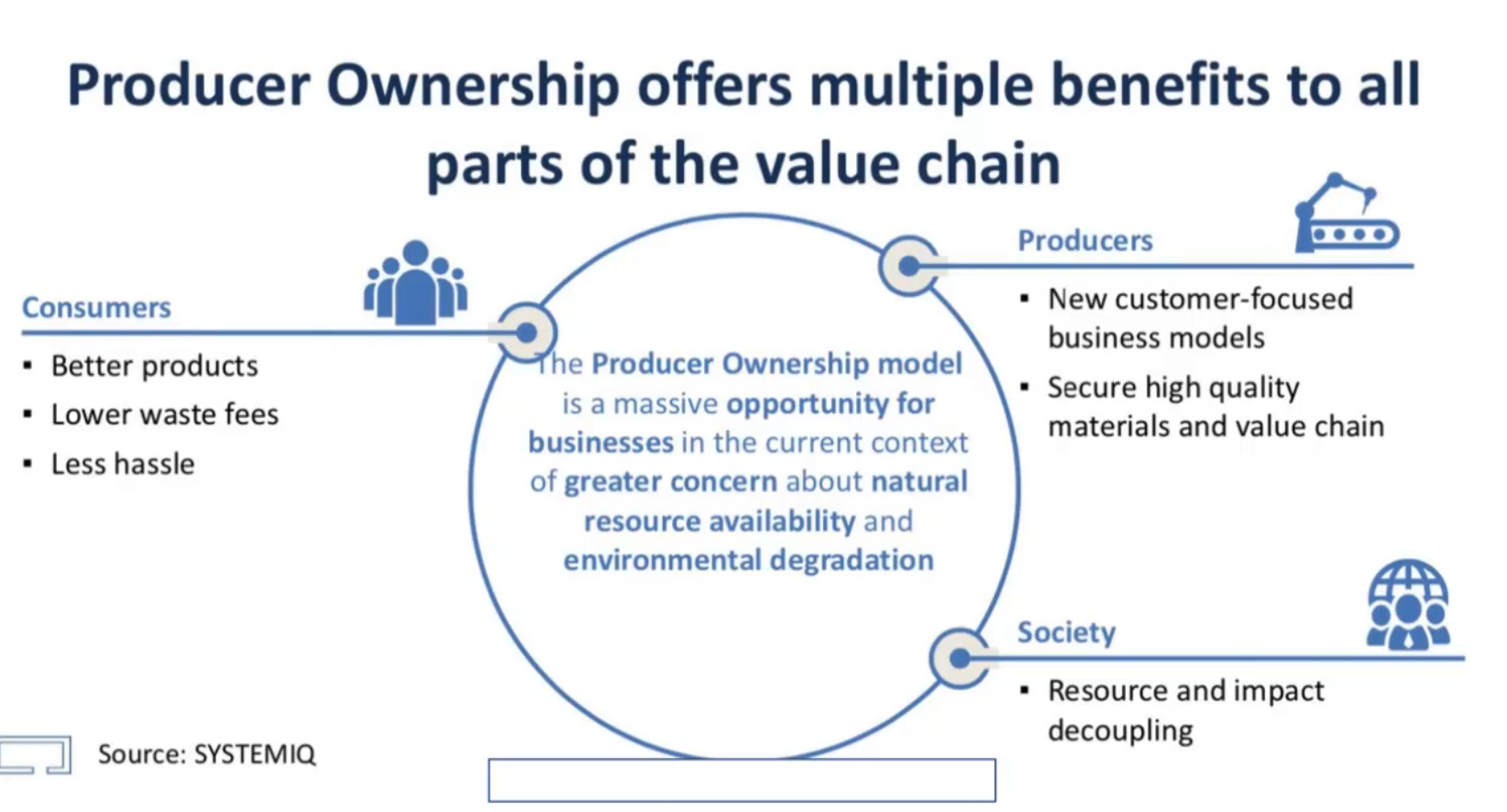
The concept is not new when considering lease cars, EV scooters, or streaming services like Spotify and Netflix. In the CIMdata PLM Roadmap/PDT Fall 2021 conference, we heard Kenn Webster explaining: In the future, you will own nothing & you will be happy.
Changing the business to a Product as a Service is not something done overnight. It requires repairable, upgradeable products. And business related, it requires a connected ecosystem of all stakeholders – the manufacturer, the finance company, and the operating entities.
Digital Transformation
All the subjects discussed before require real-time reporting and analysis combined with data access to compliance-related databases. More in the section related to Life Cycle Assessment. As I discussed last year in several conferences, a sustainability initiative starts with data-driven and model-based approaches during the concept phase, but when manufacturing and operating (connected) products in the field. You can read the entire story here: Sustainability and Data-Driven PLM – the Perfect Storm.
Life Cycle Analysis
Special attention is given in this chapter to Life Cycle Analysis, which seems to be a popular topic among PLM vendors. Here, they can provide tools to make a lifecycle assessment, and you can read an impression of these tools in a guest blog from Roger L. Franz titled PLM Tools to Design for Sustainability – PLM Green Global Alliance.
However, Lifecycle Analysis is not as simple. Looking at the ISO 14040 framework, which describes – having the right goals and scope in mind, allows you to do an LCA where the Product Category Rules (PCS) will enable companies to compare their products with others.
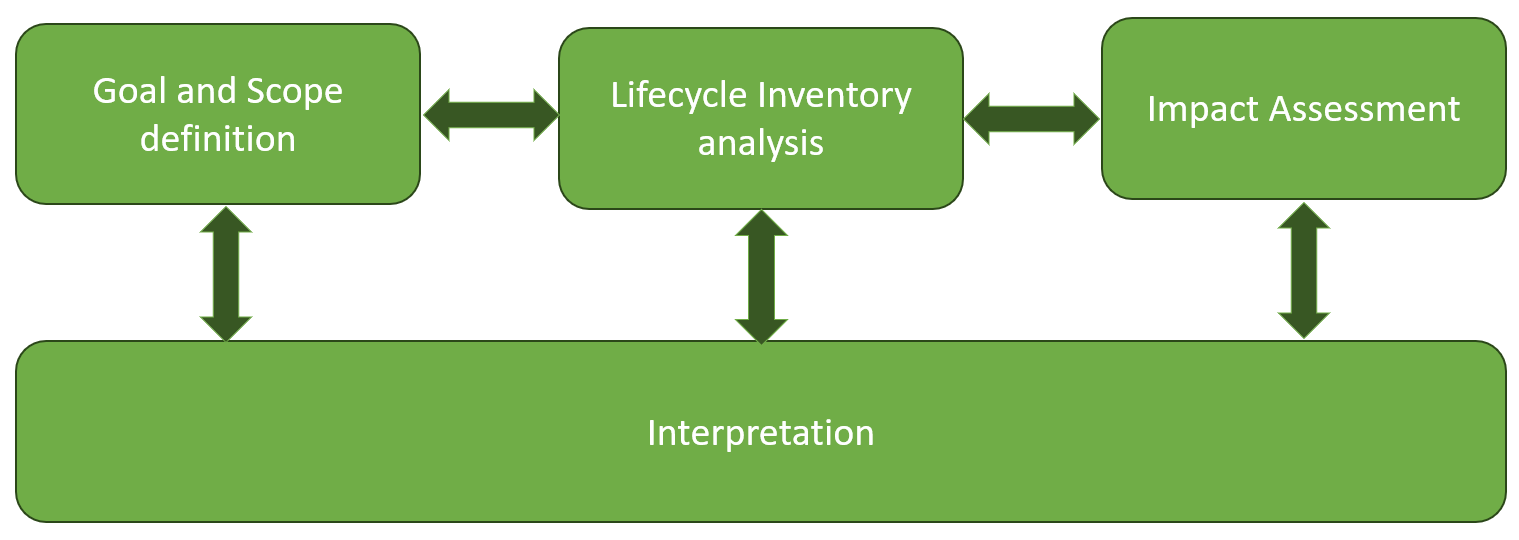
PCRs include the description of the product category, the goal of the LCA, functional units, system boundaries, cut-off criteria, allocation rules, impact categories, information on the use phase, units, calculation procedures, requirements for data quality, and other information on the lifecycle Inventory Phase.
So be aware there is more to do than installing a tool.
Digital Twin
 This section describes the importance of implementing a digital twin for the design phase, allowing companies to develop, test and analyze their products and services first virtually. Trade-off studies on virtual products are much cheaper, and when they are done in a data-driven, model-based environment, it will be the most efficient environment. In my terminology, setting up such a collaboration environment might be considered a System of Engagement.
The second crucial digital twin mentioned is the digital twin from a product in operation where performance can be monitored and usage can be optimized for a minimal environmental impact. Suppose a company is able to create a feedback loop between its products in the field and its product innovation platform. In that case, it can benchmark its design models and update the product behavior for better performance.
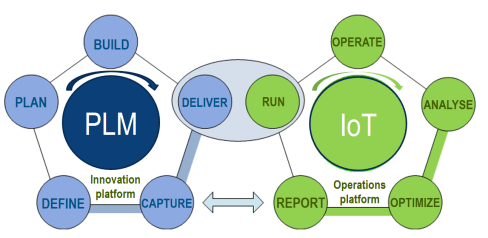
The manufacturing digital twin is also discussed in the context of environmental impact, as choosing the right processes and resources can significantly affect scope 3 emissions.
The chapter finishes with the story of a fictive company, WePack, where we can follow the impact and implementations of the topics described in this chapter.
Conclusion
As I described in the introduction, the topic of PLM and Sustainability is relatively new and constantly evolving. What do you think? Did I miss any dimensions?
Feel free to contribute to our PLM Global Green Alliance LinkedIn group.
Looking forward to meet you here
 Yes, it is not a typo. Clayton Christensen famous book written in 1995 discussed the Innovator’s Dilemma when new technologies cause great firms to fail. This was the challenge two decades ago. Existing prominent companies could become obsolete quickly as they were bypassed by new technologies.
The examples are well known. To mention a few: DEC (Digital Equipment Corporation), Kodak, and Nokia.
Why the innovation dilemma?
This decade the challenge has become different. All companies are forced to become more sustainable in the next ten years. Either pushed by global regulations or because of their customer demands. The challenge is this time different. Besides the priority of reducing greenhouse gas emissions, there is also the need to transform our society from a linear, continuous growth economy into a circular doughnut economy.
The circular economy makes the creation, the usage and the reuse of our products more complex as the challenge is to reduce the need for raw materials and avoid landfills.
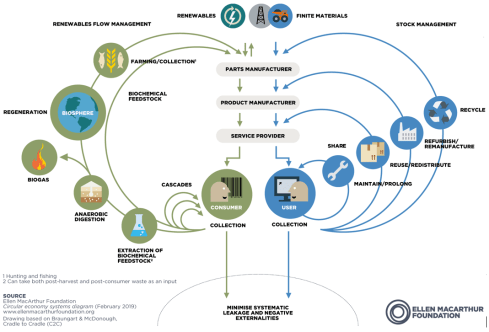
The circular economy concept – the regular product lifecycle in the middle
The doughnut economy makes the values of an economy more complex as it is not only about money and growth, human and environmental factors should also be considered.
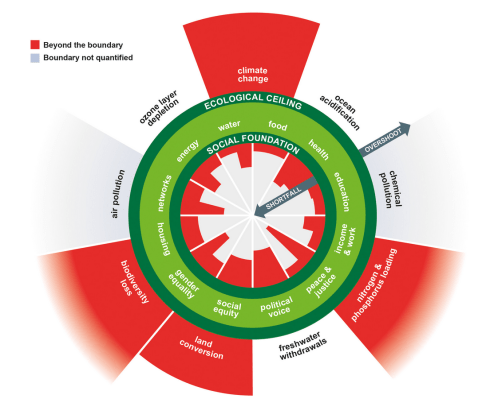
Doughnut Economics: Trying to stay within the green boundaries
To manage this complexity, I wrote SYSTEMS THINKING – a must-have skill in the 21st century, focusing on the logical part of the brain. In my follow-up post, Systems Thinking: a second thought, I looked at the human challenge. Our brain is not rational and wants to think fast to solve direct threats. Therefore, we have to overcome our old brains to make progress.
An interesting and thought-provoking was shared by Nina Dar in this discussion, sharing the video below. The 17 Sustainability Development Goals (SDGs) describe what needs to be done. However, we also need the Inner Development Goals (IDGs) and the human side to connect. Watch the movie:
Our society needs to change and innovate; however, we cannot. The Innovation Dilemma.The future is data-driven and digital.
What is clear to me is that companies developing products and services have only one way to move forward: becoming data-driven and digital.
Why data-driven and digital?
 Let’s look at something companies might already practice, REACH (Registration, Evaluation, Authorization and Restriction of Chemicals). This European directive, introduced in 2007, had the aim to protect human health and protect the environment by communicating information on chemicals up and down the supply chain. This would ensure that manufacturers, importers, and their customers are aware of information relating to the health and safety of the products supplied.
 The regulation is currently still suffering in execution as most of the reporting and evaluation of chemicals is done manually. Suppliers report their chemicals in documents, and companies report the total of chemicals in their summary reports. Then, finally, authorities have to go through these reports.
Where the scale of REACH is limited, the manual effort to have end-to-end reporting is relatively high. In addition, skilled workers are needed to do the job because reporting is done in a document-based manner.
Life Cycle Assessments (LCA)
Where you might think REACH is relatively simple, the real new challenges for companies are the need to perform Life Cycle Assessments for their products. In a Life Cycle Assessment. The Wiki definition of LCA says:
Life cycle assessment or LCA (also known as life cycle analysis) is a methodology for assessing environmental impacts associated with all the stages of the life cycle of a commercial product, process, or service. For instance, in the case of a manufactured product, environmental impacts are assessed from raw material extraction and processing (cradle), through the product’s manufacture, distribution and use, to the recycling or final disposal of the materials composing it (grave)

This will be a shift in the way companies need to define products. Much more thinking and analysis are required in the early design phases. Before committing to a physical solution, engineers and manufacturing engineers need to simulate and calculate the impact of their design decisions in the virtual world.
 This is where the digital twin of the design and the digital twin of the manufacturing process becomes relevant. And remember: Digital Twins do not run on documents – you need connected data and various types of models to calculate and estimate the environmental impact.
LCA done in a document-based manner will make your company too slow and expensive.
I described this needed transformation in my series from last year: The road to model-based and connected PLM – nine posts exploring the technology and concept of a model-based, data-driven PLM infrastructure.

Digital Product Passport (DPP)
 The European Commission has published an action plan for the circular economy, one of the most important building blocks of the European Green Deal. One of the defined measures is the gradual introduction of a Digital Product Passport (DPP). As the quality of an LCA depends on the quality and trustworthy information about products and materials, the DPP is targeting to ensure circular economy metrics become reliable.
This will be a long journey. If you want to catch a glimpse of the complexity, read this Medium article: The digital product passport and its technical implementation related to the DPP for batteries.
The innovation dilemma
Suppose you agree with my conclusion that companies need to change their current product or service development into a data-driven and model-based manner. In that case, the question will come up: where to start?
 Becoming data-driven and model-based, of course, is not the business driver. However, this change is needed to be able to perform Life Cycle Assessments and comply with current and future regulations by remaining competitive.
A document-driven approach is a dead-end.
Now let’s look at the real dilemmas by comparing a startup (clean sheet / no legacy) and an existing enterprise (experience with the past/legacy). Is there a winning approach?
The Startup
 Having lived in Israel – the nation where almost everyone is a startup – and working with startups afterward in the past 10 years, I always get inspired by these people’s energy in startup companies. They have a unique value proposition most of the time, and they want to be visible on the market as soon as possible.
This approach is the opposite of systems thinking. It is often a very linear process to deliver this value proposition without exploring the side effects of such an approach.
 For example, the new “green” transportation hype. Many cities now have been flooded with “green” scooters and electric bikes to promote transportation as a service. The idea behind this concept is that citizens do not require to own polluting motorbikes or cars anymore, and transportation means will be shared. Therefore, the city will be cleaner and greener.
However, these “green” vehicles are often designed in the traditional linear way. Is there a repair plan or a plan to recycle the batteries? Reuse of materials used.? Most of the time, not. Please, if you have examples contradicting my observations, let me know. I like to hear good news.
When startup companies start to scale, they need experts to help them grow the company. Often these experts are seasoned people, perhaps close to retirement. They will share their experience and what they know best from the past: traditional linear thinking.
As a result, even though startup companies can start with a clean sheet, their focus on delivering the product or service blocks further thinking. Instead, the seasoned experts will drive the company towards ways of working they know from the past.
 Out of curiosity: Do you know or work in a startup that has started with a data-driven and model-based vision from scratch? Please add the name of this company in the comments, and let’s learn how they did it.
The Existing company
Working in an established company is like being on board a big tanker. Changing its direction takes a clear eye on the target and navigation skills to come there. Unfortunately, most of the time, these changes take years as it is impossible to switch the PLM infrastructure and the people skills within a short time.
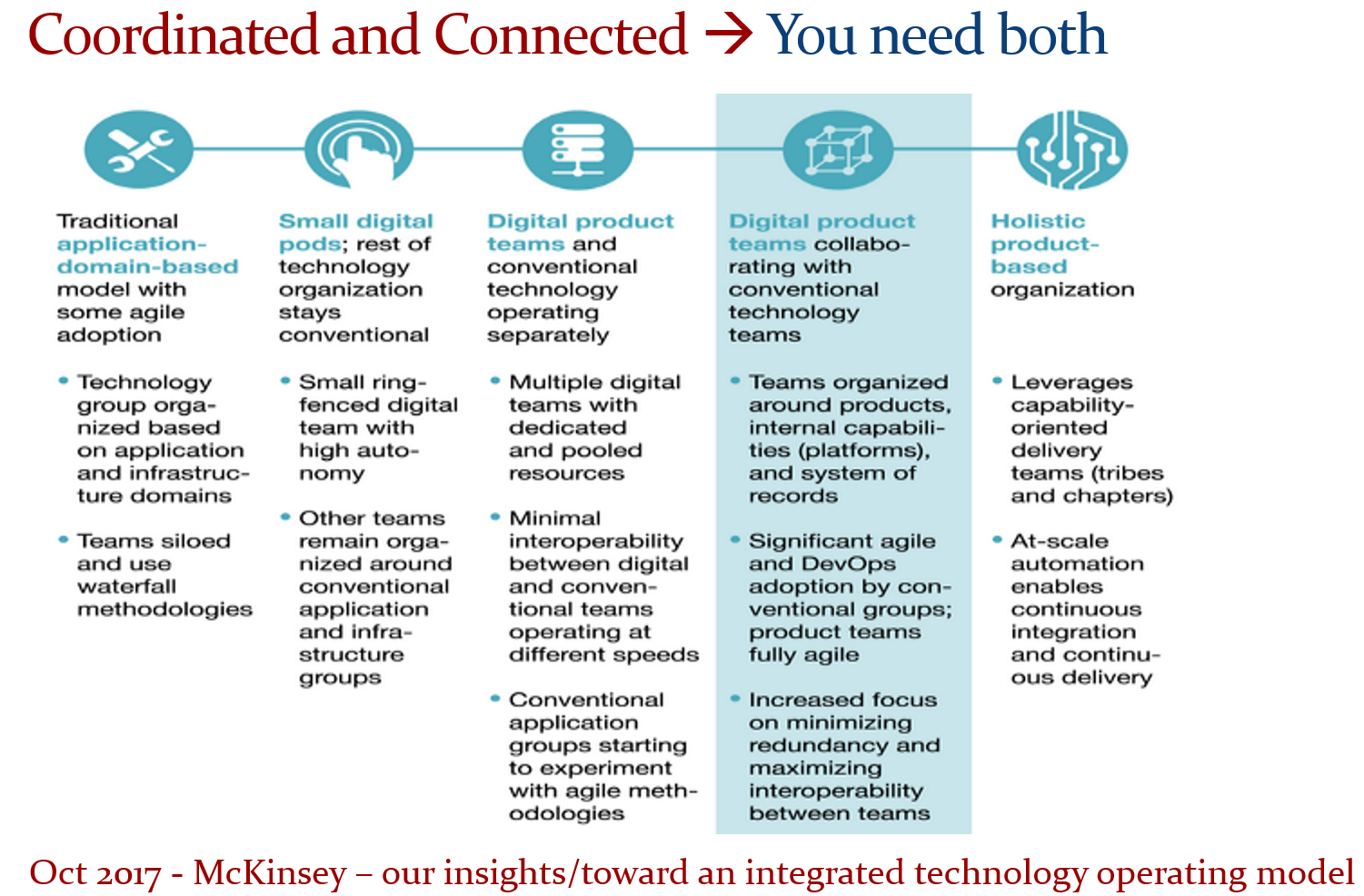
From the bimodal approach in 2015 to the hybrid approach for companies, inspired by this 2017 McKinsey article: Toward an integrated technology operating model, I discovered that this is probably the best approach to ensure a change will happen. In this approach – see image – the organization keeps running on its document-driven PLM infrastructure. This type of infrastructure becomes the system of record. Nothing different from what PLM currently is in most companies.
In parallel, you have to start with small groups of people who independently focus on a new product, a new service. Using the model-based approach, they work completely independently from the big enterprise in a data-driven approach. Their environment can be considered the future system of engagement.
The data-driven approach allows all disciplines to work in a connected, real-time manner. Mastering the new ways of working is usually the task of younger employees that are digital natives. These teams can be completed by experienced workers who behave as coaches. However, they will not work in the new environment; these coaches bring business knowledge to the team.
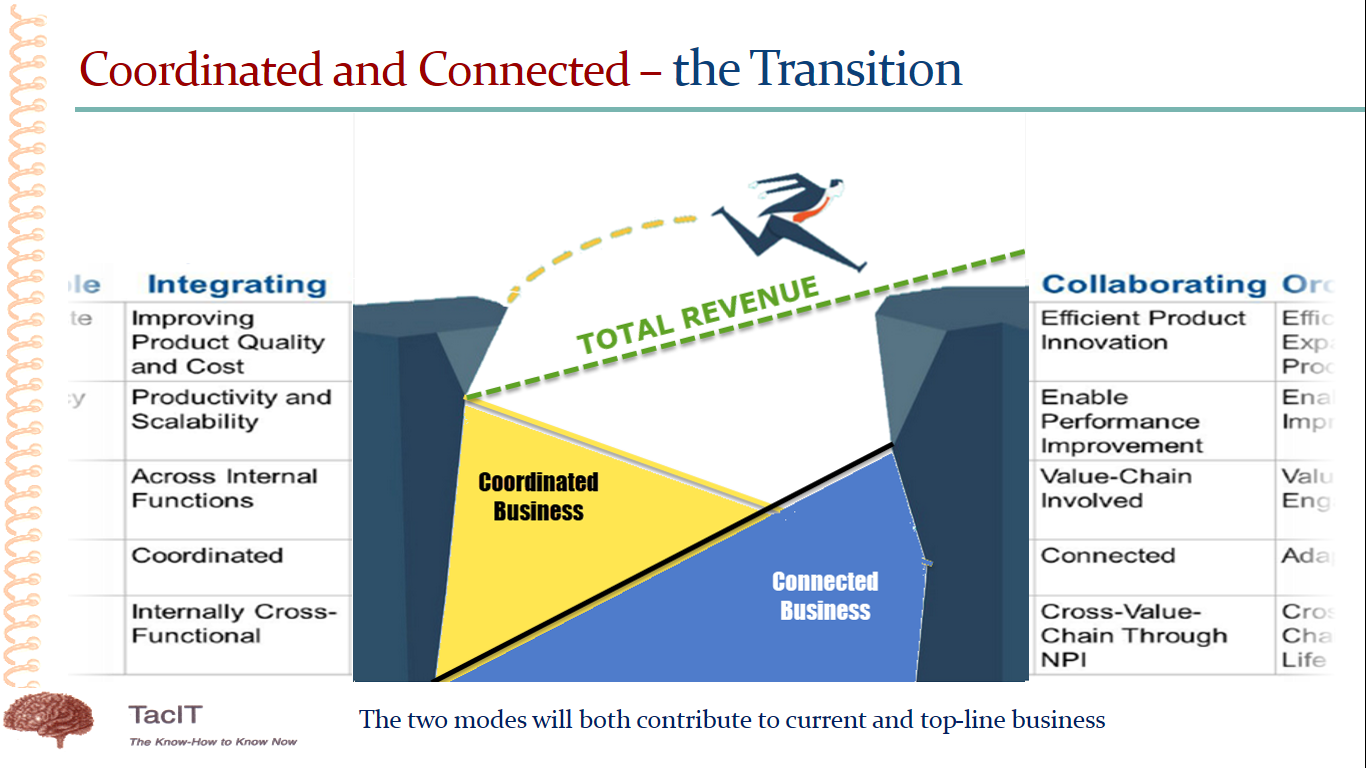
People cannot work in two modes, but organizations can. As you can see from the McKinsey chart, the digital teams will get bigger and more important for the core business over time. In parallel, when their data usage grows, more and more data integration will occur between the two operation modes. Therefore, the old PLM infrastructure can remain a System of Record and serve as a support backbone for the new systems of engagement.
The Innovation Dilemma conclusion
The upcoming ten years will push organizations to innovate their ways of working to become sustainable and competitive. As discussed before, they must learn to work in a data-driven, connected manner. Both startups and existing enterprises have challenges – they need to overcome the “thinking fast and acting slow” mindset. Do you see the change in your company?
 Note: Before publishing this post, I read this interesting and complementary post from Jan Bosch Boost your digitalization: instrumentation.
It is in the air – grab it.
In several discussions and posts I wrote, I talked about systems thinking, assuming everyone has the same understanding.
For example last year with the PLM Global Green Alliance (PGGA) we had a discussion with Frank Popielas Managing Partner and Co-founder of SMS_ThinkTank™ related to sustainability. We used the term “Systems Thinking” several times assuming everyone knows the concept.
I should have known better. When using terms in your profession, you always have to verify if the others have the same meaning. Crucial when you start a PLM implementation project.
 For example, several years ago, I was asked to audit a PLM implementation that got stalled because the PDM and ERP-system capabilities created a conflict. In my first interview with the PLM team, they mentioned they were quite advanced in Systems Engineering. Everyone in the core team confirmed this. However, when diving into the details of the “Systems Engineering” activities, it appeared that they were talking about (product) Configuration Management.
When working with different people, always make sure you have a common dictionary.
 What is a part? What is a material? What is a Workflow, and is it different from a Business Process? And also, for Configuration Management, you often see two definitions.
One focuses on the consistency of the product’s definition, the other more on the allowed configurations of a product. So now let’s dive into Systems Thinking which is not the same as Systems Engineering.
Systems thinking – a definition
When I checked on Wiki, I found this complex definition:
Systems thinking is a way of making sense of the complexity of the world by looking at it in terms of wholes and relationships rather than by splitting it down into its part. It has been used as a way of exploring and developing effective action in complex contexts. Systems thinking draws on and contributes to systems theory and the system sciences.
A careful reader would extract from this definition that the focus for systems thinking is looking at the bigger picture, the whole, a holistic approach. Of course, when using a holistic approach, you take more relationships or possibilities into account, which broadens your thinking (or value of your solution). The opposite of Systems Thinking is to focus on a single issue or part and describe it best. Let me explain this by an example:
The BIC ballpoint
 You might remember the first BIC ballpoints with the sharp cap when you are as old as me.
This image is from the time I was born. The BIC ballpoint, with the pointed cap, was one of the most popular ballpoints during my teenage years.
In primary school not allowed, as we first had to learn to write with an ink pen or fountain pen. The BIC pen at that time was designed as a product with a single purpose: enabling people to write affordable, comfortable, and fast.
 With a more holistic view of the BIC pen, you might say: “What happens when children play with it?” And apparently, there were accidents with children stabbing themselves in the eye with the sharp cap.
And this was indeed the case when considering the BIC ballpoint as a system; other stakeholders and scenarios were considered.
 Now the cap is flattened (safe for children). The cap’s open end is apparently there to support performing a tracheotomy when no medical equipment is available (just a sharp knife and the BIC ballpoint are needed).
Don’t try this at home for fun: Performing the Tracheotomy
I hope the example illustrates that you can look at a product differently.
First as a product with a single purpose (single stakeholder) or as a system interacting with other stakeholders (writing, safe for children, first aid support).
System Thinking, therefore, is an attitude which not natural for humans. In his famous book Thinking Fast & Slow, Daniel Kahneman explains that our evolutionary brain always wants to save energy.
Therefore our brain is pushing us to make fast intuitive decisions, not always the ones that you would make after serious thinking.
Systems Thinking costs energy for the brain.
 Often we hear that companies want to reduce their costs and time spent on engineering – more efficiency.
Systems Thinking and Systems Engineering are aiming for the opposite – spend more time thinking and analyzing in the virtual world, before committing to the physical world. Fixing issues once you are in the physical world is much more costly than in the virtual world.
Click on the image to see the details.
This brings us to the relationship with Systems Engineering
Systems thinking and Systems Engineering
You could say Systems Engineering is the best example of Systems Thinking. There are various viewpoints on Systems Engineering, best characterized in these two directions (Wiki here):
- Systems engineering is an interdisciplinary field of engineering and engineering management that focuses on how to design, integrate, and manage complex systems over their life cycles. At its core, systems engineering utilizes systems thinking principles to organize this body of knowledge. The individual outcome of such efforts, an engineered system, can be defined as a combination of components that work in synergy to collectively perform a useful function. Here the focus is on managing in a proven manner complexity
- Systems engineering focuses on analyzing and eliciting customer needs and required functionality early in the development cycle, documenting requirements, then proceeding with design synthesis and system validation while considering the complete problem, the system lifecycle. This includes fully understanding all of the stakeholders involved. Here the focus is on delivering the best product for the relevant stakeholders involved, not necessarily managing the complexity of the product.
 To manage complexity, we have always used models. The weather forecast is based on models, the profitability of a business is based on models, and the behavior of a product can be predicted and analyzed using models. This is Model-Based Systems Engineering MBSE), and I wrote a lot about the Model-Based approach last year. Read The road to model-based and connected PLM
When it comes to extending the support for different stakeholders, we have seen the example of the BIC ballpoint.
However, when we start to talk about sustainability, we will see that by enlarging the number of stakeholders and their importance, we observe another way of Systems Thinking.
Systems thinking and sustainability
 The title of this post is related to the challenges we have with sustainability, our society and even our planet. Currently, reducing carbon emissions gets the highest priority as we see the impact on our planet. Perhaps the awareness is not the same for everyone; the richer you are, the less you might feel impacted by climate change. Still, indisputably it is happening as the IPCC is reporting.
Now let’s look at the relation between systems thinking and sustainability.
Let’s imagine I work for a tier 2 or tier 3 supplier of an OEM. This means the OEM wants a component for their solution with the highest quality and the lowest price.
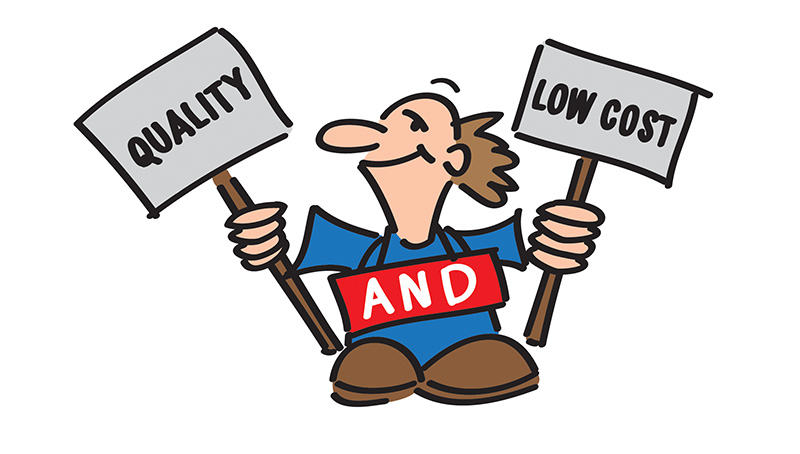 In the traditional approach, the supplier will try to find the cheapest materials that match the required quality. They will look for the most inexpensive manufacturing process to build their component. Everything extra will reduce their chances of remaining the OEM contractor and profitable. The only stakeholder in this process is the OEM and potentially some existing regulations. For example, ROHS controls the usage of hazardous materials.
Next, imagine a supplier that wants to be more sustainable. They will add sustainability requirements to their component design. They start to treat their product as a system. What would be the difference between choosing material A over material B or choosing production process ABC over production Process XYZ?
 If it is up to the OEM, it is only costs, quality and compliance. Suppose the supplier will select an alternative material that has less impact on the environment. For example, recycling or needing less energy (carbon emissions) is easier to produce. In that case, this option might be more expensive. It is up to the OEM to decide if they accept this higher cost price to be more sustainable with their products.
To understand the sustainability of a product, we need to dive into a full Life Cycle Assessment (LCA). LCA is at the heart of PLM.
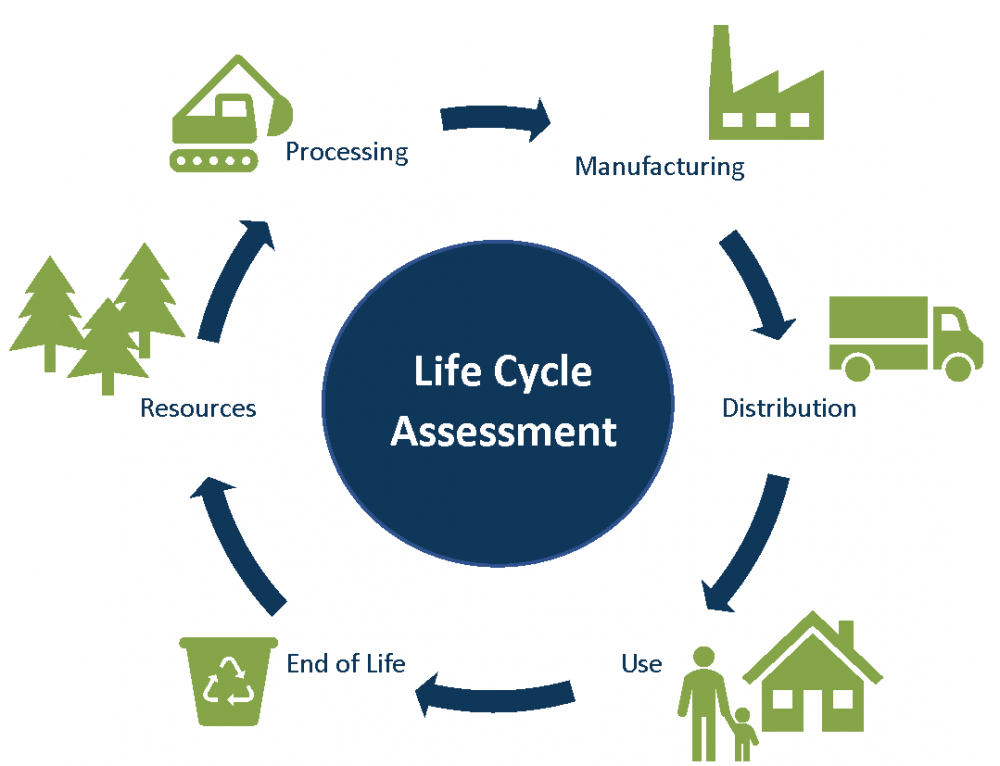 When a product or component is designed, the LCA will give you the information related to the impact of your product, assuming you have the accurate data to make the assessment. This is currently one of the major areas to focus on when it comes to sustainability – how can we measure the environmental impact of each part through its whole lifecycle.
With sustainability, the needs are no longer defined by the OEM. Other stakeholders, like authorities and consumers, will also have an impact. Realistically, we will see that mainly regulations will be the biggest driver towards sustainability as consumers still want the lowest price.
 Currently, we see this behavior with the rising energy prices. Unfortunately, people complain about the price instead of realizing the price has always been too low. Changing behavior (energy consumption) might be the best path for the future, but that is more difficult than complaining.
Systems Thinking and the Circular Economy
Finally, I want to mention one topic closely related to Systems Thinking and Sustainability: the Circular Economy. The Circular Economy is well explained by the Ellen McArthur Foundation. Follow the link and get educated as the Circular Economy is about a system. A system that tries to minimize the leakage of resources and the need for new raw materials. Each loop is a process to consider.
With the PLM Global Green Alliance, we discussed the circular economy together with Darren West from SAP in our session: PLM and Sustainability: talking with SAP. I hope and trust we will learn more about companies to follow the principle of a circular economy.
Want to learn more?
 There is so much more to say about Systems Thinking in general, and I will come back to this topic in a future post. Meanwhile, I recommend this post for all of you who want to learn more about systems thinking and sustainability: Systems Thinking can help build a sustainable world: A Beginning Conversation from the MAHB (Millennium Alliance for Humanity and the Biosphere). There is so much to learn and discuss if you are actively looking for it.
Conclusions
Systems Thinking is needed to solve the issues in a complex society. It is an attitude, not a new approach. Systems Thinking helps to manage a complex system, it helps to address sustainability, and it helps fight against populism. Simple answers do not exist – looking to the bigger picture, using systems thinking will make you better informed wherever you are on this limited planet
 War is a place where young people who don’t know each other, and don’t hate each other, kill each other, by the decision of old people who know each other, and hate each other, but don’t kill each other…”
 Sustainability has been already a topic on my agenda for many years. So when Rich McFall asked me to start the PLM Global Green Alliance (PGGA) in 2018, I supported that initiative. You can read more about my PLM and Sustainability ideas in this post here.
I have been lecturing about the relation between PLM and Sustainability last year. In 2018, the PGGA was a niche alliance trying to find people who would like to work and share PLM-related practices with others for a greener and sustainable planet.
 Thanks to, or actually due to, the pandemic, climate disasters and the return of the US supporting the Paris Climate agreements, it became clear companies need to act. And preferably as soon as possible, which led to sustainability activities in many companies.
Also, the main PLM vendors started to publish their support and vision for a sustainable future, the area where we believe the PGGA can contribute in spreading the practices and experiences.
For that reason, the PGGA is aiming this year to have a series of discussions with the main PLM Vendors and their sustainability programs.
SAP
 This time we are happy to publish an interview with Darren West from SAP. Darren West is the product management lead for SAP’s Circular Economy solutions. His role is to work with customers, sales and pre-sales colleagues, partners, solutions teams and product owners to expand existing and build new sustainability products, particularly those impacting Circular Economy topics.
We are glad to speak with Darren, as we believe sustainability and the circular economy go hand in hand and it requires systems thinking. We believe SAP, strong in managing materials and manufacturing processes, should be a leader in providing insights in ESG reporting. Helping companies to improve their environmental impact of products and production processes as they have the data.
Have a look at this 34 minutes interview and discussion with Darren West
The slides shown in this recording can be found here: Circular Economy -SAP for PLM Green Alliance
What we have learned
The interview showed that SAP is actively working on a sustainable future. Both by acting by themselves, but even more important, by helping their customers to change to more sustainable designs and production methods. There is still a way to go and we do not have too much time to sit back. The power of the current SAP Responsible Design and Production module is that it allows companies to understand their environmental impact and improve where possible. This is step 1 in my opinion to find a way to create sustainable products and business models.
The second, more general observation, is that we need to make our full product lifecycle management digital and connected. Data-driven is the only way to have efficient processes to estimate and calculate our environmental impact – my favorite From Coordinated to Connected topic.
Want to learn more?
In the context of this recording, Daren shared the following links for those of you who got inspired by the discussion (in alphabetical order):
- Catena-X, the german automotive alliance for secure and standardized data exchange
- Circularity Gap Report – a status where we are in our circularity targets
- Ellen MacArthur Foundation – all you want to learn about the circular economy
- Material Economics – Circular Economy and Climate study -explores the opportunities for the four largest materials in terms of emissions (steel, plastics, aluminum, and cement) and two large use segments for these materials (passenger cars and buildings).
- PLM Global Green Alliance – the place where Climate Change & Sustainability are discussed in the context of PLM
- SAP Circular Economy offerings and information
- SystemIQ – the place to discuss systems change/systems thinking
- World Business Council for Sustainable Development (WBCSD) – their vision and more
- World Economic Forum Global Plastic Action Partnership (GPAP) – a plastic sustainable economy
- World Wildlife Fund (WFF) about plastic pollution and plastic usage
Conclusion
This was a motivating session to see PLM-related vendors are taking action. Next time, you will learn more from the design side when we talk with Autodesk about their sustainability program.
Unfortunately the day after this motivating session we were shocked by the invasion of Ukraine by Russia. So I am in a mixed mood, as having friends in both countries makes me realize that one dictator can kill people and hope.
Listen to president Zelensky’s speech to the Russian people and get inspired to act against any brainwashing or dictatorship. To my friends and readers, wherever you are, stay strong, informed and human.
 This Friday, February 26th, we had a PLM Green Global Alliance (PGGA) core team meeting to discuss our current status and next steps for 2021. If you are a PGGA member, you joined us because of the PLM Green Global Alliance LinkedIn group. The LinkedIn group is currently our primary channel for social interaction with the outside world.
Meanwhile, in the background, Rich McFall has been working on structuring the PLM Green Alliance website, which you can find here.
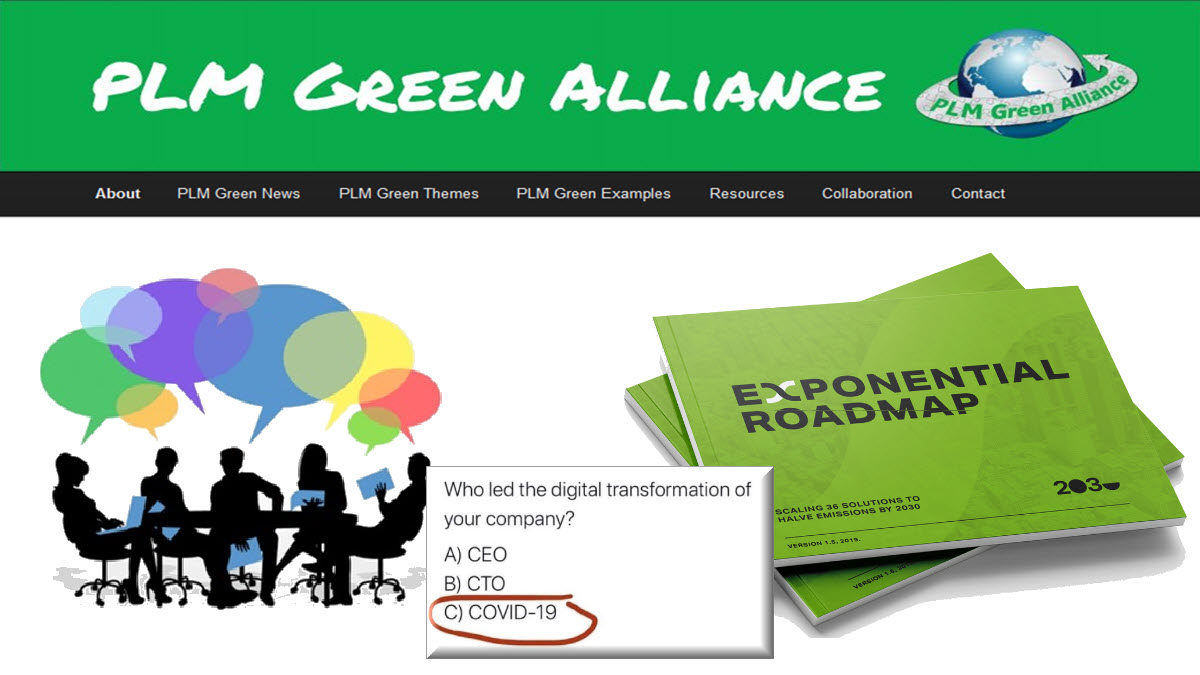 The PLM Green Alliance website is the place where we consolidate information and will experiment with forum discussions. LinkedIn is not the place to serve as an archive for information. Neither is LinkedIn a place for discussion on sensitive topics. Viewpoints on LinkedIn might even damage your current or future career if you have a controversial opinion. More about the forum discussions soon.
The PLM Green Alliance website
 Therefore, the PLM Green Alliance website will be the place where interested parties can obtain information and active members can participate in forum discussions.
As a reminder, all our actions are related to PLM and PLM-related technologies – a niche environment bringing PLM-related skills and a Green and Sustainable society together.
Our actions are driven by a personal interest to contribute. With the limited time and means, we are aware of the differences with more prominent and professional organizations addressing a much broader scope and audience.
What makes us unique is the focus on PLM and PLM-related practices/technologies.
The PLM Green Themes
Although the website is still under development, our intentions become visible through the home page header. I want to zoom in on the area where we are currently focusing, the PLM Green Themes.
We decided on five PLM Green Themes, with each of them having their dedicated moderation and focus. Although the themes can overlap, they will help us to specialize and dive deeper into specific topics.
PLM and Climate Change
You might argue PLM and its related technologies do not directly impact activities related to climate change. However, as the moderators of this theme group, Klaus Brettschneider, and Richard McFall state:

The goal of this PLM Green discussion forum and working group on Climate Change is to promote activities to understand, analyze and reduce human-generated greenhouse gas (GHG) emissions through PLM-enabling technologies. We hope to help to answer the question of what the role and value of PLM technologies is in addressing the most critical challenge facing humankind this century, climate change.
And although there are still individuals with other opinions, the group will focus on the targeted outcome: reducing greenhouse gasses in the atmosphere. What are the types of innovations that make this possible? Find interesting posts here and start contributing.
PLM and Sustainability
 This theme will be moderated by me, Jos Voskuil. We are still looking for one or more volunteers to extend our capabilities here.
The topic of sustainability is again broad, as you can read on the Sustainability theme page.
To be more precise, the page states:
Specific topics we wish to discuss further in this forum include how PLM can be used to:
- Make products and processes more efficient and greener.
- Understand and measure the impact on the carbon footprint of design decisions and production processes, along with changes to them.
- Develop, distribute, and use new sources of renewable green energy.
- Design products and their lifecycles to be sustainable.
- Recycle, reuse, or repurpose assets, materials, and natural resources.
- Enhance the resiliency and Sustainability of infrastructures, communities, and economies.
In my early 2021 survey asked participants their viewpoint on PLM and Sustainability. As you can see from the scores, the majority of us are currently observing what is happening.
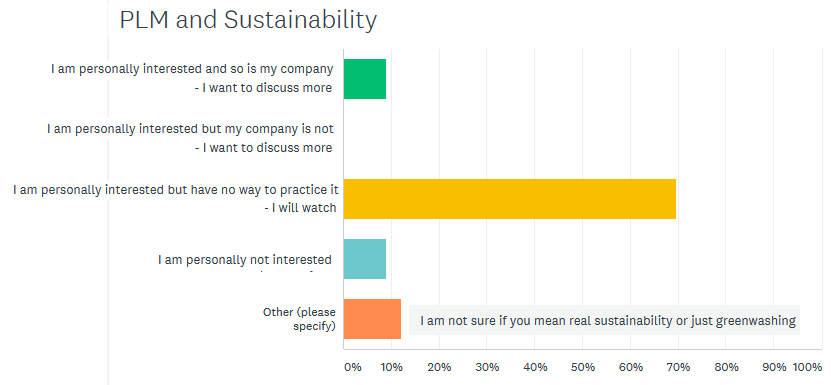
One of the interesting “other” responses I highlighted here: “I am not sure if you mean real sustainability or just greenwashing.”
Good point. Greenwashing is needed when you know you have something to fix/hide. We are not fixing or hiding; we will discuss and share information and probably dismantle greenwashing attempts.
PLM and Green Energy
 Green energy is an important topic on its own as many of the issues related to a green and sustainable society are dealing with the transition from limited fossil energy sources to a sustainable energy model. The moderator of this theme group, Bjorn Fidjeland, is well known for his skills and coaching on PLM in the context of Plant Lifecycle Management through his PLMpartner website.
Of course, we are looking for an additional moderator to support Bjorn, so feel free to contact Bjorn through the website if you can and want to contribute. The theme group objectives are:
…. to share experiences, examples, and best practices in a collaborative mode to promote discussion, learning, and understanding with respect to the mentioned focus areas. We also plan to publish our own “industry heads up” news, articles and case studies illustrating all that is happening in the global race towards “going green” and a low-carbon economy.
PLM and a Circular Economy
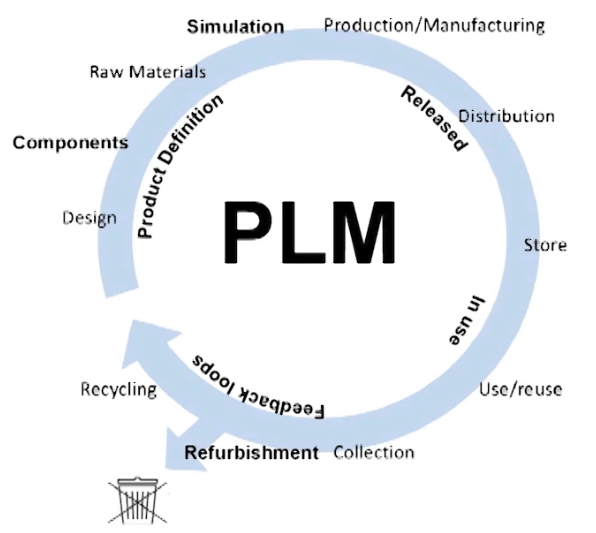 As the Circular Economy is itself an innovation, it provides an opportunity to innovate business models and reimagine how we consider something to be a product, a service, or a product as a service. Similarly, a more circular way of thinking requires different expectations when it comes to Information Technology systems, including PLM, that support the enablement of these new business models and the execution of their commercial strategies.
 This theme group is currently moderated by a real passionate follower of the Circular Economy, Hannes Lindfred, and also here we are looking to another volunteer.
A year ago, I saw Hannes Lindfred presentation at the TECHNIA PLM Innovation Forum and wrote about his lecture as one of the highlights from the first day.
See my blog post: The Weekend after the PLM Innovation Forum, where I mention his session in the Business drivers for Sustainable Manufacturing paragraph.
The circular economy framework nicely aligns with concepts like “Product as a Service” or Outcome-based services. The original manufacturer becomes responsible for the full lifecycle of their products. A theme group, I expect we can make a lot of progress through sharing.
Accordingly, the main objective within our theme discussion group is to provide a support network for PLM professionals who seek to overcome the legacy linear economy mindset that may be systemic in their jobs, products, employers, or industries. We hope to incite the development and use of road maps for employing both existing and new PLM technologies to implement Circular Economy principles and best practices.
PLM and Industry 4.0
 A topic that is closely related to PLM is Industry 4.0. At first glance, Industry 4.0 is an initiative to manufacture products smarter, more flexible, more automated, more modular by using new technologies and practices, all with the goal for (initially German) companies to become more competitive.
We are pleased that the PLM and Industry 4.0 theme group’s moderator is Lionel Grealou, quite active in the area of knowledge sharing related to PLM. A second moderator would be more than welcome too for this theme.
Recently Lionel published this interesting article on engineering.com: Exploring the Intersection of PLM and Industry 4.0. In this article, Lionel touches briefly on the potential contribution of Industry 4.0 towards a circular economy, new business models, and waste reduction, thanks to the interaction of PLM and Industry 4.0. There is a lot to explore, as Lionel states on the theme group introduction page:
This PLM Green theme group’s plan will explore the “intersection” of how PLM strategies and technologies enable the vision of Industry 4.0 for a more sustainable circular economy. In doing so, we plan to investigate the following questions concerning their green value:
- How do data and product connectivity contribute to feeding smart factories and enhancing the product lifecycle practice?
- How to improve feedback loops and data integration upstream-downstream of new product development to contribute positively to the circular economy?
- How to drive downstream waste reduction by improving data traceability and accessibility with better product analytics throughout its lifecycle?
- How to link more tightly manufacturing planning and execution?
- How to more robustly connect and integrate engineering, manufacturing, and service/maintenance process operations?
- How to reduce time to market, with both product development and production cost optimization, integrating co-creation from the design office to the shop floor?
- How to align the digital and the physical worlds, delivering more customer-centric products enabled by fully horizontally-integrated PLM strategies, taking an ecosystem approach to collaboration, leveraging more agile and continual release processes?
- How to reduce pre-launch costs and generate downstream manufacturing improvements?
Much more to do.
 As you can see, the PLM Green Global Alliance is transforming slowly, as we are not marketing people, web designers, or a sponsored organization. We rely on our networks and your inputs to reach the next level of interaction. The majority of the PLM Themes need a second moderator to keep the workload balanced.
Do you want to contribute?
In the core team meeting, we also discussed improving ways to make the PLM Green Alliance more interactive, shifting and balancing the LinkedIn group’s activities and the persistent PLM Green Alliance website.
Conclusion
As a person, I cannot do big things for our future society; however, I can do small things. And if we all make sure our “small things” are directed to the same outcome, we achieve big things without a revolution. Be part of the active PLM Global Green Alliance with your small things.
 Jos Voskuil's Weblog
Interesting reflection, Jos. In my experience, the situation you describe is very recognizable. At the company where I work, sustainability…
[…] (The following post from PLM Green Global Alliance cofounder Jos Voskuil first appeared in his European PLM-focused blog HERE.) […]
[…] recent discussions in the PLM ecosystem, including PSC Transition Technologies (EcoPLM), CIMPA PLM services (LCA), and the Design for…
Jos, all interesting and relevant. There are additional elements to be mentioned and Ontologies seem to be one of the…
Jos, as usual, you've provided a buffet of "food for thought". Where do you see AI being trained by a…