
You are currently browsing the category archive for the ‘ROI on PLM’ category.
 Two weeks ago I received through the PLM group on LinkedIn, the following question from Nathalie: “Do you know any specific examples of what some companies have done to get their users ready, excited or more committed to the new PLM system?”
When digging in my mind and planning to give a quick answer, I realized it was an interesting question with a contradiction embedded: users and excitement for a new PLM system.
This week I was attending the SmarTeam User Group meeting in the Netherlands, where an excellent presentation was given by Simon and Hessel from a Dutch company called Meyn (Poultry processing) about their PLM implementation. They shared their excitement !
Combined with an interesting discussion on Oleg’s blog with Frank, I believe I have the ingredients to answer the above question more complete.
PLM is not exiting for users
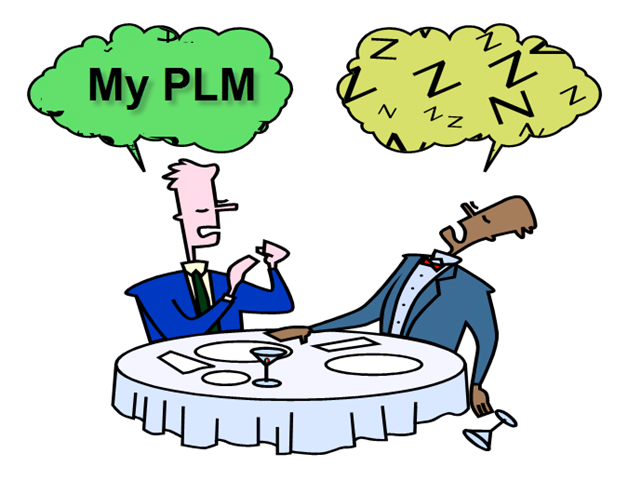 I think this is fact number one. When you go to tradeshows or PLM exhibitions, you see usually only 3D CAD demos, nobody tries to demonstrate PLM functions and features in detail. As a side step, I believe the best PLM system should be almost invisible for the user. Users want to work in their own environment with applications like CAD, Excel (BOM handling apps), Office, FEA tools, Simulation tools and more.
ERP has a more clear value proposal, if you want to define and schedule your manufacturing and manage the financial transactions, everyone has accepted that you need ERP. User acceptance is not relevant, users have to work with the provided interface as otherwise production or accounting will fail, there is no alternative.
In contrary, the clear value and definition of PLM are not clear to user. For that reason these users do not get excited when confronted with PLM. They have been surviving without implementing PLM, so they believe there is an alternative.
But we know there are PLM benefits?
My previous post – PLM in the mid-market a mission impossible? – lead to a discussion with Oleg and Frank coming with anew and interesting view point. Frank mentioned that in the German area, many mid-market companies do PLM without purchasing an enterprise PLM system from the known vendors.
 The discussion focused on granularity, as all of us believed that a set-by-step approach towards PLM best practices, driven by people who understand the company very well, is the key to success. For this approach you need people inside the customer’s organization who can formulate the vision assisted by consultants working very dedicated in that industry. It requires a different type of consultant as those active in the big enterprise projects.
Instead of implementing PLM as a standard process, in this approach the customer drives and leads the activities where they see benefits in their overall business process. To achieve this, the company must have has a clear vision, where they want to be in the next 5 – 10 years.
Next implementations steps should fit in this strategy and prioritized based on different parameters and these steps are not always with a focus on PLM.
And here lies the key for successful PLM implementations.
 The implementation might be based on an academic approach around a core PLM data model and best practices. Mid-market offerings are around an OOTB (Out-Of-The-Box) quick implementation – the PLM system/implementer leads.
Something the management of likes to hear; quick and with little customization, which would translate in lower costs of implementation and disruption of the organization. But then, the end-users start to complain. There is too much change their standard way of working and they do not see the advantages – keying in more data in a system does not help them.
 The introduction of PLM brings more complexity and as the new system has to prove itself, there is not big enthusiasm from the average user. The management can push, like in the ERP situation, but in general also the management is anxious to learn if this OOTB-approach brings the benefits and when it fails they ask the vendor where the estimated ROI can be found.
Concluding you will be lucky if users get excited form the OOTB approach.
 In the second and granular approach, the company defines their strategy and vision, not necessary a 100 % PLM vision. This strategy need to be clear and shared with the employees in the company, especially for those who are affected by changes.
Next together with implementation partners, who bring in the know-how and possible software tools, a part of the company’s process is addressed and improved. It can be in any area, changing the CAD engine, automate BOM handling, connect sales to engineering or connect after sales/service to engineering.
Many of these areas of interest have different solutions, some are extensions of the CAD environment, some of them are extensions of the ERP environment and some of them are extensions of the IT-platform used in the company.
This approach is not sold by the PLM vendors, as they want to introduce their system as the IT-platform, wrap around the CAD and even capture the definition of the MBOM and initiation of the Item master.
A step-by-step approach based on different granular components, every time in the direction of the company’s strategy, plus all the time feed-back to the end-users on the positive impact of the change, is for me the key to success. In my previous post I was looking for a global provider for these required components.
With the step by step approach with granular solutions, we get users involved and excited.
And this brings me the to the presentation from Meyn
 The first time I got involved with Meyn was in October 2004. At that time they had chosen to move from their BaaN-2D CAD infrastructure to a new environment with BaaN – 3D CAD (CATIA). Simon presented their target strategy and vision: moving away from being an Engineering To Order company to become primarily a Configure To Order company.
ENOVIA SmarTeam was chosen to manage the 3D CAD and to connect the information to BaaN. Initially Meyn started in the classical PLM approach, but already after a few months, the understanding was there, they need have step-by-step approach, focused on results for the new CATIA users, without communicating around a complete PLM focused project.
So they followed a stepped approach, they called them waves.
Moving from Engineering to Order to Configure to Order is not software implementation. It requires rationalization of your products; convert them into modular, configurable parts. For this you need to be an engineering expert, not a software expert.
But when it comes to implementation of this concept in the software, you need both experts. And through this collaboration, a methodology for skeleton design was established which was driven by Meyn. And the reason the users were excited was, that they were doing real engineering, the benefits were significant visible.
 Customer project related engineering time (typical ETO), which was in the beginning their core activity, became around 30 % of the time. More time could be spent on developing new machines in a modular way. With almost the same amount of engineers the turn-over of the company had more than doubled. A win-win environment which makes also the end-users excited.
Still the backend with ERP at Meyn remained almost the same similar to the time they were working in the 2D environment. And the most interesting conclusion at the end of the presentation was, they are still using the same slide with the vision and they can explain why each step was taken and justify it by measurable benefits.
And this brings me to the answer of the question
“Do you know any specific examples of what some companies have done to get their users ready, excited or more committed to the new PLM system”?
- The management needs to have a clear vision where they want to be as a company in the future. This is not an IT-vision, but a business vision which explain why changes are needed. This vision should be clear to the employees. Communicate!
- Where possible provide metrics!
- Do not talk about a PLM system; it can be also in other tools. Talk about improvement steps in the business processes contributing to the vision. The PLM system is the information backbone, not the front-end. Management and implementers should talk business functionality not IT functions and features. Do not talk in applications!
- Build step by step user scenarios with focus on methodology and user understanding. Implementations with a function-feature focus are hard to accept by the users. Talk business!
- The management should present their vision again and again, supported by metrics what has been accomplished and what has been learned for the future – repeat!
Conclusion
There are thousands of mid-market companies that have a vision to improve their business. The PLM system should never be the topic of discussion with the end users; it is the change in working methods that is important, supported by various systems -CAD/ERP/CRM – and almost invisible …….. PLM
The company Meyn is an example of this approach. Simon and Hessel are working for Meyn as engineers improving their company’s business. Unfortunate it is not their business to explain all around the world, how PLM supports business change in a mid-market company. I was glad to attend their session last week.
 The title of this post came in my mind when looking back on some of the activities I was involved in, in the past two weeks. I was discussing with several customers their progress or status of the current PLM integration. One of the trends was, that despite the IT department did their best to provide a good infrastructure for project or product related information, the users always found a problem ,why they could not use the system.
 I believe the biggest challenge for every organization implementing PDM and later PLM is, to get all users aligned to store their information in a central location and to share it with others. Only in this manner a company can achieve the goal of having a single version of the truth.
With single version of the truth I mean – if I look in the PLM system I find there all the needed data to explain me the exact status of a product or a project.
If it is not in the PLM system, it does not exist !
How many companies can make that statement ?
If your company does not have the single version of the truth implemented yet , you might be throwing away money and even bring your company at risk in the long term. Why ? Let’s look at some undisclosed examples I learned in the past few weeks:
- A company ordering 16 pumps which on arrival where not the correct ones –
1 M Euro lost - During installation at a drilling site the equipment did not fit and had many clashes – 20 M Dollar lost, due to rework and penalties
- 7000 K Euro lost due to a wrong calculation based on the wrong information
- A major bid lost due to high price estimation due to lack of communication between the estimator and the engineering department
- 500 K Euro penalty for delivering the wrong information (and too late)
All the above examples – and I am sure it is just a tip of what is happening around the world – were related to the power & process industry, where of course high-capital projects run and the losses might look small related to the size of the projects.
But what was the source of all this: Users
 Although the companies were using a PLM system, in one company a user decided that some of the data should not be in the system, but should be in his drawer, to assure proper usage (according to his statement, as otherwise when the data is public available, people might misuse the data) – or was it false job security as at the end you loose your job by this behavior.
People should bring value in collaboration not in sitting on the knowledge.
 Another frequently heard complaint is that users decide the PLM system is too complex for them and it takes too much time for them to enter data. And as engineers have not been bothered by any kind of strict data management, as ERP users are used to work with, their complaints are echoed to the PLM implementer. The PLM implementer can spend a lot of time to customize or adapt the system to the user’s needs.
But will it be enough ? It is always subjective and from my experience, the more you customize the higher the future risks. What about upgrades or changes in the process ?
And can we say NO to the next wish of this almighty user ?
Is the PLM system to blame ?
 The PLM system is often seen as the enemy of the data creator, as it forces a user in a certain pattern. Excel is much easier to use, some home-made macros and the user feels everything is under control (as long as he is around).
Open Source PLM somehow seems to address this challenge, as it does not create the feeling, that PLM Vendors only make their money from complex, unneeded functionality. Everything is under own control for the customer, they decide if the system is good enough.
PLM On Demand has even a harder job to convince the unwilling user, therefore they also position themselves as easy to use, friend of the user and enemy of the software developer. But at the end it is all about users committing to share and therefore adapt themselves to changes.
So without making a qualification of the different types of PLM systems, for me it is clear that:
 The first step all users in a company should realize is that, by working together towards a single version of the truth for all product or project related data, it brings huge benefits. Remember the money lost due to errors because another version of data existed somewhere. This is where the most ROI for PLM is reported
Next step is to realize, it is a change process and by being open minded towards change, either motivated or pushed by the management, the change will make everyone’s work more balanced – not in the first three months but in the longer term.
Conclusion: Creating the single version of the truth for project or product data is required in any modern organization, to remain competitive and profitable. Reaching this goal might not be as easy for every person or company but the awards are high when reaching this very basic goal.
At the end it is about human contribution – not what the computer says:
 This week I was reading a management article completely unrelated to PLM, but very applicable for PLM. The article stated that one of the basics of capitalism is innovation through crisis. Never let a crisis pass by without using it for your benefits was the message.
As we are currently in the middle of the economical downturn (according to the optimists or pessimists – we still have to figure out who is right), this is the moment for the management to decide. Do we try to sit still till it does not hurt anymore , or are we making strategic changes that will for sure demolish some holy houses but from the other hand will create a more lean and stronger organization after the change ?
Examples of IBM and GM were given from the nineties. IBM made the change from a hardware company towards a software company, where GM kept on doing the same with even bigger SUVs’. We know the results…….
Does it prove anything ?
For sure there are many companies that haven’t survived the nineties as they were not successful in their transformation, although they really tried. So where is the relation to PLM ?
 I believe that the problem of implementing PLM, and specially in mid-market companies is the fact that there is no ambition for change when things are going relatively well. In one of my old posts I referred to the story of the boiling frog.
This happens when an organization is slipping down slowly and it is hard for the management to change and define and sell internally another strategy. Jobs and people are kept in place as long as affordable and only natural evolvement (an aging workforce) or mergers are drivers for a change.
Now with this crisis it is different. Everyone realizes (or should realize) that going on the same manner with the same people is not good for survival (unless you are in one of the few industries that benefit from the crisis – apparently the fast food industry I read)
 In times of a crisis, first of all the management is challenged to come with a survival plan and in most cases this time they can get support from their employees as there is always the threat of lay offs if people are not creative or flexible for change. Secondly, employees will be also more flexible to save their jobs and the company (usually in this order)
Therefore this is the ideal moment to implement PLM in phased approach. For a successful PLM implementation you need employees, who are open minded to change the way they work, plus you need internal resources that have time to work with the implementer to fine tune the PLM system.
This moment exists now and by implementing PLM in a phased approach, each phase will bring ROI, perhaps even before the end of the crisis as you can start with the low hanging fruits and start to collect the benefits.
In parallel there is the discussion around free open source software or dumping software for free by some PLM providers in order to stay in the market. I think here as a customer you should always realize that every company, also software providers, need to survive the crisis and will look for income in another way – services / maintenance / additional software.
So my conclusion this time:
I never realized that both capitalism and PLM were striving for innovation. They have a crisis in common – For capitalism it is a must to push innovation for PLM it is an enabler for innovation
 The last month I have been working with Aerosud Aviation in South Africa to finalize and conclude on ROI and the lessons learned around their PLM implementation, which started in May 2007. I was lucky to be involved in the initial scoping of the project in 2007 and assisted the local Value Added Reseller together with the team from Dassault Systèmes UK team in a step by step project towards PLM.
 When I met the people in Aerosud the first time in 2007, I noticed it was a young company, with open-minded people, everyone trying to improve their daily activities per department. There was the need for PLM as some of their major customers required Aerosud to have a PLM system in place. Also Configuration Management was mentioned many times in the interviews and what I learned that time: Excel was the tool for configuration management.
Based on the initial interviews a plan needed to be developed in which steps to implement PLM. The following three major points were the guidance for the implementation:
- The company was thinking documents and understanding documents especially Excel
- The company had no clear understanding of what PLM would mean for them as real awareness was not inside the company. Customers like Boeing and Airbus talked about the importance of PLM, but how this could impact Aerosud as a company was no commonly clear
- People in the company had a major focus on their department and there was no availability of a overarching group of people leading the implementation
You could say you will see the above points in many smaller and medium-sized companies. I wrote about it also in one of my previous posts: Where does PLM start beyond document management ?
The project phases
 The good news for Aerosud was that their PLM Champion was an expert in CATIA and was familiar with writing macros in Visual Basic plus the fact that everyone in the company was open for using the system as standard as possible – no demands for special behavior of the system: “because we do this already for 100 years”
The last phrase you hear a lot in ancient Europe
The choice was to start with implementing ENOVIA SmarTeam Design Express and to focus in two phases around design data management (phase 1) and the usage of design data by other users (phase 2)
The plan was that each phase would take maximum 2-3 months and we would give the users the time to digest and change their habits towards the standards in the system. In reality it took almost a year, not due to technical or conceptual issues, but this was the maximum pace we could have with the amount of time and available resources. The good news after these two phases was that the first bullet was much clearer understood – the difference between having a system with a single version of the truth or Excel management.
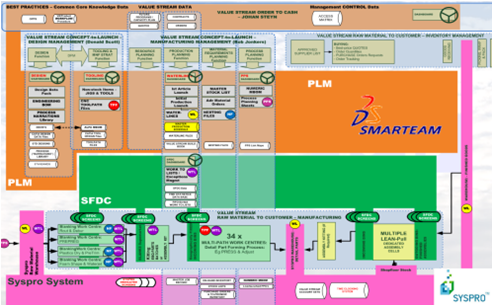 In the summer of 2008 (our summer – as it was winter in South Africa) there was a management workshop in Aerosud and here after three days of discussion the position of PLM became clear. One year ago this would not have been possible, now people had seen ENOVIA SmarTeam and they could imagine what benefits the system could further bring. This addressed the second bullet I mentioned before. Although this workshop was not scheduled upfront, looking back now I see this was a crucial point to get understanding for the next PLM steps.
The next PLM steps were extending to a real Item-centric data model, because if you want to do PLM you need to work around Bill of Materials and all related information to the items in the Bill of Material. At the end this gives you configuration management without chasing Excels.
Again the next steps were divided in two phases with again a scope of 2 – 3 months. The implementation would be based on the ENOVIA SmarTeam Engineering Express methodology which came as a logic extension of the current implementation, without having to change the database or existing data model.
In the first phase we had awareness sessions for BOM (discussing EBOM / MBOM / Effectivity, etc) plus in parallel we introduced the item as place holder for the information. Not longer folders or projects as the base.
Introduction of the item was conceptual not a big issue and the major activities in this phase were focused on connection legacy data or current data from projects to the items. Data coming from various sources (directories, legacy databases) plus NC data became connected and visible in the single version of truth.
In the second phase of moving to PLM the focus was on EBOM and MBOM. Initially assuring that from the designer point of view the CATIA design and EBOM were connected as smoothly as possible, trying to avoid a lot of administrative overhead on the designer (sometimes unavoidable – see my previous post: Where is my ROI, Mr. Voskuil)
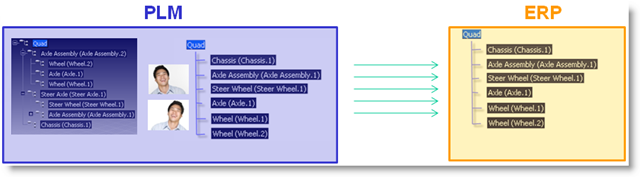
After having implemented a streamlined CATIA – EBOM connection, the focus moved to the MBOM. For me this is the differentiator for companies if they implement PLM or just Product Data Management). Implementing the MBOM requires a culture change and this is the place where the ERP people need to see the benefits instead of the threats . Luckily in Aerosud the manufacturing engineers were working in their Excels initially and not in the ERP system – which happens a lot in older companies.
For that reason the concept of MBOM in PLM was much better understood. Now Aerosud is experiencing these capabilities and once they become obvious for everyone the third bullet will be addressed: people start to work in processes cross-departmental instead of optimizing their department with a specific tool.
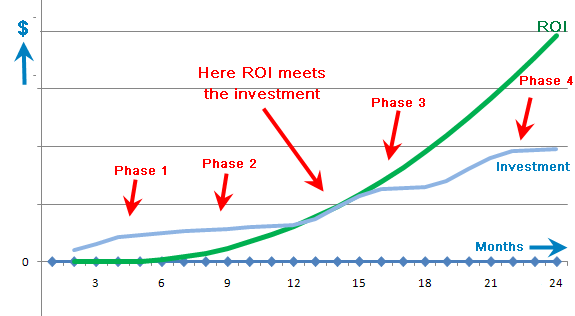 As this activity will continue, I also conducted with the Aerosud management and PLM implementation team an ROI assessment. Estimates about the experienced and projected benefits were kept low and on the realistic side. The result was that the outcome for the ROI period was approx 27 months, almost the same time as the whole project had as throughput time. This proved again the statement about a phased PLM approach. payback of project comes in parallel with the implementation and will ultimately fund the next steps.
 End of July I will be holding a webinar with more details about this implementation for the Dassault VAR Community. I will be happy to expand this information for a wider audience afterwards, as I believe the project is representative for many mid-market companies that struggle to find the place where PLM fits ….. and brings ROI
Let me know if you are interested in this follow up and I will collect the inputs for a follow up.
 Again three busy weeks and I envy my colleagues who had the time to write a blog post on a regular base.
Two major topics kept me busy:
- explaining the complete PLM scenario from concept (initial BOM), through CAD, through EBOM and MBOM to a final shipped product. I will come back on this topic in future posts as it even goes beyond my old post: Where is the MBOM. To be more detailed in the future
- analyzing ROI and predicting ROI for various PLM implementations. And this is the topic I want to share 2 experiences with you, and I am curious for feedback or other viewpoints
Where is my ROI, Mister Voskuil?
 Some years ago I supervised a PLM implementation and I only was involved after the company had already implemented their 3D CAD software (SolidWorks) after years of 2D AutoCAD. The reason for my visit was that the technical manager was a good guy in monitoring the productivity of his engineering department.
And then he showed me some statistics. Working with AutoCAD 2D was defined as the baseline. Implementing SolidWorks brought initially a drop in their drawing output (pay attention to the wording) but after 6 – 9 month the started to be more efficient with SolidWorks and at that time the output was rated at 120 % (or sometimes even more due to more and enhanced product modeling)
Then came the SmarTeam implementation and again the output of the engineering department dropped and going down to 70 % and after a year effort of the SmarTeam implementing VAR, they were still not happy as output was below 100 % still.

Conclusion from their side: There is no ROI on implementing PLM
In the following discussion, we discovered that the working methods of the engineers had changed. Less freedom in adding data, incomplete information as the integration with SolidWorks enforced a more strict methodology to the CAD users (who of course complained). The effect of the changed working procedures was however that downstream tasks should have been eliminated. In production preparation 4 people were in the past completing, checking the engineering BOM coming from the design department. They fixed the mistakes and then typed them all in another order into their ERP system for production.
 It appeared that those 4 people had a much easier job – first of all, they did not complain. Data was immediately on release of the design sent to the ERP system – no manual interaction – and there they could pick-up the EBOM and adapt it for production. There was less search work to do – as the designer already provided validated input plus there were no typos anymore. Amazingly these 4 people never complained to their management that they could do more, they kept on having their ‘busy’ days.
Morale 1: Measuring ROI in a single department (often a mid-market characteristic) does not give you a good understanding of PLM benefits. PLM once implemented correct, affects the whole organization
We know there is ROI, but where is it ?
 As you noticed, a less confronting customer, as we all feel being involved in a successful PLM implementation going in the right direction. Yes, perhaps a little to slow, but the advantage is that people start to see the benefits of a ‘single version of the truth’ – we haven’t reached the advanced scenarios yet as I mentioned in the top.
But now we tried to measure, as I also wrote in previous posts, if you had your organization under control before PLM, in that case, you would be able to measure the impact – after 6 months / after 12 months / after 2 years?
It is like climate change, statistics demonstrate there is a trend and I believe we have an impact on this planet. Still, skeptics (luckily less and less) explain to us that it is just a normal climate variation, and after 10 – 50 years we will have a new ice age. Not sure if these people are optimists or …….. it just does not fit in their lives
But PLM is somehow the same, we see it has an impact, we measure and try to explain, especially in the mid-market companies, skeptics is a natural survival mechanism as you cannot risk to be too optimistic. (This is how startup’
 So in our situation, we started to fill in spreadsheets which brought huge benefits. Imagine searching goes much faster – let’s say instead of 1 hour per day we need only 10 minutes per day per employee. We have 120 people per day searching for data, does it mean we can do it with 20 people instead? Or what would these people do in the remaining 50 minutes per hour?
Right, they will find other work to do – less stress, more time to chat with colleagues, have a coffee and above all, they won’t complain. People are flexible in filling their day and if the company is lucky some of the ambitious people might fill their day with innovation or other relevant improvements.
Morale 2: Even if there is an indisputable ROI on a PLM implementation, the management should analyze what should be the impact on the organization. Invest more in creativity/engineering instead of quality assurance? In the mid-market, this might be perceived as a bad sign – as the quality is key. But how much money would we make on a high-quality product that no-body buys anymore?
Conclusion: With these two anecdotes I tried to share my ROI struggle which is still following PLM. I am looking forward to more anecdotes or inputs on the soft side of ROI. Be welcomed to join the discussion
 The past few weeks I have been busy in an area which I believe is crucial for understanding PLM. I had meetings, web meetings with prospects, with implementers and existing customers – of course all in the mid-market. And the generalized key question on the table was: “

Yes, we understand document management, and yes, CAD management is understandable to us, but why do you need to work with the BOM further down the product lifecycle, as this is ERP, isn’t it ?
I realized several topics play a role here:
- Mid-market companies usually do not think top-down in their approach. As an example: they will not look at their whole organization’s business processes and then try to map all the activities cross departments, cross suppliers, etc. Usually they are looking per department to optimize the way they are working.
Classical enterprise PLM implementations are designed to go top-down. Describe the as-is situation, describe the the to-be situation and then transform the company to meet the to-be situation. Decisions are pushed to the people in the company as the to-be situation seems to be clear. Many of the classical PLM implementers still believe in this approach – and the risk / challenge is always that the to-be situation was not well understood, or that at the time we reach the to-be situation the environment of the company has changed and another to-be is needed. - Mid-market companies understand a central storage for documents brings a lot of benefits. Most companies realize that all this departmental archives of documents and files create too much overhead and a higher quality risk. Finding the absolute right file for a certain product release might be a quest and of course each of the departments claims that their solution fits exactly their needs. This is what I believe the main driver behind the success of SharePoint. As Microsoft Office is used as a common document authoring tool among all departments, why not use the Office Document Management tool as our common backbone ? PLM and ERP vendors might say we also manage documents, but usually these documents are managed in a structured manner – related to revisions of a product or to a product order. Usually an infrastructure to manage unstructured documents does not exist in ERP systems.
- Mid-market companies do not understand the value of managing the BOM outside ERP. As I mentioned, everyone understands documents, but items seem to be the domain of an ERP system. Understandable as ERP was often the first IT-system implemented. As mid-market companies usually do not have a holistic view, items will remain to be managed there (“as we invested so much in the first implementation the management will say – no other source for items !!!”)
And here i believe is the crucial go-no/go point for a PLM implementation. Once the company starts to understand that the definition of items is not done in the ERP system, but is a result of the work done in the engineering department, only then the value of managing the BOM outside ERP become apparent. And here is the catch 22, we already manage our documents in environments without items (BOM’s) (SharePoint / CAD Documents management) – so no place for PLM ?
So what to do as a mid-market company ?
 It is hard to understand the full picture (because of the above points), can you trust the selling PLM partner ?(we have been promised easy implementations in the past with other IT-systems too) and at the end you do not believe the value PLM can bring (as you cannot imagine and digest the impact of PLM to your company)
And just when thinking about this – three articles came to my attention as they all address this topic, somehow from a different perspective:
- An upcoming white paper written by TechClarity on ENOVIA SmarTeam Express solutions
- A blog post written by Jim Brown (TechClarity) on the TeamCenter Express solution
- A blog post written by Oleg Shilovitsky (PLMtwine): PLM action plan for dummies
The first two posts deal with a packaged approach for mid-market companies, allowing them to implement PLM faster and with a faster ROI. As Jim (and many others are stating – in an economical down turn you cannot focus on efficiency only (the ERP slogan). It is innovation – better and more customer oriented and attractive products – brings much higher revenue as compared to doing more of the same more efficient.
Oleg focuses on the steps to implement PLM and I agree with most of the statements there. It needs to be gradual and implementing the business processes comes as the last phase.
There is one difference I see in my approach compared to what Jim and Oleg are writing. Both believe that PLM brings value (and i support this statement 100 % based on experiences with customers I have worked).
However the missing point to be addressed is the lack of understanding (and often also trust) of companies talking with a PLM vendor and committing to PLM. I tried to explain these points in the above 3 statements. As long as those points are not addressed, each stepped approach will lead to the question: “When are we really going to do PLM instead of CAD Document management or enhanced ERP ? “
My experiences with guiding successful PLM implementations are the following:
- Start with basic document management and CAD data management. It aligns with the understanding of companies that a centralized and secure repository for documents brings ROI. This step introduces to the company that a company wide approach of data management brings value (and ROI). Some basic processes might be introduced here already- basic document approval as required by all quality systems.
- Once basic CAD and Document Management are introduced, the company will realize that it is missing ‘place holders’ to hook the information. If you work in a document management system only, the system implementer will say: Use projects to collect your product data and use folders to collect your item related data. A PLM vendor would say; Now you are ready to introduce Items in your system, as they are the logical place holders for information. Here PLM starts to be introduced.
- Once understood that the item is a needed place holder to manage development data, the understanding for managing items in a structure becomes clear. Here we introduce the EBOM and as Items also contain logistical data, this is the first point to start connecting PLM and ERP to work with a shared ‘place holder’ but with different focus on characteristics.
- Once the Engineering BOM is understood, the discussion starts around the MBOM. Who is responsible for defining how a product is manufactured ? PLM believes this is part of their duty, ERP vendors will say, we own the item historically ,so we manage the MBOM. As a 100 % PLM believer, I think it should be in PLM as it is not part of the execution but part of the product definition (See the post I wrote on this topic: Where is the MBOM).
At the end the defined MBOM can be pushed to ERP once required. - Once you are able to manage and centralize all data related to product development and definition, a company becomes ready to guarantee the quality and flow of the data, by implementing company wide engineering change and development processes. Much in line with Oleg’s PLM action plan.
I have supported implementations of the above approach in several mid-market companies and key success factors were:
- the company understanding PLM brings benefits but also understands it will take a time to realize this vision.
Management vision and support were always there. - a PLM system that allows you to start simple with centralizing documents and keeping things understandable but also allows you to scale up to a PDM system and finally supporting the whole PLM vision once accepted and understood .
Think Top-Down – Implement Bottom-Up - an implementer who understands that in the mid-market a push of concepts will bring rejections from the end-users, and where listening to the end-users only, it will result in an unguided system. The implementation partner needs to say No at the right time and to push for Yes when needed.
The implementer is 50 % of the success !
 Conclusion: A management vision, a scalable PLM system and an experienced implementation partner are needed to bring the innovation to survive in the long term – document management and ERP alone will not bring this unique value. The phased approach allows a company with digestible steps to grow to their ‘to-be’ situation – as building trust and understanding is still required in the mid-market of PLM
See also: ENOVIA SmarTeam Express
 It is time to continue with my posts about ROI and the need for measuring. I described in previous posts the concept phase and planning phase and will touch in this post the development phase.
But before doing so, there are two points I want to share before.
Queen’s Day in the Netherlands 2009
First as a Dutchman (although many times virtual) I enjoy April 30, as a special day, as it is our Queen’s Day.
People around the world celebrate the 1st of May, we Dutch celebrate Queen’s Day the day before.
It is a celebration of the people, with free flee markets, concerts and activities all around the country and at some special locations our royal family contributes to the atmosphere by participating amongst us. We celebrate this day not because the Dutch are so royalty minded, it is also a good excuse to celebrate our existence together, and there is always the discussion if a president of the country would bring more to the country as compared to the royal family.
This year Queens Day however became the blackest Queens Day ever. A lunatic apparently decided to make a statement and tried to drive his car into the bus with the royal family. However to get there he drove through the cheering crowd – 7 people died, including the driver because of this attempt. It makes you realize that in the modern society innocence is gone and that life is not as obvious as it is.
Hopefully Queen’s Day will be again a day of the people celebrating , with respect to the victims, still we should not change our lives because we fear.
Concurrent Engineering around the BOM
 Next point, back to PLM again, I read an interesting discussing on two blogs regarding the need for the BOM – For me the shared and consolidated BOM, is the major object (placeholder / entry point) for a company to share developed data, so it is an interesting discussion.
Read these posts at: vuuch.com and plwtwine.com – they give points to consider, and I support the observation that although we try to do concurrent engineering already for many years, I haven’t seen many successful implementations, mainly due to the human behavior. Classically PDM and PLM require the BOM for collaboration and we might stay with this concept for a long time. Knowing the mid-market, I believe alternative solutions have to come up as a boom embraced by everyone (and conquer the market within a few years) or we will stick to what we know and what we are doing – changing habits and culture is hard. For the moment I stick to the current situation.
To PLM or Not to PLM – Measuring the development phase
So what happens in the development phase.> We have a concept and a plan and now we need to develop or change the product. In the past this was much easier. Companies worked mainly locally and around a single discipline. Now product development has the typical challenges of collaboration between different locations (many times around the globe), different disciplines (mechanical, electrical, software), integrate suppliers (as we focus on core competence) and meanwhile comply to (local) regulations. A lot of activities in parallel that should run coordinated to a single goal, the developed product. The phase where a lot of data is created and need to be shared among along the enterprise.
So the most important questions related to the development phase are:
- How many review cycles does a product introduction require in general?
Measure: time spent on getting a joined status on development and plan next detailed steps
Analyze: Can we improve the quality of the status information to better plan next steps - How much time does it take to prepare a product status review
Measure: the amount of time and people spent to collect information to make a status review
Analyze: Can this process of collecting data be shortened and (semi-) automated - How do we make sure we select the right parts and solutions for a certain function / system ?
Measure: The amount of changes during the development phase or after this phase
Analyze: Why were these changes needed ? Missing information, obsolete/redundant parts, failed solutions ? - How do we make sure our products comply to local regulations
Measure: At which state of the development process compliance is checked and how it affects development / go to market time.
Analyze: Can we verify compliance earlier than current – and how - How much effort does it take to communicate around an engineering change
Measure: What does it take to communicate and implement a change during the development phase. How much time, many resources are involved around this communication process (and how reliable is it)
Analyze: Can we improve by doing things different ? Implementing processes, push technology, ….?
Most of the above points focus on facilitating (global) processes and making information available anywhere needed. This brings me to my previous post, where I talked about Can ERP vendors do PLM ? The ERP vendors that do PLM, will claim they are addressing these points in their PLM offering too. The major difference however is that (and I am generalizing) ERP based systems score low on usability as their systems are not planned to work from within an application (CAD or Office for example) . This is the major difference with PLM systems, closely related to CAD systems. Through their CAD integrations, the PLM environment will be embedded in the day-to-day user / design environment (immersive is the term).
An immersive integration has the benefit that collecting data is much more natural and the chance of having more accurate data available all the time is higher. So most of the point mentioned above will have a higher ROI when working from an integrated PLM environment. And in addition to that, in the mid-market users have a voice – their acceptance is also part of the ROI.
Conclusion
The keywords for the development phase are global collaboration and visibility of actual data and affected changes. To make data available, integration with the data creator’s desktop is important as then it will be available straight from the source. I keep it here to ‘classical’ PDM / PLM as new concepts like PLM 2.0 will drastically change the way we work, however getting there will take years
 Note: It might be misleading to talk about ROI benefits per phase, as other and additional benefits may come from doing the whole process different. I will stick to my initial approach as it will give you a baseline to start working from. Remember in order to understand– you need to start measuring even if it is not the ultimate approach
And closing with Queen’s day how it could be (2008 – learning Dutch is not required)
 You might have heard about the chaos theory and the butterfly effect ? In general, the theory promoted by Edward Lorentz and others, claims that the flapping of the wings of a butterfly, somewhere in South America may influence ultimately the path of a tornado, either preventing or accelerating that a tornado may hit at a certain place in North America.
WOW, if a butterfly can do this, can you imagine the impact of all of us, flapping our notes and plans around PLM in an organization ? What a chaos we can create ?
I came to this association, looking back on my activities the past three weeks. Talking with implementers and companies, who all had a tornado of wishes and activities, trying to create order through a PLM implementation – the anti-chaos theory.
Most of the discussions were based on a typical mid-market approach.
What do I mean by a typical mid-market approach – and I am generalizing here. None of the people I have been talking to in the past weeks match the exact characteristics, however all contributed to the picture in my mind.

Typical mid-market approach (my generalization):
- (Power) User Driven / Do It yourself approach – inside the organization there are people who have the dream to improve the company with PDM / PLM and the energy to prove it. They build the plan and define the solutions. External resources are only hired to do specialized services, fitting in the thought process of the power users. They believe that everyone will see the benefits of the implementation and join their approach step-by-step enthusiastically.
- Focus on technical details– often the wishes are based on implementing technical capabilities close to the understanding of users, usually requiring a minimum of change in the daily processes. For example the focus might be on a technical capability how to connect the PLM system to the ERP system (Middleware / XML /Web Services / …..) instead of discussing how it will work from the process point of view – how is the process impacted ?
- Task solving – much in combination with the previous point, the focus is on optimizing and/or automating tasks of a certain user. The end-user’s daily tasks/pains are the focus for solving, which means trying to automate as much as possible, providing as much as possible single system / single screen solutions.
- Risk Avoidance – often these companies do not have the capabilities (people / time / budget) to experiment with new directions. Approaches from other similar companies are followed (looking for references). For sure not a bad approach, however the result is it will be harder to be differentiate from your competitors. And of course risk avoidance should always be considered in the scope of manageable risks.
- Lack of top-management investment / push – although the top management in these companies subscribe to the needs for PLM, the focus of the investment is usually mainly on the external costs (software and services), where internal resources are forced to do the PLM activities beside daily tasks. Later the management will wonder why things are going slow, as they did their job (they approved the investment– waiting for the results now)
- Focus on business skills – the people in the project team are often well educated in their daily business and practices, but lack project management, risk management and change management skills. These ‘soft’ skills are often acquired by buying a book to be placed on the desk.

After writing these generalizations, I had the feeling that instead of characteristics, i was writing about risks . As this was not the intention, let see the how to manage these risks:
- The power users should realize that they are sent on a difficult mission which requires a lot of creativity to implement changes in the context of the PLM project. And strange as it seems the PLM software might not be the biggest challenge.
The biggest challenge will be on choosing the right best practices and to implement them with acceptance of the users. This is change management combined with implementation knowledge / experience. They point for the power users should be to have an implementation partner with experience, who can explain why best practices work and explain how other companies address this issue. Without practical guidance the power users have become pioneers, which is something the management for sure wants to avoid.
Often to avoid user objections, the project team decides on heavy customizations or ‘weird’ compromises – nice to keep the user community quiet, but bad for the future, as benefits will not be the same.
This mainly happens as there is too much focus the ‘hard’ side of the project ( hardware /software /IT /Services ) , and no or limited attention to the human / change management side.
Power Users – be aware ! - The management should realize that it is a company’s decision and vision. So from their side a steering committee with a clear vision is required. Their job is to keep the vision, prioritize the activities and make sure the power users are not creating an isolated solution based on their dreams.
The most important role of the management is to take continues responsibility for the project – it does not end by giving the approval for the project and budget. Where users might reluctantly accept changes, it is the job of the management to enforce the changes and support them.
This can be done in a harsh way by imposing the changes, however this will cause resistance and the end users will demonstrate the management was wrong. This leads at the end to a situation where the company as a whole will be in a worse position as before.
So managing by motivation should be the approach, as after all the power lies in motivated users, who understand the benefits of the changes and benefits for their future job.
Management – be aware ! - Make sure the focus and priority is on business not on IT. Sell and explain the business benefits internally all the time.
All be aware !
To conclude:
- The mid-market characteristics look like risks for a successful PLM implementation, if not addressed and taken seriously
- There is significant management support and control needed to monitor, guide and sell the PLM project.
To make sure the company benefits are targeted and not the individual users or departments demands only. - Implement bottom up but control and direct top-down
- Your implementation partner should have resources with skills for both levels – so not only programmers who can do miracles, but also consultants that can explain, validate best practices based on other experiences
Understanding chaos – enjoy:
 Finally I have time to continue on my sequence: “How to come to measurable PLM benefits ?” I think it is a topic where everyone talks about, but little is known in concrete figures. One of the main challenges is also “What to measure ? “. As I added to Martin’s comment on my previous post, we can measure comparable activities, like how much time and people are involved in average for an engineering change. And when a company makes the statement: “We reduced the time for an engineering change in average from 23 days to 8 days” – what does it mean ?
Does is mean people have spent less time to understand and implement correctly the change ? Probably – so there might me xxx amount of money related to this saving in time. Of course, there might be also a saving in distribution costs, assuming in the traditional approach a paper-based distribution process was used – people spending time in distribution, printing, copying etc.
Everyone experienced with Excel and formulas can make these kind of calculations (and I did it too) and often I was surprised about the huge benefits showing up in the spreadsheet. So please continue filling spreadsheets as in general the benefits will be high
In parallel a second approach should be considered. Benchmarking against similar companies and Aberdeen has published some papers in this area, (see for example: The Best Kept Secret of Top SMB Product Developers -Finding the Shortest Path to PLM Value) . Maybe less specific per activity but they offer a good secondary view of the PLM benefits, in this case viewed from the business point of view.
Back to ROI measuring – and now in the planning phase
 The planning phase, by my definition is the phase where we have a concept and we start to analyze which activities and which resources are required to develop the concept. In a Built To Order process, the planning phase might overlap the concept phase, as the inputs from the prospect require besides to provide a solution also the need to have it done within a certain budget and timeframe.
So the most important questions related to the planning phase are:
- How many projects we are doing are similar in approach?
Measure: time spent in finding similar solutions / percentage reuse /classify projects
Analyze: Can we improve by standardization - How often do we have to do a major change /disruption in our planning ?
Measure: the amount of projects that have small compared to major changes (define a rule to differentiate)
Analyze: What is the reason for the major changes - During execution of a project – do we know if we are on track ?
Measure: Select an arbitrary project and make a status
Analyze: Was this status correct looking back later ? ( a month – some months) - How much time and effort do we spent to understand the status of a project ?
Measure: Select an arbitrary project and make a status
Analyze: How much time and people were involved to get the status - How much time does it take to plan an engineering change ?
Measure: Once an ECO (Engineering Change Order) has been approved, what does it take to plan the change
(perhaps you already planned too as part of the ECR process- excellent) – resources and time
Analyze: Can we improve by doing things different
Again all the above points can be addressed by PLM, either through a sales and product configurator (a configurator btw already requires a certain level of standardization or modularization of products. I will write more on configurators and how to get there perhaps in the future. Meanwhile read this excellent white paper from the Valent Group: 7 Myths of Configurators).
Project and program management combined with template best practices, how to do execute an customer order or a new product introduction are also providing huge benefits. Every time you have the chance to do something similar, you have reduced the risk dramatically. So investing in standardization and templates is an investment in risk reduction and increased reliability
At then the measurable results will come from two sides: customer satisfaction and market share (hard to measure) and internal increased efficiency (easy to measure)which contributes to your margin or to your market share as you can follow a different price point.
 Conclusion
The keywords for the planning phase are: standardization, reuse (in the broadest context) and activities that can be monitored with low effort . This allows companies to control their margin and their risks and their health status.
And planning is import – see video below (and I hope all are still alive)
 I am writing this week’s post on my way to a customer to finalize an implementation and in parallel describing the Return On Investment of this project. But before that, I would like to have a short note about my previous post ‘Free PLM software does not help companies“.
The reason I wrote this post was because I wanted to assure that companies do not believe that ROI for implementing PLM is based on the software costs. PLM implementations are a combination of software, business skills and the company culture. Specially in the current economical situation, I wanted to make clear that these factors are not overlooked. Also I did not want to say Open Source PLM is bad, I made my points on the messaging, however in functionality and usage I do not see a big difference between other types of PLM systems. I got some interesting comments on this post and I advise all of you, who have read the post to go through the comments to get a broader perspective. Once I have had some more opportunity to investigate this area deeper, I will come with a more in-depth post on this topic.
To PLM or Not To PLM
But now back to: To PLM or Not To PLM, where I wrote in a first post on this topic that before judging the costs and ROI of PLM, we should start analyzing our current processes and situation and use this as a baseline to guesstimate the PLM benefits.
The first PLM phase to analyze is the concept phase, where new ideas are picked up (or not). Actually this is the phase where we define the future of the company. The economical recession in a way forces companies to rethink their strategy and fortunately all of the competition is in a similar position. downturn means less activities, the company might be in the position to allocate time to address these analysis for PLM ROI. Instead of making people redundant, use these people to work on a new and optimized product strategy.
 Existential questions to ask yourself as a company
The basic questions to ask about the concept phase:
- Do we know where our products are currently in their lifecycle ?
Measure: quantity, sales trends, margin
Analyze: is our portfolio healthy ? - How do customer rate our products ?
Measure: market share, market awareness, customer satisfaction, quality, field issues
Analyze: will customers keep on buying from us ? - Where are we different from the competition ?
Measure: where do we win/ where do we loose and compare per quarter ?
Analyze: how can we improve the success ratio ? - In case of bidding
Measure: how many bids do we handle per quarter and with which effort
Analyze: What is the win percentage and how to influence this ? - Who are our customers ?
Measure: does the 80-20 rule apply – does 80 % of the revenue come from 20 % of the customers ?
Analyze: What is the trend specially in relation to the current market situation - Where does innovation come from ?
Measure: the amount of new ideas, the source (people, customers) and the ones that reach it to the portfolio
Analyze: Do we have a guarantee for innovation ?
Additional questions to be asked due to current financial and global situation: 
- How do we strive for climate neutral products – sustainable development ?
Measure: the amount of energy used to build the products but also to recycle and what remains
Analyze: How can we change our products and production process ? - How do we capture our company’s IP due to the aging workforce in most of the countries
Measure: How many people with the specific knowledge will retire in 5 – 10 years ?
Analyze: Where and how can I assure this knowledge remains in the company ?
For many of the above questions you might say that you know how to conduct your business as you are doing most of these activities and even more. However the question you should ask yourself also is: How long does it take to answer these questions and to react on these trends ?
Because all the above topics are positively influenced by PLM – here it the PLM ROI !
 Project and Portfolio Management, company wide workflow process allow the company to measure, to run analysis and to have information within hours (or worse case in days), where in a company where every department and discipline has their own environment, the effort to collect this information becomes huge and not natural. And as it will take a lot of time to collect the information, people tend to react on their guts or intuition, which might be wrong if you are among the wrong people or if the world changes in a way never seen before.
Additional capturing product and process knowledge allows companies to contain their IP. And just to make this point clear: Product knowledge is not only CAD and Bills of Materials. It is all collected information: issues during design, during production, coming from field services, best practices used and more. The challenge anyway for every PLM system is to provide an environment, user-friendly enough for all users, to start managing their total product IP in a single environment.
Conclusion
PLM as a total approach brings a lot of value and control in the concept phase, the phase where the company’s future is merely defined. And it is obvious that the future should be green and sustainable. Use the current downturn to shape the future – the questions in this post and your analysis should be the base.
 Jos Voskuil's Weblog
Interesting reflection, Jos. In my experience, the situation you describe is very recognizable. At the company where I work, sustainability…
[…] (The following post from PLM Green Global Alliance cofounder Jos Voskuil first appeared in his European PLM-focused blog HERE.) […]
[…] recent discussions in the PLM ecosystem, including PSC Transition Technologies (EcoPLM), CIMPA PLM services (LCA), and the Design for…
Jos, all interesting and relevant. There are additional elements to be mentioned and Ontologies seem to be one of the…
Jos, as usual, you've provided a buffet of "food for thought". Where do you see AI being trained by a…