
You are currently browsing the category archive for the ‘PDM’ category.

“Confused? You won’t be after this episode of Soap. “
Who does not remember this tagline from the first official Soap series starting in 1977 and released in the Netherlands in 1979?
Every week the Campbells and the Tates entertained us with all the ingredients of a real soap: murder, infidelity, aliens’ abduction, criminality, homosexuality and more.
The episode always ended with a set of questions, leaving you for a week in suspense , hoping the next episode would give you the answers.
For those who do not remember the series or those who never saw it because they were too young, this was the mother of all Soaps.
What has it to do with PLM?
Soap has to do with strange people that do weird things (I do not want to be more specific). Recently I noticed that this is happening even in the PLM blogger’s world. Two of my favorite blogs demonstrated something of this weird behavior.
First Steve Ammann in his Zero Wait-State blog post: A PLM junkie at sea point-solutions versus comprehensive mentioned sailing from Ventura CA to Cabo San Lucas, Mexico on a 35 foot sailboat and started thinking about PLM during his night shift. My favorite quote:
Besides dealing with a couple of visits from Mexican coast guard patrol boats hunting for suspected drug runners, I had time alone to think about my work in the PLM industry and specifically how people make decisions about what type of software system or systems they choose for managing product development information. Yes only a PLM “junkie” would think about PLM on a sailing trip and maybe this is why the Mexican coast guard was suspicious.
Second Oleg in his doomsday blog post: The End of PLM Communism, was thinking about PLM all the weekend. My favorite quote:
I’ve been thinking about PLM implementations over the weekend and some perspective on PLM concepts. In addition to that, I had some healthy debates over the weekend with my friends online about ideas of centralization and decentralization. All together made me think about potential roots and future paths in PLM projects.
 It demonstrates the best thinking is done during out-of-office time and on casual locations. Knowing this from my long cycling tours in the weekend, I know it is true.
I must confess that I have PLM thoughts during cycling.
Perhaps the best thinking happens outside an office?
I leave the follow up on this observation to my favorite Dutch psychologist Diederik Stapel, who apparently is out of office too.
Now back to serious PLM
Both posts touch the topic of a single comprehensive solution versus best-of-breed solutions. Steve is very clear in his post. He believes that in the long term a single comprehensive solution serves companies better, although user performance (usability) is still an issue to consider. He provides guidance in making the decision for either a point solution or an integrated solution.
And I am aligned with what Steve is proposing.
Oleg is coming from a different background and in his current position he believes more in a distributed or network approach. He looks at PLM vendors/implementations and their centralized approach through the eyes of someone who knows the former Soviet Union way of thinking: “Centralize and control”.
 The association with communism which was probably not the best choice when you read the comments. This association makes you think as the former Soviet Union does not exist anymore, what about former PLM implementations and the future? According to Oleg PLM implementations should be more focused on distributed systems (on the cloud ?), working and interacting together connecting data and processes.
And I am aligned with what Oleg is proposing.
Confused? You want be after reading my recent experience.
I have been involved in the discussion around the best possible solution for an EPC contractor (Engineering Procurement Construction) in the Oil & Gas industry. The characteristic of their business is different from standard manufacturing companies. EPC contractors provide services for an owner/operator of a plant and they are selected because of their knowledge, their price, their price, their price, quality and time to deliver.
This means an EPC contractor is focusing on execution, making sure they have the best tools for each discipline and this is the way they are organized and used to work. The downside of this approach is everyone is working on its own island and there is no knowledge capitalization or sharing of information. The result each solution is unique, which brings a higher risk for errors and fixes required during construction. And the knowledge is in the head of experience people ….. and they retire at a certain moment.
So this EPC contractor wanted to build an integrated system, where all disciplines are connected and sharing information where relevant. In the Oil & Gas industry, ISO15926 is the standard. This standard is relative mature to serve as the neutral exchange standard of information between disciplines. The ideal world for best in class tools communicating with each other, or not ?
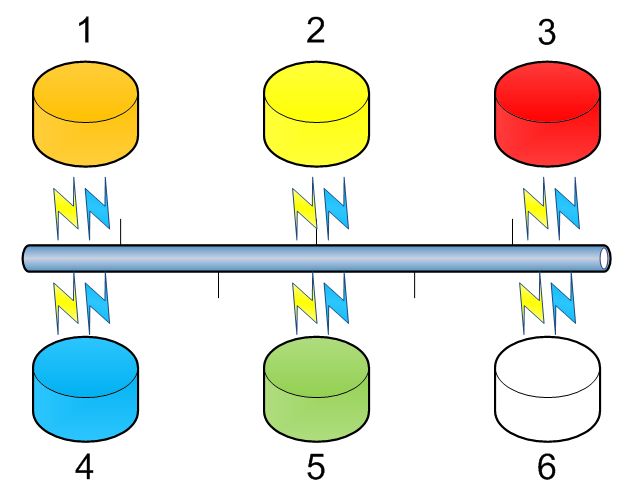 Imagine there are 6 discipline tools, an engineering environment optimized for plant engineering, a project management environment, an execution environment connecting suppliers and materials, a delivery environment assuring the content of a project is delivered in the right stages and finally a knowledge environment, capitalizing lessons learned, standards and best practices.
This results in 6 tools and 12 interfaces to a common service bus connecting these tools. 12 interfaces as information needs to be send and received from the service bus per application. Each tools will have redundant data for its own execution.
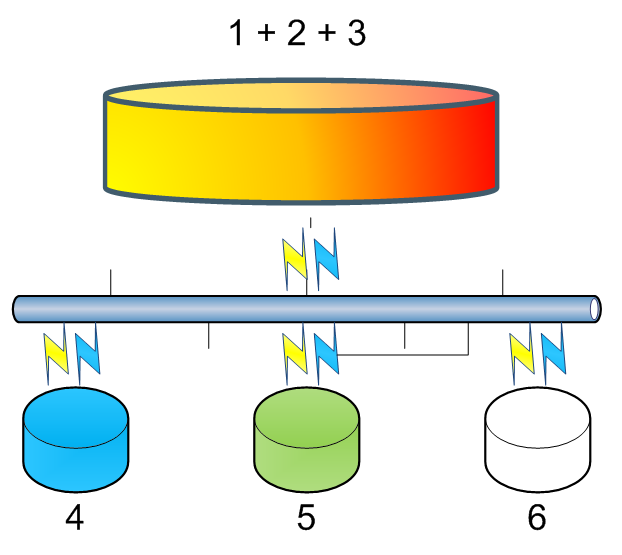
What happens if a PLM provider could offer three of these tools on a common platform? This would result into 4 tools to install and only 8 interfaces. The functionality in the common PLM system does not require data redundancy but shares common information and therefore will provide better performance in a cross-discipline scenario.
In the ultimate world all tools will be on one platform, providing the best performance and support for this EPC contractor. However this is utopia. It is almost impossible to have a 100 % optimized system for a group of independent companies working together. Suppliers will not give up their environment and own IP to embed it in a customer´s ideal environment. So there is always a compromise to find between a best integrated platform (optimal performance – reduced cost of interfaces and cost of ownership) and the best connected environment (tools connection through open standards).
And this is why both Steve and Oleg have a viewpoint that makes sense. Depending on the performance of the tools and the interaction with the supplier network the PLM platform can provide the majority of functionality. If you are a market dominating OEM you might even reach 100 % coverage for your own purpose, although the modern society is more about connecting information where possible.
MY CONCLUSION after reading both posts:
- Oleg tries to provoke, and like a soap, you might end up confused after each episode.
- Steve in his post gives a common sense guidance, useful if you spend time on digesting it, not a soap.
Now I hope you are not longer confused and wish you all a successful and meaningful 2013. The PLM soap will continue in alphabetical order:
- Will Aras survive 21-12-2012 and support the Next generation ?
- Will Autodesk get of the cloud or have a coming out ?
- Will Dassault get more Experienced ?
- Will Oracle PLM customers understand it is not a database ?
- Will PTC get out of the CAD jail and receive $ 200 ?
- Will SAP PLM be really 3D and user friendly ?
- Will Siemens PLM become a DIN or ISO standard ?
See the next episodes of my PLM blog in 2013
May 24th, 2008 was the date I posted my first blog post as a Virtual Dutchman aiming to share PLM related topics for the mid-market.
I tried to stay away from technology and function/feature debates and based on my day to day observations, describe the human side of the PLM – what people do and why . All from a personal perspective and always open to discuss and learn more.
Looking back and reviewing my 86 posts and 233 comments so far, I would like to share a summary around some of the main topics in my blog.
PLM
 In 2008, PLM awareness was much lower – at that time one of the reasons for me to start blogging. There was still a need to explain that PLM was a business strategy needed beside ERP and PDM.
PLM will bring more efficiency, and in better quality, new innovative products to the market due to better collaboration between teams and departments.
At that time the big three, Dassault Systemes, Siemens and PTC were all offering a very CAD-centric, complex approach for PLM. There was no real mid-market offering, although their marketing organizations tried to sell as-if a mid-marketing offering existed. Express, Velocity, ProductPoint where are these offerings now ?
Now, In 2012 there is an established PLM awareness as everyone is talking about (their interpretation of) PLM and with Autodesk, a company that knows how to serve the mid-market, also acknowledged there is a need for PLM in their customer base, the term PLM is widespread
The new PLM providers focus on a disconnect between PDM and PLM, as in particular the handling of enterprise data outside the PDM scope is a white space for many mid-market companies that need to operate on a global platform.
PLM & ERP
 In the relation between PLM and ERP, I haven’t seen a big change the past four years. The two dominating ERP originated vendors, SAP and Oracle were paying attention to PLM in 2008 in their marketing and portfolio approach.
However their PLM offerings in my perception, haven’t moved much forward. SAP is selling ERP and yes there is a PLM module and Oracle is having PLM systems, but I haven’t seen a real targeted PLM campaign explaining the needs and value of PLM integrated with ERP.
Historically ERP is the main IT-system and gets all the management attention. PLM is more considered something for engineering (and gets less focus and budget). Understanding PLM and how it connects to ERP remains a point of attention and the crucial point of interaction is the manufacturing BOM and the place where it is defined. The two most read posts from my blog are: Where is the MBOM and next Bill of Materials for Dummies – ETO, indicating there is a lot of discussion around this topic.
I am happy to announce here that in October this year during PLM Innovation US, I will present and share my thoughts in more detail with the audience, hoping for good discussions
New trends
There are three new trends that became more clear the past four years.
 The first one to mention is the upcoming of Search Based Applications (SBA). Where PLM systems require structured and controlled data, search based applications assist the user by “discovering” data anywhere in the organization, often in legacy systems or possible in modern communication tools.
I believe companies that develop an integrated concept of PLM and SBA can benefit the most. PLM and ERP vendors should think about combining these two approaches in an integrated offering. I wrote about this combined topic in my post: Social Media and PLM explained for Dummies
 The second trend is the cloud. Where two-three years ago social media combined with PLM was the hype as a must for product innovation and collaboration, currently cloud is in focus.
Mainly driven and coming for the US, where the big marketing engine from Autodesk is making sure it is on the agenda of mid-market companies.
In Europe there is less a hype at this moment, different countries and many languages to support plus discussions around security take the overhand here.
For me a cloud solution for sure is lowering the threshold for mid-market companies to start implementing PLM. However how to make the change in your company ? It is not only an IT-offering. Like a similar discussion around Open Source PLM, there is still a need to provide the knowledge and change push inside a company to implement PLM correct. Who will provide these skills ?
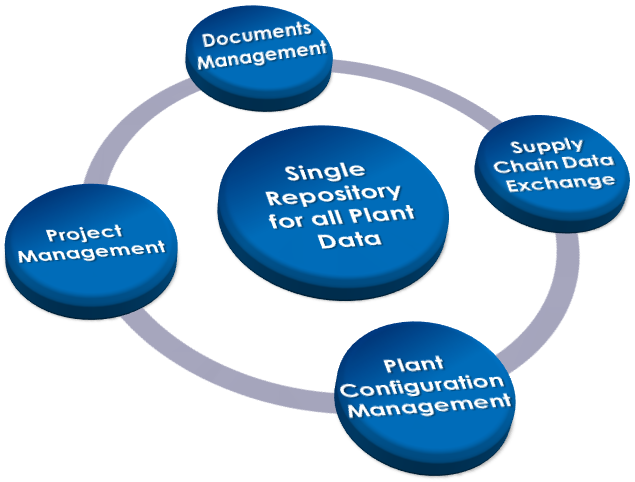 The third trend is the applicability of PLM systems outside the classical manufacturing industries.
I have been writing about the usage of PLM systems for Owner/Operators and the civil / construction industry, where the PLM system becomes the place to store all plant related information, connected to assets and with status handling. Currently I am participating in several projects in these new areas and the results are promising
People and Change
 I believe PLM requires a change in an organization not only from the IT perspective but more important from the way people will work in an organization and the new processes they require.
The change is in sharing information, making it visible and useful for others in order to be more efficient and better informed to make the right decisions much faster.
This is a global trend and you cannot stay away from it. Keeping data locked in your reach might provide job security but in the long term it kills all jobs in the company as competiveness is gone.
The major task here lies with the management that should be able to understand and execute a vision that is beyond their comfort zone. I wrote about this topic in my series around PLM 2.0
Modern companies with a new generation of workers will have less challenges with this change and I will try to support the change with arguments and experiences from the field.
Audience
Since February this year, WordPress provides much more statistics and interesting is the map below indicating in which countries my blog is read. As you can see there are only a few places left on earth where PLM is not studied. Good news !!

Although most of my observations come from working in Europe, it is the US that provides the most readers (30 %) , followed by India (9 %) and on the third place the UK (6 %).
This might be related to the fact that I write my blog in English (not in 100 % native English as someone commented once).
It makes me look forward to be in October in Atlanta during the PLM Innovation US conference to meet face to face with many of my blog readers and share experiences.
Conclusion
Reading back my posts since 2008, it demonstrated for me that the world of PLM is not a static environment. It is even that dynamic that some of the posts I wrote in the early days have become obsolete.
At the end of 2008 I predicted the future of PLM in 2050 – here we are on the right track.
There is still enough blogging to do without falling into repetitions and I am looking forward to your opinion, feedback and topics to discuss.
Related articles
- PLM misconceptions (virtualdutchman.com)

I am just back from an exciting PLM Innovation 2012 conference. With a full program and around 250 participants, it was two intensive days of PLM interaction.
What I liked the most is that the majority of the audience was focusing on PLM business related topics. The mood of PLM has changed.
In this post, I will give an impression of the event, how I experienced it without going into the details of each session.
Several interesting sessions were in parallel so I could not attend them all, but MarketKey, the organizer of the conference confirmed that all presentations are filmed and will become available on-line for participants. So more excitement to come.
First my overall impression: Compared to last year’s conference there was more a focus on the PLM business issues and less on PLM IT or architecture issues (or was it my perception ?)
DAY 1
Gerard Litjens (CIMdata Director European Operations) opened the conference as CIMdata co-hosted the conference. In his overview he started with CIMdata’s PLM definition – PLM is a strategic business approach. (Everyone has his own definition as Oleg noticed too). Next he presented what CIMdata sees as the hottest topics. No surprises here: Extension from PLM to new industries, extending PDM towards PLM, Integration of Social Media, Cloud, Open Source, Enterprise integration and compliance.
 Next speaker was Thomas Schmidt (Vice President, Head of Operational Excellence and IS – ABB’s Power Products Division) was challenging the audience with his key note speech: PLM: Necessary but not sufficient. With this title it seemed that the force was against him (thanks Oleg for sharing).
Thomas explained that the challenge of ABB is being a global company and at the same time acting as a ‘local’ company everywhere around the world. In this perspective he placed PLM as part of a bigger framework to support operational excellence and presented some major benefits from a platform approach. I believe the Q&A session was an excellent part to connect Thomas’s initial statements to the PLM focused audience.
Marc Halpern from Gartner gave his vision on PLM. Also Marc started with the Gartner definition of PLM, where they characterized PLM as a discipline. Gartner identified the following 5 major trends: Software everywhere in products, usage of social media for product development and innovation, using analytics tools to support the whole product lifecycle – after sales, service, connecting to the customer. Opportunities for existing products to deliver them through services (media content, transportation)
 Next I attended the Autodesk session, a PLM journey using the cloud, where I was eager to learn their approach towards PLM. Autodesk (Mike Lieberman) let Linda Maepa, COO from Electron Vault in the USA explain the benefits of the Autodesk PLM 360 solution. Electron Vault, a young, high-tech company, has implemented the solution within 2 weeks. And here I got disconnected . Also when the suggestion was raised that you do not need time to specify the requirements for the system (old-fashioned stuff),
I suddenly got into a trance and saw a TV advert from a new washing power, with numerous features (program management, new product introduction, …..) that was washing whiter than all the others and a happy woman telling it to the world. I believe if Autodesk wants to be considered as serious in the PLM world it should also work with existing customers and managing the change in these organizations. Usually it takes already more than two weeks to get them aligned and agree on the requirements. Unfortunate I did not have time during the breaks to meet Autodesk at their booth as I would love to continue the discussion about reality as my experience and focus is on mid-market companies. Waiting for a next opportunity.
After Autodesk, I presented in my session what are the main drivers for making the case for PLM. I also started with my favorite PLM definition (a collection of best practices – 2PLM) and explained that PLM starts with the management vision and targets for the future. Is it about efficiency, quality, time to market, knowledge capture or a more challenging task: creating the platform for innovation?
 Next I followed the Energy tracks, where I listened to Charles Gagnon from Hydro Quebec, who gave an interesting lecture called: Implementing Open Innovation and Co-Development.
At first glance this is a sensitive topic. When you innovate it is all about creating new intellectual property, and the fear that when working with partners the IP might be out of the company, Charles explained how this process of collaborative innovation was started and monitored. At the end he reported they measured a significant gain in R&D value perceived when working with external partners. And they did not use a PLM system to manage Innovation (to be investigated how they could survive)
After the lunch I continued with Jonas Hagner from WinWinD, a young manufacturer of windmills that are targeted to operate in extreme climate conditions ( a niche market). They are both implementing PLM and ERP in parallel and they did not have to suffer from years of ERP before PLM and therefore could have a more balanced discussion around part information availability / part number and more. Still I believe they have the challenge to connect in an efficient manner the services of the windmills back to their R&D organization, to do a full PLM circle.
Karer consulting together with Siemens Energy presented the case how they have designed and starting the implement the interface between their PLM system (Teamcenter) and ERP system (SAP). What was disappointing to see was that the interface between Teamcenter and SAP was relative complex (bi-directional with engineering activities in both sides) . Almost 1½ years of development of this interface and one of the main reasons, because SAP was first and they start the engineering order in SAP.
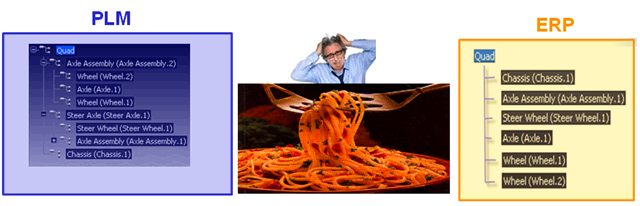
Apparently 2 years later Siemens Energy could not implement a clear distinct separation between PLM and ERP anymore and will not have to live with this complex interface. In the past I have written several times about this complexity that companies seem to accept due to political or historical reasons. Sad story for PLM – Where is the MBOM ?.

The day finished with a closing keynote from Peter Bilello, explaining how a successful PLM implementation could look like. Many wise statements that everyone should follow in case you want to come to a successful implementation (and define correctly what success is)
Thanks to Autodesk we had a nice evening reception, discussion and evaluating with peers the first day.
Day 2
 Day 2 started for me with an interesting lecture from Peter Fassbender, Head Design Center Fiat Latin America, describing how in Brazil the Fiat Mio experiment used modern social media techniques, like crowdsourcing, communities and user involvement to guide the innovation and development of a potential car. A unique experiment demonstrating that this type of projects are influence the brand reputation positively (if managed correct) and for me an example of what PLM could bring if R&D is connected to the outside world.
Christian Verstraete Chief Technologist – Cloud Strategy from HP gave an inspiring session about the open frontiers of innovation. The speed of business in the past 30 years has increased dramatically (you need to be from an older generation to be aware of this – the definition of response time has changed due to new technologies) Christian pushed everyone to think Out of the Box and to be innovative, which made me wonder how long will companies in the future build standard boring products. Will keep on innovating in this amazing pace as we did in the past 30 years ?
 Graeme Hackland, IT/IS director from the UK based Lotus F1 team presented the challenges a F1 team has to face every year due to changing regulations. I visited Lotus F1 last year and was impressed by the fact that over 500 engineers are all working around one carper year to optimize the car mainly for aerodynamics, but next to assure it performs during the years. Thousands of short interactions, changes to be implemented a.s.a.p. challenge the organization to collaborate in an optimum manner. And of course this is where PLM contributes. All the F1 fans could continue to dream and listen to Graeme’s stories but Jeremie Labbe from Processia brought us back to earth by explaining how Processia assisted Lotus F1 in a PLM value assessment as a next step.
Meanwhile I had some side discussions on various PLM topics and went back to the sessions, seeing how David Sherburne, Director of Global R&D Effectiveness from Carestream Health presented his case (open source PLM) and his analysis why an open source PLM model (based on Aras) is very appealing in their case. Indeed the business value perceived and significant lower operational costs for the software are appealing for his organization and for sure will influence the other PLM vendors in their pricing model.
Pierfrancesco Manenti, from IDC Manufacturing Insights gave a clear presentation indicating the future directions for PLM: managing operational complexity, not product complexity. As you could expect from IDC Manufacturing Insights all was well based on surveys in the manufacturing industry and clearly indicating that there is still a lot to do for companies to efficient share and work around a common product development and operational platform. New technologies (the four IT forces: mobility, cloud, social business and big data analytics) will help them to improve.

The closing keynote came from Jason Spyromilio , who was director of the European Southern Observatory’s Very Large Telescope (http://www.eso.org) and he gave us the insights in designing (and building) the biggest eye on the sky. Precision challenges for such a huge telescope mirror, being built in the high mountains of Chili in an earthquake sensitive area demonstrate that all participants are required to contribute their IQ in order to realize such a challenge.
Conclusion: This PLM Innovation 2012 event doubled the 2011 event from a year ago in all dimensions. Thanks to the sponsors, the organization and high quality lectures, I expect next year we could double again – in participants, in content and innovation. It shows PLM is alive. But comming back to the title of this post: I saw some interesting innovation concepts – now how to enabale them with PLM ?
Note: looking at the pictures in this postyou will notice PLM is everywhere. I published this post on February 29th – a unique day which happens only every 4 years. In May this year my blog will be 4 years old.
Last week I started a small series of posts related to the topic PLM 2.0. I was hoping for more comments and discussion about the term PLM 2.0, although I must say I was glad Oleg picked it up in his posts: PLM 2.0 born to die? and Will JT-open enable future of PLM 2.0?
Oleg, as a full-time blogger, of course had the time to draw the conclusions, which will take me another two weeks, hoping meanwhile the discussion evolves. Where Oleg’s focus is on technology and openness (which are important points), I will also explain that PLM 2.0 is a change in doing business, but this will be in next week’s post.
This week I will focus on the current challenges and pitfalls in PLM. And we all know that when somebody talks about challenges, there might be problems.

| Last week | : What is PLM 2.0? |
| This week: | : Challenges in current PLM |
| Next | : Change in business |
| Final post | : Why PLM 2.0 – conclusions |
The Challenges in current PLM
First I want to state that there are several types of definition in the world for PLM, coming from different type of organizations – I listed here two vendor independent definitions:

In industry, product lifecycle management (PLM) is the process of managing the entire lifecycle of a product from its conception, through design and manufacture, to service and disposal. PLM integrates people, data, processes and business systems and provides a product information backbone for companies and their extended enterprise.
Product Lifecycle Management (PLM) is the business activity of managing a company’s products all the way across the lifecycle in the most effective way. The objective of PLM is to improve company revenues and income by maximizing the value of the product portfolio
And there are more definitions. Just recently, I noticed on the PlanetPTC blog from Aibhe Coughlan a post where she promoted a definition of PLM published in the Concurrent Engineering blog. Here I got immediate a little irritated reading the first words: “PLM is software designed to enhance process efficiencies ……… and more …”
 I do not believe PLM is software. Yes there is software used to automate or implement PLM practices, but this definition starts to neglect the culture and process sides of PLM. And as Oleg was faster – read his more extended comment here
(I am not paid by Oleg to promote his blog, but we seem to have similar interests)
Back to the classical definitions
The Wiki definition gives the impression that you need to have an infrastructure to manage (store) all product data in order to serve as an information backbone for the extended enterprise. It becomes more an IT-project, often sponsored by the IT-department, with the main goal to provide information services to the company in a standardized manner.
This type of PLM implementations tends to be the same type of implementation as an ERP system or other major IT-system. In this type of top-down implementations, the classical best practices for project management should be followed. This means:
- A clear vision
- Management sponsorship
- A steering committee
- A skilled project leader and team
- Committed resources
- Power user involvement
- Communication
- …… and more …

These PLM projects are promoted by PLM vendors and consultants as the best way to implement PLM. And there are a lot of positive things to say about this approach. For many big companies implementing cPDM or PLM was a major step forward. Most of the ROI stories are based on this type of implementations and have been the showcases on PLM events. It is true that data quality increases, therefore efficiency and product quality. Without PLM they would not reach the same competiveness as they have now.
But sometimes these projects go into extreme when satisfying users or IT-guidelines
To avoid the implementation of a ‘new IT-system’, companies often have the strategy that if we already have an ERP-system , let’s customize or extend it, so we can store the additional data and perform workflow processes based on this system.
In a recent webinar, I heard a speaker saying that in their company they had the following automation strategy defined together with IT is:
- First they will see if the needed PLM functionality exists in their ERP system or is part of the portfolio of their ERP provider. If the functionality is there (this means the ERP vendor has the capability to store metadata and a factsheet mentioning the right name), there is no looking outside.
- If the functionality is not there, there will be a discussion with the ERP vendor or implementer to build it on top of their ERP system.
 I have seen implementations where the company has developed complete custom user interfaces in order to get user acceptance (the users would not accept the standard graphical interface). At that time, no one raised the flag about future maintenance and evolution of these custom environments. The mood was: we kept it simple – one single system.
I believe this closes the door for real PLM, as storing data in a system does not mean you will use it in an efficient and optimized manner. How will you anticipate on changes in business if it is just doing more with the same system?
And mid-market companies ?
The top-down approach described before is the fear of many mid-market companies, as they remember how painful their first ERP implementation was. And now with PLM it is even more unclear. PLM aims to involve the engineering department, which so far has not worked in a very procedural manner. Informal and ad-hoc communication combined with personal skills within this department was often the key for success.
 And now an unfriendly system is brought in, with low or little usability, pushing these creative people to enter data without seeing any benefits. The organization downstream benefits but this will be only noticed later in time. And for the engineering department it will take more effort to change their work methodology focused on innovation. However, in general in the mid-market, the target of a PLM project is to have a Return on Investment (ROI) in a very short timeframe ( 1-2 years). Investing in usability should be even more important for this type of companies as there is less top-down pressure to accept this new PLM system.
And flexibility ?
 In the past years we have seen that business is changing – there is a shift in global collaboration and manufacturing and from the recent history we can learn that those big enterprise projects from the past became a threat. Instead of being able to implement new concepts or new technology, the implementation became more and more vendor monolithic as other capabilities and applications do not fit anymore. This is against the concept of openness and being flexible for the future. I believe if PLM becomes as rigid as ERP, it blocks companies to innovate – the challenge for big companies is to find the balance between stability and flexibility (This was the title from Sony Ericsson’s presentation at the PLM forum in Sweden this year)
And again for mid-market companies who do not have the budget or resources to invest in similar projects. They have less a drive to optimize themselves in the same manner as big companies do as flexibility is often their trade mark (and capability to innovate) . So PLM for the mid-market will not work in the classical way.
This is one of the reasons why a mid-market PLM standard has not yet been found (yet ?). From the other hand many mid-market companies are dealing with PLM practices although often it is more close to PDM and CAD data management. And mid-market companies do not change their organization easily – there is more a departmental approach avoiding therefore a change in business.
To summarize the biggest challenges in current PLM described in this post:
- PLM is considered complex to implement
- PLM is a huge IT-project
- PLM requires change and structuring – but what about flexibility
- Where is the PLM value and ROI – user acceptance
- PLM for the mid-market – does it exist ?
Conclusion: I have been writing about the PLM challenges in the past, see the links below if you are interested in more details on a specific topic.
In 2008,I thought that Out-of-the-Box PLM systems and standard functionalities could bring a solution for the mid-market, perhaps future solutions based on the cloud. However I learned that if you want to do real PLM in a modern manner, you need to change the way you do your business – and this I will explain in my upcoming post.
Related links:
 Last weeks have been busy weeks and I have seen various PLM candidates all around Europe. As these companies were mid-market companies, I noticed again how difficult it is for these companies to follow the ideal path towards PLM.
For those reading my blog frequently they might remember my definition of mid-market and PLM. For newer readers I will give my definitions again, as everyone has their own definition.
Mid market company: For me the definition of a mid-market company does not have to do with revenue or the amount of people working for this company. I characterize a mid-market company as a company, where everyone has a focus on the company’s primary process. There is no strategic layer of people, who are analyzing the current business and defining new strategies for the future. In addition, the IT-staff is minimal, more seen as an overhead than as strategic. Mid-market companies have their strength in being flexible and reacting fast on changes, which might contradict with a long term strategic approach.

As what happens if you are only in a reactive mode – it can be too late.
PLM: For me PLM is not a product but a vision or business approach based on a collection of best practices (per industry). Main characteristics of PLM are centralizing all product knowledge (IP) throughout all the lifecycle stages and a focus on best practices and immediate visibility on all lifecycle stages. Combining concept, planning, development, production planning and after sales / service into one integrated process. It is more than concurrent engineering, it is about sharing data and ownership of data through different departments. And this means business transformation, breaking through traditional barriers. Of course PLM vendors have a slight different definition in order to differentiate themselves from other vendors. For example more focus on a virtual product definition (CAD PLM vendors) or a focus on efficiency and one single platform (ERP PLM vendors)
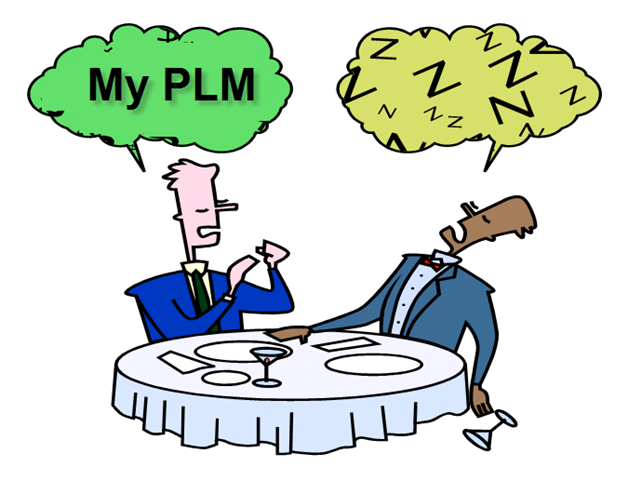
Who will initiate this change ?
And these two definitions already raise the questions I want to reflect here as I experienced again in two recent visits that the pain to move to PLM is here.
First what is the result of a reactive mode, even when it is a quick reaction ?
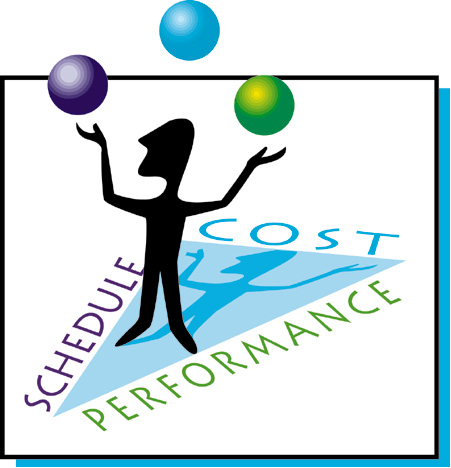 A reactive mode leads to a situation where a company will never be able to differentiate rapidly from their competition. As every change takes time to implement, it is logically that a real business change will not be implemented as a quick reaction. The company needs to have a long term vision. And this is one of the things I noticed talking with mid-market companies. Ask these questions: “Where do you want to be in five years from now” and “How do you make sure you achieve these goals (if goals exist)” and often you find the company is depending on the business instinct of the founder(s) and has no real answers for the long term future.
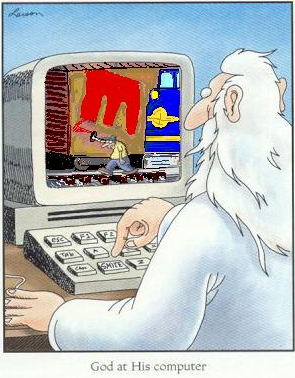 This is of course a result of the typical mid-market company, they have no internal people who will step outside the daily hectic and work on a change. And being reactive always means you are (a little) behind. And this was the situation in one of the companies that I have met recently. There was an initial understanding of the values that PLM could bring, but when talking about some of the basic principles of PLM, the answers was: In our company ERP is God. This means real PLM has no chance – you do not want to fight against God.
And now the discussion who can initiate the change towards PLM
 Now another example of a mid-market company that had a long term PLM vision but got trapped in their own approach. The company has been growing fast and like many European companies, production is done in China. And this causes collaboration issues around communication and quality between Europe and China as the company only knows CAD data management and ERP. The engineering manager was assigned to solve these issues.He did not get a full strategic assignment to look at the complete picture, but the management pushes him to solve the current pains, having the PLM wishes still in mind.
And solving the current pains lead again to function / feature comparison with a short term justification, believing that in the future all will fit in the PLM vision, as the potential resellers for the new solution said: “Yes we can”. Have you ever heard a reseller say “No we cannot”
The result, the engineering manager has to make a decision based on the ‘blue eyes’ of the reseller as he does not get the mandate and power from his management to analyze and decide on a PLM strategy for the long term. For one of the resellers talking about the details of PLM was even more a disadvantage as it creates an impression that PLM is complex. It is easier to sell a dream. A similar situation as I described in my posts: Who decides for PLM in a mid-market company
My conclusion
Although I am aware that many mid-market companies implement basics of PLM, it is frustrating to see that lack of priority and understanding of the management in mid-market companies blocks the growth to full benefits for PLM. The management is not to blame, as most PLM messages either come from the high-end PLM vendors or from product resellers both not packaged for the mid-market. See PLM for the mid-market – a mission impossible ?
PLM is a cross-departmental solution and the management should look for partners who can explain the business values and share best practices for mid-market companies business wise.
The partner is 50 % of the success for a PLM implementation.
Do you recoginize similar situations ? How would you address them ?
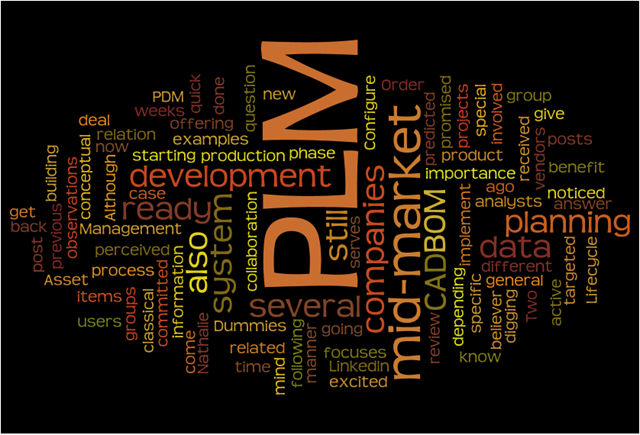
My PLM blog cloud based on Wordie – see the virtualdutchman blog cloud
 In my previous post, BOM for Dummies related to Configure To Order, I promised to come back on the special relation between the items in the BOM and the CAD data. I noticed from several posts in PLM and PDM groups that also the importance of CAD data is perceived in a different manner, depending on the background of the people or the systems they are experienced with.
So I would like to start with some general statements based on these observations.
 People who are talking about the importance of CAD data and product structures are usually coming from a background in PDM. In an environment where products are designed, the focus is around data creation, mostly CAD data. The language around parts in the BOM is mostly targeting design parts. So in a PDM environment CAD data is an important topic – therefore PDM people and companies will talk about CAD data and vaults as the center of information.
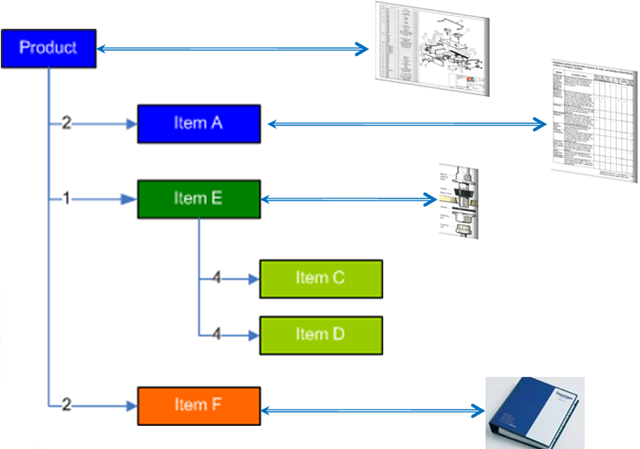
When you are working in a PLM environment, you need a way to communicate around a product, through its whole lifecycle, not only the design phase but also supporting manufacturing phases, the possible changes of an existing product through engineering changes, the traceability of as-built data and more. In a PLM environment, people have the physical part (often called the ERP part) in mind, when they talk about a part number.
As PLM covers product information across various departments and disciplines, the information carrier for product information cannot be the CAD data. The BOM, usually the mBOM, is the main structure used to represent and produce the product. Most parts in the mBOM have a relation to a CAD document (in many companies still the 2D drawing). Therefore PLM people and companies understanding PLM will talk about items and products and their lifecycle as their center of information.
CAD data in relation to Engineering to Order
The above generalizations have to be combined with the different main business processes. In a strict Engineering To Order environment, where you design and build a solution only once for a specific customer, there is no big benefit of going through an eBOM and mBOM transition.
During the design process the engineer already has manufacturing in mind, which will be reflected in the CAD structure they build – sometime hybrid representing both engineering and manufacturing items. In such an environment CAD data is leading to build a BOM structure.
And in cases where engineering is done in one single 3D CAD system, the company might use the PDM system from this vendor to manage their Bill of Materials. The advantage of this approach is that PDM is smoothly integrated with the design environment. However it restricts in a certain matter the future as we will see in further reading.
 Not everyone needs the Engineering to Order process !
Moving to an integrated, multi-disciplinary engineering process or changing the main process from Engineering To Order to Built To Order / Configure To Order will cause major challenges in the company.
I have seen in the recent past, several companies that would like to change their way of working from a CAD centric Engineering To Order process towards a more Built to Order or Configure To Order process. The bottle neck of making this switch was every time that engineering people think in CAD structures and all knowledge is embedded in the CAD data. They now want to configure their products in the CAD system.
For Configure to Order you have to look at a different way to your CAD data:
Questions to ask yourself as a company are:
- When I configure my products around a CAD structure, what should I do with data from other disciplines (Electrical/Tooling/Supplier data) ?
- When I upgrade my 3D CAD system to a new version, do I need to convert all old CAD data to the newest versions in order to keep my configurations alive?
- When configuring a new customer solution, do I need to build my whole product in CAD in order to assure it is complete?
- In Configure to Order the engineering BOM and manufacturing BOM are different. Does this mean that when I go through a new customer order, all CAD data need to be handled, going through eBOM and mBOM transition again?
For me it is obvious that only in an Engineering to Order environment the CAD data are leading for order fulfillment. In all other typical processes, BTO (Built to Order), CTO (Configure to Order) and MTS (Make to Stock), product configuration and definition is done around items and the CAD data is important associated data for the product definition and manufacturing
In the case of order fulfillment in a Configure to Order process, the CAD structure is not touched as configuration of the product is available based on items. Each item in the mBOM has it relations to CAD data or other specifying information.
In the case of Built To Order, a huge part of the product is already configured, like in Configure To Order. Only new interfaces or functionality will go through a CAD design process. This new design might be released through a process with an eBOM to mBOM transition. In cases where the impact or the amount of data created in engineering is not huge, it is even possible to configure the changes immediately in an mBOM environment.
 A second point, which is also under a lot of discussion in the field ( PLM interest groups), is that PDM is easily to introduce as a departmental solution. The engineering BOM is forwarded to manufacturing and there further (disconnected) processed. The step from PDM to PLM is always a business change.
When PDM vendors talk about ERP integration, they often mean the technical solution of connecting the two systems, not integrating the processes around the BOM (eBOM/mBOM transition) 0r an integrated engineering change (ECR/ECO). See how easy it is according to some PDM vendors:
or
PLM requires an adaptation of all departments to work different and together around a single product definition. Especially in a mid-market company, this is a big issue, as all product knowledge is stored in the CAD data and the knowledge how to produce the product is stored in the mBOM on the ERP side. These environments are often disconnected.
Conclusion: In the context of PDM the importance of CAD data is clear and for companies following a strict Engineering To Order process the main source of product knowledge. Companies following the Built To Order / Configure To Order process should configure their products around items to keep flexibility towards the future.
Companies with the intention to move to Built To Order or Configure To Order should not invest too much in CAD data configuration as it creates a roadblock for the future.
In my next post I will address the question that comes up from many directions, addressed by Jim Brown and others, as discussed in one of his recent posts around a PLM standard definition and more ….
 I realized that time is flying when you are busy, and I promised to publish the conclusion from my previous post: More on who decides for plm in a mid market company. In my two previous posts, I described the difficulties companies have to select the right PLM system. So far I discussed the two extremes, the silent approach where a possible bottom up approach was discussed and as the opposite where an ‘academical’ approach was followed.
Now it is time to get the answers on the academical approach.
These were the questions to be answered in the previous post:
- How much time has passed since the management decided PLM was good for their organization?
- How independent is the consultancy firm?
- Did they consider open source PLM as a solution?
- What was the ranking of the PLM vendors?
How much time has passed since the management decided PLM was good for their organization?
 The whole process of selecting a PLM system often takes more than one or two years, starting from the first activities till the final conclusion to start. I believe this is unavoidable, as especially in mid-market companies the business values that PLM can bring are not always discussed and realized on the strategic level.
However, I believe the recent years PLM has been recognized by analysts, by software vendors and many young companies as a necessity for innovation and in the long term remaining competitive. And this is not only in the classical domains where PLM started – automotive / aero / industrial equipment. PLM value is everywhere in different industries, even apparel for example.
For companies that are now in the decision process, I believe 2009 and early 2010 are the years to decide, because a recovery of the economy might put back the focus on execution and not on strategy and they might miss the management focus for PLM. And as I wrote in a previous post, companies who made the best pit stop will benefit upmost.
For companies still in doubt: It is now or never
How independent is the consultancy firm?
It is clear that real independent consultancy firms do not exist – even if a consultant wants to be independent, there are three challenges to meet:
- How can a consultant evaluate or judge PLM systems they have not seen?
- How much experience does the consultant have in your business?
- How much work is there required in the project for the consultant?
 As you can imagine, reviewing the above challenges, you will realize that consultants usually specialize in systems, where their expertise it required – as they also want to make a living. Consultants cannot afford to be an academic institute, as coming back to the previous point, all consultancy work at the end will be paid by the customer.
So to conclude on this point, if you want to be cost-effective, a company should do already a pre-selection based on systems and possible implementation partners, that fit naturally to their type of business and then evaluate how consultancy can be achieved.
What you will find out is that the major ‘expensive’ packages have loads of consultants to offer en the more and more you go into a mid-market environment, consultants become rare. For software from PLM vendors you will usually find a reseller network with people close to your offices that can support you. For Open Source software you will need to find the consultancy services through their software delivery program.
Anyway remember: 50 % of the success of a PLM implementation is based on the right implementation approach and partner not on the PLM functions and features.
Did they consider open source PLM as a solution?
 No, because the consultant was not familiar with it, and discouraged the company to look at it. In general Open Source PLM, like PLM On-Demand are interesting trends to follow and should not be neglected. However the focus and approach for this type of solutions is different. I will not generalize at this moment as also I have no clear picture where Open Source PLM or PLM on Demand would be a big differentiator. I will try to evaluate and report it in future posts.
Comments from Open Source PLM Vendors or On Demand PLM Vendors are welcome to complete the PLM selection approach.
What was the ranking of the PLM vendors?
Ranking was done by the management, the selection team and the design department. These were the results plus their major comment:
Management
1. The slide show PLM provider – they liked the business pitch
2. The CAD supplier with PLM features and gadgets – good guys – we know them
3. The PLM provider who showed everything – too much handling of data – too complex
Selection Team
1. The PLM Provider who showed everything – they really did it
2. The CAD supplier with PLM features and gadgets– we understand where they are going
3. The slide show PLM provider – do they really have a solution?
The Designers
1. The CAD supplier with PLM features and gadgets– he knows what we want
2. The slide show PLM provider– could be a good solution too
3. The PLM Provider who showed everything – too complex, it will limit our productivity
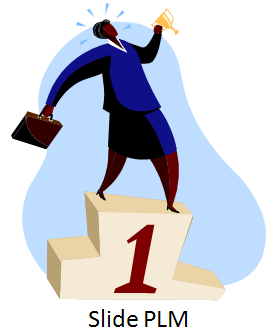 As the management had the final vote, they decided for the slide show PLM Provider, as they felt most comfortable with them.
The reason to drop the CAD supplier was that they were too afraid this provider does not know all about PLM. Both management and users felt the PLM provider that showed everything was too complex, this opposite to the project team where the members were very familiar with PLM capabilities after two years investigation and many demos and trade shows.
Conclusion: Selecting PLM, even in an academical manner is a subjective process. As in general the customer does not exactly knows what he needs and often the PLM provider shows too much in detail, the real journey starts at implementation time. And in this stage you need an experienced implementation partner who can match and communicate the expectations
 Two weeks ago I was writing about the Silent PLM approach. What I showed in that post that often the PLM vision as a complete vision does not exist in all layers of the organization.
Often the management in is not aware of where and how PLM can have an impact. In the Silent Management approach, one or more visionary people believe they can introduce PLM by starting it in their department, and from there grow and extend the impact of PLM. As I concluded, this approach usually fails in most of the cases as when the decisive step comes to extend PLM to other departments and to change current processes, this is the point where is mostly gets stuck.
Other departments and the management do not see how this engineering / CAD extension could benefit for them and the whole organization. Why not extending our ERP system as this already exists ? And here a stand still will come up until a push comes. The push can come from the top or from the outside world. From my experience more then half of the companies that started this silent PLM approach got stuck where they are ……..
So this time another approach, called the academical approach. And again a disclaimer, I am generalizing and putting some points a little more in the extreme to demonstrate the difference between the approaches. Any similarity with the real world is pure coincidence
Approach 2: Academical PLM
Inside our mid-market company ACCPY, the management has understood that PLM will bring a lot of benefits and in case they were not aware of it, they have learned from analyst reports, from blogs and from their network that PLM should bring a lot benefit for them.
 So the management decides to prepare and educate themselves and they start a PLM taskforce inside ACCPY to collect and digest all the information. The team has enthusiastic members from all departments and starts buying some books and reports on PLM. In addition they visit some PLM events all around the country and sometimes around the continent. These visits lead to contact with PLM Vendors who also start to educate why their PLM is the one fitting ACCPY the best. After one or two years of education they are theoretical skilled and know to differentiate between EDM, PDM, cPDM and even they learn to understand the difference between PDM and ERP.
As a conclusion of their learning stage the PLM taskforce presents to the management a firm report, explaining what is PLM and how ACCPY can benefit from it plus recommendations how to proceed.
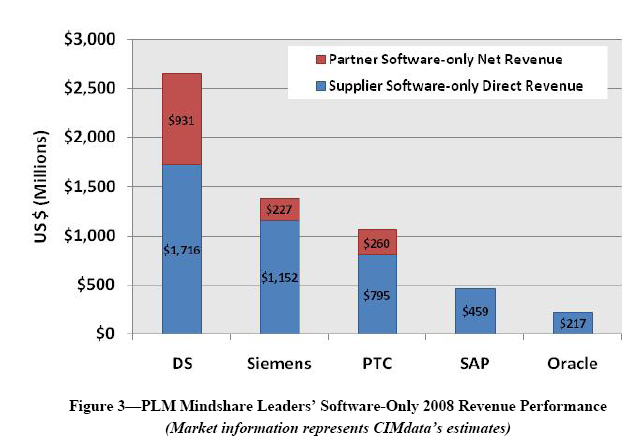 The management is happy with the result, that what they thought two year ago was really valid and agrees with the report and recommendations. Now the selection of the PLM system needs to be done and who will be the implementation partner. Although all PLM vendors have been knocking on their door already to explain the benefits and implementation approach from their solution, ACCPY decides to hire an ‘independent’ PLM consultancy firm to assist with the selection of the solution.
The consultancy firm starts with interviewing the key members of ACCPY, in order to understand the major processes and the needs per department. A month later they present to the management a PLM Vendor Selection Procedure, where in 15 pages the PLM Vendor has to explain and confirm requirement per requirement, the implementation approach and give a budget estimate.
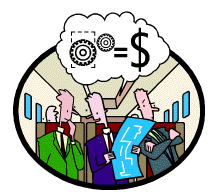 This RFQ will be sent to 5 PLM vendors which were already in touch with ACCPY since the PLM research started. Also the consultancy firm brought in a company which they new very well. It takes a few weeks for the consultancy firm to compile the RFQ and two months later the responses are there.
From the received proposals three PLM vendors are invited to benchmark their system and company based on a business case developed by the consultancy firm together ACCPY.
PLM Vendor 1
The first PLM vendor gives a standard demo of the system and explains that the business case is well known to them and therefore instead of showing it, they give a whole set of screenshots and references. The attendees had a good feeling with this vendor
PLM Vendor 2
The second PLM vendor tries to follow exactly the business case as defined. The attendees liked the fact that all was demonstrated so well, however the PLM system seems to be rather too complex and giving a lot of overhead to the engineers, according to their impression.
PLM Vendor 3
The third PLM vendor was already known to the company as they were also providing the 3D CAD system. In their presentation they explained how well they knew ACCPY already and that the business case was too artificial. They demonstrated some gadgets of their PLM system which none of the competing vendors could do, thanks to their tight integration with the CAD system. The attendees were impressed, however a few days later, they were asking themselves, why were those gadgets needed ? None of the other vendors talked about it and it was also not part of the RFQ.
 So now it was time for the consultancy firm together with the task force to process all the information and to determine the final score. On product features they had a nice comparison – only hard to tell what was most important. On usage it was more difficult, as they got three different approaches during the benchmark, so the scores for this section was rather artificial. Also the financial part seemed to be hard to compare but at least it gave an indication.
As it is an academical approach, my post for this week ends here. We need to give the ACCPY task force together with the consultancy firm some time to build a justification for their choice and next week we will discover how this story ended. Meanwhile ask yourself:
- how much time has passed since the management decided PLM was good for their organization ?
- how independent is the consultancy firm ?
- did they consider open source PLM as a solution ?
- what was the ranking of the PLM vendors ?
- read the book Blink the power of thinking without thinking about intuition
Conclusion (so far): Academical PLM takes time and it would be unfair to explain it all in one post.
So next week the real conclusion.
 This week I realized that, although I believe the benefits of PLM are more and more accepted in mid-market companies, the decision how to start and where to start with PLM is often not clear. I recognize several approaches which I will describe in this and some upcoming posts.
All persons in this post are fiction and in case you recognize these persons in your company, it is pure coincidence. Instead of talking about approaches,I was tempted to call it strategies, but when you read my observation you will realize the word strategy would not fit.
Approach 1: The silent PLM
 Inside our company, often there is an engineer or an engineering manager, who got caught by the PxM virus. The PxM virus is a modern virus, which makes you a believer that PDM or PLM will bring your company a lot of benefits. Documents and proof points of the severe impact exist all around the world. However nobody has gotten infected so far in this company. Everyone is working the way they worked since many years and life is secure and predictable.
Now this infected engineer is getting exited and dreams about the introduction of PLM in his company and how he will become the hero of the company and gets a big promotion. Unfortunate for him in this kind of business there are no big bonuses to collect, so the honor of promotion is already a big achievement.
So the first thing this engineer does is chatting with his peers and friends to find out where PxM has been implemented successful and he studies some success stories which he learned from his network.
Now the challenge starts.
He goes to the management and shows a nice PowerPoint, explaining why the company needs PxM and what are the expected benefits, based on reference stories. The management has no real clue what he is talking about, but it looks promising and they allow him to select a PxM system for his department and to start a pilot.
 The engineer already knows which PxM system to choose. The one, recommended by the friendly reseller, who sold them their 3D CAD system (which is a success) and worked hard with him to finalize the slides. As requested by the management he had to invite two other PxM vendors to make an objective selection and at the end an impressive comparison matrix is shown to the management why system A has been chosen.
Now the implementation starts and step 1 is very successful. The document management part around the CAD system goes smoothly and everyone in the engineering department starts to be happy.
Following this successful implementation there are two options:
- the engineer does not get promoted and the implementation ends. It will remain a silent document management implementation and the dream is put aside.
- the engineer gets promoted and continues to push his vision as now he has a broader audience to spread the PxM virus. We will follow this story line…….
The engineer gets promoted and continues to push his vision
This is the best that can happen and the engineer, who now became the head of engineering, starts to express his vision to his fellow managers, explaining the advantages of PLM. Notice, he is now talking about PLM as the scope has been extended beyond product data management, involving other disciplines in the organization.
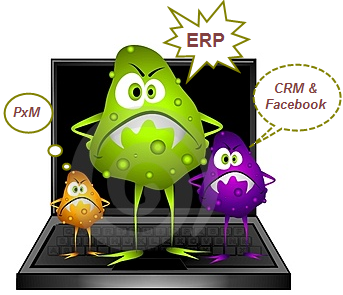
And here the head of engineering discovers that his fellow managers are also infected by a virus. Not the PxM virus, but one of them has already for many years the ERP virus. And as the ERP virus addresses the operational and financial tasks in the organization, the management trusts him. The sales and marketing department seems to be infected by CRM, but currently they caught a social disease, which made them push for all kind of communities. The management either likes it (as their kids are also on Facebook) or dislikes it, because they believe work is a serious business and being on internet all day is considered gaming.
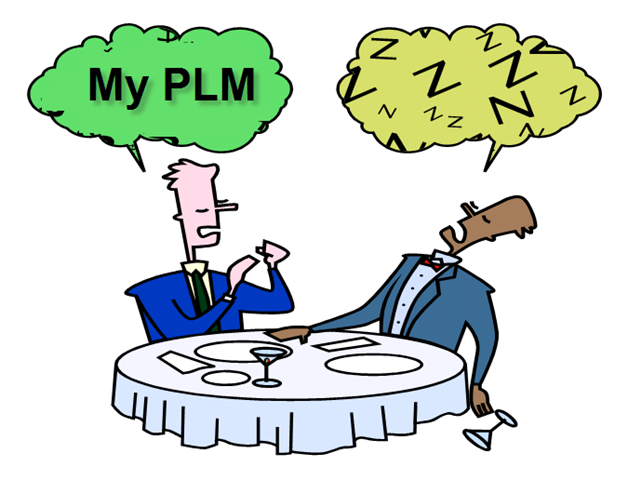 So the head of engineering realizes that he has some freedom within his department, but the other departments and the management have their own priorities. And PLM is not on their list. Together with the friendly CAD reseller, who meanwhile was promoted to be Senior PLM Consultant, they work on a perfect PLM environment within the engineering department and they believe their success will show off in the upcoming years.
And then the crisis came and the company had to cut budgets. To be continued in (hopefully) 1 or 2 years
Conclusion: The silent PLM approach has a huge chance to fail as there is no corporate vision and management push to get PLM implemented. PLM should be addressed top-down. As in many mid-market companies there was also no strategically partner, who could assist the management to build a vision and to set priorities.
Next week:
approach 2: Academical PLM
 Last week was a week of transition. As I wrote in my previous post, I finalized a traditional PLM 1.0 project ( I will come back on this term ‘traditional’ PLM 1.0) and now probably because of the sunny days and some interesting articles I read (each word goes to a different article), I am reflecting what it means to think about the new trends: WEB 2.0 or even PLM 2.0
In this post I will try to explain the developments I have seen so far in the mid-market and from there project what might happen.
In the 80’s there was no PDM or PLM in the mid-market. This was the time most companies were moving away from the drawing board towards CAD. Most of the CAD was 2D and at that time in the mid-market AutoCAD was the dominant CAD software.
 At that time I was working for the biggest AutoCAD distributor in the Netherlands (picture on the left). This was the golden age for hardware and software resellers – margins were high and there was little or none IT-knowledge inside mid-market companies. In order to keep the high margin we provided a free helpdesk for our customers to differentiate from others. It was an interesting time. Prospects came to our demo room to plot a drawing of A0 format and to discuss the quality of the lines and the hatching as compared to handmade drawings. There was always the discussion if CAD was more productive and must of us agreed that benefits only came when rework or changes were needed. In parallel we offered a training course for the heads of a design department how they learned to understand if their designers were productive. They were used to observe the behavior of the draftsman and the minor bar on the drawing board and from there they understood if someone was productive. We were talking about the new digital generation that would replace the people at the drawing board.
Are there still drawing boards ? Is there still free support as the margins are high ? This was 20 years ago.
 Then slowly 3D CAD was introduced for the mid-market, initially only on Unix boxes, but with the introduction of Microsoft Windows it became achievable – SolidWorks for sure was leading in this area. Hardware became already more a commodity so the customer relation changed from free support to paid support, which required quality and knowledge. At that time in my company, we also saw the first demands for what customers called an “engineering database”. In the 2D world it was all about drawing management, now with 3D the focus was on managing the whole product. Initially called EDM (Engineering Data Management), later evolving in Product Data Management. The term PDM was not known at that time and I remember one of our customers visiting us with a sample of 13 reports – drawing list, spare part list, manufacturing BOM, etc. He told us: “I need a system that can generate these reports for me at anytime”. The solution: we implemented a PDM system for this customer. At the end of the nineties 3D was introduced in the mid-market combined with PDM. We were talking about the new generation of people that thinks in 3D which would replace the people who still worked in 2D
Are we still working with 2D ? Do we still look for support on hard- and software ? This was 10 years ago.
 Then came the era of connectivity, initially through the first internet wave, leading to terms as cPDM and ultimately PLM. Instead of focusing on productivity in a single department, the intention was to focus on collaboration between departments, development teams and to address the whole product lifecycle. Specially Dassault Systems extended this concept by focusing on the process and virtualization: test and build your product virtually before you spend any money on prototypes. Autodesk does the same in different words, they call it Digital Prototyping and they try to avoid talking about the processes as here we touch the most sensitive point in mid-market companies: touching or changing processes – ‘classical PLM 1.0. And this is also what I read between the lines of Jim Brown’s post Is innovation or product pipeline killing profitability ? As long as we do not change our product development process but focus still on doing the same with better tools, the real innovation will not come. We are now talking about the global collaboration generation that has to learn to work together and replaces the people who are not changing their processes.
Are we still solving our departmental problems only ? Can we survive keep on doing the same ? This is now !
And meanwhile mid-market companies are learning to understand and digest the above, we already see the new wave coming. WEB 2.0 – social networking – social collaboration – PLM 2.0 – communities and more. Instead of companies working on their own data, the future is to work in communities, live data, cross-company with employees, who are focused as a team to bring a result, we do not send so much emails anymore, we chat, we twitter, we …….. and more. In addition as we will see the trend that teams have members from all around the world, the question comes up: What is the standard communication language ? German (past) , English (present), Chinese (future) ? Here I am a big fan and believer of the Dassault vision that 3D becomes the global language for communication as the people participating do not come from the same educational background anymore – so it easier to see what you mean. Meanwhile the futurists are all the time talking about the aging workforce (a lot of people plan to retire), but if you read back, you will notice every ten years we are talking about an aging workforce. Every time there was a new generation picking up the new capabilities and challenging the next generation.
Are we in 2020 a global, 3D twittering world ? What is each individual’s added value ? What are companies doing to anticipate to the above trends ? It looks like it is going to happen and the current economical downturn allows us to anticipate even earlier till the next pit stop.
A thought I take with me on the summer holidays.
(Yes, in Europe we still have holidays that are so long you have time to think about work –
you can find me on the island below in August)

 Jos Voskuil's Weblog
Interesting reflection, Jos. In my experience, the situation you describe is very recognizable. At the company where I work, sustainability…
[…] (The following post from PLM Green Global Alliance cofounder Jos Voskuil first appeared in his European PLM-focused blog HERE.) […]
[…] recent discussions in the PLM ecosystem, including PSC Transition Technologies (EcoPLM), CIMPA PLM services (LCA), and the Design for…
Jos, all interesting and relevant. There are additional elements to be mentioned and Ontologies seem to be one of the…
Jos, as usual, you've provided a buffet of "food for thought". Where do you see AI being trained by a…