
You are currently browsing the category archive for the ‘Design for Sustainabillity’ category.
 Do you ever think about where we’ll be ten years from now? I’ve noticed I ask that question more and more these days. Probably because I have the time, not being involved anymore in day-to-day business and alerts.
Interestingly, we tend to assume that long-term thinking is someone else’s job — left to business management and governments. Roadmaps, strategies, and vision stories have always been part of my work with companies.
And yet, the dominant reality right now is a dramatic focus on the short term — driven by populism on one side and quarterly profit targets on the other. The result is a collective inability to make decisions that matter for the next decade, let alone the next generation.
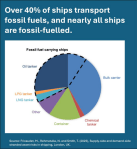 The current war in the Middle East has made something painfully visible that many of us already knew: we are dangerously dependent on fossil fuels.
Around 40 percent of global shipping is tied to fossil fuel supply chains. Countries that have not invested in energy independence are now feeling that vulnerability acutely.
The energy transition is not just an environmental ambition — it is a geopolitical necessity.
- China understood this years ago and has been investing accordingly.
- AI data centers are now one of the fastest-growing sources of electricity demand, and even in Texas, they are building wind and solar parks to keep that energy demand under their own control.
- And Cuba — pushed by American sanctions — has been forced to innovate into wind and solar energy, with Chinese support. These are not coincidences.
They are signals that working on an energy transition makes you less vulnerable!
A real “burning platform”!
While we see burning platforms in the Middle East, we are also in a classic “burning platform” situation — a phrase from the world of change management that captures a simple truth: people only change when staying the same becomes more costly than changing.
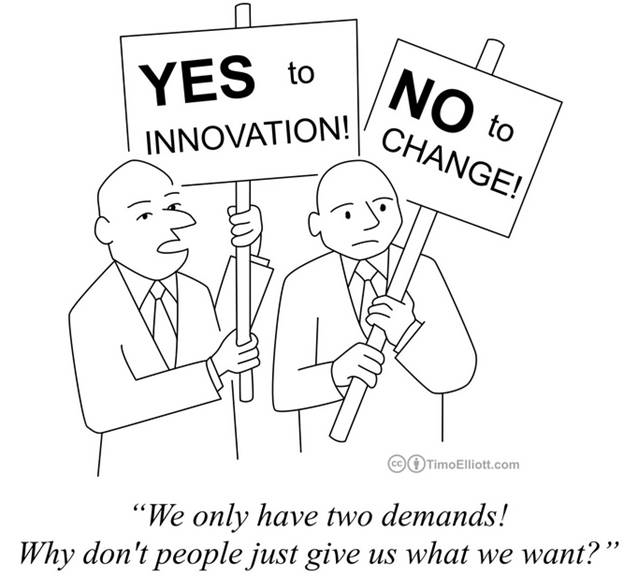
It’s a depressing observation about human nature — and one I keep coming back to whenever I see exciting possibilities on the horizon that we simply refuse to act on.
The fossil fuel dependency is one burning platform, willingly used at the moment by those countries and companies that are benefiting from this industry.
The downside is that the path towards a more circular economy — reducing waste, rethinking production, designing for longevity — is equally urgent and equally neglected.
This is precisely why the PLM Green Global Alliance (PGGA) exists — to keep these conversations alive and focus on the topics that support a sustainable future.
Four weeks ago, I launched a survey among our new LinkedIn group members. Due to a low response rate, I extended it to the whole group two weeks later.
The takeaway? Even within this community, the energy transition and sustainability don’t appear to feel like a burning platform — something demanding urgent action.
PLM Green Global Alliance survey
A quick overview of the responses — given the low number of replies, treat this as an indication rather than a statistically solid survey.
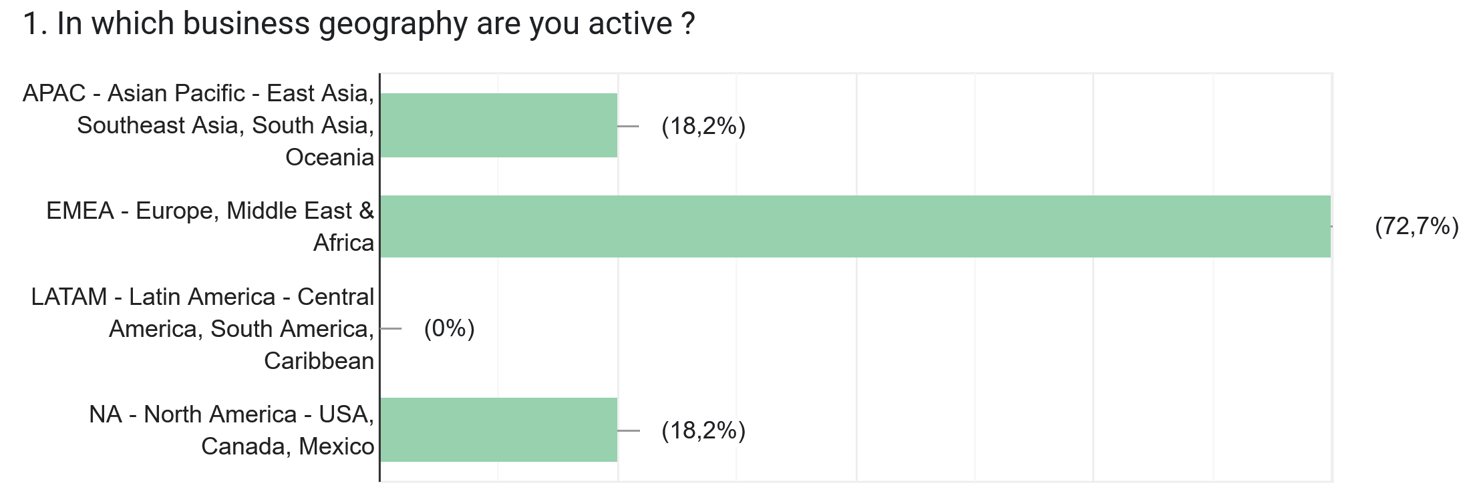
Although we launched the PGGA as a truly GLOBAL alliance — with core team members from both the US and Europe — the membership skews heavily toward the EMEA region. The political climate and culture of each region explain a lot about that.
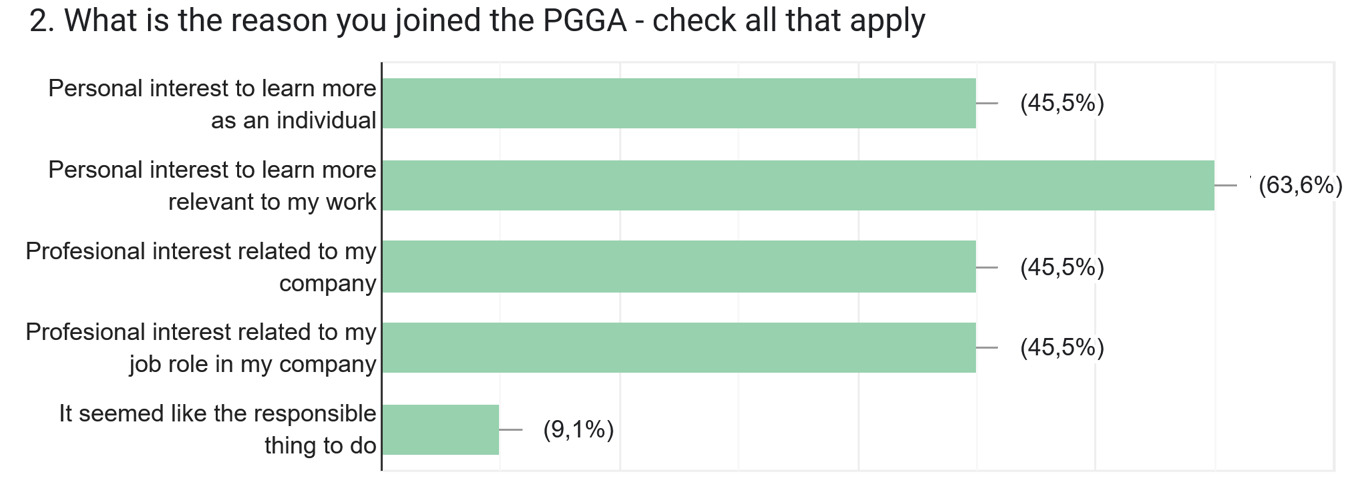
It’s encouraging to see that most people joined out of personal interest, with professional motivations also playing a role. That tells us the PGGA needs to keep its focus on sharing real experiences — not just theory.
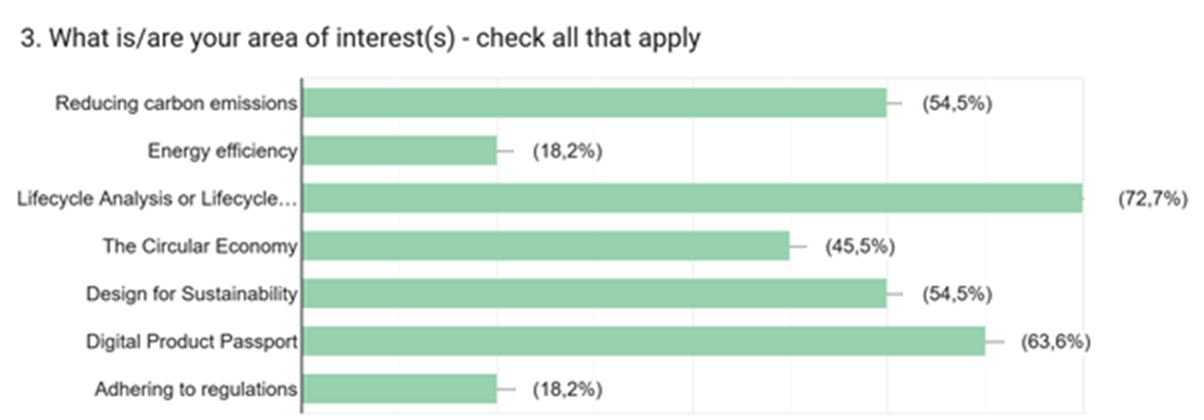
LCA (Life Cycle Analysis or Life Cycle Assessments) stands out as a strong area of interest — and the good news is that several of our core team members are actively working on it. Don’t hesitate to post your questions to the group.
On the Digital Product Passport (DPP), we’re planning an interview and/or webinar. The DPP is a great example of a topic that’s as much about digitizing product information as it is about methodology.
As you may have seen the post The show must go on – but will it be sustainable? last week. Erik Rieger and Matthew Sullivan, the Design for Sustainability team, are actively looking for more participants to help shape guidance in this area.
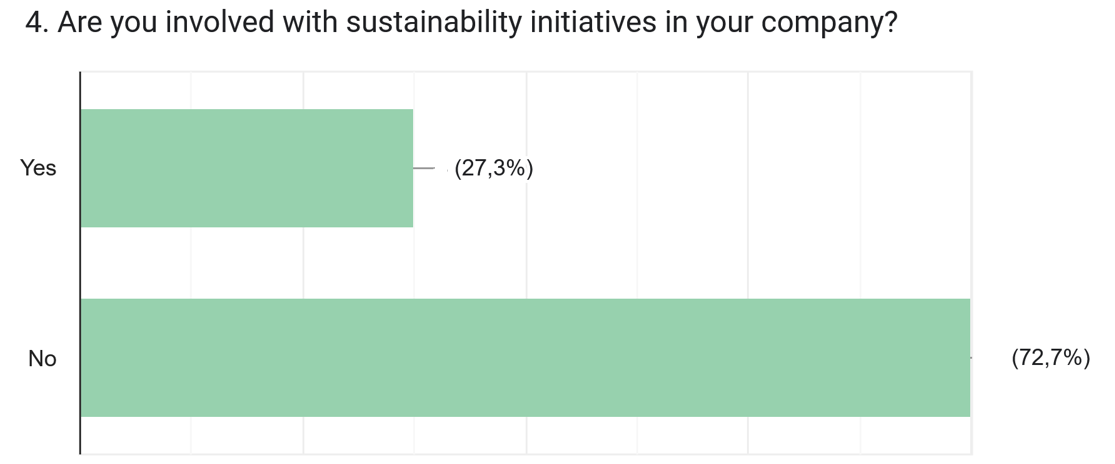
The answers illustrate that for most people, working on sustainability activities is (still) not part of their daily mission.

Question 5 allowed the participants to vote for topics of interest, and we can summarize the answers as follows:
- Understand what PLM solution providers are offering (we continue with our interviews)
- Discussing how to determine the carbon impact/LCA in the full scope, not only in the design scope and how various platforms contribute to it in the various lifecycle stages.
- Design for Sustainability guidance and info
- The role of PLM and AI in the context of sustainability
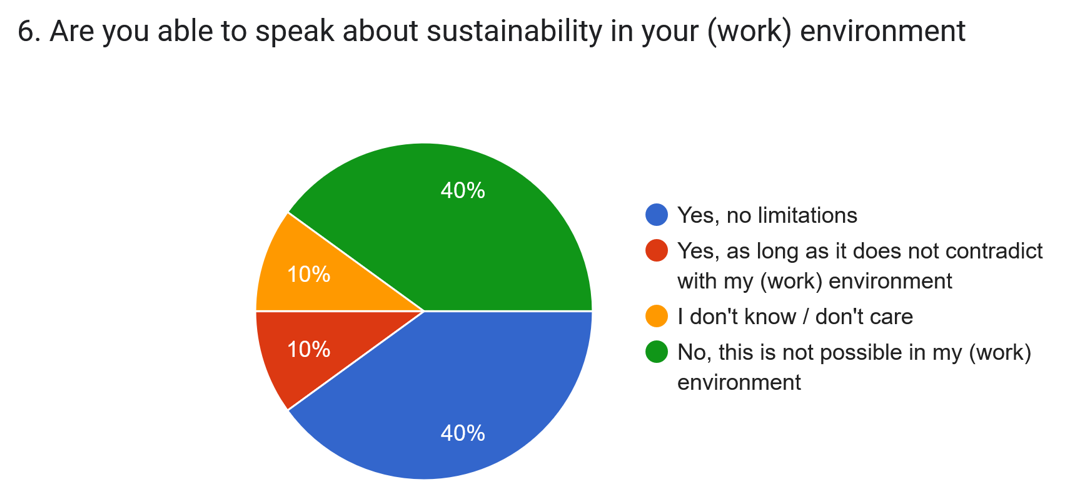
Since the survey was anonymous, we can’t link answers to specific regions. But we’re aware that in some countries, polarization has made certain topics off-limits — either by mandate or out of fear of a difficult working atmosphere.
The last two questions were about potential involvement for the PGGA from the people answering the survey. 3 people responded positively to support the PGGA in action.
 Within the PGGA, everyone is welcome to share their perspective — with respect for those who see it differently. It’s not about being right or wrong. It’s about the dialogue, and about finding paths forward to a future that’s sustainable not just for the planet, but for businesses and the people within them.
A low response or apathy?
The survey results are interesting on their own — but when you combine them with the low response rate, they say something more: even in communities that care, mobilizing action is hard.
 Are we too busy with the short term, or have we become apathetic to what is happening around us and have the feeling our efforts do not matter?
On that last point, I keep thinking of Hannah Arendt — the German-American historian and philosopher who lived from October 1906 till December 1975.
Her famous book, published after the Second World War, is The Origins of Totalitarianism (1951), an alarming book if you read it in today’s context.
My favorite quote from this book:

Written in the context of the Holocaust, it explained how the indifference of ordinary people allowed atrocities to unfold. Arendt warns against moral detachment. Staying informed and engaged takes effort — but it’s the effort that matters.
Today, she might write:
“Evil thrives on social media, and cannot exist without it.”
To conclude
So what can we do? The conclusion is simple, even if the execution is not directly possible: don’t just watch it burn. Every one of us has a space of influence — in our companies, in our communities, in our professional networks. The energy transition, the circular economy, the push for longer-term thinking — none of these will happen because a government issued a directive or a CEO signed a strategy paper. They happen because individuals within their sphere of influence decide to make them happen.
Where are you standing?
Respond with a “like” if you care!
This blog post is especially written for our PLM Global Green Alliance LinkedIn members — a message from a “boomer” to the next generation of PLM enthusiasts.
If you belong to that next generation, please read until the end and share your thoughts.
With last week’s announcement from the US government, no longer treating greenhouse gas emissions as a threat to the planet or climate.
We see a push to remove regulations that limit companies from continuing or expanding business without considering the broader consequences for other countries and future generations.
It feels like a short-term, greedy decision, largely influenced by those who benefit from fossil-carbon economies. Decisions like this make the energy transition harder, because the path of least resistance is always the easiest to follow.
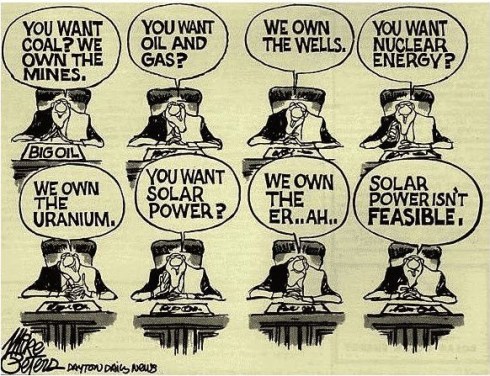
Transitions are never simple. But when science is ignored, data is removed, and opinions replace facts, we are no longer supporting a transition — we are actively working against it.
My Story
 When I started working in the PLM domain in 1999, climate change already existed in the background of society. The 1972 Limits to Growth report by the Club of Rome had created waves long before, encouraging some people to rethink business and lifestyle choices.
For me, however, it stayed outside my daily focus. I was at the beginning of my career, excited about the new challenges.
And important to notice that connecting to the internet with a 28k modem was the standard, a world without social media constantly reminding us of global issues.
 I enjoyed my role as the “Flying Dutchman,” travelling around the world to support PLM implementations and discussions. Flying was simply part of the job. Real communication meant being in the same room; early phone and video calls were expensive, awkward, and often ineffective. PLM was — and still is — a human business.
Back then, the effects of carbon emissions and global warming felt distant, almost abstract. Only around 2014 did the conversation become more mainstream for me, helped by social media, before algorithms and bots began driving polarization.
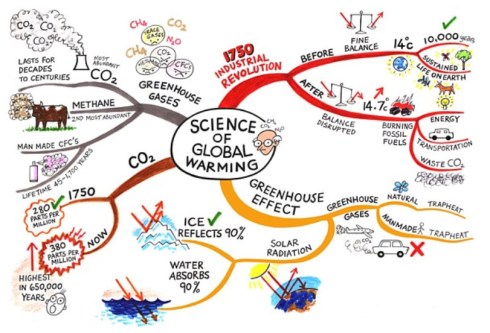
In 2015, while writing about PLM and global warming, I realized something that still resonates today: even when we understand change is needed, we often stick to familiar habits, because investments in the future rarely deliver immediate ROI for ourselves or our shareholders.
The PLM Green Global Alliance
When Rich McFall approached me in 2019 with the idea of creating an alliance where people and companies could share ideas and experiences around sustainability in the PLM domain, I was immediately interested — for two reasons.
- First, there was a certain sense of responsibility related to my past activities as the Flying Dutchman. Not guilt — life is about learning and gaining insight — but awareness that I needed to change, even if the past could not be changed.
- Second, and more importantly, the PLM Green Global Alliance offered a way to contribute. It gave me a reason to act — for personal peace of mind and for future generations. Not only for my children or grandchildren, but for all those who will share this planet with them.
In the first years of the PGGA, we saw strong engagement from younger professionals. Over time, however, we noticed that career priorities often came first — which is understandable.
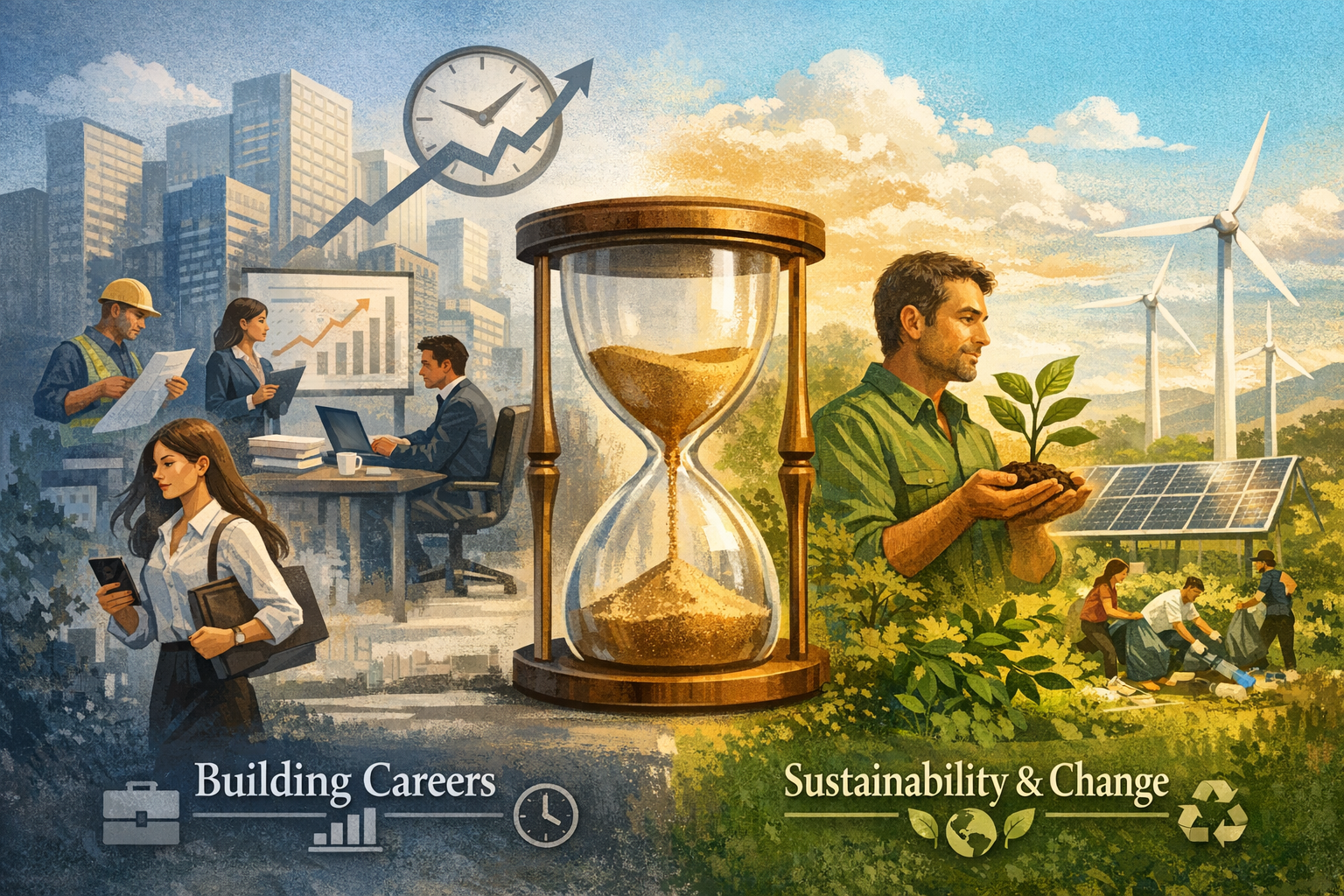
Like me at the start of my career, many focus first on building their future. Career and sustainability can coexist, but investing extra time in long-term change is not easy when daily responsibilities already demand so much.
Your Chance to Work on the Future
 The real challenge lies with those willing to go the extra mile — staying focused on today’s business while also investing energy in the long-term future.
At the same time, I understand that not everyone is in a position to speak out or dedicate time to sustainability initiatives. Circumstances differ. For many, current responsibilities leave little space for additional commitments.
Still, for those willing to join us, we have two requests to better understand your expectations.
Two weeks ago, I connected with our 40 newest members of the PLM Green Global Alliance. We are now close to 1,600 members — up from around 1,500 in September 2025, as mentioned in Working on the Long Term.
That post was a gentle call to action. Seeing our PGGA membership continue to grow is encouraging — and naturally raises a question:
1. What motivates people to join the PGGA LinkedIn group?
So far, only a small number of the recent new members have completed a survey that was especially sent to them to explore changing priorities. Due to the low response, we extended the invitation to all members. We are curious about your expectations — and quietly hopeful about your involvement.
 If you haven’t filled in the survey yet, please click here and share your feedback. The survey is anonymous unless you choose to leave your details for follow-up. We will share the results in approximately 2 weeks from now.
2. Design for Sustainability – your contribution?
Last year, Erik Rieger and Matthew Sullivan launched a new workgroup within the PLM Green Global Alliance focused on Design for Sustainability. While the initial energy was strong, changes in personal priorities meant the team could not continue at the pace they hoped. Since many new members have joined since last May, we decided to relaunch the initiative.
If you are interested in contributing to the revival of Design for Sustainability, please take five minutes to complete the short survey. Your input will help shape the direction of the DfS working group and frame future discussions.
Note: If you are worried about clicking on the links for the survey, you can always contact us directly (in private) to share your ambition
Conclusion
The outside world often pushes us to focus only on daily business. In some places, there is even active pressure to avoid long-term sustainability investments. Remember that pressure often comes from those invested in keeping the current system unchanged.
If you care about the future — your generation and those that follow — stay engaged. Small actions by millions of people can create meaningful change.
We look forward to your input and participation.
— says the boomer who still cares 😉
On November 11th, we celebrated our 5th anniversary of the PLM Green Global Alliance (PGGA) with a webinar where ♻️ Jos Voskuil (me) interviewed the five other PGGA core team members about developments and experiences in their focus domain, potentially allowing for a broader discussion.
In our discussion, we focused on the trends and future directions of the PLM Green Global Alliance, emphasizing the intersection of Product Lifecycle Management (PLM) and sustainability.
 Probably, November 11th was not the best day for broad attendance, and therefore, we hope that the recording of this webinar will allow you to connect and comment on this post.
Enjoy the discussion – watch it, or listen to it, as this time we did not share any visuals in the debate. Still, we hope to get your reflections and feedback on the interview related to the LinkedIn post.
The discussion centered on the trends and future directions of the PLM Green Global Alliance, with a focus on the intersection of Product Lifecycle Management (PLM) and sustainability.
Short Summary
♻️ Rich McFall shared his motivations for founding the alliance, highlighting the need for a platform that connects individuals committed to sustainability and addresses the previously limited discourse on PLM’s role in promoting environmental responsibility. He noted a significant variance in vendor engagement with sustainability, indicating that while some companies are proactive, others remain hesitant.
The conversation delved into the growing awareness and capabilities of how to perform a Life Cycle Assessment (LCA) with ♻️ Klaus Brettschneider, followed by the importance of integrating sustainability into PLM strategies, with ♻️ Mark Reisig discussing the ongoing energy transition and the growing investments in green technologies, particularly in China and Europe.
♻️ Evgeniya Burimskaya raised concerns about implementing circular economy principles in the aerospace industry, emphasizing the necessity of lifecycle analysis and the upcoming digital product passport requirements. The dialogue also touched on the Design for Sustainability initiative, led by ♻️ Erik Rieger, which aims to embed sustainability into the product design phase, necessitating a cultural shift in engineering education to prioritize sustainability.
Conclusion
We concluded with understanding the urgent realities of climate change, but also advocating for an optimistic mindset in the face of challenges – it is perhaps not as bad as it seems in the new media. There are significant investments in green energy, serving as a beacon of hope, which encourage people to remain committed to collaborative efforts in advancing sustainable practices.
We agreed on the long-term nature of behavioral change within organizations and the role of the Green Alliance in fostering this transformation, concluding with a positive outlook on the potential for future generations to drive necessary changes in sustainability.

 Recently, we initiated the Design for Sustainability workgroup, an initiative from two of our PGGA members, Erik Rieger and Matthew Sullivan. You can find a recording of the kick-off here on our YouTube channel.
Thanks to the launch of the Design for Sustainability workgroup, we were introduced to Dr. Elvira Rakova, founder and CEO of the startup company Direktin.
Her mission is to build the Digital Ecosystem of engineering tools and simulation for Compressed Air Systems. As typical PLM professionals with a focus on product design, we were curious to learn about developments in the manufacturing space. And it was an interesting discussion, almost a lecture.
Compressed air and Direktin
 Dr. Elvira Rakova has been working with compressed air in manufacturing plants for several years, during which she has observed the inefficiency of how compressed air is utilized in these facilities. It is an available resource for all kinds of machines in the plant, often overdimensioned and a significant source of wasted energy.
To address this waste of energy, linked to CO2 emissions, she started her company to help companies scale, dimension, and analyse their compressed air usage. A mix of software and consultancy to make manufacturing processes using compressed air responsible for less carbon emissions, and for the plant owners, saving significant money related to energy usage.
For us, it was an educational discussion, and we recommend that you watch or listen to the next 36 minutes
What I learned
- The use of compressed air and its energy/environmental impact were like dark matter to me.
I never noticed it when visiting customers as a significant source to become more sustainable. - Although the topic of compressed air seems easy to understand, its usage and impact are all tough to address quickly and easily, due to legacy in plants, lack of visibility on compressed air (energy usage) and needs and standardization among the providers of machinery.
- The need for data analysis is crucial in addressing the reporting challenges of Scope 3 emissions, and it is also increasingly important as part of the Digital Product Passport data to be provided. Companies must invest in the digitalization of their plants to better analyze and improve energy usage, such as in the case of compressed air.
- In the end, we concluded that for sustainability, it is all about digital partnerships connecting the design world and the manufacturing world and for that reason, Elvira is personally motivated to join and support the Design for Sustainability workgroup
Want to learn more?
- Another educational webinar: Design Review Culture and Sustainability
- Explore the Direktin website to learn more
Conclusions
The PLM Green Global Alliance is not only about designing products; we have also seen lifecycle assessments for manufacturing, as discussed with Makersite and aPriori. These companies focused more on traditional operations in a manufacturing plant. Through our lecture/discussion on the use of compressed air in manufacturing plants, we identified a new domain that requires attention.
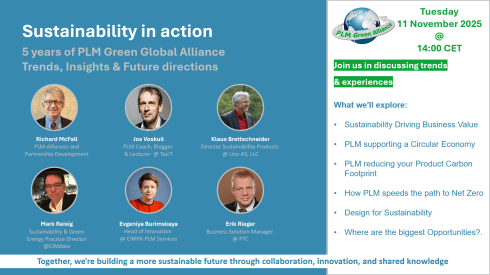
Don’t forget to register for our sustainability in action event on November 11th
This week is busy for me as I am finalizing several essential activities related to my favorite hobby, product lifecycle management or is it PLM😉?
And most of these activities will result in lengthy blog posts, starting with:
“The week(end) after <<fill in the event>>”.
Here are the upcoming actions:
Click on each image if you want to see the details:
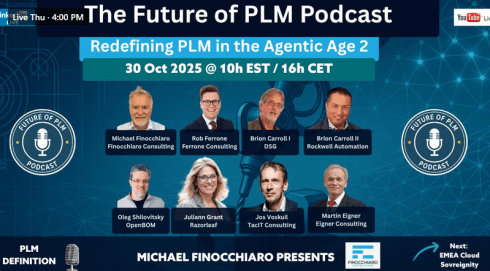
In this Future of PLM Podcast series, moderated by Michael Finocciaro, we will continue the debate on how to position PLM (as a system or a strategy) and move away from an engineering framing. Personally, I never saw PLM as a system and started talking more and more about product lifecycle management (the strategy) versus PLM/PDM (the systems).
Note: the intention is to be interactive with the audience, so feel free to post questions/remarks in the comments, either upfront or during the event.
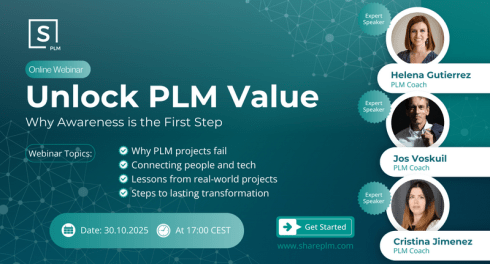
You might have seen in the past two weeks some posts and discussions I had with the Share PLM team about a unique offering we are preparing: the PLM Awareness program. From our field experience, PLM is too often treated as a technical issue, handled by a (too) small team.
We believe every PLM program should start by fostering awareness of what people can expect nowadays, given the technology, experiences, and possibilities available. If you want to work with motivated people, you have to involve them and give them all the proper understanding to start with.
Join us for the online event to understand the value and ask your questions. We are looking forward to your participation.
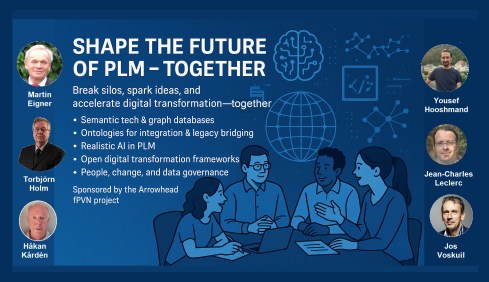
This is another event related to the future of PLM; however, this time it is an in-person workshop, where, inspired by four PLM thought leaders, we will discuss and work on a common understanding of what is required for a modern PLM framework. The workshop, sponsored by the Arrowhead fPVN project, will be held in Paris on November 4th, preceding the PLM Roadmap/PDT Europe conference.
We will not discuss the term PLM; we will discuss business drivers, supporting technologies and more. My role as a moderator of this event is to assist with the workshop, and I will share its findings with a broader audience that wasn’t able to attend.
Be ready to learn more in the near future!
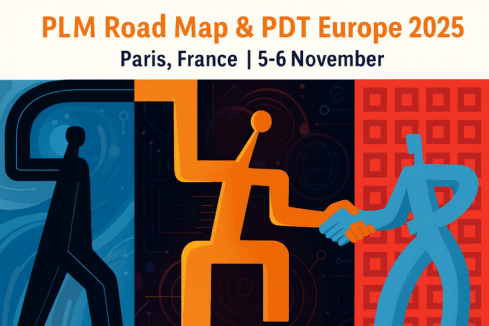
Suppose you have followed my blog posts for the past 10 years. In that case, you know this conference is always a place to get inspired, whether by leading companies across industries or by innovative and engaging new developments. This conference has always inspired and helped me gain a better understanding of digital transformation in the PLM domain and how larger enterprises are addressing their challenges.
This time, I will conclude the conference with a lecture focusing on the challenging side of digital transformation and AI: we humans cannot transform ourselves, so we need help.
At the end of this year, we will “celebrate” our fifth anniversary of the PLM Green Global Alliance. When we started the PGGA in 2020, there was an initial focus on the impact of carbon emissions on the climate, and in the years that followed, climate disasters around the world caused serious damage to countries and people.
How could we, as a PLM community, support each other in developing and sharing best practices for innovative, lower-carbon products and processes?
In parallel, driven by regulations, there was also a need to improve current PLM practices to efficiently support ESG reporting, lifecycle analysis, and, soon, the Digital Product Passport. Regulations that push for a modern data-driven infrastructure, and we discussed this with the major PLM vendors and related software or solution partners. See our YouTube channel @PLM_Green_Global_Alliance
In this online Zoom event, we invite you to join us to discuss the topics mentioned in the announcement. Join us in this event and help us celebrate!
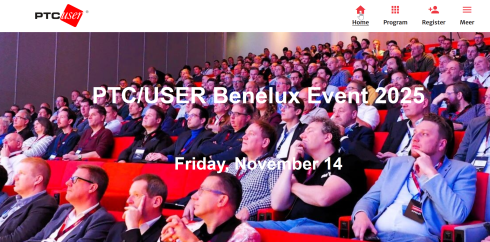
I am closing that week at the PTC/User Benelux event in Eindhoven, the Netherlands, with a keynote speech about digital transformation in the PLM domain. Eindhoven is the city where I grew up, completed my amateur soccer career, ran my first and only marathon, and started my career in PLM with SmarTeam. The city and location feel like home. I am looking forward to discussing and meeting with the PTC user community to learn how they experience product lifecycle management, or is it PLM😉?
 With all these upcoming events, I did not have the time to focus on a new blog post; however, luckily, in the 10x PLM discussion started by Oleg Shilovitsky there was an interesting comment from Rob Ferrone related to that triggered my mind. Quote:
The big breakthrough will come from 1. advances in human-machine interface and 2. less % of work executed by human in the loop. Copy/paste, typing, voice recognition are all significant limits right now. It’s like trying to empty a bucket of water through a drinking straw. When tech becomes more intelligent and proactive then we will see at least 10x.
This remark reminded me of one of my first blog posts in 2008, when I was trying to predict what PLM would look like in 2050. I thought it is a nice moment to read it (again). Enjoy!
PLM in 2050
 As the year ends, I decided to take my crystal ball to see what would happen with PLM in the future. It felt like a virtual experience, and this is what I saw:
- Data is no longer replicated – every piece of information will have a Universal Unique ID, also known as a UUID. In 2020, this initiative became mature, thanks to the merger of some big PLM and ERP vendors, who brought this initiative to reality. This initiative dramatically reduced exchange costs in supply chains and led to bankruptcy for many companies that provided translation and exchange software.
- Companies store their data in ‘the cloud’ based on the concept outlined above. Only some old-fashioned companies still handle their own data storage and exchange, as they fear someone will access their data. Analysts compare this behavior with the situation in the year 1950, when people kept their money under a mattress, not trusting banks (and they were not always wrong)
- After 3D, a complete virtual world based on holography became the next step in product development and understanding. Thanks to the revolutionary quantum-3D technology, this concept could even be applied to life sciences. Before ordering a product, customers could first experience and describe their needs in a virtual environment.
- Finally, the cumbersome keyboard and mouse were replaced by voice and eye recognition. Initially, voice recognition
and eye tracking were cumbersome. Information was captured by talking to the system and by recording eye movements during hologram analysis. This made the life of engineers so much easier, as while researching and talking, their knowledge was stored and tagged for reuse. No need for designers to send old-fashioned emails or type their design decisions for future reuse - Due to the hologram technology, the world became greener. People did not need to travel around the world, and the standard became virtual meetings with global teams(airlines discontinued business class). Even holidays can be experienced in the virtual world thanks to a Dutch initiative inspired by coffee. The whole IT infrastructure was powered by efficient solar energy, drastically reducing the amount of carbon dioxide.
- Then, with a shock, I noticed PLM no longer existed. Companies were focusing on their core business processes. Systems/terms like PLM, ERP, and CRM no longer existed. Some older people still remembered the battle between those systems over data ownership and the political discomfort this caused within companies.
- As people were working so efficiently, there was no need to work all week. There were community time slots when everyone was active, but 50 per cent of the time, people had time to recreate (to re-create or recreate was the question). Some older French and German designers remembered the days when they had only 10 weeks holiday per year, unimaginable nowadays.
As we still have more than 40 years to reach this future, I wish you all a successful and excellent 2009.
I am looking forward to being part of the green future next year.
 Last week we celebrated World Ozone Day on September 16 again. Forty years ago, many nations united to protect the ozone layer through science and action.
For those who missed the excitement, it started with a historic environmental agreement: the Montreal Protocol on Substances that Deplete the Ozone Layer.
What has happened?
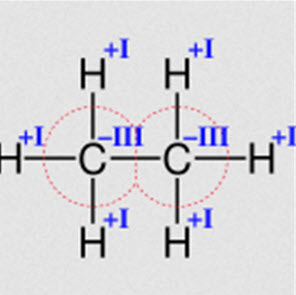 In the 1970s and 1980s, scientists discovered that CFCs from refrigerators, sprays, and foams were damaging the ozone layer. In 1985, the “ozone hole” over Antarctica was confirmed. Also, the ozone layer at the Arctic side showed signs of depletion.
As a result of these findings, the Montreal Protocol was adopted on September 16, 1987. It is a global treaty signed by virtually all countries concerning the rapid elimination of substances that deplete the ozone layer.
Countermeasures are slowly restoring the ozone layer, making the treaty a success story.
What were the reasons for success?
 Although scientists engaged in a discussion about the scientific evidence, there were no significant economic forces behind the scenes influencing the scientific research.
The lack of substantial financial dependencies, combined with the absence of social media and Duning-Kruger experts, led to the belief that human influence on the Earth’s atmosphere could be stopped.
And probably an even more important fact, the depletion of the ozone layer was at the poles, making, in particular, the richer countries more vulnerable to the effects.
Where most attention focused on the hole above the South Pole, affecting New Zealand and Australia, the thinner layer at the North Pole was making Canada, the US, and Northern Europe vulnerable.
What have we learned?
- Switching from CFCs was a minor inconvenience for consumers. Now we all accept the current solutions.
- There was enough consensus in science when the majority of scientists agreed. In addition, there were no undermining forces with financial stakes in CFCs. Science was leading.
- Today, science struggles as stakeholders sponsor research to protect their interests. In addition, social media is used to recruit supporters in a polarized environment (the side effect of social media)
- Ultimately, after 40 years, the hole in the Ozone layer gets smaller and smaller and hopefully becomes normal. We keep on working on the long term.
The PLM Green Global Alliance
 When Rich McFall approached me at the end of 2019 to start the PLM Green Global Alliance together, there was a kind of consensus that we human beings both influence the planet’s climate and its natural resources.
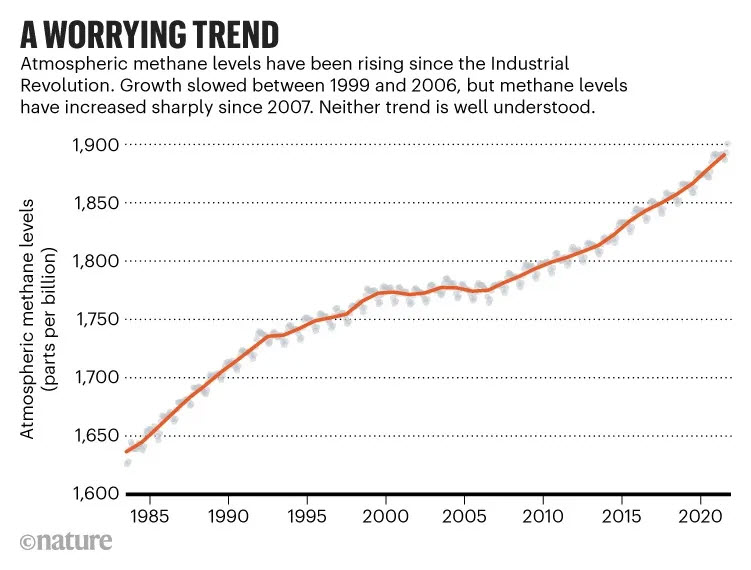 Where Rich focused on the causes and consequences of climate change due to human-generated greenhouse gas emissions (GHG) from products and processes, my additional focus was broader, encompassing Sustainability in the context of where PLM practices could have an impact.
Our idea was to bring people together to address these issues by sharing thoughts and practices or enabling discussions in the context of PLM-related technologies.
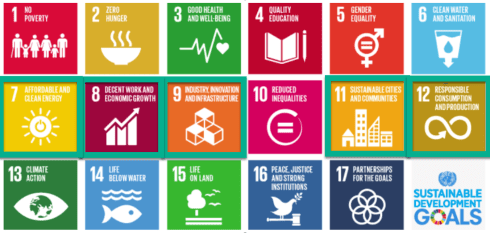
Can we develop more eco-friendly products, and what are the conditions required?
Meanwhile, six years later, a lot has happened for better and for worse. Here is a set of observations
The PLM Green Global Alliance continues to grow.
Currently, we have over 1,500 registered members in our LinkedIn group.
Historically, most members came from Europe and then the US; now, India is catching up and approaching the number of US members.
This trend suggests that the focus of the alliance should shift slightly and seek more contributors from Asian countries.
 We look forward to having Asian representatives in our PLM Green Global Alliance to gain a deeper understanding and engage in discussions about global issues.
Please feel free to contact us if you are interested in joining the core team. It might be a challenge to have group meetings that accommodate all time zones, but the planet is still relatively small compared to the universe – nothing is impossible.
The tools are there ..
In PLM, we often discuss people, processes, and then the tools. Here, we can confirm that, through our work and discussions with major PLM vendors, they are all providing tools and, in some cases, embedded practices to support a more sustainable product development process.
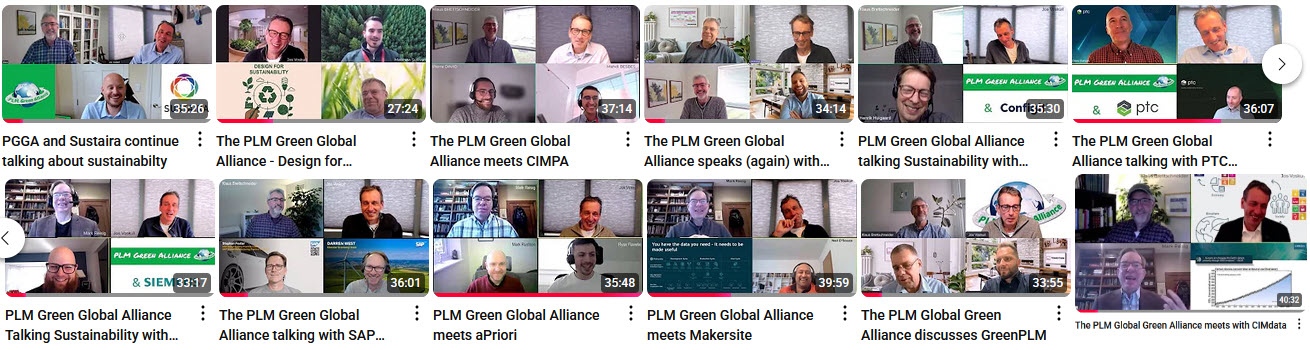
Have a look at our YouTube channel: The PLM Green Global Alliance channel.
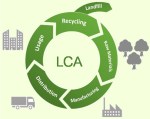 The tools for generative design, life cycle assessment, and, of course, digital twins for the various lifecycle phases can help companies to develop and manufacture more sustainable products.
However, as mentioned, the tools will only be practical when the people have the mandate and when the processes are transformed into data-driven ones.
The need for a data-driven approach
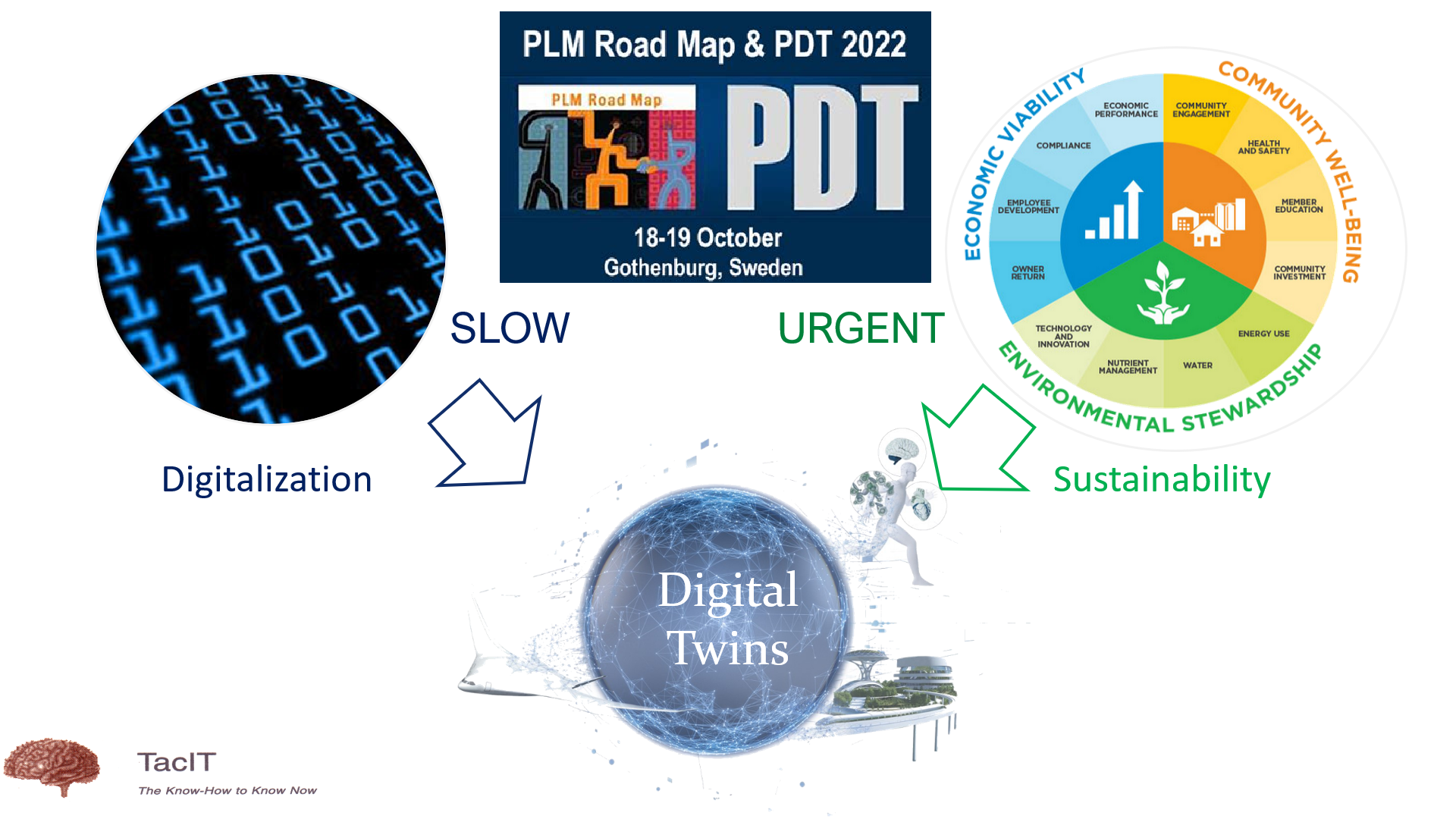 Two years ago, during the PLM Roadmap/PDT Europe conference in Gothenburg, I had already mentioned that Sustainability might prompt companies to invest more time and effort in achieving a digital transformation in their PLM domain.
Compliance with regulations can be challenging when you still need to collect data from various sources with a lot of “guesstimate”. Greenhouse gas reporting, ESG reporting, and the upcoming Digital Product Passport can only be done efficiently if data is directly accessible without requiring people to collect it.
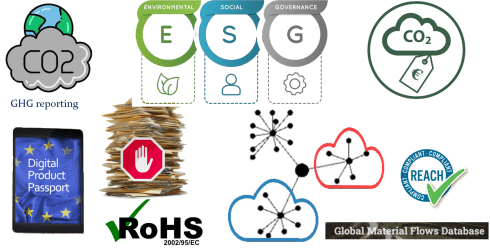
Unfortunately, in my recent discussions with companies, particularly management, they are not seeking a fundamental digital transformation from a document-driven approach to a data-driven and model-based approach.
 Part of this challenge is the lack of education among top management, who are primarily focused on efficiency gains rather than adopting new approaches or mitigating risk.
The other challenge is that, as most companies lag behind on this topic, they do not feel the pressure of competition and do not want to take the risk of being first.
I will discuss this last topic in my upcoming PLM blog
It is about the people!
 However, first and foremost, the most critical factor in driving sustainability within organizations is the people. Where companies are challenged in creating a green image, including the introduction of the Chief Sustainability Officer (CSO), there has always been resistance from existing business leaders, who prioritize money and profitability.
The global shift towards right-wing capitalism and efforts to remove regulations supporting sustainability are currently impacting these efforts. The term “Sustainability” has become negatively connoted, similar to “PLM” (Product Lifecycle Management – Don’t mention the P** word), and there is a need to reframe discussions at the management level to focus on risk mitigation and business strategies.
Where politicians might avoid a long-term vision, there are examples of companies like Ørsted, Pacific Gas & Electric, Maersk, the Holcim group, BlackRock, IKEA and more that are adopting sustainable practices as a risk mitigation strategy for the future and securing their companies’ long-term existence.
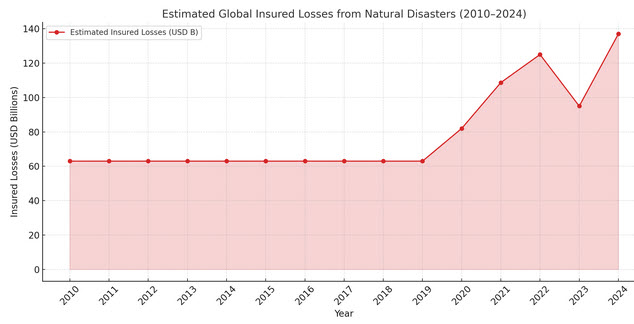
An interesting game changer for both businesses and behavior might be the rising costs of insurance against natural disasters. As the graph shows, the estimated global insured losses due to natural disasters over the last 15 years have increased significantly, starting in 2019. In the richer countries, the governments might be pushed to provide financial help after a disaster, but this will also have a (taxpayer) limit.
We are the people!
 There is a lot we can do as a PLM Green Global Community. Have you read CIMdata’s commentary, written by our Sustainability & Energy core team member Mark Reisig – read the full article here: How PLM is Decarbonizing Automotive Transport—Amid Political Uncertainty, addressing the importance of modern digital PLM to support digital twin, digital thread and digital product passport implementations.
 Or the paper from our core team member, LCA specialist Klaus Brettschneider, with the title The Sustainability Thread – Rethinking the digital thread to drive sustainability performance and green R&D, again stressing the importance of extending the digital thread to include sustainability metrics, enabling companies to design, produce, and operate products more efficiently while reducing environmental impact and supporting green R&D.
 Additionally, there are the monthly ESG newsletters from Vincent De La Mar of Sustaira, as well as the recent interview with Vincent, in which PGGA and Sustaira continue to discuss sustainability. Sustaira helps companies with a sustainability reporting platform on top of their existing enterprise systems. A first step that is needed to understand where measures have an impact.
 A regular guest at our discussions, Dave Duncan, Head of Sustainability at PTC, who published this year a very comprehensive, free-to-download book: Product Sustainability for Dummies. We also had a great discussion about the Product Service System, a mandatory business model for sustainable business.
 And recently, we saw the kick-off for the Design for Sustainability workgroup, organised by Erik Reiger and Matthew Sullivan. They are in the process of establishing this workgroup, where there will be more discussion and information exchanged between the workgroup members about the people and process angle (Erik‘s focus) and the tools and technology dimension (Matthew‘s focus)
 The post concludes with Rich McFall, who, in 2018, observed that there was so little organized action fighting climate change and started to motivate people to launch the PLM Green Global Alliance. It was his initiative to bring people together and raise awareness about the fact that, as a PLM community, we can help one another and start making a difference. Rich helped us a lot in setting up the website and ensuring that we have regular updates and a persistent storage of the information generated.
Working on the long term
We are still in the awareness phase and are seeing progress in the field. There is more to come and share, and we need your help. Working on the long term in a hectic day-to-day environment can be a challenge. However, in the end, if each of us helps our business and social ecosystem move towards a more sustainable economy and planet, we are moving in the right direction. It will take time, but we have an undeniable mission. Join and help us!
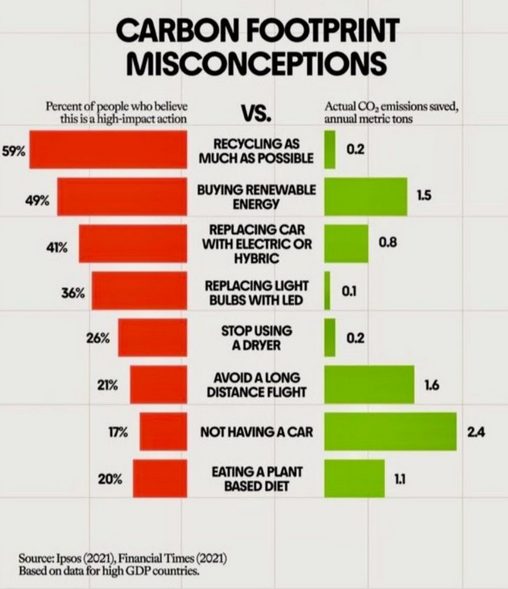
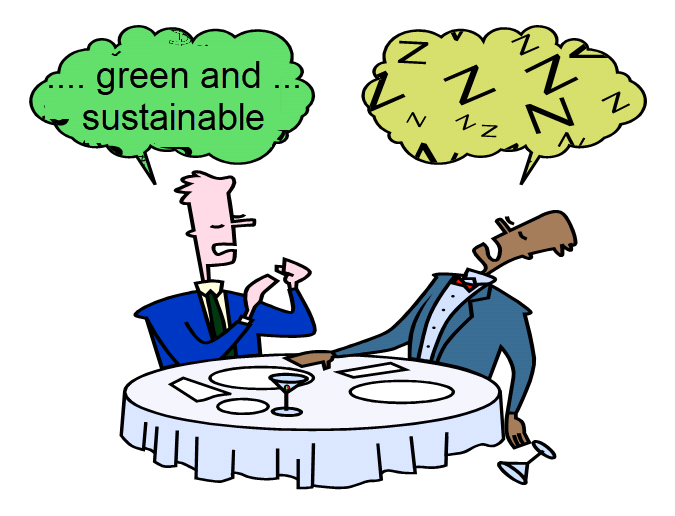 In recent months, I’ve noticed a decline in momentum around sustainability discussions, both in my professional network and personal life. With current global crises—like the Middle East conflict and the erosion of democratic institutions—dominating our attention, long-term topics like sustainability seem to have taken a back seat.
But don’t stop reading yet—there is good news, though we’ll start with the bad.
The Convenient Truth
 Human behavior is primarily emotional. A lesson valuable in the PLM domain and discussed during the Share PLM summit. As SharePLM notes in their change management approach, we rely on our “gator brain”—our limbic system – call it System 1 and System 2 or Thinking Fast and Slow. Faced with uncomfortable truths, we often seek out comforting alternatives.
The film Don’t Look Up humorously captures this tendency. It mirrors real-life responses to climate change: “CO₂ levels were high before, so it’s nothing new.” Yet the data tells a different story. For 800,000 years, CO₂ ranged between 170–300 ppm. Today’s level is ~420 ppm—an unprecedented spike in just 150 years as illustrated below.
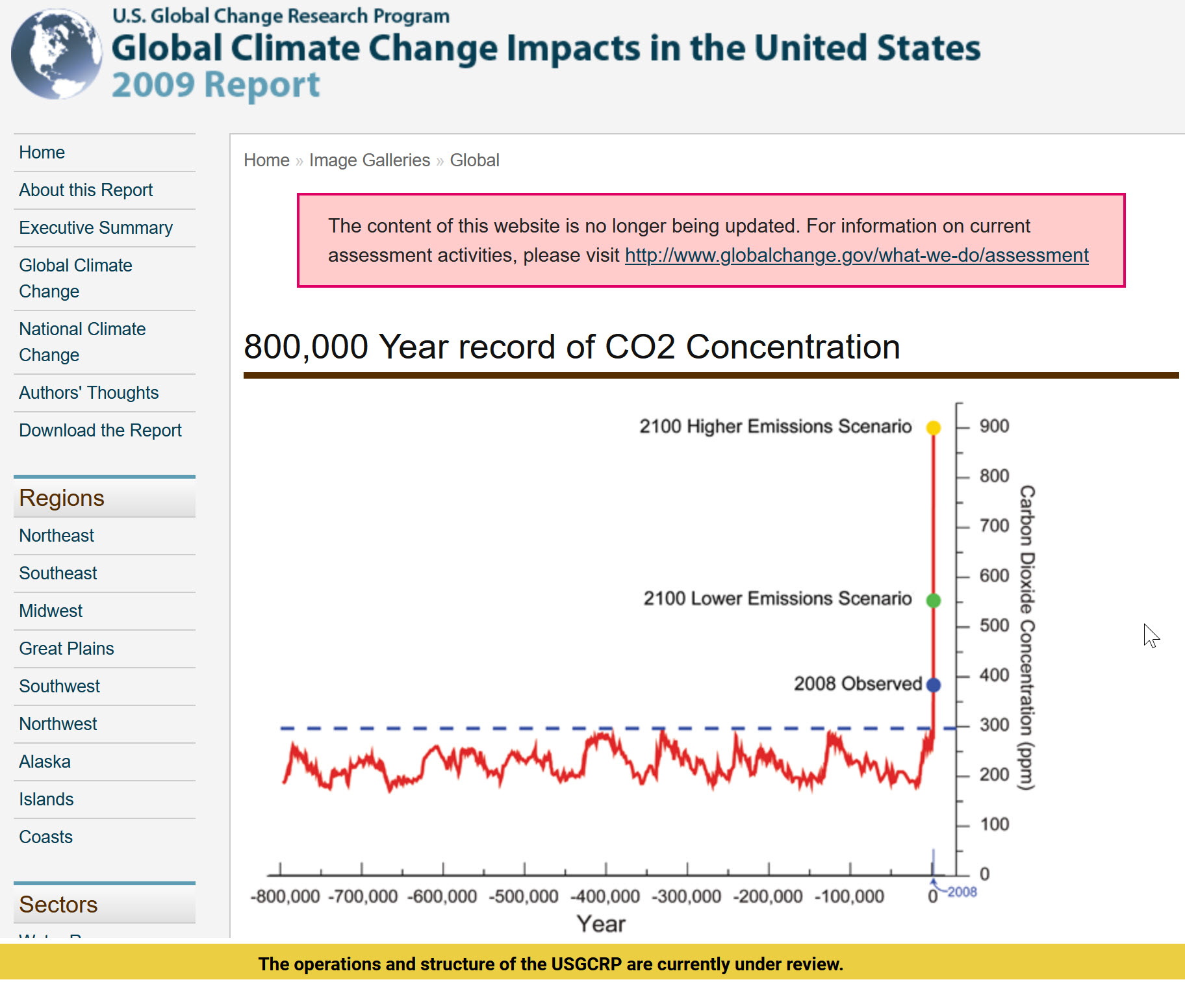
Frustratingly, some of this scientific data is no longer prominently published. The narrative has become inconvenient, particularly for the fossil fuel industry.
Persistent Myths
Then there is the pseudo-scientific claim that fossil fuels are infinite because the Earth’s core continually generates them. The Abiogenic Petroleum Origin theory is a fringe theory, sometimes revived from old Soviet science, and lacks credible evidence. See image below
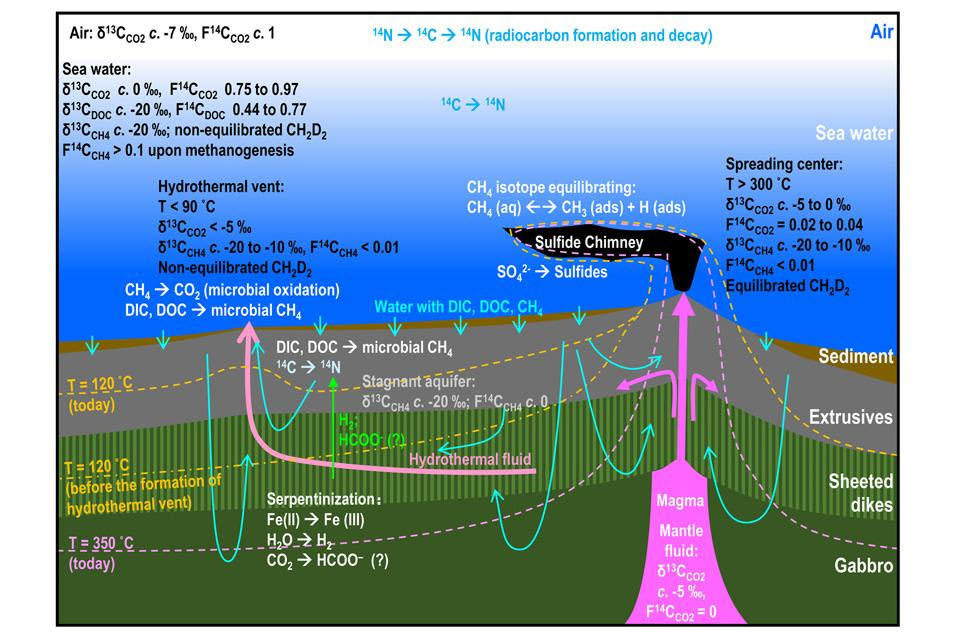
Oil remains a finite, biologically sourced resource. Yet such myths persist, often supported by overly complex jargon designed to impress rather than inform.
The Dissonance of Daily Life
A young couple casually mentioned flying to the Canary Islands for a weekend at a recent birthday party. When someone objected on climate grounds, they simply replied, “But the climate is so nice there!”
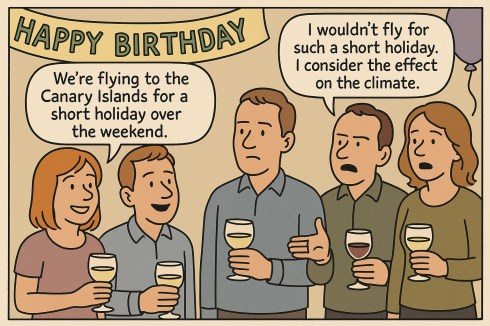
“Great climate on the Canary Islands”
This reflects a common divide among young people—some are deeply concerned about the climate, while many prioritize enjoying life now. And that’s understandable. The sustainability transition is hard because it challenges our comfort, habits, and current economic models.
The Cost of Transition
 Companies now face regulatory pressure such as CSRD (Corporate Sustainability Reporting Directive), DPP (Digital Product Passport), ESG, and more, especially when selling in or to the European market. These shifts aren’t usually driven by passion but by obligation. Transitioning to sustainable business models comes at a cost—learning curves and overheads that don’t align with most corporations’ short-term, profit-driven strategies.
However, we have also seen how long-term visions can be crushed by shareholder demands:
- Xerox (1970s–1980s) pioneered GUI, the mouse, and Ethernet, but failed to commercialize them. Apple and Microsoft reaped the benefits instead.
- General Electric under Jeff Immelt tried to pivot to renewables and tech-driven industries. Shareholders, frustrated by slow returns, dismantled many initiatives.
-
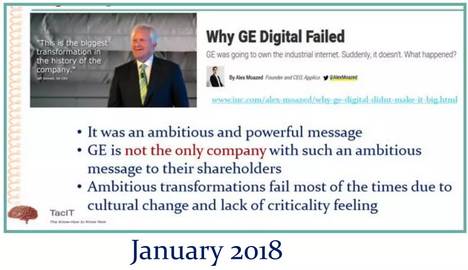
My presentation at the 2019 PLM Roadmap / PDT Europe conference – click on the image to get access through SlideShare.
- Despite ambitious sustainability goals, Siemens faced similar investor pressure, leading to spin-offs like Siemens Energy and Gamesa.
The lesson?
Transforming a business sustainably requires vision, compelling leadership, and patience—qualities often at odds with quarterly profit expectations. I explored these tensions again in my presentation at the PLM Roadmap/PDT Europe 2024 conference, read more here: Model-Based: The Digital Twin.
 I noticed discomfort in smaller, closed-company sessions, some attendees said, “We’re far from that vision. ”
My response: “That’s okay. Sustainability is a generational journey, but it must start now”.
Signs of Hope
Now for the good news. In our recent PGGA (PLM Green Global Alliance) meeting, we asked: “Are we tired?” Surprisingly, the mood was optimistic.
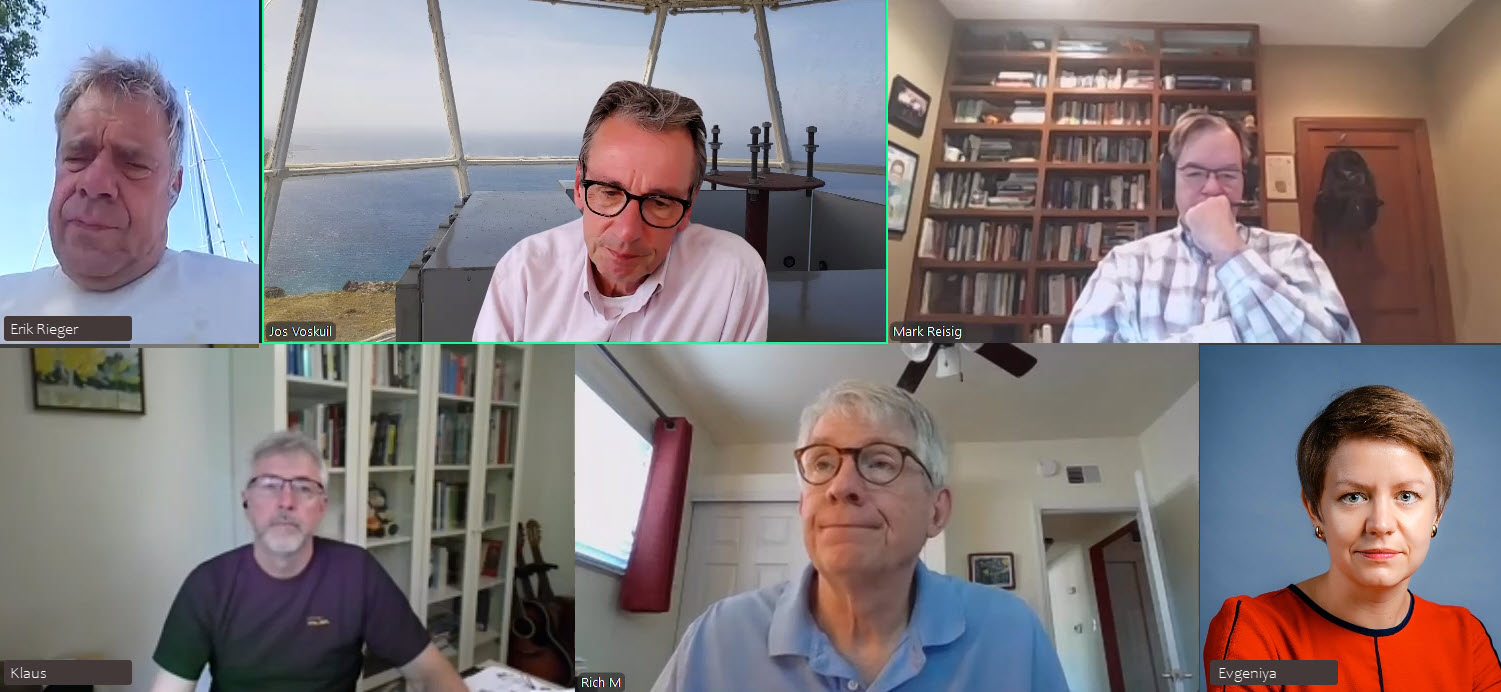
Our PGGA core team meeting on June 20th
Yes, some companies are downscaling their green initiatives or engaging in superficial greenwashing. But other developments give hope:
- China is now the global leader in clean energy investments, responsible for ~37% of the world’s total. In 2023 alone, it installed over 216 GW of solar PV—more than the rest of the world combined—and leads in wind power too. With over 1,400 GW of renewable capacity, China demonstrates that a centralized strategy can overcome investor hesitation.
- Long-term-focused companies like Iberdrola (Spain), Ørsted (Denmark), Tesla (US), BYD, and CATL (China) continue to invest heavily in EVs and batteries—critical to our shared future.
A Call to Engineers: Design for Sustainability
We may be small at the PLM Green Global Alliance, but we’re committed to educating and supporting the Product Lifecycle Management (PLM) community on sustainability.
That’s why I’m excited to announce the launch of our Design for Sustainability initiative on June 25th.
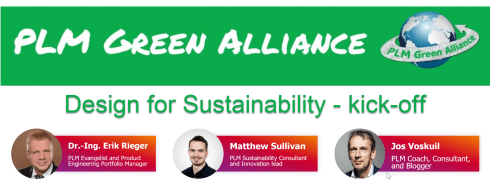
Led by Eric Rieger and Matthew Sullivan, this initiative will bring together engineers to collaborate and explore sustainable design practices. Whether or not you can attend live, we encourage everyone to engage with the recording afterward.
Conclusion
Sustainability might not dominate headlines today. In fact, there’s a rising tide of misinformation, offering people a “convenient truth” that avoids hard choices. But our work remains urgent. Building a livable planet for future generations requires long-term vision and commitment, even when it is difficult or unpopular.
So, are you tired—or ready to shape the future?
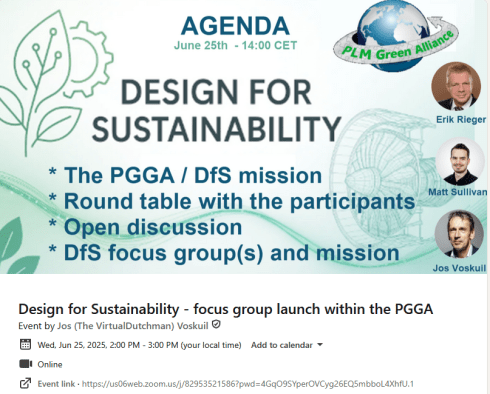
Within the PLM Green Global Alliance (PGGA), we had an internal kick-off meeting related to the topic of Design for Sustainability. As you might have seen on our website, Erik Rieger, PLM Evangelist and now working for PTC, took the initiative to start this focus group.
You might know Erik from a previous interview from the PGGA where we discussed TTPSC’s ecoPLM offering based on Windchill: PLM and Sustainability: talking about ecoPLM.
 When Erik announced the Design for Sustainability initiative, it was Matthew Sullivan from CIMPA PLM Service who immediately contacted Erik to work together on this initiative.
And again, you might know CIMPA PLM services from our recent interview with them related to regulations and best practices related to sustainability in the aerospace industry (CSRD, LCA, DPP, AI and more): PLM and Sustainability: talking with CIMPA.
Erik and Matthew decided to participate in an introductory interview, during which they shared their background, passion, and goals related to Design for Sustainability.
Watch the episode here:
Why Design for Sustainability?
Design for Sustainability (DfS) is an approach to designing products, services, systems, and experiences that prioritize environmental, social, and economic sustainability throughout their entire lifecycle. It means creating things in a way that reduces negative impacts on the planet and people while still being functional, profitable, and desirable.
In theory, this should be one of the key areas in which our PGGA members can have a common discussion.
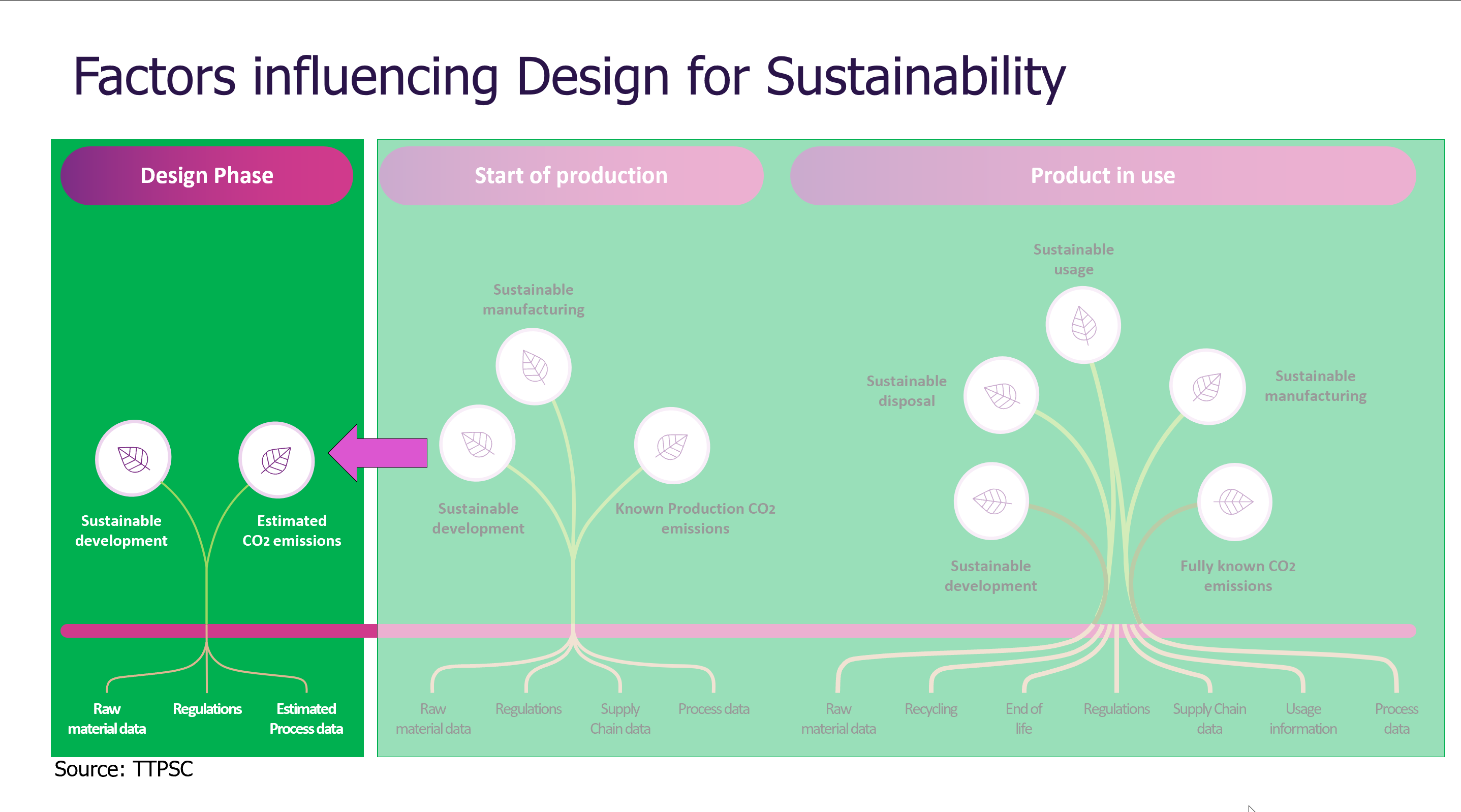
As Erik mentions, it is estimated that 80 % of the environmental impact is defined during the design phase. This is a number that has been coming back in several of our PGGA discussions with all the other software vendors.
More on Design for Sustainability
 Just after the recording, Dave Duncan, head of Sustainability at PTC, published the eBook Product Sustainability for Dummies. An excellent book that brings all aspects of sustainability and products together in an easy-to-digest manner. There is also a chapter on Design for Sustainability in the eBook.
Note: Dave Duncan is a recognized PGGA leader in PLM and Sustainability, as we reported last year.
Read the post here: Leaders in PLM and Sustainability – December 2024
A call for action
We hope you watched and enjoyed the interview with Erik and Matthew as an inspiration to become active in this Design for Sustainability discussion group.
 The intention is, as mentioned, to share experiences and discuss challenges within the group. It will be a private group where people can discuss openly to avoid any business conflicts. The plan is to start with an initial kick-off Zoom meeting in June the date still to be fixed.
If you are interested in joining this exciting discussion group, please contact Erik Rieger, who will be the focal point for this group. We are looking forward to your contribution, and now is the time to prepare and act.
Join us in the discussion
 Jos Voskuil's Weblog
Interesting reflection, Jos. In my experience, the situation you describe is very recognizable. At the company where I work, sustainability…
[…] (The following post from PLM Green Global Alliance cofounder Jos Voskuil first appeared in his European PLM-focused blog HERE.) […]
[…] recent discussions in the PLM ecosystem, including PSC Transition Technologies (EcoPLM), CIMPA PLM services (LCA), and the Design for…
Jos, all interesting and relevant. There are additional elements to be mentioned and Ontologies seem to be one of the…
Jos, as usual, you've provided a buffet of "food for thought". Where do you see AI being trained by a…