
You are currently browsing the category archive for the ‘Data centric’ category.

In my business ecosystem, I have seen a lot of discussions about technical and architectural topics since last year that are closely connected to the topic of artificial intelligence. We are discussing architectures and solutions that will make our business extremely effective. The discussion is mostly software vendor-driven as vendors usually do not have to deal with the legacy, and they can imagine focusing on the ultimate result.
Legacy (people, skills, processes and data) is the mean inhibitor for fast forward in such situations, as I wrote in my previous post: Data, Processes and AI.
However, there are also less visible discussions about business efficiency – methodology and business models – and future sustainability.
 These discussions are more challenging to follow as you need a broader and long-term vision, as implementing solutions/changes takes much longer than buying tools.
This time, I want to revisit the discussion on modularity and the need for business efficiency and sustainability.
Modularity – what is it?
 Modularity is a design principle that breaks a system into smaller, independent, and interchangeable components, or modules, that function together as a whole. Each module performs a specific task and can be developed, tested, and maintained separately, improving flexibility and scalability.
Modularity is a best practice in software development. Although modular thinking takes a higher initial effort, the advantages are enormous for reuse, flexibility, optimization, or adding new functionality. And as software code has no material cost or scrap, modular software solutions excel in delivery and maintenance.
 In the hardware world, this is different. Often, companies have a history of delivering a specific (hardware) solution, and the product has been improved by adding features and options where the top products remain the company’s flagships.
Modularity enables easy upgrades and replacements in hardware and engineering, reducing costs and complexity. As I work mainly with manufacturing companies in my network, I will focus on modularity in the hardware world.
Modularity – the business goal
How often have you heard that a business aims to transition from Engineering to Order (ETO) to Configure/Build to Order (BTO) or Assemble to Order (ATO)? Companies often believe that the starting point of implementing a PLM system is enough, as it will help identify commonalities in product variations, therefore leading to more modular products.
 The primary targeted business benefits often include reduced R&D time and cost but also reduced risk due to component reuse and reuse of experience. However, the ultimate goal for CTO/ATO companies is to minimize R&D involvement in their sales and delivery process.
More options can be offered to potential customers without spending more time on engineering.
 Four years ago, I discussed modularity with Björn Eriksson and Daniel Strandhammar, who wrote “The Modular Way” during the COVID-19 pandemic. I liked the book because it is excellent for understanding the broader scope of modularity along with marketing, sales, and long-term strategy. Each business type has its modularity benefits.
I had a follow-up discussion with panelists active in modularization and later with Daniel Strandhammar about the book’s content in this blog post: PLM and Modularity.
Next, I got involved with the North European Modularity Network (NEM) group, a group of Scandinavian companies that share modularization experiences and build common knowledge.
 Historically, modularization has been a popular topic in North Europe, and meanwhile, the group is expanding beyond Scandinavia. Participants in the group focus on education-sharing strategies rather than tools.
The 2023 biannual meeting I attended hosted by Vestas in Ringkobing was an eye-opener for me.
We should work more integrated, not only on the topic of Modularity and PLM but also on a third important topic: Sustainability in the context of the Circular Economy.
You can review my impression of the event and presentation in my post: “The week after North European Modularity (NEM)“
 That post concludes that Modularity, like PLM, is a strategy rather than an R&D mission. Integrating modularity topics into PLM conferences or Circular Economy events would facilitate mutual learning and collaboration.
Modularity and Sustainability
 The PLM Green Global Alliance started in 2020 initially had few members. However, after significant natural disasters and the announcement of regulations related to the European Green Deal, sustainability became a management priority. Greenwashing was no longer sufficient.
One key topic discussed in the PLM Green Global Alliance is the circular economy moderated by CIMPA PLM services. The circular economy is crucial as our current consumption of Earth’s resources is unsustainable.

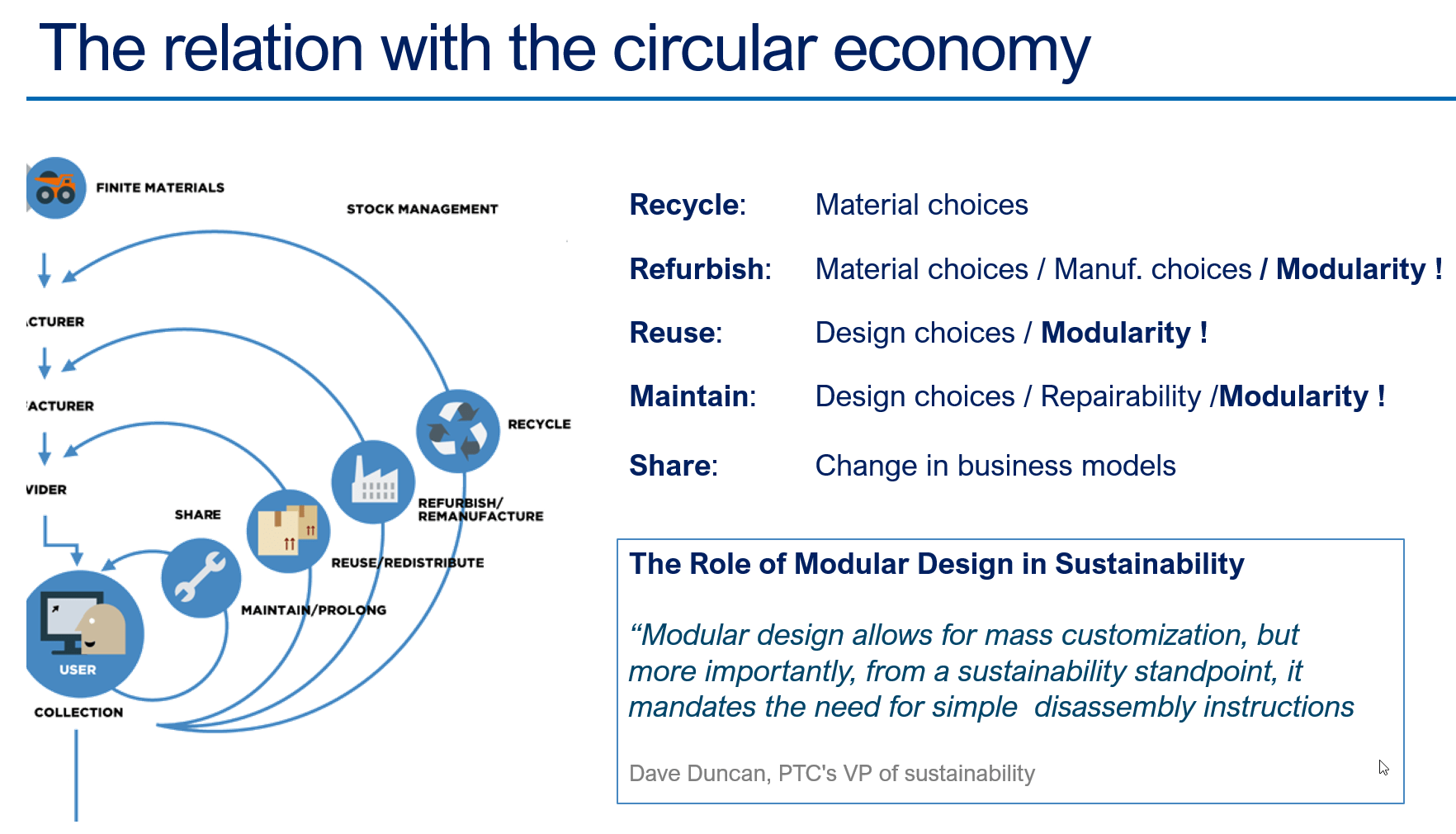
The well-known butterfly diagram from the Ellen MacArthur Foundation below, illustrates the higher complexity of a circular economy, both for the renewables (left) and the hardware (right)
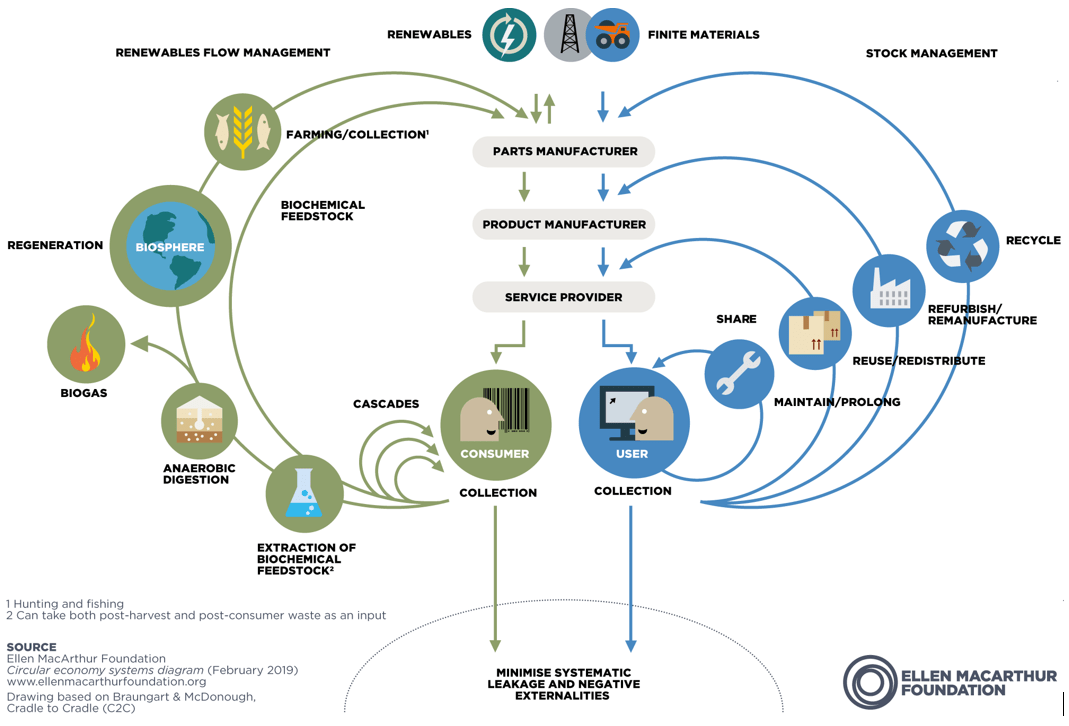
In a circular economy, modularity is essential. The SHARE loop focuses on a Product Service Model, where companies provide services based on products used by different users. This approach requires a new business model, customer experience, and durable hardware. After Black Friday last year, I wrote about this transition: The Product Service System and a Circular Economy.

Modularity is vital in the MAINTAIN/PROLONG loop. Modular products can be upgraded without replacing the entire product, and modules are easier to repair. An example is Fairphone from the Netherlands, where users can repair and upgrade their smartphones, contributing to sustainability.
In the REUSE/REMANUFACTURE loop, modularity allows for reusing hardware parts when electronics or software components are upgraded. This approach reduces waste and supports sustainability.
The REFURBISH/REMANUFACTURE loop also benefits from modularity, though to a lesser extent. This loop helps preserve scarce materials, such as batteries, reducing the need for resource extraction from places like the moon, Mars, or Greenland.
A call for action
 If you reached this point of the article, my question is now to reflect on your business or company. Modularity is, for many companies, a dream (or vision) and will become, for most companies, a must to provide a sustainable business.
Modularity does not depend on PLM technology, as famous companies like Scania, Electrolux and Vestas have shown (in my reference network).
Where is your company and its business offerings?
 IMPORTANT:
If you aim to implement modularity to support the concepts of the Circular Economy, make sure you do it in a data-driven, model-based environment – here, technology counts.
Conclusion
Don’t miss the focus on the potential relevance of modularity for your company. Modularity improves business and sustainability, AND it touches all enterprise stakeholders. Technology alone will not save the business. Your thoughts?

Do you want to learn more about implementing PLM at an ETO space company?
Listen to our latest podcast: OHB’s Digital Evolution: Transforming Aerospace PLM with Lucía Núñez Núñez
Last week, my memory was triggered by this LinkedIn post and discussion started by Oleg Shilovitsky: Rethinking the Data vs. Process Debate in the Age of Digital Transformation and AI.

me, 1989
In the past twenty years, the debate in the PLM community has changed a lot. PLM started as a central file repository, combined with processes to ensure the correct status and quality of the information.
Then, digital transformation in the PLM domain became achievable and there was a focus shift towards (meta)data. Now, we are entering the era of artificial intelligence, reshaping how we look at data.
In this technology evolution, there are lessons learned that are still valid for 2025, and I want to share some of my experiences in this post.
 In addition, it was great to read Martin Eigner’s great reflection on the past 40 years of PDM/PLM. Martin shared his experiences and insights, not directly focusing on the data and processes debate, but very complementary and helping to understand the future.
It started with processes (for me 2003-2014)
In the early days when I worked with SmarTeam, one of my main missions was to develop templates on top of the flexible toolkit SmarTeam.
 For those who do not know SmarTeam, it was one of the first Windows PDM/PLM systems, and thanks to its open API (COM-based), companies could easily customize and adapt it. It came with standard data elements and behaviors like Projects, Documents (CAD-specific and Generic), Items and later Products.
On top of this foundation, almost every customer implemented their business logic (current practices).
And there the problems came …..
 The implementations became too much a highly customized environment, not necessarily thought-through as every customer worked differently based on their (paper) history. Thanks to learning from the discussions in the field supporting stalled implementations, I was also assigned to develop templates (e.g. SmarTeam Design Express) and standard methodology (the FDA toolkit), as the mid-market customers requested. The focus was on standard processes.
You can read my 2009 observations here: Can chaos become order through PLM?
The need for standardization?
When developing templates (the right data model and processes), it was also essential to provide template processes for releasing a product and controlling the status and product changes – from Engineering Change Request to Engineering Change Order. Many companies had their processes described in their ISO 900x manual, but were they followed correctly?
 In 2010, I wrote ECR/ECO for Dummies, and it has been my second most-read post over the years. Only the 2019 post The importance of EBOM and MBOM in PLM (reprise) had more readers. These statistics show that many people are, and were, seeking education on general PLM processes and data model principles.
It was also the time when the PLM communities discussed out-of-the-box or flexible processes as Oleg referred to in his post..
You would expect companies to follow these best practices, and many small and medium enterprises that started with PLM did so. However, I discovered there was and still is the challenge with legacy (people and process), particularly in larger enterprises.
The challenge with legacy
 The technology was there, the usability was not there. Many implementations of a PLM system go through a critical stage. Are companies willing to change their methodology and habits to align with common best practices, or do they still want to implement their unique ways of working (from the past)?
“The embedded process is limiting our freedom, we need to be flexible”
is an often-heard statement. When every step is micro-managed in the PLM system, you create a bureaucracy detested by the user. In general, when the processes are implemented in a way first focusing on crucial steps with the option to improve later, you will get the best results and acceptance. Nowadays, we could call it an MVP approach.
 I have seen companies that created a task or issue for every single activity a person should do. Managers loved the (demo) dashboard. It never lead to success as the approach created frustration at the end user level as their To-Do list grew and grew.
 Another example of the micro-management mindset is when I worked with a company that had the opposite definition of Version and Revision in their current terminology. Initially, they insisted that the new PLM system should support this, meaning everywhere in the interface where Revisions was mentioned should be Version and the reverse for Version and Revision.
Can you imagine the cost of implementing and maintaining this legacy per upgrade?
And then came data (for me 2014 – now)
In 2015, during the pivotal PLM Roadmap/PDT conference related to Product Innovation Platforms, it brought the idea of framing digital transformation in the PLM domain in a single sentence: From Coordinated to Connected. See the original image from Marc Halpern here below and those who have read my posts over the years have seen this terminology’s evolution. Now I would say (till 2024): From Coordinated to Coordinated and Connected.
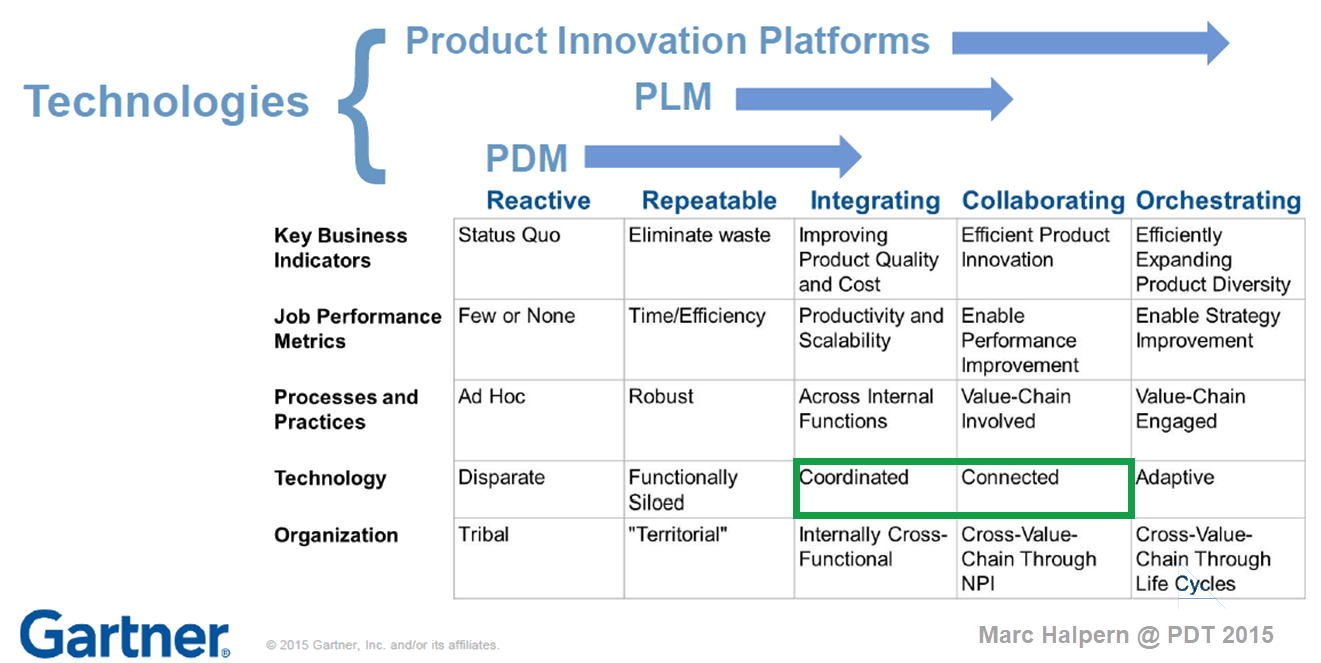
A data-driven approach was not new at that time. Roughly speaking, around 2006 – close to the introduction of the Smartphone – there was already a trend spurred by better global data connectivity at lower cost. Easy connectivity allowed PLM to expand into industries that were not closely connected to 3D CAD systems(CATIA, CREO or NX). Agile PLM, Aras, and SAP PLM became visible – PLM is no longer for design management but also for go-to-market governance in the CPG and apparel industry.

However, a data-driven approach was still rare in mainstream manufacturing companies, where drawings, office documents, email and Excel were the main information carriers next to the dominant ERP system.
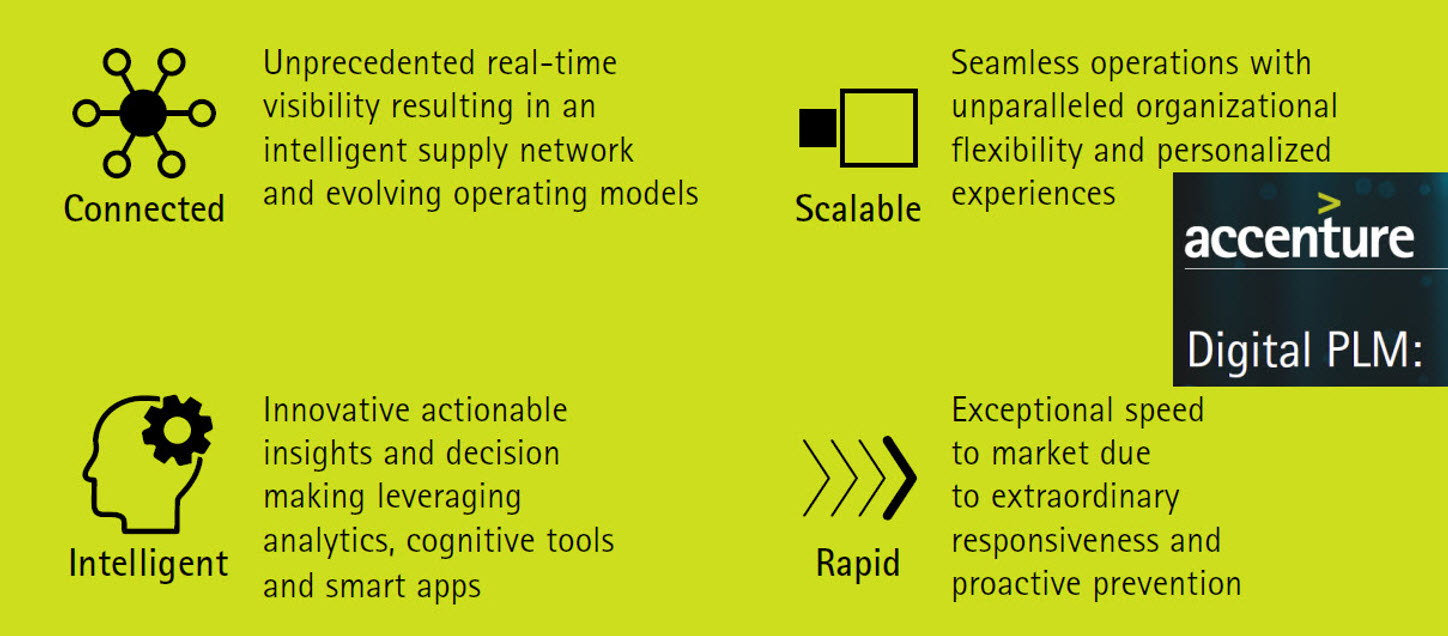
A data-driven approach was a consultant’s dream, and when looking at the impact of digital transformation in other parts of the business, why not for PLM, too? My favorite and still valid 2014 image is the one below from Accenture describing Digital PLM. Here business and PLM come together – the WHY!
Again, the challenge with legacy
 At that time, I saw a few companies linking their digital transformation to implementing a new PLM system. Those were the days the PLM vendors were battling for the big enterprise deals, sometimes motivated by an IT mindset that unifying the existing PDM/PLM systems would fulfill the digital dream. Science was not winning, but emotion. Read the PLM blame game – still actual.
One of my key observations is that companies struggle when they approach PLM transformation with a migration mindset. Moving from Coordinated to Connected isn’t just about technology—it’s about fundamentally changing how we work. Instead of a document-driven approach, organizations must embrace a data-driven, connected way of working.
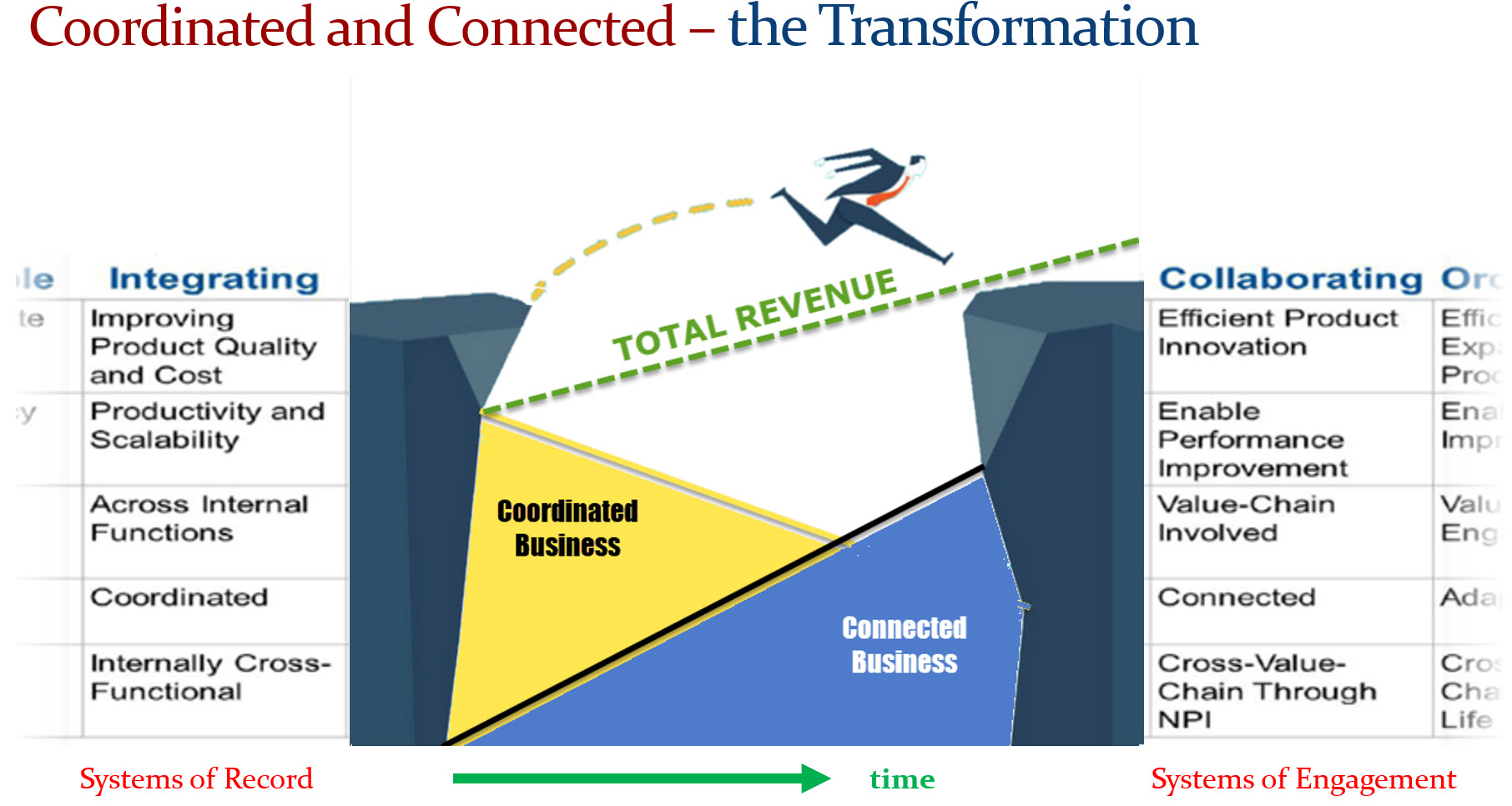
The PLM community increasingly agrees that PLM isn’t a single system; it’s a strategy that requires a federated approach—whether through SaaS or even beyond it.
 Before AI became a hype, we discussed the digital thread, digital twins, graph databases, ontologies, and data meshes. Legacy – people (skills), processes(rigid) and data(not reliable) – are the elephant in the room. Yet, the biggest challenge remains: many companies see PLM transformation as just buying new tools.
A fundamental transformation requires a hybrid approach—maintaining traditional operations while enabling multidisciplinary, data-driven teams. However, this shift demands new skills and creates the need to learn and adapt, and many organizations hesitate to take that risk.

In his Product Data Plumber Perspective on 2025. Rob Ferrone addressed the challenge to move forward too, and I liked one of his responses in the underlying discussion that says it all – it is hard to get out of your day to day comfort (and data):
Rob Ferrone’s quote:
Transformations are announced, followed by training, then communication fades. Plans shift, initiatives are replaced, and improvements are delayed for the next “fix-all” solution. Meanwhile, employees feel stuck, their future dictated by a distant, ever-changing strategy team.
And then there is Artificial Intelligence (2024 ……)
 In the past two years, I have been reading and digesting much news related to AI, particularly generative AI.
Initially, I was a little skeptical because of all the hallucinations and hype; however, the progress in this domain is enormous.
I believe that AI has the potential to change our digital thread and digital twin concepts dramatically where the focus was on digital continuity of data.
Now this digital continuity might not be required, reading articles like The End of SaaS (a more and more louder voice), usage of the Fusion Strategy (the importance of AI) and an (academic) example, on a smaller scale, I about learned last year the Swedish Arrowhead™ fPVN project.
I hope that five years from now, there will not be a paragraph with the title Pity there was again legacy.
We should have learned from the past that there is always the first wave of tools – they come with a big hype and promise – think about the Startgate Project but also Deepseek.
 Still remember, the change comes from doing things differently, not from efficiency gains. To do things differently you need an educated, visionary management with the power and skills to take a company in a new direction. If not, legacy will win (again)
Conclusion
In my 25 years of working in the data management domain, now known as PLM, I have seen several impressive new developments – from 2D to 3D, from documents to data, from physical prototypes to models and more. All these developments took decades to become mainstream. Whilst the technology was there, the legacy kept us back. Will this ever change? Your thoughts?

The pivotal 2015 PLM Roadmap / PDT conference
 First, I wish you all a prosperous 2025 and hope you will take the time to digest information beyond headlines.
Taking time to digest information is my number one principle now, which means you will see fewer blog posts from my side and potentially more podcast recordings.
My theme for 2025 : “It is all about people, data,
a sustainable business and a smooth digital transformation”.
Fewer blog posts
Fewer blog posts, as although AI might be a blessing for content writers, it becomes as exciting as Wikipedia pages. Here, I think differently than Oleg Shilovitsky, whose posts brought innovative thoughts to our PLM community – “Just my thoughts”.
 Now Oleg endorses AI, as you can read in his post: PLM in 2025: A new chapter of blogging transformation. I asked ChatGPT to summarize my post in 50 words, and this is the answer I got – it saves you reading the rest:
The author’s 2025 focus emphasizes digesting information deeply, reducing blog posts, and increasing podcast recordings exploring real-life PLM applications. They stress balancing people and data-centric strategies, sustainable digital transformation, AI’s transformative role, and forward-looking concepts like Fusion Strategy. Success requires prioritizing business needs, people, and accurate data to harness AI’s potential.
 Summarizing blog posts with AI saves you time. Thinking about AI-generated content, I understand that when you work in marketing, you want to create visibility for your brand or offer.
Do we need a blogging transformation? I am used to browsing through marketing content and then looking for the reality beyond it – facts and figures. Now it will be harder to discover innovative thoughts in this AI-generated domain.
Am I old fashioned? Time will tell.
More podcast recordings
 As I wrote in a recent post, “PLM in real life and Gen AI“, I believe we can learn much from exploring real-life examples. You can always find the theory somewhere and many of the articles make sense and address common points. Some random examples:
- Top 4 Reasons Why PLM Implementations Fail
- 13 Common PLM Implementation Problems And How to Avoid Them
- 10 steps to a Successful PLM implementation
- 11 Essential Product Lifecycle Management Best Practices for Success
 Similar recommendations exist for topics like ERP, MES, CRM or Digital Transformation (one of the most hyped terms).
They all describe WHAT to do or not to do. The challenge however is: HOW to apply this knowledge in your unique environment, considering people, skills, politics and culture.
With the focus on the HOW, I worked with Helena Gutierrez last year on the Share PLM podcast series 2. In this series, we interviewed successful individuals from various organizations to explore HOW they approached PLM within their companies. Our goal was to gain insights from their experiences, particularly those moments when things didn’t go as planned, as these are often the most valuable learning opportunities.
 I am excited to announce that the podcast will continue this year with Series 3! Joining me this season will be Beatriz Gonzales, Share PLM’s co-founder and new CEO. For Series 3, we’ve decided to broaden the scope of our interviews. In addition to featuring professionals working within companies, we’ll also speak with external experts, such as coaches and implementation partners, who support organizations in their PLM journey.
Our goal is to uncover not only best practices from these experts but also insights into emerging “next practices.”
Stay tuned for series 3!
#datacentric or #peoplecentric ?
 The title of the paragraph covers topics from the previous paragraphs and it was also the theme from a recent post shared through LinkedIn from Lionel Grealou: Driving Transformation: Data or People First?
We all agree here that it is not either one or the other, and as the discussion related to the post further clarifies, it is about a business strategy that leads to both of these aspects.
This is the challenge with strategies. A strategy can be excellent – on paper – the success comes from the execution.
This discussion reminds me of the lecture Yousef Hooshmand gave at the PLM platform in the Netherlands last year – two of his images that could cover the whole debate:

Whatever you implement starts from the user experience, giving the data-centric approach the highest priority and designing the solution for change, meaning avoiding embedded hard-coded ways of working.
 While companies strive to standardize processes to provide efficiency and traceability, the processes should be reconfigurable or adaptable when needed, reconfigured on reliable data sources.
Jan Bosch shared this last thought too in his Digital Reflection #5: Cog in the Machine. My favorite quote from this refection
“However, in a world where change is accelerating, we need to organize ourselves in ways that make it easy to incorporate change and not ulcer-inducing hard. How do we get there?”
Of course, before we reach tools and technology, the other image Yousef Hooshmand shared below gives a guiding principle that I believe everyone should follow in their context.

It starts with having a C-level long-term commitment when you want to perform a business transformation, and then, in an MVP approach, you start from the business, which will ultimately lead you to the tools and technologies.
 The challenge seen in this discussion is that:
most manufacturing companies are still too focused on investing in what they are good at now and do not explore the future enough.
This behavior is why Industry 4.0 is still far from being implemented, and the current German manufacturing industry is in a crisis.
It requires an organization that understands the big picture and has a (fusion) strategy.
Fusion Strategy ?
 Is the Fusion Strategy the next step, as Steef Klein often mentions in our PLM discussions? The Fusion Strategy, introduced by world-renowned innovation guru Vijay Govindarajan (The Three Box Solution) and digital strategy expert Venkat Venkatraman (Fusion Strategy), offers a roadmap that will help industrial companies combine what they do best – creating physical products – with what digital technology companies do best – capturing and analyzing data through algorithms and AI.
 It is a topic I want to explore this year and see how to connect it to companies in my ecosystem. It is an unknown phenomenon as most of them struggle with a data-driven foundation and skills and focus on the right AI applications.
The End of SaaS?
 A potential interesting trend als related to AI I want to clarify further is the modern enterprise architecture . Over the past two years, we have seen a growing understanding that we should not think in systems connected through interfaces but towards a digitally connected infrastructure where APIs, low-code platforms or standardized interfaces will be responsible for real-time collaboration.
I wrote about these concepts in my PLM Roadmap / PDT Europe review. Look at the section: R-evolutionizing PLM and ERP and Heliple. At that time, I shared the picture below, which illustrates the digital enterprise.

The five depicted platforms in the image ( IIoT, CRM, PLM, ERP, MES) are not necessarily a single system. They can be an ecosystem of applications and services providing capabilities in that domain. In modern ways of thinking, each platform could be built upon a SaaS portfolio, ensuring optimal and scalable collaboration based on the company’s needs.
Implementing such an enterprise based on a combination of SaaS offerings might be a strategy for companies to eliminate IT overhead.
However, known forward-thinking experts like Vijay Govindarajan and Venkat Venkatraman with their Fusion Strategy. Also, Satya Nadella, CEO of Microsoft, imagines instead of connected platforms a future with an AI layer taking care of the context of the information – the Microsoft Copilot message. Some of his statements:
This transformation is poised to disrupt traditional tools and workflows, paving the way for a new generation of applications.
The business logic is all going to these AI agents. They’re not going to discriminate between what the backend is — they’ll update multiple databases, and all the logic will be in the AI tier.
Software as a Business Weapon?
Interesting thoughts to follow and to combine with this Forbes article, The End Of The SaaS Era: Rethinking Software’s Role In Business by Josipa Majic Predin. She introduces the New Paradigm: Software as a Business Weapon.
Quote:
Instead of focusing solely on selling software subscriptions, innovative companies are using software to enhance and transform existing businesses. The goal is to leverage technology to make certain businesses significantly more valuable, efficient, and competitive.
This approach involves developing software that can improve the operations of “real world” businesses by 20-30% or more. By creating such powerful tools, technology companies can position themselves to acquire or partner with the businesses they’ve enhanced, thereby capturing a larger share of the value they’ve created.
It is interesting to see these thoughts popping up, usually 10 to 20 years ahead before companies adopt them. However, I believe with AI’s unleashed power, this is where we should be active and learn. It is an exciting area where terms like eBOM or mBOM sound hackneyed.
Sustainability?
As a PLM Green Global Alliance member, I will continue to explore topics related to PLM and how they can serve Sustainability. They are connected as the image from the 2022 PLM Roadmap/PDT Europe indicates:

I will keep on focusing on separate areas within my PGGA network.
Conclusion
I believe 2025 will be the year to focus on understanding the practical applications of AI. Amid the hype and noise, there lies significant potential to re-imagine our PLM landscape and vision. However, success begins with prioritizing the business, empowering people, and ensuring accurate data.

 Most times in this PLM and Sustainability series, Klaus Brettschneider and Jos Voskuil from the PLM Green Global Alliance core team speak with PLM related vendors or service partners.
This year we have been speaking with Transition Technologies PSC, Configit, aPriori, Makersite and the PLM Vendors PTC, Siemens and SAP.
Where the first group of companies provided complementary software offerings to support sustainability – “the fourth dimension”– the PLM vendors focused more on the solutions within their portfolio.
This time we spoke with , CIMPA PLM services, a company supporting their customers with PLM and Sustainability challenges, offering an end-to-end support.
What makes them special is that they are also core partner of the PLM Global Green Alliance, where they moderate the Circular Economy theme – read their introduction here: PLM and Circular Economy.
CIMPA PLM services
 We spoke with Pierre DAVID and Mahdi BESBES from CIMPA PLM services. Pierre is an environmental engineer and Mahdi is a consulting manager focusing on parts/components traceability in the context of sustainability and a circular economy. Many of the activities described by Pierre and Mahdi were related to the aerospace industry.
We had an enjoyable and in-depth discussion of sustainability, as the aerospace industry is well-advanced in traceability during the upstream design processes. Good digital traceability is an excellent foundation to extend for sustainability purposes.
CSRD, LCA, DPP, AI and more
A bunch of abbreviations you will have to learn. We went through the need for a data-driven PLM infrastructure to support sustainability initiatives, like Life Cycle Assessments and more. We zoomed in on the current Corporate Sustainability Reporting Directive(CSRD) highlighting the challenges with the CSRD guidelines and how to connect the strategy (why we do the CSRD) to its execution (providing reports and KPIs that make sense to individuals).
In addition, we discussed the importance of using the proper methodology and databases for lifecycle assessments. Looking forward, we discussed the potential of AI and the value of the Digital Product Passport for products in service.
Enjoy the 37 minutes discussion and you are always welcome to comment or start a discussion with us.
What we learned
- Sustainability initiatives are quite mature in the aerospace industry and thanks to its nature of traceability, this industry is leading in methodology and best practices.
- The various challenges with the CSRD directive – standardization, strategy and execution.
- The importance of the right databases when performing lifecycle analysis.
- CIMPA is working on how AI can be used for assessing environmental impacts and the value of the Digital Product Passport for products in service to extend its traceability
Want to learn more?
Here are some links related to the topics discussed in our meeting:
- CIMPA’s theme page on the PLM Green website: PLM and Circular Economy
- CIMPA’s commitments towards A sustainable, human and guiding approach
- Sopra Steria, CIMPA’s parent company: INSIDE #8 magazine
Conclusion
The discussion was insightful, given the advanced environment in which CIMPA consultants operate compared to other manufacturing industries. Our dialogue offered valuable lessons in the aerospace industry, that others can draw on to advance and better understand their sustainability initiatives

 This year, I will celebrate 25 years since I started my company, TacIT, to focus on knowledge management. However, quickly, I was back in the domain of engineering data management, which became a broader topic, which we now call PLM.
Looking back, there have been significant changes in these 25 years, from systems to strategy, for documents to data, from linear to iterative. However, in this post, I want to look at my 2024 observations to see where we can progress. This brings me to the first observation.
PLM is human
Despite many academic and marketing arguments describing WHAT and WHY companies need specific business or software capabilities, there is, above all, the need for people to be personally inspired and connected. We want to belong to a successful group of people, teams and companies because we are humans, not resources.

It is all about people, which was also the title of my session during the March 2024 3DEXPERIENCE User Conference in Eindhoven (NL). I led a panel discussion on the importance of people with Dr. Cara Antoine, Daniel Schöpf, and Florens Wolters, each of whom actively led transformational initiatives within their companies.
 Through Dr. Cara Antoine, e at Capgemini and a key voice for women in tech, I learned about her book Make It Personal. The book inspired me and motivated me to continue using a human-centric approach. Give this book to your leadership and read it yourself. It is practical, easy to read, and encouraging
Recently, in my post “PLM in real life and Gen AI“, I shared insights related to PLM blogs and Gen AI – original content is becoming increasingly the same, and the human touch is disappearing, while generating more and longer blogs.
 I propose keeping Gen AI-generated text for the boring part of PLM and exploring the human side of PLM engagements in blogs. What does this mean? In the post, I also shared the highlights of the Series 2 podcast I did together with Helena Gutierrez from Share PLM. Every recording had its unique human touch and knowledge.
We are now in full preparation for Series 3—let us know who your hero is and who should be our guest in 2025!
PLM is business
One of the most significant changes I noticed in my PLM-related projects was that many of the activities connected the PLM activities to the company’s business objectives. Not surprisingly, it was mostly a bottom-up activity, explaining to the upper management that a modern, data-driven PLM strategy is crucial to achieving business or sustainability goals.
I wrote two long posts about these experiences. The first one,” PLM – business first,” zooms in on the changing mindset that PLM is not an engineering system anymore but part of a digital infrastructure that supports companies in achieving their business goals. The image below from Dr. Yousef Hooshmand is one of my favorites in this context. The 5 + 1 steps, where the extra step is crucial: Long Executive Commitment.
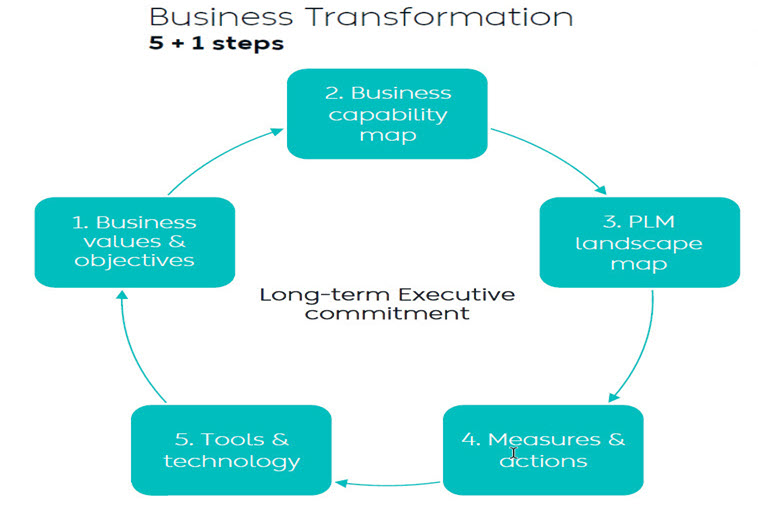
So, to get an executive commitment, you need to explain and address business challenges.
Executive commitment and participation can be achieved through a Benefits Dependency Network approach, as illustrated in this webinar I did with the Heliple-2 team, where we were justifying the business needs for Federated PLM. More about the Federated PLM part in the next paragraph.

Another point to consider is that when the PLM team is part of the IT organization (the costs side), they have a big challenge in leading or even participating in business discussions. In this context, read (again) Jan Bosch’s post: Structure Eats Strategy.
 The second post, more recent, summarized the experiences I had with several customer engagements. The title says it all: “Don’t use the P**-word! – 5 lessons learned“, with an overlap in content with the first post.
Conclusion: A successful PLM strategy starts with the business and needs storytelling to align all stakeholders with a shared vision or goal.
PLM is technology
This year has seen the maturation of PLM technology concepts. We are moving away from a monolithic PLM system and exploring federated and connected infrastructures, preferably a mix of Systems of Record (the old PLMs/ERPs) and Systems of Engagement (the new ways of domain collaboration). The Heliple project manifests such an approach, where the vertical layers are Systems of Record, and the horizontal modules could be Systems of Engagement.

I had several discussions with typical System of Engagement vendors, like Colab (“Where traditional PLM fails”) and Partful (“Connected Digital Thread for Lower and Mid-market OEMs“), but I also had broader discussions during the PLM Roadmap PDT Europe conference – see: R-evolutionizing PLM and ERP and Heliple.

 I also follow Dr. Jorg Fischer, who lectures about digital transformation concepts in the manufacturing business domain. Unfortunately, for a broader audience, Jörg published a lot in German, and typically, his references for PLM and ERP are based on SAP and Teamcenter. His blog posts are always interesting to follow – have a look at his recent blog in English: 7 keys to solve PLM & ERP.
 Of course, Oleg Shilovitsky’s impressive and continuous flow of posts related to modern PLM concepts is amazing—just browse through his Beyond PLM home page to read about the actual topics happening in his PLM ecosystem or for example, read about modern technology concepts in this recent OpenBOM article.
Conceptually, we are making progress. As a commonality, all future concepts focus on data, not so much on managing documents—and here comes the focus on data.
PLM needs accurate data
In a data-driven environment, apps or systems will use a collection of datasets to provide a user with a working environment, either a dashboard or an interactive real-time environment. Below is my AI (Artist Impression) of a digital enterprise.
Of course, it seems logical; the data must be accurate as you no longer have control over access to the data in a data-driven environment. You can be accountable for the data; others can consume the data you created without checking its accuracy by your guidance.
Therefore, data governance and an excellent enterprise architecture are crucial to support the new paradigm:
The nearest source of truth supported by a single source of change
Quote: Yousef Hoohmand
Forget the Single Source of Truth idea, a previous century paradigm.
With data comes Artificial intelligence and algorithms that can play an essential role in your business, providing solutions or insights that support decision-making.
 In 2024, most of us have been exploring the benefits of ChatGPT and Generative AI. You can describe examples of where AI could assist in every aspect of the product lifecycle. I saw great examples from Eaton, Ocado, and others at the PLM Roadmap/PDT Europe conference.
See my review here: A long week after the PLM Roadmap / PDT Europe conference.
Still, before benefiting from AI in your organization, it remains essential that the AI runs on top of accurate data.
Sustainability needs (digital) PLM
 This paragraph is the only reverse dependency towards PLM and probably the one that is less in people’s minds, perhaps because PLM is already complex enough. In 2024, with the PLM Green Global Alliance, we had good conversations with PLM-related software vendors or service partners (aPriori, Configit, Makersite, PTC, SAP, Siemens and Transition Technologies PSC) where we discussed their solutions and how they are used in the field by companies.
We discovered here that most activities are driven by regulations, like ESG reporting, the new CSRD directive for Europe and the implementation of the Digital Product Passport. What is clear from all these activities is that companies need to have a data-driven PLM infrastructure to connect product data to environmental impacts, like carbon emissions equivalents.
Besides complying with regulations, I have been discussing the topic of Product-As-A-Service, or the Product Service System, this year, with excellent feedback from Dave Duncan. You can find a link to his speech: Improving Product Sustainability – PTC with PGGA.
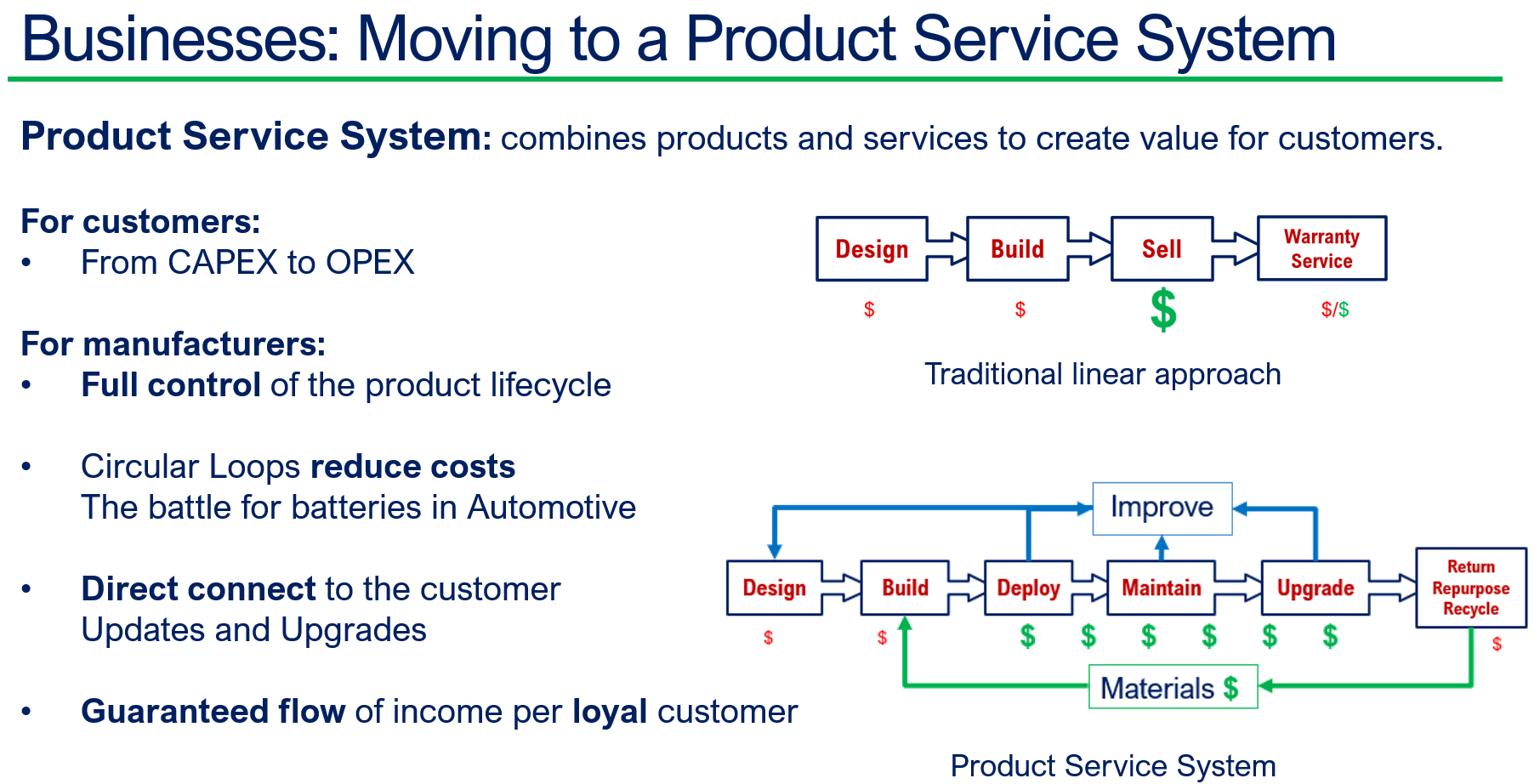
Also, during the PLM Roadmap / PDT Europe conference, I discussed this topic, explaining that achieving a circular economy is a long-term vision, and the starting point is to establish a connected infrastructure within your organizations and with your customers/users in the field.
 Sustainability should be on everyone’s agenda. From the interactions on LinkedIn, you can see that we prefer to discuss terms like PDM/PLM or eBOM/mBOM in the PLM domain. Very few connect PLM to sustainability.
Sustainability is a long-term mission; however, as we have seen from long-term missions, they can be overwhelmed by the day’s madness and short-term needs.
PLM is Politics
You might not expect this paragraph in my log, as most PLM discussions are about the WHAT and the WHY of a PLM solution or infrastructure. However, the most challenging part of PLM is the HOW, and this is the area that I am still focused on.
In the early days of mediating mainly in SmarTeam implementations, it became clear that the technology was not the issue. A crisis was often due to a lack of (technical) skills or methodology and misplaced expectations.

Unicorns & HIPPOs in an enterprise (Peter Vind)
When the way out became clear, politics often started. Sometimes, there was the HIPPO (HIghest Paid Person’s Opinion) in the company, as Peter Vind explained, or there was the blame game, which I described in my 2019 “The PLM blame game post”.
What makes it even more difficult is that people’s opinions in PLM discussions are often influenced by their friendly relations or history with a particular vendor or implementer from the past, which troubles a proper solution path.
These aspects are challenging to discuss, and nobody wants to discuss them openly. A company (and a country) must promote curiosity instead of adhering to mainstream thinking and working methods. In our latest Share PLM podcast, Brian Berger, a VP at Metso, mentions the importance of diversity within an organization.
“It is a constant element of working in a global business, and the importance cannot be overstated.”
This observation should make us think again when we want to simplify everything and dim the colors.
Conclusion
Initially, I thought this would be a shorter post, but again, it became a long read – therefore, perhaps ideal when closing 2024 and looking forward to activities and focus for 2025. Use this time to read books and educate yourself beyond the social media posts (even my blogs are limited 😉)
In addition, I noticed the build-up of this post was unconsciously influenced by Martijn Dullaart‘s series of messages titled “Configuration Management is ……”. Thanks, Martijn, for your continuous contributions to our joint passion – a digital enterprise where PLM and CM flawlessly interact based on methodology and accurate data.

 I am sharing another follow-up interview about PLM and Sustainability with a software vendor or implementer. Last year, in November 2023, Klaus Brettschneider and Jos Voskuil from the PLM Green Global Alliance core team spoke with Transition Technologies PSC about their GreenPLM offering and their first experiences in the field.
As we noticed with most first interviews, sustainability was a topic of discussion in the PLM domain, but it was still in the early discovery phases for all of us.
 Last week, we spoke again with Erik Rieger and Rafał Witkowski, both working for Transition Technologies PSC, a global IT solution integrator in the PLM world known for their PTC implementation services. The exciting part of this discussion is that system integrators are usually more directly connected to their customers in the field and, therefore, can be the source of understanding of what is happening.
ecoPLM and more
Where Erik is a and he is a long term PLM expert and Rafal is the PLM Practice Lead for Industrial Sustainability. In the interview below they shared their experiences with a first implementation pilot in the field, the value of their _ecoPLM offering in the context of the broader PTC portfolio. And of course we discussed topics closely related to these points and put them into a broader context of sustainably.
Enjoy the 34 minutes discussion and you are always welcome to comment or start a discussion with us.
The slides shown in this presentation and some more can be downloaded HERE.
What I learned
- The GreenPLM offering has changed its name into ecoPLM as TT PSC customers are focusing on developing sustainable products, with currently supporting designer to understand the carbon footprint of their products.
- They are actually in a MVP approach with a Tier 1 automotive supplier to validate and improve their solution and more customers are adding Design for Sustainability to their objective, besides Time to Market, Quality and Cost.
- Erik will provide a keynote speech at the Green PLM conference on November 14th in Berlin – The conference is targeting a German speaking audience although the papers are in English. You can still register and find more info here
- TT PSC is one of the partners completing the PTC sustainability offering and working close with their product management.
- A customer quote: “Sustainability makes PLM sexy again”
Want to learn more?
Here are some links related to the topics discussed in our meeting:
- YouTube: ecoPLM: your roadmap for eco-friendly product development
- ecoPLM – a sustainable product development website
- YouTube: Win the Net-Zero Race with PLM (and PTC)
Conclusions
We are making great progress in the support to design and deliver more sustainable products – sustainability goes beyond marketing as Rafal Witkowski mentioned – the journey has started. What do you see in your company?

Next week – week 46 – more news from Day 2 from the #plmroadmappdt conference
Recently, I attended several events related to the various aspects of product lifecycle management; most of them were tool-centric, explaining the benefits and values of their products.
 In parallel, I am working with several companies, assisting their PLM teams to make their plans understood by the upper management, which has always been my mission in the past.
However, nowadays, people working in the business are feeling more and more challenged and pained by not acting adequately to the upcoming business demands.
The image below has been shown so many times, and every time, the context becomes more relevant.

Too often, an evolutionary mindset with small steps is considered instead of looking toward the future and reasoning back for what needs to be done.
Let me share some experiences and potential solutions.
Don’t use the P** word!
 The title of this post is one of the most essential points to consider. By using the term PLM, the discussion is most of the time framed in a debate related to the purchase or installation of a system, the PLM system, which is an engineering tool.
PLM vendors, like Dassault Systèmes and Siemens, have recognized this, and the word PLM is no longer on their home pages.
They are now delivering experiences or digital industries software.
Other companies, such as PTC and Aras, broadened the discussion by naming other domains, such as manufacturing and services, all connected through a digital thread.
 The challenge for all these software vendors is why a company would consider buying their products. A growing issue for them is also why would they like to change their existing PLM system to another one, as there is so much legacy.
For all of these vendors, success can come if champions inside the targeted company understand the technology and can translate its needs into their daily work.
 Here, we meet the internal PLM team, which is motivated by the technology and wants to spread the message to the organization. Often, with no or limited success, as the value and the context they are considering are not understood or felt as urgent.
Lesson 1:
Don’t use the word PLM in your management messaging.
 In some of the current projects I have seen, people talk about the digital highway or a digital infrastructure to take this hurdle. For example, listen to the SharePLM podcast with Roger Kabo from Marel, who talks about their vision and digital product highway.

The Marel digital product highway
As soon as you use the word PLM, most people think about a (costly) system, as this is how PLM is framed. Engineering, like IT, is often considered a cost center, as money is made by manufacturing and selling products.
According to experts (CIMdata/Gartner), Product Lifecycle Management is considered a strategic approach. However, the majority of people talk about a PLM system. Of course, vendors and system integrators will speak about their PLM offerings.
To avoid this framing, first of all, try to explain what you want to establish for the business. The terms Digital Product Highway or Digital Infrastructure, for example, avoid thinking in systems.
Lesson 2:
Don’t tell your management why they need to reward your project – they should tell you what they need.
This might seem like a bit of strange advice; however, you have to realize that most of the time, people do not talk about the details at the management level. At the management level, there are strategies and business objectives, and you will only get attention when your proposal addresses the business needs. At the management level, there should be an understanding of the business need and its potential value for the organization. Next, analyzing the business changes and required tools will lead to an understanding of what value the PLM team can bring.

Yousef Hooshmand’s 5 + 1 approach illustrates this perfectly. It is crucial to note that long-term executive commitment is needed to have a serious project, and therefore, the connection to their business objective is vital.
 Therefore, if you can connect your project to the business objectives of someone in management, you have the opportunity to get executive sponsorship. A crucial advice you hear all the time when discussing successful PLM projects.
Lesson 3:
Alignment must come from within the organization.
Last week, at the 20th anniversary of the Dutch PLM platform, Yousef Hooshmand gave the keynote speech starting with the images below:
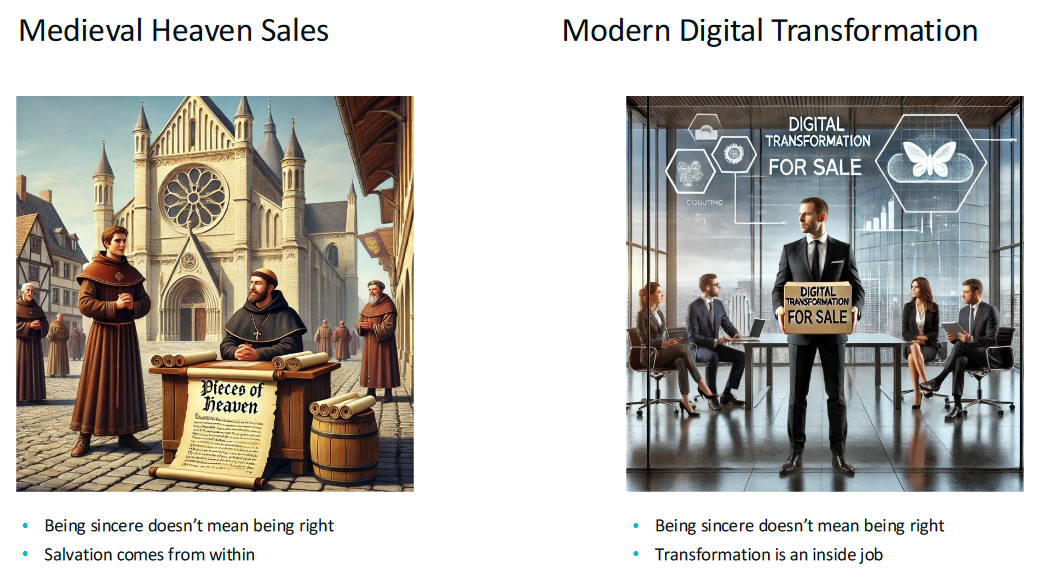
On the left side, we see the medieval Catholic church sincerely selling salvation through indulgences, where the legend says Luther bought the hell, demonstrating salvation comes from inside, not from external activities – read the legend here.
 On the right side, we see the Digital Transformation expert sincerely selling digital transformation to companies. According to LinkedIn, there are about 1.170.000 people with the term Digital Transformation in their profile.
As Yousef mentioned, the intentions of these people can be sincere, but also, here, the transformation must come from inside (the company).
When I work with companies, I use the Benefits Dependency Network methodology to create a storyboard for the company. The BDN network then serves as a base for creating storylines that help people in the organization have a connected view starting from their perspective.
Companies might hire strategic consultancy firms to help them formulate their long-term strategy. This can be very helpful where, in the best case, the consultancy firm educates the company, but the company should decide on the direction.
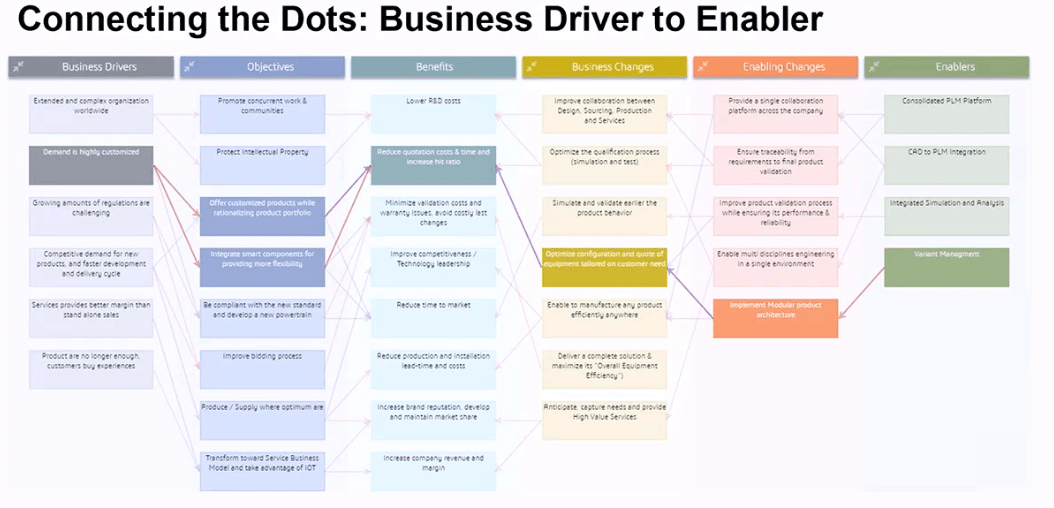
In an older blog post, I wrote about this methodology, presented by Johannes Storvik at the Technia Innovation forum, and how it defines a value-driven implementation.
Dassault Systèmes and its partners use this methodology in their Value Engagement process, which is tuned to their solution portfolio.
You can also watch the webinar Federated PLM Webinar 5 – The Business Case for the Federated PLM, in which I explained the methodology used.
Lesson 4:
PLM is a business need not an IT service
 This lesson is essential for those who believe that PLM is still a system or an IT service. In some companies, I have seen that the (understaffed) PLM team is part of a larger IT organization. In this type of organization, the PLM team, as part of IT, is purely considered a cost center that is available to support the demand from the business.
The business usually focuses on incremental and economic profitability, less on transformational ways of working.
In this context, it is relevant to read Chris Seiler’s post: How to escape the vicious circle in times of transformation? Where he reflects on his 2002 MBA study, which is still valid for many big corporate organizations.
It is a long read, but it is gratifying if you are interested. It shows that PLM concepts should be discussed and executed at the business level. Of course, I read the article with my PLM-twisted brain.

A Pessimistic Scenario of External Driving Forces and Their Internal Interrelations (Christ Seiler)
The image above from Chris’s post could be a starting point for a Benefits-Dependent Network diagram, expanded with Objectives, Business Changes and Benefits to fight this vicious downturn.
As PLM is no longer a system but a business strategy, the PLM team should be integrated into the business potential overlooked by the CIO or CDO, as a CEO is usually not able to give this long-term executive commitment.
Lesson 5:
Educate yourselves and your management
 The last lesson is crucial, as due to improving technologies like AI and, earlier, the concepts of the digital twin, traditional ways of coordinated working will become inefficient and redundant.
However, before jumping on these new technologies, everyone, at every level in the organization, should be aware of:
WHY will this be relevant for our business? Is it to cut costs – being more efficient as fewer humans are in the process? Is it to be able to comply with new upcoming (sustainability) regulations? Is it because the aging workforce leaves a knowledge gap?
WHAT will our business need in the next 5 to 10 years? Are there new ways of working that we want to introduce, but we lack the technology and the tools? Do we have skills in-house? Remember, digital transformation must come from the inside.
HOW are we going to adapt our business? Can we do it in a learning mode, as the end target is not clear yet—the MVP (Minimum Viable Product) approach? Are we moving from selling products to providing a Product Service System?
My lesson: Get inspired by the software vendors who will show you what might be possible. Get educated on the topic and understand what it would mean for your organization. Start from the people and the business needs before jumping on the tools.
 In the upcoming PLM Roadmap/PDT Europe conference on 23-24 October, we will be meeting again with a group of P** experts to discuss our experiences and progress in this domain. I will give a lecture here about what it takes to move to a sustainable economy based on a Product-as-a-service concept.
If you want to learn more – join us – here is the link to the agenda.
Conclusion
I hope you enjoyed reading a blog post not generated by ChatGPT, although I am using bullet points. With the overflow of information, it remains crucial to keep a holistic overview. I hope that with this post, I have helped the P** teams in their mission, and I look forward to learning from your experiences in this domain.
 I have not been writing much new content recently as I feel that from the conceptual side, so much has already been said and written. A way to confuse people is to overload them with information. We see it in our daily lives and our PLM domain.
With so much information, people become apathetic, and you will hear only the loudest and most straightforward solutions.
One desire may be that we should go back to the past when everything was easier to understand—are you sure about that?
This attitude has often led to companies doing nothing, not taking any risks, and just providing plasters and stitches when things become painful. Strategic decision-making is the key to avoiding this trap.

I just read this article in the Guardian: The German problem? It is an analog country in a digital world.
The article also describes the lessons learned from the UK (quote):
Britain was the dominant economic power in the 19th century on the back of the technologies of the first Industrial Revolution and found it hard to break with the old ways even when it should have been obvious that its coal and textile industries were in long-term decline.
As a result, Britain lagged behind its competitors. One of these was Germany, which excelled in advanced manufacturing and precision engineering.
Many technology concepts originated from Germany in the past and even now we are talking about Industrie 4.0 and Catena-X as advanced concepts. But are they implemented? Did companies change their culture and ways of working required for a connected and digital enterprise?
Technology is not the issue.
 The current PLM concepts, which discuss a federated PLM infrastructure based on connected data, have become increasingly stable.
Perhaps people are using different terminologies and focusing on specific aspects of a business; however, all these (technical) discussions talk about similar business concepts:
- Prof. Dr. Jorg W. Fischer, managing partner at Steinbeis – Reshape Information Management (STZ-RIM), writes a lot about a modern data-driven infrastructure, mainly in the context of PLM and ERP. His recent article: The Freeway from PLM to ERP.
- Oleg Shilovitsky, CEO of OpenBOM, has a never-ending flow of information about data and infrastructure concepts and an understandable focus on BOMs. One of his recent articles, PLM 2030: Challenges and Opportunities of Data Lifecycle Management
- Matthias Ahrens, enterprise architect at Forvia / Hella, often shares interesting concepts related to enterprise architecture relevant to PLM. His latest share: Think PLM beyond a chain of tools!
- Dr. Yousef Hooshmand, PLM lead at NIO, shared his academic white paper and experiences at Daimler and NIO through various presentations. His publication can be found here: From a Monolithic PLM Landscape to a Federated Domain and Data Mesh.
- Erik Herzog, technical fellow at SAAB Aeronautics, has been active for the past two years, sharing the concept of federated PLM applied in the Heliple project. His latest publication post: Heliple Federated PLM at the INCOSE International Symposium in Dublin
Several more people are sharing their knowledge and experience in the domain of modern PLM concepts, and you will see that technology is not the issue. The hype of AI may become an issue.
From IT focus to Business focus
 One issue I observed at several companies I worked with is that the PLM’s responsibility is inside the IT organization – click on the image to get the mindset.
This situation is a historical one, as in the traditional PLM mode, the focus was on the on-premise installation and maintenance of a PLM system. Topics like stability, performance and security are typical IT topics.
IT departments have often been considered cost centers, and their primary purpose is to keep costs low.
Does the slogan ONE CAD, ONE PLM or ONE ERP resonate in your company?
 It is all a result of trying to standardize a company’s tools. It is not deficient in a coordinated enterprise where information is exchanged in documents and BOMs. Although I wrote in 2011 about the tension between business and IT in my post “PLM and IT—love/hate relation?”
Now, modern PLM is about a connected infrastructure where accurate data is the #1 priority.
Most of the new processes will be implemented in value streams, where the data is created in SaaS solutions running in the cloud. In such environments, business should be leading, and of course, where needed, IT should support the overall architecture concepts.
In this context, I recommend an older but still valid article: The Changing Role of IT: From Gatekeeper to Business Partner.
This changing role for IT should come in parallel to the changing role for the PLM team. The PLM team needs to first focus on enabling the new types of businesses and value streams, not on features and capabilities. This change in focus means they become part of the value creation teams instead of a cost center.
From successful PLM implementations, I have seen that the team directly reported to the CEO, CTO or CIO, no longer as a subdivision of the larger IT organization.
Where is your PLM team?
Is it a cost center or a value-creation engine?
The role of business leaders
As mentioned before, with a PLM team reporting to the business, communication should transition from discussing technology and capabilities to focusing on business value.
I recently wrote about this need for a change in attitude in my post: PLM business first. The recommended flow is nicely represented in the section “Starting from the business.”
Image: Yousef Hooshmand.
Business leaders must realize that a change is needed due to upcoming regulations, like ESG and CSRD reporting, the Digital Product Passport and the need for product Life Cycle Analysis (LCA), which is more than just a change of tools.
I have often referred to the diagram created by Mark Halpern from Gartner in 2015. Below you can see and adjusted diagram for 2024 including AI.
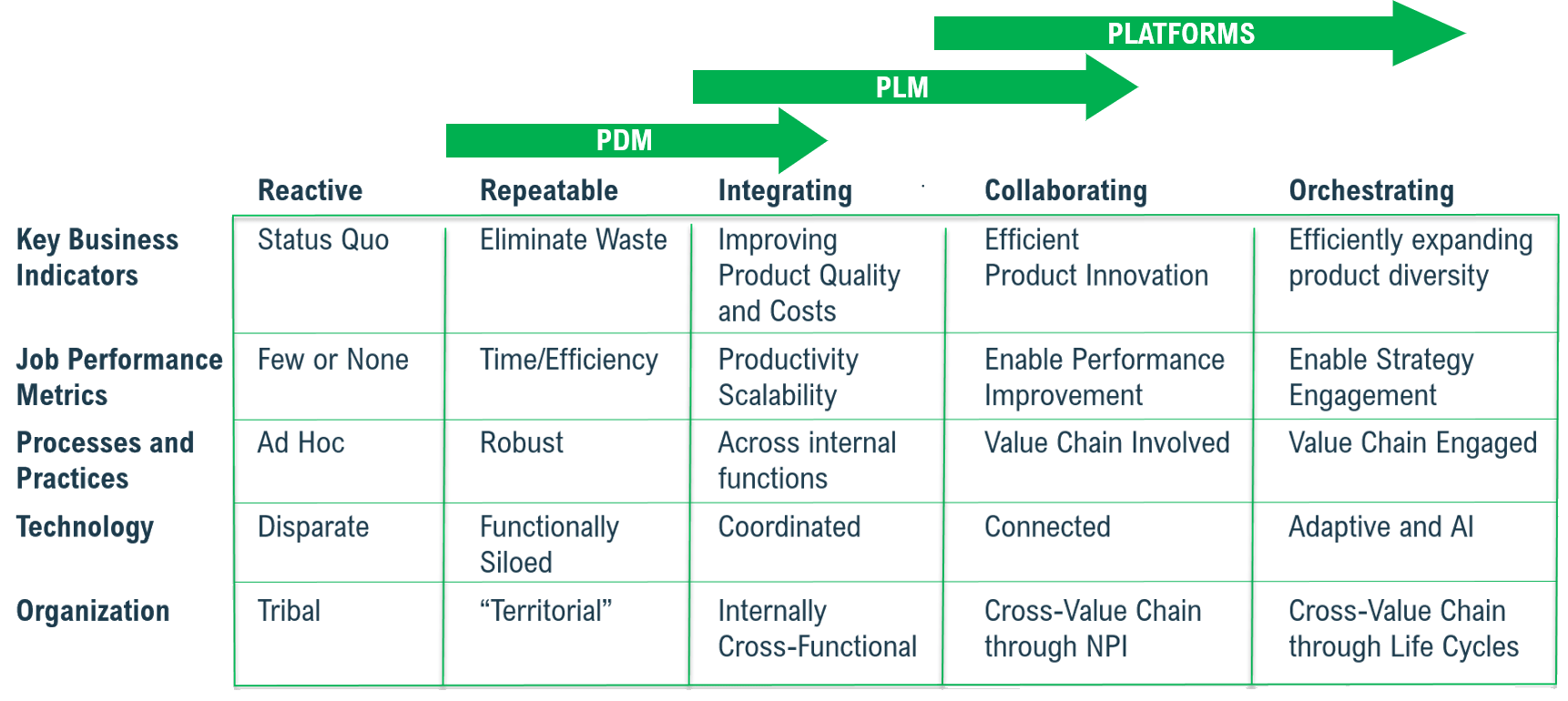
It looks like we are moving from Coordinated technology toward Connected technology. This seems easy to frame. However, my experience discussing this step in the past four to five years has led to the following four lessons learned:
- It is not a transition from Coordinated to Connected.
At this step, a company has to start in a hybrid mode – there will always remain Coordinated ways of working connected to Connected ways of working. This is the current discussion related to Federated PLM and the introduction of the terms System of Record (traditional systems / supporting linear ways of working) and Systems of Engagement (connected environments targeting real-time collaboration in their value chain) - It is not a matter of buying or deploying new tools.
Digital transformation is a change in ways of working and the skills needed. In traditional environments, where people work in a coordinated approach, they can work in their discipline and deliver when needed. People working in the connected approach have different skills. They work data-driven in a multidisciplinary mode. These ways of working require modern skills. Companies that are investing in new tools often hesitate to change their organization, which leads to frustration and failure. - There is no blueprint for your company.
Digital transformation in a company is a learning process, and therefore, the idea of a digital transformation project is a utopia. It will be a learning journey where you have to start small with a Minimum Viable Product approach. Proof of Concepts is a waste of time as they do not commit to implementing the solution. - The time is now!
The role of management is to secure the company’s future, which means having a long-term vision. And as it is a learning journey, the time is now to invest and learn using connected technology to be connected to coordinated technology. Can you avoid waiting to learn?
I have shared the image below several times as it is one of the best blueprints for describing the needed business transition. It originates from a McKinsey article that does not explicitly refer to PLM, again demonstrating it is first about a business strategy.
It is up to the management to master this process and apply it to their business in a timely manner. If not, the company and all its employees will be at risk for a sustainable business. Here, the word Sustainable has a double meaning – for the company and its employees/shareholders and the outside world – the planet.
Want to learn and discuss more?
Currently, I am preparing my session for the upcoming PLM Roadmap/PDT Europe conference on 23 and 24 October in Gothenburg. As I mentioned in previous years, this conference is my preferred event of the year as it is vendor-independent, and all participants are active in the various phases of a PLM implementation.

If you want to attend the conference, look here for the agenda and registration. I look forward to discussing modern PLM and its relation to sustainability with you. More in my upcoming posts till the conference.
Conclusion
Digital transformation in the PLM domain is going slow in many companies as it is complex. It is not an easy next step, as companies have to deal with different types of processes and skills. Therefore, a different organizational structure is needed. A decision to start with a different business structure always begins at the management level, driven by business goals. The technology is there—waiting for the business to lead.

 In recent years, I have assisted several companies in defining their PLM strategy. The good news is that these companies are talking first about a PLM strategy and not immediately about a PLM system selection.
In addition, a PLM strategy should not be defined in isolation but rather as an integral part of a broader business strategy. One of my favorite one-liners is:
“Are we implementing the past, or are we implementing the future?”
When companies implement the past, it feels like they modernize their current ways of working with new technology and capabilities. The new environment is more straightforward to explain to everybody in the company, and even the topic of migration can be addressed as migration might be manageable.
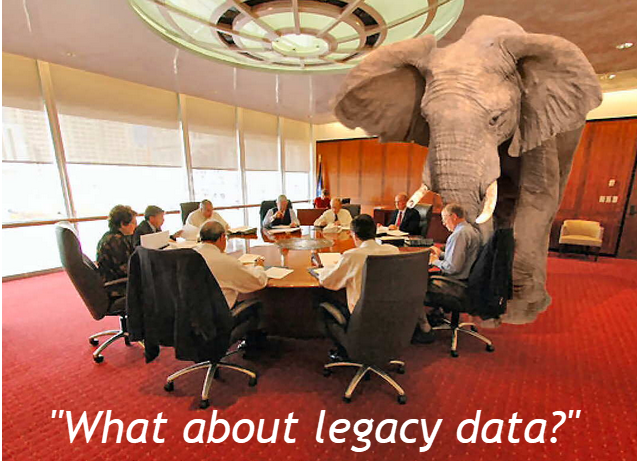 Note: Migration should always be considered – the elephant in the room.
I wrote about Migration Migraine in two posts earlier this year, one describing the basics and the second describing the lessons learned and the path to a digital future.
Implementing PLM now should be part of your business strategy.
 Threats coming from different types of competitors, necessary sustainability-related regulations (e.g., CSRD reporting), and, on the positive side, new opportunities are coming (e.g., Product as a Service), all requiring your company to be adaptable to changes in products, services and even business models.
Suppose your company wants to benefit from concepts like the Digital Twin and AI. In that case, it needs a data-driven infrastructure—
Digital Twins do not run on documents, and algorithms need reliable data.
Digital Transformation in the PLM domain means combining Coordinated and Connected working methods. In other words, you need to build an infrastructure based on Systems of Record and Systems of Engagement. Followers of my blog should be familiar with these terms.
PLM is not an R&D and Engineering solution
(any more)
One of the biggest misconceptions still made is that PLM is implemented by a single system mainly used by R&D and Engineering. These disciplines are considered the traditional creators of product data—a logical assumption at the time when PLM was more of a silo, Managing Projects with CAD and BOM data.
 However, this misconception frames many discussions towards discussions about what is the best system for my discipline, more or less strengthening the silos in an organization. Being able to break the silos is one of the technical capabilities digitization brings.
Business and IT architecture are closely related. Perhaps you have heard about Conway’s law (from 1967):
“Any organization that designs a system (defined broadly) will produce a design whose structure is a copy of the organization’s communication structure.”
 This means that if you plan to implement or improve a PLM infrastructure without considering an organizational change, you will be locked again into your traditional ways of working – the coordinated approach, which is reflected on the left side of the image (click on it to enlarge it).
An organizational change impacts middle management, a significant category we often neglect. There is the C-level vision and the voice of the end user. Middle management has to connect them and still feel their jobs are not at risk. I wrote about it some years ago: The Middle Management Dilemma.
How do we adapt the business?
The biggest challenge of a business transformation is that it starts with the WHY and should be understood and supported at all organizational levels.
If there is no clear vision for change but a continuous push to be more efficient, your company is at risk!
For over 60 years, companies have been used to working in a coordinated approach, from paper-based to electronic deliverables.
- How do you motivate your organization to move in a relatively unknown direction?
- Who in your organization are the people who can build a digital vision and Strategy?
These two questions are fundamental, and you cannot outsource ownership of it.
 People in the transformation teams need to be digitally skilled (not geeks), communicators (storytellers), and, very importantly, connected to the business.
Often, the candidates come from the existing business units where they have proven skills. The challenging part is educating them and making them available for this mission.
Digital transformation is not a side job.
Education can come from the outside world. Making people available to work on the new digital infrastructure is a management decision and their sense of priority.
How to get external support?
If you are connected to the PLM world like me, a lot of information is available. In academic papers, projects and in particular on LinkedIn currently, there is an overflow of architectural debates:
Recently, I participated in the discussions below:
- How to Solve PLM & ERP (Oleg Shilovitsky)
- Last week, we finally solved PLM & ERP (Prof. Dr. Jörg W. Fischer / Martin Eigner)
- PLM and MBOM: Supply Chain Debates and Future Solution Architecture (Oleg Shilovitsky)
- Could be a Knowledge Graph resp. the Linked Data technologies the key to …. (Matthias Ahrens)
The challenge with these articles is that they are for insiders and far from shareable with business people. There is always a discussion, as we are all learning to match theory with reality. For example,Prof. Dr. Jörg W. Fischer introduced the Information Architecture as a missing link. You can read his recent post here and the quote below to get interested:
All of these methods focus either on Data Architecture or Business Architecture. And the blind spot? I am convinced that an essential layer between the two is missing. We at STZ-RIM Reshape Information Management call this Information Architecture.
Still, we remain in the expert domain, which a limited group of people understands. We need to connect to the business. Where can we find more education from the business side?
The reaction below in one of the discussions says it all, in my opinion:

Starting from the business
What I have learned from my discussions with the management is:
- Don’t mention PLM – you will be cornered in the R&D / Engineering frame.
- Don’t explain their problems, and tell them that you have the solution (on PowerPoint)
- Create curiosity about topics that are relevant to the business – What if …?
- Use storytelling to imagine a future state – Spare the details.
- Build trust and confidence that you are not selling a product. Let the company discover their needs as it is their transformation.
The diagram below, presented by Yousef Hooshmand during the PLM Roadmap/PDT Europe 2023 conference in Paris, describes it all:

It will be a continuous iterative process where, starting from business values and objectives, an implementation step is analyzed, how it fits in the PLM landscape and ultimately, how measures and actions guide the implementation of the tools and technology.
It is important to stress that this is not the guidance for a system implementation; it is the guidance for a digital transformation journey. Therefore, the message in the middle of the image is: Long-term Executive Commitment!
 In addition, I want to point to articles and blogs written by Jan Bosch. Jan is an Executive, professor and consultant with more than 20 years of experience in large-scale software R&D management and business.
Although our worlds do not intersect yet, the management of mechanical products and software is different; his principles fit better and better with a modern data-driven organization. Often, I feel we are fighting the same battle to coach companies in their business transformation.
In the context of this article, I recommend reviewing the BAPO model coming from the software world.
BAPO stands for Business, Architecture, Process and Organization. As the diagram below indicates, you should start from the business, defining the needs for the architecture and then the preferred ways of working. Finally, the organization has to be established in accordance with the processes.

Often, companies use the OPAB approach, which makes them feel more comfortable (Conway’s Law). For further reading in this context, I recommend the following posts from Jan Bosch:
Business and technology
I want to conclude by discussing ways to connect business and technology as you need both.
First, I want to point to an example that we presented in the Federated PLM interest group on LinkedIn. Although the discussion initially focused on technical capabilities, we concluded by connecting them to business transformational needs. The diagram below is our characteristic image used to explain the interaction between Systems of Record (the vertical pillars) and the Systems of Engagement (the horizontal bars – modularity).

Have a look at the business discussion below:
Next, the diagram below comes from a 2017 McKinsey whitepaper: Toward an integrated technology operating model. Here, the authors describe how a company can move toward an integrated technology operating model using both coordinated and connected technologies.
They do not mention PLM; they have a business focus, and it is important to mention a company can work in different modes. This is an organizational choice, but don’t let people work in two modes,
Conclusion
With this post, I hope I moved the focus from technology and tools to an understandable business focus. Even within my 1500 words, there is much more to say, and this makes our (PLM) mission so complex and interesting. Let me know where you can connect.

We, the PLM Green Global Alliance, started our first interviews with PLM-related software vendors two years ago in 2022 with SAP, and recently, we revisited them for a much broader interview.
The initial interview in 2022 focused on companies getting pushed by legislation related to plastic packaging and how they could collect and analyze their product data.
Now, two years later, we discussed a much broader scope, including the Circular Economy and even Circular Manufacturing in the automotive industry. You can read and listen to this interview following this link: The PGGA talking again with SAP on Sustainability.
 However, as it is claimed that almost eighty percent of the environmental impact of a product is defined and decided during its design phase, we were eager to learn from the primary PLM vendors what they have observed.
PTC
 We were fortunate to talk again with Dave Duncan, VP Sustainability at PTC, who had just returned from a three-month tour in Europe, talking with 200 manufacturers in 21 different locations and having deep discussions to understand the market and their customer’s needs.
You could follow his movements through Europe on LinkedIn and his posting from the Munich workshop was fascinating. Besides meeting customers, there were also PTC partners like MakerSite, aPriori, and Transition Technologies PSC. All three companies have recently contributed to our PGGA series related to Sustainability.
Together with Dave, we spoke again with James Norman, who is responsible for driving PTC’s solutions and strategy for the digital and Sustainability transformation. He helped us make the connection between what’s happening in the field and what PTC is considering.
When listening to the interview, you will observe that in the PLM domain, so much has changed in the past two years.
Enjoy the 36 minutes of the interview and listen to what Dave has learned from the field, as reflected by James, on how PTC is addressing Sustainability.
Slides shown during the interview combined with additional company information can be found HERE.
What we have learned
- The Corporate Sustainability Reporting Directive (CSRD) has forced companies to address Sustainability and the need for the digitalization of their processes (the digital thread)
- For Sustainability impact, do not focus just on the component properties; identify hot-spots when analyzing analyzing the impact of the product on the product level.
- As the OEM often only assembles the final product, the environmental impact is defined upstream in the supply chain.
- Modularity and Systems Thinking are crucial methodologies for implementing a Circular Economy.
- If you only consider the cradle-to-gate part of a product’s lifecycle, you might miss the big picture entirely. Even worse, you might implement design changes in the name of sustainability that result in outcomes far less sustainable than the original design. It’s crucial to look at the entire Product Service System/lifecycle to truly understand a product’s environmental impact
- We did not talk about Digital Twins and AI this time. Implementing a connected Digital Thread is, at this moment, the highest priority.
Want to learn more?
- There is the PTC Impact Report
- Dave Duncan’s article: Join PTC on Our Sustainability Journey
- A customer story: How Cummins Prioritizes Sustainability for New Product Designs
Conclusion
I enjoyed the dialogue with Dave and James and the progress we all have made towards understanding what is needed to ensure a sustainable future for our planet. So much has changed in two years.
PLM plays a crucial role in the discussion of a circular economy, the need for modularity, and sustainability reporting. All of these elements require a digital infrastructure related to the products we manufacture or use.
In addition, I was impressed by Dave’s pragmatic approach, who was in the hot spots of European manufacturing companies to understand their needs instead of telling them about their should-be dreams.
Hi Jos, Knowing your background in methodology and education, I wanted to share a longer article with you: “What is…
Interesting reflection, Jos. In my experience, the situation you describe is very recognizable. At the company where I work, sustainability…
[…] (The following post from PLM Green Global Alliance cofounder Jos Voskuil first appeared in his European PLM-focused blog HERE.) […]
[…] recent discussions in the PLM ecosystem, including PSC Transition Technologies (EcoPLM), CIMPA PLM services (LCA), and the Design for…
Jos, all interesting and relevant. There are additional elements to be mentioned and Ontologies seem to be one of the…