
You are currently browsing the category archive for the ‘PLM’ category.
As today it was again ‘Black Saturday”, the day that the French and German roads are filled with cars and traffic jams above100 km length, it was a moment for me to reflect in the middle of my summer holiday. I do not want to make other continents jealous, but the summer holiday is important (and long), still time for some thoughts.
PLM is dead, long live Social / User focused PLM ?
In one of my old 2008 posts, PLM in 2050, I predicted that PLM would no longer exist at that time, as companies would no longer focus on individual systems, but on full coverage of business processes, through integrated and federated data sources. I see this trend coming from two major PLM vendors (Dassault Systems / Siemens) with their 3DLive / HD PLM concepts. These concepts are trying to provide a unique user experience, where in an intuitive manner, a user in a specific role can obtain relevant data, analyze and simulate it in a virtual environment. Here the PLM vendors are really taking the lead to become the main platform for product development processes. Will the name PLM disappear at a certain stage ?
Additional you see startups and also some of the major PLM vendors experimenting with community concepts, social media. Moving towards a “Facebook’- like environment for product development and collaboration processes. The idea behind this direction is partly driven by the fact that the old generation of workforce slowly moves towards retirement where the new generation is not motivated to follow up the same working processes and procedures. The old generation moved from paper-based, manual processes to terminal-like screens, email and excel sheets.
If the new generation of employees will benefit from Facebook like environments is the question. Product development and collaboration requires a lot of boring data entry, even if we have a unique user experience. In addition, I was reading a preview of some research done with American and Dutch students, stating that study results from those students active on Facebook are significant lower as the result of student not active on Facebook, although they spend the same time on internet. I haven’t found the original source – here is a Dutch link. Curious to learn who will develop and bring better products to the market in the future with modern social PLM ?
ALM based on PLM is underestimated by owner /operators
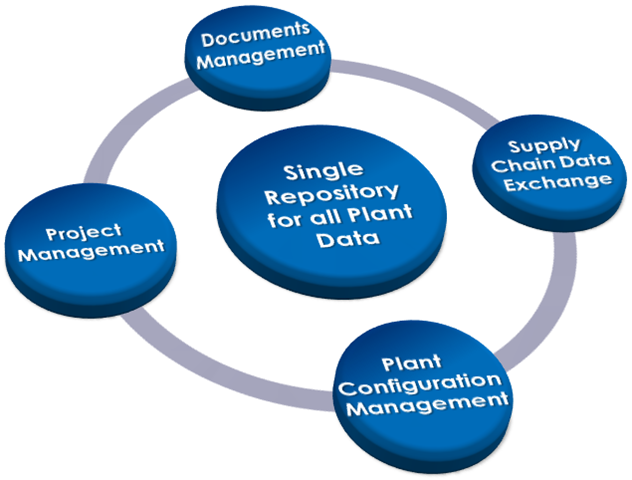 As I have been active the past two years in some Asset Lifecycle Management projects based on PLM, I also feel that many owner/operators do not have the understanding or guts to change the way they are working. Understandable from their point of view – as long as the errors and risks are acceptable, why change the way the whole industry is working ?
In the nuclear industry you see the awareness growing. People know the risks of a nuclear disaster (after Chernobyl) and as we need more energy resources, nuclear energy with enhanced containment of risks is a natural way to go.
Perhaps after the BP disaster in the Mexican gulf, where apparently to the various reports, people were taking the wrong decisions due to inaccurate data or due to lack of information (could not be found in time) ALM based on PLM could be considered. However, investing even a few millions and changing the company’s way of working will never be approved by the BP management, as it will never happen a second time. It is all about being proactive (which is not a natural behavior) or being reactive and trying to control the damage. Here I have no predictions for 2050, I only believe that the proactive companies have a higher chance of survival – no matter which industry
But now my holiday activities call me back – for those not blessed by a holiday, here an overview of some of the relevant posts from the past year/
PLM and Organization
How to get users excited for PLM ?
Some users do not like the single version of the truth
Implementing PLM requires a vision
What not to do in a bottom up PLM implementation ?
Culture change in a mid-sized company a management responsibility !
PLM selection
PLM for mid-market a mission impossible ?
Who decides for PLM in a mid-market company ?
More on who decides for PLM in a mid-market company
The academic conclusion on who decides for PLM in a mid-market company
Free PLM does not help companies
ALM
Asset Lifecycle Management based on PLM experiences
Asset Lifecycle Management using a PLM system
Tutorials
and if these links are not enough – look at my favorite blogs:
 The past month I have been very busy in a specific area where PLM is not yet as understood. Where PLM is a ‘must have’ for companies developing and manufacturing products, in the world of Asset Development and Asset Management not many companies are yet aware of the benefits PLM can bring. I wrote about it in one of my previous posts . I will share some of my experiences here and I must thank Stephen Porter for mentioning my blog in his review (and pushing me to write today – even during the soccer championships in South Africa.
PLM benefits for Owner / Operators
I had discussions with a few owner/operators in the past week and as they all came from different industries (nuclear power generation / gas distribution / chemical processing), the details might differ but the values a PLM system can bring is for all of them the same.
When talking to Owner/Operators there are a few standard situations you observe:
- The usage of a transactional system (MRO / ERP /SCADA) which is managing the operational and financial activities as job scheduling and purchasing. Main dominant players in this area are Maximo and SAP. Most Owner / Operators believe that this is the only main system they need.This looks very similar to what we see in the typical manufacturing companies. They all have an ERP system, and specially in the mid-market these companies are not looking for another major IT-system.
The problem with only the transactional system as the core system for the company is that there is no natural storage for product or process information that can change (the Intellectual Property of the company). Transactional systems use pointers to actual product or process information that they require. But where do they store other and historical information ?
- The challenge to manage in parallel data for maintenance, rework and innovation projects. As the transactional system provides data for the operational environment, these companies are used to copy out data to their project environment avoiding not released project data can be seen in the operational environment. Another situation in relation to the engineering projects is that the owner / operator usually outsources the engineering work to EPC contractors and only coordinates the activities taking ownership of the data only after the new installation is under operation
 The two owner / operators I met in the past month were in two different stages. The first one had already many years of experience in maintaining the plant operational and there they understood that the SAP PM module could not help them managing all required plant information around scheduled maintenance projects. Having already four different document management systems in place, the biggest challenge remained to coordinate the different baselines for the various projects scheduled for the annual maintenance. At the end they developed the concept where the PLM system is the owner of all plant related information, based on an Asset Structure in PLM and the PLM system ‘pushes’ the right information to SAP when the changes become operational.
 The other owner / operator was in the early stage. They were planning to have a process to become operational. Their understanding is that they need only one system that provides them all the time the actual information and if needed also all the history and approvals of each of the components. For sure the actual information needs to be managed in a transactional system (SCADA) and for sure the SCADA vendor will say they can manage all information in their system. The pity for this owner / operator is that once they need historical data, or need to manage complex maintenance projects, they have lost the opportunity to do it right from the beginning.
 Of course there is also a significant difference between the two owner operators.. The first owner / operator is situated in the Nordics, where the cost of labor is high. This means investing in IT-solutions to assure people are working with the right information brings a much faster ROI as compared to the owner / operator from South Europe. Sometime the labor cost can be one-third or less in comparison to the Nordic countries.
The owner/operator in the South Europe will initially not focus on efficiency and reducing labor costs. Due to the economical crisis unemployment is also high, so working with less people – improving by investments in IT are also not a popular measure.
But for all owner/operators a main consideration should be to remain competitive also over 10 – 20 years. Short term strategy is not good for this type of companies
Conclusion so far:
PLM concepts are bringing competitive benefits for Owner/Operator, despite the fact that they do not develop products. The value is based on bringing a single version of the truth (no island systems) and working in a single environment for the as-built and the to-be environment, without data conversions or transitions
next post I will talk about Asset Development and the PLM benefits
 Last weeks have been busy weeks and I have seen various PLM candidates all around Europe. As these companies were mid-market companies, I noticed again how difficult it is for these companies to follow the ideal path towards PLM.
For those reading my blog frequently they might remember my definition of mid-market and PLM. For newer readers I will give my definitions again, as everyone has their own definition.
Mid market company: For me the definition of a mid-market company does not have to do with revenue or the amount of people working for this company. I characterize a mid-market company as a company, where everyone has a focus on the company’s primary process. There is no strategic layer of people, who are analyzing the current business and defining new strategies for the future. In addition, the IT-staff is minimal, more seen as an overhead than as strategic. Mid-market companies have their strength in being flexible and reacting fast on changes, which might contradict with a long term strategic approach.

As what happens if you are only in a reactive mode – it can be too late.
PLM: For me PLM is not a product but a vision or business approach based on a collection of best practices (per industry). Main characteristics of PLM are centralizing all product knowledge (IP) throughout all the lifecycle stages and a focus on best practices and immediate visibility on all lifecycle stages. Combining concept, planning, development, production planning and after sales / service into one integrated process. It is more than concurrent engineering, it is about sharing data and ownership of data through different departments. And this means business transformation, breaking through traditional barriers. Of course PLM vendors have a slight different definition in order to differentiate themselves from other vendors. For example more focus on a virtual product definition (CAD PLM vendors) or a focus on efficiency and one single platform (ERP PLM vendors)
Who will initiate this change ?
And these two definitions already raise the questions I want to reflect here as I experienced again in two recent visits that the pain to move to PLM is here.
First what is the result of a reactive mode, even when it is a quick reaction ?
 A reactive mode leads to a situation where a company will never be able to differentiate rapidly from their competition. As every change takes time to implement, it is logically that a real business change will not be implemented as a quick reaction. The company needs to have a long term vision. And this is one of the things I noticed talking with mid-market companies. Ask these questions: “Where do you want to be in five years from now” and “How do you make sure you achieve these goals (if goals exist)” and often you find the company is depending on the business instinct of the founder(s) and has no real answers for the long term future.
 This is of course a result of the typical mid-market company, they have no internal people who will step outside the daily hectic and work on a change. And being reactive always means you are (a little) behind. And this was the situation in one of the companies that I have met recently. There was an initial understanding of the values that PLM could bring, but when talking about some of the basic principles of PLM, the answers was: In our company ERP is God. This means real PLM has no chance – you do not want to fight against God.
And now the discussion who can initiate the change towards PLM
 Now another example of a mid-market company that had a long term PLM vision but got trapped in their own approach. The company has been growing fast and like many European companies, production is done in China. And this causes collaboration issues around communication and quality between Europe and China as the company only knows CAD data management and ERP. The engineering manager was assigned to solve these issues.He did not get a full strategic assignment to look at the complete picture, but the management pushes him to solve the current pains, having the PLM wishes still in mind.
And solving the current pains lead again to function / feature comparison with a short term justification, believing that in the future all will fit in the PLM vision, as the potential resellers for the new solution said: “Yes we can”. Have you ever heard a reseller say “No we cannot”
The result, the engineering manager has to make a decision based on the ‘blue eyes’ of the reseller as he does not get the mandate and power from his management to analyze and decide on a PLM strategy for the long term. For one of the resellers talking about the details of PLM was even more a disadvantage as it creates an impression that PLM is complex. It is easier to sell a dream. A similar situation as I described in my posts: Who decides for PLM in a mid-market company
My conclusion
Although I am aware that many mid-market companies implement basics of PLM, it is frustrating to see that lack of priority and understanding of the management in mid-market companies blocks the growth to full benefits for PLM. The management is not to blame, as most PLM messages either come from the high-end PLM vendors or from product resellers both not packaged for the mid-market. See PLM for the mid-market – a mission impossible ?
PLM is a cross-departmental solution and the management should look for partners who can explain the business values and share best practices for mid-market companies business wise.
The partner is 50 % of the success for a PLM implementation.
Do you recoginize similar situations ? How would you address them ?
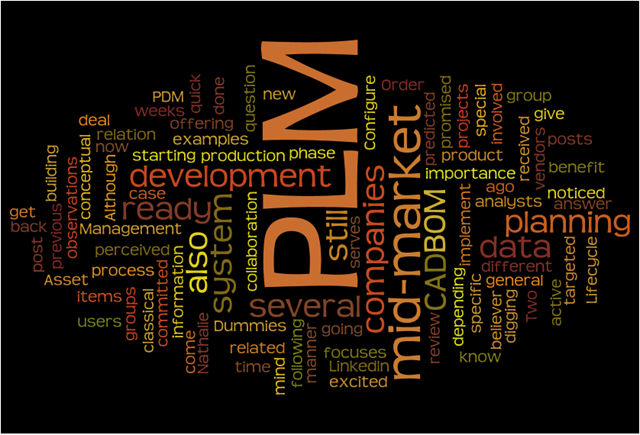
My PLM blog cloud based on Wordie – see the virtualdutchman blog cloud
 Two weeks ago I received through the PLM group on LinkedIn, the following question from Nathalie: “Do you know any specific examples of what some companies have done to get their users ready, excited or more committed to the new PLM system?”
When digging in my mind and planning to give a quick answer, I realized it was an interesting question with a contradiction embedded: users and excitement for a new PLM system.
This week I was attending the SmarTeam User Group meeting in the Netherlands, where an excellent presentation was given by Simon and Hessel from a Dutch company called Meyn (Poultry processing) about their PLM implementation. They shared their excitement !
Combined with an interesting discussion on Oleg’s blog with Frank, I believe I have the ingredients to answer the above question more complete.
PLM is not exiting for users
 I think this is fact number one. When you go to tradeshows or PLM exhibitions, you see usually only 3D CAD demos, nobody tries to demonstrate PLM functions and features in detail. As a side step, I believe the best PLM system should be almost invisible for the user. Users want to work in their own environment with applications like CAD, Excel (BOM handling apps), Office, FEA tools, Simulation tools and more.
ERP has a more clear value proposal, if you want to define and schedule your manufacturing and manage the financial transactions, everyone has accepted that you need ERP. User acceptance is not relevant, users have to work with the provided interface as otherwise production or accounting will fail, there is no alternative.
In contrary, the clear value and definition of PLM are not clear to user. For that reason these users do not get excited when confronted with PLM. They have been surviving without implementing PLM, so they believe there is an alternative.
But we know there are PLM benefits?
My previous post – PLM in the mid-market a mission impossible? – lead to a discussion with Oleg and Frank coming with anew and interesting view point. Frank mentioned that in the German area, many mid-market companies do PLM without purchasing an enterprise PLM system from the known vendors.
 The discussion focused on granularity, as all of us believed that a set-by-step approach towards PLM best practices, driven by people who understand the company very well, is the key to success. For this approach you need people inside the customer’s organization who can formulate the vision assisted by consultants working very dedicated in that industry. It requires a different type of consultant as those active in the big enterprise projects.
Instead of implementing PLM as a standard process, in this approach the customer drives and leads the activities where they see benefits in their overall business process. To achieve this, the company must have has a clear vision, where they want to be in the next 5 – 10 years.
Next implementations steps should fit in this strategy and prioritized based on different parameters and these steps are not always with a focus on PLM.
And here lies the key for successful PLM implementations.
 The implementation might be based on an academic approach around a core PLM data model and best practices. Mid-market offerings are around an OOTB (Out-Of-The-Box) quick implementation – the PLM system/implementer leads.
Something the management of likes to hear; quick and with little customization, which would translate in lower costs of implementation and disruption of the organization. But then, the end-users start to complain. There is too much change their standard way of working and they do not see the advantages – keying in more data in a system does not help them.
 The introduction of PLM brings more complexity and as the new system has to prove itself, there is not big enthusiasm from the average user. The management can push, like in the ERP situation, but in general also the management is anxious to learn if this OOTB-approach brings the benefits and when it fails they ask the vendor where the estimated ROI can be found.
Concluding you will be lucky if users get excited form the OOTB approach.
 In the second and granular approach, the company defines their strategy and vision, not necessary a 100 % PLM vision. This strategy need to be clear and shared with the employees in the company, especially for those who are affected by changes.
Next together with implementation partners, who bring in the know-how and possible software tools, a part of the company’s process is addressed and improved. It can be in any area, changing the CAD engine, automate BOM handling, connect sales to engineering or connect after sales/service to engineering.
Many of these areas of interest have different solutions, some are extensions of the CAD environment, some of them are extensions of the ERP environment and some of them are extensions of the IT-platform used in the company.
This approach is not sold by the PLM vendors, as they want to introduce their system as the IT-platform, wrap around the CAD and even capture the definition of the MBOM and initiation of the Item master.
A step-by-step approach based on different granular components, every time in the direction of the company’s strategy, plus all the time feed-back to the end-users on the positive impact of the change, is for me the key to success. In my previous post I was looking for a global provider for these required components.
With the step by step approach with granular solutions, we get users involved and excited.
And this brings me the to the presentation from Meyn
 The first time I got involved with Meyn was in October 2004. At that time they had chosen to move from their BaaN-2D CAD infrastructure to a new environment with BaaN – 3D CAD (CATIA). Simon presented their target strategy and vision: moving away from being an Engineering To Order company to become primarily a Configure To Order company.
ENOVIA SmarTeam was chosen to manage the 3D CAD and to connect the information to BaaN. Initially Meyn started in the classical PLM approach, but already after a few months, the understanding was there, they need have step-by-step approach, focused on results for the new CATIA users, without communicating around a complete PLM focused project.
So they followed a stepped approach, they called them waves.
Moving from Engineering to Order to Configure to Order is not software implementation. It requires rationalization of your products; convert them into modular, configurable parts. For this you need to be an engineering expert, not a software expert.
But when it comes to implementation of this concept in the software, you need both experts. And through this collaboration, a methodology for skeleton design was established which was driven by Meyn. And the reason the users were excited was, that they were doing real engineering, the benefits were significant visible.
 Customer project related engineering time (typical ETO), which was in the beginning their core activity, became around 30 % of the time. More time could be spent on developing new machines in a modular way. With almost the same amount of engineers the turn-over of the company had more than doubled. A win-win environment which makes also the end-users excited.
Still the backend with ERP at Meyn remained almost the same similar to the time they were working in the 2D environment. And the most interesting conclusion at the end of the presentation was, they are still using the same slide with the vision and they can explain why each step was taken and justify it by measurable benefits.
And this brings me to the answer of the question
“Do you know any specific examples of what some companies have done to get their users ready, excited or more committed to the new PLM system”?
- The management needs to have a clear vision where they want to be as a company in the future. This is not an IT-vision, but a business vision which explain why changes are needed. This vision should be clear to the employees. Communicate!
- Where possible provide metrics!
- Do not talk about a PLM system; it can be also in other tools. Talk about improvement steps in the business processes contributing to the vision. The PLM system is the information backbone, not the front-end. Management and implementers should talk business functionality not IT functions and features. Do not talk in applications!
- Build step by step user scenarios with focus on methodology and user understanding. Implementations with a function-feature focus are hard to accept by the users. Talk business!
- The management should present their vision again and again, supported by metrics what has been accomplished and what has been learned for the future – repeat!
Conclusion
There are thousands of mid-market companies that have a vision to improve their business. The PLM system should never be the topic of discussion with the end users; it is the change in working methods that is important, supported by various systems -CAD/ERP/CRM – and almost invisible …….. PLM
The company Meyn is an example of this approach. Simon and Hessel are working for Meyn as engineers improving their company’s business. Unfortunate it is not their business to explain all around the world, how PLM supports business change in a mid-market company. I was glad to attend their session last week.
 In 2008 and 2009 several analysts predicted that the mid-market was now ready for PLM and that most of the PLM vendors were building a targeted offering for the mid-market. I was, and still am, a believer that mid-market companies will benefit from PLM in case ………… they implement it.
When you review my observations in my blog from the past two years, apparently this does not seem to happen. Therefore in the past months, I have been analyzing posts and discussions around the ‘old’ and ‘new’ PLM, I have been talking with representatives from various PLM and PDM vendors, and last but not least analyzed what was the implementation process of a PLM system in companies, where I could get these insights.
This all lead to this post, perhaps too big for a blog, too small for a report.
First the definitions
Before giving my opinion, first my definitions of PLM and mid-market (as everyone has their own definition):
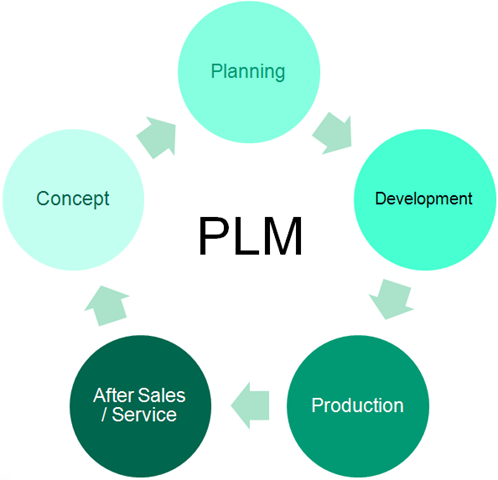 PLM means for me the management of all product related data and processes, from the initial concept phase, through planning, development, production planning and after sales/service. When talking about PLM, I have always a circular process in mind. Experiences from products in the market are again inputs for new product development. Instead of a linear process where every department manages their own data, the challenge is that every discipline contributes and collaborates around the product data. This implies that a PLM implementation always requires a business change process for a customer
 Mid-market companies are for those companies where there is no strategic layer available plus a minimized investment in IT-resources. This leads to organizations where most changes are happening inside departments and cross-departmental changes are hard to implement. The IT-department might be a facilitator here but usually IT people focus on architecture and infrastructure instead of business change. This implies that a PLM changed should come from external people.
And who are doing PLM?
On the enterprise level, there is a battle between the big three (Dassault Systems, Siemens and PTC) and they are challenged mostly by the two big ERP vendors (SAP and Oracle) and on the PLM front by Aras, competing through its Open Source model. Of course there are many other vendors. These observations come from the area where I am active.
 There are various ways to group these PLM vendors; one is from the CAD engine point of view: DS-CATIA / Siemens-NX / PTC-Pro/E. Although all claim to support a multi-CAD environment, the main focus in these companies is around the PLM integration with their primary CAD engine.
Where in the past, CAD independent PDM systems existed (Metaphase, MatrixOne), they could only survive in the major PLM industries by being integrated with CAD tools and were acquired for that reason. It will be interesting to see if Aras can play a major role in the PLM only domain, where others failed in the past due to lack of integration capabilities.
 SAP and Oracle took a different path; they have understood that PLM cannot be neglected in an enterprise, so they need to address it. SAP did this by developing a PLM module as a logical extension on their infrastructure. Oracle has chosen to add PLM to their portfolio by the acquisition of two different PLM vendors. Where SAP does not have the challenge to explain to customers a full integrated story, Oracle has to spend more time on marketing to make it look like a single platform, which will come in the future. Big question however for both companies: do they really understand PLM? Is it in their veins and core strategy or does it remain an extension to gain market share, especially as you have no connections to the design world? (Try to find PLM on their corporate website).
 Interesting to see how Aras will evolve. In their business model, the initial purchase of software is not needed, but once working with Aras you pay also for maintenance like with other PLM vendors. Their advantage is that switching from an existing legacy PLM vendor is less painful, as there are no initial software costs, which can be huge for an enterprise. I believe they have a good chance to succeed in industries where there is less a dependency on the CAD engine.So on the enterprise level the need for PLM is justified. Resources exist and are budgeted both at the customer level as at the supplier level. The PLM suppliers are either the PLM vendors themselves with service teams, or big, global service providers specialized in implementing the PLM software. They can do strategic PLM projects and support the required business change.
So why does it look like a mission impossible in the mid-market ?
The big enterprise vendors (PLM/ERP) believe that you can just strip down your enterprise software in a kind of prepackaged mode – PLM Out of the Box is a common heard expression. Also the analysts praise in their reports the mid-market approach from some of these vendors.
But do they really address the mid-market or only the high-end mid-market? Again it is all about the definition of where is the mid-market and in this post I stay with my definition of mid-market.
There are two main characteristics for this mid-market:
- Sales and implementation of software is done through Value Added Resellers and not through the vendors or big service companies. The software revenue per customer does not justify high expenses for global consultants with additional high expenses due to travel costs (and sometimes the local language issue). The local VAR is supposed to be the point of contact.
- Mid-market companies do not change their main company processes. Depending on the type of core process, let’s assume ETO or BTO, they have sales and engineering working close together on product/solution definition and they have manufacturing planning and production working close together on product/solution delivery. In term of functionality a PDM focus for sales/engineering and an ERP focus for manufacturing.
A mid-market company can be characterized as a two pillar company :
Who are successful in the mid-market ?
There are two software vendors, touching our PLM prospects , that really understand the mid-market, Autodesk and Microsoft.
Autodesk has a huge range of products and when we focus on the area of manufacturing, Autodesk does not talk about PLM. And I believe for several reasons.
 Autodesk has never been a front-runner in making new technology and concepts available for the mainstream. They are more a company providing functionality for mainstream concepts, as compared to a company pushing new concepts and technology for premium pricing.
And this is what their customers like, as they also do not have internal strategic resources to push the company to new directions and surely no one wants to take the risk.
Thus risk avoidance and understandable concepts are key targets for mid-market companies.
Autodesk tries to avoid reaching beyond their engineering domain, the maximum they cover is presented in their Digital Prototyping solution. With their Vault product range they stay close to PDM, but do not go into the concepts of PLM, like mBOM handling. PLM is not established enough in the mid-market, so a no-go area for Autodesk.
Microsoft addresses the mid-market more from the IT-infrastructure. Slowly SharePoint has reached a certain status of an infrastructure component for content management – so why not for all the engineering data? SharePoint is the most relevant component related to PDM or PLM in my review and what I observed here is that the IT-manager often is the person who supports and enables a cross-departmental implementation of SharePoint. So not pushed from a strategic business level but from a strategic IT architecture approach.
 PLM providers and implementers jumped on this opening in the mid-market by providing PLM capabilities on top of SharePoint. This to get their software used in the mid-market. It does not mean they do PLM, it means they expand the visibility of engineering data across the organization. Microsoft apparently does not want to enter the area of managing CAD or engineering data. You see mainly investments in the Microsoft Dynamics software, where ERP and CRM are targeted. Again PLM is not established enough in the mid-market to provide common functionality, so a no-go area for Microsoft.
And the impact of a indirect sales channel….
 VARs are the next challenge for PLM in the mid-market. The PLM Vendors, who work with VARs, expect that these VARs are an extension of their sales organization. And sales means here selling software . PLM means however also selling services and I learned in the hard way in my past that companies selling products and services within the same group of people are constant in internal conflict how to balance software and service budgets
Selling and implementing PLM software is also difficult in mid-market companies as these companies buy software because they want to solve a pain in one of their departments. It is not common that they have a holistic approach. So VARs trying to sell PLM are engineering centric – often with their roots in CAD Selling. And as their nature comes from product selling, they feel comfortable in selling data management and PDM as this remains close to product features easy to justify. PLM requires different people, who can guide a business change across departments at the customer.
 It is very rare for VARs to have these skilled people in place due to lack of scale. You need to act local to be cost efficient and close to your customer. As a VAR has only visibility of a limited group of implementations, the consultancy practices often are not based on global experience and best practices, but defined on their own best practices, sometimes bring their ‘magic’ to be even more different than required, to differentiate from other VARs.
The companies implementing PLM for enterprises can afford to share global knowledge; VARs need to build up the knowledge locally, which leads to an extreme dependency on the person who is available. And to be affordable on the payroll a VAR, the consultant often is an experienced application engineer, who knows to satisfy his customer by providing services on top of the product.
And as PLM is not established enough in the mid-market, they will not invest and push for PLM which requires a long term experience build-up, so almost a no-go area for VARs
So no PLM in the mid-market?
I believe real PLM in my mid-market will be a rarity, based on a lucky coincidence of the right people, the right company and the right product at a certain time. It will not become a main stream solution in the mid-market as there is the design world and the ERP world.
PLM SaaS (Software As A Service) delivered by Arena or PLMplus will not bring the solution either for the mid-market. You might remove the IT complexity, but you are missing the resources (internal and external) for business change – who will be there to initiate and guide the change . PLM SaaS probably will be implemented as a PDM environment.
 I give more credits for Social PLM (Facebook alike collaboration, Google Wave). This approach might bypass the classical way of working in companies and lead to new concepts, which probably will not be tagged PLM – will the new trigram be SPC (Social Product Collaboration) ?
Still it will not happen fast I believe. It requires a change of the management in mid-market companies. Most of the managers are representative of the older generation, not wanting to take the risk to jump on a new hype they haven’t made themselves familiar yet
Conclusion: PLM in the mid-market seems like a mission impossible and although PLM concepts are valuable for the mid-market as analysts report, the typical mid-market characteristics block PLM to become a common practice there.
I am looking forward to learn from your comments
 In my previous post, BOM for Dummies related to Configure To Order, I promised to come back on the special relation between the items in the BOM and the CAD data. I noticed from several posts in PLM and PDM groups that also the importance of CAD data is perceived in a different manner, depending on the background of the people or the systems they are experienced with.
So I would like to start with some general statements based on these observations.
 People who are talking about the importance of CAD data and product structures are usually coming from a background in PDM. In an environment where products are designed, the focus is around data creation, mostly CAD data. The language around parts in the BOM is mostly targeting design parts. So in a PDM environment CAD data is an important topic – therefore PDM people and companies will talk about CAD data and vaults as the center of information.
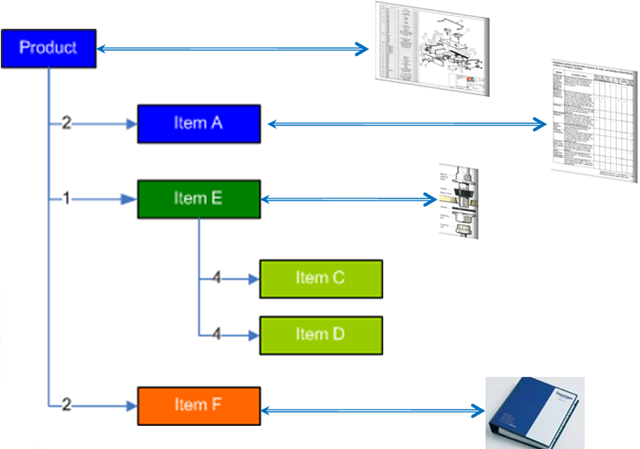
When you are working in a PLM environment, you need a way to communicate around a product, through its whole lifecycle, not only the design phase but also supporting manufacturing phases, the possible changes of an existing product through engineering changes, the traceability of as-built data and more. In a PLM environment, people have the physical part (often called the ERP part) in mind, when they talk about a part number.
As PLM covers product information across various departments and disciplines, the information carrier for product information cannot be the CAD data. The BOM, usually the mBOM, is the main structure used to represent and produce the product. Most parts in the mBOM have a relation to a CAD document (in many companies still the 2D drawing). Therefore PLM people and companies understanding PLM will talk about items and products and their lifecycle as their center of information.
CAD data in relation to Engineering to Order
The above generalizations have to be combined with the different main business processes. In a strict Engineering To Order environment, where you design and build a solution only once for a specific customer, there is no big benefit of going through an eBOM and mBOM transition.
During the design process the engineer already has manufacturing in mind, which will be reflected in the CAD structure they build – sometime hybrid representing both engineering and manufacturing items. In such an environment CAD data is leading to build a BOM structure.
And in cases where engineering is done in one single 3D CAD system, the company might use the PDM system from this vendor to manage their Bill of Materials. The advantage of this approach is that PDM is smoothly integrated with the design environment. However it restricts in a certain matter the future as we will see in further reading.
 Not everyone needs the Engineering to Order process !
Moving to an integrated, multi-disciplinary engineering process or changing the main process from Engineering To Order to Built To Order / Configure To Order will cause major challenges in the company.
I have seen in the recent past, several companies that would like to change their way of working from a CAD centric Engineering To Order process towards a more Built to Order or Configure To Order process. The bottle neck of making this switch was every time that engineering people think in CAD structures and all knowledge is embedded in the CAD data. They now want to configure their products in the CAD system.
For Configure to Order you have to look at a different way to your CAD data:
Questions to ask yourself as a company are:
- When I configure my products around a CAD structure, what should I do with data from other disciplines (Electrical/Tooling/Supplier data) ?
- When I upgrade my 3D CAD system to a new version, do I need to convert all old CAD data to the newest versions in order to keep my configurations alive?
- When configuring a new customer solution, do I need to build my whole product in CAD in order to assure it is complete?
- In Configure to Order the engineering BOM and manufacturing BOM are different. Does this mean that when I go through a new customer order, all CAD data need to be handled, going through eBOM and mBOM transition again?
For me it is obvious that only in an Engineering to Order environment the CAD data are leading for order fulfillment. In all other typical processes, BTO (Built to Order), CTO (Configure to Order) and MTS (Make to Stock), product configuration and definition is done around items and the CAD data is important associated data for the product definition and manufacturing
In the case of order fulfillment in a Configure to Order process, the CAD structure is not touched as configuration of the product is available based on items. Each item in the mBOM has it relations to CAD data or other specifying information.
In the case of Built To Order, a huge part of the product is already configured, like in Configure To Order. Only new interfaces or functionality will go through a CAD design process. This new design might be released through a process with an eBOM to mBOM transition. In cases where the impact or the amount of data created in engineering is not huge, it is even possible to configure the changes immediately in an mBOM environment.
 A second point, which is also under a lot of discussion in the field ( PLM interest groups), is that PDM is easily to introduce as a departmental solution. The engineering BOM is forwarded to manufacturing and there further (disconnected) processed. The step from PDM to PLM is always a business change.
When PDM vendors talk about ERP integration, they often mean the technical solution of connecting the two systems, not integrating the processes around the BOM (eBOM/mBOM transition) 0r an integrated engineering change (ECR/ECO). See how easy it is according to some PDM vendors:
or
PLM requires an adaptation of all departments to work different and together around a single product definition. Especially in a mid-market company, this is a big issue, as all product knowledge is stored in the CAD data and the knowledge how to produce the product is stored in the mBOM on the ERP side. These environments are often disconnected.
Conclusion: In the context of PDM the importance of CAD data is clear and for companies following a strict Engineering To Order process the main source of product knowledge. Companies following the Built To Order / Configure To Order process should configure their products around items to keep flexibility towards the future.
Companies with the intention to move to Built To Order or Configure To Order should not invest too much in CAD data configuration as it creates a roadblock for the future.
In my next post I will address the question that comes up from many directions, addressed by Jim Brown and others, as discussed in one of his recent posts around a PLM standard definition and more ….
 Although I am still active most of my time in ‘classical’ PLM, some of the projects I am involved with also deal with Asset Lifecycle Management. In general PLM focuses on a product development process, starting from a conceptual phase, going through planning, development and production. The PLM system serves as a collaboration and information backbone for all product IP (Intellectual Property). One of the main capabilities a PLM system provides is a ‘single version of the truth’.
And it is this capability, which makes a PLM system an excellent choice for Asset Lifecycle Management
Who practices Asset Lifecycle Management ?
 Asset Lifecycle Management can be found at any location, where a company is maintaining a process – we call these companies Owners/ Operators. Best known industry for Asset Lifecycle Management is the Process & Power industry, where a company produces oil, energy or chemicals. However the same concept is also valid for water companies (water distribution process), food processing and infrastructure companies (railways, airports, roads)
All these companies have in common that they support a certain process and the challenge is, while being in operation, to optimize the process. During operation, maintenance and improvement activities should be as little as disruptive as possible.
A maintenance stop is very costly for Owner/Operators. Imagine a plant not producing fuel for two weeks (millions of liters) or a nuclear reactor not producing electricity for a month (millions of kilowatts) – no income. And no maintenance will lead to unexpected problems and in the worse case, disasters. So it is also about balancing these activities.
Let’s look at a definition of Asset Lifecycle Management
Asset Lifecycle Management is a balanced and active management of assets over the lifecycle, coupled with business objectives.
Simply said it translates into an approach, where based on business objectives (process stability, safety, margin) a company tries to optimize the usage of their assets (a reactor, a pump, a rail track, a road) through their individual lifecycles. This means perform preventive maintenance; renovate a part of the process and perform more parallel activities with a focus on improving the lifecycle of the process
So why not use a MRO system?
 An MRO (Maintenance, Repair & Overhaul) system can be compared with an ERP system for manufacturing companies. The MRO system manages and schedules activities and resources on the plant, keeping track of maintenance activities done on inventory. But can it serve as the system providing the single version of the truth for all plant information? No!
So why not use an ERP system?
 An ERP system is mostly used by owner/operators to control all financial transactions (contracts, purchasing, suppliers, projects/resources accounting). Some ERP vendors provide MRO functionality in a single system; still can this system provide the single version of truth for all plant information? Again I am sure it is not the case.
So why not use a document management system?
 As most of the process information is stored in various types of documents, is seems to be appropriate to store all information in a document management system. And actually this is what owner/operators try to do, however they maintain inside their company different document management systems (paper archives, office documents in a specific system, engineering documents in another system, etc, etc). Each of the systems can provide a single version of the truth for specific content, however there is a consolidated single entry point for all asset data. Often the documents also do not reflect the status of an asset. Is the asset running in, is it active, is it demolished?
The tag number does not show it, and changing the status of an asset forces people to go through the various document systems to change the status there. An inefficient and costly procedure, not reliable and often not done.
So why not an integrated plant engineering system?
 Engineering plant software is designed to support the design collaboration and is mostly used by EPC contractors. These engineering companies are hired by the owner/operator to design and construct the plant or make major modifications of the plant. EPC contractors need to work as efficient as possible (to get the job), which means for them work as intelligent as possible in an integrated manner with tag numbers, P&IDs, 3D Equipment, Piping, ISOs. This intelligence leads to an application specific format and infrastructure.
During the hand-over of the plant or modification, this intelligence disappears as the owner/operator does not use the engineering plant software. They do not want to be dependent on a single software provider or version of the data. As data has to live for many years, sometimes 30 years or more, application specific data is hard to maintain. So as part of the hand-over data will be provided in neutral formats, worst case paper, but often in PDFs, TIFFs or other publishing format, losing all the intelligence.
 There is an intelligent, neutral format based on ISO 15926. This requires an investment from the EPC contractor and an investment from the owner/operator to manage all information in this format. For complex and long-lasting environments, like a nuclear plant, this approach surely pays off; however what you see is that on both sides (EPC and Owner/Operator) they try to minimize the costs on data handling/conversion. This leads in the long term to much more labor time internal at the owner/operator to manage and assure the data is accurate. But these costs somehow come later and are more hidden. And the question remains: can this system serve as the single version of truth for all plant information? No, plant engineering systems are too application specific
In addition, plant engineering software environments are not targeted to work integrated in an owner/operator environment, managing parallel projects and resources, quality processes and inventory statuses related to a certain asset and project.
So why not use a project management software system?
 As in a plant many projects can run in parallel, it happens that they run on the same assets or locations in the plant. For engineers and maintenance it is important to have visibility on which projects have impact on each other. Project management software is not targeted to make data visible related to a collection of assets or locations. No, project management software can not be the system to serve as the single version of truth for all plant information.
So either we give up for looking a single version of the truth and pay the price for multiple software systems to maintain in the company and take the extra efforts for configuration management for granted, or we look at PLM ?
The PLM based solution
In the past 15 years I have done several projects with ENOVIA and projects where Asset Lifecycle Management was done with ENOVIA. For sure, other flexible PLM systems can do the same, as the solution lies in an adapted data model for ALM.
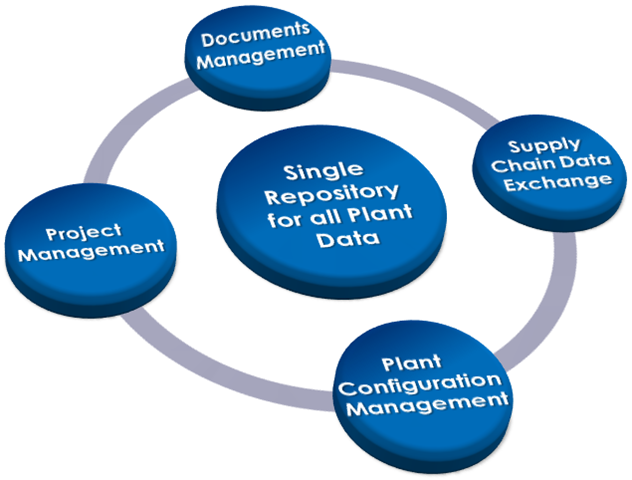
This picture shows what a PLM system can do:

It can provide all related information (documents, inventory, locations, and projects) to an asset with one click from within single system. In addition it can also give the actual status of the asset. Assets are often identified by tag numbers, and the lifecycle of an asset can be managed by default in a PLM system, combined with Asset Change processes.
Best Practices coming from the PLM world can be used here too. The major challenge for PLM vendors is to reduce the complexity for data handling, as ALM users will not be engineers experienced to complex CAD environments. They are information workers, who need with a short learning curve, direct access to the data they require (and they should be sure the data is reliable)
Note: the PLM system will need to interface with the MRO and ERP system. Like in the classical PLM concept, MRO and ERP are the transactional systems, controlling the day to day activities, where the PLM system provides the accurate plant information (IP) required for an activity.
Also the PLM system will manage the non-standard activities through projects, change processes and will rely on accurate information from ERP.
The major benefits reported from implementations based on a PLM system are: 
- Reduced down-time for the plant, due to better planning and accurate information when preparing a maintenance stop. Less surprises with unforeseen delays of production.
- More reliable and less effort to be complaint to safety, health, environment and governmental regulations as all information is available in a single, controlled and traceable environment
- Lower cost of ownership for ALM. Instead of maintaining various silos of information and provide access to certain users, a single system with a common interface is available for most of the users.
Conclusion: Owner/Operators should look into the benefits a PLM system can bring for them. Interesting the benefits are not based on the integration of product development, but on providing accurate information from different entry points for different roles
I am curious to learn who has seen a similar approach – feel free to comment
 This is the third post on Bill of Material handling for different types of companies, this time the focus on Configure To Order (CTO). In the CTO process, products are assembled and configured based on customer requirements. This means there is no more engineering needed when customer requirements are known. CTO examples are, the ordering process of a car with all its options, or ordering a personal computer over the internet.
So what has Configure To Order to do with PLM as there is no engineering?
The main PLM activity takes places when designing the configurable product. Designing a product that is configurable, requires a complete different approach as compared to Engineering to Order or Build to Order. Although we see a similar Configure to Order activity in the R&D departments of companies that follow the Build to Order process. They are also designing products or modules that can be used as-is in customer specific orders as part of the solution.
 The challenge of CTO is to design products that are modular, and where options and variants are designed on a common platform with common interfaces. If you look to the dashboard of a car you will see placeholders for additional options (in case you have the minimal car version) and also you might see that for example the radio display in a basic car version differs from the complete board computer in the luxury version. The common platform is one dashboard, fitting to numerous options.
An engineering department will not focus on designing and defining each of the possible combinations of options as this would be impossible to manage. What can be managed is the common platform (the baseline) and all different options on top of this baseline.
So what happens with the BOM?
The initial design of configurable products goes through similar steps as the BTO process, which means starting from a conceptual BOM, moving to an Engineering BOM (eBOM) and finally produce a BOM for manufacturing (mBOM). The difference is that in the CTO process the mBOM is not developed for just one product, but contains all definitions for all possible products. In this situation we talk about a generic mBOM.
Only when a customer order exists, the generic mBOM is resolved into a specific mBOM for this customer order, which then can be sent to the ERP system for execution.
 In a generic BOM the relations are managed by filters. These filters define the effectivity of the link, in simple words if the relation between two parts in the BOM is valid (and shown) or not. There are various ways to define effectivity – with again a differentiation in usage
- revision based effectivity – which means the relation between two items is valid in case the revisions match
- date effectivity – which means the relation is valid during a certain time interval
Both methods are used most of the time for non-configurable products. The revision and date effectivity are used to be able to track the product history through time and therefore to have full traceability. But this does not work if you want to configure every time a customer specific order.
In that case we use unit or option based filtering.
- unit effectivity – which means the relation between two items is valid for a unit (or a range of units) produced. For example a batch of products or a unique product with a serial number
- option effectivity – which means the relation between two items is valid in case a certain condition is valid. Which condition depends on the configuration rules for this option. Example of options are: color, version, country
It is clear that unit and option based filtering of a BOM can lead to a conceptual complex product definition which goes beyond the BOM for Dummies target. Below an illustration of the various filter concepts (oops the animated gif does not work – i will investigate):

The benefit of this filtering approach is that there is a minimum of redundancy of data to manage. This makes it a common practice in the aerospace and automotive industry. An example describing all the complexity can be found for example here, but I am sure on this level there are enough publications and studies available.
And what about the CAD ?
I will write a separate post on this topic, as all the possible interactions and use cases with CAD are a topic on its own. You can imagine, having the 3D virtual world combined with a configurable BOM brings a lot of benefits
What PLM functions are required to support Configure to Order ?
- Project management – not so much focus here as the delivery project for a customer does not require much customer interaction. Of course, the product development processes requires advanced capabilities which I will address later in a future post.
- Document management – same approach as for project management. The product related documentation needs to exist and secured. Customer specific documentation can be generated often automatically.
- Product Management – managing all released and available components for a solution, related to their Bill of Materials. Often part of product management is the classification of product families and its related modules
- Item management – The main activities here are in the mBOM area. Capabilities for BOM generation (eBOM/mBOM), baseline and compare using filtering (unit based / option based) in order to support the definition if the manufactured product
- Workflow processes – As we are dealing with standardized components in the BOM, the Engineering Change Request (ECR) and Engineering Change Order (ECO) processes will be the core for changes. And as we want to manage controlled manufacturing definition, the Manufacturer Change Order process and Standard Item Approval process are often implemented
Optional:
- Requirements Management – specially for complex products, tracking of individual requirements and their implementation, can save time and costs during delivery to understand and handle the complex platform
- Service Management – as an extension of item management. When a customer specific order has been delivered it might be still interesting for the company that delivered the product to keep traceability of the customer configuration for service options – managing the Service and As-Built BOM
- Product Configurator – the reason I write it as optional, is because the target is order execution, which is not a PLM role anymore. The ERP system should be able to resolve the full mBOM for an order. The PLM product configuration definition is done through Product and Item management. Depending on the customer environment the role of configurator might be found in PLM in case ERP does not have the adequate tools.
Conclusion:
It is hard to describe the Configure To Order process in the scope of BOM for Dummies. As various detailed concepts exist per industry there is no generic standard. This is often the area where the PLM system, the PLM users and implementers are challenged the most: to make it workable, understandable and maintainable
Next time some industry specific observations for a change
 Continuing the posts on Bill of Material handling for different types of companies, this time the focus on BOM handling in a Build to Order process. When we are talking about Build to Order process, we mean that the company is delivering solutions for its customers, based on existing components or modules. A typical example is the food processing industry. In order to deliver a solution, a range of machinery (ingredient manipulation) and transporting systems are required. The engineering tasks are focused on integrating these existing components. In many cases new or adjusted components are required to complete the solution.
Research and Development in a BTO company
In a typical BTO company you see actually two processes.
- The main BTO process, fulfilling the needs for the customers based on existing components
- An R&D department, which explores new technologies and develops new components or modules, which will become available for selling to new customers.
 This is the innovation engine of the company and often can be found in a complete isolated environment – extra security – no visibility for other departments till release. The task for this R&D department is to develop machinery or modules based on new, competitive technologies, which are rapidly configurable and can be used in various customer solutions. The more these machines or modules are configurable, the better the company can respond to demands from customers, assuming a generic machine and interfaces does not degrade performance, compared to optimal tuned machinery.
I will describe the BOM handling for this department in a future post, as also here you will see particular differences with the ETO and BTO BOM handling.
Back to the core of BTO
I found a nice picture from 2003 published by Dassault Systems describing the BTO process:

We see here the Bidding phase where a conceptual BOM is going to be defined for costing. Different from the ETO process, the bidding company will try to use as much as possible known components or technology. The reason is clear: it reduces the risk and uncertainties, which allow the bidding company to make a more accurate and competitive cost estimate for these parts. When a company becomes mature in this area, a product configurator can be used to quantify the estimated costs.
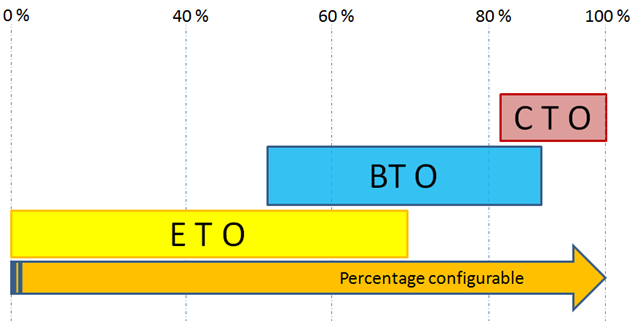
The result from the bidding phase is a conceptual BOM, where hopefully 60 % or more is already resolved. Now depending on the amount of reuse, the discussion comes up: Should modifications being initiated from the eBOM or from the mBOM?
In case of 60 % reuse, it is likely that engineering will start working around the eBOM and from there complete the mBOM. Depending on the type of solution, the company might decide to handle the remaining 40 % engineering work as project unique and treat it the same way as in an ETO process. This means no big focus on the mBOM as we are going to produce it only once.
I have worked with companies, which tried to analyze the 40 % customer specific engineering per order and from there worked towards more generic solutions for future orders. This would mean that a year later the same type of order would now be defined for perhaps 80 %. Many companies try to change themselves from a project centric company towards a product centric company, delivering configured products through projects.
Of course when solutions become 100 % configurable, we do not speak from BTO anymore, but from Configure to Order (CTO). No engineering is needed; all components and interfaces are designed to work together in certain conditions without further engineering. As an example, when you buy a car or you order a PC through the internet – it is done without sales engineering – it is clearly defined which options are available and in which relation.
See below:
However the higher the amount of reuse, the more important it becomes to work towards an mBOM, which we will than push the order to ERP.
And this is the area where most of the discussions are in a PLM implementation.
- Are we going to work based on the mBOM and handle all required engineering modifications from there?
Or
- Do we first work on a complete eBOM and once completed, we will complete the mBOM?
The reuse from existing components and modules (hardware) is one of the main characteristics of BTO. Compare this to ETO where the reuse of knowledge is the target no reuse of components.
The animation shows the high level process that I discussed in this post.
What PLM functions are required to support Build to Order ?
- Project management – the ability to handle data in the context of project. Depending on the type of industry extended with advanced security rules for project access
- Document management – where possible integrated with the authoring applications to avoid data be managed outside the PLM system and double data entry
- Product Management – managing all released and available components for a solution, related to their Bill of Materials. Often part of product management is the classification of product families and its related modules
- Item management – The main activities here are in the mBOM area. As items in a BTO environment are reused, it is important to provide relevant ERP information in the PLM environment. Relevant ERP information is mostly actual costs, usage information (when was it used for the last time) and availability parameters (throughput time / warehouse info).
As historically most of the mBOM handling is done in ERP, companies might not be aware of this need. However they will battle with the connection between the eBOM in PLM and the mBOM (see many of my previous posts).
As part of the BTO process is around engineering, an EBOM environment with connections to specifying documents is needed. This requires that the PLM system has eBOM/mBOM compare capabilities and an easy way to integrate engineering changes in an existing mBOM.
- Workflow processes – As we are dealing with standardized components in the BOM, the Engineering Change Request (ECR) and Engineering Change Order (ECO) processes will be the core for changes. In addition you will find a Bidding Process, a Release process for the customer order, Manufacturer Change Order process and a Standard Item Approval process.
Optional:
- A Sales Configurator allowing the sales engineering people to quickly build the first BOM for costing. Working with a Sales Configurator requires a mature product rationalization.
- Supplier Exchange data management – as many BTO companies work with partners and suppliers
- Service Management – as an extension of item management. Often in this industry the company who Builds the solutions provides maintenance services and for that reason requires another Bill of Material, the service BOM, containing all components needed when revising a part of the machine
- Issues Management – handling issues in the context of PLM gives a much better environment for a learning organization
- Requirements Management – specially for complex products, tracking of individual requirements and their implementation, can save time and costs during delivery
Conclusion (so far):
When you compare these PLM requirements with the previous post around ETO, you will discover a lot of similarities. The big difference however is HOW you use them. Here consultancy might be required as I do not believe that by having just functionality a company in the mid-market will have time to learn and understand the special tweaks for their business processes.
Next post more on configurable products
 This time a few theoretical posts about BOM handling, how the BOM is used in different processes as Engineering To Order (ETO), Make To Order (MTO) and Build To Order (BTO) organizations and finally which PLM functions you would expect to support these best practices.
I noticed from various lectures I gave, from the search hits to my blog and from discussions in forums that there is a need for this theoretical base. I will try to stay away from too many academic terminologies, so let’s call it BOM for Dummies.
Note: All information is highly generalized to keep is simple. I am sure in most of the companies where the described processes take place more complexity exists.
What is a BOM?
A BOM, abbreviation for Bill of Materials, is a structured, often multi-level list of entities and sub-entities used to define a product
I keep the terminology vague as it all depends to who is your audience. In general when you speak with people in a company that does engineering and manufacturing, you have two major groups:
- The majority will talk about the manufacturing BOM (mBOM), which is a structure that contains the materials needed to manufacture a product in a certain order.
We will go more in depth into the mBOM later. - When you speak with the designers in a company they will talk about the eBOM, which is a structure that contains the components needed to define a product.
Both audiences will talk about ‘the BOM’ and ‘parts’ in the BOM, without specifying the context (engineering or manufacturing). So it is up to you to understand their context.
Beside these two major types of BOMs you will find some other types, like Conceptual BOM, Customer Specific BOM, Service BOM, Purchase BOM, Shipping BOM.
Each BOM is representing the same product only from a different usage point of view
The BOM in an Engineering To Order company
In an Engineering to Order company, a product is going to be developed based on requirements and specifications. These requirements lead to functions and systems to be implemented. For complex products companies are using systems engineering as a discipline, which is a very structured approach that guarantees the system you develop is matching all requirements and these requirements have been validated.
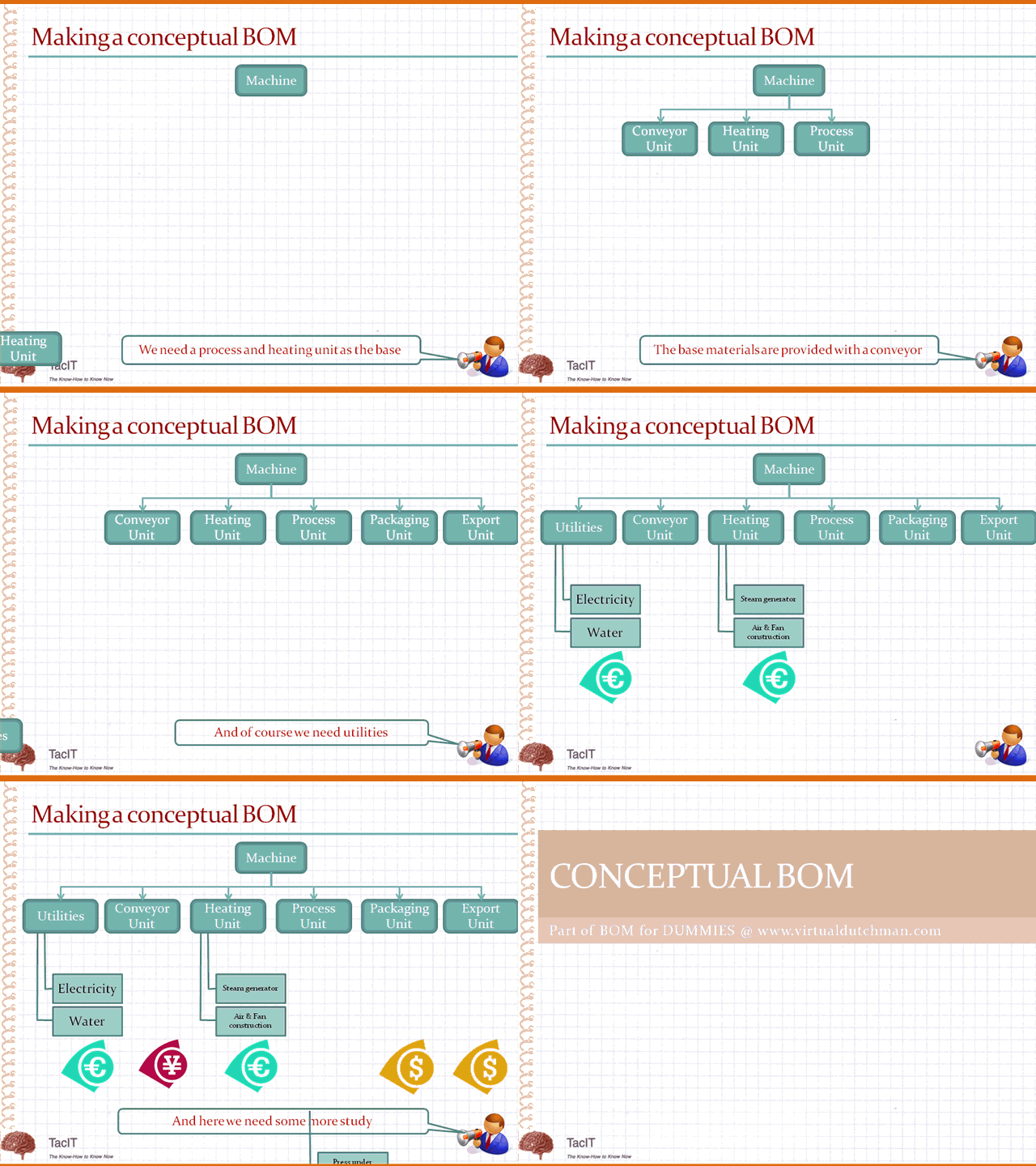
In less complex and less automated environments, you will see that the systems engineering is done in the head of the experienced engineers. Based on the requirements, they recognize solutions that have been done before and they build a first conceptual structure to describe the product. This is a conceptual BOM, often only a few levels deep, and this BOM is mainly used for costing and planning the work to be done.
A conceptual BOM could like this (open the picture in a separate window to see the animation)
Depending of the type of engineering company, they are looking for the reuse of functions or systems. The reuse of functions means that you manage your company’s Intellectual Property (IP) where the reuse of systems can be considered as the reuse of standard building blocks (modules) to build a product. The advantage of system reuse of course is the lower risk, as the system has been designed and built and tested before.
From the conceptual BOM different disciplines start to work and design the systems and their interfaces. This structure could be named the eBOM as it represents the engineering point of view from the product. In Engineering to Order companies there is a big variation on how to follow up after engineering. Some companies only specify how the product should be made, which materials to use and how to assemble them. The real manufacturing of the product is in that case done somewhere else, for example at the customer site. Other companies still do the full process from engineering and manufacturing.
As there is usually no reuse of the designed products, there is also no investment in standardizing items and optimizing the manufacturing of the product. The eBOM is entered in the ERP system and there further processed to manufacture the product. A best practice in this type of environments is the approach that the eBOM is not a 100 % pure the eBOM, also items and steps needed for manufacturing might be added by the engineers as it is their responsibility to specify everything for manufacturing without actually making the product.
This animation shows on high level the process that I described (open the link in a separate window to see the animation)

What PLM functions are required to support Engineering To Order
The following core functions apply to this process:
- Project management – the ability to handle data in the context of project. Depending on the type of industry extended with advanced security rules for project access
- Document management – where possible integrated with the authoring applications to avoid data be managed outside the PLM system and double data entry
- Classification of functions and/or systems in order to have an overview of existing IP (what have we done) and to promote reuse of it
- Item management – to support the eBOM and its related documentation. Also the items go through a lifecycle representing its maturity:
– The eBOM might be derived from the mechanical 3D CAD structure and further extended from there.
– For design reviews it would be useful to have the capability to create baselines of the eBOM including its specifying documents and have the option to compare baselines to analyze progress
– The completed eBOM would be transferred to the ERP system(s). In case of a loose ERP connection a generic XML export would be useful (or export to Excel as most companies do) - Workflow processes – to guarantee a repeatable, measurable throughput of information – both approval and change processes
Optional:
- Supplier Exchange data management – as many ETO companies work with partners and suppliers
- Issues Management – handling issues in the context of PLM gives a much better environment for a learning organization
- Requirements Management – specially for complex products, tracking of individual requirements and their implementation, can save time and costs during delivery
- A configurator allowing the sales engineering people to quickly build the first conceptual BOM based on know modules combined with engineering estimates. This is the base for a better controlled bidding / costing
Let me know if this kind of posts make sense for you …..
Next time we will look at the BOM in a Build To Order process
 Jos Voskuil's Weblog
Interesting reflection, Jos. In my experience, the situation you describe is very recognizable. At the company where I work, sustainability…
[…] (The following post from PLM Green Global Alliance cofounder Jos Voskuil first appeared in his European PLM-focused blog HERE.) […]
[…] recent discussions in the PLM ecosystem, including PSC Transition Technologies (EcoPLM), CIMPA PLM services (LCA), and the Design for…
Jos, all interesting and relevant. There are additional elements to be mentioned and Ontologies seem to be one of the…
Jos, as usual, you've provided a buffet of "food for thought". Where do you see AI being trained by a…