
You are currently browsing the category archive for the ‘PLM’ category.
 This strange title came to my mind when I made an overview of my PLM posts in this blog so far. As I am working in the PLM space already for many years, I noticed by reviewing the topics below, that progress in PLM is slow. Yes, technology changes every 5 years, business models can change due to that, but most of the underlying concepts haven’t changed much.
At the implementation level, especially in traditional manufacturing companies, you notice a slow progress, although closely related to PLM, I believe 3D CAD has become a common practice, which could be one of the drivers for further change towards more PLM.
And this brought me to the Echternach procession, which currently is a dancing procession, where the pilgrims dance slowly to the church ( 1 mile / 1.6 km – dancing from left to right). In the Netherlands, we learned in primary school, that in the past the pilgrims made three steps forward and then two steps backward, which became an expression for a slow forward moving process in our idiom.
And if you look back to the topics overview underneath the movie , you see PLM adaptation is a slow process in the mid-market, still a way to go – perhaps dancing like the pilgrims this year ?
PLM and ERP
PLM and ERP – the culture change , continued, conclusion
Connecting PLM and ERP , continued
PLM and change
PLM for the SMB – a process of culture change
Culture Change in a mid-sized company a management responsibility
The gap between mid-market companies and PLM – 15 year ?
What not to do in a bottom-up PLM implementation approach
Implementing PLM requires a vision
What if SMB as vision for PLM and PLM vendors do not understand it
Can Chaos become order through PLM
What have PLM and Capitalism in common ?
Some users do not like the single version of the truth
PLM concepts
Working file based in the supply chain – manager have two options (actually one)
Where does PLM start beyond document management ?
PLM and ROI
5 reasons not to implement PLM
2. PLM implementations take too long
3. We already have an ERP system
4. Isn’t PLM the same as CAD data management ?
To PLM or not to PLM – start measuring
Measuring the development phase
Free PLM software does not help companies
Where is my PLM Return On Investment
Who decides for PLM in a mid-market company ? continued academic conclusion

Like many people, the meditation of the dark Christmas days and the various 2009 reviews give you a push to look back and reflect. What happened and what did not happen in 2009?
And what might happen in 2010?
Here my thoughts related to:
ERP-related PLM vendors
Here I think mainly about Oracle and SAP. They have already identified PLM as an important component for a full enterprise solution. They are further pushing their one-shop-stop approach . Where Oracle’s offering is based on a set of acquired and to-be-integrated systems, SAP has been extending their offering by more focus on their own development.
 If you are one of those companies that require PLM, and believe all software should come from one vendor (beside Microsoft), it is hard to decide.
As there might be real PLM knowledge in the Oracle organization as an effect of the acquisitions, but is it easily accessible for you? Is it reflected in the company’s strategy ?
With SAP I am even more in doubt; here you might find more people with ERP blood having learned the PLM talk. Maybe for that reason, I saw mostly Oracle as a PLM option in my environment and very few SAP opportunities for real PLM.
I assume in 2010 Oracle will push stronger and SAP try harder.
CAD-related PLM vendors
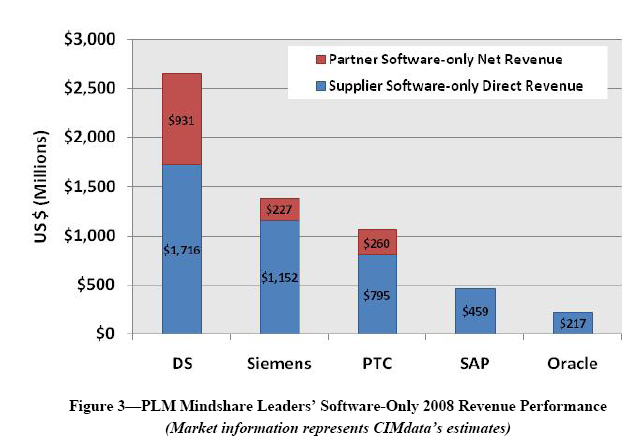
In this group you find as the major players PTC, Siemens and Dassault Systems. Autodesk could be there too, but they refuse to do PLM and remain focused around design collaboration. All these PLM vendors are striving to get the PLM message towards the mid-market. They have solutions for the enterprise, but to my feeling, most of the enterprises in the traditional well-know PLM markets, like Automotive and Aerospace, are in a kind of stand-still due to economical and upcoming environmental crisis.
It is sure business will not be as usual anymore, but where will the sustainable future go? Here I believe answers will come from innovation and small mid-market companies. The bigger enterprises need time to react so before we see new PLM activities in this area it will take time.
 Therefore all PLM vendors move in directions outside engineering, like apparel, life sciences, and consumer packaged goods. These industries do not rely on the 3D CAD, but still can benefit from the key building blocks of PLM, like lifecycle management, program and portfolio management and quality/compliancy management. The challenge I believe for the PLM vendors is: Will these CAD-focused organizations be able to learn and adapt other industries fast enough? Where does 3D fit – although Dassault has a unique vision here.
For the mid-market, the PLM vendors offer more OOTB (Out Of The Box) solutions, mostly based on limited capabilities or more common available Microsoft components like SharePoint and SQL Server. This is not so strange as according to my observation, most smaller mid-market companies have not really made or understood the difference internally between document management and product data management, including Bill Of Materials not to be managed in Excel.
I assume 2010 the CAD related PLM vendors initially will focus on the bigger enterprises and new industries, the smaller mid-market companies require a different approach
PLM-only vendors
This is an area which I expect to disappear in the future, although this is also the area where interesting developments start to happen. We see open source PLM software coming up with Aras leading and we see companies coming up with PLM on-demand software, Arena as the first company to sell this concept.

The fact that the traditional PLM-only vendors disappeared in this area (Eigner bought by Agile, Agile bought by Oracle, MatrixOne bought by Dassault Systems) indicates that the classical way of selling PLM-only was not profitable enough.
Either PLM needs to be integrated in companywide business processes (which I believe), or there will be PLM-only vendors that find a business model to stay alive.
Here I hope to see more clarity in 2010
Smaller mid-market companies
 What I have seen in the past year is, that despite the economical crisis, PLM investments by these companies remained active. Maybe not in purchasing much more licenses or implementing new PLM features. Main investments here were around optimizing or slightly extending the PLM base. Maybe because there was time to sit still and analyze what could be changed, or maybe it was planned but due to work pressure, it was never executed. Anyway there was a lot of activity in this area not less than in 2008.
An interesting challenge for these mid-market companies will be to remain attractive for the new generation. They are not used to the classical ways of structured work as most of the current workforce is used to.
Social networking, social PLM, I have seen the thoughts, discussions and benefits, still trying to see where it will become reality.
2010 is another chance.
Sustainability and going green
 This is an area where I am a little disappointed and this is perhaps not justified. I would expect with the lessons learned around energy and the upcoming shortage of natural resources, companies would take the crisis as a reason to change.
To my observation most of the companies I have seen are still trying to continue as usual, hoping that the traditional growth will come back. The climate conference in Copenhagen also showed that, we as human beings, do not feel pressured enough to adapt, by nature we are optimists (or boiling frogs).
Still there are interesting developments – I assume in the next few years we will see innovation coming – probably first from smaller companies as they have the flexibility to react. During the European Customer Conference in Paris, I heard Bernard Charles talking about the concept of a Bill Of Energy (The energy needed to create, maintain and demolish a product) As PLM consultants we already have a hard time explaining to our customers the various views on a BOM, still I like the concept, as a Bill Of Energy makes products comparable.
2010 the acceptance of Bill Of Energy
Here I want to conclude my post for this year. Thank you all for reading and sharing your thoughts and comments with this community. My ultimate conclusion for 2009 is, that is was a good PLM year for the mid-market, better as expected but the changes are going slow. Too slow – we will see next year.

 A short intermediate post to conclude this topic. In August 2009, I wrote a post, How PLM is NOKIA, where I expressed my astonishment that a company as big and as professional as NOKIA did not react on launching problems of the new NOKIA N97. As I knew NOKIA as a company, which has implemented the basics of PLM, I would anticipate more customer centric activities.
Apparently, and now we are four months later, it is clear that NOKIA brought a product on the market too early with several design errors. Probably to be competitive with the iPhone, it was launched too early to maintain market share.
All early purchasers of the N97 were promised that in October 2009, the major software fix would come and then the N97 would be working as promised. As an early adopter, you feel swindled as the statement is more or less telling you: “We released a beta product – you paid the premium price – and in October the official release will be available”
So in November 2009, the software fix came (V 2.0) and after installing this new version, minor problems were solved, still the GPS was malfunctioning and also the camera lens could be scratched by the cover. Instead of making a firm and honest statement to its customers, NOKIA decided to keep things silent. On their support forum there was a discussion around the malfunctioning GPS. At the end, before it was removed by NOKIA, it was almost 30 pages long full of posts.
 It started with loyal users, who thought that they had done something wrong, guessing and helping others trying to optimize the GPS reception. No contribution from NOKIA people in that forum. Later (page 25 and later), the posts became more and more angry, as these people, who were trying to make it work, were sent from repair centre to repair centre without getting a fix. Many were trying to get a statement from NOKIA support people.
At the end, NOKIA removed the forum to hide all these issues to new potential customers. Now, if you search again for NOKIA N97 and GPS issue, you find a few pages of new people trying to make it work.
Anyway, two weeks ago I received my ‘repaired’ N97 and still the GPS failed despite the NOKIA claimed to have replaced some components. My telephone network provider, who sold the N97 together in a bundle, now proposed to replace the NOKIA N97 with a similar phone from another brand, which I will do.
Back to PLM, what is the relation with this post ?
 PLM allows you to become more customer focused, using field experience as feedback and input for your new models. Also virtual testing – not sure if GPS reception can be virtually tested – can save huge costs due to product recalls and repairs. This is the situation NOKIA is suffering now around the N97. And as they do not publicly communicate that there are errors, it might reduce the amount of claims they get from all N97 buyers as not everyone uses all features. Soon a new model will come up and everyone forgot the stinker with the N97. People inexperienced with GPS might think the behavior they experience with the N97 is normal finding only a few pages of other people with problems instead of 30+ pages.
The back side of this approach for NOKIA is that modern, loyal customers are expecting a customer centric company and they will move to another brand, only to come back when this competitor fails. It is worth to lose loyal customers to avoid claims ?

For me the NOKIA book is closed, now I will move to Sony Ericsson , thanks to my mobile phone provider. And as I learned on the recent ECF (European Customer Forum) last month in Paris, Sony Ericsson is using PLM for their global design and production process, striving to a single version of the truth. So also Sony Ericsson is connecting people and I hope they have a better connection with their customers as people are allowed to make mistakes but hiding them is the biggest mistake.
Just closing with a funny movie. This NOKIA marketing movie shows a guy with a N97 easily finds his friend through GPS. For sure it works in the dessert where you can see each other for miles – but in a dense city, you have to realize your friend can be 200 meters on either side from you, although you think you are in the same location.
 The title of this post came in my mind when looking back on some of the activities I was involved in, in the past two weeks. I was discussing with several customers their progress or status of the current PLM integration. One of the trends was, that despite the IT department did their best to provide a good infrastructure for project or product related information, the users always found a problem ,why they could not use the system.
 I believe the biggest challenge for every organization implementing PDM and later PLM is, to get all users aligned to store their information in a central location and to share it with others. Only in this manner a company can achieve the goal of having a single version of the truth.
With single version of the truth I mean – if I look in the PLM system I find there all the needed data to explain me the exact status of a product or a project.
If it is not in the PLM system, it does not exist !
How many companies can make that statement ?
If your company does not have the single version of the truth implemented yet , you might be throwing away money and even bring your company at risk in the long term. Why ? Let’s look at some undisclosed examples I learned in the past few weeks:
- A company ordering 16 pumps which on arrival where not the correct ones –
1 M Euro lost - During installation at a drilling site the equipment did not fit and had many clashes – 20 M Dollar lost, due to rework and penalties
- 7000 K Euro lost due to a wrong calculation based on the wrong information
- A major bid lost due to high price estimation due to lack of communication between the estimator and the engineering department
- 500 K Euro penalty for delivering the wrong information (and too late)
All the above examples – and I am sure it is just a tip of what is happening around the world – were related to the power & process industry, where of course high-capital projects run and the losses might look small related to the size of the projects.
But what was the source of all this: Users
 Although the companies were using a PLM system, in one company a user decided that some of the data should not be in the system, but should be in his drawer, to assure proper usage (according to his statement, as otherwise when the data is public available, people might misuse the data) – or was it false job security as at the end you loose your job by this behavior.
People should bring value in collaboration not in sitting on the knowledge.
 Another frequently heard complaint is that users decide the PLM system is too complex for them and it takes too much time for them to enter data. And as engineers have not been bothered by any kind of strict data management, as ERP users are used to work with, their complaints are echoed to the PLM implementer. The PLM implementer can spend a lot of time to customize or adapt the system to the user’s needs.
But will it be enough ? It is always subjective and from my experience, the more you customize the higher the future risks. What about upgrades or changes in the process ?
And can we say NO to the next wish of this almighty user ?
Is the PLM system to blame ?
 The PLM system is often seen as the enemy of the data creator, as it forces a user in a certain pattern. Excel is much easier to use, some home-made macros and the user feels everything is under control (as long as he is around).
Open Source PLM somehow seems to address this challenge, as it does not create the feeling, that PLM Vendors only make their money from complex, unneeded functionality. Everything is under own control for the customer, they decide if the system is good enough.
PLM On Demand has even a harder job to convince the unwilling user, therefore they also position themselves as easy to use, friend of the user and enemy of the software developer. But at the end it is all about users committing to share and therefore adapt themselves to changes.
So without making a qualification of the different types of PLM systems, for me it is clear that:
 The first step all users in a company should realize is that, by working together towards a single version of the truth for all product or project related data, it brings huge benefits. Remember the money lost due to errors because another version of data existed somewhere. This is where the most ROI for PLM is reported
Next step is to realize, it is a change process and by being open minded towards change, either motivated or pushed by the management, the change will make everyone’s work more balanced – not in the first three months but in the longer term.
Conclusion: Creating the single version of the truth for project or product data is required in any modern organization, to remain competitive and profitable. Reaching this goal might not be as easy for every person or company but the awards are high when reaching this very basic goal.
At the end it is about human contribution – not what the computer says:
As a consultant working with mid-market companies, I enjoyed reading this post from Al Dean and its related comments and posts. Although I must say Al’s statement:
PLM+ are looking to solve this by creating a rich application that engages the user, provides ease of implementation and ongoing maintenance (by allowing the user/admin, rather than costly consultant) and can be delivered over the web, in an on-demand manner (which saves hardware and infrastructure cost)

was a trigger to react, as I am a consultant.
The base of every PDM/PLM
First I believe the base of PLM and PDM is to agree inside your company that you share and centralize product data. This means not only files, but also Bill of Materials, Issues, etc, etc, ..
To share and centralize product data seems like an easy mission and this is what all PLM software as a base provides, and I assume PLM+ does the same, only they store the data in the cloud, like Arena.
 Sharing data is not a natural process in all companies as there is always the culture to share the minimum and to keep the rest to prove your own value – the bigger the company the more this will happen. This is human nature and this differs case by case. To make people share data is an area where either the management has to push, or in very small companies, a power user. In larger companies, often an external consultant is doing this job, in the role of an ‘outsider’ who can moderate and explain the benefits for all, instead of the threats.
This is what consultants really do; they do not install or administer systems.
PLM solutions can vary in the way they make sharing of data available. Some solutions are very rigid in what they offer as data model, but most of the necessary entities and attributes are there. They are based on best practices and target the 80 %. Often this is good enough, if the customer has no alternative and has the power by themselves to enforce the system as their platform for sharing data.
 More flexible PLM solutions have an advantage and in the same time this is their disadvantage. They can be extended beyond the 80 % scenario and both the implementer and the customer will be challenged to reach the 100 % satisfaction. However we all know from the 80-20 rule, this is where it gets complicated.
80 % of the project is done in 20 % of the time, or in other words: you spent 80 % of your time (and budget) on reaching the last 20 %
Once having reached a common platform for sharing all product related information, for me the real PLM is starting. This is where a company would implement processes, that streamline the product development or delivery process – it requires a cross departmental change.
And at this stage, it is often where a consultant comes in. It is very rare, that in mid-market companies, management reserves time and resources to come with a strategic plan to implement PLM – I wrote about this in an older post. PLM requires a change in the way the company currently works.
So I am curious to learn how PLM+ and other On-Demand PLM software companies will try to address this step, as change is needed and someone has to push for it.
In my last three consecutive posts, I wrote about who decides on PLM in mid-market companies (a generalization from 15 years experience). There I claim that the selection for a PLM system is subjective, very much based on personal relations with the mid-market company. Again how PLM+ will address this in their business model, as there is a need for someone to push.
 Open Source PLM software has somehow similar challenges. You need the drive from inside the customer to agree on sharing product data and next to extend. This is where the traditional PDM and PLM vendors push their business in direct contacts. Of course Open Source PLM providers have their focus on after the initial installation of the platform to extend it with a consultative and service model.
Conclusion: As every PLM provider at the end needs revenue for a living, I am looking forward to see where On-Demand PLM will go and finds it place. What will be business model that makes people buy and create the change
 I realized that time is flying when you are busy, and I promised to publish the conclusion from my previous post: More on who decides for plm in a mid market company. In my two previous posts, I described the difficulties companies have to select the right PLM system. So far I discussed the two extremes, the silent approach where a possible bottom up approach was discussed and as the opposite where an ‘academical’ approach was followed.
Now it is time to get the answers on the academical approach.
These were the questions to be answered in the previous post:
- How much time has passed since the management decided PLM was good for their organization?
- How independent is the consultancy firm?
- Did they consider open source PLM as a solution?
- What was the ranking of the PLM vendors?
How much time has passed since the management decided PLM was good for their organization?
 The whole process of selecting a PLM system often takes more than one or two years, starting from the first activities till the final conclusion to start. I believe this is unavoidable, as especially in mid-market companies the business values that PLM can bring are not always discussed and realized on the strategic level.
However, I believe the recent years PLM has been recognized by analysts, by software vendors and many young companies as a necessity for innovation and in the long term remaining competitive. And this is not only in the classical domains where PLM started – automotive / aero / industrial equipment. PLM value is everywhere in different industries, even apparel for example.
For companies that are now in the decision process, I believe 2009 and early 2010 are the years to decide, because a recovery of the economy might put back the focus on execution and not on strategy and they might miss the management focus for PLM. And as I wrote in a previous post, companies who made the best pit stop will benefit upmost.
For companies still in doubt: It is now or never
How independent is the consultancy firm?
It is clear that real independent consultancy firms do not exist – even if a consultant wants to be independent, there are three challenges to meet:
- How can a consultant evaluate or judge PLM systems they have not seen?
- How much experience does the consultant have in your business?
- How much work is there required in the project for the consultant?
 As you can imagine, reviewing the above challenges, you will realize that consultants usually specialize in systems, where their expertise it required – as they also want to make a living. Consultants cannot afford to be an academic institute, as coming back to the previous point, all consultancy work at the end will be paid by the customer.
So to conclude on this point, if you want to be cost-effective, a company should do already a pre-selection based on systems and possible implementation partners, that fit naturally to their type of business and then evaluate how consultancy can be achieved.
What you will find out is that the major ‘expensive’ packages have loads of consultants to offer en the more and more you go into a mid-market environment, consultants become rare. For software from PLM vendors you will usually find a reseller network with people close to your offices that can support you. For Open Source software you will need to find the consultancy services through their software delivery program.
Anyway remember: 50 % of the success of a PLM implementation is based on the right implementation approach and partner not on the PLM functions and features.
Did they consider open source PLM as a solution?
 No, because the consultant was not familiar with it, and discouraged the company to look at it. In general Open Source PLM, like PLM On-Demand are interesting trends to follow and should not be neglected. However the focus and approach for this type of solutions is different. I will not generalize at this moment as also I have no clear picture where Open Source PLM or PLM on Demand would be a big differentiator. I will try to evaluate and report it in future posts.
Comments from Open Source PLM Vendors or On Demand PLM Vendors are welcome to complete the PLM selection approach.
What was the ranking of the PLM vendors?
Ranking was done by the management, the selection team and the design department. These were the results plus their major comment:
Management
1. The slide show PLM provider – they liked the business pitch
2. The CAD supplier with PLM features and gadgets – good guys – we know them
3. The PLM provider who showed everything – too much handling of data – too complex
Selection Team
1. The PLM Provider who showed everything – they really did it
2. The CAD supplier with PLM features and gadgets– we understand where they are going
3. The slide show PLM provider – do they really have a solution?
The Designers
1. The CAD supplier with PLM features and gadgets– he knows what we want
2. The slide show PLM provider– could be a good solution too
3. The PLM Provider who showed everything – too complex, it will limit our productivity
 As the management had the final vote, they decided for the slide show PLM Provider, as they felt most comfortable with them.
The reason to drop the CAD supplier was that they were too afraid this provider does not know all about PLM. Both management and users felt the PLM provider that showed everything was too complex, this opposite to the project team where the members were very familiar with PLM capabilities after two years investigation and many demos and trade shows.
Conclusion: Selecting PLM, even in an academical manner is a subjective process. As in general the customer does not exactly knows what he needs and often the PLM provider shows too much in detail, the real journey starts at implementation time. And in this stage you need an experienced implementation partner who can match and communicate the expectations
 Two weeks ago I was writing about the Silent PLM approach. What I showed in that post that often the PLM vision as a complete vision does not exist in all layers of the organization.
Often the management in is not aware of where and how PLM can have an impact. In the Silent Management approach, one or more visionary people believe they can introduce PLM by starting it in their department, and from there grow and extend the impact of PLM. As I concluded, this approach usually fails in most of the cases as when the decisive step comes to extend PLM to other departments and to change current processes, this is the point where is mostly gets stuck.
Other departments and the management do not see how this engineering / CAD extension could benefit for them and the whole organization. Why not extending our ERP system as this already exists ? And here a stand still will come up until a push comes. The push can come from the top or from the outside world. From my experience more then half of the companies that started this silent PLM approach got stuck where they are ……..
So this time another approach, called the academical approach. And again a disclaimer, I am generalizing and putting some points a little more in the extreme to demonstrate the difference between the approaches. Any similarity with the real world is pure coincidence
Approach 2: Academical PLM
Inside our mid-market company ACCPY, the management has understood that PLM will bring a lot of benefits and in case they were not aware of it, they have learned from analyst reports, from blogs and from their network that PLM should bring a lot benefit for them.
 So the management decides to prepare and educate themselves and they start a PLM taskforce inside ACCPY to collect and digest all the information. The team has enthusiastic members from all departments and starts buying some books and reports on PLM. In addition they visit some PLM events all around the country and sometimes around the continent. These visits lead to contact with PLM Vendors who also start to educate why their PLM is the one fitting ACCPY the best. After one or two years of education they are theoretical skilled and know to differentiate between EDM, PDM, cPDM and even they learn to understand the difference between PDM and ERP.
As a conclusion of their learning stage the PLM taskforce presents to the management a firm report, explaining what is PLM and how ACCPY can benefit from it plus recommendations how to proceed.
 The management is happy with the result, that what they thought two year ago was really valid and agrees with the report and recommendations. Now the selection of the PLM system needs to be done and who will be the implementation partner. Although all PLM vendors have been knocking on their door already to explain the benefits and implementation approach from their solution, ACCPY decides to hire an ‘independent’ PLM consultancy firm to assist with the selection of the solution.
The consultancy firm starts with interviewing the key members of ACCPY, in order to understand the major processes and the needs per department. A month later they present to the management a PLM Vendor Selection Procedure, where in 15 pages the PLM Vendor has to explain and confirm requirement per requirement, the implementation approach and give a budget estimate.
 This RFQ will be sent to 5 PLM vendors which were already in touch with ACCPY since the PLM research started. Also the consultancy firm brought in a company which they new very well. It takes a few weeks for the consultancy firm to compile the RFQ and two months later the responses are there.
From the received proposals three PLM vendors are invited to benchmark their system and company based on a business case developed by the consultancy firm together ACCPY.
PLM Vendor 1
The first PLM vendor gives a standard demo of the system and explains that the business case is well known to them and therefore instead of showing it, they give a whole set of screenshots and references. The attendees had a good feeling with this vendor
PLM Vendor 2
The second PLM vendor tries to follow exactly the business case as defined. The attendees liked the fact that all was demonstrated so well, however the PLM system seems to be rather too complex and giving a lot of overhead to the engineers, according to their impression.
PLM Vendor 3
The third PLM vendor was already known to the company as they were also providing the 3D CAD system. In their presentation they explained how well they knew ACCPY already and that the business case was too artificial. They demonstrated some gadgets of their PLM system which none of the competing vendors could do, thanks to their tight integration with the CAD system. The attendees were impressed, however a few days later, they were asking themselves, why were those gadgets needed ? None of the other vendors talked about it and it was also not part of the RFQ.
 So now it was time for the consultancy firm together with the task force to process all the information and to determine the final score. On product features they had a nice comparison – only hard to tell what was most important. On usage it was more difficult, as they got three different approaches during the benchmark, so the scores for this section was rather artificial. Also the financial part seemed to be hard to compare but at least it gave an indication.
As it is an academical approach, my post for this week ends here. We need to give the ACCPY task force together with the consultancy firm some time to build a justification for their choice and next week we will discover how this story ended. Meanwhile ask yourself:
- how much time has passed since the management decided PLM was good for their organization ?
- how independent is the consultancy firm ?
- did they consider open source PLM as a solution ?
- what was the ranking of the PLM vendors ?
- read the book Blink the power of thinking without thinking about intuition
Conclusion (so far): Academical PLM takes time and it would be unfair to explain it all in one post.
So next week the real conclusion.
 This week I realized that, although I believe the benefits of PLM are more and more accepted in mid-market companies, the decision how to start and where to start with PLM is often not clear. I recognize several approaches which I will describe in this and some upcoming posts.
All persons in this post are fiction and in case you recognize these persons in your company, it is pure coincidence. Instead of talking about approaches,I was tempted to call it strategies, but when you read my observation you will realize the word strategy would not fit.
Approach 1: The silent PLM
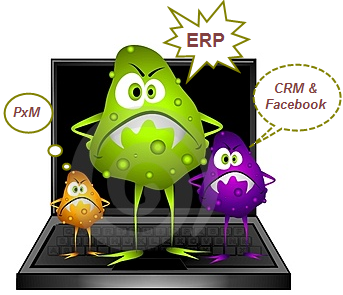
 Inside our company, often there is an engineer or an engineering manager, who got caught by the PxM virus. The PxM virus is a modern virus, which makes you a believer that PDM or PLM will bring your company a lot of benefits. Documents and proof points of the severe impact exist all around the world. However nobody has gotten infected so far in this company. Everyone is working the way they worked since many years and life is secure and predictable.
Now this infected engineer is getting exited and dreams about the introduction of PLM in his company and how he will become the hero of the company and gets a big promotion. Unfortunate for him in this kind of business there are no big bonuses to collect, so the honor of promotion is already a big achievement.
So the first thing this engineer does is chatting with his peers and friends to find out where PxM has been implemented successful and he studies some success stories which he learned from his network.
Now the challenge starts.
He goes to the management and shows a nice PowerPoint, explaining why the company needs PxM and what are the expected benefits, based on reference stories. The management has no real clue what he is talking about, but it looks promising and they allow him to select a PxM system for his department and to start a pilot.
 The engineer already knows which PxM system to choose. The one, recommended by the friendly reseller, who sold them their 3D CAD system (which is a success) and worked hard with him to finalize the slides. As requested by the management he had to invite two other PxM vendors to make an objective selection and at the end an impressive comparison matrix is shown to the management why system A has been chosen.
Now the implementation starts and step 1 is very successful. The document management part around the CAD system goes smoothly and everyone in the engineering department starts to be happy.
Following this successful implementation there are two options:
- the engineer does not get promoted and the implementation ends. It will remain a silent document management implementation and the dream is put aside.
- the engineer gets promoted and continues to push his vision as now he has a broader audience to spread the PxM virus. We will follow this story line…….
The engineer gets promoted and continues to push his vision
This is the best that can happen and the engineer, who now became the head of engineering, starts to express his vision to his fellow managers, explaining the advantages of PLM. Notice, he is now talking about PLM as the scope has been extended beyond product data management, involving other disciplines in the organization.
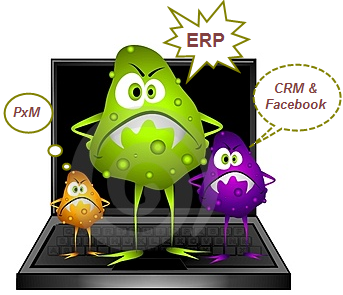
And here the head of engineering discovers that his fellow managers are also infected by a virus. Not the PxM virus, but one of them has already for many years the ERP virus. And as the ERP virus addresses the operational and financial tasks in the organization, the management trusts him. The sales and marketing department seems to be infected by CRM, but currently they caught a social disease, which made them push for all kind of communities. The management either likes it (as their kids are also on Facebook) or dislikes it, because they believe work is a serious business and being on internet all day is considered gaming.
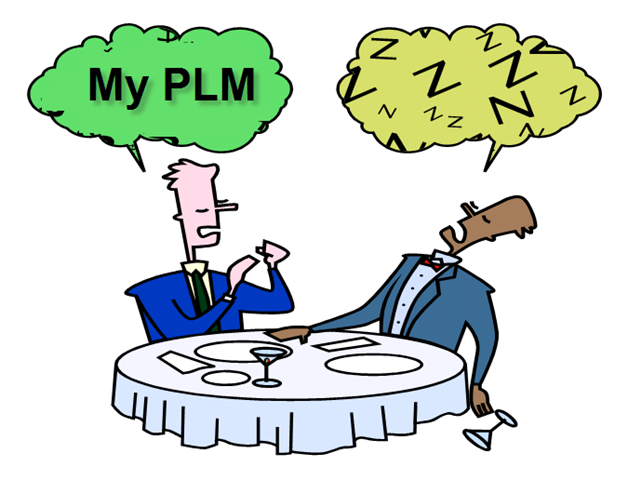 So the head of engineering realizes that he has some freedom within his department, but the other departments and the management have their own priorities. And PLM is not on their list. Together with the friendly CAD reseller, who meanwhile was promoted to be Senior PLM Consultant, they work on a perfect PLM environment within the engineering department and they believe their success will show off in the upcoming years.
And then the crisis came and the company had to cut budgets. To be continued in (hopefully) 1 or 2 years
Conclusion: The silent PLM approach has a huge chance to fail as there is no corporate vision and management push to get PLM implemented. PLM should be addressed top-down. As in many mid-market companies there was also no strategically partner, who could assist the management to build a vision and to set priorities.
Next week:
approach 2: Academical PLM
 This week I was reading a management article completely unrelated to PLM, but very applicable for PLM. The article stated that one of the basics of capitalism is innovation through crisis. Never let a crisis pass by without using it for your benefits was the message.
As we are currently in the middle of the economical downturn (according to the optimists or pessimists – we still have to figure out who is right), this is the moment for the management to decide. Do we try to sit still till it does not hurt anymore , or are we making strategic changes that will for sure demolish some holy houses but from the other hand will create a more lean and stronger organization after the change ?
Examples of IBM and GM were given from the nineties. IBM made the change from a hardware company towards a software company, where GM kept on doing the same with even bigger SUVs’. We know the results…….
Does it prove anything ?
For sure there are many companies that haven’t survived the nineties as they were not successful in their transformation, although they really tried. So where is the relation to PLM ?
 I believe that the problem of implementing PLM, and specially in mid-market companies is the fact that there is no ambition for change when things are going relatively well. In one of my old posts I referred to the story of the boiling frog.
This happens when an organization is slipping down slowly and it is hard for the management to change and define and sell internally another strategy. Jobs and people are kept in place as long as affordable and only natural evolvement (an aging workforce) or mergers are drivers for a change.
Now with this crisis it is different. Everyone realizes (or should realize) that going on the same manner with the same people is not good for survival (unless you are in one of the few industries that benefit from the crisis – apparently the fast food industry I read)
 In times of a crisis, first of all the management is challenged to come with a survival plan and in most cases this time they can get support from their employees as there is always the threat of lay offs if people are not creative or flexible for change. Secondly, employees will be also more flexible to save their jobs and the company (usually in this order)
Therefore this is the ideal moment to implement PLM in phased approach. For a successful PLM implementation you need employees, who are open minded to change the way they work, plus you need internal resources that have time to work with the implementer to fine tune the PLM system.
This moment exists now and by implementing PLM in a phased approach, each phase will bring ROI, perhaps even before the end of the crisis as you can start with the low hanging fruits and start to collect the benefits.
In parallel there is the discussion around free open source software or dumping software for free by some PLM providers in order to stay in the market. I think here as a customer you should always realize that every company, also software providers, need to survive the crisis and will look for income in another way – services / maintenance / additional software.
So my conclusion this time:
I never realized that both capitalism and PLM were striving for innovation. They have a crisis in common – For capitalism it is a must to push innovation for PLM it is an enabler for innovation
 I am not sure if it depending on the holiday season but apparently from my side at this moment things have gone quiet. Customers are either on holiday or delaying their PLM processes due to holidays or economical downturn. For that reason some unstructured thoughts
How PLM is Nokia ?
 Two weeks ago I wrote a post about the problems found with the introduction of the new N97 phone from Nokia – see How PLM is NOKIA. As a victim of their NPI process I am still trying to understand their business reasons to be quiet in their responses. From the NOKIA forum, at this moment already 14 pages of discussion, there is no response from NOKIA, see GPS is cutting out on my N97. It is clear that NOKIA is following the discussion as the moderator has removed some posts, but no positive response from NOKIA’s side. Personally I believe a missed opportunity.
Interesting to see that NOKIA avoids to communicate around this problem. I can imagine keeping the problem silent at least does not alert people not using the GPS, from the other side, in times of crisis customer loyalty is probably something that assists a company in hard times.
PLM lesson learned: the costs of fixing problems once your product is in the field is dramatically higher as compared to the cost made during engineering. Did they do virtual testing ? Did they have a prototype phase ? Or was the product dumped into the market to compete with the iPhone ?
An interesting case to follow – anyone from NOKIA to comment ?
PLM Market Forecast Revised Downward.
V or a W-shape?
Another surprise was the report coming out from CIMdata where they mention that the initial growth expectation for PLM needs to be adjusted – see PLM Market Forecast Revised Downward.
In March, the research house had predicted 3.8% year-over-year growth in 2009 and 6.3% compound annual growth over the next five years — which would have pushed the market to $36 billion in revenue in 2013. Stating in a mid-year report released this week that “the global economic situation has been even more severe than anticipated,” the PLM consulting and research firm said it circled back to include data from the first half of 2009 in its figuring.
CIMdata revised its forecast for the PLM software market in 2009 and beyond, saying it now expects a decline of 2.1% in 2009 from 2008 revenue levels and a 3.5% compound annual growth rate from 2009 to 2013, to just under $31 billion in 2013. The company estimated the 2009 market at $25 billion.
The article contains some more interesting details, as it is also mentions virtual manufacturing, which I believe is one of the key benefits of PLM. I see it as one of the competitive advantages many companies should pursue to cut costs even though it requires an investment and change of work ( real PLM implementation)
 This brought me to the good (or relative good) news. According to the first optimistic signs we have had our worst point of the recession and things can only go better – this are the V-shape believers. After the downturn we will continue as before.
The more pessimistic analysts say we are in a W-shaped recession. Although things are getting better, we will fall back again and recover later, perhaps in 2010.
Both might be right, but what I see is that either end of 2009 or end of 2010 the estimates are that PLM is back in focus. Will this be business as usual or did companies take the opportunity to modernize themselves towards PLM ? The CIMdata reports suggest the opposite, in my post Economical Crisis and PLM – YES WE CAN I tried to explain that investing now in PLM brings an advantage for the future. Companies that now do not look or investigate in PLM might come in a more difficult situation when the economical growth starts again. As the focus will be than on the old business, the chance for management attention and focus on PLM might become too low. Companies that currently invest in PLM take obviously more risk at this time, but will already reap the benefits faster
PLM, PLM 2.0 or a new PLM ?
 Another interesting and ongoing discussion is the discussion where PLM is heading. Where in mid-market companies the discussion often is around the need for PLM beyond CAD data management and ERP, others are already visionary talking about the new PLM, which is based on people, social networking and communities. Look at Vuuch and discussions on PLMTwine and Tech-Clarity. Main question here how will people change, will it be the new workforce that naturally replaces the old workforce and while replacing introduces new ways of PLM or will it be a concept driven from the big enterprises as a new wave of PLM ? I believe this will become more clear when the economy picks up again and companies might have the bandwidth again for some experiments in this area.
Meanwhile I stay on my island
 Jos Voskuil's Weblog
Interesting reflection, Jos. In my experience, the situation you describe is very recognizable. At the company where I work, sustainability…
[…] (The following post from PLM Green Global Alliance cofounder Jos Voskuil first appeared in his European PLM-focused blog HERE.) […]
[…] recent discussions in the PLM ecosystem, including PSC Transition Technologies (EcoPLM), CIMPA PLM services (LCA), and the Design for…
Jos, all interesting and relevant. There are additional elements to be mentioned and Ontologies seem to be one of the…
Jos, as usual, you've provided a buffet of "food for thought". Where do you see AI being trained by a…