
 Potential digital transformation is everywhere. This time I want to share a personal story based on my IoT cycling device from Garmin. Several years ago I became an enthusiastic cyclist, mainly because it clears your mind and cycling keeps you in good shape after enjoying customer visits with great dinners and excellent breakfasts. As the Dutch lack real mountains, we challenge ourselves with through open fields with strong winds to suffer a little too.

Four years ago, started tracking my cycling performance, with a Garmin Edge 810. The story of my Garmin is a real IoT story. GPS trackers, in the beginning, did not communicate with the outside world. Now, this device connects to sensors registering my speed, my location, my heart rate, pedal cadence and produced power at any time, finally uploading it to the Garmin Connect platform.
The IoT platform
The Garmin Connect platform gives me insights on my performance, activities, and segments. The segment demonstrates the social part of the platform. Here you can see how you rank with others who have cycled the same track segment over time. And you can register your own preferred segment too, where you challenge yourself and others in your area. So the number of segments is growing continuously. Imagine all these cyclists around the world virtually sharing and taking the same track. I am curious to learn from Garmin how many people are connected to the platform.
I could not find these numbers. You?
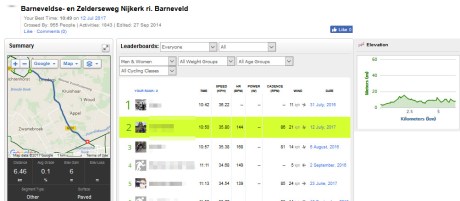
The fun of segments
Digital Twin
Through the platform, Garmin collects huge amounts of data of connected users. Each data set of the connected user could be considered a simple digital twin. The Connect platform provides me insights about my overall performance through the years through various reports. Garmin could offer as a (paid) service to deliver insights of my performance compared to other users and propose predictive enhancements similar to the GE Predix platform. The difference of course that 1 % performance improvement for me in cycling does not bring the same value as 1 % performance improvement of a GE product (turbine, jet engine, train, …). However, the concept is the same and GE is promoting themselves as the next Digital Industrial Company, leading in digital transformation. Read more here.

Digital Twin performance
Connecting to the customer
 Tthe change from moving from a document-driven approach towards a data-driven approach to collect and store information is not the main concept behind a digital transformation. The data-driven approach is an enabler to connect directly to the customer and change the current business model from delivering products into a business model delivering services or even more advanced delivering experiences. Services and experiences create a closer relation to the customer, more loyalty, but also the challenge that you need to connect to the customer in such a way that the customer sees value. Otherwise, the customer will switch to another service or experience. The Apple, Nespresso, Uber experiences are all known for their new ways of connecting to the customer, differentiating from traditional product sales. Garmin could also be on that list. However, I discovered they are not there yet, despite an IoT-platform and connected devices. What is missing?
Why Garmin is not a digital enterprise.
Two years ago my Garmin Edge started crashing in the middle of a ride. The system rebooted after some minutes, and the recordings were lost or at least unreadable. When I contacted Garmin support their standard response was: “Please reset the device and update to the latest software.” Two years ago the software had still bug fixes. After two years you would expect a stable experience.
 However, a year ago the problems started to become more frequent. I started to send log files illustrating where the error occurred. Still, the Garmin response was the same: “Please reset the device and update to the latest software.”
However as there were no new software updates, there must be another reason why the device failed more and more.
After pushing for a resolution, the service department concluded I needed a new device. There might be an issue with the hardware. A little bit skeptical I agreed on a hardware switch again, and as expected this did not solve the crashes. My guess is that due to the increasing amount of segments at some places, the software gets confused where the rider is exactly located and in which direction the rider is going. These are the moments when the crash happens, and this is probably a software issue.
Still, the Garmin help desk believes there is a hardware problem (preferably swap the device) where I kept on providing evidence data of crashes to support Garmin in their error-discovery. Till now there is no resolution. The good news is that Garmin support mentioned investigating further.
 For me, the interaction with Garmin illustrates that the company internally is not yet digital transformed. The service desk probably has KPIs (Key Performance Indicators) related to their response time and problem resolution time. Although I can debate the response time, it is clear that the problem resolution approach: Update to the latest software and if this does not work swap to a new device is not increasing the knowledge from Garmin as a company what their customers are experiencing.
Apparently, their software management is disconnected from the service department and customers. Only clear bugs during the first launch are fixed. Next, it is a disconnected world again.
 A must for a digital enterprise is to dive into customer issues and to connect them back to R&D, both for the hardware part and software part. Something a modern product manager would do. If a company is not able to understand the multidisciplinary dependencies and solve issues from the field (with some effort), they will keep on making the same mistakes again with new product launches and lose customers who are looking for a better experience.
My conclusion
PLM should be part of the digital enterprise too as this is the only way to deliver consistent customer value and positive experience. It requires companies to break down silos and create multidisciplinary teams that are capable of supporting the full customer journey. A digital device and a digital customer platform are just facades to the outside world – the inside needs to change too.
What do you think?
Does your company understand the challenges to transform across all disciplines?
Are you managing PLM, ALM, and IoT in context of the product and across the whole lifecycle?
I am curious !
 Last week I published a dialogue I had with Flip van der Linden, a fellow Dutchman and millennial, eager to get a grip on current PLM. You can read the initial post here:
 You are right, the main challenge for future PLM experts is to explain and support more agile processes, mainly because software has become a major part of the solution. The classical, linear product delivery approach does not match the agile, iterative approach for software deliveries. The ECR/ECO process has been established to control hardware changes, in particular because there was a big impact on the costs. Software changes are extremely cheap and possible fast, leading to different change procedures. The future of PLM is about managing these two layers (hardware/software) together in an agile way. The solution for this approach is that people have to work in multi-disciplinary teams with direct (social) collaboration and to be efficient this collaboration should be done in a digital way.
 I believe the ideal archetype does not exist yet. We are all learning, and we see examples from existing companies and startups pitching their story for a future enterprise. Some vendors sell a solution based on their own product innovation platform, others on existing platforms and many new vendors are addressing a piece of the puzzle, to be connected through APIs or Microservices. I wrote about these challenges in
  (Flip) But then given point 2: ‘Model-based enterprise transformations,’ in my view, a key effort for a successful PLM expert would also be to embed this change mgt. as a business process in the actual Enterprise Architecture. So he/she would need to understand and work out a ‘business-ontology’ (Dietz, 2006) or similar construct which facilitates at least a. business processes, b. Change (mgt.) processes, c. emerging (Mfg.) technologies, d. Data structures- and flows, e. implementation trajectory and sourcing.
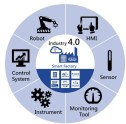
  Only this question could be a next future blog post. Yes, it is crucial to define a business ontology to support the modern flow of information through an enterprise. Products become systems, depending on direct feedback from the market. Only this last sentence already requires a redefinition of change processes, responsibilities. Next, the change towards data-granularity introduces new ways of automation, which we will address in the upcoming years. Initiatives like Industry 4.0 / Smart Manufacturing / IIoT all contribute to that. And then there is the need to communicate around a model instead of following the old documents path. Read more about it in
  (Flip) Where to draw the PLM line in a digital enterprise? I personally think this barrier will vanish as Product Lifecycle Management (as a paradigm, not necessarily as a software) will provide companies with continuity, profitability and competitive advantage in the early 21st century. The PLM monolith might remain, but supported by an array of micro services inside and outside the company (next to IoT, hopefully also external data sets).
 I believe there is no need to draw a PLM line. As Peter’s article:





 However, all companies are discovering the modern digital enterprise, and here nothing is permanent and most likely nothing with remain stable. You will see companies making data available from various systems through APIs (Application Program Interface). In the past the meaning of API was directly tied to one system, now it is a wider concept, read for example
  Five years ago there was an interesting debate on engineering.com following upon a discussion between Jim Brown and Chad Jackson with the theme:
  On the other side, PLM-platforms can be found from the classical PLM vendors, Dassault Systemes, Siemens PLM and PTC have their platforms coming from the classical PLM world, all with some different variations in focus. Aras and Autodesk do not rely necessary on the classical engineering environments and position themselves as a new, modern PLM.
 Looking forward to your point of view !




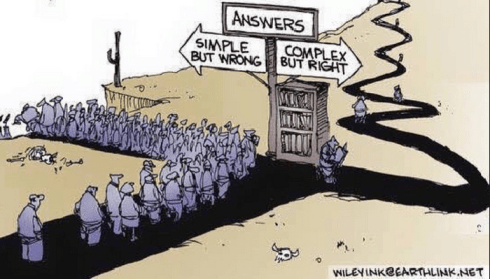
 One of the companies, I am currently working with, decided to keep all employees on board by demanding for a PLM system that is so rigid and automated that a user cannot make mistakes or wrong decisions. For example: Instead of allowing the user to decide which approval path should be chosen, the predefined workflow should be started where all participants are selected by automation. The idea: reducing the complexity for the (older) user. The user does not have to learn how to navigate in a new environment to decide what is the best option. There is always one option. Simple isn’t it?
 My last blog post was about reasons why PLM is not simple. PLM supporting a well-planned business transformation requires business change / new ways of working. PLM is going through different stages. We are moving from drawing-centric (previous century), through BOM-centric (currently) towards model-centric (current and future). You can read the post here:
  My comments on this part: PLM becomes more and more an infrastructure for product information along the whole lifecycle. PLM is no longer an engineering tool provided by IT.
 Here we are aligned. All PLM vendors are dreaming of simplifying their software. Imagine: if you have a simple product everyone can use, you would be the market leader and profitable like crazy without a big effort as the product is simple. Of course, this only works, assuming this dream can be realized.
 Here we are totally aligned. In the past, I have been involved in potential alliances where certain service providers evaluated SmarTeam as a potential tool for their business. In particular, the major PLM service providers did not see enough value in an easy to configure and relatively cheap product. Cheap means no budget for a huge amount of services.
 Here we are not aligned. Business transformations will never happen because of simple tools. People are measured and pushed to optimize their silos in the organization. A digital transformation, which is creating a horizontal flow and transparency of information, will never happen through a tool. The organization needs to change, and this is always driven by a top-down strategy. PLM consultants are valuable to explain the potential future, to coach all levels of the organization. In theory, a PLM consultant’s job is tool independent. However, the challenge of being completely disconnected from the existing tools might allow for dreams that never can be realized. In reality, most PLM consultants are experienced in one or more specific tools they have been implementing. The customer should be aware of that and make sure they own the PLM roadmap.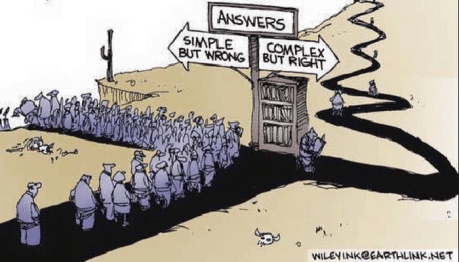
 Oleg and I can continue this debate for a long time. We would be interested in learning your view on PLM and Simplicity – please tune in through the comments section below:
 Digital transformation is just starting in the domain of PLM. Sharing and collecting knowledge is crucial, independent from particular solutions. For me, the upcoming PDT-conference in October is going to be a reference point where we are on this journey. In case your company has the experience to share related to this topic, please react to this link: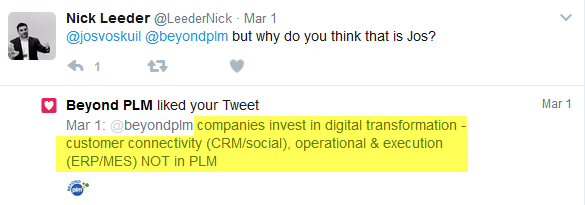
 A digital enterprise is the next ultimate dream after the paperless office. Where the paperless office was focusing on transforming paper-based information into electronic information, there was not a mind-shift in the way people could work. Of course, when information became available in an electronic format, you could easily centralize it and store in places accessible to many others. Centralizing and controlling electronic information is what we did in the previous century with document management, PDM, and classical PLM. An example: your airline ticket now provided as a PDF-file – electronic, not digital.
 Digital Transformation means that information is broken down into granular information objects that can be stored in a database in the context of other information objects. As they have a status and/or relation to other information objects, in a certain combination they bring, in real-time, relevant information to a user. The big difference with electronic information is that the content does not need a person to format, translate or pre-process the data. An example: your boarding app, showing the flight, the departure time, the gate all in real-time. If there is a change, you are immediately updated.
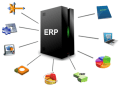 ERP systems by nature have been designed to be digital. Logistical information, financial information, part information for scheduling, etc., all is managed in database tables, to allow algorithms and calculations to take place in real-time. Documents are generated to store snapshots of information (a schedule / a report), or there are pointers to documents that should contain digital, unmanaged information, like contracts, drawings, models. Therefore, the digital transformation does not impact ERP so much.
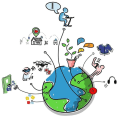 Customer connected platforms are a typical new domain for manufacturers, as this is where the digital transformation takes place in business. Connecting either to your products in the field or connecting to your consumers in the market have been the typical business changes almost every manufacturer is implementing, thanks to IoT and thanks to global connectivity. As this part of the business is new for a company, there is no legacy to deal with and therefore exciting to present to the outside world and the management.
 To give an example. A year ago I wrote a post: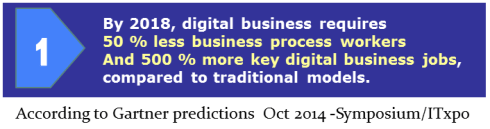
![GettyImages-157335388[1]](https://virtualdutchman.com/wp-content/uploads/2017/03/gettyimages-1573353881.jpg "GettyImages-157335388[1]")





 Jos Voskuil's Weblog
Interesting reflection, Jos. In my experience, the situation you describe is very recognizable. At the company where I work, sustainability…
[…] (The following post from PLM Green Global Alliance cofounder Jos Voskuil first appeared in his European PLM-focused blog HERE.) […]
[…] recent discussions in the PLM ecosystem, including PSC Transition Technologies (EcoPLM), CIMPA PLM services (LCA), and the Design for…
Jos, all interesting and relevant. There are additional elements to be mentioned and Ontologies seem to be one of the…
Jos, as usual, you've provided a buffet of "food for thought". Where do you see AI being trained by a…