
You are currently browsing the tag archive for the ‘Data centric’ tag.
 This is the fifth year that marketkey organized their vendor-independent conference in Europe around Product Innovation, where PLM is the major cornerstone. Approximate 100 companies attended this conference coming from various industries. As there were most of the time two till four parallel tracks (program here), it will still take time for me to digest all the content. However here a first impression and a comparison to what has changed since the PI Conference in 2014 – you can read my review from that conference here.
First of all the keynote speeches for this conference were excellent and were a good foundation for attendees to discuss and open their mind. Secondly I felt that this conference was actually dealing with the imminent shift from classic, centralized businesses towards the data-centric approach to connectivity of information coming from anyone / anything connected. Naturally the Internet of Everything (IoE) and the Internet of Things (IoT) were part of the discussion combined with changing business models: moving from delivering products toward offering services (CAPEX versus OPEX).
Some of the highlights here:
 The first keynote speaker was Carlo Rati Director, MIT Senseable Lab. He illustrated through various experiments and examples how being connected through devices we can change and improve our world: tagging waste, mobile phone activity in a city and the Copenhagen Wheel. His main conclusion (not a surprise): For innovation there is a need to change collaboration. Instead of staying within the company / discipline boundaries solving problems through collaboration between different disciplines will lead to different thinking. How is your company dealing with innovation?
 The second session I attended was John Housego from W.L. Gore and Associates who explained the company’s model for continuous growth and innovation. The company’s future is not based on management but based on leadership of people working in teams in a flat organization. Every employee is an associate, directly involved and challenged to define the company’s future. Have a read about the company’s background here on Wikipedia.
Although the company is 50 years old, I realized that their cultural model is a perfect match with the future of many businesses. More and more companies need to be lean and flexible and support direct contact between the field, customers, market and experts inside the company. Implementing a modern PLM platform should be “a piece of cake” if the technology exists, as W.L. Gore’s associates will not block the change if they understand the value. No silos to break down.
 My presentation “The Challenge of PLM Upgrades as We See the Rules of Business Change” was based around two themes (perpetual software ? / seamless upgrades ?) and from there look towards the future what to expect in business. When we look back, we see that every 10 years there is a major technology change, which makes the past incompatible to upgrade. Now we are dreaming that cloud-based solutions are the future to guarantee seamless upgrades (let’s wait 10 years). To my opinion companies should not consider a PLM upgrade at this moment.
The changes in business models, people behavior and skills plus technology change, will enable companies to move towards a data-centric approach. Companies need to break with the past (a linear, mechanical-design-based, product development approach) and redesign a platform for the future (a business-innovation platform based on the data). In my upcoming blog post(s) I will give more background on this statement.

Trond Zimmerman from the Volvo Group Truck explained the challenges and solution concept they experienced as they are currently implementing answering the challenge of working in a joint venture with Dongfeng Commercial Vehicles. As in a joined venture you want to optimize sharing of common parts, still you cannot expect a single PLM solution for the total joint venture. For that reason, Volvo Group Truck is implementing Share-A-Space from Eurostep to have a controlled collaboration layer between the two joint venture partners.
This is, to my opinion, one of the examples of future PLM practices, where data will not be stored in a single monolithic system, but data will be connected through information layers and services. The case is similar to what has been presented last year at Product Innovation 2014 where Eurostep and Siemens Industrial Turbomachinery implemented a similar layer on top of their PDM environment to enable controlled sharing with their suppliers.
 David Rowan from wired.co.uk closed the day with his keynote: Understanding the New Rules of Product Innovation. He touched the same topic as John Housego from W.L. Gore somehow: it is all about democratization. Instead of hierarchy we are moving to network-based activities. And this approach has a huge impact on businesses. David’s message: Prepare for constant change. Where in the past we lived in a “linear” century, change according to Moore’s law, we are entering now an exponential century where change is going faster and faster. Besides examples of the Internet of Thing, David also gave some examples of the Internet of Stupid Things. He showed a quote from Steve Balmer stating that nobody would pay $ 500 for a phone (Apple). The risk he made is that by claiming some of these stupid inventions might lead to a quote in the future. I think the challenge is always to stay open-minded without judging as at the end the market will decide.
PLM and ERP
 I spent the evening networking with a lot of people, most of them excited about the future capabilities that have been presented. In parallel, the discussion was also about the conservative behavior of many companies. Topics that are already for ten years under discussion – how to deal and connect PLM and ERP, where is the MBOM, what are the roles of PLM and ERP for an organization, are still thankful topics for a discussion, showing where most companies now are with their business understanding.
In parallel to a product innovation conference apparently there is still a need to agree on basic PLM concepts from the previous century.
 The second day opened with an excellent keynote speech from Dirk Schlesinger from Cisco. He talked about the Internet of Everything and provided examples of the main components of IoE: Connectivity, Sensors, Platform, Analytics, and Mobility. In particular the example of Connectivity was demonstrating the future benefits modern PLM platforms can bring. Dirk talked about a project with Dundee Mining where everything in the mine was tagged with RFI devices (people, equipment, vehicles, and resources) and the whole mine was equipped with Wi-Fi.
Based on this approach the execution and planning of what happened was done in their HQ through a virtual environment, giving planners immediate visibility of what happens and allowing them to decide on real data. This is exactly the message I have posted in my recent blog posts.
The most fascinating part were the reported results. This project is ongoing now for 3 years and the first year they achieved a production increase of 30 %. Now they are aiming for this year for a 400 % production increase and a 250 % efficiency increase. These are the numbers to imagine when you implement a digital strategy. It is no longer any more about making our classical processes more efficient, it is about everyone connected and everyone collaborates.
 Marc Halpern from Gartner gave an good presentation connecting the hype of the Internet of Things with the world of PLM again, talking about Product Innovation Platforms. Marc also touched on the (needed) upcoming change in engineering processes. More and more we will develop complex products, which need system thinking. Systems of Systems to handle this complexity, As Marc stated: “Product, process, culture is based on electro-mechanical products where the future trend is all about software.” We should reconsider our Bill of Materials (mechanical) and think probably more about a Bill of Features (software). Much of Marc’s presentation contained the same elements as I discussed in my PDT2014 blog post from October last year.
 I was happy to see Jenni Ala-Mantila presenting the usage of PLM system for Skanska Oy. Skanska is one of the largest construction companies operating global. See one of their beautiful corporate videos here. I always have been an advocate to use PLM practices and PLM infrastructure to enhance, in particular, the data-continuity in a business where people work in silos with separate tools. There are so many benefits to gain by having an end-to-end visibility of the project and its related data. Jenni’s presentation was confirming this.
By implementing a PLM backbone with a focus on project management, supplier collaboration and risk management, she confirmed that PLM has contributed significant to their Five Zero – vision: Zero loss-making projects, Zero Environmental incidents, Zero Accidents, Zero Ethical breaches and Zero Defects. Skanska is really a visionary company although it was frustrating to learn that there was still a need to build a SharePoint connection with their PLM environment. The future of data-centric has not reached everyone in the organization yet.
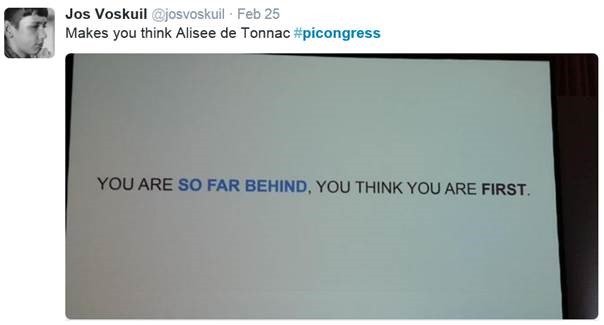
The last two sessions of the conference, a panel discussion “Why is Process Innovation Challenging & What can be done about it” plus the final keynote “Sourcing Growth where Growth Takes Place” had some commonality which I expressed in some twitter quotes:


Conclusion
Where last year I had the impression that the PLM world was somehow in a static mode, not so much news in 2014. It became clear in this 2015 conference that the change towards new business paradigms is really happening and at a faster pace than expected. From mechanical development processes to software processes, from linear towards continuous changes. Moe to come this year
 This is for the moment the last post about the difference between files and a data-oriented approach. This time I will focus on the need for open exchange standards and the relation to proprietary systems. In my first post, I explained that a data-centric approach can bring many business benefits and is pointing to background information for those who want to learn more in detail. In my second post, I gave the example of dealing with specifications.
It demonstrated that the real value for a data-centric approach comes at the moment there are changes of the information over time. For a specification that is right the first time and never changes there is less value to win with a data-centric approach. Moreover, aren’t we still dreaming that we do everything right the first time.
The specification example was based on dealing with text documents (sometimes called 1D information). The same benefits are valid for diagrams, schematics (2D information) and CAD models (3D information)
1D,2D,3D …..
 The challenge for a data-oriented approach is that information needs to be stored in data elements in a database, independent of an individual file format. For text, this might be easy to comprehend. Text elements are relative simple to understand. Still the OpenDocument standard for Office documents is in the background based on a lot of technical know-how and experience to make it widely acceptable. For 2D and 3D information this is less obvious as this is for the domain of the CAD vendors.
CAD vendors have various reasons not to store their information in a neutral format.
- First of all, and most important for their business, a neutral format would reduce the dependency on their products. Other vendors could work with these formats too, therefore reducing the potential market capture. You could say that in a certain manner the Autodesk 2D format for DXF (and even DWG) have become a neutral format for 2D data as many other vendors have applications that read and write back information in the DXF-data format. So far DXF is stored in a file but you could store DXF data also inside a database and make it available as elements.
- This brings us to the second reason why using neutral data formats are not that evident for CAD vendors. It reduces their flexibility to change the format and optimize it for maximal performance. Commercially the significant, immediate disadvantage of working in neutral formats is that it has not been designed for particular needs in an individual application and therefore any “intelligent” manipulations on the data are hard to achieve..
 The same reasoning can be applied to 3D data, where different neutral formats exist (IGES, STEP, …. ). It is very difficult to identify a common 3D standard without losing many benefits that an individual 3D CAD format brings currently. For example, CATIA is handling 3D CAD data in a complete different way as Creo does, and again handled different compared to NX, SolidWorks, Solid Edge and Inventor. Even some of them might use the same CAD kernel.
However, it is not only about the geometry anymore; the shapes represent virtual objects that have metadata describing the objects. In addition other related information exists, not necessarily coming from the design world, like tasks (planning), parts (physical), suppliers, resources and more
PLM, ERP, systems and single source of truth
This brings us in the world of data management, in my world mainly PLM systems and ERP systems. An ERP system is already a data-centric application, the BOM is already available as metadata as well as all the scheduling and interaction with resources, suppliers and financial transactions. Still ERP systems store a lot of related documents and drawings, containing content that does not match their data model.
PLM systems have gradually becoming more and more data centric as the origin was around engineering data, mostly stored in files. In a data-centric approach, there is the challenge to exchange data between a PLM system and an ERP system. Usually there is a need to share information between two systems, mainly the items. Different definitions of an item on the PLM and ERP side make it hard to exchange information from one system to the other. It is for that reason why there are many discussions around PLM and ERP integration and the BOM.
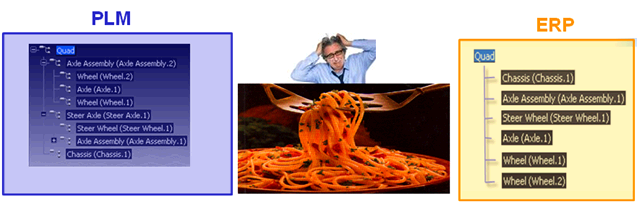
In the modern data-centric approach however we should think less and less in systems and more and more in business processes performed on actual data elements. This requires a company-wide, actually an enterprise-wide or industry-wide data definition of all information that is relevant for the business processes. This leads into Master Data Management, the new required skill for enterprise solution architects
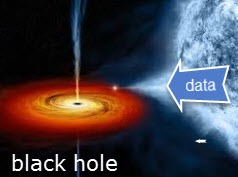 The data-centric approach creates the impression that you can achieve a single source of the truth as all objects are stored uniquely in a database. SAP solves the problem by stating everything fits in their single database. To my opinion this is more a black hole approach: Everything gets inside, but even light cannot escape. Usability and reuse of information that was stored with the intention not to be found is the big challenge here.
Other PLM and ERP vendors have different approaches. Either they choose for a service bus architecture where applications in the background link and synchronize common data elements from each application. Therefore, there is some redundancy, however everything is connected. More and more PLM vendors focus on building a platform of connected data elements, where on top applications will run, like the 3DExperience platform from Dassault Systèmes.
 As users we are more and more used to platforms as Google, Apple provide these platforms already in the cloud for common use on our smartphones. The large amount of apps run on shared data elements (contacts, locations …) and store additional proprietary data.
Platforms, Networks and standards
And here we enter an interesting area of discussion. I think it is a given that a single database concept is a utopia. Therefore, it will be all about how systems and platforms communicate with each other to provide in the end the right information to the user. The systems and platforms need to be data-centric as we learned from the discussion around the document (file centric) or data-centric approach.
In this domain, there are several companies already active for years. Datamation from Dr. Kais Al-Timimi in the UK is such a company. Kais is a veteran in the PLM and data modeling industry, and they provide a platform for data-centric collaboration. This quote from one of his presentations, illustrates we share the same vision:
“……. the root cause of all interoperability and data challenges is the need to transform data between systems using different, and often incompatible, data models.
It is fundamentally different from the current Application Centric Approach, in that data is SHARED, and therefore, ‘NOT OWNED’ by the applications that create it.
This means in a Data Centric Approach data can deliver MORE VALUE, as it is readily sharable and reusable by multiple applications. In addition, it removes the overhead of having to build and maintain non-value-added processes, e.g. to move data between applications.”
Another company in the same domain is Eurostep, who are also focusing on business collaboration between in various industries. Eurostep has been working with various industry standards, like AP203/214, PLCS and AP233. Eurostep has developed their Share-A-space platform to enable a data-centric collaboration.
 This type of data collaboration is crucial for all industries. Where the aerospace and automotive industry are probably the most mature on this topic, the process industry and construction industry are currently also focusing on discovering data standards and collaboration models (ISO 15926 / BIM). It will be probably the innovators in these industries that clear the path for others. For sure it will not come from the software vendors as I discussed before.
Conclusion
If you reach this line, it means the topic has been interesting in depth for you. In the past three post starting from the future trend, an example and the data modeling background, I have tried to describe what is happening in a simplified manner.
If you really want to dive into the PLM for the future, I recommend you visit the upcoming PDT 2014 conference in Paris on October 14 and 15. Here experts from different industries will present and discuss the future PLM platform and its benefits. I hope to meet you there.
Some more to read:
https://us.sogeti.com/wp-content/uploads/2014/04/PLM-Systems-White-Paper.pdf
 In my previous post, I talked about the unstoppable trend towards digital information and knowledge based on data becoming the new business paradigm.
Building knowledge based on information extracted from data, instead of working with documents and people, who need to manipulate these documents.
Moreover, the reasons to move towards a digital data-oriented approach are the immense business benefits it can bring to an organization. Having online visibility on information in context of other information from different stakeholders allows companies to be more proactive.
A proactive company will react faster to the market or customer. This will reduce waste and resources (materials / people) and therefore in the end be more competitive. This is all described in my first post, with relevant links to various global references.
In this post, I want to describe in an example what the differences are between a document-oriented and a data-oriented approach and how it affects people and business. This might give you an impression of the expected business benefits.
The ultimate goal behind a data-oriented approach is to have a single version of the truth for a product, project or plant. This can be realized by treating information as data elements in various connected database, where on demand reports or dashboards can be created based on actual information, instead of documents generated by duplicating data in new systems and locations. Digital data will provide paperless processes accessible almost anywhere around the world.
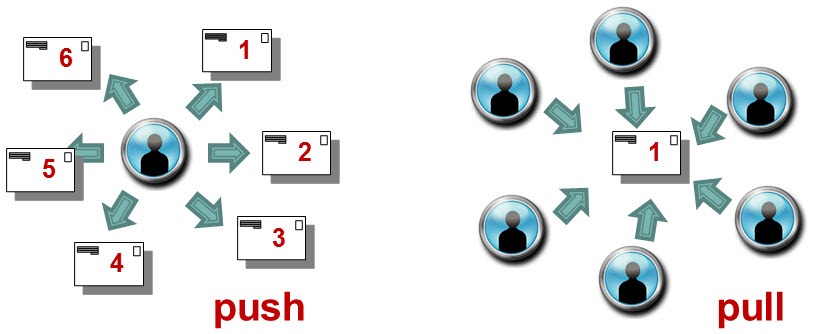
As an example, I will explain the difference between document-centric and data-centric when dealing with specifications.
The specification
Everyone knows the challenge with specifications. Most of the time in printed documents describing how a product or service should work from the client point of view. There are two principles behind specifications:
- Complexity. The more complex product or service is, the bigger chance that specifications are not complete or hundred percent understood, leading to an iterative change process. The challenge here is to manage the change and the consistency of the full specifications.
- Industry and margins. In a repetitive business, for example, the automotive or other mass consumer products, products can be quiet complex and once sold hard to maintain and repair. In a competitive business, an error in the field can consume a lot of the expected profit. In the construction industry, where most of the time single projects are executed by a chain of disciplines, the industry (still) accepts the costs overrun and the high costs of fixing issues in the field, instead of being clearer upfront during the design and planning.
Let’s stay with the example in the middle of complexity and industry volume. In color the various stages of the process.
The document based specification – 1
 When the document based specification arrives, the company has to get an understanding of the content. The project manager has a first read through the document (100+ pages) and decides to send the document (it is a pdf) to sales, engineering, legal and planning. Engineering decides to distribute the document internally to mechanical, electrical and quality (for compliance).
The project manager stresses everyone on a weekly base to deliver the responses and tries to understand if the answers will come in time. There are some meetings needed with the stakeholders as the whole understanding needs to be consistent. Based on several iterations a response is compiled.
The data-oriented approach – 1
 When the document based specification arrives, the project leader first stores the document as a reference in the PLM system and extracts all the customer requirements as data elements in the system. While extracting the requirements, the projects manager groups them into digital folders (functional / non-functional, contractual, regulations, etc.) and assigns them to the relevant stakeholders, who get notified by the system. Each of the persons assigned, again the engineering manager has distributed the discipline specific requirements internally.
The project manager watches the progress of the requirements analyses which are around a virtual model. There is still a need for meetings with the stakeholders to agree on the solution approach. Everything is stored and visible online in the system. This visibility has helped some of the stakeholders to be better-aligned upfront. In the end, the response is generated and converted to the customer’s format.
Not much benefit for step 1
 If you compare the two approaches, there is mainly one person happy: the project manager. Instead of spending time to collect the status of all information, direct visibility on the response helps him/her to prioritize of focus where attention is needed, instead of discovering it on a weekly base.
There is some small benefit from the virtual model as other stakeholders can have a better understanding of the actual progress.
However, for the rest, all stakeholders are complaining. It is difficult to work. (Fl)Excel was much easier. Moreover, thinking about a virtual model takes time as we are not used working in this way. Typically something for aerospace you might think.
And now the benefits come – step 2
The customer has placed the order, and the project has started. The design has started, and people start to discover discrepancies or ambiguous demands that need to be negotiated with the customer. Is it part of the project and if not, should it become part of the project and at which costs (for whom)
The document oriented approach – 2
 Several engineers are now discussing with the counterparts at the customer the detailed interpretation of the requirements, either through face-to-face meetings or emails. Changes are collected and sent to the project manager, who tries to understand what has changed and how to merge it in an on-going specification document. To avoid many revisions, he/she tries to update the document on a bi-weekly base, send it to the internal stakeholders for review and with their feedback generates a specification document for the customer that supposed to cover the latest agreements.
Unfortunate not all changes have reached the document as some of the stakeholders were busy and forgot to include some of the changes agreed with the customer as they were in a lost email. Also, a previous change of a requirement was overwritten as an update from quality used the old data. Finally, some design solutions were changed, which raised the costs. And not sure if the product with all its changes will be compliant after delivery. However, luckily nobody noticed so far, not even the customer
The data-oriented approach – 2
 Thanks to the virtual model and the relations between all the requirements, any change in a requirement gets notified in the system. When a requirement is further clarified, it is updated in the system. When a requirement needs to be changed, it is clear what the impact of this change is. A change workflow assures that decisions are made visible and approved. Potentially changes that lead to more work were quoted to the customer for acceptance. Luckily the compliancy engineer noted that the change of materials used would lead to a compliancy issue. On a bi-weekly base, the project manager generates an agreed specification for the customer based on the data in the system.
Benefits are growing.
 The project manager remains the happiest person and is even happier as less discussion is needed about who changed what and why. Alternatively, discussions about changes that should exist and cannot be found. The time saved by the project manager could be used to collaborate even better with the teams (without annoying them) or perhaps a second project to manage in parallel.
Other stakeholders start to enjoy the data-oriented approach too. Less ambiguity on their side too, fewer iterations because changes were not apparent. As all information is related to the virtual model online, the actual status is clear when making a decision. Less fixing afterwards and luckily still project meeting between the stakeholders to synchronize. The PLM system does not eliminate communication; it provides a reliable baseline of the truth. No need (and option) to look in your archives.
At this stage, benefits start to become clear. Fewer iterations and better decisions will have an impact on the costs and project stress. Still a complaint from the engineers might be that they need to do too much upfront thinking although some years later they might discover that this will be their main job. Fixing issues from the past have diminished.
And then the ultimate benefits
Now the project has reached the physical state. It is manufactured or under commissioning.
The document oriented approach – 3
 In the document oriented approach, many issues might pop-up because they have not been considered in the early phase, or they got lost during document exchanges. Does the product work as specified? Is the building certified as specified?
The customer is king and for manufacturing companies this might lead to product recalls or launch delays. In the construction world, people in the field, will fix the issues by using skilled resources and creating a waste of materials and/or resources.
Data handover to the owner is a nightmare for a the project-centric delivery. Several people have been searching for documents, specifications and emails to build and compile the required documents for handover.
The data-oriented approach – 3
 In the data-centric approach, the behavior of the physical product works as expected as most of the issues have been solved in the virtual model. When testing the product it works as specified as the specifying requirements have always been linked to the product. Moreover, they have been agreed and approved by the relevant stakeholders. Where relevant, the customer has paid for the extra work specified.
The handover process was not so stressful as before with the document-oriented approach. As the required information was known and specified upfront related to the requirements, the maturity process of the virtual model assured this data exists in the system. Now the as-built information matches the as-specified information. What a relief.
Conclusion
 It is clear that the significant benefits can be found in step 3. I wrote the comparison in an extreme manner, knowing that reality lies in the middle. Excellent people can comprehend and fix more upfront because of their experience. Building the ultimate virtual model is not yet an easy achievement either.
The savings in materials and required resources are significant in a data-oriented approach. The time savings and the quality enhancements might change your company into a market-leader. The cost savings achieved through a pro-active approach will make your margin growing (unless competition does the same) and enable you to innovate.
One final remark on business change
 If business change could be achieved by selecting the right tool or system without a business change, you will never get a competitive advantage. As your competitor can buy these too.
However, if you change to a data-centric approach, it will be a though change process and therefore once implemented you will leave competitors behind that keep on hanging on the past.
 I will be attending the annual Product Innovation conference again in Berlin next week. Looking forward to this event, as it is one of the places where you have the chance to network and listen to presentations from people that are PLM minded. A kind of relaxation, as strangely enough, most of the companies I am visiting, considerer PLM still considered as something difficult, something related to engineering, not so much connected to the future of their business.
I believe one of the reasons is that people have founded their opinion on the past. An expensive implementation horror story, an engineering focuses implementation or other stories that have framed PLM in a certain manner.
However PLM has changed and it significance has grown !
During the Product Innovation conference, I will present in more depth this topic related to the change of PLM.,with more examples and a surprising projection to the future. Later, when time permits, I will share the more in-depth observations in my blog, hopefully extended based on discussions during the conference. And if you attend the conference, don’t miss my session.
 Fifteen years ago,

the term PLM (Product Lifecycle Management) was introduced as a logical extension to cPDM (collaborative Product Data Management). Where the initial focus was of global file sharing of mechanical CAD data, PLM extended the scope with multidisciplinary support, connecting manufacturing preparation and providing an infrastructure for change management.
In the nineties product data management was in transition.
In the early 90s, UNIX dominated, and installing a PDM system was the work of IT-experts. Large enterprises, already operating globally, were pushing for standardization, and control of data to connect their engineers in a more efficient manner. Connectivity was achieved through expensive lease lines; people like me, had to connect to the internet through dial-up modems and its usage was limited, providing static web pages with minimal graphics.
It was obvious that cPDM and the first PLM projects were extremely expensive. There was no experience; it was learning on the job. The costs were high and visible at the management level. Giving the management the impression that PLM is potentially the same challenge as ERP, but with a less clear scope. And the projects were executed by IT-experts, end-users were not really in the game.
At the end of the 90s, a small revolution started to take place. The power of the PC combined with Microsoft technology provided a much cheaper and flexible alternative for a complex UNIX based implementation. 
Affordable 3D CAD emerged in the mid-market, leading to the need for Windows-based PDM systems and with Windows came Excel, the PDM/PLM killer application.
A person with some rudimentary Visual Basic skills could do magic with Excel and although not an IT-expert would become the champion of the engineering department.
At that time, PLM conferences provided a platform on which industry could discuss and share their tips and tricks on how to implement in the best manner a system. The focus was mainly on the IT-side and large enterprises. The scope was engineering centric, connecting the various disciplines including mechanical, electrical and simulation, in a database and connecting files and versions.
 Ten years ago,

most large enterprises had already started to implement a PLM system. The term PLM became an accepted acronym associated with something that is needed for big companies and is complex and expensive, a logical statement based on the experiences of early adopters.
PLM was the infrastructure that could connect product information between disciplines and departments working from different locations. The NPI (New Product Introduction) process became a topic pushed by all enterprise PLM vendors and was a practice that demonstrated the value of providing visibility on information across a large, dispersed company, to better decision-making.
As this process was more data-centric instead of CAD-centric, these capabilities promoted the recognition and introduction of PLM in non-traditional manufacturing industries like Consumer Packaged Goods, Pharmaceuticals and Apparel where planning and coordination of information leads, instead of a Bill of Material.
In large enterprises, PLM still lay with the IT-architects as they were the ones deciding the standards and software to be used. PLM and ERP connectivity was an expensive topic.
 For the mid-market, many PLM vendors were working on offers to standardize a PLM implementation; this usually involved a stripped-down or limited version from the full PLM system, a preconfigured system with templates or something connected to SharePoint. Connectivity was much easier then 15 years ago, thanks to a better internet infrastructure and the deployment of VPN.
For me at that time selling PLM to the mid-market was challenging; how do you explain the value and minimize the risk while current business was still running well? What was so wrong with the existing practices based on Excel? In summary, with good margins and growing business, wasn’t everything under control without the need for PLM? This was the time I started to share my experiences in my blog: A Virtual Dutchman´s introduction
Mid-market PLM projects focused on departmental needs, with IT providing implementation support and guidance. As the number of IT-staff is usually limited in these companies and often organized around ERP and what they learned from its implementation, it was hard to find business experts for PLM in the implementation teams.
 Five years ago,

the financial crisis had started, and globalization had started to become real through world-wide connectivity – better infrastructure and WEB 2.0. The world became an open space for consumers and competitors; the traditional offshore countries became consumers and began to invest in developing products and services for their domestic market but also targeted the rest of the world. Large enterprises were still expanding their huge PLM implementations though some were challenged because of a change of ownership. Capital investors did not come from the US or Europe anymore but from the BRIC (Brazil, Russia, India, China) countries, forcing some established companies to restructure and refocus.
 In response to the crisis, mid-market companies started to reduce costs and focus on efficiency. Lots of discussions related to PLM began as it appeared to be THE strategy needed to survive, though a significant proportion of the investment in PLM was cancelled or postponed by management due to uncertainty and impact on the organization.
PLM conferences showed that almost all of the big enterprises and the mid-market companies still using PLM for connecting departments without fundamentally integrating them in one complete PLM concept. It is easier to streamline the sequential process (thinking lean) instead of making it a concurrent process with a focus on the market needs. PLM conferences were being attended by a greater mix of IT and Business representatives from different businesses learning from each other.
 Today,

everyone in the world is connected and consequently, the amount of data is piling up. And now it is more about data than about managing document. The introduction of smart devices has had an impact on how people want to work; instead of sharing files and documents, we start sharing and producing huge amounts of data. In addition the upcoming “Internet of Things” demonstrates we are moving to a world where connectivity through data becomes crucial.
Sharing data is the ideal strategy for modern PLM. PLM vendors and other leading companies in enterprise software are discovering that the classical method of storing all information into one database does not work anymore and will not work in the future.
 In the future, a new generation of PLM systems, either as an evolution of existing systems or as a disruption from the current market, will come. No longer will the target be to store all information in one system; the goal will be to connect and interpret data and make the right decisions based on that. This is similar to what the new generation of workers are used to, and they will replace the (my) older generation in the upcoming decade
Combined with more and more cloud-based solutions and platforms, the role of IT will diminish, and the importance of business people driving PLM will become ever more crucial.
PLM has become a business-driven strategy and requires people that are strong enough to develop, justify and implement this approach in their companies. New champions are needed !
The value of communities, blogs and conferences
is bringing together the global brainpower in social environments. Complemented with presentations, opinions and discussions from all different industries and domains the ideal environment to grow new ideas. Here you can associate the information, question its relevancy for your business and network with others – the perfect base for innovating and securing your future business.
Therefore, do not use communities or conferences to stick to your opinion but be open and learn.

One of my favorite quotes
 Jos Voskuil's Weblog
Interesting reflection, Jos. In my experience, the situation you describe is very recognizable. At the company where I work, sustainability…
[…] (The following post from PLM Green Global Alliance cofounder Jos Voskuil first appeared in his European PLM-focused blog HERE.) […]
[…] recent discussions in the PLM ecosystem, including PSC Transition Technologies (EcoPLM), CIMPA PLM services (LCA), and the Design for…
Jos, all interesting and relevant. There are additional elements to be mentioned and Ontologies seem to be one of the…
Jos, as usual, you've provided a buffet of "food for thought". Where do you see AI being trained by a…