
You are currently browsing the category archive for the ‘Observations’ category.
 In the past months, I have talked and working with various companies about the topic of Asset Lifecycle Management (ALM) based on a PLM system. Conceptual it is a very strong concept and so far only a few companies have implemented this approach, as PLM systems have not been used so much outside the classical engineering world.
Why using a PLM system ?
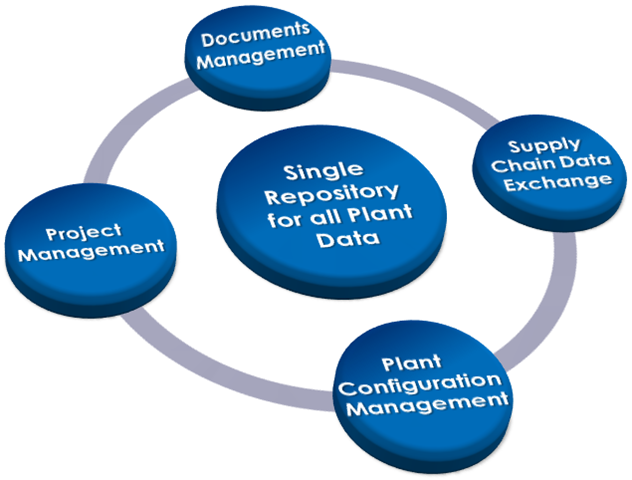
To use a PLM system for managing all asset related information ( asset parameters, inventory, documents, locations, lifecycle status) in a single system assures the owner / operator that a ‘single version of the truth’ starts to exist. See also one of my older posts about ALM to understand the details.
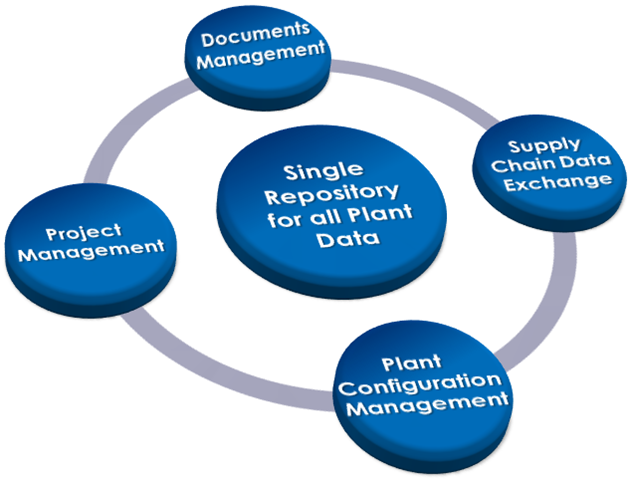 The beauty lies in the fact that this single version of the truth concept combines the world of as-built for operators and the world of as-defined / as-planned for preparing changes. Instead of individual silos the ALM system provides all information, of course filtered in such a way that a user only sees information related to the user’s role in the system.
The challenge for PLM vendors is to keep the implementation simple as PLM initially in its core industries was managing the complexity. Now the target is to keep it extremely simple and easy to used for the various user roles, meanwhile trying to stay away from heavy customizations to deliver the best Return on Investment.
Having a single version of the truth provides the company with a lot of benefits to enhance operations. Imagine you find information and from its status you know immediately if it is the latest version and if other versions exists. In the current owner / operator world often information is stored and duplicated in many different systems, and finding the information in one system does not mean that this is the right information. I am sure the upcoming event from IDC Manufacturing Insights will also contribute to these findings
It is clear that historically this situation has been created due to the non-intelligent interaction with the EPC contractors building or changing the plant. The EPC contractors use intelligent engineering software, like AVEVA , Bentley, Autodesk and others, but still during hand-over we provide dumb documents, paper based, tiff, PDF or some vendor specific formats which will become unreadable in the upcoming years. For long-term data security often considered the only way, as neutral standards like ISO-15926 still require additional vision and knowledge from the owner/operator to implement it.
Now back to the discussions…
In many discussions with potential customers the discussion often went into the same direction:
“How to get the management exited and motivated to invest into this vision ? The concept is excellent but applying it to our organization would lead to extra work and costs without immediate visibility of the benefits !”
This is an argument I partly discussed in one of my previous posts: PLM, CM and ALM not sexy. And this seems to be the major issue in western Europe and the US. Business is monitored and measured for the short term, maximum with a plan for the next 4 – 5 years. Nobody is rewarded for a long-term vision and when something severe happens, the current person in power will be to blame or to excuse himself.
 As a Dutch inhabitant, I am still proud of what our former Dutch government decided and did in the after the flooding in 1953. The Dutch invested a lot of money and brain power into securing inhabitants behind the coast line in a project called the Delta Works. This was an example of vision instead of share holder value. After the project has been finished in the eighties there was no risk for a severe flooding anymore and the lessons learned from that time, brought the Dutch the knowledge to support other nations at risk for flooding. I am happy that in 1953 the government was not in the mood to optimize their bonus ( an unknown word at that time)
Back to Asset Lifecycle Management ….
Using a PLM system for asset lifecycle management provides the economical benefits by less errors during execution (working on the right information), less human involvement in understanding the information ( lower labor costs) and lower total cost of ownership (less systems to maintain and connect by IT).
But these benefits are in no relation with risk containment. What happens if something goes really wrong ?
If you you are a nuclear plant owner, you are in global trouble. A chemical plant owner or oil company can be in regional trouble, but they also will suffer from the damage done to their brand name globally. Other types of plant owners might come away with less, depending on the damage they potential ‘embank’
The emerging visionaries
 For that reason, it is enlightening to see that some companies in Asia think different. There the management understands that they have the opportunity to build their future in a more clever way. Instead of copying the old way EPC contractors and plant owners work together, they start from a single version of the truth concept, pushing their contractors to work more integrated and clever with them. Instead of becoming boiling frogs, they are avoiding to fall into the same trap of many owners / operators in European and US based companies: “Why change the way we work, it does not seem to be so bad”
It requires a vision for the long term, something that will lead to extra benefits in the long term future: more efficient management of their assets, including risk containment and therefore being more competitive. If European and US-based companies want to be dominating in this industry they will need to show their vision too ..
Tomorrow I am attending the European Chemical Manufacturing Masters conference in Berlin, where I hope to learn and discuss this vision with the participants. I will keep you updated if i found the vision …..

Two years ago I wrote a post called PLM in 2050 as the concluding post for 2008. Now two years later it is time to see what has changed my landscape during this period. Are we going to a predictable future or are new trends arising ?
These were the points I raised at that time:
1. “Data is not replicated any more – every piece of information that exists will have a Universal Unique ID, some people might call it the UUID. In 2020 this initiative became mature, thanks to the merger of some big PLM and ERP vendors, who brought this initiative to reality. This initiative reduced the exchange costs in supply chains dramatically and lead to bankruptcy for many companies providing translators and exchange software.”
 I believe this trend is still happening only the big risk here is that it requires an open standard definition of this UUID. I am sure that before my retirement (see later below), there will be no global standard. There will be platform-vendor specific UUIDs and the challenge will be to operate in a heterogeneous platform-heterogeneous vendor environment. I feel less discussion on this topic in my environment, therefore the downward arrow.
2.”Companies store their data in ‘the cloud’ based on the previous concept. Only some old-fashioned companies still have their own data storage and exchange issues, as they are afraid someone will touch their data. Analysts compare this behavior with the situation in the year 1950, when people kept their money under a mattress, not trusting banks (and they were not always wrong)”
 For sure this is the most important trend and I would rank it now as the number one trend for 2010. I just read an interesting article about Cloud Computing Predictions which addresses all dimensions of a cloud strategy and execution – very much worth reading.
What you see in that article and also around you, is that there is going to be a battle between legacy vendors, who will try to transform the cloud definition to a private cloud into a way it suits their platform, and the new cloud solution vendors which also require a platform and from there build and extend their services. It relates to one of the other trends I also mentioned in the 2008 post:
3. “Then with a shock, I noticed PLM did not longer exist. Companies were focusing on their core business processes. Systems/terms like PLM, ERP and CRM did not longer exist. Some older people still remembered the battle between those systems to own the data and the political discomfort this gave inside companies”
 Combined with the new battle around the services platform it will be clear that in this approach dominant business systems, like CRM, ERP and PLM will no longer exist, as the focus will be to build business processes based on services and apps on a platform. Here I see PLM as the last hurdle to take. CRM already is understood by the market that it can be replaced by a cloud based solution, the first ERP attempts are already there too, but as PLM is a more, diverse and wide set of non-standardized functions, you will see that in this area the challenge to offer the required PLM capabilities will be the biggest. Another rising trend PLM vendors will move more towards the manufacturing execution, where ERP vendors will provide more PLM services.
The battle will be around, who owns the intellectual property of the company and where it is stored and managed.
4. “After 3D, a complete virtual world, based on holography, became the next step for product development and understanding of products. Thanks to the revolutionary quantum-3D technology, this concept could be even applied to life sciences. Before ordering a product, customers could first experience and describe their needs in a virtual environment”
 This trend will also continue I believe and combined with different types of user-interfaces, mainly from the gaming world; the virtual reality will be the space where we do the most of our engineering work, shopping experience and entertainment. Big question will be, especially for the Matrix fans, will the real world stop to exist? So also here a growing trend – 3D television, 3D communication narrow the gap between the real and virtual world and understanding.
A trend I did not pick up at that time was the issue of social media and their influence on the existing business processes. At that time I wrote:
5. “As people were working so efficient, there was no need to work all week. There were community time slots, when everyone was active, but 50 per cent of the time, people had the time to recreate (to re-create or recreate was the question). Some older French and German designers remembered the days when they had only 10 weeks holiday per year, unimaginable nowadays.”
 And I have to say I was completely wrong there. Thanks to social communities, I am spending now more time per day to jump from community to community, from blog post to blog post (I admire my colleagues who have time to produce blog posts). Meanwhile I try to follow all my Twitter and Facebook friends and meanwhile processing the messages coming from everywhere, without having time to really dig into a problem I want to solve.
So quickly I post a question in various forums to see if someone has the answer, as I have not time to solve it anymore – hopefully somewhere in the world there will be a person who has the answer or time. Where to position this new trend into the relation of PLM is still a question for me. Yes, collaboration becomes easier, less boundaries, but also less structure to store data. Intelligent search engines which also understand the context of the information become more and more important, as we cannot structure upfront all information as we did in the classical past.

Due to the economical crisis another trend came clear. There is no retirement money left for the older workforce that should retire in the next 20 years. So companies will have a new generation of people asking the questions and if the older workforce adapts the new social media capabillities, they can be the ones that provide the answers.
In 2050 I will just be retired at the age of 90, and according to statistics, I have still another 20 years to enjoy my bionic life.
I wish you all a happy and successful new year and that the good dreams may come true.
Keep innovation and sustainability on your agenda


The past week I was involved in three different situations, which seem to be disconnected from each other, but when looking back, I found one common similarity
The first case was with a company that had implemented pdm with a tight CAD integration many years ago. They have built together with their implementer(s) a dedicated environment, which was working efficient, perhaps never efficient enough. In the beginning of this year they planned an upgrade to the latest available software and after going live with the upgrade of CAD and PLM software, they discovered severe issues both in performance, in data inaccuracy and user acceptance. With ups and downs and serious effort from several sides, it looked like things were going better, but now they are in a down again as some users refuse to work with the system.
What do to: Fix the system everyone would think ?
 In the second case a company has implemented document management and with the support of the IT department the system was defined to cover the known needs.
The users however were reluctant to work with the system, complaining it was too slow, too complex and a lot of extra work, so nothing happened.
More than a year later, the engineering department got the assignment from the management to revive the system and they focused on implementing their main processes in the system, so everyone could work with the system. Still the system has not gone live! As all the time, when the management or users see the system, there are discussions on making it more user-friendly, simple interfaces and more.
What to do: Simplify the system everyone would think?
The third case is a company ready to launch their first PLM implementation and they really go for the full PLM story, including CAD data management, EBOM, MBOM and even BOP (Bill of Process) managed in their PLM system. Main reason they were able to plan the full PLM story was the fact that they were implementing a new ERP system too, so no legacy habits from the ERP side around ‘owning data’ like the Item master, MBOM or BOP. The past year has been spent on building the systems (PLM & ERP) conceptually in a test environment and from there on the PLM side they discovered some performance issues, which were considered critical to fix. And then they would go live both PLM and ERP at the same moment (a big bang), after almost a year of isolated preparation.
What to do: Fix the critical issues and go live everyone would think?
Although all three projects are in different countries, in a different culture and with different software, they all share one thought:
Implementing PLM is like installing an operating system. Once it is installed fix some bugs and the company will work with it. Perhaps not everyone is happy, similar like we have Windows, Apple MAC and UNIX communities, but the platform is there and we make it work. And updates of the system come with the new hardware; check our applications – if they are still running we are happy, if they are not running anymore we implement new versions or other software
By writing it so black and white, I hope you will agree it is more complicated. And I will be very happy that you agree here, as in many PLM implementations, the management of such a company has this impression – not being aware, not being knowledgeable, not being informed it is different. In addition PLM vendors and implementers try to stay close to this simple message, as no-one wants to be the messenger of the bad news that PLM is more than a software installation
 The root cause of all these problems is exactly the lack of management understanding and commitment to PLM.
As most of the members in a management team are relying on their ERP system for financial activities, production status, order status, stock value, etc, they also try not to touch ERP anymore once it is running. It is a mandatory system for execution and everyone is aware and somehow comfortable with costs.
And there is the difference with PLM. Do we need PLM ? We have been doing projects, designing projects already before our ERP system ? And if we install a PLM system, isn’t it like the ERP system, you install it and it is up and running ?
No !
PLM is not a system, it a vision how to work more efficient and intelligent. And by collaboration (using modern tools and means) between all stakeholders: market, design, execution (production or construction) and field services, we are better able to understand what is happing and as a next step, we are able to react or even better, be pro-active and come with better and innovative products and services.
So it is not about automation only. It is a change in doing businesses. It is about connecting people who were not used to work together, share information together. And there are various ways to achieve this – but not by installing simple, error free software only.
And this happened in all three companies I described. The vision of PLM was (partly) based on certain software capabilities. In the first example, it was not really PLM. It was automating the existing situation and now several years later, the company assumes after upgrading it still works, without making an evaluation, where the PLM vendor was heading to, without making an evaluation what the current quality of their data was. The focus was again on a system and fixing errors that the system should be able to understand
In the two other situations, there was the thought that once the system is there, users will accept it and start working with it.
Big, big mistake !
Users do not like software that requires them to change their way of working and we forget every time that changing the way someone works is not a software change. For the oldies: remember MS-DOS ? Single screen – no window swapping/multiple applications open. Many users loved the old MS-DOS due its simplicity (now they are retired) and we see the Apple generation (single window and single tasking again, but modern interface)
Building a multi-tasking environment, which PLM often is, requires a guided change process, motivation of the users, but at the end a firm statement from the management that this is the chosen way to go forward -assuming they support the introduction and usage of PLM.
(I received a nice comment on my previous post, stating we should give every user £100 to commit start working with the software, instead of paying thousands of pounds for customization to comfort the user)
 And here is the major pain in all of these three companies. The management is not able to take the ownership of the PLM vision and guide it through the company.
They let the execution to their project leader, lead engineer or IT staff and assume like ERP, everyone knows what to do and fix the bugs – no business change – just software implementation.
This leaves these front-runners in a very difficult position.
- Not loved by the end-user, who wants no change and if there is a change it should be more fun. The will show the system is not working for them.
- Not loved by the management as they are wondering why it takes so long to fix the issues. Should not we be up and running already after such a long time ?
- Not loved by the PLM implementer as there is a limit to fixing the problem. After solving a problem there is always a next problem discovered
- Not loved by the PLM vendor as they need positive references
And put any combination of people above in a meeting, the ones who are not there are to blame – and I realize I am doing the same – I am pointing to the management who is often invisible.
Call for the management
 For me the management has the task to feel responsible for PLM – as they are responsible for the company’s future – not the end-users. This means they should be able to judge the steps executed during a PLM implementation, or for an upgrade and assure they fit in the vision. They should realize that they are the voice to the end-users to explain the value of PLM and why there is a different way of working. They do not have to go into the details, but keep the bigger picture in mind.
And the management must show commitment to all –they want PLM . So commitment is needed to the end-users, to the IT department, to project team and to the implementation partner. And commitment is not easy to delegate.
Unfortunate commitment for PLM is also a long-term engagement, as it is not like ERP. Once it is running do not touch it. The markets change, the people change, technology changes and therefore the software practices change. To decide where, when and how to engage with a next PLM step should be a strategic decision from the management, not from a user who wants a new interface.
My last remark: it is clear that the management does not have the time and in-depth knowledge of PLM today as also the PLM is a young and moving vision due to changes in our society. (In my next post I will go into the new social hype – ask yourself is there also social ERP ?).
 So the management team needs a sparring partner, a PLM supporter, who will reflect their vision into PLM steps and how to enroll them and communicate them into the organization, without losing visions and faith but also without talking about software features. Either you should make sure this knowledge is in your company, as several companies have already successfully discovered. Or search for an external PLM supporter – looking to my blog questionnaire results they exist !!!
I am curious to learn if you recognize these situations, if you agree, disagree – feel free to comment

If you think you have the need for PLM, as everyone around you has PLM and you are sure you need it also, how do you select a PLM system?
If you are not familiar with PLM, PLM (Product Lifecycle Management) stands for a vision and a combination of best practices, industry dependent, that allow you as a company to be more innovative, faster too market, more customer centric and also with a higher quality and efficiency. The result: you are doing better as the competition – more margin, market share etc, etc
Next the implementation of this vision can be done by implementing pieces of the PLM vision on top of the existing systems already in your company. Extending the capabilities of your CAD system with some macros ; programming some capabilities around SharePoint to make information available and combined with Excel macros and an import in our ERP system, you believe you are doing PLM as you implemented parts of the PLM vision, mainly the efficiency part.
 And then we get stuck, we would like to be more customer centric. Which macro to write for that? Or we want to connect our 3D designs to be used in a virtual prototype environment so we do not have to make the first real prototype to understand where to improve. Here the local reseller or IT-provider mentions it goes beyond his expertise (if he is fair).
For the full PLM vision, we see that the major PLM vendors have an integrated story, where all best practices and capabilities are connected and available on demand. Of course there is a discussion between themselves who has the best vision, the best integration between all these modules and who is the most efficient, but this is normal in a competitive world. You will find out the details during your selection process, but let’s agree you want all these benefits now or in the future, so the first conclusion is, you need to implement a PLM system in your company, and not small pieces of PLM capabilities in different systems and infrastructure.
And now comes the do not do this part, which I encountered in the past two months several times and from which I thought this approach was already considered by people, knowledgeable in this are as leading to failure.

The content below might lead to dissatisfaction in the near or longer future and the writer warns you NOT to use the methodology below
The company starts collecting requirements from all departments to assure they can implement the new vision. And as collecting requirements is a lot of work, they hire an external consulting company to do this work. The consultant(s) go and talk with all the different departments and at the end they collected a list of 100+ requirements, which after discussing them with the management are completed with another 50 requirements to assure the company is not going to select the wrong PLM system.

Then the company sends this book to all the known PLM vendors, telling them to respond within a timely matter (two – four ) weeks. And questions will be answered only through a very formal process via the consultancy company.
This type of questions you will find (and they are real):
- There should be a control for the renaming of CAD-parts and links
- It should be possible to search from the top to the bottom in the structure with all documents
- It should be possible to work with the following formats (3 common and 15 rare formats mentioned)
- It should be able to drag and drop information from one structure to the other
- The system should protect the users to make an error
- The system should run integrated with our ERP system (xyz mentioned)
- The system should be able to identify and manage project risk to support product and process changes throughout the product lifecycle
And one of my favorites:
- The system shall be able to create, update, maintain and process main and typical sorts and types of documents and their source data. Both “tabular” data (lists/datasheets) and graphic (diagrams, etc.) data, as well as text data (technical reports, etc.) are understood in this requirement. However see also requirement 18 and requirement 54. The scope and types of documents should be possible to be modified in an easy way for various projects and various stages of development documentation for those projects
And the management added:
- The implementer should come with a detailed implementation plan and budget
- The implementer should guarantee the budget stays with xxx range
- The implementer should provide 3 references of similar companies and tools.
 The RFP document is usually a 20 to 50 page document – the amount of pages seems to have a correlation with the amount of money spent to consultancy. The total assembly costs for this document: 400 to 1000 man-hours (do your math for the initial costs)
Then the RFP document is sent to 5 or more potential suppliers, who need to answer for each requirement in detail if:
- It is standard in the system
- It can be done through configuring the system, explain.
- It can be done through customization, please specify
- It is not supported
 Each vendor spends at least 500 man-hours to answer all these questions as much as possible with yes, it is standard. An although not understanding the requirements at all at some points, they only give positive answers, trying to stay away from the “It is not supported answer”.
So after at least 2500 (5 times 500) man-hours the company assisted by the consultant(s) think the know who to invite for the next stage of the PLM selection.
Did they make the right choice?
My statement is perhaps yes. So far they have wasted 3000 man-hours or more in the world just to be busy and come to a result which an experienced independent PLM consultant could do in a few days:
If you are this type of company – look at these vendors: company A, company B and perhaps company C for your PLM solution as you are in this industry, this IT-platform and this maturity – let’s discuss with them what we want to achieve
Next the real PLM selection process starts, here the investment and research should begin – and I would do this different. In my next post I will explain my approach.
Do you agree and would you do it different?
I am looking forward to your feedback.
 In my previous post (PLM for the mid-market – your opinion) I started a very small questionnaire – if you did not have the time (takes less than 5 minutes) or encouragement (please, please) to answer the 4 anonymous questions, please go there. End of October I promised to publish the results in this blog.
Direct link to the questionnaire: http://www.enquetemaken.be/toonenquete.php?id=48804
 As a follow-up of my holiday thoughts, I want to discuss this time the various interpretations of PLM that exist. Of course we have the ‘official’ definitions of the consultancy companies like CIMdata and 2PLM ( I took an American and European example). They describe clearly that it is a business approach, not necessary a set of technologies and tools to implement.
 Then we have the PLM vendors, where Dassault Systems and Siemens claim their visionary leadership. Looking at their websites, it is hard to find an explicit message. They both claim PLM brings innovation (how ?) , where Dassault Systemes has a strong message around 3D and virtual product development and Siemens focuses more on efficiency and better collaboration benefits. I am not going in depth into PTC and Aras or other PLM vendors as I am only taking two examples per type of company, but look at their websites and find out how (and if) they describe PLM as a business approach.
 For a PLM definition at SAP you have to dig a little deeper and I got even more surprised when searching through the Oracle web site. Here it was difficult to find a generic PLM message. There was the list of acquisitions (which make me wonder if this means they are all integrated) and there was the list of industries and only when drilling down into the industries, you will find PLM related information. Here I still have the feeling that these companies understand there is a need for PLM, but that it is not in their veins, they want to manage product data as a ‘single version of the truth’ – which is not a bad idea and I will come back on that later – but they want to manage different data.
 Also upcoming are the generic PLM on-line solutions (Arena and PLM+), which for me still are somehow a contradiction to what consultancy companies describe as PLM. Instead of a bussiness approach it is an IT-solution. In parallel there are more dedicated on-line solutions that support a specific business process (where PLM practices are embedded) – like for Apparel, CPG.
For these type of solutions, I have a more positive opinion as they are lowering the threshold to implement PLM in a certain industry. However the biggest skepticism I have for these types of solutions is the degrees of flexibility it will offer the implementing company to be different from standard best practices. As all companies have their uniqueness in being competitive, will they be able to support this ?
And then there was the press release from Zero Wait-State which struck me:
 Zero Wait-State is launching a new website that will provide a central location for Product Lifecycle Management software and partner reviews. This site will be a valuable resource for companies trying to assess different PLM solutions and which partners to work with. The site will be driven by users and allow them to share their experiences with different software products and implementation partners.
See the full press release here: Zero Wait-State Announces New Website for PLM and Service Provider Reviews.
I believe in these times of product selection and reviews certainly a good initiative. Where do we find vendor independent reviews of various PLM products ? Bringing PLM to social communities.
But ……
Here I want to take a step back. What is the essence of PLM and how do you know as a company you want to implement PLM ?
The majority of mid-market companies are not looking for a PLM system. Most of the mid-market companies have the impression that PLM is complex and expensive and typical mid-market vendors like Autodesk or SolidWorks are not pushing PLM (try for fun to search for PLM on their websites).
So will a mid-market company be able to select a PLM product through communities in the same manner as you select a consumer product ?
I believe the main challenge for a PLM implementation is not the software, but the business change.
In a company where most people are thinking (and rewarded) departmental, it is difficult to implement a new system that affects all departments. Creating the single version of the truth for product data is one of the basics for PLM. Try to get an agreement with sales, engineering, production and service who will be responsible for which part of the BOM. SAP’s single version of the truth is much more a statement from an IT-infrastructure point of view not focusing and pushing a change of business processes.
I believe, and this is also based on discussions and comments from colleagues focusing on the mid-market, that many mid-market companies are implementing basics of PLM, not always using a ‘certified’ PLM system or PLM vendor, but a pragmatic solution (customization / piece of software) which connects parts of the product information. These solutions are usually extensions on top of the CAD data management environment or the ERP system.
And here PLM vendors have a mission. Provide building blocks (services) that allow mid-market companies to connect data between departments based on known standard authoring tools. For classical PLM industries (Automotive/Aero/Fabrication & Assembly) the major CAD systems and virtual product development plus analysis software are major disciplines to manage. Other industries also have their authoring tools. Connecting them through services and provide an easy to implement backbone for product information. This should be not a big-boom effect in the mid-market, but more an evolution – moving to PLM 2.0 or beyond ?
Will this come from PLM providers or IT-providers ?
Conclusion:
For the mid-market it is not about which PLM, but more about who can provide a gradual business change from sequential and departmental business processes towards company-wide processes, where people share and collaborate around the single version of data. So which PLM should be called which provider …..
I am looking forward to your opinion.
As today it was again ‘Black Saturday”, the day that the French and German roads are filled with cars and traffic jams above100 km length, it was a moment for me to reflect in the middle of my summer holiday. I do not want to make other continents jealous, but the summer holiday is important (and long), still time for some thoughts.
PLM is dead, long live Social / User focused PLM ?
In one of my old 2008 posts, PLM in 2050, I predicted that PLM would no longer exist at that time, as companies would no longer focus on individual systems, but on full coverage of business processes, through integrated and federated data sources. I see this trend coming from two major PLM vendors (Dassault Systems / Siemens) with their 3DLive / HD PLM concepts. These concepts are trying to provide a unique user experience, where in an intuitive manner, a user in a specific role can obtain relevant data, analyze and simulate it in a virtual environment. Here the PLM vendors are really taking the lead to become the main platform for product development processes. Will the name PLM disappear at a certain stage ?
Additional you see startups and also some of the major PLM vendors experimenting with community concepts, social media. Moving towards a “Facebook’- like environment for product development and collaboration processes. The idea behind this direction is partly driven by the fact that the old generation of workforce slowly moves towards retirement where the new generation is not motivated to follow up the same working processes and procedures. The old generation moved from paper-based, manual processes to terminal-like screens, email and excel sheets.
If the new generation of employees will benefit from Facebook like environments is the question. Product development and collaboration requires a lot of boring data entry, even if we have a unique user experience. In addition, I was reading a preview of some research done with American and Dutch students, stating that study results from those students active on Facebook are significant lower as the result of student not active on Facebook, although they spend the same time on internet. I haven’t found the original source – here is a Dutch link. Curious to learn who will develop and bring better products to the market in the future with modern social PLM ?
ALM based on PLM is underestimated by owner /operators
 As I have been active the past two years in some Asset Lifecycle Management projects based on PLM, I also feel that many owner/operators do not have the understanding or guts to change the way they are working. Understandable from their point of view – as long as the errors and risks are acceptable, why change the way the whole industry is working ?
In the nuclear industry you see the awareness growing. People know the risks of a nuclear disaster (after Chernobyl) and as we need more energy resources, nuclear energy with enhanced containment of risks is a natural way to go.
Perhaps after the BP disaster in the Mexican gulf, where apparently to the various reports, people were taking the wrong decisions due to inaccurate data or due to lack of information (could not be found in time) ALM based on PLM could be considered. However, investing even a few millions and changing the company’s way of working will never be approved by the BP management, as it will never happen a second time. It is all about being proactive (which is not a natural behavior) or being reactive and trying to control the damage. Here I have no predictions for 2050, I only believe that the proactive companies have a higher chance of survival – no matter which industry
But now my holiday activities call me back – for those not blessed by a holiday, here an overview of some of the relevant posts from the past year/
PLM and Organization
How to get users excited for PLM ?
Some users do not like the single version of the truth
Implementing PLM requires a vision
What not to do in a bottom up PLM implementation ?
Culture change in a mid-sized company a management responsibility !
PLM selection
PLM for mid-market a mission impossible ?
Who decides for PLM in a mid-market company ?
More on who decides for PLM in a mid-market company
The academic conclusion on who decides for PLM in a mid-market company
Free PLM does not help companies
ALM
Asset Lifecycle Management based on PLM experiences
Asset Lifecycle Management using a PLM system
Tutorials
and if these links are not enough – look at my favorite blogs:
 This time it is hard to write my blog post. First of all, because tomorrow there will be the soccer final between Holland and Spain and as a Virtual Dutchman I still dream of a real cup for the Dutch team.
Beside that I had several discussions around PLM (Product Lifecycle Management), CM (Configuration Management) and ALM (Asset Lifecycle Management), where all insiders agreed that it is hard to explain and sell the value and best practices, because it is boring, because it is not sexy, etc, etc.
So why am I still doing this job…..
Product Lifecycle Management (PLM)
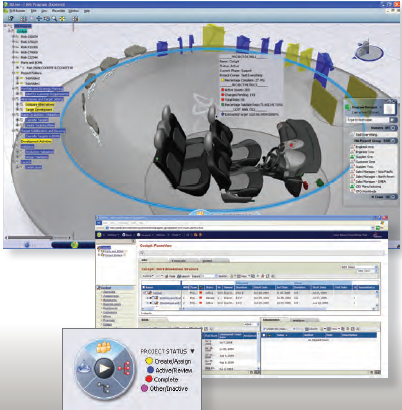
If you look at trade shows and major events of PLM vendors, the eye-catching  stuff is 3D (CAD).
Dassault Systemes introduced in 2006 3DLive as the 3D collaboration layer for all users with the capability to provide in a 3D manner (see what you mean) on-line role specific information, coming from different information sources. Recently Siemens introduced their HD PLM, which as far as I understood, brings decision making capabilities (and fun) to the user.
Both user interfaces are focusing on providing information in a user-friendly and natural way – this is sexy to demonstrate, but a question never asked: “Where does the information come from ? “
And this is the boring but required part of PLM. Without data stored or connected to the PLM system, there is no way these sexy dashboards can provide the right information. The challenge for PLM systems will be to extract this information from various applications and from users to have the discipline to enter the needed data.
Those software vendors, who find an invisible way to capture the required information hold the key to success. Will it be through a more social collaboration with a lot of fun, I am afraid not. The main issue is that the people who need to enter the data are not rewarded for doing it. It is downstream the organization, in the product lifecycle, that other people benefit from the complete information. And I even suspect in some organizations that there are people who do not want share data to assure being required in the organization – see also Some users do not like the single version of the truth.

So who can reward these users and make them feel important. I believe this is a management job and no sexy (3D) environment will help here
Configuration Management (CM)
 Although it is considered a part of PLM, I added configuration management to my post as a separate bullet. Two weeks ago, I attended the second day of the CMII Europe conference in Amsterdam. What I learned from this event was that the members of the CMII community are a group of enthusiastic people with somehow the same vision as PLM missionaries.
Quoting the organization: “CMII is about changing faster and documenting better. It is about accommodating change and keeping requirements clear, concise and valid.”
And it was interesting to listen to speeches of the members. Like with PLM, everyone is convinced configuration management brings a lot of value to a company, they are also fighting for acknowledgement. Not sexy is what I learned here and also here those people who are responsible for data accuracy are not necessary the ones that benefit (the most).
Like PLM, but even more in Configuration Management, the cultural change should not be neglected. Companies are used to have a certain level of “configuration management”, often based on manual processes, not always as efficient, clear and understood and satisfactory for the management, till something happens due to incorrect information.

Of course the impact of an error differentiates per industry, a problem occurring due to wrong information for an airplane is something different compared to a problem with a sound system.
So the investment in configuration management pays of for complex products with critical behaviors and in countries where labor costs are high. It was interesting to learn that a CM maturity assessment showed that most companies score below average when it comes to management support and that they score above average when talking about the tools they have in place.
This demonstrates for me that also for configuration management, companies believe tools will implement the change without a continuous management push. I remember that in several PLM selection processes, prospects were asking for all kind of complex configuration management capabilities, like complex filtering of a product structure. Perhaps pushed by a competitor, as at the end it was never implemented 😦
Asset Lifecycle Management (ALM)
 In some previous posts, I wrote about the benefits a PLM system can bring, when used as the core system for all asset related information. For nuclear plants, the IAEA (International Atomic Energy Agency) recommends to use configuration management best practices and I have met an owner/operator of a nuclear plant who recognized that a PLM system brings the right infrastructure, instead of SAP for example, which has more focus on operational data.
Also I had a meeting with another owner/operator, who was used to manage their asset data in a classical manner – documents in an as-built environment and changes of documents in various projects environments.
 When discussing the ALM best practices based on a PLM system, it was clear all the benefits it could bring, but also we realized that implementing these concepts would require a conceptual revolution. People would need to start thinking asset centric (with lifecycle behavior) instead of document centric with only revisions.
This kind of change requires a management vision, clear explanation of the benefits and a lot of attention for the user. Only then when these changes have been implemented, and data is available in a single repository, only then the fun and sexy environments become available for use.
Conclusion
PLM, CM and ALM are not sexy especially for the users who need to provide the data. But they provide the base for sexy applications where users have instant access to complete information to make the right decisions. To get there a cultural change is required. The management needs to realize that the company changes into becoming proactive (avoiding errors) instead of being reactive (trying to contain errors); investing upfront and never be able to know what the losses would be in case an error occurred.
Not sexy, however the benefits this approach can bring allow employees and companies to continue to do their work for a secure future
And now … time to close as the final is near

 The past month I have been very busy in a specific area where PLM is not yet as understood. Where PLM is a ‘must have’ for companies developing and manufacturing products, in the world of Asset Development and Asset Management not many companies are yet aware of the benefits PLM can bring. I wrote about it in one of my previous posts . I will share some of my experiences here and I must thank Stephen Porter for mentioning my blog in his review (and pushing me to write today – even during the soccer championships in South Africa.
PLM benefits for Owner / Operators
I had discussions with a few owner/operators in the past week and as they all came from different industries (nuclear power generation / gas distribution / chemical processing), the details might differ but the values a PLM system can bring is for all of them the same.
When talking to Owner/Operators there are a few standard situations you observe:
- The usage of a transactional system (MRO / ERP /SCADA) which is managing the operational and financial activities as job scheduling and purchasing. Main dominant players in this area are Maximo and SAP. Most Owner / Operators believe that this is the only main system they need.This looks very similar to what we see in the typical manufacturing companies. They all have an ERP system, and specially in the mid-market these companies are not looking for another major IT-system.
The problem with only the transactional system as the core system for the company is that there is no natural storage for product or process information that can change (the Intellectual Property of the company). Transactional systems use pointers to actual product or process information that they require. But where do they store other and historical information ?
- The challenge to manage in parallel data for maintenance, rework and innovation projects. As the transactional system provides data for the operational environment, these companies are used to copy out data to their project environment avoiding not released project data can be seen in the operational environment. Another situation in relation to the engineering projects is that the owner / operator usually outsources the engineering work to EPC contractors and only coordinates the activities taking ownership of the data only after the new installation is under operation
 The two owner / operators I met in the past month were in two different stages. The first one had already many years of experience in maintaining the plant operational and there they understood that the SAP PM module could not help them managing all required plant information around scheduled maintenance projects. Having already four different document management systems in place, the biggest challenge remained to coordinate the different baselines for the various projects scheduled for the annual maintenance. At the end they developed the concept where the PLM system is the owner of all plant related information, based on an Asset Structure in PLM and the PLM system ‘pushes’ the right information to SAP when the changes become operational.
 The other owner / operator was in the early stage. They were planning to have a process to become operational. Their understanding is that they need only one system that provides them all the time the actual information and if needed also all the history and approvals of each of the components. For sure the actual information needs to be managed in a transactional system (SCADA) and for sure the SCADA vendor will say they can manage all information in their system. The pity for this owner / operator is that once they need historical data, or need to manage complex maintenance projects, they have lost the opportunity to do it right from the beginning.
 Of course there is also a significant difference between the two owner operators.. The first owner / operator is situated in the Nordics, where the cost of labor is high. This means investing in IT-solutions to assure people are working with the right information brings a much faster ROI as compared to the owner / operator from South Europe. Sometime the labor cost can be one-third or less in comparison to the Nordic countries.
The owner/operator in the South Europe will initially not focus on efficiency and reducing labor costs. Due to the economical crisis unemployment is also high, so working with less people – improving by investments in IT are also not a popular measure.
But for all owner/operators a main consideration should be to remain competitive also over 10 – 20 years. Short term strategy is not good for this type of companies
Conclusion so far:
PLM concepts are bringing competitive benefits for Owner/Operator, despite the fact that they do not develop products. The value is based on bringing a single version of the truth (no island systems) and working in a single environment for the as-built and the to-be environment, without data conversions or transitions
next post I will talk about Asset Development and the PLM benefits
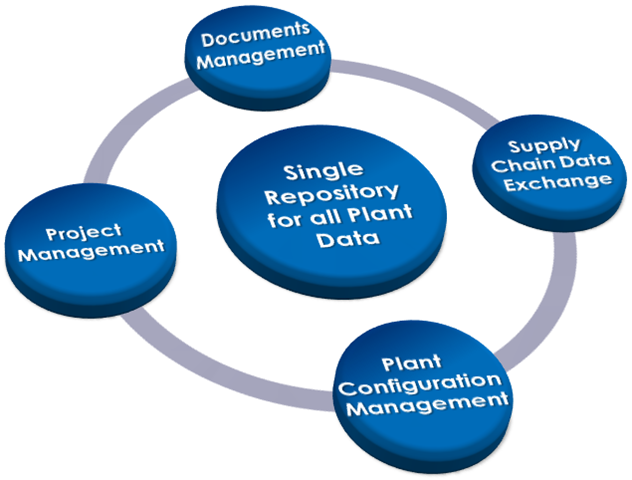
 Last weeks have been busy weeks and I have seen various PLM candidates all around Europe. As these companies were mid-market companies, I noticed again how difficult it is for these companies to follow the ideal path towards PLM.
For those reading my blog frequently they might remember my definition of mid-market and PLM. For newer readers I will give my definitions again, as everyone has their own definition.
Mid market company: For me the definition of a mid-market company does not have to do with revenue or the amount of people working for this company. I characterize a mid-market company as a company, where everyone has a focus on the company’s primary process. There is no strategic layer of people, who are analyzing the current business and defining new strategies for the future. In addition, the IT-staff is minimal, more seen as an overhead than as strategic. Mid-market companies have their strength in being flexible and reacting fast on changes, which might contradict with a long term strategic approach.

As what happens if you are only in a reactive mode – it can be too late.
PLM: For me PLM is not a product but a vision or business approach based on a collection of best practices (per industry). Main characteristics of PLM are centralizing all product knowledge (IP) throughout all the lifecycle stages and a focus on best practices and immediate visibility on all lifecycle stages. Combining concept, planning, development, production planning and after sales / service into one integrated process. It is more than concurrent engineering, it is about sharing data and ownership of data through different departments. And this means business transformation, breaking through traditional barriers. Of course PLM vendors have a slight different definition in order to differentiate themselves from other vendors. For example more focus on a virtual product definition (CAD PLM vendors) or a focus on efficiency and one single platform (ERP PLM vendors)
Who will initiate this change ?
And these two definitions already raise the questions I want to reflect here as I experienced again in two recent visits that the pain to move to PLM is here.
First what is the result of a reactive mode, even when it is a quick reaction ?
 A reactive mode leads to a situation where a company will never be able to differentiate rapidly from their competition. As every change takes time to implement, it is logically that a real business change will not be implemented as a quick reaction. The company needs to have a long term vision. And this is one of the things I noticed talking with mid-market companies. Ask these questions: “Where do you want to be in five years from now” and “How do you make sure you achieve these goals (if goals exist)” and often you find the company is depending on the business instinct of the founder(s) and has no real answers for the long term future.
 This is of course a result of the typical mid-market company, they have no internal people who will step outside the daily hectic and work on a change. And being reactive always means you are (a little) behind. And this was the situation in one of the companies that I have met recently. There was an initial understanding of the values that PLM could bring, but when talking about some of the basic principles of PLM, the answers was: In our company ERP is God. This means real PLM has no chance – you do not want to fight against God.
And now the discussion who can initiate the change towards PLM
 Now another example of a mid-market company that had a long term PLM vision but got trapped in their own approach. The company has been growing fast and like many European companies, production is done in China. And this causes collaboration issues around communication and quality between Europe and China as the company only knows CAD data management and ERP. The engineering manager was assigned to solve these issues.He did not get a full strategic assignment to look at the complete picture, but the management pushes him to solve the current pains, having the PLM wishes still in mind.
And solving the current pains lead again to function / feature comparison with a short term justification, believing that in the future all will fit in the PLM vision, as the potential resellers for the new solution said: “Yes we can”. Have you ever heard a reseller say “No we cannot”
The result, the engineering manager has to make a decision based on the ‘blue eyes’ of the reseller as he does not get the mandate and power from his management to analyze and decide on a PLM strategy for the long term. For one of the resellers talking about the details of PLM was even more a disadvantage as it creates an impression that PLM is complex. It is easier to sell a dream. A similar situation as I described in my posts: Who decides for PLM in a mid-market company
My conclusion
Although I am aware that many mid-market companies implement basics of PLM, it is frustrating to see that lack of priority and understanding of the management in mid-market companies blocks the growth to full benefits for PLM. The management is not to blame, as most PLM messages either come from the high-end PLM vendors or from product resellers both not packaged for the mid-market. See PLM for the mid-market – a mission impossible ?
PLM is a cross-departmental solution and the management should look for partners who can explain the business values and share best practices for mid-market companies business wise.
The partner is 50 % of the success for a PLM implementation.
Do you recoginize similar situations ? How would you address them ?
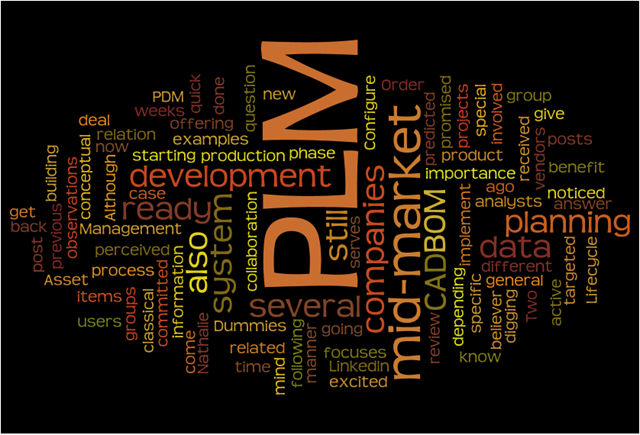
My PLM blog cloud based on Wordie – see the virtualdutchman blog cloud
 Although I am still active most of my time in ‘classical’ PLM, some of the projects I am involved with also deal with Asset Lifecycle Management. In general PLM focuses on a product development process, starting from a conceptual phase, going through planning, development and production. The PLM system serves as a collaboration and information backbone for all product IP (Intellectual Property). One of the main capabilities a PLM system provides is a ‘single version of the truth’.
And it is this capability, which makes a PLM system an excellent choice for Asset Lifecycle Management
Who practices Asset Lifecycle Management ?
 Asset Lifecycle Management can be found at any location, where a company is maintaining a process – we call these companies Owners/ Operators. Best known industry for Asset Lifecycle Management is the Process & Power industry, where a company produces oil, energy or chemicals. However the same concept is also valid for water companies (water distribution process), food processing and infrastructure companies (railways, airports, roads)
All these companies have in common that they support a certain process and the challenge is, while being in operation, to optimize the process. During operation, maintenance and improvement activities should be as little as disruptive as possible.
A maintenance stop is very costly for Owner/Operators. Imagine a plant not producing fuel for two weeks (millions of liters) or a nuclear reactor not producing electricity for a month (millions of kilowatts) – no income. And no maintenance will lead to unexpected problems and in the worse case, disasters. So it is also about balancing these activities.
Let’s look at a definition of Asset Lifecycle Management
Asset Lifecycle Management is a balanced and active management of assets over the lifecycle, coupled with business objectives.
Simply said it translates into an approach, where based on business objectives (process stability, safety, margin) a company tries to optimize the usage of their assets (a reactor, a pump, a rail track, a road) through their individual lifecycles. This means perform preventive maintenance; renovate a part of the process and perform more parallel activities with a focus on improving the lifecycle of the process
So why not use a MRO system?
 An MRO (Maintenance, Repair & Overhaul) system can be compared with an ERP system for manufacturing companies. The MRO system manages and schedules activities and resources on the plant, keeping track of maintenance activities done on inventory. But can it serve as the system providing the single version of the truth for all plant information? No!
So why not use an ERP system?
 An ERP system is mostly used by owner/operators to control all financial transactions (contracts, purchasing, suppliers, projects/resources accounting). Some ERP vendors provide MRO functionality in a single system; still can this system provide the single version of truth for all plant information? Again I am sure it is not the case.
So why not use a document management system?
 As most of the process information is stored in various types of documents, is seems to be appropriate to store all information in a document management system. And actually this is what owner/operators try to do, however they maintain inside their company different document management systems (paper archives, office documents in a specific system, engineering documents in another system, etc, etc). Each of the systems can provide a single version of the truth for specific content, however there is a consolidated single entry point for all asset data. Often the documents also do not reflect the status of an asset. Is the asset running in, is it active, is it demolished?
The tag number does not show it, and changing the status of an asset forces people to go through the various document systems to change the status there. An inefficient and costly procedure, not reliable and often not done.
So why not an integrated plant engineering system?
 Engineering plant software is designed to support the design collaboration and is mostly used by EPC contractors. These engineering companies are hired by the owner/operator to design and construct the plant or make major modifications of the plant. EPC contractors need to work as efficient as possible (to get the job), which means for them work as intelligent as possible in an integrated manner with tag numbers, P&IDs, 3D Equipment, Piping, ISOs. This intelligence leads to an application specific format and infrastructure.
During the hand-over of the plant or modification, this intelligence disappears as the owner/operator does not use the engineering plant software. They do not want to be dependent on a single software provider or version of the data. As data has to live for many years, sometimes 30 years or more, application specific data is hard to maintain. So as part of the hand-over data will be provided in neutral formats, worst case paper, but often in PDFs, TIFFs or other publishing format, losing all the intelligence.
 There is an intelligent, neutral format based on ISO 15926. This requires an investment from the EPC contractor and an investment from the owner/operator to manage all information in this format. For complex and long-lasting environments, like a nuclear plant, this approach surely pays off; however what you see is that on both sides (EPC and Owner/Operator) they try to minimize the costs on data handling/conversion. This leads in the long term to much more labor time internal at the owner/operator to manage and assure the data is accurate. But these costs somehow come later and are more hidden. And the question remains: can this system serve as the single version of truth for all plant information? No, plant engineering systems are too application specific
In addition, plant engineering software environments are not targeted to work integrated in an owner/operator environment, managing parallel projects and resources, quality processes and inventory statuses related to a certain asset and project.
So why not use a project management software system?
 As in a plant many projects can run in parallel, it happens that they run on the same assets or locations in the plant. For engineers and maintenance it is important to have visibility on which projects have impact on each other. Project management software is not targeted to make data visible related to a collection of assets or locations. No, project management software can not be the system to serve as the single version of truth for all plant information.
So either we give up for looking a single version of the truth and pay the price for multiple software systems to maintain in the company and take the extra efforts for configuration management for granted, or we look at PLM ?
The PLM based solution
In the past 15 years I have done several projects with ENOVIA and projects where Asset Lifecycle Management was done with ENOVIA. For sure, other flexible PLM systems can do the same, as the solution lies in an adapted data model for ALM.
This picture shows what a PLM system can do:

It can provide all related information (documents, inventory, locations, and projects) to an asset with one click from within single system. In addition it can also give the actual status of the asset. Assets are often identified by tag numbers, and the lifecycle of an asset can be managed by default in a PLM system, combined with Asset Change processes.
Best Practices coming from the PLM world can be used here too. The major challenge for PLM vendors is to reduce the complexity for data handling, as ALM users will not be engineers experienced to complex CAD environments. They are information workers, who need with a short learning curve, direct access to the data they require (and they should be sure the data is reliable)
Note: the PLM system will need to interface with the MRO and ERP system. Like in the classical PLM concept, MRO and ERP are the transactional systems, controlling the day to day activities, where the PLM system provides the accurate plant information (IP) required for an activity.
Also the PLM system will manage the non-standard activities through projects, change processes and will rely on accurate information from ERP.
The major benefits reported from implementations based on a PLM system are: 
- Reduced down-time for the plant, due to better planning and accurate information when preparing a maintenance stop. Less surprises with unforeseen delays of production.
- More reliable and less effort to be complaint to safety, health, environment and governmental regulations as all information is available in a single, controlled and traceable environment
- Lower cost of ownership for ALM. Instead of maintaining various silos of information and provide access to certain users, a single system with a common interface is available for most of the users.
Conclusion: Owner/Operators should look into the benefits a PLM system can bring for them. Interesting the benefits are not based on the integration of product development, but on providing accurate information from different entry points for different roles
I am curious to learn who has seen a similar approach – feel free to comment
 Jos Voskuil's Weblog
Interesting reflection, Jos. In my experience, the situation you describe is very recognizable. At the company where I work, sustainability…
[…] (The following post from PLM Green Global Alliance cofounder Jos Voskuil first appeared in his European PLM-focused blog HERE.) […]
[…] recent discussions in the PLM ecosystem, including PSC Transition Technologies (EcoPLM), CIMPA PLM services (LCA), and the Design for…
Jos, all interesting and relevant. There are additional elements to be mentioned and Ontologies seem to be one of the…
Jos, as usual, you've provided a buffet of "food for thought". Where do you see AI being trained by a…