
You are currently browsing the category archive for the ‘Customer centric’ category.

First of all happy new year to all of you. As there is no “End of the World” risk anymore in the near future , we can start looking forward and set our goals for the next 5 years or is it a 7-years plan Oleg ?.
Christmas, the moment the light returns on the Northern hemisphere, plus the food , cycling and the preparations for the next Product Innovation conference in Berlin were the drivers for this blog post.
The title might give you the impression that it is an IQ-quiz: “Which word does not fit in this sequence”? Well, It’s not, they are all related. Let’s put them in a chronological order.
Frogs
 Frogs existed first, and were exploring the world before us humans. Paleontologists assume they had no notion of what was global. In their world it was probably a few ponds in size. For certain, they did not have anything to do with innovation. At that time, survival depended on the slow process of evolution.
Millions of years later, the first Homos appeared on the earth surface; Homo Sapiens, Homo Erectus, Homo Ludens and perhaps more. They all had something in common: Instead of waiting for the evolution which was ongoing, they started in parallel to innovate. First by walking upright, using a more advanced language to communicate and learning to have tools to achieve more. Their world was still within a reasonable walking distance and probably they started to eat frogs.
Human evolution
 This evolution continued for thousands of years. Human beings started to spread around the world and in waves they brought innovation. They built stone temples, learned to sail, discovered gunpowder, electricity, the universe, the internet and more. It is interesting to see that every time a major innovation was born, these innovators enriched their region in wealth and culture, using their innovation as a competitive advantage to dominate their neighbors.
In many cases 1000 years later, this innovation became a commodity and other civilizations stood up with their innovation and dominated their regional environment which became bigger and bigger in size. Where possible they made use of the cheap resources (modern word for what was initially called slaves) to enrich their civilization. For certain, the most civilized were eating frogs!
Market expansion – innovation pace
During the last century, the pace of innovation went faster and faster. New ways of communication and transportation became available and affordable, which made it impossible for innovations to stay within a specific civilization. Innovation became available for everyone around the world and the domination shifted towards companies and markets.
 Companies with a strategy to innovate, discovered that there were new ways needed to respond faster than before to market opportunities. This was the driving force behind PDM, as an first attempt to get a better grip and understanding of their fast evolving, more complex products, that require more and more global collaboration between design teams.
PDM is now accepted as critical by all manufacturing companies around the world, to guarantee quality and efficiency. Customer focus became the next demand from the market and interestingly enough, the demand for frogs decreased.
However this wave of innovation was followed by a wave with even greater impact on the global society. New technologies, the availability of internet and social media, suddenly changed society. Combined with the financial crisis in the US and Europe, it became clear that the way we worked in the past is no longer the way to survive in the future.
Faster and global
 PLM was introduced early this century as a new strategy to become more customer-centric, being able to respond faster and better to market demands by bringing innovation to the market before the competition. PLM requires a different approach by companies to work internally and interact with the (global) outside world. The need to implement the PLM vision requires change and as it cannot be considered as an evolutionary process over several generations, it will be a business change. However, in general, human beings do not like rapid change. Here the frogs come back into the picture, now as the boiling frog metaphor.
It is based on 19th century anecdote describing a frog slowly being boiled alive. The premise is that if a frog is placed in boiling water, it will jump out, but if it is placed in cold water that is slowly heated, it will not perceive the danger and will be cooked to death. The story is often used as a metaphor for the inability of people to react to significant changes that occur gradually. This metaphor is very applicable for the classical approach companies bring their products to the market, where innovation is more a lucky coincidence than a result of a strategy.
Here it all comes together again.
 Innovation is the only way for companies to avoid becoming a commodity – not able to differentiate for your potential customers. Now the title of this post should be clear: “Do not be a boiling frog, use PLM to support your innovation and become available for the global market”
As the new year has started and it is still time to extend your good intentions, add Innovation, PLM and Change to your survival list.
I look forward to your comments and hope to discuss with you the relation between PLM and Innovation during the upcoming Product Innovation event in Berlin, where I present a session with the title: “PLM loves Innovation ?”
(when you know me, you know the answer, but there are always surprises)
Related articles
- Are we as dumb as “Slowly Boiling Brainless Frogs”? (1) (blogs.redding.com)
 Last week I started my final preparation for the PLM Innovation Congress 2012 on February 22nd and 23rd in Munich, where I will speak about Making the Case for PLM. Looking forward for two intensive days of knowledge sharing and discussion
The question came to my mind that when you make the case for PLM, you also must be clear about what you mean by PLM. And here I started to struggle a little. I have my perception of PLM, but I am also aware everyone has a different perception about the meaning of PLM.
 I wrote about it last year, triggered by a question in the CMPIC group (configuration management) on LinkedIn. The question was Aren’t CM and PLM the same thing ? There was a firm belief from some of the members that PLM was the IT-platform to implement CM.
 A few days ago Inge Craninckx posted a question in the PDM PLM CAD network group about the definition of PLM based on a statement from the PLMIG. In short:
“PDM is the IT platform for PLM.”Or, expressed from the opposite viewpoint: “PLM is the business context in which PDM is implemented
The response from Rick Franzosa caught my attention and I extracted the following text:
The reality is that most PLM systems are doing PDM, managing product data via BOM management, vaulting and workflow. In that regard, PDM [read BOM management, vaulting and workflow], IS the IT platform for the, in some ways, unfulfilled promise of PLM.
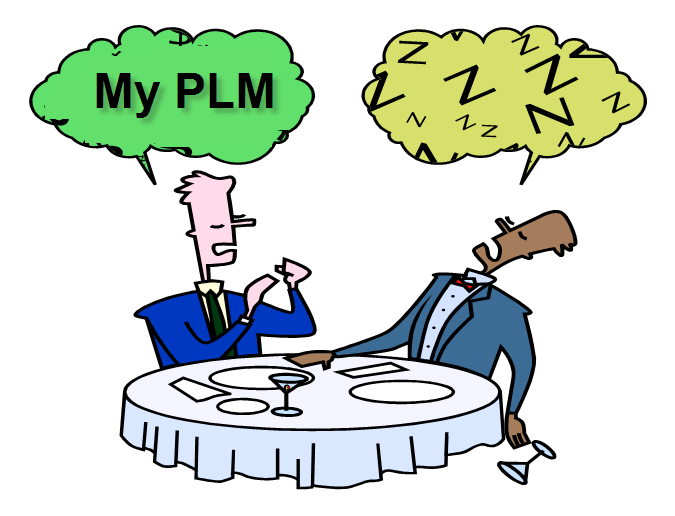
I fully agree with Rick’s statement and coming back to my introduction about making the case for PLM, we need to differentiate how we implement PLM. Also we have to take into our minds that no vendor, so also not a PLM vendor, will undersell their product. They are all promising J
Two different types of PLM implementation
Originally PLM has started in 1999 by extending the reach of Product Data outside the engineering department. However besides just adding extra functionality to extend the coverage of the lifecycle, PLM also created the opportunity to do things different. And here I believe you can follow two different definitions and directions for PLM.
Let’s start with the non-disruptive approach, which I call the extended PDM approach
Extended PDM
 When I worked 6 years ago with SmarTeam on the Express approach, the target was to provide an OOTB (Out of the Box) generic scenario for mid-market companies. Main messages were around quick implementation and extending the CAD data management with BOM and Workflow. Several vendors at that time have promoted their quick start packages for the mid-market, all avoiding one word: change.
I was a great believer of this approach, but the first benchmark project that I governed demonstrated that if you want to do it right, you need to change the way people work, and this takes time (It took 2+ years). For the details: See A PLM success story with ROI from 2009

Cloud based solutions have become now the packaging for this OOTB approach enriched, with the ease of deployment – no IT investment needed (and everyone avoids the word change again).
If you do not want to change too much in your company, the easiest way to make PDM available for the enterprise is to extend this environment with an enterprise PLM layer for BOM management, manufacturing definition, program management, compliancy and more.
Ten years ago, big global enterprises started to implement this approach, using local PDM systems for mainly engineering data management and a PLM system for the enterprise. See picture below:
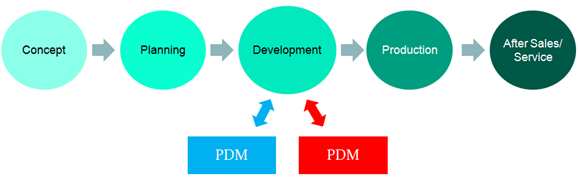
This approach is now adapted by the Autodesk PLM solution and also ARAS is marketing themselves in the same direction. You have a CAD data management environment and without changing much on that area, you connect the other disciplines and lifecycle stages of the product lifecycle by implementing an additional enterprise layer.
The advantage from this approach is you get a shared and connected data repository of your product data and you are able to extend this with common best practices, BOM management (all the variants EBOM/MBOM/SBOM, …) but also connect the market opportunities and the customer (Portfolio management, Systems engineering)
 The big three, Dassault Systemes, Siemens PLM and PTC, provide the above functionality as a complete set of functionalities – either as a single platform or as a portfolio of products (check the difference between marketing and reality).
Oracle and SAP also fight for the enterprise layer from the ERP side, by providing their enterprise PLM functionality as an extension of their ERP functionality. Also here in two different ways: as a single platform or as a portfolio of products. As their nature is on efficient execution, I would position these vendors as the one that drive for efficiency in a company, assuming all activities somehow can be scheduled and predicted
My statement is that extended PDM leads to more efficiency, more quality (as you standardize on your processes) and for many companies this approach is a relative easy way to get into PLM (extended PDM). If your company exists because of bringing new products quickly to the market, I would start from the PDM/PLM side with my implementation.
The other PLM – innovative PLM

Most PLM vendors associate the word PLM in their marketing language with Innovation. In the previous paragraph I avoided on purpose the word Innovation. How do PLM vendors believe they contribute to Innovation?
This is something you do not hear so much about. Yes, in marketing terms it works, but in reality? Only few companies have implemented PLM in a different way, most of the time because they do not carry years of history, numbering systems, standard procedures to consider or to change. They can implement PLM in a different way, as they are open to change.
If you want to be innovative, you need to implement PLM in a more disruptive manner, as you need to change the way your organization is triggered – see the diagram below:
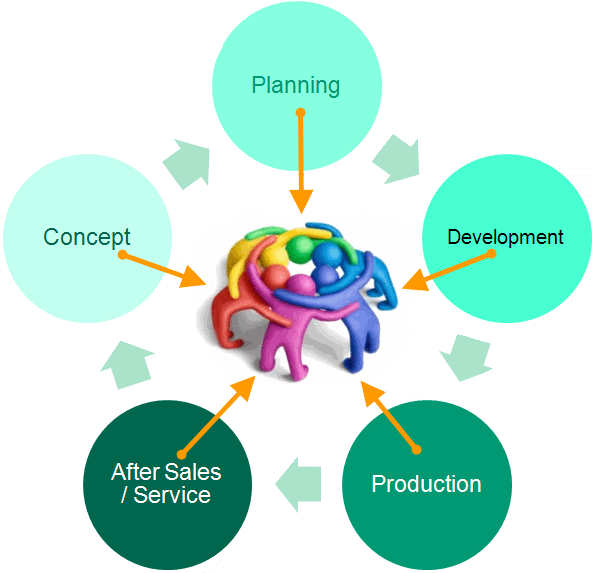
The whole organization works around the market, the customer. Understanding the customer and the market needs at every moment in the organization is key for making a change. For me, an indicator of innovative PLM is the way concept development is connected with the after sales market and the customers. Is there a structured, powerful connection in your company between these people? If not, you do the extended PLM, not the innovative PLM.
Innovative PLM requires a change in business as I described in my series around PLM 2.0. Personally I am a big believer that this type of PLM is the lifesaver for companies, but I also realize it is the hardest to implement as you need people that have the vision and power to change the company. And as I described in my PLM 2.0 series, the longer the company exist, the harder to make a fundamental change.
Conclusion
There are two main directions possible for PLM. The first and oldest approach, which is an extension of PDM and the second approach which is a new customer centric approach, driving innovation. Your choice to make the case for one or the other, based on your business strategy.
Looking forward to an interesting discussion and see you in Munich where I will make the case

 Recently I have been reading various interesting articles, it started with Why Amazon can’t Make a Kindle in the USA from Steve Denning and from here I followed several interesting links.
Most of the articles were business driven and not with a focus on technology. However what caught my attention was the similarity of issues that were raised in these articles as-if it was about PLM.
At the end it is a plea/cry for change to be more competitive in the future. With the current economical stand still, I believe there is a need and an opportunity for this change also in PLM. I am not pointing to regime changes all around the world, but somehow they are all connected to this new wave of globalization and openness to information.
And as my domain is PLM, I took PLM 2.0 as the vehicle to describe the change currently in the PLM world. Although PLM 2.0 is a term invented by Dassault Systems, I will use it as the placeholder to describe the changes in PLM.
In four posts I will guide you in the upcoming weeks through the thought process:
| This week | : What is PLM 2.0 ? |
| Next | : Challenges in current PLM |
| Next | : Change in business |
| Final post | : Why PLM 2.0 – conclusions |
I hope you will stay with me when going through these four steps and look forward to your immediate feedback.
What is PLM 2.0 ?
In 2006 Dassault Systems announced PLM 2.0 as the new generation of PLM implemented on their V6 platform. If you go to the 3DS website you see the following definition of PLM 2.0
Look for the header PLM 2.0: PLM Online for All
In the DS definition you will find several keywords that will help us further to understand the PLM 2.0 capabilities:

a typical Dassault Systems viewpoint, as they are coming from the world or 3D CAD and virtualization and the company’s vision is around lifelike – and life is mostly in 3D.
3D as interface towards all product related information is a paradigm shift for companies that were used to display only metadata on boring tabular screens where you navigate on numbers and text. The other major CAD-related PLM vendors of course could follow this paradigm too, as 3D visualization of information is known to them. However when coming from an ERP-based PLM system you will see 3D is something far out of reach for these vendors (at this moment).

This is what I believe is a crucial keyword for all PLM future implementations it builds upon the Business Information concepts that became in fashion 8 years ago. Online means direct access to the actual data. No information conversion, no need for import or export, but sharing and filtering. What you are allowed to see is actual data and an actual status. Imagine what kind of impact working on-line would have on your organization. Evaluation of trends, Key Performance Indicators directly available – still of course the interpretation to be done by experts.

Intellectual Property – a topic that should be on every company’s agenda. The reason a company currently exists and will exist in the future is based on how they manage their unique knowledge. This knowledge can be based on how certain processes are done, which components are chosen, which quality steps are critical and more. Working in a global collaboration environment challenges the company to keep their IP hidden for others, for sure when you talk about online data. Losing your IP means for a company to be vulnerable for the future – read in the referenced blog post from Steve Jennings about DELL.

This is currently the platform for change as technologies are now enabling people and companies to implement applications in a different manner. Not only on premises, but it could be online, Software As A Service, Cloud based solutions and through standardized programming interfaces, companies could implement end-to-end business process without a huge, monolithic impact. Also Web 2.0 provides the platform for communities.

The concept of communities opens new perspectives for collaboration. In general people in a community, have a common interest or task, and they share thoughts, deliverables back to the community across all company borders. This is the power of the community and the collective intelligence built inside such a community. Without company borders it should give the people a better perspective on their market on their business due to the global participation
The vision is there – now ….
All the above keywords are capabilities for the future and in the world of PLM you see that every PLM vendor / implementer is struggling with them. How to implement them consistently across their offering is the major challenge for the upcoming years, assuming PLM 2.0 is considered as the next step.
If you look at the PLM vendors beside Dassault Systems, you see that Siemens and PTC are closest to following the PLM 2.0 approach, without mentioning the term PLM 2.0. Other vendors even refuse to talk about PLM, but they share already similar components, for example Autodesk.
Interesting to see that the ERP-based PLM vendors do not follow this trend in their communication, they are still working on consolidating and completing their ‘classical’ PLM components
But the classical PLM vendors struggle with the change in paradigm too.
- What to do with current, huge and structured implementations ?
- Is PLM 2.0 having the same demands or can it be different ?
Here you see opportunities for new comers in this market as you can implement online collaboration, intellectual property creation/handling and communities in different manners with different types of implementation demands.
So far my introduction in PLM 2.0. Browsing on the web, I did not find too much other viewpoints on this specific terminology, so I am curious about your thoughts or and complementary comments on this topic.
In my next post I will zoom in into the challenges of PLM and relate them to the PLM 2.0 vision
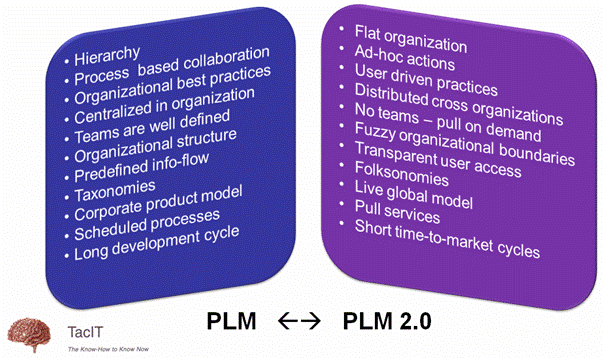
My take on PLM (classical) and PLM 2.0
Referenced in this context – not directly mentioned:
- IBM visionary presentation from 2006 – Michael Neukirchen
- The future of PLM – Martin Ohly (global PLM blog)
- PLM 2.0 technology or facelift – Oleg Shilovitsky
- Social Media and PLM explained for Dummies – Jos Voskuil
- Going Social With Product Development – Jim Brown
 In the past two weeks I had some interesting observations related to the core of PLM. Reading posts and some in-depth discussions with customers lead to the statements below:
Single version of truth ?
 First I am going back to the intent of PLM – companies that implement PLM are not looking for a system where they can store information in a single database. Often the single version of the truth story is translated into technology . To illustrate this statement I was explaining a medical device company some weeks before how in PLM practices the interaction of requirements, integrated with regulatory compliance verification speeds up the product development process as deviations are early discovered during the development stage. The astonishing answer from the customer was; “Yes we already store this information in our well-known ERP system – so no need for PLM to handle this”
For this person the conclusion was that once data is stored in a system, it is managed. However what the company never tried was to track each requirement individually (and its possible change) during the engineering process and have a direct connection to regulatory demands.
 In that area Excel, people’s knowledge and stored documents were used to collaborate. Off course with the late discovery of errors and several extra iterations due to it. As long as this company does not understand that the PLM system is not yet another tool to store data, but an enabler to work different and more efficient, these tools based statements will not bring them further. But as nobody get fired for selecting a well-known ERP system, but trying to change the way people work is a risk, often the first option is chosen.
And the more conservative the company culture, the more likely this will happen.
Tools do not make a change
 In a last week meeting I met a VP of a business group of a real global company. I am stressing the word real as there are many global companies, that actually have one main location where the IP and influence comes from – as compared to the real global companies where all around the world the knowledge and IP of the company is invented and spread from there. Although the discussion was on the current status and quality of the tools in use, during breaks we concluded that although the discussion is about tools, the hardest part for implementing PLM in their company is to master and motivate the changes in the way of working towards the users.
 In several blog posts from Oleg (and others) I see the hope that new user interfaces, user data handling can provide a break through here. I partly agree here – in the eighties/nineties we had the single window terminal screens, which were easy to understand (no multi-tasking / no multi-windows). Slowly the current workforce got used to windows (still no multi-tasking) and the new generation (generation-Y) is less and less single tasking and has different ways of solving issues. New interfaces can contribute to the acceptation of a tool, but as in the end we are still doing the same – storing data in a central system without changing the way we work – there is nothing improved
MBOM in PLM
Another interesting statement of this VP was also that they are in the process of bringing all engineering data coming from different disciplines in their R&D / PLM environment. Originally it was the ERP system that was used to combine all data coming from different disciplines. However the disadvantage was that this product definition resided partly in an ERP (there is no concept of a single ERP as manufacturing differ so much globally) and partly in PLM. Their future plan was therefore to extend the coverage of PLM toward the whole preparation for manufacturing – my favorite topic too: see Where is the MBOM ?
Conclusion so far
In day to day relations customers and PLM vendors, implementers are talking about functions and features to implement and where and how data is stored. The major driver should be the concept of changing the way we work to be more efficient, more clever and with higher quality. This is not reached by storing data, but by having the right data available at the right moment. And this moment changes when implementing PLM
- PLM Customers: Make sure that change of doing business is the target of your PLM implementation – do not look for tools only – check with your implementer and vendor which experience they have.
- PLM Implementers: Schedule time and activities during the implementation to understand the business change and the customer to adapt. It is a different type of skill required but as important.
- PLM Vendors: You have a hard time – as all are talking about the tools, you do not want to talk about the changes PLM implies – a pity but most customers do not want to hear this side during their PLM selection process
 A short intermediate post to conclude this topic. In August 2009, I wrote a post, How PLM is NOKIA, where I expressed my astonishment that a company as big and as professional as NOKIA did not react on launching problems of the new NOKIA N97. As I knew NOKIA as a company, which has implemented the basics of PLM, I would anticipate more customer centric activities.
Apparently, and now we are four months later, it is clear that NOKIA brought a product on the market too early with several design errors. Probably to be competitive with the iPhone, it was launched too early to maintain market share.
All early purchasers of the N97 were promised that in October 2009, the major software fix would come and then the N97 would be working as promised. As an early adopter, you feel swindled as the statement is more or less telling you: “We released a beta product – you paid the premium price – and in October the official release will be available”
So in November 2009, the software fix came (V 2.0) and after installing this new version, minor problems were solved, still the GPS was malfunctioning and also the camera lens could be scratched by the cover. Instead of making a firm and honest statement to its customers, NOKIA decided to keep things silent. On their support forum there was a discussion around the malfunctioning GPS. At the end, before it was removed by NOKIA, it was almost 30 pages long full of posts.
 It started with loyal users, who thought that they had done something wrong, guessing and helping others trying to optimize the GPS reception. No contribution from NOKIA people in that forum. Later (page 25 and later), the posts became more and more angry, as these people, who were trying to make it work, were sent from repair centre to repair centre without getting a fix. Many were trying to get a statement from NOKIA support people.
At the end, NOKIA removed the forum to hide all these issues to new potential customers. Now, if you search again for NOKIA N97 and GPS issue, you find a few pages of new people trying to make it work.
Anyway, two weeks ago I received my ‘repaired’ N97 and still the GPS failed despite the NOKIA claimed to have replaced some components. My telephone network provider, who sold the N97 together in a bundle, now proposed to replace the NOKIA N97 with a similar phone from another brand, which I will do.
Back to PLM, what is the relation with this post ?
 PLM allows you to become more customer focused, using field experience as feedback and input for your new models. Also virtual testing – not sure if GPS reception can be virtually tested – can save huge costs due to product recalls and repairs. This is the situation NOKIA is suffering now around the N97. And as they do not publicly communicate that there are errors, it might reduce the amount of claims they get from all N97 buyers as not everyone uses all features. Soon a new model will come up and everyone forgot the stinker with the N97. People inexperienced with GPS might think the behavior they experience with the N97 is normal finding only a few pages of other people with problems instead of 30+ pages.
The back side of this approach for NOKIA is that modern, loyal customers are expecting a customer centric company and they will move to another brand, only to come back when this competitor fails. It is worth to lose loyal customers to avoid claims ?

For me the NOKIA book is closed, now I will move to Sony Ericsson , thanks to my mobile phone provider. And as I learned on the recent ECF (European Customer Forum) last month in Paris, Sony Ericsson is using PLM for their global design and production process, striving to a single version of the truth. So also Sony Ericsson is connecting people and I hope they have a better connection with their customers as people are allowed to make mistakes but hiding them is the biggest mistake.
Just closing with a funny movie. This NOKIA marketing movie shows a guy with a N97 easily finds his friend through GPS. For sure it works in the dessert where you can see each other for miles – but in a dense city, you have to realize your friend can be 200 meters on either side from you, although you think you are in the same location.
 For many years NOKIA has been my favorite phone brand. I grew up with with their phones – every two years a new subscription and enjoying the new stuff. Although to be fare, 10 years ago a phone was just there to make phone calls and send SMS messages.
My previous and last successful phone was the N95, which had the nice feature that beside the fact it was a telephone, you could do a lot more with this apparatus, making pictures, listening to stereo music from decent built-in speakers and my favorite, an accurate GPS using for it navigation and sports.
For my job this was the perfect phone. The GPS brought me all around the globe, to places I did not know they exist, but the GPS brought me there. Every time I rented a navigation license for a week when i was in South Africa, the US, Greece or Asia and it worked – and the man or lady spoke my language.
 As as I have seen NOKIA presentations on several PLM events like the ECF in Paris, i was sure that beside the nice features of various phones type, there are managing their portfolio well and everyone in the audience was always impressed by the short go-to-market time for a mobile phone and how competitive this market is and how NOKIA addressed these challenges. Other phone manufactures do no feel jealous (yet), as so far, I never had the drive to switch to another mobile phone manufacturer.
Yes, I was tempted when I saw the iPhone coming up and for sure, I would have switched to it, if Nokia had not announced the N97. For me the logical next phone as:
- I am loyal to the brand
- the N97 is the logical extension of the N95
- it counters all the remarks from my friends that have an iphone
Of course the announcement was in time and the availability was a little later as expected. But this is what you accept as a loyal customer. The grass might be greener elsewhere, but as long as you feel you have a “communication partner” you will feel comfortable and not jump over (the worst nightmare for any competitor – happy customers)
But then it happened:
 Two weeks ago, I got my new 97 and immediately after going through the new gadgets and look-and-feel, I decided this phone was worth waiting. Specially the combination of touch screen and keyboard pleased me a lot. Then I decided to drive from the Netherlands to Paris and used my GPS.
This was the biggest disaster so far.
Even in situations that there was only the highway, the GPS was trying to snap to roads 200 meters to the left or right and my fear became right, once in a dense area as Paris you have no clue where you were driving.
But I am a loyal customer so I go to the NOKIA support forum and to my satisfaction, I found already 4 pages of remarks from other people experiencing the same – not being alone helps. Here the NOKIA community was working well, suggestions and remarks from others lead to at least a better understanding of the issue but not to a solution.
Here I was surprised to see the absence of Nokia technical experts, who could assist the audience in the right direction. And some of the local NOKIA helpdesk responses were even worse – see quote from the forum below:
And what are Nokias’ thoughts on all this??? It would appear nothing, unless they do not read this feedback. Having said that, on one occasion I contacted Nokia “support” they blamed it on the satellites, and the fact they are owned by the USA government, and Nokia have no control on them!!!! Honest, that is EXACTLY what I was told. Dohhhh (A “knee jerk” response from a body which SHOULD be supporting their product(s).
 So I went to a NOKIA care center, where the latest available phone software was loaded. I had an interesting of-the-record discussion there with one of the specialists. He mentioned that this kind of issues became more and more standard not only for NOKIA.
Due to time-to-market pressure, phone suppliers bring their products on the market, almost untested. It is the first wave of gadget chasers who detect all the bugs and then in the longer term, the telephone will come with a stable fix almost at End-Of-Life of the phone.
I agreed that this was an interesting strategy and I have seen other companies doing the same, only difference: They mention to their gadget chasers: “Note is is a preliminary version, our official release date is xx – xx – 2009”
Meanwhile the new installed software version improved some of the features, still the GPS is unacceptable. In parallel the amount of pages on the Nokia support forum has grown to 7+ and people, like me, getting more and more frustrated from the lack of response from Nokia. They keep silent ……..
So now coming back to my question: How PLM is NOKIA ?
On of the major benefits of PLM is being more focused on customer inputs and feedback, allowing you to make better products. I know the whole PLM infrastructure is in place at NOKIA, but there is no response:
It is all about connecting people
To my understanding none of the people exposing their GPS problem have been able to get an useful answer. Is it because there is no answer ? Making mistakes is not dramatic but as Confucius said: “A man who has committed a mistake and doesn’t correct it, is committing another mistake”.
So I am waiting for the Nokia response to create a solution path – and yes for the competition the door gets open
Below in this YouTube video you can see how it was tested 🙂
 Jos Voskuil's Weblog
Interesting reflection, Jos. In my experience, the situation you describe is very recognizable. At the company where I work, sustainability…
[…] (The following post from PLM Green Global Alliance cofounder Jos Voskuil first appeared in his European PLM-focused blog HERE.) […]
[…] recent discussions in the PLM ecosystem, including PSC Transition Technologies (EcoPLM), CIMPA PLM services (LCA), and the Design for…
Jos, all interesting and relevant. There are additional elements to be mentioned and Ontologies seem to be one of the…
Jos, as usual, you've provided a buffet of "food for thought". Where do you see AI being trained by a…