
You are currently browsing the category archive for the ‘PLM’ category.
 The brain has become popular in the Netherlands in the past two years. Brain scientists have been publishing books sharing their interpretations on various topics of human behavior and the brain. Common theme of all: The brain is influencing your perceptions, thoughts and decisions without you even being aware of it.
Some even go that far by claiming certain patterns in the brain can be a proof if you have a certain disorder. It can be for better or for worse.
“It was not me that committed this crime; it was my brain and more…”
Anyway this post will be full of quotes as I am not the brain expert, still giving the brain an important role (even in PLM)
“My brain? That´s my second favorite organ” – Woody Allen
It is good to be aware of the influence of the brain. I wrote about this several times in the past, when discussing PLM vendor / implementer selection or when even deciding for PLM. Many of my posts are related to the human side of justifying and implementing PLM.
As implementing PLM for me primary is a business change instead of a combination of IT-tools to implement, it might be clear that understanding the inhibitors for PLM change are important to me.
In the PLM communities, we still have a hard job to agree between each other what is the meaning of PLM and where it differs from ERP. See for example this post and in particular the comments on LinkedIn (if you are a member of this group): PLM is a business process, not a (software) tool
And why it is difficult for companies to implement PLM beside ERP (and not as an extension of ERP) – search for PLM and ERP and you find zillions of thoughts and answers (mine too).
 The brain plays a major role in the Why PLM we have ERP battle (blame the brain). A week ago I read an older publication from Charles Roxburgh (published in May 2003 for McKinsey) called: Hidden flaws in strategy subtitle: Can insights from behavioral economics explain why good executives back bad strategies. You can read, hear and download the full article here if you are a registered user.
The article has been written long before the financial and global crises were on the agenda and Mr. Roxburgh describes 8 hidden flaws that influence our strategic decision making (and PLM is a strategy). I recommend all of you to read the full article, so the quotes I will be making below will be framed in the bigger picture as described by Mr. Roxburgh. Note all quotes below are from his publication.
Flaw 1: Overconfidence
We often make decisions with too much confidence and optimism as the brain makes us feel overconfident and over optimistic about our own capabilities.
Flaw 2: Mental accounting
Avoiding mental accounting traps should be easier if you adhere to a basic rule: that every pound (or dollar or euro) is worth exactly that, whatever the category. In this way, you will make sure that all investments are judged on consistent criteria and be wary of spending that has been reclassified. Be particularly skeptical of any investment labeled “strategic.”
Here I would relate to the difference in IT-spending and budget when you compare ERP and PLM. ERP spending is normal (or strategic) where PLM spending is not understood.
Flaw 3: The status quo bias
People would rather leave things as they are. One explanation for the status quo bias is aversion to loss—people are more concerned about the risk of loss than they are excited by the prospect of gain.
Another reason why adapting and implementing PLM in an organization is more difficult than for example just automating what we already do.
Flaw 4: Anchoring
Anchoring can be dangerous—particularly when it is a question of becoming anchored to the past
PLM has been anchored with being complex and expensive. Autodesk is trying to change the anchoring. Other PLM-like companies stop talking about PLM due to the anchoring and name what they do different: 3DExperience, Business Process Automation, …..
Flaw 5: The sunk-cost effect
A familiar problem with investments is called the sunk-cost effect, otherwise known as “throwing good money after bad.” When large projects overrun their schedules and budgets, the original economic case no longer holds, but companies still keep investing to complete them.
I have described several cases in the past anonymously; where companies kept on investing and customizing their ERP environment in order to achieve PLM goals. Although it never reached the level of acceptance and quality a PLM system could offer, stopping these projects was impossible.
Flaw 6: The herding instinct
This desire to conform to the behavior and opinions of others is a fundamental human trait and an accepted principle of psychology.
Warren Buffett put his finger on this flaw when he wrote, “Failing conventionally is the route to go; as a group, lemmings may have a rotten image, but no individual lemming has ever received bad press.”
A quote in a quote but so true. Innovative thinking, introducing PLM in a company requires a change. Who needs to be convinced? If you do not have consensus (which usually happens as PLM is vague) you battle against the other lemmings.
Flaw 7: Misestimating future hedonic states
Social scientists have shown that when people undergo major changes in circumstances, their lives typically are neither as bad nor as good as they had expected—another case of how bad we are at estimating. People adjust surprisingly quickly, and their level of pleasure (hedonic state) ends up, broadly, where it was before
A typical situation every PLM implementation faces: users complaining they cannot work as efficient anymore due to the new system and their work will be a mess if we continue like this. Implementers start to customize quickly and we are trapped. Let these people ‘suffer’ with the right guidance and motivation for some months (but this is sometimes not the business model the PLM implementer pushes as they need services as income)
Flaw 8: False consensus
People tend to overestimate the extent to which others share their views, beliefs, and experiences—the false-consensus effect. Research shows many causes, including these:
- confirmation bias, the tendency to seek out opinions and facts that support our own beliefs and hypotheses
- selective recall, the habit of remembering only facts and experiences that reinforce our assumptions
- biased evaluation, the quick acceptance of evidence that supports our hypotheses, while contradictory evidence is subjected to rigorous evaluation and almost certain rejection; we often, for example, impute hostile motives to critics or question their competence
- groupthink, the pressure to agree with others in team-based cultures
Although positioned as number 8 by Mr. Roxburgh, I would almost put it as the top when referring to PLM and PLM selection processes. So often a PLM decision has not been made in an objective manner and PLM selection paths are driven to come to the conclusion we already knew. (Or is this my confirmation bias too  )
)
Conclusion
As scientists describe, and as Mr. Roxburgh describes (read the full article !!!) our strategic thinking is influenced by the brain and you should be aware of that. PLM is a business strategy and when rethinking your PLM strategy tomorrow, be prepared to avoid these flaws mentioned in this post today.
The problem with a TLA is that there is a limited number of combinations that make sense. And even once you have found the right meaning for a TLA, like PLM you discover so many different interpretations.
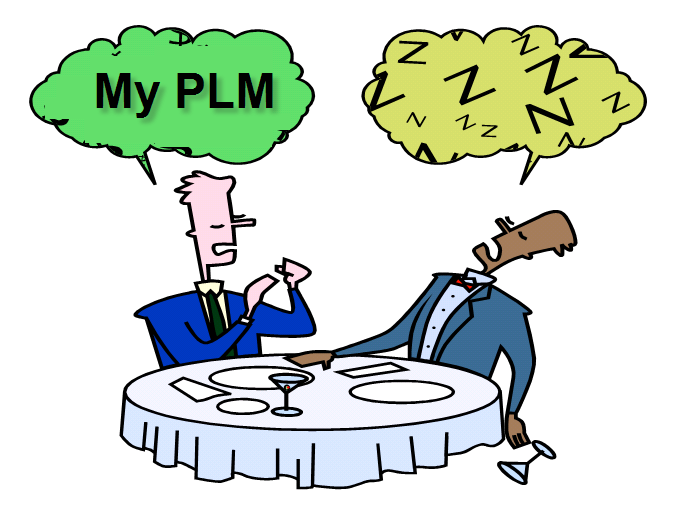 For PLM I wrote about this in my post PLM misconceptions –: PLM = PLM ?
I can imagine an (un)certain person, who wants to learn about PLM, might get confused (and should be – if you take it too serious).
At the end your company’s goal should be how to drive innovation, increase profitability and competiveness and not about how it is labeled.
As a frequent reader of my blog, you might have noticed I wrote sometimes about ALM and here a similar confusion might exist as there are three ALMs that might be considered in the context I am blogging.
Therefore this post to clarify which ALM I am dedicated to.
So first I start with the other ALMs:
ALM = Application Lifecycle Management
 This is an upcoming discipline in the scope of PLM due to the fact that more and more in the product development world embedded software becomes a part of the product. And like in PLM where we want to manage the product data through its lifecycle, ALM should become a logical part of a modern PLM implementation. Currently most of the ALM applications in this context are isolated systems dealing only with the software lifecycle, see this Wiki Page
ALM = Asset Lifecycle Management (operational)
In 2009 I started to focus on (my type of) ALM, called Asset Lifecycle Management, and I discovered the same confusion as when you talk about a BOM. What BOM really means is only clear when you understand the context. Engineers will usually think of an Engineering BOM, representing product as specified by engineering (managed by PDM). Usually the rest of the organization will imagine the Manufacturing BOM, representing the product the way it will be produced (managed mostly in ERP).
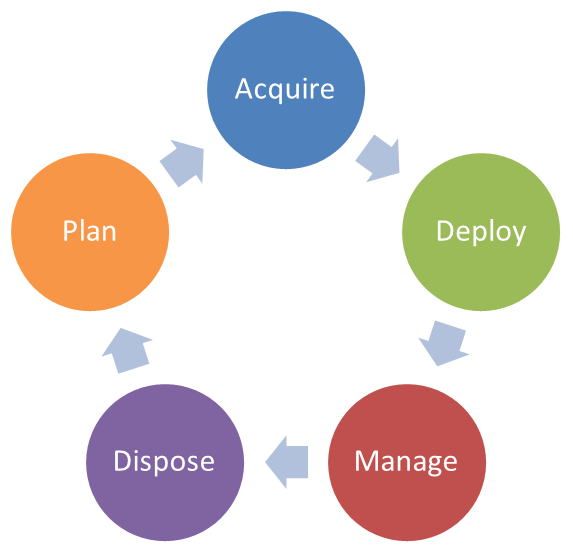 The same is valid for ALM. The majority of people in a production facility, plant or managed infrastructure will consider ALM as the way to optimize the lifecycle of assets. This means optimizing the execution of the plant, when to service or replace an asset ? What types of MRO activities to perform. Sounds a lot like ERP and as it has direct measurable impact on finance, it is the area that gets most of the attention by the management.
ALM = Asset Lifecycle Management (information management)
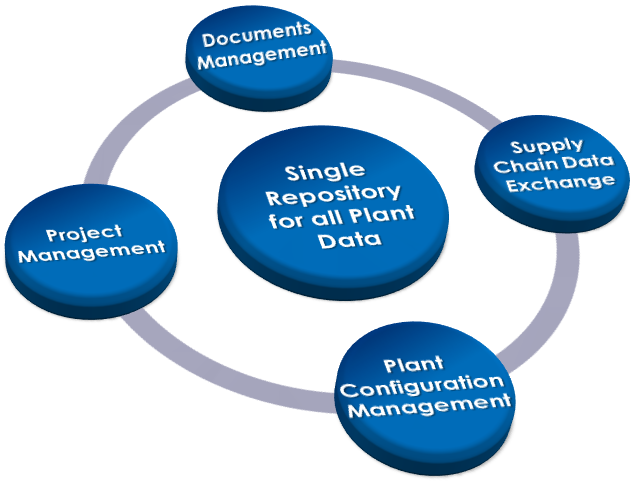 Here we talk about the information management of assets. When you maintain your assets only in a MRO system, it is similar like in a manufacturing company when only using an ERP system. You have the data for operations, but you do not have the process in place to manage the change and quality of data. In the manufacturing world this is done in PDM and PLM system and I believe owners/operators of plant can learn from that.
I wrote a few posts about this topic, see Asset Lifecycle Management using a PLM system, PLM CM and ALM – not sexy or using a PLM system for Asset Lifecycle Management requires a vision and I am not going to rewrite them in this post. So get familiar with my thoughts if you read the first time about ALM in my blog.
What I wanted to share is that thanks to modern PLM systems, IT infrastructure/technologies and SBA it becomes achievable for owner/operators to implement an Asset Lifecycle Management vision for their asset information and I am happy to confirm that in my prospect and customer base, I see companies investing and building this ALM vision.
And why do they do this:
 Reduce maintenance time (incidental and planned) by days or weeks due to the fact that people have been working with the right and complete data. Depending on the type of operations, one week less maintenance can bring millions (power generation, high demand/high cost chemicals and more)

.
 Reduce the failure costs dramatically. As maintenance is often a multi-disciplinary activity errors due to miscommunication are considered as normal in this industry (10 % up and even more). It is exactly this multi-disciplinary coordination that PLM systems can bring to this world. And the more you can do in a virtual world the more you can assure you do the right thing during real maintenance activities. Here industries similar as for the previous bullet, but also industries where high-costly materials and resources are used, the impact on reducing failure costs is high.

.
 Improve the quality of data. Often the MRO system contains a lot of operational parameters that were entered there at a certain time by a certain person with certain skills – the fact that although I used the word certain three times, the result is uncertainty as there is no separate tracing and validation of the parameters per discipline and an uncertain person looking at the data might not discover there is an error, till it goes wrong. Here industries where a human error can be dramatic benefit the most from it (nuclear, complex chemical processes)

Conclusion: The PLM system based ALM implementations are more and more becoming reality next to the ALM operational world. After spending more then three years focused on this area, I believe we can see and learn from the first results.
Are you interested in more details or do you want to share your experience ? Please let me know and I will be happy to extend the discussion
Note: On purpose I used as much TLA’s to assure it looks like an specialist blog, but you can always follow the hyperlink to the wiki explanation, when the TLA occurs the first time.
 Sorry for the provoking title in a PLM blog, but otherwise you would not read my post till the end.
In the past months I have been working closely with several large companies (not having a mid-market profile). And although they were all in different industries and have different business strategies, they still had these common questions and remarks:
- How to handle more and more digital data and use it as valuable information inside the company or for their customers / consumers ?
- What to do with legacy data (approved in the previous century) and legacy people (matured and graduated in the previous century) preventing them to change ?
- We are dreaming of a new future, where information is always up-to-date and easy to access – will this ever happen ?
- They are in the automotive industry, manufacturing industry, infrastructure development and maintenance, plant engineering, construction and plant maintenance
- They all want data to be managed with (almost) zero effort
- And please, no revolution or change for the company
Although I have been focusing on the mid-market, it is these bigger enterprises that introduce new trends and as you can see from the observations above, there is a need for a change. But also it looks like the demands are in a contradiction to each other.
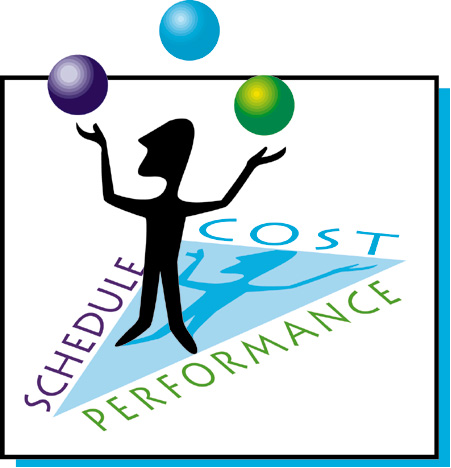
I believe it is just about changing the game.
If you look at the picture to the left, you see one of the contradictions that lead to PLM.
Increasing product quality, reducing time to market and meanwhile reducing costs seemed to be a contradiction at that time too.
Change ?
Although PLM has not been implemented (yet) in every company that could benefit from it, it looks like the bigger enterprises are looking for more.
 the P from PLM becomes vague – it is no longer only the product that has the focus, it is also the whole context around the product that might influence it, that they want to take in consideration
the L from PLM remains – they still want to connect all information that is related to the lifecycle of their products or plants.
the M from Management has a bad association – companies believe that moving from their current state towards a managed environment of data is a burden. Too much overhead is the excuse to not manage dat. And their existing environments to manage data do not excel in user-friendliness. And therefore people jump towards using Excel.
Next
So if the P is not longer relevant, the M is a burden, what remains of PLM ?
Early June I presented at the Dassault Systems 3DExperience forum the topic of digital Asset Lifecycle Management for owners / operators. One of the areas where I believe PLM systems can contribute a lot to increase business value and profitability (quality and revenue – see using a PLM system for Asset Lifecycle Management )
Attending the key note speech it was clear that Dassault Systems does not talk about PLM anymore as a vision. Their future dream is a (3D) lifelike experience of the virtual world. And based on that virtual model, implement the best solution based on various parameters: revenue, sustainability, safety and more. By trying to manage the virtual world you have the option to avoid real costly prototypes or damaging mistakes.
I believe it is an ambitious dream but it fits in the above observations. There is more beyond PLM.
In addition I learned from talking with my peers (the corridor meetings) that also Siemens and PTC are moving towards a more industry or process oriented approach, trying to avoid the association with the generic PLM label.
Just at the time that Autodesk and the mid-market started to endorse PLM, the big three are moving away from this acronym.
This reminds me of what happened in the eighties when 3D CAD was introduced. At the time the mid-market was able to move to mainstream 3D (price / performance ratio changed dramatically) the major enterprises started to focus on PDM and PLM. So it is logical that the mid-market is 10 – 15 years behind new developments – they cannot afford experiments with new trends.
So let’s see what are the new trends:
- the management of structured and unstructured data as a single platform. We see the rise of Search Bases Application and business intelligence based on search and semantic algorithms. Using these capabilities integrated with a structured (PLM ? ) environment is the next big thing.
- Apps instead of generic applications that support many roles. The generic applications introduce such a complexity to the interface that they become hard to use by a casual user. Most enterprise systems, but also advanced CAD or simulation tools with thousands of options suffer from this complexity. Would not it be nice if you only had to work with a few dedicated apps as we do in our private life ?
- Dashboards (BI) that can be created on the
fly representing actual data and trends based
on structured and unstructured data.
It reminded me of a PLM / ERP discussion I had with a company, where the general manager all the time stated the types of dashboards he wanted to see. He did not talk about PLM, ERP or other systems – he wanted the on-line visibility - Cloud services are coming. Not necessary centralizing all data on the cloud to reduce it cost. But look at SIRE and other cloud services that support a user with data and remote processing power at the moment required.
- Visual navigation through a light 3D Model providing information when required. This trend is not so recent but so far not integrated with other disciplines, the Google maps approach for 3D.

So how likely are these trends to change enterprise systems like PLM, ERP or CRM. In the table below I indicated where it could apply:
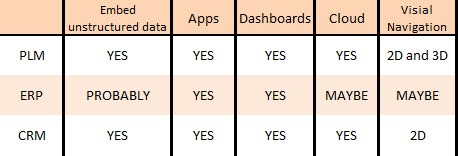
As you can see the PLM row has all the reasons to introduce new technologies and change the paradigm. For that reason combined with the observations I mentioned in the beginning, I am sure there is a new TLA (Three Letter Acronym) upcoming.
The good news is that PLM is dynamic and on the move. The bad news for potential PLM users is that the confusion remains – too many different PLM definitions and approaches currently – so what will be the next thing after PLM ?
Conclusion: The acronym PLM is not dead and becomes mainstream. On the high-end there is for sure a trend to a wider and different perspective of what was initially called PLM. After EDM, TDM, PDM and PLM we are waiting for the next TLA

May 24th, 2008 was the date I posted my first blog post as a Virtual Dutchman aiming to share PLM related topics for the mid-market.
I tried to stay away from technology and function/feature debates and based on my day to day observations, describe the human side of the PLM – what people do and why . All from a personal perspective and always open to discuss and learn more.
Looking back and reviewing my 86 posts and 233 comments so far, I would like to share a summary around some of the main topics in my blog.
PLM
 In 2008, PLM awareness was much lower – at that time one of the reasons for me to start blogging. There was still a need to explain that PLM was a business strategy needed beside ERP and PDM.
PLM will bring more efficiency, and in better quality, new innovative products to the market due to better collaboration between teams and departments.
At that time the big three, Dassault Systemes, Siemens and PTC were all offering a very CAD-centric, complex approach for PLM. There was no real mid-market offering, although their marketing organizations tried to sell as-if a mid-marketing offering existed. Express, Velocity, ProductPoint where are these offerings now ?
Now, In 2012 there is an established PLM awareness as everyone is talking about (their interpretation of) PLM and with Autodesk, a company that knows how to serve the mid-market, also acknowledged there is a need for PLM in their customer base, the term PLM is widespread
The new PLM providers focus on a disconnect between PDM and PLM, as in particular the handling of enterprise data outside the PDM scope is a white space for many mid-market companies that need to operate on a global platform.
PLM & ERP
 In the relation between PLM and ERP, I haven’t seen a big change the past four years. The two dominating ERP originated vendors, SAP and Oracle were paying attention to PLM in 2008 in their marketing and portfolio approach.
However their PLM offerings in my perception, haven’t moved much forward. SAP is selling ERP and yes there is a PLM module and Oracle is having PLM systems, but I haven’t seen a real targeted PLM campaign explaining the needs and value of PLM integrated with ERP.
Historically ERP is the main IT-system and gets all the management attention. PLM is more considered something for engineering (and gets less focus and budget). Understanding PLM and how it connects to ERP remains a point of attention and the crucial point of interaction is the manufacturing BOM and the place where it is defined. The two most read posts from my blog are: Where is the MBOM and next Bill of Materials for Dummies – ETO, indicating there is a lot of discussion around this topic.
I am happy to announce here that in October this year during PLM Innovation US, I will present and share my thoughts in more detail with the audience, hoping for good discussions
New trends
There are three new trends that became more clear the past four years.
 The first one to mention is the upcoming of Search Based Applications (SBA). Where PLM systems require structured and controlled data, search based applications assist the user by “discovering” data anywhere in the organization, often in legacy systems or possible in modern communication tools.
I believe companies that develop an integrated concept of PLM and SBA can benefit the most. PLM and ERP vendors should think about combining these two approaches in an integrated offering. I wrote about this combined topic in my post: Social Media and PLM explained for Dummies
 The second trend is the cloud. Where two-three years ago social media combined with PLM was the hype as a must for product innovation and collaboration, currently cloud is in focus.
Mainly driven and coming for the US, where the big marketing engine from Autodesk is making sure it is on the agenda of mid-market companies.
In Europe there is less a hype at this moment, different countries and many languages to support plus discussions around security take the overhand here.
For me a cloud solution for sure is lowering the threshold for mid-market companies to start implementing PLM. However how to make the change in your company ? It is not only an IT-offering. Like a similar discussion around Open Source PLM, there is still a need to provide the knowledge and change push inside a company to implement PLM correct. Who will provide these skills ?
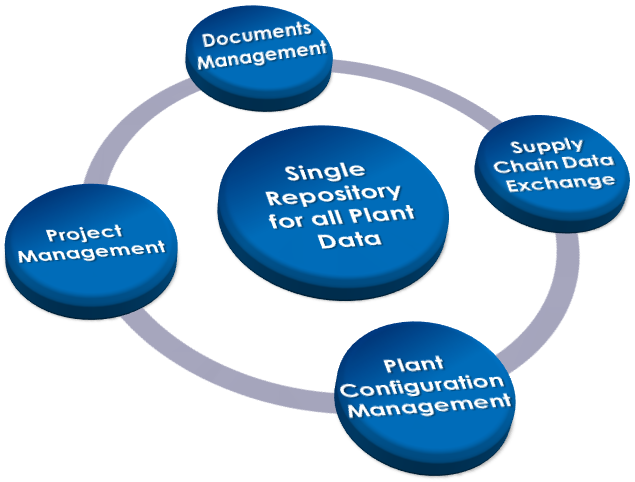 The third trend is the applicability of PLM systems outside the classical manufacturing industries.
I have been writing about the usage of PLM systems for Owner/Operators and the civil / construction industry, where the PLM system becomes the place to store all plant related information, connected to assets and with status handling. Currently I am participating in several projects in these new areas and the results are promising
People and Change
 I believe PLM requires a change in an organization not only from the IT perspective but more important from the way people will work in an organization and the new processes they require.
The change is in sharing information, making it visible and useful for others in order to be more efficient and better informed to make the right decisions much faster.
This is a global trend and you cannot stay away from it. Keeping data locked in your reach might provide job security but in the long term it kills all jobs in the company as competiveness is gone.
The major task here lies with the management that should be able to understand and execute a vision that is beyond their comfort zone. I wrote about this topic in my series around PLM 2.0
Modern companies with a new generation of workers will have less challenges with this change and I will try to support the change with arguments and experiences from the field.
Audience
Since February this year, WordPress provides much more statistics and interesting is the map below indicating in which countries my blog is read. As you can see there are only a few places left on earth where PLM is not studied. Good news !!

Although most of my observations come from working in Europe, it is the US that provides the most readers (30 %) , followed by India (9 %) and on the third place the UK (6 %).
This might be related to the fact that I write my blog in English (not in 100 % native English as someone commented once).
It makes me look forward to be in October in Atlanta during the PLM Innovation US conference to meet face to face with many of my blog readers and share experiences.
Conclusion
Reading back my posts since 2008, it demonstrated for me that the world of PLM is not a static environment. It is even that dynamic that some of the posts I wrote in the early days have become obsolete.
At the end of 2008 I predicted the future of PLM in 2050 – here we are on the right track.
There is still enough blogging to do without falling into repetitions and I am looking forward to your opinion, feedback and topics to discuss.
Related articles
- PLM misconceptions (virtualdutchman.com)
 The trigger for this post is based was a discussion I had around the Autodesk 360 cloud based PLM solution. To position this solution and to simplify the message for my conversation partner Joe the plumber, I told him”: “You can compare the solution with Excel on-line. As many small mid-market companies are running around with metadata (no CAD files) in Excel, the simplified game changer with this cloud based PLM offering is that the metadata is now in the cloud, much easier to access and only a single version exists.”
(sorry for Autodesk, if I simplified it too much, but sometimes your conversation partner does not have an IT background as they are plumbers)

Interesting enough Joe said: “But what is the difference with Google docs or SharePoint where I can centralize my Excel files too – and Google Docs is like a cloud solution, right ?”
He was right and I had to go more in-depth to explain difference. This part of the conversation was similar to discussions I had in some meetings with owner / operators in the civil and energy sector, discussing the benefits of PLM practices for their industry.
I wrote about this in previous posts:
Using a PLM system for asset lifecycle management requires a vision
PLM practices for the engineering / construction industry
The trouble with dumb documents
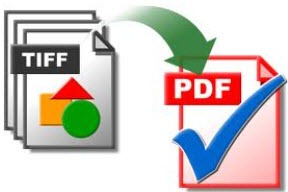 Here it was even more a key point of the discussion that most of the legacy data is stored in dumb documents. And the main reason dumb documents are used is because the data needs to be available during the long lifecycle of the the plant, application independent if possible. So in the previous century this was paper, later scanned documents (TIFF – PDF) and currently mainly PDF. Most of the data now is digital but where is the intelligence ?
The challenges these companies have is that despite the fact information is now stored in a digital file, the next step is how to deal with the information in an intelligent manner. A document or an Excel file is a collection of information, you might call it knowledge, but to get access to the knowledge you need to find it.
Did you try to find a specific document in Google docs or SharePoint ? The conclusion will be the file name becomes very important, and perhaps some keywords ?
Is search the solution ?
 To overcome this problem, full text search and search based applications were developed, that allow us to index and search inside the documents. A piece of cake for Google and a niche for others to index not only standard documents but also more technical data (drawings, scans from P&ID, etc, etc).
Does this solve the problem ?
Partly, as suddenly the user finds a lot more data. Search on Google for the words “Right data” and you have 3.760.000.000 hits (or more). But what is the right data ? The user can only decide what is the right data by understanding the context.
- Is it the latest version ?
- Is it reflecting the change we made at that functional position ?
- What has changed ?
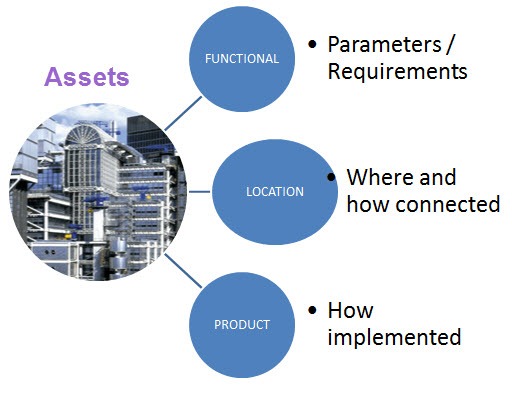
And here comes the need for more intelligent data. And this is typically where a PLM system provides the answer.
A PLM systems is able to manage different types of information, not only documents. In the context of a plant or a building, the PLM system would also contain:
- a functional definition / structure (linked to its requirements)
- a logical definition / structure (how is it supposed to be ?)
- a physical definition / structure (what is physically there ?)
- a location definition / structure (where in the plant / building ?)
and this is all version managed and related to the supported documents and other types of information. This brings context to the documents and therefore it exposes knowledge.
As there is no automatic switch from dumb documents towards intelligent data, it will be a gradual process to move towards this vision. I see a major role for search based applications to support data discovery. Find a lot of information, but than have the capability to capture the result (or generate a digest of the result) and store it connected to your PLM system, where is it managed in the future and provides the context.
Conclusion: We understand that paper documents are out of time. Moving these documents to digital files stored in a central location, either in SharePoint or a cloud-based storage location is a step we will regret in ten years from now, as intelligent data is not only inside the digital files but also depending on its context.
 The past three weeks I had time to observe some PLM Vendors marketing messages (Autodesk as the major newbie). Some of these message lead to discussions in blogs or (LinkedIn) forums. Always a good moment to smile and think about reality.
In addition the sessions from PLM Innovation 2012 became available for the attendees (thanks MarketKey – good quality). I had the chance to see the sessions I missed. On my wish list was “The future of PLM Business Models” moderated by Oleg as here according to Oleg some interesting viewpoints came up. This related to my post where I mentioned the various definitions of PLM.
All the above inspired me to write this post, which made me realize we keep on pushing misconceptions around PLM in our customer’s mind, with the main goal to differentiate.
I will address the following four misconceptions. The last one is probably not a surprise, therefore on the last position. Still sometimes taken for granted.
- PLM = PLM
- On the cloud = Open and Upgradeable
- Data = Process Support
- Marketing = Reality
1. PLM = PLM
It is interesting to observe that the definition of PLM becomes more and more a marketing term instead of a common definition which applies to all.
 Let me try to formulate again a very generic definition which captures most of what PLM Vendors target to do.
PLM is about connecting and sharing the company’s intellectual property through the whole product lifecycle. This includes knowledge created at the concept phase going through the whole lifecycle till a product is serviced in the field or decommissioned.
Experiences from the field (services / customers / market input) serve again for the other lifecycle phases as input to deliver a better or innovative product.
Innovation is an iterative process. It is not only about storing data, PLM is also covering the processes of managing the data, especially the change processes. Sharing data is not easy. It requires a different mind set, data is not only created for personal or departmental usage, but also should be found and extended by other roles in the organization. This all makes it a serious implementation, as aligning people is a business change, not an IT driven approach.
Based on this (too long) high-level PLM definition, it does not imply you cannot do PLM without a PLM system. You might also have a collection of tools that are able to provide a complete coverage of the PLM needs.
 Oleg talks about DIY (Do It Yourself) PLM, and I have seen examples of Excel spreadsheets managing Excel spreadsheets and Email archives. The challenge I see with this type of PLM implementations is that after several years it is extremely difficult for a company to change. Possible reasons: the initial gurus do not longer work for the company, new employees need years of experience to find and interpret the right data.
A quick and simple solution can become a burden in the long term if you analyze the possible risks.
Where in the early years of PLM, it was mainly a Dassault Systemes, Siemens and PTC driven approach with deep CAD integrations, the later years other companies like Aras and now Autodesk, started to change the focus from classical PLM more to managing enterprise metadata. A similar approach SAP PLM is offering. Deep integrations with CAD are the most complex parts of PLM and by avoiding them, you can claim your system is easier to implement, etc., etc.
 A Single version of the truth is a fancy PLM expression. It would be nice if this was also valid for the definition of PLM. The PLM Innovation 2012 session at the future of PLM models demonstrated that the vendors in this panel discussion had a complete different opinion about PLM. So how can people inside their company explain to the management and others why the need PLM and which PLM they have in mind ?
2. On the cloud = Open and Upgradeable
 During the panel discussion Grant Rochelle from Autodesk mentioned the simplicity of their software and how easy it will be upgradeable in the future. Also he referred to Salesforce.com as a proof point.They provide online updates from the software, without the customer having to do anything.
The above statement is true as long as you keep your business coverage simple and do not anticipate changes in the future. Let me share you an analogy with SmarTeam, how it started in 1995
At that time SmarTeam was insanely configurable. The Data Model Wizard contained several PDM templates an within hours you could create a company specific data model. A non-IT skilled person could add attributes, data types, anything they wanted and build the application, almost the same as Autodesk 360. The only difference, SmarTeam was not on the cloud, but it was running on Windows, a revolution at that time as all serious PDM systems were Unix based.
The complexity came however when SmarTeam started to integrate deeply with CAD systems. These integrations created the need for a more standardized data model per CAD system. And as the SmarTeam R&D was not aware of each and every customer’s implementation, it became hard to define a common business logic in the data (and to remain easily upgradable).
 I foresee similar issues with the new cloud based PLM systems. They seem to be very easy to implement (add what you want – it is easy). As long as you do not integrate to other systems it remains safe. Integrating with other and future systems requires either a common data definition (which most vendors do not like) or specific integrations with the cost of upgrading.
In the beginning everything is always possible with a well-defined system. But be aware looking back in history, every 10 years a disruptive wave comes in, changing the scope and upgradability.
And to challenge the cloud-based PLM vendors: in the generic definition of PLM that I shared above, PLM integrates also design data.
3. Data = Process Support
Another misconception, which originates from the beginning of PLM is the idea that once you have support for specific data in your system, you support the process.
 First example: Items defined in ERP. When engineers started to use a PDM system and started to define a a new item there were challenges. I had many discussions with IT-departments, that they did not need or wanted items in PDM. ERP was the source for an item, and when a designer needed a new item, (s)he had to create it in ERP. So we have a single definition of the item.
Or the designer had to request a new item number from the ERP system. And please do not request numbers too often as we do not want to waste them was the message.
Ten years later this looks like a joke, as most companies have an integrated PDM/ERP process and understand that the initial definition of a new item comes from PDM and at a certain stage the matured item is shared (and completed) by the ERP system. It is clear that the most efficient manner to create a new item is through PLM as the virtual definition (specs / CAD data) also reside there and information is handled in that context.
 A second more actual example is the fact that compliancy is often handled in ERP. It is correct that in the case you manufacture a product for a specific target market, you need to be able to have the compliancy information available.
However would you do this in your ERP system, where you are late (almost at the end) of the design lifecycle or is it more logical that during your design stages at all time you verify and check compliancy ? The process will work much more efficient and with less cost of change when done in PLM but most companies still see ERP as their primary IT system and PLM is an engineering tool.
Finally on this topic a remark to the simplified PLM vendors. Having the ability to store for example requirements in your system does not mean you have support for a complete requirements management process. It is also about the change and validation of requirements, which should be integrated for a relevant role during product definition (often CAD) and validation. As long as the data is disconnected there is not such a big advantage compared to Excel.
4. Marketing = Reality
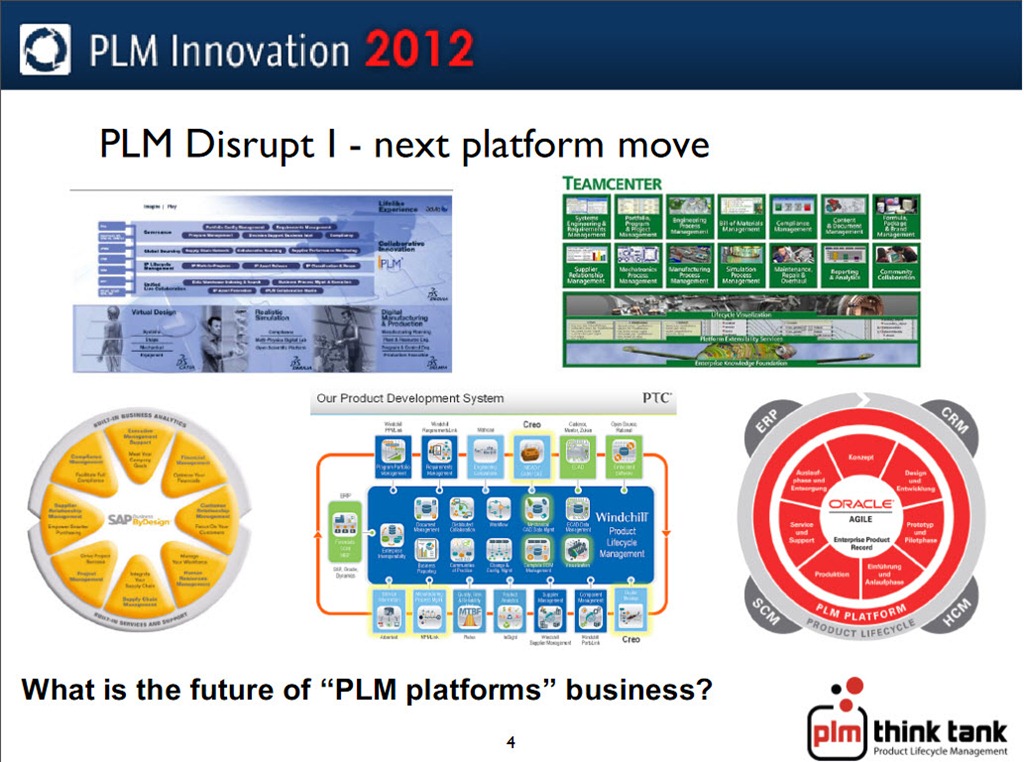 In the future of PLM Business Models
Oleg showed a slide with the functional architectures of the major PLM Vendors. In the diagram all seems to be connected as a single system, but in reality this is usually not the case.
As certain components / technologies are acquired, they provide the process coverage and only in the future you can imagine it works integrated. You cannot blame marketing for doing so, as their role is to position their products in the most appealing way customers will buy it. Without marketing perhaps no-one would buy a PLM system, when understanding the details 
Autodesk as a newcomer in PLM has a strong background in marketing. This is understandable as similar to Microsoft, their main revenue comes from selling a large volume of products, where the classical PLM vendors often have a combination with services and business change. And therefore a different price point.
When in the eighties Autodesk introduced AutoCAD, it was a simple, open 2D CAD environment, able to run on a PC. Autodesk’s statement at that time: “We provide 80 percent of the functionality for 20 % of the price”.
Does this sound familiar nowadays ?
As AutoCAD was a basic platform allowing customers and resellers to build their solutions on top of it, this became the mid-market success for Autodesk with AutoCAD.
The challenge with Autodesk PLM 360 is that although the same logic seems to make sense, I believe the challenge is not in the flexible platform. The challenge is in the future, when people want to do more complex things with the system, like integrations with design, enterprise collaboration.
At that time you need people who can specify the change, guide the change and implement the change. And this is usually not a DIY job.
 Autodesk is still learning to find the right PLM messages I noticed recently. When attending the Autodesk PLM session during PLM Innovation 2012 (end of February), one of their launching customers ElectronVault presented their implementation – it took only two weeks !!! Incredible
However reading Rob Cohee’s blog post the end of March, he mentions ElectronVault again. Quote:
ElectronVault was searching for something like this for over two years and after 6 weeks they have implemented Project Management, EBOM, MBOM, and starting on their APQP project. Six Weeks!!!
As you see, four weeks later the incredible two weeks have become six weeks and again everything is implemented. Still incredible and I am looking forward to meet ElectronVault in the future as I believe they are a typical young company and they will go through all of the maturity phases a company will go through: people, processes and tools (in this order). A tool driven implementation is more likely to slow down in the long term.
Conclusion: Misconceptions are not new. History can teach us a lot about what we experience now. New technology, new concepts can be a break through. However implementing them at companies requires a change in organizations and this has been the biggest challenge the past 100 years.
Related articles
- The Question of PLM or Not to PLM (arnoldit.com)
- Innovation @ PLM Innovation 2012 ? (virtualdutchman.com)
 In my last post PLM kills Innovation or not, I tried to provoke PLM vendors to respond to my claim that PLM has too much a focus on structuring data (and therefore removing freedom) claiming it blocks innovation as everyone believes innovation requires freedom and flexibility. This statement is often heard from startups claiming implementing any type of management would kill their competitive advantage. Still in the PLM marketing world everyone mentions PLM and Innovation as Siamese twins, but no one explains explicitly why they are connected.
So not too many reactions from vendors but some interesting comments from others to this post. Andrew Mack mentions that we should not confuse Innovation and Invention as for native English speakers there is a clear distinction. I agree with him however as most of my blog readers are not native English speakers I will explain the difference in this post.
For me it is clear PLM supports Innovation in three different manners, which I will explain here in a logical order – see the conclusion for the order of profit it will bring:
Invention Discovery
 Invention, the creation of a new idea that might be the golden egg for the future of a company. It is often the result of one or more individuals- not something a systematic approach or system will bring automatically. If you look how big companies handle with invention, you see that often they do not manage it. They look around the world for , or sometimes get approached by, startups that have a concept that fits to their portfolio and they buy the company and concept.
This is of course a very disconnected way of invention, but from the other hand, the drive from many startups is to work day and night to develop a concept and ultimately sell the company for a good price. Compare it to the big soccer companies that have only money (currently mainly Russian or Arabic) but no own youth development plan to raise new talents. So it is a common way for companies to acquire invention (and promote innovation).
But I believe there is also a way companies can stimulate invention by implementing the modern way of PLM (PLM 2.0 – see my posts on that) and not use PLM as an extended PDM as I described in PLM What is the target. When a company has implemented PLM in a PLM 2.0 approach, it means there is a full visibility and connection of all product data, customer demands (through sales) and experiences (through service) for an R&D department to innovate.
Why this does not happen so much?
 Because inside most companies, people do not have an approach or drive for sharing data through the whole product lifecycle. Every department is optimizing themselves, not taking into account the value and overall company needs as they are not measured on that. In order to support invention PLM can provide an R&D department and individuals with all related market and customer information in order to create relevant inventions. So PLM helps here on understanding the areas of invention and probably the most unexplored area of PLM
Support selection of the right invention
 The second area where PLM contributes to innovation is assisting companies to select the right opportunities that can be the next big opportunity for these companies. In case you have many opportunities, which one would you select and invest in ? As usually it unaffordable to invest in every opportunity usually and knowing at this stage you are not sure if a particular opportunity will lead to a profitable new product, you need a process and tool to select the right ones.
Here comes portfolio management as a functionality that allows companies to have an overview of all running initiatives and through reporting on key performance indicators (KPIs) being able to select the opportunities where to invest.
Support New Product Introduction
Once you have selected an opportunity and also as part of the portfolio management process you feel secure, there is the third step. How to bring this opportunity to the market as fast as possible, with the right quality and the right manufacturing definition? As being first on the market gives you market share and premium pricing.
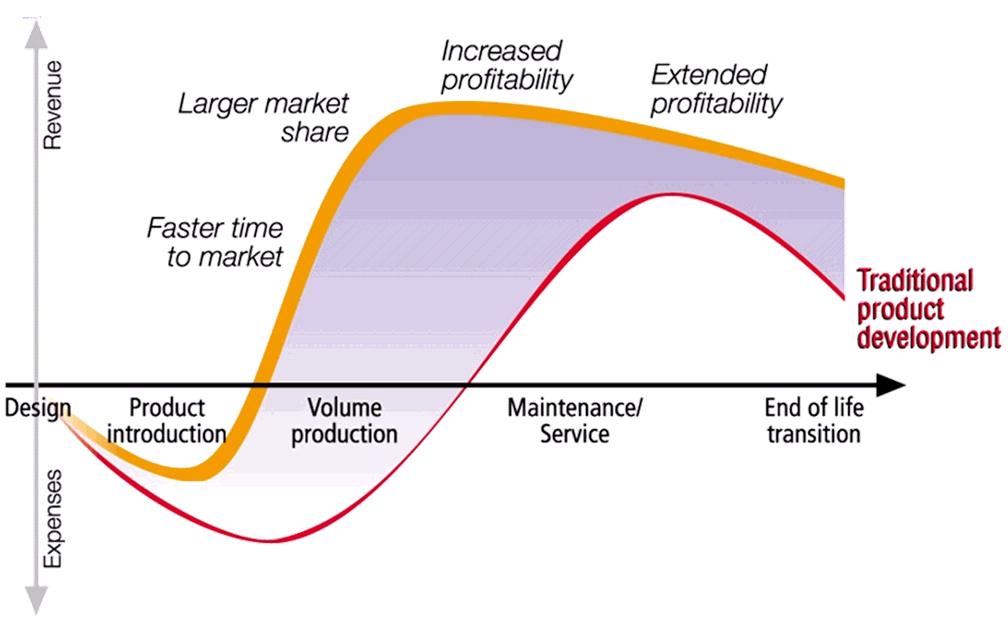 Also as changes in the early manufacturing stage and later during the go to market phase are extremely costly, it is important to bring a new product to the market as fast as possible in the right quality, avoiding changes when the new product is in the market. This is the area where PLM contributes the most. Allowing R&D organizations to work on their virtual product definition and perform simulations, design and customer verifications. Also anticipate and resolve compliancy and sourcing issues in the early stages of the product development. All this assures a reduction in the amount of iterations before a new product is ready to ´ hit´ the market.
A famous PLM one-liner is for PLM is: PLM – doing it right the first time, it refers more to the fact that a product introduction process is done only once and with the right quality. It does not mean iterations to improve or change the product scope are not needed.
Improvement cycles are necessary to bring a product to the market. But as they are done in the virtual world, the R&D department has the option to evaluate several alternatives (virtually), work and improve them till the best option is selected for the market saving cost for late design changes or errors to be solved. And even when the product is defined, PLM can help by defining the right generic manufacturing process and make it available for the local manufacturing organizations (where is the MBOM ?)
Conclusion
PLM does not kill innovation and although the PLM Vendor marketing is not very explicit, there are three areas where PLM supports Innovation. In a (subjective) order of priority I would say:
· New Product Introduction – bringing the highest revenue advantages for a selected invention
· Invention discovery – by providing R&D a 360 view of their customers and market landscape enable inventions to happen in your company
· Portfolio Management – to assist in selecting the right opportunities to focus

Your thoughts ?
 This time a little provocative title, which I hope will give some feedback from those who claim PLM brings INNOVATION. In one of my earlier posts, I talked about PLM – what is the target and also acted as an advocate for innovation.
Now after hearing PLM and INNOVATION mentioned the past two weeks everywhere as a logical combination, I started to question myself is this is just marketing ?
In this post I will act as the advocate of the devil.
Two weeks ago I attended the PLM Innovation congress, where first of all these two words were accepted by the audience as obvious linked together PLM INNOVATION. I participated in three sessions where INNOVATION was the topic. Charles Gagnon from Hydro Quebec talked about open innovation, but mentioned Hydro Quebec did not use any tool to manage INNOVATION so also not PLM. Peter Fassbender talked about the innovative approach to connect to the outside world using crowd sourcing and social media, but again no mentioning about PLM. Finally Christian Verstraete held an appeal for INNOVATION, urging everyone to think outside the box (did he mean outside the PLM box? Anyway no mentioning of PLM contribution)
Autodesk´s CEO Carl Bass talked about The New Rules of INNOVATION at TEDx and in the first part of his speech he is making the same statement that I would make related to PLM – see video:
Innovation–the work of the individual
Some quotes from his speech:
“Innovation is fundamentally not a corporate phenomena. Innovation involves taking risks and involves breaking the rules. And companies aren’t particularly good at that. In fact let´s say that it is just the opposite: companies are good in making rules and minimizing risk”
and quoting the author of The Innovator´s Dilemma Clayton Christensen:
“The lack of innovation is not the failure of companies but rather the result of prudent and sound management”
Autodesk
A week later Autodesk PLM 360 is launched. Again a PLM system that is bringing rules and structure, but apparently so far not affecting INNOVATION as we can see in one of the videos that came with the launch.
What the experts say.
Unfortunate the above video is only a teaser to get to the Autodesk Facebook page where, if you like them, you will be rewarded with access. A modern way of marketing: Only if you like us, we will tell you what we like.
Sanjeev Pal believes PLM is a business strategy that helps companies to reach their INNOVATION goals. Tom Grant starts with: “INNOVATION is really the word to focus on. At the heart of PLM is INNOVATION”. Later he states that probably one of the problems in PLM is the M (the Management part) that misleads the mind shifting in the wrong direction (against user acceptance and involvement’) and he prefers to call it more enablement instead of management. Somehow the conclusion is that PLM supports INNOVATION by bringing products faster to market. Does this mean PLM is the vehicle of bringing new innovations to the market ? Instead of creating a platform for INNOVATION?
STATS: Autodesk PLM + Innovation: 199.000 hits on Google
Once you have struggled like me to find the roundtable discussion and its content, let´s look at other PLM vendors in alphabetical order:
Aras
Aras INNOVATOR– the word INNOVATOR it is already in the name but when you read more clearly what is stated at the Aras website, you see the word INNOVATOR is more targeting themselves (the software / the delivery model) instead of customer oriented INNOVATION. There the message is more about streamlining and connecting people and businesses (efficiency / collaboration). So not much INNOVATION here related to PLM is my conclusion
STATS: Aras + Innovation: 11.200.000 hits on Google
Dassault Systèmes
When looking for Dassault Systèmes and INNOVATION I found an interesting statement on their website.
Dassault Systems launched its Passion for Innovation program in 2005. The program is based on a simple guiding principle: it is often the case that outstanding ideas do not come to fruition due to lack of appropriate resources. At Dassault Systèmes, all employees are free to install CATIA on their workstation. The idea of the program is to provide this opportunity to everyone
Is INNOVATION a result of the CAD tool ? not related to PLM ? I am sure there must a better story – but where is it ? There is a lot of talk about innovation, but related to PLM ?
STATS: Dassault Systèmes+ Innovation 1.340.000 hits on Google
Oracle Agile PLM
Oracle Agile PLM has a clear statement how they support INNOVATION:
Accelerate innovation through ideation management and collaboration, product portfolio management and analytics, data consolidation and cleansing, and a rich enterprise product record
I am not sure from this statement if we know the source wrote it. Marketing or a serious attempt to describe how Agile supports INNOVATION. I would love to learn a refined statement here that I understand.
STATS: Oracle PLM + Innovation: 150.000 hits on Google
PTC
PTC does not give a direct association with INNOVATION. When I searched for PTC and INNOVATION the first suggestion was: Did you mean HTC INNOVATION ?
Also when searching the PTC website, INNOVATION was hard to find. Interesting I noticed that the first main tab on the left was Discover our software capabilities. I was expecting that PTC like most PLM vendors would start from the business and not from the products.
STATS: PTC + Innovation 3.450.000 hits on Google
SAP PLM
On the SAP PLM website I found a tab called Innovation Management and here SAP PLM gave a clear explanation which practices contribute to INNOVATION Management. SAP mentions here:
- Strategy and planning
- Managing innovative ideas
- Program and project management
- Portfolio management
As I expected SAP will not hint in any direction towards CAD tools and their focus is mainly on the management side. I would love to learn the part of managing innovative ideas as this is the challenging part. Ideas and management ?
STATS: SAP PLM + Innovation 131.000 hits on Google
Siemens PLM
On the Siemens PLM website you have to search for INNOVATION and when you do a search, you are mainly directed to blog articles, The word-cloud next to the blog did not show the word INNOVATION in bold, showing it is not a common used word. Digging deeper, I found a blog post related to an Innovation Leadership Summit, which suggests again there is a relation between PLM and INNOVATION. The closest match I found here was:
The HBR survey found that enterprises rely on PLM and IT to manage all this complexity, including new sustainability and regulatory requirements. PLM solutions track the ideation process, monitor progress, identify laggard projects, and facilitate collaboration. Leading organizations leverage PLM to improve new product development processes and outcomes
That´s all. So my conclusion here is that also Siemens PLM not naturally connects PLM and Innovation.
STATS: Siemens PLM + Innovation 901.000 hits on Google
Common rumors
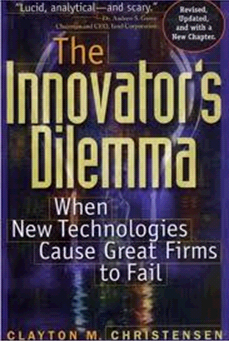
Without mentioning names, I hear stories from PLM implementations (or should I call it extended PDM implementations) that have created such a massive lock-in on the current state of the company, that changing the processes or innovating is almost a mission impossible. Exact what Clayton Christensen mentions in his Innovator´s Dilemma.
So having played the devil´s advocate role, I hope I made my statement that there is no real relation between PLM and INNOVATION despite it seems these two words are mentioned together as if they are linked.
Call for action
Therefore I challenge all vendors and companies that have a proven relation between PLM and INNOVATION to come to this debate and make their statement.
Where are the mythbusters that will crack the statement:
PLM has nothing to do with INNOVATION?
Looking forward to your responses.


I am just back from an exciting PLM Innovation 2012 conference. With a full program and around 250 participants, it was two intensive days of PLM interaction.
What I liked the most is that the majority of the audience was focusing on PLM business related topics. The mood of PLM has changed.
In this post, I will give an impression of the event, how I experienced it without going into the details of each session.
Several interesting sessions were in parallel so I could not attend them all, but MarketKey, the organizer of the conference confirmed that all presentations are filmed and will become available on-line for participants. So more excitement to come.
First my overall impression: Compared to last year’s conference there was more a focus on the PLM business issues and less on PLM IT or architecture issues (or was it my perception ?)
DAY 1
Gerard Litjens (CIMdata Director European Operations) opened the conference as CIMdata co-hosted the conference. In his overview he started with CIMdata’s PLM definition – PLM is a strategic business approach. (Everyone has his own definition as Oleg noticed too). Next he presented what CIMdata sees as the hottest topics. No surprises here: Extension from PLM to new industries, extending PDM towards PLM, Integration of Social Media, Cloud, Open Source, Enterprise integration and compliance.
 Next speaker was Thomas Schmidt (Vice President, Head of Operational Excellence and IS – ABB’s Power Products Division) was challenging the audience with his key note speech: PLM: Necessary but not sufficient. With this title it seemed that the force was against him (thanks Oleg for sharing).
Thomas explained that the challenge of ABB is being a global company and at the same time acting as a ‘local’ company everywhere around the world. In this perspective he placed PLM as part of a bigger framework to support operational excellence and presented some major benefits from a platform approach. I believe the Q&A session was an excellent part to connect Thomas’s initial statements to the PLM focused audience.
Marc Halpern from Gartner gave his vision on PLM. Also Marc started with the Gartner definition of PLM, where they characterized PLM as a discipline. Gartner identified the following 5 major trends: Software everywhere in products, usage of social media for product development and innovation, using analytics tools to support the whole product lifecycle – after sales, service, connecting to the customer. Opportunities for existing products to deliver them through services (media content, transportation)
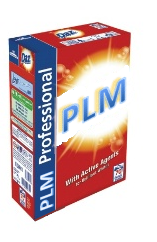 Next I attended the Autodesk session, a PLM journey using the cloud, where I was eager to learn their approach towards PLM. Autodesk (Mike Lieberman) let Linda Maepa, COO from Electron Vault in the USA explain the benefits of the Autodesk PLM 360 solution. Electron Vault, a young, high-tech company, has implemented the solution within 2 weeks. And here I got disconnected . Also when the suggestion was raised that you do not need time to specify the requirements for the system (old-fashioned stuff),
I suddenly got into a trance and saw a TV advert from a new washing power, with numerous features (program management, new product introduction, …..) that was washing whiter than all the others and a happy woman telling it to the world. I believe if Autodesk wants to be considered as serious in the PLM world it should also work with existing customers and managing the change in these organizations. Usually it takes already more than two weeks to get them aligned and agree on the requirements. Unfortunate I did not have time during the breaks to meet Autodesk at their booth as I would love to continue the discussion about reality as my experience and focus is on mid-market companies. Waiting for a next opportunity.
After Autodesk, I presented in my session what are the main drivers for making the case for PLM. I also started with my favorite PLM definition (a collection of best practices – 2PLM) and explained that PLM starts with the management vision and targets for the future. Is it about efficiency, quality, time to market, knowledge capture or a more challenging task: creating the platform for innovation?
 Next I followed the Energy tracks, where I listened to Charles Gagnon from Hydro Quebec, who gave an interesting lecture called: Implementing Open Innovation and Co-Development.
At first glance this is a sensitive topic. When you innovate it is all about creating new intellectual property, and the fear that when working with partners the IP might be out of the company, Charles explained how this process of collaborative innovation was started and monitored. At the end he reported they measured a significant gain in R&D value perceived when working with external partners. And they did not use a PLM system to manage Innovation (to be investigated how they could survive)
After the lunch I continued with Jonas Hagner from WinWinD, a young manufacturer of windmills that are targeted to operate in extreme climate conditions ( a niche market). They are both implementing PLM and ERP in parallel and they did not have to suffer from years of ERP before PLM and therefore could have a more balanced discussion around part information availability / part number and more. Still I believe they have the challenge to connect in an efficient manner the services of the windmills back to their R&D organization, to do a full PLM circle.
Karer consulting together with Siemens Energy presented the case how they have designed and starting the implement the interface between their PLM system (Teamcenter) and ERP system (SAP). What was disappointing to see was that the interface between Teamcenter and SAP was relative complex (bi-directional with engineering activities in both sides) . Almost 1½ years of development of this interface and one of the main reasons, because SAP was first and they start the engineering order in SAP.
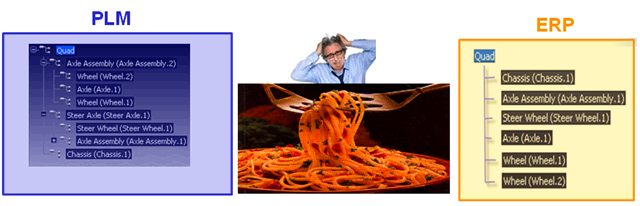
Apparently 2 years later Siemens Energy could not implement a clear distinct separation between PLM and ERP anymore and will not have to live with this complex interface. In the past I have written several times about this complexity that companies seem to accept due to political or historical reasons. Sad story for PLM – Where is the MBOM ?.

The day finished with a closing keynote from Peter Bilello, explaining how a successful PLM implementation could look like. Many wise statements that everyone should follow in case you want to come to a successful implementation (and define correctly what success is)
Thanks to Autodesk we had a nice evening reception, discussion and evaluating with peers the first day.
Day 2
 Day 2 started for me with an interesting lecture from Peter Fassbender, Head Design Center Fiat Latin America, describing how in Brazil the Fiat Mio experiment used modern social media techniques, like crowdsourcing, communities and user involvement to guide the innovation and development of a potential car. A unique experiment demonstrating that this type of projects are influence the brand reputation positively (if managed correct) and for me an example of what PLM could bring if R&D is connected to the outside world.
Christian Verstraete Chief Technologist – Cloud Strategy from HP gave an inspiring session about the open frontiers of innovation. The speed of business in the past 30 years has increased dramatically (you need to be from an older generation to be aware of this – the definition of response time has changed due to new technologies) Christian pushed everyone to think Out of the Box and to be innovative, which made me wonder how long will companies in the future build standard boring products. Will keep on innovating in this amazing pace as we did in the past 30 years ?
 Graeme Hackland, IT/IS director from the UK based Lotus F1 team presented the challenges a F1 team has to face every year due to changing regulations. I visited Lotus F1 last year and was impressed by the fact that over 500 engineers are all working around one carper year to optimize the car mainly for aerodynamics, but next to assure it performs during the years. Thousands of short interactions, changes to be implemented a.s.a.p. challenge the organization to collaborate in an optimum manner. And of course this is where PLM contributes. All the F1 fans could continue to dream and listen to Graeme’s stories but Jeremie Labbe from Processia brought us back to earth by explaining how Processia assisted Lotus F1 in a PLM value assessment as a next step.
Meanwhile I had some side discussions on various PLM topics and went back to the sessions, seeing how David Sherburne, Director of Global R&D Effectiveness from Carestream Health presented his case (open source PLM) and his analysis why an open source PLM model (based on Aras) is very appealing in their case. Indeed the business value perceived and significant lower operational costs for the software are appealing for his organization and for sure will influence the other PLM vendors in their pricing model.
Pierfrancesco Manenti, from IDC Manufacturing Insights gave a clear presentation indicating the future directions for PLM: managing operational complexity, not product complexity. As you could expect from IDC Manufacturing Insights all was well based on surveys in the manufacturing industry and clearly indicating that there is still a lot to do for companies to efficient share and work around a common product development and operational platform. New technologies (the four IT forces: mobility, cloud, social business and big data analytics) will help them to improve.

The closing keynote came from Jason Spyromilio , who was director of the European Southern Observatory’s Very Large Telescope (http://www.eso.org) and he gave us the insights in designing (and building) the biggest eye on the sky. Precision challenges for such a huge telescope mirror, being built in the high mountains of Chili in an earthquake sensitive area demonstrate that all participants are required to contribute their IQ in order to realize such a challenge.
Conclusion: This PLM Innovation 2012 event doubled the 2011 event from a year ago in all dimensions. Thanks to the sponsors, the organization and high quality lectures, I expect next year we could double again – in participants, in content and innovation. It shows PLM is alive. But comming back to the title of this post: I saw some interesting innovation concepts – now how to enabale them with PLM ?
Note: looking at the pictures in this postyou will notice PLM is everywhere. I published this post on February 29th – a unique day which happens only every 4 years. In May this year my blog will be 4 years old.

Since the past six months I am involved in several discussions related to the (building) construction industry. If you look to this industry, it seems like this is one of the few industries without innovation in its processes.
Someone in the discussion even claimed that if a worker from the middle ages would come back to this century, he would be quickly adapt and understand the way people work. OK, there are some new tools and materials, but the way the building construction industry works has not changed.
And let’s look to productivity. Where in the past 60 years in all industries productivity has increased, I have seen a survey where productivity in this industry has not increased and even decreased a little.

Although the survey ends in 2003, another article caught my attention. Robert Prieto, Senior Vice President from Fluor Corporation wrote end of last year in Engineering News Record his viewpoint: Engineering-Construction Needs a New Model. Reading this article and the comments demonstrates there is a need for innovation in the building construction industry.
Failure costs up to 15 % and delayed deliveries are considered normal business in this industry, where if this would be applied to mid-market companies in the manufacturing industry, they would have gone bankrupt due to claims and lost profit.
If we look at this industry, the first excuse you hear is that every project is unique and that project execution is done by a group of loose connected suppliers, not really pushed to stay within the targeted budget. But you might ask yourself: what is the correct budget?
 I noticed that in this industry when a project is estimated, suppliers are asked to deliver their bid and proposed solution based on their understanding. Usually the lowest bid wins the bid.
All participants are aware that not all requirements are clear, but no one wants to ask and invest further as to invest more in accurate cost estimation. This is not anticipated. It is about winning the bid with the lowest trouble and investment.
So who is to blame? First of all, the client who has a short term vision. By selecting the lowest bids and not pushing for in-depth analysis of the project delivery and operational costs in the long term, the situation will not change.
What if the client was using the basics of PLM – Product Lifecycle Management? For me PLM means a connection and sharing of the concept phase, the delivery phase, production phase and maintenance phase.
What I consider as strange is the fact that in the engineering and construction industry these four phases are not connected and often that the maintenance phase (operations) is not taken into account during the concept phase.
 And then there is the data handover. After engineering and construction specific data is handed over to the maintenance organization. What is the quality of the data, how applicable is it to the maintenance organization and how does it support maintenance is not clear. There is a disconnect and loss of knowledge as the handover is just based on the minimum data required.
What if the engineering construction industry would use PLM best practices, like:
- Requirements Management – connecting, implementing and validating all the requirements from each stakeholder. Making sure all requirements are considered and negotiated in a structured manner – no excuse for surprises.
- Data sharing with versions and status. Instead of a handover, data becomes mature during the lifecycle of the project. It requires the maintenance organization to be involved from the start
- Standardized validation and approval processes related to requirements and data. These processes might be considered as an overhead but they are the ones that lead to quality, risk and cost management
Conclusion: I believe connecting the engineering and maintenance phase for engineering construction companies will lead to higher productivity and quality. For sure the initial engineering cost will be higher, but during the construction and maintenance phase these costs will be recovered and probable much more – here is the ROI
As my intention was to write shorter blog posts this year, I stop at this point and look forward to your comments for a further discussion.
YOUR THOUGHTS ??
Related articles
- Why PLM 2.0 – Conclusions (virtualdutchman.com)
 Jos Voskuil's Weblog
Interesting reflection, Jos. In my experience, the situation you describe is very recognizable. At the company where I work, sustainability…
[…] (The following post from PLM Green Global Alliance cofounder Jos Voskuil first appeared in his European PLM-focused blog HERE.) […]
[…] recent discussions in the PLM ecosystem, including PSC Transition Technologies (EcoPLM), CIMPA PLM services (LCA), and the Design for…
Jos, all interesting and relevant. There are additional elements to be mentioned and Ontologies seem to be one of the…
Jos, as usual, you've provided a buffet of "food for thought". Where do you see AI being trained by a…