
You are currently browsing the category archive for the ‘Data centric’ category.
 My holidays are over. After reading and cycling a lot, it is time to focus again on business and future. Those of you who have followed my blog the past year must have noticed that I have been talking on a regular base about business moving to a data-oriented approach instead of a document / file-based approach. I wrote an introduction to this topic at the beginning of this year: Did you notice PLM has been changing?
It is part of a bigger picture, which some people might call the Second Machine Age, Industry 4.0, The Third Wave or even more disturbing The onrushing wave.
This year I have had many discussions around this topic with companies acting in various industries; manufacturing, construction, oil & gas, nuclear and general EPC-driven companies. There was some commonality in all these discussions:
- PLUS: Everyone believes it is a beautiful story and it makes sense
- MINUS: Almost nobody wants to act upon it as it is an enormous business change and to change the way a company works you need C-level understanding
- PLUS: Everyone thinks the concept is clear to them
- MINUS: Few understand what it means to work data-oriented and what the impact on their business would be
Therefore, what I will try to do in the upcoming blog posts (two-three-four ??) is to address the two negative observations and how to make them more precise.
What is data / information / knowledge?
 Data for me is a collection of small artifacts (numbers, characters, lines, sound bits, …) which have no meaning at all. This could be bundled together as a book, a paper drawing, a letter but also bundled together as a digital format like an eBook, a CAD file, an email and even transmission bytes of a network / internet provider can be considered as data.
 Data becomes significant once provided in the context of each other or in the context of other data. At that time, we start calling it information. For that reason, a book or a drawing provides information as the data has been structured in such a manner to become meaningful. The data sent through the network cable only becomes information when it is filtered and stripped from the irrelevant parts.
 Information is used to make decisions based on knowledge. Knowledge is the interpretation of information, which combined in a particular way, helps us to make decisions. And the more decisions we make and the more information we have about the results of these decisions, either by us or other, it will increase our knowledge.
Data and big data
Now we have some feeling about data, information and knowledge. For academics, there is room to discuss and enhance the definition. I will leave it by this simple definition.
Big data is the term for all digital data that is too large to handle in a single data management system, but available and searchable through various technologies. Data can come from any source around the world as through the internet an infrastructure exists to filter and search for particular data.
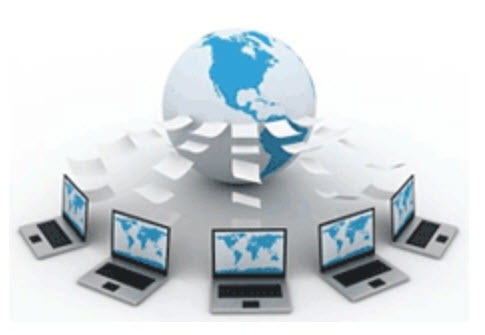 By analyzing and connecting the data coming from these various sources, you can generate information (placing the data in context) and build knowledge. As it is an IT-driven activity, this can be done in the background and give almost actual data to any person. This is a big difference with information handling in the old way, where people have to collect and connect manual the data.
The power of big data applies to many business areas. If you know how your customers are thinking and associating their needs to your products, you can make them better and more targeted to your potential market. Or, if you know how your products are behaving in the field during operation (Internet of Things) you can provide additional services, instant feedback and be more proactive. Plus the field data once analyzed provide actual knowledge helping you to make better products or offer more accurate services.
Wasn’t there big data before?
 Yes, before the big data era there was also a lot of information available. This information could be stored in “analogue” formats ( microfiche, paper, clay tablets, papyrus) or in digital formats, better known as files or collections of files (doc, pdf, CAD-files, ZIP….).
Note the difference. Here I am speaking about information as the data is contained in these formats.
You have to open or be in front of information container first, before seeing the data. In the digital world, this is often called document management, content management. The challenge of these information containers is that you need to change the whole container version once you modify one single piece of data inside it. And each information container holds duplicated information from a data element. Therefore, it is hard to manage a “single version of the truth” approach.
And here comes the data-oriented approach
The future is about storing all these pieces of data inside connected data environments, instead of storing a lot of data inside a (versioned) information container (a file / a document).
Managing these data elements in the context of each other allow people to build information from any viewpoint – project oriented, product oriented, manufacturing oriented, service oriented, etc.
The data remains unique, therefore supporting much closer the single version of the truth approach. Personally I consider the single version of the truth as a utopia, however reducing the amount of duplicated data by having a data-oriented approach will bring a lot more efficiency.
In my next post, I will describe an example of a data-oriented approach and how it impacts business, both from the efficiency point of view and from the business transformation point of view. As the data-oriented approach can have immense benefits . However, they do not come easy. You will have to work different.
Some more details
An important point to discuss is that this data-oriented approach requires a dictionary, describing the primary data elements used in a certain industry. The example below demonstrates a high-level scheme for a plant engineering environment.

Data standards exist in almost any industry or they are emerging and crucial for the longevity and usage of the data. I will touch it briefly in one of the upcoming posts, however, for those interested in this topic in relation to PLM, I recommend attending the upcoming PDT Europe. If you look at the agenda there is a place to learn and discuss a lot about the future of PLM.
I hope to see you there.
 Last week I attended the PI Apparel conference in London. It was the second time this event was organized and approximate 100 participants were there for two full days of presentations and arranged network meetings. Last year I was extremely excited about this event as the different audience, compare to classical PLM events, and was much more business focused.
Read my review from last year here: The weekend after PI Apparel 2013
This year I had the feeling that the audience was somewhat smaller, missing some of the US representatives and perhaps there was a slightly more, visible influence from the sponsoring vendors. Still an enjoyable event and hopefully next year when this event will be hosted in New York, it will be as active as last year.
Here are some of my observations.
Again the event had several tracks in parallel beside the keynotes, and I look forward in the upcoming month to see the sessions I could not attend. Obvious where possible I followed the PLM focused sessions.
 First keynote came from Micaela le Divelec Lemmi, Executive Vice President and Chief Corporate Operations Officer of Gucci. She talked us through the areas she is supervising and gave some great insights. She talked about how Gucci addresses sustainability through risk and cost control. Which raw materials to use, how to ensure the brands reputation is not at risk, price volatility and the war on talent. As Gucci is a brand in the high-end price segment, image and reputation are critical, and they have the margins to assure it is managed. Micaela spoke about the short-term financial goals that a company as Gucci has related to their investors. Topics she mentioned (I did not write them down as I was tweeting when I heard them) were certainly worthwhile to consider and discuss in detail with a PLM consultant.

Micaela further described Gucci´s cooperate social responsibility program with a focus on taking care of the people, environment and culture. Good to learn that human working conditions and rights are a priority even for their supply chain. Although it might be noted that 75 % of Gucci´s supply chain is in Italy. One of the few brands that still has the “Made in Italy” label.
My conclusion was that Micaela did an excellent PR job for Gucci, which you would expect for a brand with such a reputation. Later during the conference we had a discussion would other brands with less exclusivity and more operating in the mass consumer domain be able to come even close to such programs?
 Next Göktug and Hakan gave us their insights deploying their first PLM system at the AYDINLI group.
The company is successful in manufacturing and selling licensed products from Pierre Cardin, Cacharel and US Polo Association mainly outside the US and Western Europe.
Their primary focus was to provide access to the most accurate and most updated information from one source. In parallel, standardization of codes and tech packs was a driver. Through standardization quality and (re)use could be improved, and people would better understand the details. Additional goals are typical PLM goals: following the product development stages during the timeline, notify relevant users about changes in the design, work on libraries and reuse and integrate with SAP.
Interesting Hakan mentioned that in their case SAP did not recommend to use their system for the PLM related part due to lack of knowledge of the apparel industry. A wise decision which would need followup for other industries.
In general the PLM implementation described by Göktug and Hakan was well phased and with a top-down push to secure there is no escape to making the change. As of all PLM implementations in apparel they went live in their first phase rather fast as the complex CAD integrations from classical PLM implementations were not needed here.
Next I attended the Infor session with the title: Work the Way you Live: PLM built for the User. A smooth marketing session with a function / feature demo demonstrating the flexibility and configuration capabilities of the interface. Ease of use is crucial in the apparel industry, where Excel is still the biggest competitor. Excel might satisfy the needs from the individual, it lacks the integration and collaboration aspect a PLM system can offer.
 More interesting was the next session that I attended from Marcel Oosthuis, who was responsible as Process Re-Engineering Director (read PLM leader). Marcel described how they had implemented PLM at Tommy Hilfiger, and it was an excellent story (perhaps too good to be true).
I believe larger companies with the right focus and investment in PLM resources can achieve this kind of results. The target for Tommy Hilfiger´s PLM implementation was beyond 1000 users, therefore, a serious implementation.
Upfront the team defined first what the expected from the PLM system to select (excellent !!). As the fashion industry is fast, demanding and changing all the time, the PLM system needs to be Swift, Flexible and Prepared for Change. This was not a classical PLM requirement.
In addition, they were looking for a high-configurable system, providing best practices and a vendor with a roadmap they could influence. Here I got a little more worried as high-configurable and best practices not always match the prepared for change approach. A company might be tempted to automate the way they should work based on the past (best practices from the past)
It was good to hear that Marcel did not have to go into the classical ROI approach for the system. His statement, which I fully endorse that it is about the capability to implement new and better processes. They are often not comparable with the past (and nobody measured the past)
Marcel described how the PLM team (eight people + three external from the PLM vendor) made sure that the implementation was done with the involvement of the end users. End user adoption was crucial as also key user involvement when building and configuring the system.
It was one of the few PLM stories where I hear how all levels of the organization were connected and involved.
 Next Sue Butler, director from Kurt Salmon, described how to maximize ROI from your PLM investment. It is clear that many PLM consultants are aligned, and Sue brought up all the relevant points and angles you needed to look at for successful PLM implementation.
Main points: PLM is about changing the organization and processes, not about implementing a tool. She made a point that piloting the software is necessary as part of the learning and validation process. I agree on that under the condition that it is an agile pilot which does not take months to define and perform. In that case, you might be already locked in into the tool vision too much – focus on the new processes you want to achieve.
Moreover, because Sue was talking about maximize ROI from a PLM implementation, the topics focus on business areas that support evolving business processes and measure (make sure you have performance metrics) came up.
 The next session Staying Ahead of the Curve through PLM Roadmap Reinvention conducted by Austin Mallis, VP Operations, Fashion Avenue Sweater Knits, beautifully completed previous sessions related to PLM.
Austin nicely talked about setting the right expectations for the future (There is no perfect solution / Success does not mean stop / Keeping the PLM vision / No True End). In addition, he described the human side of the implementation. How to on-board everyone (if possible) and admitting you cannot get everyone on-board for the new way of working.
 Next in row was my presentation with potential the longest title: “How to transform your Business to ensure you Benefit from the Value PLM can deliver”.
Luckily the speakers before me that day already addressed many of the relevant topics, and I could focus on three main thoughts completing the story:
1. Who decides on PLM and Why?
I published the results from a small survey I did a month ago via my blog (A quick PLM survey). See the main results below.
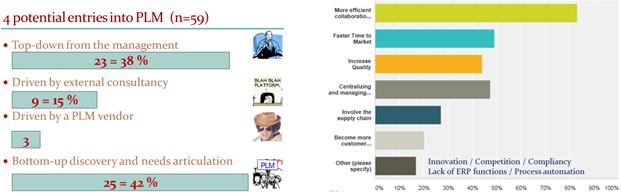
It was interesting to observe that both the management and the users in the field are the majority demanding for PLM. Consultants have some influence and PLM vendors even less. The big challenge for a company is that the management and consultants often talk about PLM from a strategic point of view, where the PLM vendor and the users in the field are more focused on the tool(s).
From the expectations you can see the majority of PLM implementations is about improving collaboration, next time to market, increase quality and centralizing and managing all related information.
2. Sharing data instead of owning data
(You might have read about it several times in my blog) and the trend that we move to platforms with connected data instead of file repositories. This should have an impact on your future PLM decisions.
3. Choosing the right people
The third and final thought was about choosing the right people and understanding the blocker. I elaborated on that topic already before in my recent blog post: PLM and Blockers
My conclusions for the day were:
A successful PLM implementation requires a connection in communication and explanation between all these levels. These to get a company aligned and have an anchored vision before even starting to implement a system (with the best partner)
 The day was closed by the final keynote of the day from Lauren Bowker heading T H E U N S E E N. She and her team are exploring the combinations of chemistry and materials to create new fashion artifacts. Clothes and materials that change color based on air vent, air pollution or brain patterns. New and inspiring directions for the fashion lovers.
Have a look here: http://seetheunseen.co.uk/
The morning started with Suzanne Lee, heading BioCouture who is working on various innovative methodologies to create materials for the apparel industry by using all kind of live micro-organisms like bacteria, fungi and algae and using materials like cellulose, chitin and protein fibers, which all can provide new possibilities for sustainability, comfort, design, etc. Suzanne´s research is about exploring these directions perhaps shaping some new trends in the 5 – 10 years future ahead. Have a look into the future here:
 Renate Eder took us into the journey of visualization within Adidas, with her session: Utilizing Virtualization to Create and Sell Products in a Sustainable Manner.
It was interesting to learn that ten years ago she started the process of having more 3D models in the sales catalogue. Where classical manufacturing companies nowadays start from a 3D design, here at Adidas at the end of the sales cycle 3D starts. Logical if you see the importance and value 3D can have for mass market products.
Adidas was able to get 16000 in their 3D catalogue thanks to the work from 60 of their key suppliers who were fully integrated in the catalogue process. The benefit from this 3D catalogue was that their customers, often the large stores, need lesser samples, and the savings are significant here (plus a digital process instead of transferring goods).
Interesting discussion during the Q&A part was that the virtual product might even look more perfect than the real product, demonstrating how lifelike virtual products can be.
And now Adidas is working further backwards from production patterns (using 3D) till at the end 3D design. Although a virtual 3D product cannot 100 % replace the fit and material feeling, Renate believes that also introducing 3D during design can reduce the work done during pilots.
Finally for those who stayed till the end there was something entirely different. Di Mainstone elaborating on her project: Merging Architecture & the Body in Transforming the Brooklyn Bridge into a Playable Harp. If you want something entirely different, watch here:
Conclusion
The apparel industry remains an exciting industry to follow. For some of the concepts – being data-centric, insane flexible, continuous change and rapid time to market are crucial here.
This might lead development of PLM vendors for the future, including using it based on cloud technology.
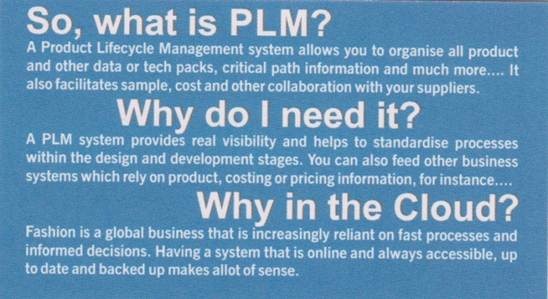
From the other side, the PLM markets in apparel is still very basic and learning, see this card that I picked up from one of the vendors. Focus on features and functions, not touching the value (yet)
 In my previous post, I wrote about the different ways you could look at Service Lifecycle Management (SLM), which, I believe, should be part of the full PLM vision. The fact that this does not happen is probably because companies buy applications to solve issues instead of implementing a consistent company wide vision (When and Where to start is the challenge). Oleg Shilovitsky just referred one more time to this phenomena – Why PLM is stuck in PDM.
I believe PLM as the enterprise information backbone for product information. I will discuss the logical flow of data that might be required in a PLM data model, to support SLM. Of course all should be interpreted in the context of the kind of business your company is in.
This post is probably not the easiest to digest as it assumes you are somehow aware and familiar with the issues relevant for the ETO (Engineering To Order) /EPC (Engineering Procurement Construction) /BTO (Build To Order) business
A collection of systems or a single device
The first significant differentiation I want to make is between managing an installation or a single device as I will focus only on installations.
 An installation can be a collection of systems, subsystems, equipment and/or components, typically implemented by companies that deliver end-to-end solutions to their customers. A system can be an oil rig, a processing production line (food, packages, …), a plant (processing chemicals, nuclear materials), where maintenance and service can be performed on individual components providing full traceability.
Most of the time a customer specific solution is delivered to a customer, either direct or through installation / construction partners. This is the domain I will focus on.
 I will not focus on the other option for a single device (or system) with a unique serial number that needs to be maintained and serviced as a single entity. For example a car, a computer device. Usually a product for mass consumption, not to be traced individually.
In order to support SLM at the end of the PLM lifecycle, we will see a particular data model is required which has dependencies on the early design phases.
Let´s go through the lifecycle stages and identify the different data types.
The concept / sales phase
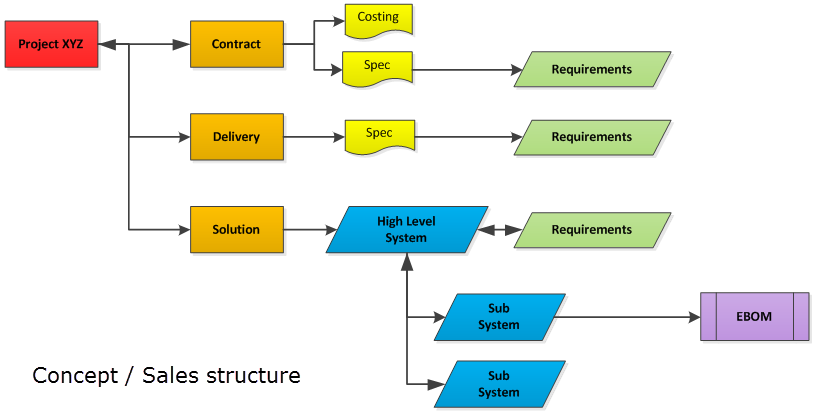
In the concept/sales phase the company needs to have a template structure to collect and process all the information shared and managed during their customer interaction.
In the implementations that I guided, this was often a kind of folder structure grouping information into a system view (what do we need), a delivery view (how and when can we deliver), a services view (who does what ) and a contractual view (cost, budget, time constraints). Most of these folders had initially relations to documents. However the system view was often already based on typical system objects representing the major systems, subsystems and components with metadata.
In the diagram, the colors represent various data types often standard available in a rich PLM data model. Although it can be simplified by going back to the old folder/document approach shared on a server, you will recognize the functional grouping of the information and its related documents, which can be further detailed into individual requirements if needed and affordable. In addition, a first conceptual system structure can already exist with links to potential solutions (generic EBOMs) that have been developed before. A PLM system provides the ideal infrastructure to store and manage all data in context of each other.
The Design phase
Before the design phase starts, there is an agreement around the solution to be delivered. In that situation, an as-sold system structure will be leading for the project delivery, and later this evolved structure will be the reference structure for the as-maintained and as-services environment.
A typical environment at this stage will support a work breakdown structure (WBS), a system breakdown structure (SBS) and a product breakdown structure (PBS). In cases where the location of the systems and subsystems are relevant for the solution, a geographical breakdown structure (GBS) can be used. This last method is often used in shipbuilding (sections / compartments) and plant design (areas / buildings / levels) and is relevant for any company that needs to combine systems and equipment in shared locations.
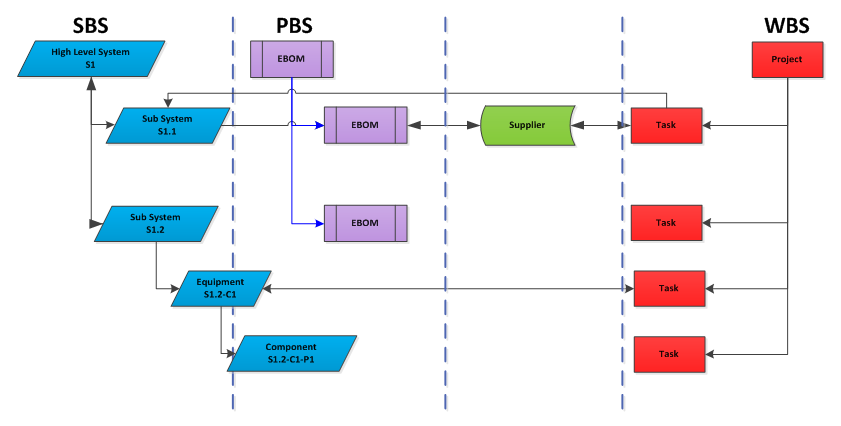
The benefit of having the system breakdown structure is that it manages the relations between all systems and subsystems. Potentially when a subsystem will be delivered by a supplier this environment supports the relationship to the supplier and the tracking of the delivery related to the full system / project.
Note: the system breakdown structure typically uses a hierarchical tag numbering system as the primary id for system elements. In a PLM environment, the system breakdown elements should be data objects, providing the metadata describing the performance of the element, including the mandatory attributes that are required for exchange with MRO (Maintenance Repair Overhaul) systems.
Working with a system breakdown structure is common for plant design or a asset maintenance project and this approach will be very beneficial for companies delivering process lines, infrastructure projects and other solutions that need to be delivered as a collection of systems and equipment.
The delivery phase
During the delivery phase, the system breakdown structure supports the delivery of each component in detail. In the example below you can see the relation between the tag number, the generic part number and the serial number of a component.
The example below demonstrates the situation where two motors (same item – same datasheet) is implemented at two positions in a subsystem with a different tag number, a unique serial number and unique test certificates per motor.
The benefit of a system breakdown structure here is that it supports the delivery of unique information per component that needs to be delivered and verified on-site. Each system element becomes traceable.
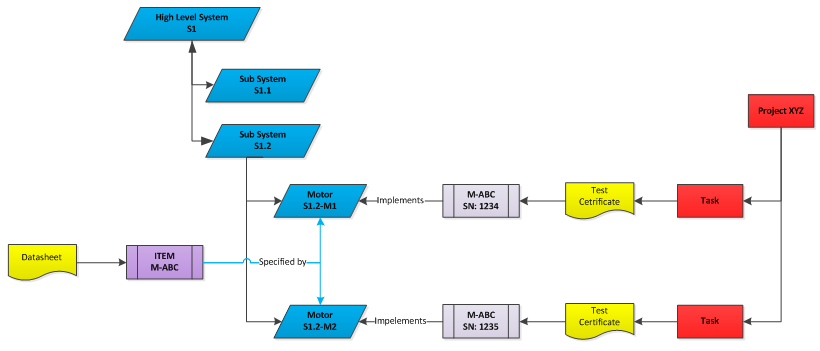
The maintenance phase
For the maintenance phase the system breakdown structure (or a geographical breakdown structure) could be the place holder to follow up the development of an installation at a customer site.
Imagine that, in the previous example, the motor with tag number S1.2-M2 appears to be under dimensioned and needs to be replaced by a more powerful one. The situation after implementing this change would look like the following picture:
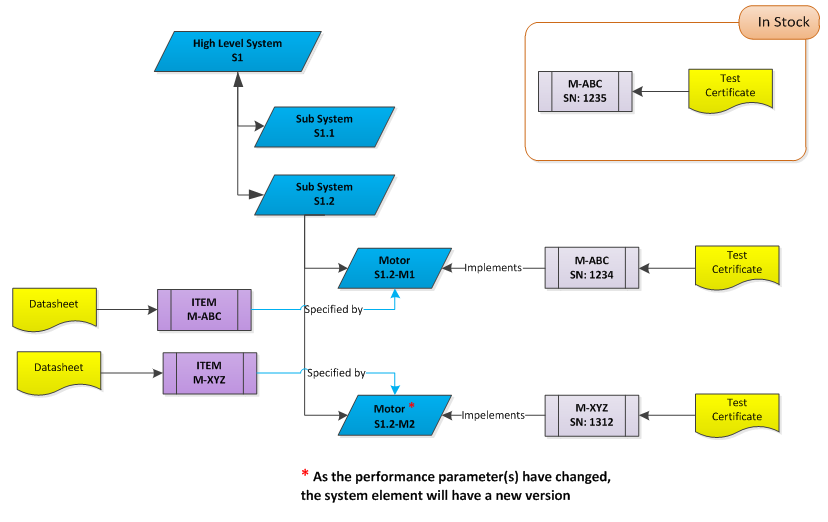
Through the relationships with the BOM items (not all are shown in the diagram), there is the possibility to perform a where-used query and identify other customers with a similar motor at that system position. Perhaps a case for preventive maintenance?
Note: the diagram also demonstrates that the system breakdown structure elements should have their own lifecycle in order to support changes through time (and provide traceability).
From my experience, this is a significant differentiator PLM systems can bring in relation to an MRO system. MRO and ERP (Enterprise Resource Planning)systems are designed to work with the latest and actual data only. Bringing in versioning of assets and traceability towards the initial design intent is almost impossible to achieve for these systems (unless you invest in a heavy customized system).
Conclusion
In this post and my previous post, I tried to explain the value of having at least a system breakdown structure as part of the overall PLM data model. This structure supports the early concept phase and connects data from the delivery phase to the maintenance phase.
Where my mission in the past 8 years was teaching non-classical PLM industries the benefits of PLM technology and best practices, in this situation you might say it is where classical BTO companies can learn from best practices from the process and oil & gas industry.
Note: Oleg just published a new blog post: PLM Best Practices and Henry Ford Mass Production System where he claims PLM vendors, Service partners and consultants like to sell Best Practices and still during implementation discover mass customization needs to be made to become customer specific, therefore, the age of Best Practices is over.
I agree with that conclusion, as I do not believe in an Out-Of-The-Box approach, to lead a business change.
Still Best Practices are needed to explain to a company what could be done and in that context without starting from a blank sheet.
Therefore I have been sharing this Best Practice (for free)
Everyone wants to be a game changer and in reality almost no one is a game changer. Game changing is a popular term and personally I believe that in old Europe and probably also in the old US, we should have the courage and understanding changing the game in our industries.
Why ? Read the next analogy.
1974
With my Dutch roots and passion for soccer, I saw the first example of game changing happening in 1974 with soccer. The game where 22 players kick a ball from side to side, and the Germans win in the last minute.
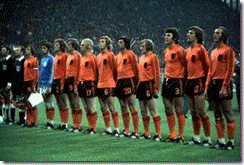 My passion and trauma started that year where the Dutch national team changed the soccer game tactics by introducing totaalvoetbal.
The Dutch team at that time coached by Rinus Michels and with star player Johan Cruyff played this in perfection.
Defenders could play as forwards and they other way around. Combined with the offside-trap; the Dutch team reached the finals of the world championship soccer both in 1974 and 1978. Of course losing the final in both situations to the home playing teams (Germany in 74 – Argentina in 78 with some help of the referee we believe)
This concept brought the Dutch team for several years at the top, as the changed tactics brought a competitive advantage. Other teams and players, not educated in the Dutch soccer school could not copy that concept so fast
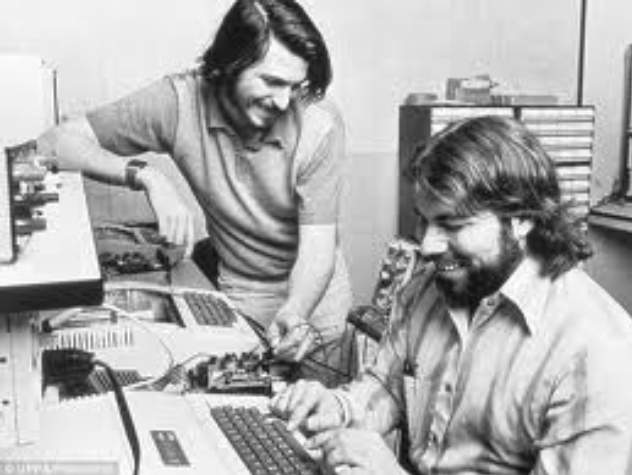
At the same time, there was a game changer for business upcoming in 1974, the PC.
On the picture, you see Steve Jobs and Steve Wozniak testing their Apple 1 design. The abbreviation IT was not common yet and the first mouse device and Intel 8008 processor were coming to the market.
This was disruptive innovation at that time, as we would realize 20 years later. The PC was a game changer for business.
2006
Johan Cruyff remained a game changer and when starting to coach and influence the Barcelona team, it was his playing concept tika-taka that brought the Spanish soccer team and the Barcelona team to the highest, unbeatable level in the world for the past 8 years
![clip_image002[6]](https://virtualdutchman.com/wp-content/uploads/2014/01/clip_image0026.gif "clip_image002[6]") Instead of having strong and tall players to force yourself to the goal, it was all about possession and control of the ball. As long as you have the ball the opponent cannot score. And if you all play very close together around the ball, there is never a big distance to pass when trying to recapture the ball.
Instead of having strong and tall players to force yourself to the goal, it was all about possession and control of the ball. As long as you have the ball the opponent cannot score. And if you all play very close together around the ball, there is never a big distance to pass when trying to recapture the ball.
This was a game changer, hard to copy overnight, till the past two years. Now other national teams and club teams have learned to use these tactics too, and the Spanish team and Barcelona are no longer lonely at the top.
Game changers have a competitive advantage as it takes time for the competition to master the new concept. And the larger the change, the bigger the impact on business.
Also, PLM was supposed to be a game changer in 2006. The term PLM became more and more accepted in business, but was PLM really changing the game ?
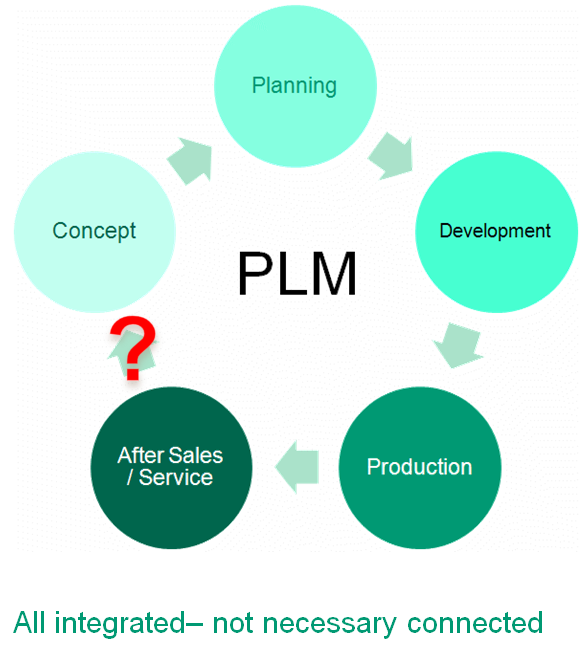 PLM at that time was connecting departments and disciplines in a digital manner with each other, no matter where they were around the globe. And since the information was stored in centralized places, databases and file sharing vaults, it created the illusion that everyone was working along the same sets of data.
The major successes of PLM in this approach are coming from efficiency through digitization of data exchange between departments and the digitization of processes. Already a significant step forward and bringing enough benefits to justify a PLM implementation.
Still I do not consider PLM in 2006 a real game changer. There was often no departmental or business change combined with it. If you look at the soccer analogy, the game change is all about a different behavior to reach the goal, it is not about better tools (or shoes).
The PLM picture shows the ideal 2006 picture, how each department forwards information to the next department. But where is PLM supporting after sales/services in 2006 ? And the connection between After Sales/Services and Concept is in most of the companies not formalized or existing. And exactly that connection should give the feedback from the market, from the field to deliver better products.
The real game changer starts when people learn and understand sharing data across the whole product or project lifecycle. The complexity is in the word sharing. There is a big difference between storing everything in a central place and sharing data so other people can find it and use it.
 People are not used to share data. We like to own data, and when we create or store data, we hate the overhead of making data sharable (understandable) or useful for others. As long as we know where it is, we believe our job is safe.
But our job is no longer safe as we see in the declining economies in Europe and the US. And the reason for that:
Data is changing the game
In the recent years the discussion about BI (Business Intelligence) and Big Data emerged. There is more and more digital information available. And it became impossible for companies to own all the data or even think about storing the data themselves and share it among their dispersed enterprises. Combined with the rise of cloud-based platforms, where data can be shared (theoretically) no matter where you are, no matter which device you are using, there is a huge potential to change the game.
It is a game changer as it is not about just installing the new tools and new software. There are two major mind shifts to make.
- It is about moving from documents towards data. This is an extreme slow process. Even if your company is 100 % digital, it might be that your customer, supplier still requires a printed and wet-signed document or drawing, as a legal confirmation for the transaction. Documents are comfortable containers to share, but they are killing for fast and accurate processing of the data that is inside them.
- It is about sharing and combining data. It does not make sense to dump data again in huge databases. The value only comes when the data is shared between disciplines and partners. For example, a part definition can have hundreds of attributes, where some are created by engineering, other attributes created by purchasing and some other attributes directly come from the supplier. Do not fall in the ERP-trap that everything needs to be in one system and controlled by one organization.
 Because of the availability of data, the world has become global and more transparent for companies. And what you see here is that the traditional companies in Europe and the US struggle with that. Their current practices are not tuned towards a digital world, more towards the classical, departmental approach. To change this, you need to be a game changer, and I believe many CEOs know that they need to change the game.
The upcoming economies have two major benefits:
- Not so much legacy, therefore, building a digital enterprise for them is easier. They do not have to break down ivory towers and 150 years of proud ownership.
- The average cost of labor is lower than the costs in Europe and the US, therefore, even if they do not do it right at the first time; there is enough margin to spend more resources to meet the objectives.
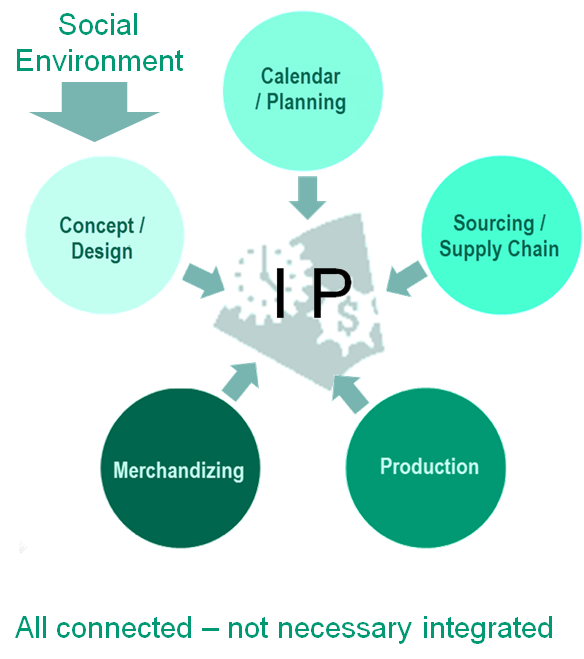 The diagram I showed in July during the PI Apparel conference was my interpretation of the future of PLM. However, if you analyze the diagram, you see that it is not a 100 % classical PLM scope anymore. It is also about social interaction, supplier execution and logistics. These areas are not classical PLM domains and therefore I mentioned in the past, the typical PLM system might dissolve in something bigger. It will be all about digital processes based on data coming for various sources, structured and unstructured. Will it still be PLM or will we call it different ?
The big consultancy firms are all addressing this topic – not necessary on the PLM level:
2012 Cap Gemini – The Digital advantage: …..
2013 Accenture – Dealing with digital technology’s disruptive impact on the workforce
2014 McKinsey – Why every leader should care about digitization and disruptive innovation
For CEOs it is important to understand that the new, upcoming generations are already thinking in data (generation Y and beyond). By nature, they are used to share data instead of owning data in many aspects. Making the transition to the future is, therefore, also a process of connecting and understanding the future generations. I wrote about it last year: Mixing past and future generations with a PLM sauce
This cannot be learned from an ivory tower. The easiest way is not to be worried by this trend and continue working as before, losing business and margin slowly year by year.
As in many businesses people are fired for making big mistakes, doing nothing unfortunate is most of the time not considered as a big mistake, although it is the biggest mistake.
 During the upcoming PI Conference in Berlin I will talk about this topic in more detail and look forward to meet and discuss this trend with those of you who can participate.
The soccer analogy stops here, as the data approach kills the the old game.
In soccer, the maximum remains 11 players on each side and one ball. In business, thanks to global connectivity, the amount of players and balls involved can be unlimited.
![clip_image002[8]](https://virtualdutchman.com/wp-content/uploads/2014/01/clip_image0028.gif "clip_image002[8]") A final observation:
A final observation:
In my younger days, I celebrated many soccer championships, still I am not famous as a soccer player.
Why ?
Because the leagues I was playing in, were always limited in scope: by age, local,regional, etc. Therefore it was easy to win in a certain scope and there are millions of soccer champions beside me. For business, however, there are almost no borders.
Global competition will require real champions to make it work !!!
 Jos Voskuil's Weblog
Interesting reflection, Jos. In my experience, the situation you describe is very recognizable. At the company where I work, sustainability…
[…] (The following post from PLM Green Global Alliance cofounder Jos Voskuil first appeared in his European PLM-focused blog HERE.) […]
[…] recent discussions in the PLM ecosystem, including PSC Transition Technologies (EcoPLM), CIMPA PLM services (LCA), and the Design for…
Jos, all interesting and relevant. There are additional elements to be mentioned and Ontologies seem to be one of the…
Jos, as usual, you've provided a buffet of "food for thought". Where do you see AI being trained by a…