
You are currently browsing the category archive for the ‘Cloud’ category.
 It is interesting to read management books and articles and reflect the content in the context of PLM. In my previous post How the brain blocks PLM acceptance and in Stephen Porter´s (not yet finished) serial The PLM state: the 7 habits of highly effective PLM adoption, you can discover obvious points that we tend to forget in the scope of PLM as we are so focused on our discipline.
 This summer holiday I was reading the Innovator´s Dilemma: When New Technologies Cause Great Firms to Fail by Clayton Christensen. Christensen is an associated professor at the Harvard Business School and he published this book already in 1997. Apparently not everyone has read the book and I recommend that if you are involved in the management of a PLM company to read it.
Sustaining technology
Christensen states there are two types of technologies. Leading companies are supporting their customers and try to serve them better and better by investing a lot in improving their current products. Christensen calls this sustaining technology as the aim is to improve existing products. Sustaining technologies lead to every time more and more effort to improve the current product performance and capabilities due to the chosen technology and solution concepts. These leading companies are all geared up around this delivery process and resources are optimized to sustain leadership, till ….
Disruptive technology
The other technology Christensen describes is disruptive technology, which initially is not considered as competition for existing technologies as it under performs in the same scope, so no way to serve the customer in the same way. The technology underperforms if you would apply to the same market, but it has unique capabilities that make it fit for another market. Next if the improvement path of disruptive technology can be faster than the improvement path for the sustaining technology, it is possible that their paths meet at a certain point. And although coming from a different set of capabilities, due to the faster improvement process the disruptive technology becomes the leading one and companies that introduced the disruptive technology became the new market leaders.
Why leading companies failed..
 Christensen used the disk drive industry as an example as there the change in technology was so fast that it was a perfect industry to follow it´s dynamics. Later he illustrates the concepts with examples from other industries where the leading firms failed and stopped to exist because disruptive technologies overtook them and they were not able to follow that path too.
Although the leading companies have enough resources and skills, he illustrates that it is a kind of logical path – big companies will always fail as it is in their nature to focus on sustaining technology. Disruptive technologies do not get any attention as they are targeting a different unclear market in the beginning and in addition it is not clear where the value from this disruptive technology comes from, so which manager wants to risk his or her career to focus on something uncertain in an existing company.
Christensen therefore advises these leading companies, if they expect certain technologies to become disruptive for their business, to start a separate company and take a major share position there. Leave this company focus on its disruptive technology and in case they are successful and cross the path of the sustaining technology embed them again in your organization. Any other approach is almost sure to fail, quote:
Expecting achievement-driven employees in a large organization to devote critical mass of resources, attention and energy to disruptive projects targeted at a small market is equivalent to flapping one´s arms in an effort to fly

As the book was written in 1997, it was not in the context of PLM. Now let´s start with some questions.
Is ERP in the stage of sustaining technology?
 Here I would say Yes. ERP vendors are extending their functional reach to cover more than the core functionality for two reasons: they need continuous growth in revenue and their customers ask for more functionality around the core. For sustaining technologies Christensen identifies four stages. Customers select a product for functionality, when other vendors have the same functionality reliability becomes the main differentiation. And after reliability the next phase is convenience and finally price.
From my personal observations, not through research, I would assume ERP for the major vendors is in the phase between convenience and price. If we follow Christensen´s analysis for SAP and Oracle it means they should not try to develop disruptive technologies inside their organization, neither should they try to downscale their product for the mid-market or add a different business model. Quote:
What goes up – does not go down. Moving to a high-end market is possible (and usually the target) – they will not go to small, poor defined low-end markets
How long SAP and Oracle will remain market leaders will depend on disruptive technologies that will meet the path of ERP vendors and generate a new wave. I am not aware of any trends in that area as I am not following the world of ERP closely
Is PLM in the stage of sustaining technology?
 Here I would say No because I am not sure what to consider as a clear definition of PLM. Different vendors have a different opinion of what a PLM system should provide as core technologies. This makes it hard to measure it along the lifecycle of sustaining technology with the phases: functionality, reliability, convenience and price.
Where the three dominant PLM providers (DS/PTC/Siemens) battle in the areas of functionality, reliability and convenience others are focusing on convenience and price.
Some generalized thoughts passed my mind:
- DS and PTC somehow provoke their customers by launching new directions where they believe the customer will benefit from. This somehow makes it hard to call it sustaining technology.
- · Siemens claiming they develop their products based on what customers are asking for. According to Christensen they are at risk in the long term as customers keep you captive and do not lead you to disruptive technologies.
- · All three focus on the high-end and should not aim for smaller markets with the same technology. This justifies within DS the existence of CATIA and SolidWorks and in Siemens the existence of NX and SolidEdge. Unifying them would mean the end of their mid-market revenue and open it for others.
Disruptive technologies for PLM
Although PLM is not a sustained technology to my opinion, there are some disruptive technologies that might come into the picture of mainstream PLM.
 First of all there is the Open Source software model, introduced by Aras, which initially is not considered as a serious threat for the classical PLM players – “big customers will never rely on open source”. However the Open Source model allows product improvements to move faster than main stream, reaching at a certain point the same level of functionality, reliability and convenience. The risk for Open Source PLM is that it is customer driven, which according Christensen is the major inhibitor for disruptive steps in the future
 Next there is the cloud. Autodesk PLM and Kenesto are the two most visible companies in this domain related to PLM. Autodesk is operating from a comfort zone – it labels its product PLM, it does not try to match what the major PLM vendors try to do and they come from the small and medium mid-size market. Not too many barriers to come into the PLM mid-market in a disruptive manner. But does the mid-market need PLM? Is PLM a bad annotation for its cloud based product? Time will tell.
The management from Kenesto obviously has read the book. Although the initially concept came from PLM++ (bad marketing name), they do not to compete with mainstream PLM and aim their product at a different audience – business process automation. Then if their product picks up in the engineering / product domain, it might enter the PLM domain in a disruptive manner (all according to the book – they will become market leaders)
 Finally Search Based Applications which are also a disruptive technology for the PLM domain. Many companies struggle with the structured data approach a classical PLM system requires and especially for mid-market companies this overhead is a burden. They are used to work in a cognitive manner, the validation and formalization is often done in the brain of experienced employees. Why cannot search based technology not be used to create structured data and replace or support the experienced brain?
If I open my Facebook page, I see new content related to where I am, what I have been saying or surfing for. Imagine an employee´s desktop that works similar, where your data is immediately visible and related information is shown. Some of the data might come from the structured system in the background, other might be displayed based on logical search criteria; the way our brain works. Some startups are working in this direction and Inforbix (congratulations Oleg & team) has already been acquired by Autodesk or Exalead by DS.
For both companies if they believe in the above concept, they should remain as long as possible independent from the big parent company as according to Christensen they will not get the right focus and priorities if they are part of the sustainable mainstream technology
Conclusion
This blog post was written during a relaxing holiday in Greece. The country here is in a crisis, they need disruptive politicians. They did it 3500 years ago and I noticed the environment is perfect for thinking as you can see below.
Meanwhile I am looking forward to your thoughts on PLM, in which state we are what the disruptive technologies are.



 Sorry for the provoking title in a PLM blog, but otherwise you would not read my post till the end.
In the past months I have been working closely with several large companies (not having a mid-market profile). And although they were all in different industries and have different business strategies, they still had these common questions and remarks:
- How to handle more and more digital data and use it as valuable information inside the company or for their customers / consumers ?
- What to do with legacy data (approved in the previous century) and legacy people (matured and graduated in the previous century) preventing them to change ?
- We are dreaming of a new future, where information is always up-to-date and easy to access – will this ever happen ?
- They are in the automotive industry, manufacturing industry, infrastructure development and maintenance, plant engineering, construction and plant maintenance
- They all want data to be managed with (almost) zero effort
- And please, no revolution or change for the company
Although I have been focusing on the mid-market, it is these bigger enterprises that introduce new trends and as you can see from the observations above, there is a need for a change. But also it looks like the demands are in a contradiction to each other.
I believe it is just about changing the game.
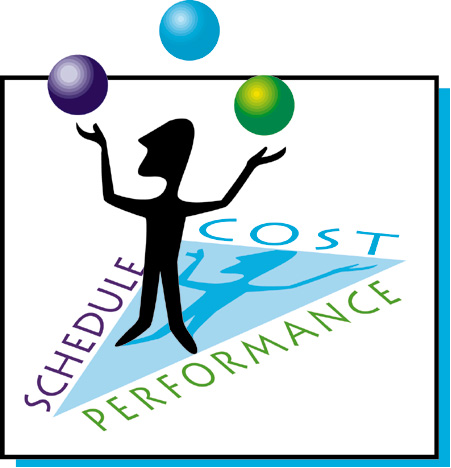
If you look at the picture to the left, you see one of the contradictions that lead to PLM.
Increasing product quality, reducing time to market and meanwhile reducing costs seemed to be a contradiction at that time too.
Change ?
Although PLM has not been implemented (yet) in every company that could benefit from it, it looks like the bigger enterprises are looking for more.
 the P from PLM becomes vague – it is no longer only the product that has the focus, it is also the whole context around the product that might influence it, that they want to take in consideration
the L from PLM remains – they still want to connect all information that is related to the lifecycle of their products or plants.
the M from Management has a bad association – companies believe that moving from their current state towards a managed environment of data is a burden. Too much overhead is the excuse to not manage dat. And their existing environments to manage data do not excel in user-friendliness. And therefore people jump towards using Excel.
Next
So if the P is not longer relevant, the M is a burden, what remains of PLM ?
Early June I presented at the Dassault Systems 3DExperience forum the topic of digital Asset Lifecycle Management for owners / operators. One of the areas where I believe PLM systems can contribute a lot to increase business value and profitability (quality and revenue – see using a PLM system for Asset Lifecycle Management )
Attending the key note speech it was clear that Dassault Systems does not talk about PLM anymore as a vision. Their future dream is a (3D) lifelike experience of the virtual world. And based on that virtual model, implement the best solution based on various parameters: revenue, sustainability, safety and more. By trying to manage the virtual world you have the option to avoid real costly prototypes or damaging mistakes.
I believe it is an ambitious dream but it fits in the above observations. There is more beyond PLM.
In addition I learned from talking with my peers (the corridor meetings) that also Siemens and PTC are moving towards a more industry or process oriented approach, trying to avoid the association with the generic PLM label.
Just at the time that Autodesk and the mid-market started to endorse PLM, the big three are moving away from this acronym.
This reminds me of what happened in the eighties when 3D CAD was introduced. At the time the mid-market was able to move to mainstream 3D (price / performance ratio changed dramatically) the major enterprises started to focus on PDM and PLM. So it is logical that the mid-market is 10 – 15 years behind new developments – they cannot afford experiments with new trends.
So let’s see what are the new trends:
- the management of structured and unstructured data as a single platform. We see the rise of Search Bases Application and business intelligence based on search and semantic algorithms. Using these capabilities integrated with a structured (PLM ? ) environment is the next big thing.
- Apps instead of generic applications that support many roles. The generic applications introduce such a complexity to the interface that they become hard to use by a casual user. Most enterprise systems, but also advanced CAD or simulation tools with thousands of options suffer from this complexity. Would not it be nice if you only had to work with a few dedicated apps as we do in our private life ?
- Dashboards (BI) that can be created on the
fly representing actual data and trends based
on structured and unstructured data.
It reminded me of a PLM / ERP discussion I had with a company, where the general manager all the time stated the types of dashboards he wanted to see. He did not talk about PLM, ERP or other systems – he wanted the on-line visibility - Cloud services are coming. Not necessary centralizing all data on the cloud to reduce it cost. But look at SIRE and other cloud services that support a user with data and remote processing power at the moment required.
- Visual navigation through a light 3D Model providing information when required. This trend is not so recent but so far not integrated with other disciplines, the Google maps approach for 3D.

So how likely are these trends to change enterprise systems like PLM, ERP or CRM. In the table below I indicated where it could apply:
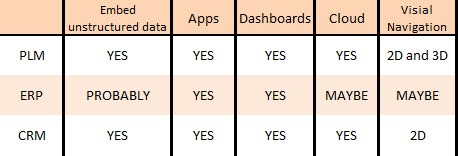
As you can see the PLM row has all the reasons to introduce new technologies and change the paradigm. For that reason combined with the observations I mentioned in the beginning, I am sure there is a new TLA (Three Letter Acronym) upcoming.
The good news is that PLM is dynamic and on the move. The bad news for potential PLM users is that the confusion remains – too many different PLM definitions and approaches currently – so what will be the next thing after PLM ?
Conclusion: The acronym PLM is not dead and becomes mainstream. On the high-end there is for sure a trend to a wider and different perspective of what was initially called PLM. After EDM, TDM, PDM and PLM we are waiting for the next TLA
May 24th, 2008 was the date I posted my first blog post as a Virtual Dutchman aiming to share PLM related topics for the mid-market.
I tried to stay away from technology and function/feature debates and based on my day to day observations, describe the human side of the PLM – what people do and why . All from a personal perspective and always open to discuss and learn more.
Looking back and reviewing my 86 posts and 233 comments so far, I would like to share a summary around some of the main topics in my blog.
PLM
 In 2008, PLM awareness was much lower – at that time one of the reasons for me to start blogging. There was still a need to explain that PLM was a business strategy needed beside ERP and PDM.
PLM will bring more efficiency, and in better quality, new innovative products to the market due to better collaboration between teams and departments.
At that time the big three, Dassault Systemes, Siemens and PTC were all offering a very CAD-centric, complex approach for PLM. There was no real mid-market offering, although their marketing organizations tried to sell as-if a mid-marketing offering existed. Express, Velocity, ProductPoint where are these offerings now ?
Now, In 2012 there is an established PLM awareness as everyone is talking about (their interpretation of) PLM and with Autodesk, a company that knows how to serve the mid-market, also acknowledged there is a need for PLM in their customer base, the term PLM is widespread
The new PLM providers focus on a disconnect between PDM and PLM, as in particular the handling of enterprise data outside the PDM scope is a white space for many mid-market companies that need to operate on a global platform.
PLM & ERP
 In the relation between PLM and ERP, I haven’t seen a big change the past four years. The two dominating ERP originated vendors, SAP and Oracle were paying attention to PLM in 2008 in their marketing and portfolio approach.
However their PLM offerings in my perception, haven’t moved much forward. SAP is selling ERP and yes there is a PLM module and Oracle is having PLM systems, but I haven’t seen a real targeted PLM campaign explaining the needs and value of PLM integrated with ERP.
Historically ERP is the main IT-system and gets all the management attention. PLM is more considered something for engineering (and gets less focus and budget). Understanding PLM and how it connects to ERP remains a point of attention and the crucial point of interaction is the manufacturing BOM and the place where it is defined. The two most read posts from my blog are: Where is the MBOM and next Bill of Materials for Dummies – ETO, indicating there is a lot of discussion around this topic.
I am happy to announce here that in October this year during PLM Innovation US, I will present and share my thoughts in more detail with the audience, hoping for good discussions
New trends
There are three new trends that became more clear the past four years.
 The first one to mention is the upcoming of Search Based Applications (SBA). Where PLM systems require structured and controlled data, search based applications assist the user by “discovering” data anywhere in the organization, often in legacy systems or possible in modern communication tools.
I believe companies that develop an integrated concept of PLM and SBA can benefit the most. PLM and ERP vendors should think about combining these two approaches in an integrated offering. I wrote about this combined topic in my post: Social Media and PLM explained for Dummies
 The second trend is the cloud. Where two-three years ago social media combined with PLM was the hype as a must for product innovation and collaboration, currently cloud is in focus.
Mainly driven and coming for the US, where the big marketing engine from Autodesk is making sure it is on the agenda of mid-market companies.
In Europe there is less a hype at this moment, different countries and many languages to support plus discussions around security take the overhand here.
For me a cloud solution for sure is lowering the threshold for mid-market companies to start implementing PLM. However how to make the change in your company ? It is not only an IT-offering. Like a similar discussion around Open Source PLM, there is still a need to provide the knowledge and change push inside a company to implement PLM correct. Who will provide these skills ?
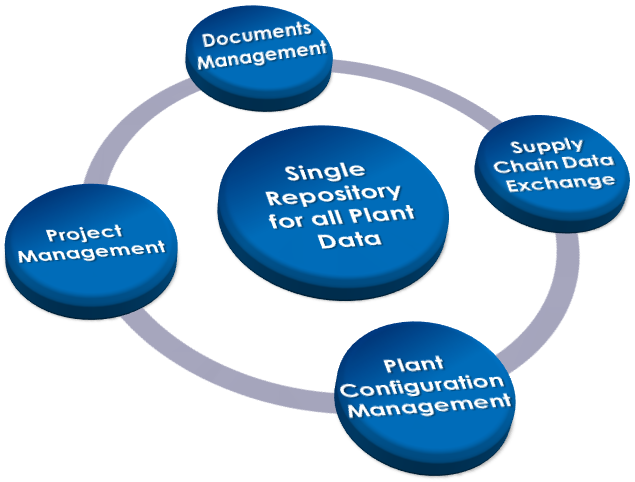 The third trend is the applicability of PLM systems outside the classical manufacturing industries.
I have been writing about the usage of PLM systems for Owner/Operators and the civil / construction industry, where the PLM system becomes the place to store all plant related information, connected to assets and with status handling. Currently I am participating in several projects in these new areas and the results are promising
People and Change
 I believe PLM requires a change in an organization not only from the IT perspective but more important from the way people will work in an organization and the new processes they require.
The change is in sharing information, making it visible and useful for others in order to be more efficient and better informed to make the right decisions much faster.
This is a global trend and you cannot stay away from it. Keeping data locked in your reach might provide job security but in the long term it kills all jobs in the company as competiveness is gone.
The major task here lies with the management that should be able to understand and execute a vision that is beyond their comfort zone. I wrote about this topic in my series around PLM 2.0
Modern companies with a new generation of workers will have less challenges with this change and I will try to support the change with arguments and experiences from the field.
Audience
Since February this year, WordPress provides much more statistics and interesting is the map below indicating in which countries my blog is read. As you can see there are only a few places left on earth where PLM is not studied. Good news !!

Although most of my observations come from working in Europe, it is the US that provides the most readers (30 %) , followed by India (9 %) and on the third place the UK (6 %).
This might be related to the fact that I write my blog in English (not in 100 % native English as someone commented once).
It makes me look forward to be in October in Atlanta during the PLM Innovation US conference to meet face to face with many of my blog readers and share experiences.
Conclusion
Reading back my posts since 2008, it demonstrated for me that the world of PLM is not a static environment. It is even that dynamic that some of the posts I wrote in the early days have become obsolete.
At the end of 2008 I predicted the future of PLM in 2050 – here we are on the right track.
There is still enough blogging to do without falling into repetitions and I am looking forward to your opinion, feedback and topics to discuss.
Related articles
- PLM misconceptions (virtualdutchman.com)
 The trigger for this post is based was a discussion I had around the Autodesk 360 cloud based PLM solution. To position this solution and to simplify the message for my conversation partner Joe the plumber, I told him”: “You can compare the solution with Excel on-line. As many small mid-market companies are running around with metadata (no CAD files) in Excel, the simplified game changer with this cloud based PLM offering is that the metadata is now in the cloud, much easier to access and only a single version exists.”
(sorry for Autodesk, if I simplified it too much, but sometimes your conversation partner does not have an IT background as they are plumbers)

Interesting enough Joe said: “But what is the difference with Google docs or SharePoint where I can centralize my Excel files too – and Google Docs is like a cloud solution, right ?”
He was right and I had to go more in-depth to explain difference. This part of the conversation was similar to discussions I had in some meetings with owner / operators in the civil and energy sector, discussing the benefits of PLM practices for their industry.
I wrote about this in previous posts:
Using a PLM system for asset lifecycle management requires a vision
PLM practices for the engineering / construction industry
The trouble with dumb documents
 Here it was even more a key point of the discussion that most of the legacy data is stored in dumb documents. And the main reason dumb documents are used is because the data needs to be available during the long lifecycle of the the plant, application independent if possible. So in the previous century this was paper, later scanned documents (TIFF – PDF) and currently mainly PDF. Most of the data now is digital but where is the intelligence ?
The challenges these companies have is that despite the fact information is now stored in a digital file, the next step is how to deal with the information in an intelligent manner. A document or an Excel file is a collection of information, you might call it knowledge, but to get access to the knowledge you need to find it.
Did you try to find a specific document in Google docs or SharePoint ? The conclusion will be the file name becomes very important, and perhaps some keywords ?
Is search the solution ?
 To overcome this problem, full text search and search based applications were developed, that allow us to index and search inside the documents. A piece of cake for Google and a niche for others to index not only standard documents but also more technical data (drawings, scans from P&ID, etc, etc).
Does this solve the problem ?
Partly, as suddenly the user finds a lot more data. Search on Google for the words “Right data” and you have 3.760.000.000 hits (or more). But what is the right data ? The user can only decide what is the right data by understanding the context.
- Is it the latest version ?
- Is it reflecting the change we made at that functional position ?
- What has changed ?
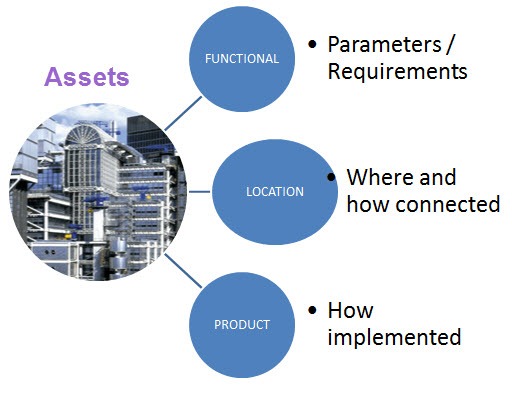
And here comes the need for more intelligent data. And this is typically where a PLM system provides the answer.
A PLM systems is able to manage different types of information, not only documents. In the context of a plant or a building, the PLM system would also contain:
- a functional definition / structure (linked to its requirements)
- a logical definition / structure (how is it supposed to be ?)
- a physical definition / structure (what is physically there ?)
- a location definition / structure (where in the plant / building ?)
and this is all version managed and related to the supported documents and other types of information. This brings context to the documents and therefore it exposes knowledge.
As there is no automatic switch from dumb documents towards intelligent data, it will be a gradual process to move towards this vision. I see a major role for search based applications to support data discovery. Find a lot of information, but than have the capability to capture the result (or generate a digest of the result) and store it connected to your PLM system, where is it managed in the future and provides the context.
Conclusion: We understand that paper documents are out of time. Moving these documents to digital files stored in a central location, either in SharePoint or a cloud-based storage location is a step we will regret in ten years from now, as intelligent data is not only inside the digital files but also depending on its context.
 The past three weeks I had time to observe some PLM Vendors marketing messages (Autodesk as the major newbie). Some of these message lead to discussions in blogs or (LinkedIn) forums. Always a good moment to smile and think about reality.
In addition the sessions from PLM Innovation 2012 became available for the attendees (thanks MarketKey – good quality). I had the chance to see the sessions I missed. On my wish list was “The future of PLM Business Models” moderated by Oleg as here according to Oleg some interesting viewpoints came up. This related to my post where I mentioned the various definitions of PLM.
All the above inspired me to write this post, which made me realize we keep on pushing misconceptions around PLM in our customer’s mind, with the main goal to differentiate.
I will address the following four misconceptions. The last one is probably not a surprise, therefore on the last position. Still sometimes taken for granted.
- PLM = PLM
- On the cloud = Open and Upgradeable
- Data = Process Support
- Marketing = Reality
1. PLM = PLM
It is interesting to observe that the definition of PLM becomes more and more a marketing term instead of a common definition which applies to all.
 Let me try to formulate again a very generic definition which captures most of what PLM Vendors target to do.
PLM is about connecting and sharing the company’s intellectual property through the whole product lifecycle. This includes knowledge created at the concept phase going through the whole lifecycle till a product is serviced in the field or decommissioned.
Experiences from the field (services / customers / market input) serve again for the other lifecycle phases as input to deliver a better or innovative product.
Innovation is an iterative process. It is not only about storing data, PLM is also covering the processes of managing the data, especially the change processes. Sharing data is not easy. It requires a different mind set, data is not only created for personal or departmental usage, but also should be found and extended by other roles in the organization. This all makes it a serious implementation, as aligning people is a business change, not an IT driven approach.
Based on this (too long) high-level PLM definition, it does not imply you cannot do PLM without a PLM system. You might also have a collection of tools that are able to provide a complete coverage of the PLM needs.
 Oleg talks about DIY (Do It Yourself) PLM, and I have seen examples of Excel spreadsheets managing Excel spreadsheets and Email archives. The challenge I see with this type of PLM implementations is that after several years it is extremely difficult for a company to change. Possible reasons: the initial gurus do not longer work for the company, new employees need years of experience to find and interpret the right data.
A quick and simple solution can become a burden in the long term if you analyze the possible risks.
Where in the early years of PLM, it was mainly a Dassault Systemes, Siemens and PTC driven approach with deep CAD integrations, the later years other companies like Aras and now Autodesk, started to change the focus from classical PLM more to managing enterprise metadata. A similar approach SAP PLM is offering. Deep integrations with CAD are the most complex parts of PLM and by avoiding them, you can claim your system is easier to implement, etc., etc.
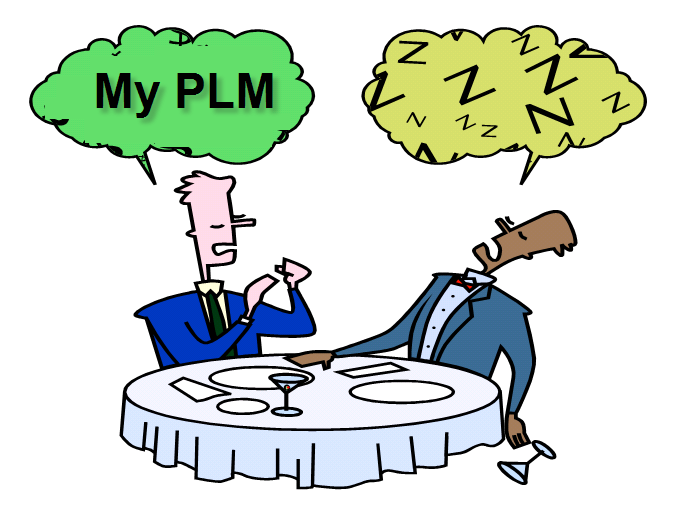 A Single version of the truth is a fancy PLM expression. It would be nice if this was also valid for the definition of PLM. The PLM Innovation 2012 session at the future of PLM models demonstrated that the vendors in this panel discussion had a complete different opinion about PLM. So how can people inside their company explain to the management and others why the need PLM and which PLM they have in mind ?
2. On the cloud = Open and Upgradeable
 During the panel discussion Grant Rochelle from Autodesk mentioned the simplicity of their software and how easy it will be upgradeable in the future. Also he referred to Salesforce.com as a proof point.They provide online updates from the software, without the customer having to do anything.
The above statement is true as long as you keep your business coverage simple and do not anticipate changes in the future. Let me share you an analogy with SmarTeam, how it started in 1995
At that time SmarTeam was insanely configurable. The Data Model Wizard contained several PDM templates an within hours you could create a company specific data model. A non-IT skilled person could add attributes, data types, anything they wanted and build the application, almost the same as Autodesk 360. The only difference, SmarTeam was not on the cloud, but it was running on Windows, a revolution at that time as all serious PDM systems were Unix based.
The complexity came however when SmarTeam started to integrate deeply with CAD systems. These integrations created the need for a more standardized data model per CAD system. And as the SmarTeam R&D was not aware of each and every customer’s implementation, it became hard to define a common business logic in the data (and to remain easily upgradable).
 I foresee similar issues with the new cloud based PLM systems. They seem to be very easy to implement (add what you want – it is easy). As long as you do not integrate to other systems it remains safe. Integrating with other and future systems requires either a common data definition (which most vendors do not like) or specific integrations with the cost of upgrading.
In the beginning everything is always possible with a well-defined system. But be aware looking back in history, every 10 years a disruptive wave comes in, changing the scope and upgradability.
And to challenge the cloud-based PLM vendors: in the generic definition of PLM that I shared above, PLM integrates also design data.
3. Data = Process Support
Another misconception, which originates from the beginning of PLM is the idea that once you have support for specific data in your system, you support the process.
 First example: Items defined in ERP. When engineers started to use a PDM system and started to define a a new item there were challenges. I had many discussions with IT-departments, that they did not need or wanted items in PDM. ERP was the source for an item, and when a designer needed a new item, (s)he had to create it in ERP. So we have a single definition of the item.
Or the designer had to request a new item number from the ERP system. And please do not request numbers too often as we do not want to waste them was the message.
Ten years later this looks like a joke, as most companies have an integrated PDM/ERP process and understand that the initial definition of a new item comes from PDM and at a certain stage the matured item is shared (and completed) by the ERP system. It is clear that the most efficient manner to create a new item is through PLM as the virtual definition (specs / CAD data) also reside there and information is handled in that context.
 A second more actual example is the fact that compliancy is often handled in ERP. It is correct that in the case you manufacture a product for a specific target market, you need to be able to have the compliancy information available.
However would you do this in your ERP system, where you are late (almost at the end) of the design lifecycle or is it more logical that during your design stages at all time you verify and check compliancy ? The process will work much more efficient and with less cost of change when done in PLM but most companies still see ERP as their primary IT system and PLM is an engineering tool.
Finally on this topic a remark to the simplified PLM vendors. Having the ability to store for example requirements in your system does not mean you have support for a complete requirements management process. It is also about the change and validation of requirements, which should be integrated for a relevant role during product definition (often CAD) and validation. As long as the data is disconnected there is not such a big advantage compared to Excel.
4. Marketing = Reality
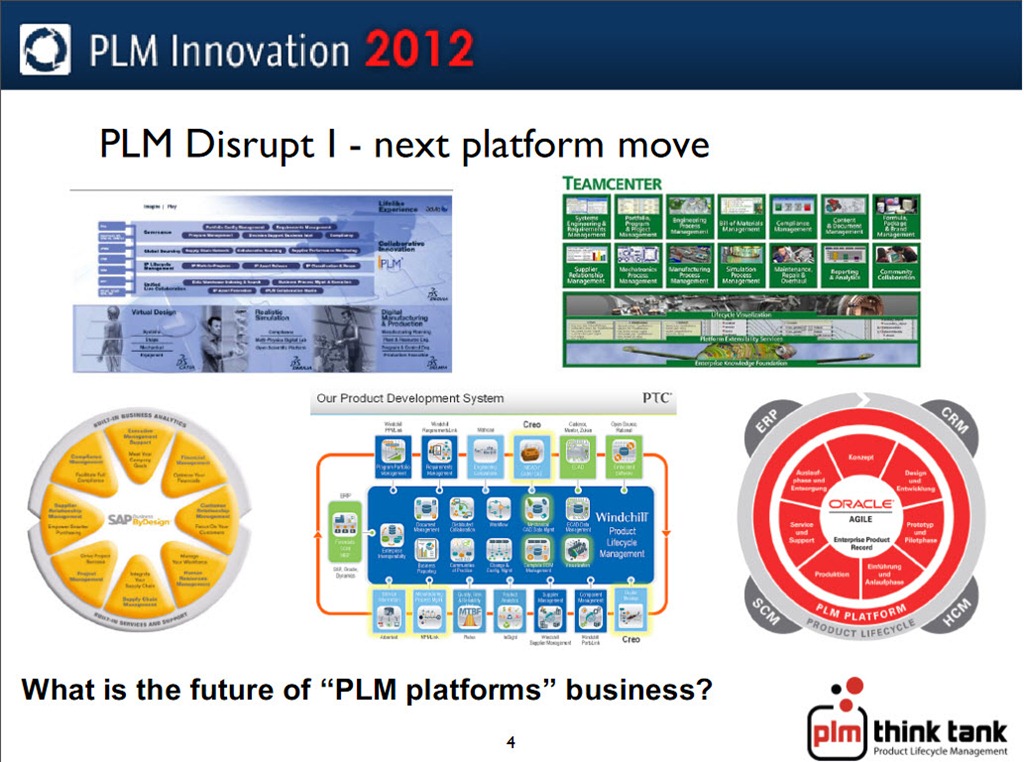 In the future of PLM Business Models
Oleg showed a slide with the functional architectures of the major PLM Vendors. In the diagram all seems to be connected as a single system, but in reality this is usually not the case.
As certain components / technologies are acquired, they provide the process coverage and only in the future you can imagine it works integrated. You cannot blame marketing for doing so, as their role is to position their products in the most appealing way customers will buy it. Without marketing perhaps no-one would buy a PLM system, when understanding the details 
Autodesk as a newcomer in PLM has a strong background in marketing. This is understandable as similar to Microsoft, their main revenue comes from selling a large volume of products, where the classical PLM vendors often have a combination with services and business change. And therefore a different price point.
When in the eighties Autodesk introduced AutoCAD, it was a simple, open 2D CAD environment, able to run on a PC. Autodesk’s statement at that time: “We provide 80 percent of the functionality for 20 % of the price”.
Does this sound familiar nowadays ?
As AutoCAD was a basic platform allowing customers and resellers to build their solutions on top of it, this became the mid-market success for Autodesk with AutoCAD.
The challenge with Autodesk PLM 360 is that although the same logic seems to make sense, I believe the challenge is not in the flexible platform. The challenge is in the future, when people want to do more complex things with the system, like integrations with design, enterprise collaboration.
At that time you need people who can specify the change, guide the change and implement the change. And this is usually not a DIY job.
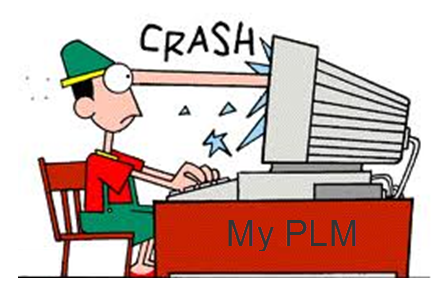 Autodesk is still learning to find the right PLM messages I noticed recently. When attending the Autodesk PLM session during PLM Innovation 2012 (end of February), one of their launching customers ElectronVault presented their implementation – it took only two weeks !!! Incredible
However reading Rob Cohee’s blog post the end of March, he mentions ElectronVault again. Quote:
ElectronVault was searching for something like this for over two years and after 6 weeks they have implemented Project Management, EBOM, MBOM, and starting on their APQP project. Six Weeks!!!
As you see, four weeks later the incredible two weeks have become six weeks and again everything is implemented. Still incredible and I am looking forward to meet ElectronVault in the future as I believe they are a typical young company and they will go through all of the maturity phases a company will go through: people, processes and tools (in this order). A tool driven implementation is more likely to slow down in the long term.
Conclusion: Misconceptions are not new. History can teach us a lot about what we experience now. New technology, new concepts can be a break through. However implementing them at companies requires a change in organizations and this has been the biggest challenge the past 100 years.
Related articles
- The Question of PLM or Not to PLM (arnoldit.com)
- Innovation @ PLM Innovation 2012 ? (virtualdutchman.com)
 It has been silent from my side the past – more than two months. Extremely busy and sometimes surprised to see the amounts of post some of my colleagues could produce, with Oleg as the unbeaten number one. During this busy period I was able to observe some interesting trends listed below:
Going Social
Social Media and PLM is one of the favorite topics for both bloggers and some PLM vendors at this moment. New products for community based collaboration or social engineering are promoted. Combined with discussions and statements how the new workforce (Generation Y) should get challenging jobs without doing the ‘old boring stuff’.
True arguments to initiate a change in the way we work. And I agree, must of current PLM systems are not ‘intelligent’ enough to support engineers in a friendly manner. However is there an alternative at this moment ? Below a commercial (in Dutch) promoting that elderly workers are still required for quality.
I discussed the relation PLM and Social Media some time ago in my post Social Media and PLM explained for dummies. In addition my observation from the field, gives me the feeling that in most companies the management is still dominated by the older generation, and most of the time they decide on the tools they will be using. No X and Y at this moment. Therefore I do not see a quick jump to social media integrated with PLM – yes the vision is there – but the readiness of most companies is not yet there.
Cloud
PLM and Cloud are also more and more mentioned by PLM vendors as a new solution specially for the mid-market. And with an optimistic mind you can indeed believe that with a low investment (pay per use) mid-market companies can do their PLM on-line. But why are existing on-line PLM systems not booming at this time ? (Arena / PLMplus / and the major PLM vendors) I believe that there are two key reasons for that:
- Implementing PLM is not equal to installing a system. PLM is a vision to be implemented using a system. And the difficulty is that a vision does not match function and features from a product vendor. There is a need for a driving force inside the company that will support the business change. Where are the consultants and advocates (with experience) for this type of solutions ?

- There is still a reluctance to store intellectual property somewhere on-line in a cloud without direct control and ownership of data. Mid-market companies are not known to choose solutions ahead of the mass. In this type of companies cloud based CAD tools might be an entry point, but all product data – no way they say.

PLM or ERP
Before even talking about new technologies or fundamentals for PLM, I see the biggest challenge for PLM is still to get the recognition as the system for product knowledge (IP) and innovation. In too many companies ERP rules and PLM is considered as a way to capture CAD and engineering data. The main PLM vendors are not addressing this challenge – they neglect ERP (yes we can connect). And ERP vendors like SAP and Oracle are not known for their PLM messages and strategy (yes we have PLM). As ERP is often the major IT-system historically, there is so often the (wrong) opinion that everything should be built and based on one system.

In some publications I have seen the Swiss knife as an example for the multi-functional system with all tools embedded. My question remains – who wants to work only with a Swiss knife when doing professional work ?
I like to have the right tools to do my job
The most important topic around my blog the past 3 years has been around the Manufacturing BOM – where should it be – and where is the MBOM current ?
Sweden – a reality check
Last week I attended the DS PLM forum in Gothenburg to present the vision of using a PLM system as the backbone for plant information management for owners/operators and how ENOVIA supports this vision.
 But I also learned Sweden is (one of) the most innovative countries (I need to verify the criteria used but can imagine there is a source of truth). What impressed me more where the presentations from Staffan Lundgren from Sony Ericsson with the title “Living in a world of change – balancing stability and flexibility” and Magnus Olsson from Volvo Cars with the title “Driving operational excellence in a challenging business environment”. Both companies are well known for their robust image. From both speakers you could experience that they are not worried so much about Generation Y, their success is depending on a clear vision and a will to go there. And this basic drive is often missing – PLM is not a product you buy and then business continues as usual
Conclusion
PLM vendors made a lot of noise the past months (events / product announcements) and customers might get the impression that technology and software (or the price of software) are the main criteria for successful PLM. Although not unimportant, I would focus on the vision and to assure this vision is understood and accepted by the company. 
Am I old fashioned ?
 In many PLM communities, you see discussions and statements, that there will be a significant impact on the way we perform product lifecycle management using social media capabilities. In this post I will give my thoughts without going in-depth into certain products. At the bottom of this post you will find some links to posts which contributed to my opinion (the usual suspects).
PLM
Let’s first establish a baseline, why we want Product Lifecycle Management. In a general PLM is a vision, to bring products to the market faster, with better quality, being innovative and more customer focused.
 This vision can be implemented by best practices, like a standardized global staged New Product Introduction process, an enterprise wide Engineering Change Process, integration between different disciplines to work globally on a single repository for product definition and many more depending on your industry..
Two words pop up here: a single repository for product definition and global. This is where the technology comes in. Due to an improved world-wide (internet / WAN) connectivity, the capabilities are there to communicate efficient around a single repository for product definition and reliable, around the globe . The world became a global workplace and we are all connected. The improved connectivity enables PLM vendors (and others) to promote the “single version of the truth” concept.
Single Version of the truth
The idea behind it is that, if you store everything in a single database, you will always find the right information. This idea was developed at the time the world was not yet global and people were thinking more local.
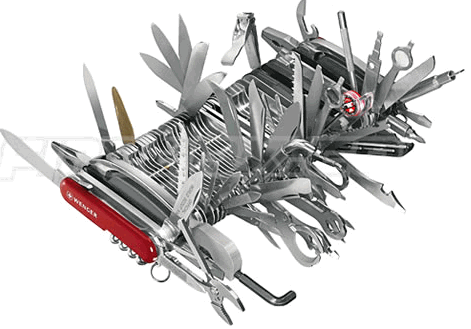 Some of the major ERP vendors also push for this concept. If you store all your data in their single platform, you are sure there is no redundancy of data, so you are always confident about the content is the message. This concept is often embraced by IT-departments, as the message having one single platform or one single system for all enterprise data sound like efficient. (I call it Swiss Knife thinking – it does everything – but would you use it for professional work ?)
As long as we are talking about explicit data and local activities, this concept seems to prove itself. However, a lot of informal activities exist around the product development process, and these activities are not managed.
In 2009, I participated in a COE Automotive panel, where one of the attendees in the audience stood up accused the PLM vendors of making their life so complex. He said:
“If we have an issue on the shop floor with production, we just gather the right people and solve the issue – no need to fill in screens of data that PLM or ERP systems require. And if there was a customer with a problem, we send a service engineer and the problem is fixed”
Of course if his company was a global company, it would be impossible to gather all around the shop floor, or to visit the customer site and solve it in a reasonable time.
 To avoid missing information, PLM and ERP systems try to collect as much as possible information in their systems, to have the best possible single version of the truth. Through immersive integrations and clever business logic, the user has to enter the minimum of information only once. However for the user still too much and way to complex they complain (and still not enough information is captured).
My conclusion so far: Single version of the truth is a concept to collect a majority of product related data, however missing all the informal communication, which is exchanged during talking (and later emailing and modern means of communication).
Extending the single version of the truth
The single version of the truth is an important implementation concept for PLM and it requires already a major challenge for companies. Imagine all information that you produce will be stored in such a manner that everyone authorized can see it and it is stored in such a manner that someone else also can understand the information (and not only you) . This is such an important change process often overlooked by IT-driven PLM implementations.
PLM Vendors focus on the tools to provide a platform to capture and share product data all around the product lifecycle. Not easy either as development is often based on generic functionality not optimized for a certain user role.
To understand the context of the shared data, you would like to hear or rewind the discussions people had at that time – as from these discussion a lot of implicit information can be retrieved. But no one wants to enter implicit information in a PLM system.
And then going global
Continuing with product development towards a global operation and addressing the communication around the product development is the next logic step. As it is much more difficult to communicate directly with everyone around the world, it is obvious that here social media come in the picture.
 Initial people were using email to exchange ideas with other people around the world. This created new problems – sometimes huge attachments of unmanaged data, sometimes important information in mail boxes of only a few people, relevant for many. Email is against the concept of a single version of the truth as people were creating there own non-pubic archives of product discussions. Before the WEB 2.0 revolution, PLM vendors provided email integrations or embedded email functionality in their PLM system. Still there a millions of email databases (Lotus Notes / Exchange) with product data, development data and more not visible for many.
The 2.0 change
A trend we see in social media is that your ‘old’ email system becomes more a notification system, that you got a direct message through one of your social platforms (RSS feeds, LinkedIn, Facebook, Blog, etc). Of course, if you are connected to all these platforms on-line all the time, you do not need a notification system anymore and you are connected to whom you want and when you want – a little bit back to the old days. If you enter a social environment, you are a participant of the communication going on – you can look around or participate.
 The benefit from social collaboration is that is does not push you into a structure of managed data. And it provides you with on-line communication with everyone who is in your selected community. The downside with the known social media is that it is not clear and secure, what happens with this information shared in social platforms. Will it be sold to special interest groups ? Can you find it through a search engine ?
For product related social collaboration, we need obviously more secure communities to collaborate. And as for this collaboration you do not know who is in your trusted company network, it is clear that cloud based solutions come in as a logical technical infrastructure. Of course these communities must be as easy accessible as popular social media and well integrated in the user’s environment.
Global single version of the truth ?
Combining the single version of the truth concept and the loose communication and content of social media brings us to the challenge of current PLM consultants, vendors and implementers. All the information collected in current social platforms is hard to find or interpret. If you use the embedded search functions in these communities, they are not designed for clever searches – you need to know the context? And then the question pops up if it is all information that existed ? You do not know as you do not see the full picture.
An old-fashioned managing all this data in our PLM system won’t work either. The capturing and classification and linking of data would be too much overhead for the reluctant user. We do not want to manage and justify each action that we do. (although this were knowledge management concepts in the 90’s)
Extended search
And this is where extended search comes in for PLM. The extended search is the glue between the single version of the truth and all the unmanaged data around the product in communities. Integrating this in a single environment is the challenge for PLM vendors (and less important for ERP vendors).
 Why mainly for PLM vendors ? The main reason is that in product development a lot of iterations, knowledge building, searching and capturing of date takes place. The more you know and understand, the better you are capable to make adequate decisions, understanding the right context during your development process. And for that you need the formal and informal information, global available across disciplines, companies and countries.
I see two major requirements for these extended search capabilities.
- First of all the search engine should understand your context and skip irrelevant discussions and posts from your social media. I have seen how this could be done. In 2007, Yedda, an Israeli startup bought by AOL, came with an intelligent question and answer engine. The concept behind the engine was that it mapped the context of the question to your profile, to the community you belonged and compared it to other profiles of people in the community. The more you asked and the more your answered the clearer your context became. In additions your answers were rewarded by others, and the more thumbs up you got, the more value you provided to the community – saving your boss to do appraisals.
- Search engines should provide you with a facetted search to drill down on the search results. As you do not know exactly what you are looking for, some keywords should do and then as a next step based on your context and the search context you should be able to drill down to the information you are looking for. This information should now give you a better understanding of the context of your product – if it is versioned ? if it is the latest ? Leave this to PLM.
My conclusion:
Classic PLM (single version of the truth) and social media capabilities (easy collaboration in communities) combined with an extended search engine are the mandatory capabilities for a modern global PLM implementation where both formal and informal data are managed in the context of a product
Links for reference:
Two years ago I wrote a post called PLM in 2050 as the concluding post for 2008. Now two years later it is time to see what has changed my landscape during this period. Are we going to a predictable future or are new trends arising ?
These were the points I raised at that time:
1. “Data is not replicated any more – every piece of information that exists will have a Universal Unique ID, some people might call it the UUID. In 2020 this initiative became mature, thanks to the merger of some big PLM and ERP vendors, who brought this initiative to reality. This initiative reduced the exchange costs in supply chains dramatically and lead to bankruptcy for many companies providing translators and exchange software.”
 I believe this trend is still happening only the big risk here is that it requires an open standard definition of this UUID. I am sure that before my retirement (see later below), there will be no global standard. There will be platform-vendor specific UUIDs and the challenge will be to operate in a heterogeneous platform-heterogeneous vendor environment. I feel less discussion on this topic in my environment, therefore the downward arrow.
2.”Companies store their data in ‘the cloud’ based on the previous concept. Only some old-fashioned companies still have their own data storage and exchange issues, as they are afraid someone will touch their data. Analysts compare this behavior with the situation in the year 1950, when people kept their money under a mattress, not trusting banks (and they were not always wrong)”
 For sure this is the most important trend and I would rank it now as the number one trend for 2010. I just read an interesting article about Cloud Computing Predictions which addresses all dimensions of a cloud strategy and execution – very much worth reading.
What you see in that article and also around you, is that there is going to be a battle between legacy vendors, who will try to transform the cloud definition to a private cloud into a way it suits their platform, and the new cloud solution vendors which also require a platform and from there build and extend their services. It relates to one of the other trends I also mentioned in the 2008 post:
3. “Then with a shock, I noticed PLM did not longer exist. Companies were focusing on their core business processes. Systems/terms like PLM, ERP and CRM did not longer exist. Some older people still remembered the battle between those systems to own the data and the political discomfort this gave inside companies”
 Combined with the new battle around the services platform it will be clear that in this approach dominant business systems, like CRM, ERP and PLM will no longer exist, as the focus will be to build business processes based on services and apps on a platform. Here I see PLM as the last hurdle to take. CRM already is understood by the market that it can be replaced by a cloud based solution, the first ERP attempts are already there too, but as PLM is a more, diverse and wide set of non-standardized functions, you will see that in this area the challenge to offer the required PLM capabilities will be the biggest. Another rising trend PLM vendors will move more towards the manufacturing execution, where ERP vendors will provide more PLM services.
The battle will be around, who owns the intellectual property of the company and where it is stored and managed.
4. “After 3D, a complete virtual world, based on holography, became the next step for product development and understanding of products. Thanks to the revolutionary quantum-3D technology, this concept could be even applied to life sciences. Before ordering a product, customers could first experience and describe their needs in a virtual environment”
 This trend will also continue I believe and combined with different types of user-interfaces, mainly from the gaming world; the virtual reality will be the space where we do the most of our engineering work, shopping experience and entertainment. Big question will be, especially for the Matrix fans, will the real world stop to exist? So also here a growing trend – 3D television, 3D communication narrow the gap between the real and virtual world and understanding.
A trend I did not pick up at that time was the issue of social media and their influence on the existing business processes. At that time I wrote:
5. “As people were working so efficient, there was no need to work all week. There were community time slots, when everyone was active, but 50 per cent of the time, people had the time to recreate (to re-create or recreate was the question). Some older French and German designers remembered the days when they had only 10 weeks holiday per year, unimaginable nowadays.”
 And I have to say I was completely wrong there. Thanks to social communities, I am spending now more time per day to jump from community to community, from blog post to blog post (I admire my colleagues who have time to produce blog posts). Meanwhile I try to follow all my Twitter and Facebook friends and meanwhile processing the messages coming from everywhere, without having time to really dig into a problem I want to solve.
So quickly I post a question in various forums to see if someone has the answer, as I have not time to solve it anymore – hopefully somewhere in the world there will be a person who has the answer or time. Where to position this new trend into the relation of PLM is still a question for me. Yes, collaboration becomes easier, less boundaries, but also less structure to store data. Intelligent search engines which also understand the context of the information become more and more important, as we cannot structure upfront all information as we did in the classical past.

Due to the economical crisis another trend came clear. There is no retirement money left for the older workforce that should retire in the next 20 years. So companies will have a new generation of people asking the questions and if the older workforce adapts the new social media capabillities, they can be the ones that provide the answers.
In 2050 I will just be retired at the age of 90, and according to statistics, I have still another 20 years to enjoy my bionic life.
I wish you all a happy and successful new year and that the good dreams may come true.
Keep innovation and sustainability on your agenda

 Jos Voskuil's Weblog
Interesting reflection, Jos. In my experience, the situation you describe is very recognizable. At the company where I work, sustainability…
[…] (The following post from PLM Green Global Alliance cofounder Jos Voskuil first appeared in his European PLM-focused blog HERE.) […]
[…] recent discussions in the PLM ecosystem, including PSC Transition Technologies (EcoPLM), CIMPA PLM services (LCA), and the Design for…
Jos, all interesting and relevant. There are additional elements to be mentioned and Ontologies seem to be one of the…
Jos, as usual, you've provided a buffet of "food for thought". Where do you see AI being trained by a…