
You are currently browsing the tag archive for the ‘Change’ tag.
 This week I was reading a management article completely unrelated to PLM, but very applicable for PLM. The article stated that one of the basics of capitalism is innovation through crisis. Never let a crisis pass by without using it for your benefits was the message.
As we are currently in the middle of the economical downturn (according to the optimists or pessimists – we still have to figure out who is right), this is the moment for the management to decide. Do we try to sit still till it does not hurt anymore , or are we making strategic changes that will for sure demolish some holy houses but from the other hand will create a more lean and stronger organization after the change ?
Examples of IBM and GM were given from the nineties. IBM made the change from a hardware company towards a software company, where GM kept on doing the same with even bigger SUVs’. We know the results…….
Does it prove anything ?
For sure there are many companies that haven’t survived the nineties as they were not successful in their transformation, although they really tried. So where is the relation to PLM ?
 I believe that the problem of implementing PLM, and specially in mid-market companies is the fact that there is no ambition for change when things are going relatively well. In one of my old posts I referred to the story of the boiling frog.
This happens when an organization is slipping down slowly and it is hard for the management to change and define and sell internally another strategy. Jobs and people are kept in place as long as affordable and only natural evolvement (an aging workforce) or mergers are drivers for a change.
Now with this crisis it is different. Everyone realizes (or should realize) that going on the same manner with the same people is not good for survival (unless you are in one of the few industries that benefit from the crisis – apparently the fast food industry I read)
 In times of a crisis, first of all the management is challenged to come with a survival plan and in most cases this time they can get support from their employees as there is always the threat of lay offs if people are not creative or flexible for change. Secondly, employees will be also more flexible to save their jobs and the company (usually in this order)
Therefore this is the ideal moment to implement PLM in phased approach. For a successful PLM implementation you need employees, who are open minded to change the way they work, plus you need internal resources that have time to work with the implementer to fine tune the PLM system.
This moment exists now and by implementing PLM in a phased approach, each phase will bring ROI, perhaps even before the end of the crisis as you can start with the low hanging fruits and start to collect the benefits.
In parallel there is the discussion around free open source software or dumping software for free by some PLM providers in order to stay in the market. I think here as a customer you should always realize that every company, also software providers, need to survive the crisis and will look for income in another way – services / maintenance / additional software.
So my conclusion this time:
I never realized that both capitalism and PLM were striving for innovation. They have a crisis in common – For capitalism it is a must to push innovation for PLM it is an enabler for innovation
 I am writing this week’s post on my way to a customer to finalize an implementation and in parallel describing the Return On Investment of this project. But before that, I would like to have a short note about my previous post ‘Free PLM software does not help companies“.
The reason I wrote this post was because I wanted to assure that companies do not believe that ROI for implementing PLM is based on the software costs. PLM implementations are a combination of software, business skills and the company culture. Specially in the current economical situation, I wanted to make clear that these factors are not overlooked. Also I did not want to say Open Source PLM is bad, I made my points on the messaging, however in functionality and usage I do not see a big difference between other types of PLM systems. I got some interesting comments on this post and I advise all of you, who have read the post to go through the comments to get a broader perspective. Once I have had some more opportunity to investigate this area deeper, I will come with a more in-depth post on this topic.
To PLM or Not To PLM
But now back to: To PLM or Not To PLM, where I wrote in a first post on this topic that before judging the costs and ROI of PLM, we should start analyzing our current processes and situation and use this as a baseline to guesstimate the PLM benefits.
The first PLM phase to analyze is the concept phase, where new ideas are picked up (or not). Actually this is the phase where we define the future of the company. The economical recession in a way forces companies to rethink their strategy and fortunately all of the competition is in a similar position. downturn means less activities, the company might be in the position to allocate time to address these analysis for PLM ROI. Instead of making people redundant, use these people to work on a new and optimized product strategy.
 Existential questions to ask yourself as a company
The basic questions to ask about the concept phase:
- Do we know where our products are currently in their lifecycle ?
Measure: quantity, sales trends, margin
Analyze: is our portfolio healthy ? - How do customer rate our products ?
Measure: market share, market awareness, customer satisfaction, quality, field issues
Analyze: will customers keep on buying from us ? - Where are we different from the competition ?
Measure: where do we win/ where do we loose and compare per quarter ?
Analyze: how can we improve the success ratio ? - In case of bidding
Measure: how many bids do we handle per quarter and with which effort
Analyze: What is the win percentage and how to influence this ? - Who are our customers ?
Measure: does the 80-20 rule apply – does 80 % of the revenue come from 20 % of the customers ?
Analyze: What is the trend specially in relation to the current market situation - Where does innovation come from ?
Measure: the amount of new ideas, the source (people, customers) and the ones that reach it to the portfolio
Analyze: Do we have a guarantee for innovation ?
Additional questions to be asked due to current financial and global situation: 
- How do we strive for climate neutral products – sustainable development ?
Measure: the amount of energy used to build the products but also to recycle and what remains
Analyze: How can we change our products and production process ? - How do we capture our company’s IP due to the aging workforce in most of the countries
Measure: How many people with the specific knowledge will retire in 5 – 10 years ?
Analyze: Where and how can I assure this knowledge remains in the company ?
For many of the above questions you might say that you know how to conduct your business as you are doing most of these activities and even more. However the question you should ask yourself also is: How long does it take to answer these questions and to react on these trends ?
Because all the above topics are positively influenced by PLM – here it the PLM ROI !
 Project and Portfolio Management, company wide workflow process allow the company to measure, to run analysis and to have information within hours (or worse case in days), where in a company where every department and discipline has their own environment, the effort to collect this information becomes huge and not natural. And as it will take a lot of time to collect the information, people tend to react on their guts or intuition, which might be wrong if you are among the wrong people or if the world changes in a way never seen before.
Additional capturing product and process knowledge allows companies to contain their IP. And just to make this point clear: Product knowledge is not only CAD and Bills of Materials. It is all collected information: issues during design, during production, coming from field services, best practices used and more. The challenge anyway for every PLM system is to provide an environment, user-friendly enough for all users, to start managing their total product IP in a single environment.
Conclusion
PLM as a total approach brings a lot of value and control in the concept phase, the phase where the company’s future is merely defined. And it is obvious that the future should be green and sustainable. Use the current downturn to shape the future – the questions in this post and your analysis should be the base.
 The last two weeks I spent around two events for the automotive industry. First the SAE event in Chicago and this week the COE Automotive in Detroit to give a lecture around the future possibilities of a supply chain in a web 2.0 (PLM 2.0) world. For many of the lower tiers suppliers in the automotive supply chain this seems to be something far from their daily business. I guess one of the issues here is, that these companies are used to solve their problems per department, without having a corporate vision or strategy where the company should be in five years from now.
And here I see many challenges (in Europe we would call them possible problems). As the smaller mid-market companies try to solve their problems per department, you will find all around the world bright engineering managers who conclude that their company needs PLM. As they understand all the engineering challenges, they understand that in order to really understand what their department is doing, they should work in a different way than file based.
This is what companies working file-based think
When working file based companies rely on the following main contributors for getting information (in order of importance)
- we do not need these expensive solutions for PLM etc …
- the most important is the experienced engineer who knows what has been done in the past and where to possible find it
- the company directory structure which allows everyone to find and store data related to a customer, project or product
- the file name of the designs and documents which ‘exactly’ describes what’s inside the file
You just need to follow this order and you will always find the right information (or be close to it).
..and these are the issues they do not tell you.
- I guess we really do not know what to do with PLM as we never studied it, what it would be for our company
- we cannot bypass our experienced engineers – although at a certain moment they will retire, currently they would feel very insecure if we tried to collect their explicit knowledge and make it available for all. They would feel their jobs are less secure
- there are some issues with this directory structure. Sometime someone deletes or overwrites a file that we needed, and of course we are not sure if all the data we need is really there. We always need to double check with the people to be sure – and sometimes it hurts, but we are used to it
- or people are creative that only they understand what is in their own files and even from the file name, which can be long, we do not fully understand where it fits, what is the status and where is it also used.
Seeing these two opposite messages, we need to understand what are the challenges for these companies in the near future.
Challenges for these companies
The current workforce is aging all around the world – i recently read that although many believe China is the next promising country for the future, due the the one-child-per-family strategy in the past, they also will face in the near future (10-20 years) the same problems Europe and the US will have.
A huge part of the population will retire and especially in Europe and the US with this retirement a lot of real knowledge will disappear. The new generation will come with different skills, a different background and attitude to engineering. And due to the difference in attitude there is little or no communication between these generations.
So if you are an (aging) manager in a mid-market company in an automotive supply chain, you have two options to react:
- you become fatalistic and believe that the new world is bad and you cling as long as possible to the old habits you are familiar with
or
- or you understand every few decades a change in the way of working is required, which means moving away for the traditional knowledgeable people with their files to an internal, knowledge sharing environment where everyone has access to understand what exists and in which status it is.
So only one conclusion
 Survival for the future requires a change in the way these companies are working. It reminds me of the boiling frog story. We do not see the world is changing around us, till it is too late. I guess human beings should be more clever than frogs and they are able to collect information from outside their ‘pan’.
Working with ENOVIA SmarTeam solutions, in particular the Design Express solution, I learned that this solution is an excellent entry point to move away from file based work towards data management.
Still not convinced ? Challenge me by adding a comment (public exposure) or sent me a private email for a one-to-one discussion
As there are many engineering managers who believe that they understood the issue and started to implement an implement a PLM solution in their department, I will address in my next post they challenges they face with this bottom-up approach to convince the company PLM is unavoidable
Below just a goodie to enjoy
 The past weeks I have been traveling and visited several implementers and potential PLM customers in Europe. Afterwards I presented and joined a panel session in the SAE 2008 Commercial Vehicle event.
Between the traveling I had enough time to reflect what i saw and heard and I realized that in the mid-market and perhaps in the lower tiers of the automotive industry, people are locked in by the way they are working and thinking, meanwhile seeing PLM vendors already coming with future concepts, talking about PLM 2.0
Many of the mid-market manufacturing companies I met in Europe are just realizing PDM (Product Data Management) in their company, usually as an extension of CAD data management. If you look to the demands of these companies through RFQs, they are trying to build a complete environment for their product data mostly around the engineering department.
This is the classical way bigger companies were implementing 15 years ago, and now mid-market companies see and understand the maturity of this concept.
Is PDM the first step to PLM ?
In my previous posts I already argued that implementing PLM (which goes beyond PDM) brings the real benefit for manufacturing companies, but this requires a change in the current way of working. Disciplines (marketing/sales,engineering, production engineering, maintenance & service) have to collaborate around the major business processes from the company, instead of optimizing each department and then forward information to the next department as we can see from the (classical) picture below:
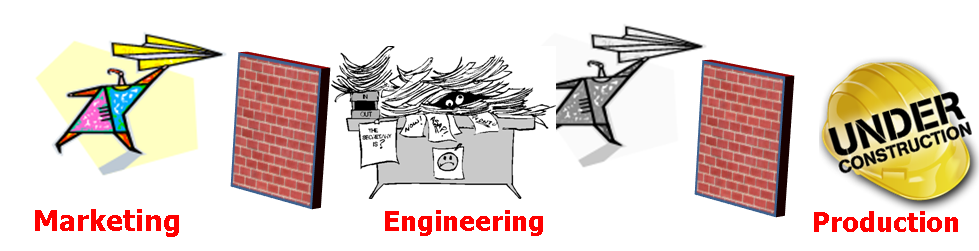
Now these companies implement PDM, but what is the result ?
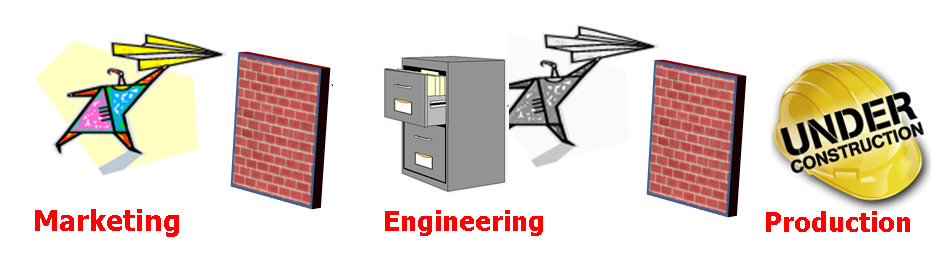
For mid-market companies the above step is easier to implement as it has not so much impact on the organization, however the fundamental way of working does not improve and does not provide the full benefits that bigger enterprises experience. The main benefits in the above situation are quality and efficiency benefits for engineer. As there is still no connection between the customers (marketing/sales) and the field (customers / service), the engineering department will work in an ivory tower, knowing what’s best. Only the real problems will reach them but the fine, combined information from the field will not reach them, and for that reason innovation is much harder to come from this approach.
Although PDM can be a first step towards PLM, it is only a step to get organized
The real benefits come when the collaboration around the whole product lifecycle is implemented. This is mostly not going to happen by a bright individual in the company. It requires a strategic vision and approach from the management, to change the way departments are working and connected.
In the very small mid-market companies this kind of collaboration has always existed ad-hoc. Quotes I heard in the past weeks were:
“if there was an issue, we all gathered around the machine in production and we solved it on the floor. This is collaboration.”
or:
“we do not need workflow and other tools to spend time informing each other. If there is something required, we just talk to each other”
These quotes above show, that people are not prepared for a structured, global approach. The main manufacturing process should be defined in such a way that exceptions like the first quote do not occur. Also the talking from the second quote is replaced by something that is traceable and secure, in order to guarantee repeatable results. This is the major task for the management in mid-market companies.
Meanwhile it is the role of the PLM providers to talk and understand the language from the mid-market companies. Not technology but work/task-oriented solutions will narrow the gap between the user and the software. Once the gap becomes smaller, mid-market companies might understand and feel the benefits of PLM.
So is the gap 15 years ?
I guess not, and for the following trends:
- More and more early adapters from PLM in the mid-market report the benefits from their PLM implementation. So the acceptance for PLM becomes mature.
- Mid-market companies will become more and more part of enterprises, which will bring the strategic vision of PLM to them.
- The aging workforce requires companies to capture knowledge that will disappear if they keep on working the same way. Joe, who knows everything, will retire in 5 – 10 years. This is where the management will get alerted to act – in time we hope.
- The new workforce comes with different, multi-tasking skills, used to work with a computer on parallel sessions. It is to the management to understand these new talents and develop them.
As most of the points are addressed to the management, I want to point once more to the following posts from the past:
culture change in a mid-sized company a management responsibility
 Jos Voskuil's Weblog
Interesting reflection, Jos. In my experience, the situation you describe is very recognizable. At the company where I work, sustainability…
[…] (The following post from PLM Green Global Alliance cofounder Jos Voskuil first appeared in his European PLM-focused blog HERE.) […]
[…] recent discussions in the PLM ecosystem, including PSC Transition Technologies (EcoPLM), CIMPA PLM services (LCA), and the Design for…
Jos, all interesting and relevant. There are additional elements to be mentioned and Ontologies seem to be one of the…
Jos, as usual, you've provided a buffet of "food for thought". Where do you see AI being trained by a…