
You are currently browsing the category archive for the ‘Social Media’ category.

May 24th, 2008 was the date I posted my first blog post as a Virtual Dutchman aiming to share PLM related topics for the mid-market.
I tried to stay away from technology and function/feature debates and based on my day to day observations, describe the human side of the PLM – what people do and why . All from a personal perspective and always open to discuss and learn more.
Looking back and reviewing my 86 posts and 233 comments so far, I would like to share a summary around some of the main topics in my blog.
PLM
 In 2008, PLM awareness was much lower – at that time one of the reasons for me to start blogging. There was still a need to explain that PLM was a business strategy needed beside ERP and PDM.
PLM will bring more efficiency, and in better quality, new innovative products to the market due to better collaboration between teams and departments.
At that time the big three, Dassault Systemes, Siemens and PTC were all offering a very CAD-centric, complex approach for PLM. There was no real mid-market offering, although their marketing organizations tried to sell as-if a mid-marketing offering existed. Express, Velocity, ProductPoint where are these offerings now ?
Now, In 2012 there is an established PLM awareness as everyone is talking about (their interpretation of) PLM and with Autodesk, a company that knows how to serve the mid-market, also acknowledged there is a need for PLM in their customer base, the term PLM is widespread
The new PLM providers focus on a disconnect between PDM and PLM, as in particular the handling of enterprise data outside the PDM scope is a white space for many mid-market companies that need to operate on a global platform.
PLM & ERP
 In the relation between PLM and ERP, I haven’t seen a big change the past four years. The two dominating ERP originated vendors, SAP and Oracle were paying attention to PLM in 2008 in their marketing and portfolio approach.
However their PLM offerings in my perception, haven’t moved much forward. SAP is selling ERP and yes there is a PLM module and Oracle is having PLM systems, but I haven’t seen a real targeted PLM campaign explaining the needs and value of PLM integrated with ERP.
Historically ERP is the main IT-system and gets all the management attention. PLM is more considered something for engineering (and gets less focus and budget). Understanding PLM and how it connects to ERP remains a point of attention and the crucial point of interaction is the manufacturing BOM and the place where it is defined. The two most read posts from my blog are: Where is the MBOM and next Bill of Materials for Dummies – ETO, indicating there is a lot of discussion around this topic.
I am happy to announce here that in October this year during PLM Innovation US, I will present and share my thoughts in more detail with the audience, hoping for good discussions
New trends
There are three new trends that became more clear the past four years.
 The first one to mention is the upcoming of Search Based Applications (SBA). Where PLM systems require structured and controlled data, search based applications assist the user by “discovering” data anywhere in the organization, often in legacy systems or possible in modern communication tools.
I believe companies that develop an integrated concept of PLM and SBA can benefit the most. PLM and ERP vendors should think about combining these two approaches in an integrated offering. I wrote about this combined topic in my post: Social Media and PLM explained for Dummies
 The second trend is the cloud. Where two-three years ago social media combined with PLM was the hype as a must for product innovation and collaboration, currently cloud is in focus.
Mainly driven and coming for the US, where the big marketing engine from Autodesk is making sure it is on the agenda of mid-market companies.
In Europe there is less a hype at this moment, different countries and many languages to support plus discussions around security take the overhand here.
For me a cloud solution for sure is lowering the threshold for mid-market companies to start implementing PLM. However how to make the change in your company ? It is not only an IT-offering. Like a similar discussion around Open Source PLM, there is still a need to provide the knowledge and change push inside a company to implement PLM correct. Who will provide these skills ?
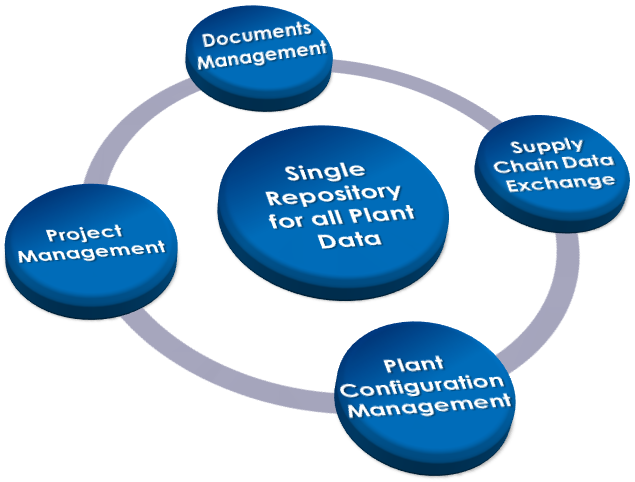 The third trend is the applicability of PLM systems outside the classical manufacturing industries.
I have been writing about the usage of PLM systems for Owner/Operators and the civil / construction industry, where the PLM system becomes the place to store all plant related information, connected to assets and with status handling. Currently I am participating in several projects in these new areas and the results are promising
People and Change
 I believe PLM requires a change in an organization not only from the IT perspective but more important from the way people will work in an organization and the new processes they require.
The change is in sharing information, making it visible and useful for others in order to be more efficient and better informed to make the right decisions much faster.
This is a global trend and you cannot stay away from it. Keeping data locked in your reach might provide job security but in the long term it kills all jobs in the company as competiveness is gone.
The major task here lies with the management that should be able to understand and execute a vision that is beyond their comfort zone. I wrote about this topic in my series around PLM 2.0
Modern companies with a new generation of workers will have less challenges with this change and I will try to support the change with arguments and experiences from the field.
Audience
Since February this year, WordPress provides much more statistics and interesting is the map below indicating in which countries my blog is read. As you can see there are only a few places left on earth where PLM is not studied. Good news !!

Although most of my observations come from working in Europe, it is the US that provides the most readers (30 %) , followed by India (9 %) and on the third place the UK (6 %).
This might be related to the fact that I write my blog in English (not in 100 % native English as someone commented once).
It makes me look forward to be in October in Atlanta during the PLM Innovation US conference to meet face to face with many of my blog readers and share experiences.
Conclusion
Reading back my posts since 2008, it demonstrated for me that the world of PLM is not a static environment. It is even that dynamic that some of the posts I wrote in the early days have become obsolete.
At the end of 2008 I predicted the future of PLM in 2050 – here we are on the right track.
There is still enough blogging to do without falling into repetitions and I am looking forward to your opinion, feedback and topics to discuss.
Related articles
- PLM misconceptions (virtualdutchman.com)
Sorry for the delay between this post and the previous post. A break with a lot of PLM work on my side and no adverts on your side: win-win. But now I have time to continue the serial around PLM 2.0. We are in the middle.
A small recap on the agenda:
| First post | : What is PLM 2.0? – published Aug 24th |
| Second post | : Challenges in current PLM – published Sept 4th |
| This post | : Change in business – published Oct 3rd |
| Final post | : Why PLM 2.0 – conclusions |
In the first post I described the changes in PLM messaging from vendors – PLM 2.0 or similar terms. In the second post I described the current challenges of PLM, which are well known – if you have access to in LinkedIn to the PLM related groups you will find discussions around the challenges of current PLM. And they set the spirit – good or bad.
Now in this post I will bring up some trends, which to my opinion, unmistakably must lead to a new way of PLM in order to adapt to the future.
Generation Y – a new generation of workers
 Generation Y: It is interesting to learn that everywhere companies are complaining or warning that their existing workforce is going to retire with all their knowledge without decent follow-up. In parallel they state it is difficult to find new employees with similar skills that will guarantee the future of the company. The new generation of workers, often identified as Generation Y, has different skills and different motivations.
Some interesting generalizations (note I am not a social anthropologist).
 The older generations were raised with the concept: Knowledge is Power – You as an individual needed to have in-depth skills to be the right person for a job – a job is your life and for life. As a negative result of this approach, you see that exactly this older generation sometimes ‘sits’ on their knowledge as a kind of job guarantee – they do not like sharing information – “Come to me and I will help you” is their motto till they retire.
Generation Y does not have this job for life attitude – they look more for short term success and fulfillment and therefore they do not fit so well in the way traditional companies work. They are not the type of knowledge workers previous generations had, but they are, thanks to their skills with modern digital media, capable of finding information and combining information into knowledge. They work different.
The interesting observation from my side is that Generation Y is exactly the type of people PLM requires, as it is all about sharing and combining data. What is blocking their acceptance for current PLM is that the implementation is not architected to their work motivation. Look at:
- The way information is stored (too structured),
- The way information is presented (too structured, boring screens).
- The way information has to be entered in the system (too unfriendly – overkill)
 For them PLM needs to move more to an intuitive way of presenting information, capturing data as-if it is something like serious gaming. And the new PLM needs to have a way to manage structured and unstructured data combined.
For companies that complain, they are losing skilled workers in the future, they should not complain but adapt. They should look forward and solve the problems for the future, which means a different way of doing business and implementing PLM. Do not choose what the dinosaurs did.
New styles of business management
 Here I want to come back to my first post – I was intrigued by reading Steve Denning’s posts and its relation to PLM. Through the post Why Amazon can’t Make a Kindle in the USA, I found the post The Death and Reinvention of Management the best fitting with my PLM drive.
Steve describes five fundamental shifts in management that make companies ready for the 21st century.
Take time to read the post (and go more in-depth if you get as enthusiastic as me) – but come back to read the rest of this post
I summarize/quote the five shifts from Steve here (as I am sure not everyone has done the reading):
1. The company’s goal has to shift to one of delighting clients i.e. a shift from inside-out (“You take what we make”) to outside-in (“We seek to understand your problems and will surprise you by solving them”)
2. The role of the manager has to shift from being a controller to an enabler, so as to liberate the energies and talents of those doing the work and remove impediments that are getting in the way of work.
3. The mode of coordination shifts from hierarchical bureaucracy to dynamic linking, i.e. to a way of dynamically linking self-driven knowledge work to the shifting requirements of delighting clients.
4. There is a shift from value to values; i.e. a shift from a single-minded focus on economic value and maximizing efficiency to instilling the values that will create innovation and growth for the organization over the long term.
5. Communications shift from command to conversation: i.e. a shift from top-down communications comprising predominantly hierarchical directives to communications made up largely of adult-to-adult conversations that solve problems and generate new insights.
Here we see the typical PLM 2.0 targets. I will translate them into our PLM terminology.
Shift # 1 – The shift to delight clients – from which PLM vendor do we hear this statement? Which PLM vendor puts the customer in focus, instead of their “superior” technology?
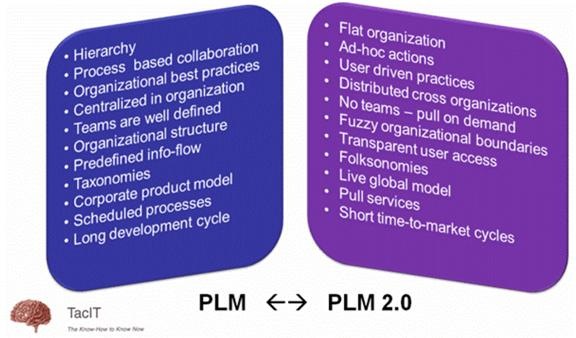
Shift #2, #3 and #5 are typical PLM 2.0 capabilities which I described in my first post. See below the PLM 2.0 differentiators:
And where do we find shift #4? How do PLM vendors address this change beyond marketing?
My conclusion on this point: Both PLM and management require a change to be ready for the 21st century – It is exactly what generation Y is looking for, it is exactly what future consumers are looking for. However currently classical PLM and classical Management are dominating the thought process – and they do not like change so much as it would put past investments and achievements at risk.
The Importance of Social Media
 Already described in the two previous trends, social media concepts fit exactly in the shift that we see towards the future. It impacts the way companies change their marketing and address their customer base. In parallel it affects the ways teams collaborate in the product development space, innovation teams are global product development teams.
My thoughts: Social media might look like a hype, but the basic concepts of social media will be required for future PLM
Globalization for SMB
 The major trend from the past decade is that SMB’s (Small and Medium Businesses) do not longer serve and fight for a regional existence. Competition and customers come from everywhere and production is more and more outsourced. The traditional company that is #1 in their region does not longer exist. Even SMBs have to consider ways to collaborate globally – again another driver for PLM 2.0
My thought: Traditional SMBs are never the leading companies in new trends, they hang on their core knowledge and have probably a longer way to go to really adapt to the future. Startup SMBs with no historical hindrance are likely to outperform them.
Innovation, Intellectual Property & War on Patents
 In a global market, innovation is the key driver to be successful combined with the point above: delight the customer. In order to delight the customer you need to innovate as delightment does not come from commodities.
And with innovation I am not only addressing the consumer market, innovation is required in all areas: green products, green production as world climate and its population forces us to change.
The successful products for the future will be those that are bringing innovation and when your company owns this Intellectual Property, your near future is going to be profitable,
Therefore the “War for Patents” will be everywhere. We currently see in the news the tablet and Smartphone patents wars, but it pops up everywhere, some more visible than others.
A “War for Patents” costs a lot of money (mainly spent to lawyers). Therefore the balance should be found between protecting your IP and to innovate faster. In this way your patents become less relevant because newer exist. To my opinion the new PLM should be the engine for innovation first and secondly the system to protect your IP
Conclusion:
 Again too many words for a blog post, but the topic is huge and I hope you see the need for a different PLM (PLM 2.0): A PLM that is targeted to the change in business all around the world. The monetary crisis which is another symptom of the old business gives us a chance to change. We need to change organizations and collaboration to remain profitable in the future – don’t be an ostrich
My thoughts –looking forward to your feedback
 It has been silent from my side the past – more than two months. Extremely busy and sometimes surprised to see the amounts of post some of my colleagues could produce, with Oleg as the unbeaten number one. During this busy period I was able to observe some interesting trends listed below:
Going Social
Social Media and PLM is one of the favorite topics for both bloggers and some PLM vendors at this moment. New products for community based collaboration or social engineering are promoted. Combined with discussions and statements how the new workforce (Generation Y) should get challenging jobs without doing the ‘old boring stuff’.
True arguments to initiate a change in the way we work. And I agree, must of current PLM systems are not ‘intelligent’ enough to support engineers in a friendly manner. However is there an alternative at this moment ? Below a commercial (in Dutch) promoting that elderly workers are still required for quality.
I discussed the relation PLM and Social Media some time ago in my post Social Media and PLM explained for dummies. In addition my observation from the field, gives me the feeling that in most companies the management is still dominated by the older generation, and most of the time they decide on the tools they will be using. No X and Y at this moment. Therefore I do not see a quick jump to social media integrated with PLM – yes the vision is there – but the readiness of most companies is not yet there.
Cloud
PLM and Cloud are also more and more mentioned by PLM vendors as a new solution specially for the mid-market. And with an optimistic mind you can indeed believe that with a low investment (pay per use) mid-market companies can do their PLM on-line. But why are existing on-line PLM systems not booming at this time ? (Arena / PLMplus / and the major PLM vendors) I believe that there are two key reasons for that:
- Implementing PLM is not equal to installing a system. PLM is a vision to be implemented using a system. And the difficulty is that a vision does not match function and features from a product vendor. There is a need for a driving force inside the company that will support the business change. Where are the consultants and advocates (with experience) for this type of solutions ?

- There is still a reluctance to store intellectual property somewhere on-line in a cloud without direct control and ownership of data. Mid-market companies are not known to choose solutions ahead of the mass. In this type of companies cloud based CAD tools might be an entry point, but all product data – no way they say.

PLM or ERP
Before even talking about new technologies or fundamentals for PLM, I see the biggest challenge for PLM is still to get the recognition as the system for product knowledge (IP) and innovation. In too many companies ERP rules and PLM is considered as a way to capture CAD and engineering data. The main PLM vendors are not addressing this challenge – they neglect ERP (yes we can connect). And ERP vendors like SAP and Oracle are not known for their PLM messages and strategy (yes we have PLM). As ERP is often the major IT-system historically, there is so often the (wrong) opinion that everything should be built and based on one system.

In some publications I have seen the Swiss knife as an example for the multi-functional system with all tools embedded. My question remains – who wants to work only with a Swiss knife when doing professional work ?
I like to have the right tools to do my job
The most important topic around my blog the past 3 years has been around the Manufacturing BOM – where should it be – and where is the MBOM current ?
Sweden – a reality check
Last week I attended the DS PLM forum in Gothenburg to present the vision of using a PLM system as the backbone for plant information management for owners/operators and how ENOVIA supports this vision.
 But I also learned Sweden is (one of) the most innovative countries (I need to verify the criteria used but can imagine there is a source of truth). What impressed me more where the presentations from Staffan Lundgren from Sony Ericsson with the title “Living in a world of change – balancing stability and flexibility” and Magnus Olsson from Volvo Cars with the title “Driving operational excellence in a challenging business environment”. Both companies are well known for their robust image. From both speakers you could experience that they are not worried so much about Generation Y, their success is depending on a clear vision and a will to go there. And this basic drive is often missing – PLM is not a product you buy and then business continues as usual
Conclusion
PLM vendors made a lot of noise the past months (events / product announcements) and customers might get the impression that technology and software (or the price of software) are the main criteria for successful PLM. Although not unimportant, I would focus on the vision and to assure this vision is understood and accepted by the company. 
Am I old fashioned ?
 In many PLM communities, you see discussions and statements, that there will be a significant impact on the way we perform product lifecycle management using social media capabilities. In this post I will give my thoughts without going in-depth into certain products. At the bottom of this post you will find some links to posts which contributed to my opinion (the usual suspects).
PLM
Let’s first establish a baseline, why we want Product Lifecycle Management. In a general PLM is a vision, to bring products to the market faster, with better quality, being innovative and more customer focused.
 This vision can be implemented by best practices, like a standardized global staged New Product Introduction process, an enterprise wide Engineering Change Process, integration between different disciplines to work globally on a single repository for product definition and many more depending on your industry..
Two words pop up here: a single repository for product definition and global. This is where the technology comes in. Due to an improved world-wide (internet / WAN) connectivity, the capabilities are there to communicate efficient around a single repository for product definition and reliable, around the globe . The world became a global workplace and we are all connected. The improved connectivity enables PLM vendors (and others) to promote the “single version of the truth” concept.
Single Version of the truth
The idea behind it is that, if you store everything in a single database, you will always find the right information. This idea was developed at the time the world was not yet global and people were thinking more local.
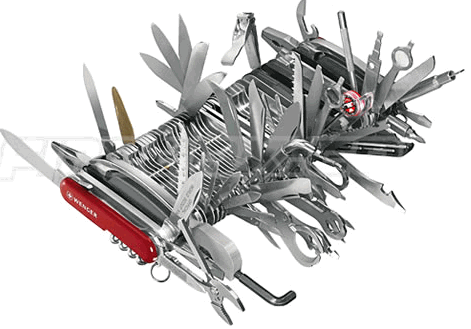 Some of the major ERP vendors also push for this concept. If you store all your data in their single platform, you are sure there is no redundancy of data, so you are always confident about the content is the message. This concept is often embraced by IT-departments, as the message having one single platform or one single system for all enterprise data sound like efficient. (I call it Swiss Knife thinking – it does everything – but would you use it for professional work ?)
As long as we are talking about explicit data and local activities, this concept seems to prove itself. However, a lot of informal activities exist around the product development process, and these activities are not managed.
In 2009, I participated in a COE Automotive panel, where one of the attendees in the audience stood up accused the PLM vendors of making their life so complex. He said:
“If we have an issue on the shop floor with production, we just gather the right people and solve the issue – no need to fill in screens of data that PLM or ERP systems require. And if there was a customer with a problem, we send a service engineer and the problem is fixed”
Of course if his company was a global company, it would be impossible to gather all around the shop floor, or to visit the customer site and solve it in a reasonable time.
 To avoid missing information, PLM and ERP systems try to collect as much as possible information in their systems, to have the best possible single version of the truth. Through immersive integrations and clever business logic, the user has to enter the minimum of information only once. However for the user still too much and way to complex they complain (and still not enough information is captured).
My conclusion so far: Single version of the truth is a concept to collect a majority of product related data, however missing all the informal communication, which is exchanged during talking (and later emailing and modern means of communication).
Extending the single version of the truth
The single version of the truth is an important implementation concept for PLM and it requires already a major challenge for companies. Imagine all information that you produce will be stored in such a manner that everyone authorized can see it and it is stored in such a manner that someone else also can understand the information (and not only you) . This is such an important change process often overlooked by IT-driven PLM implementations.
PLM Vendors focus on the tools to provide a platform to capture and share product data all around the product lifecycle. Not easy either as development is often based on generic functionality not optimized for a certain user role.
To understand the context of the shared data, you would like to hear or rewind the discussions people had at that time – as from these discussion a lot of implicit information can be retrieved. But no one wants to enter implicit information in a PLM system.
And then going global
Continuing with product development towards a global operation and addressing the communication around the product development is the next logic step. As it is much more difficult to communicate directly with everyone around the world, it is obvious that here social media come in the picture.
 Initial people were using email to exchange ideas with other people around the world. This created new problems – sometimes huge attachments of unmanaged data, sometimes important information in mail boxes of only a few people, relevant for many. Email is against the concept of a single version of the truth as people were creating there own non-pubic archives of product discussions. Before the WEB 2.0 revolution, PLM vendors provided email integrations or embedded email functionality in their PLM system. Still there a millions of email databases (Lotus Notes / Exchange) with product data, development data and more not visible for many.
The 2.0 change
A trend we see in social media is that your ‘old’ email system becomes more a notification system, that you got a direct message through one of your social platforms (RSS feeds, LinkedIn, Facebook, Blog, etc). Of course, if you are connected to all these platforms on-line all the time, you do not need a notification system anymore and you are connected to whom you want and when you want – a little bit back to the old days. If you enter a social environment, you are a participant of the communication going on – you can look around or participate.
 The benefit from social collaboration is that is does not push you into a structure of managed data. And it provides you with on-line communication with everyone who is in your selected community. The downside with the known social media is that it is not clear and secure, what happens with this information shared in social platforms. Will it be sold to special interest groups ? Can you find it through a search engine ?
For product related social collaboration, we need obviously more secure communities to collaborate. And as for this collaboration you do not know who is in your trusted company network, it is clear that cloud based solutions come in as a logical technical infrastructure. Of course these communities must be as easy accessible as popular social media and well integrated in the user’s environment.
Global single version of the truth ?
Combining the single version of the truth concept and the loose communication and content of social media brings us to the challenge of current PLM consultants, vendors and implementers. All the information collected in current social platforms is hard to find or interpret. If you use the embedded search functions in these communities, they are not designed for clever searches – you need to know the context? And then the question pops up if it is all information that existed ? You do not know as you do not see the full picture.
An old-fashioned managing all this data in our PLM system won’t work either. The capturing and classification and linking of data would be too much overhead for the reluctant user. We do not want to manage and justify each action that we do. (although this were knowledge management concepts in the 90’s)
Extended search
And this is where extended search comes in for PLM. The extended search is the glue between the single version of the truth and all the unmanaged data around the product in communities. Integrating this in a single environment is the challenge for PLM vendors (and less important for ERP vendors).
 Why mainly for PLM vendors ? The main reason is that in product development a lot of iterations, knowledge building, searching and capturing of date takes place. The more you know and understand, the better you are capable to make adequate decisions, understanding the right context during your development process. And for that you need the formal and informal information, global available across disciplines, companies and countries.
I see two major requirements for these extended search capabilities.
- First of all the search engine should understand your context and skip irrelevant discussions and posts from your social media. I have seen how this could be done. In 2007, Yedda, an Israeli startup bought by AOL, came with an intelligent question and answer engine. The concept behind the engine was that it mapped the context of the question to your profile, to the community you belonged and compared it to other profiles of people in the community. The more you asked and the more your answered the clearer your context became. In additions your answers were rewarded by others, and the more thumbs up you got, the more value you provided to the community – saving your boss to do appraisals.
- Search engines should provide you with a facetted search to drill down on the search results. As you do not know exactly what you are looking for, some keywords should do and then as a next step based on your context and the search context you should be able to drill down to the information you are looking for. This information should now give you a better understanding of the context of your product – if it is versioned ? if it is the latest ? Leave this to PLM.
My conclusion:
Classic PLM (single version of the truth) and social media capabilities (easy collaboration in communities) combined with an extended search engine are the mandatory capabilities for a modern global PLM implementation where both formal and informal data are managed in the context of a product
Links for reference:
 Jos Voskuil's Weblog
Interesting reflection, Jos. In my experience, the situation you describe is very recognizable. At the company where I work, sustainability…
[…] (The following post from PLM Green Global Alliance cofounder Jos Voskuil first appeared in his European PLM-focused blog HERE.) […]
[…] recent discussions in the PLM ecosystem, including PSC Transition Technologies (EcoPLM), CIMPA PLM services (LCA), and the Design for…
Jos, all interesting and relevant. There are additional elements to be mentioned and Ontologies seem to be one of the…
Jos, as usual, you've provided a buffet of "food for thought". Where do you see AI being trained by a…