
You are currently browsing the tag archive for the ‘Vision’ tag.
 In the last two weeks, I had some interesting observations and discussions related to the need to have a (PLM) vision. I placed the word PLM between brackets, as PLM is no longer an isolated topic in an organization. A PLM strategy should align with the business strategy and vision.
To be clear, if you or your company wants to survive in the future, you need a sustainable vision and a matching strategy as the times they are a changing, again!
I love the text: “Don’t criticize what you can’t understand” – a timeless quote.
 First, there was Rob Ferrone’s article: Multi-view. Perspectives that shape PLM – a must-read to understand who to talk to about which dimension of PLM – and it is worth browsing through the comments too – there you will find the discussions, and it helps you to understand the PLM players.
Note: it is time that AI-generated images become more creative 😉
 Next, there is still the discussion started by Gareth Webb, Digital Thread and the Knowledge Graph, further stirred by Oleg Shilovitsky.
Based on the likes and comments, it is clearly a topic that creates interaction – people are thinking and talking about it – the Digital Thread as a Service.
One of the remaining points in this debate is still the HOW and WHEN companies decide to implement a Digital Thread, a Knowledge Graph and other modern data concepts.
 So far my impression is that most companies implement their digital enhancements (treads/graphs) in a bottom-up approach, not driven by a management vision but more like band-aids or places where it fits well, without a strategy or vision.
The same week, we, Beatriz Gonzáles and I, recorded a Share PLM podcast session with Paul Kaiser from MHP Americas as a guest. Paul is the head of the Digital Core & Technology department, where he leads management and IT consulting services focused on end-to-end business transformation.
 During our discussion, Paul mentioned the challenge in engagements when the company has no (PLM) vision. These companies expect external consultants to formulate and implement the vision – a recipe for failure due to wrong expectations.
The podcast can be found HERE , and the session inspired me to write this post.
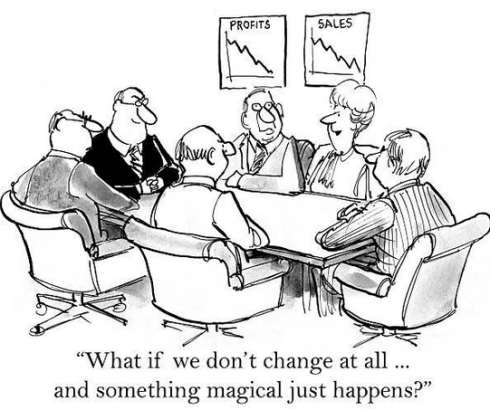
“We just want to be profitable“.
I believe it is a typical characteristic of small and medium enterprises that people are busy with their day-to-day activities. In addition, these companies rarely appoint new top management, which could shake up the company in a positive direction. These companies evolve …..
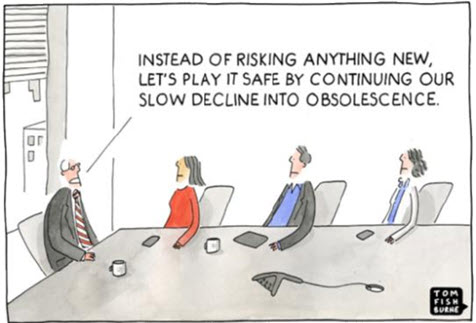
You often see a stable management team with members who grew up with the company and now monitor and guide it, watching its finances and competition. They know how the current business is running.
 Based on these findings, there will be classical efficiency plans, i.e., cutting costs somewhere, dropping some non-performing products, or investing in new technology that they cannot resist. Still, minor process changes and fundamental organizational changes are not expected.
Most of the time, the efficiency plans provide single-digit benefits.
 Everyone is happy when the company feels stable and profitable, even if the margins are under pressure. The challenge for this type of company without a vision is that they navigate in the dark when the outside world changes – like nowadays.
The world is changing drastically.
Since 2014, I have advocated for digital transformation in the PLM domain and explained it simply using the statement: From Coordinated to Connected, which already implies much complexity.
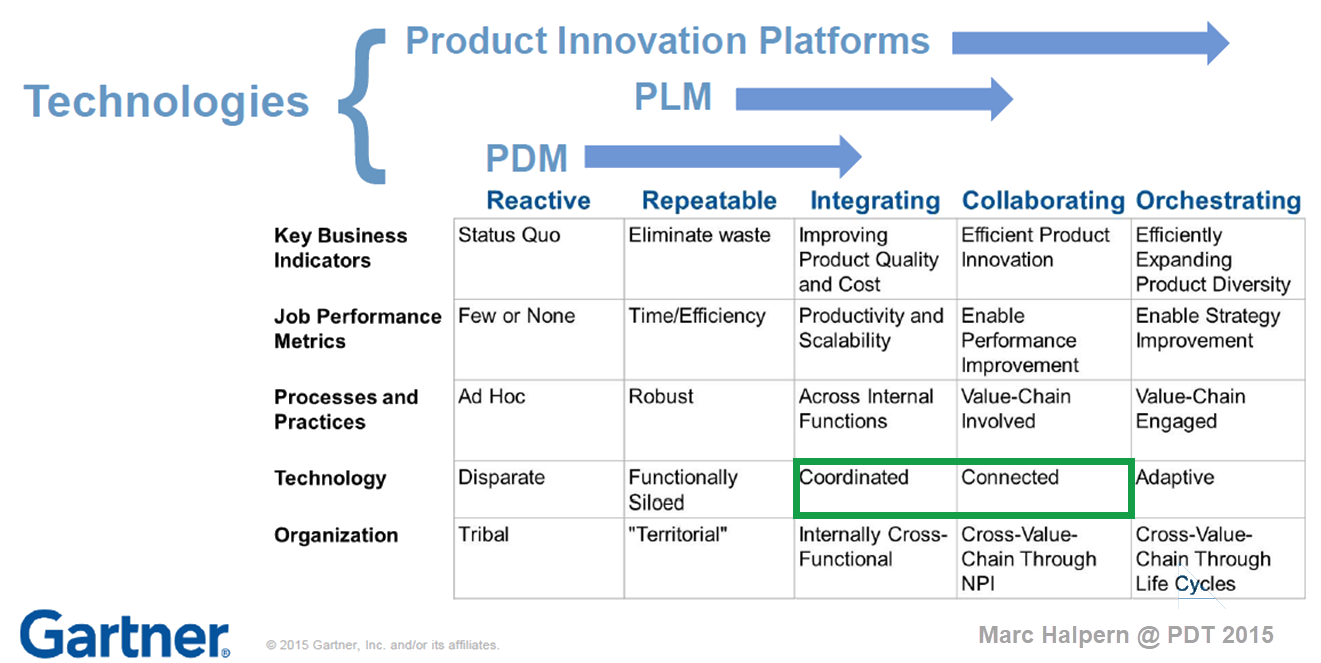
Moving from document/files to datasets and models, from a linear delivery model to a DevOps model, from waterfall to agile and many other From-To statements.
Moving From-To is a transformational journey, which means you will learn and adapt to new ways of working during the journey. Still, the journey should have a target, directed by a vision.
However, not many companies have started this journey because they just wanted to be profitable.
“Why should we go in an unknown direction?”
With the emergence of sustainability regulations, e.g., GHG and ESG reporting, carbon taxes, material reporting, and the Digital Product Passport, which goes beyond RoHS and REACH and applies to much more industries, there came the realization that there is a need to digitize the product lifecycle processes and data beyond documents. Manual analysis and validation are too expensive and unreliable.
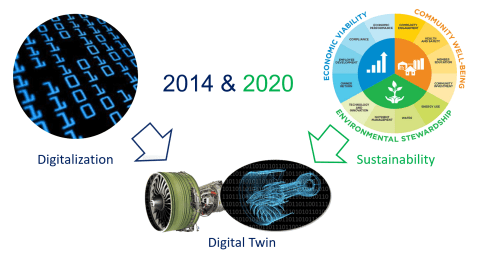
At this stage, there is already a visible shift between companies that have proactively implemented a digitally connected infrastructure and companies that still see compliance with regulations as an additional burden. The first group brings products to the market faster and more sustainably than the second group because sustainability is embedded in their product lifecycle management.
 And just when companies felt they could manage the transition from Coordinated to Coordinated and Connected, there was the fundamental disruption of embedded AI in everything, including the PLM domain.
- Large Language Models LLMs can go through all the structured and unstructured data, providing real-time access to information, which would take experts years of learning. Suddenly, everyone can behave experienced.
- The rigidness of traditional databases can be complemented by graph databases, which visualize knowledge that can be added and discovered on the fly without IT experts. Suddenly, an enterprise is no longer a collection of interfaced systems but a digital infrastructure where data flows – some call it Digital Thread as a Service (DTaaS)
- Suddenly, people feel overwhelmed by complexity, leading to fear and doing nothing, a killing attitude.
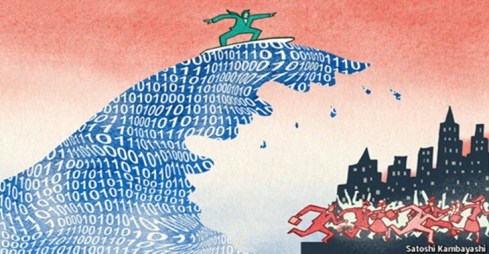
2014 The Economist – the onrushing wave
I cannot predict what will happen in the next 5 to 10 years, but I am sure the current change is one we have never seen before. Be prepared and flexible to act—to be on top of the wave, you need the skills to get there.
Building the vision
The image below might not be new to you, but it illustrates how companies could manage a complex change.
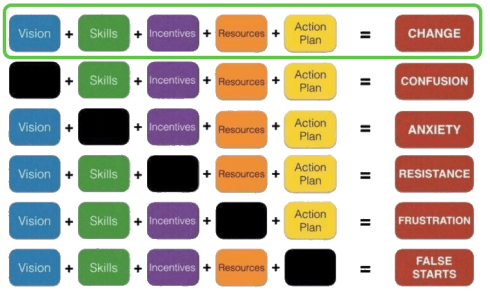
I will focus only on the first two elements, Vision and Skills, as they are the two elements we as individuals can influence. The other elements are partly related to financial and business constraints.
Vision and Skills are closely related because you can have a fantastic vision. Still, to realize the vision, you need a strategy driven by relevant skills to define and implement the vision. With the upcoming AI, traditional knowledge-based skills will suddenly no longer be a guarantee for future jobs.
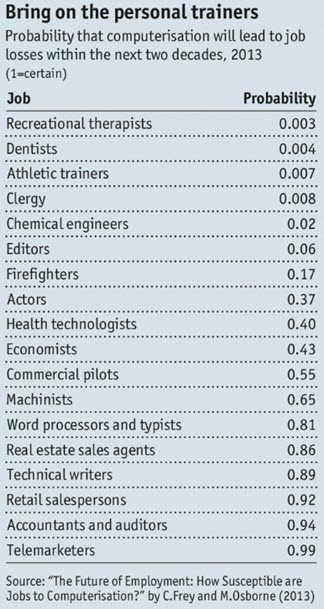 AI brings a new dimension for everyone working in a company. To remain relevant, you must develop your unique human skills that make you different from robots or libraries. The importance of human skills might not be new, but now it has become apparent with the explosion of available AI tools.
Look at this 2013 table about predicted skills for the future – You can read the details in their paper, The Future of Employment, by Carl Benedikt Frey & Michael Osborne(2013) – click on the image to see the details.
In my 2015 PLM lectures, I joked when showing this image that my job as a PLM coach was secured, because you are a recreational therapist and firefighter combined.
It has become a reality, and many of my coaching engagements nowadays focus on explaining and helping companies formulate and understand their possible path forward. Helping them align and develop a vision of progressing in a volatile world – the technology is there, the skills and the vision are often not yet there.
 Combining business strategy with in-depth PLM concepts is a relatively unique approach in our domain. Many of my peers have other primary goals, such as Rob Ferrone’s article: Multi-view. Perspectives that shape PLM explains.
And then there is …..
The Share PLM Summit 2025
Modern times need new types of information building and sharing, and therefore, I am eager to participate in the upcoming Share PLM Summit at the end of May in Jerez (Spain).
See the link to the event here: The Share PLM Summit 2025 – with the theme: Where People Take Center Stage to Drive Human-Centric Transformations in PLM and Lead the Future of Digital Innovation.
In my lecture, I will focus on how humans can participate in/anticipate this digital AI-based transformation. But even more, I look forward to the lectures and discussions with other peers, as more people-centric thought leaders and technology leaders will join us:
Quoting Oleg Shilovitsky:
PLM was built to manage data, but too often, it makes people work for the data instead of working the other way around. At Share PLM Summit 2025, I’ll discuss how PLM must evolve from rigid, siloed systems to intelligent, connected, and people-centric data architectures.
We need both, and I hope to see you at the end of May at this unique PLM conference.
Conclusion
We are at a decisive point of the digital transformation as AI will challenge people skills, knowledge and existing ways of working. Combined with a turbulent world order, we need to prepare to be flexible and resilient. Therefore instead of focusing on current best practices we need to prepare for the future – a vision developed by skilled people. How will you or your company work on that? Join us if you have questions or ideas.
PLM can be swinging and inspiring although there will be times of frustration and stress when implementing. These seven musical views will help you to make it through the project.
One Vision
Every business change should start with a vision and a strategy. Defining the vision and keeping the vision alive is the responsibility of senior management. When it comes to PLM, the vision is crucial.
No more heroes
Of course, when implementing PLM, the target is to streamline the organization’s processes, eliminate bottlenecks and reduce dependencies on individuals. No more need for firefighters or other heroes because they fix or solve issues that appear due to the lack of processes and clarity.
Let´s do it together
PLM implementations are not IT-projects, where you install, configure and roll out an infrastructure based on one or more systems. Like a music band, it should be a well-orchestrated project between business experts and IT. Here´s a song to make your project swing.
Say NO at the right time
When implementing PLM, the software geeks can do everything for you: Customize the system, create a complete new environment looking like the old environment, and more. Of course, you will pay for it. Not only for the extra services, but also in the long-term to support all these customizations. Always try to find a balance between the standard functionality and infrastructure of the PLM system and the company´s vision. This means there are times you must Say NO to your users. Maybe not always as funny as these guys say it.
Eight days a week
During the PLM implementation and for sure after one of the several rollouts, changes may appear. And, normal work still needs to be done, sometimes in a different way. There will never be enough time to do everything perfect and fast, and it feels like you need more days in the week. When you are stressed, swing with these guys.
We are the champions
Then when the PLM project has been implemented successfully, there is a feeling of relief. It has been a tough time for the company and the PLM team. This should be the moment for the management to get everyone together in the stadium as an important change for the company´s future has been realized. Sing all together.
… But the times they are a-changing
Although a moment of relief is deserved, PLM implementations never end. The current infrastructure could be improved continuously due to better business understanding. However, globalization and digitalization will create new business challenges and opportunities at an extraordinarily fast pace. So, be aware and sing along with Bob.
BONUS
Time to close the 2016 book and look forward to next year’s activities. I wish all my readers happy holidays and a healthy, successful new year with a lot of dialogue, and no more one-liners.
 Jos Voskuil's Weblog
Interesting reflection, Jos. In my experience, the situation you describe is very recognizable. At the company where I work, sustainability…
[…] (The following post from PLM Green Global Alliance cofounder Jos Voskuil first appeared in his European PLM-focused blog HERE.) […]
[…] recent discussions in the PLM ecosystem, including PSC Transition Technologies (EcoPLM), CIMPA PLM services (LCA), and the Design for…
Jos, all interesting and relevant. There are additional elements to be mentioned and Ontologies seem to be one of the…
Jos, as usual, you've provided a buffet of "food for thought". Where do you see AI being trained by a…