
You are currently browsing the tag archive for the ‘PDM’ tag.
 Last week was a week of transition. As I wrote in my previous post, I finalized a traditional PLM 1.0 project ( I will come back on this term ‘traditional’ PLM 1.0) and now probably because of the sunny days and some interesting articles I read (each word goes to a different article), I am reflecting what it means to think about the new trends: WEB 2.0 or even PLM 2.0
In this post I will try to explain the developments I have seen so far in the mid-market and from there project what might happen.
In the 80’s there was no PDM or PLM in the mid-market. This was the time most companies were moving away from the drawing board towards CAD. Most of the CAD was 2D and at that time in the mid-market AutoCAD was the dominant CAD software.
 At that time I was working for the biggest AutoCAD distributor in the Netherlands (picture on the left). This was the golden age for hardware and software resellers – margins were high and there was little or none IT-knowledge inside mid-market companies. In order to keep the high margin we provided a free helpdesk for our customers to differentiate from others. It was an interesting time. Prospects came to our demo room to plot a drawing of A0 format and to discuss the quality of the lines and the hatching as compared to handmade drawings. There was always the discussion if CAD was more productive and must of us agreed that benefits only came when rework or changes were needed. In parallel we offered a training course for the heads of a design department how they learned to understand if their designers were productive. They were used to observe the behavior of the draftsman and the minor bar on the drawing board and from there they understood if someone was productive. We were talking about the new digital generation that would replace the people at the drawing board.
Are there still drawing boards ? Is there still free support as the margins are high ? This was 20 years ago.
 Then slowly 3D CAD was introduced for the mid-market, initially only on Unix boxes, but with the introduction of Microsoft Windows it became achievable – SolidWorks for sure was leading in this area. Hardware became already more a commodity so the customer relation changed from free support to paid support, which required quality and knowledge. At that time in my company, we also saw the first demands for what customers called an “engineering database”. In the 2D world it was all about drawing management, now with 3D the focus was on managing the whole product. Initially called EDM (Engineering Data Management), later evolving in Product Data Management. The term PDM was not known at that time and I remember one of our customers visiting us with a sample of 13 reports – drawing list, spare part list, manufacturing BOM, etc. He told us: “I need a system that can generate these reports for me at anytime”. The solution: we implemented a PDM system for this customer. At the end of the nineties 3D was introduced in the mid-market combined with PDM. We were talking about the new generation of people that thinks in 3D which would replace the people who still worked in 2D
Are we still working with 2D ? Do we still look for support on hard- and software ? This was 10 years ago.
 Then came the era of connectivity, initially through the first internet wave, leading to terms as cPDM and ultimately PLM. Instead of focusing on productivity in a single department, the intention was to focus on collaboration between departments, development teams and to address the whole product lifecycle. Specially Dassault Systems extended this concept by focusing on the process and virtualization: test and build your product virtually before you spend any money on prototypes. Autodesk does the same in different words, they call it Digital Prototyping and they try to avoid talking about the processes as here we touch the most sensitive point in mid-market companies: touching or changing processes – ‘classical PLM 1.0. And this is also what I read between the lines of Jim Brown’s post Is innovation or product pipeline killing profitability ? As long as we do not change our product development process but focus still on doing the same with better tools, the real innovation will not come. We are now talking about the global collaboration generation that has to learn to work together and replaces the people who are not changing their processes.
Are we still solving our departmental problems only ? Can we survive keep on doing the same ? This is now !
And meanwhile mid-market companies are learning to understand and digest the above, we already see the new wave coming. WEB 2.0 – social networking – social collaboration – PLM 2.0 – communities and more. Instead of companies working on their own data, the future is to work in communities, live data, cross-company with employees, who are focused as a team to bring a result, we do not send so much emails anymore, we chat, we twitter, we …….. and more. In addition as we will see the trend that teams have members from all around the world, the question comes up: What is the standard communication language ? German (past) , English (present), Chinese (future) ? Here I am a big fan and believer of the Dassault vision that 3D becomes the global language for communication as the people participating do not come from the same educational background anymore – so it easier to see what you mean. Meanwhile the futurists are all the time talking about the aging workforce (a lot of people plan to retire), but if you read back, you will notice every ten years we are talking about an aging workforce. Every time there was a new generation picking up the new capabilities and challenging the next generation.
Are we in 2020 a global, 3D twittering world ? What is each individual’s added value ? What are companies doing to anticipate to the above trends ? It looks like it is going to happen and the current economical downturn allows us to anticipate even earlier till the next pit stop.
A thought I take with me on the summer holidays.
(Yes, in Europe we still have holidays that are so long you have time to think about work –
you can find me on the island below in August)

 The past weeks I have been traveling and visited several implementers and potential PLM customers in Europe. Afterwards I presented and joined a panel session in the SAE 2008 Commercial Vehicle event.
Between the traveling I had enough time to reflect what i saw and heard and I realized that in the mid-market and perhaps in the lower tiers of the automotive industry, people are locked in by the way they are working and thinking, meanwhile seeing PLM vendors already coming with future concepts, talking about PLM 2.0
Many of the mid-market manufacturing companies I met in Europe are just realizing PDM (Product Data Management) in their company, usually as an extension of CAD data management. If you look to the demands of these companies through RFQs, they are trying to build a complete environment for their product data mostly around the engineering department.
This is the classical way bigger companies were implementing 15 years ago, and now mid-market companies see and understand the maturity of this concept.
Is PDM the first step to PLM ?
In my previous posts I already argued that implementing PLM (which goes beyond PDM) brings the real benefit for manufacturing companies, but this requires a change in the current way of working. Disciplines (marketing/sales,engineering, production engineering, maintenance & service) have to collaborate around the major business processes from the company, instead of optimizing each department and then forward information to the next department as we can see from the (classical) picture below:
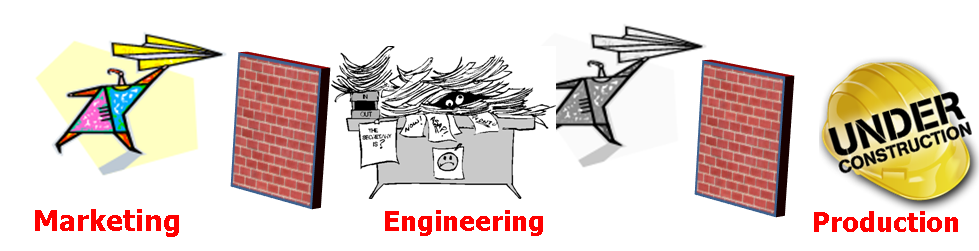
Now these companies implement PDM, but what is the result ?
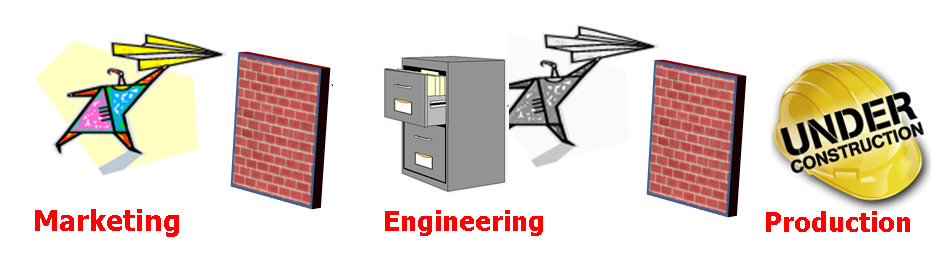
For mid-market companies the above step is easier to implement as it has not so much impact on the organization, however the fundamental way of working does not improve and does not provide the full benefits that bigger enterprises experience. The main benefits in the above situation are quality and efficiency benefits for engineer. As there is still no connection between the customers (marketing/sales) and the field (customers / service), the engineering department will work in an ivory tower, knowing what’s best. Only the real problems will reach them but the fine, combined information from the field will not reach them, and for that reason innovation is much harder to come from this approach.
Although PDM can be a first step towards PLM, it is only a step to get organized
The real benefits come when the collaboration around the whole product lifecycle is implemented. This is mostly not going to happen by a bright individual in the company. It requires a strategic vision and approach from the management, to change the way departments are working and connected.
In the very small mid-market companies this kind of collaboration has always existed ad-hoc. Quotes I heard in the past weeks were:
“if there was an issue, we all gathered around the machine in production and we solved it on the floor. This is collaboration.”
or:
“we do not need workflow and other tools to spend time informing each other. If there is something required, we just talk to each other”
These quotes above show, that people are not prepared for a structured, global approach. The main manufacturing process should be defined in such a way that exceptions like the first quote do not occur. Also the talking from the second quote is replaced by something that is traceable and secure, in order to guarantee repeatable results. This is the major task for the management in mid-market companies.
Meanwhile it is the role of the PLM providers to talk and understand the language from the mid-market companies. Not technology but work/task-oriented solutions will narrow the gap between the user and the software. Once the gap becomes smaller, mid-market companies might understand and feel the benefits of PLM.
So is the gap 15 years ?
I guess not, and for the following trends:
- More and more early adapters from PLM in the mid-market report the benefits from their PLM implementation. So the acceptance for PLM becomes mature.
- Mid-market companies will become more and more part of enterprises, which will bring the strategic vision of PLM to them.
- The aging workforce requires companies to capture knowledge that will disappear if they keep on working the same way. Joe, who knows everything, will retire in 5 – 10 years. This is where the management will get alerted to act – in time we hope.
- The new workforce comes with different, multi-tasking skills, used to work with a computer on parallel sessions. It is to the management to understand these new talents and develop them.
As most of the points are addressed to the management, I want to point once more to the following posts from the past:
culture change in a mid-sized company a management responsibility
 This week was a week full of discussion with customers and VARs (Value Added Resellers) around PLM, PDM and implementation approaches and I will come back on this topic in an upcoming post. First I want to conclude the sequel on reasons why companies believe they should not implement PLM.
The 5 reasons not to implement PLM I heard the most were:
- The costs for a PLM implementation are too high
- A PLM implementation takes too long
- We already have an ERP system
- Isn’t PLM the same as managing CAD files ?
- We are so busy, there is no time to have a PLM implementation in our company
And now, we reached #4
4. Isn’t PLM the same as managing CAD files ?
As most of our customers do not have the time to study all the acronyms that exist in our business, it is understandable that it leads to a different interpretation as expected. In non-academic language I will roughly outline the differences.
In the eighties when most of the mid-market companies designed their products in 2D, bigger enterprises were investing in 3D CAD. In parallel these companies were working on concepts to manage all their engineering data in a central place.EDM (Engineering Data Management) was the word in fashion that time. We have to realize that networks were not as affordable as nowadays and that there was no Internet. It was the first concept to centralize and manage engineering data (files – no paper drawings). An EDM system was of course a system purely for the engineering department.
More and more companies started to expand the scope of data managed, it became the central place to store product related information plus being an infrastructure to collaborate on product data. The acronyms PDM (Product Data Management) and cPDM (collaborative Product Data Management) became in fashion in the nineties. A PDM system still focuses on the engineering department but no multi-discipline and if available in dispersed locations.
In 2000 the focus of PDM was again expanded to other departments in the company working on the product in different lifecycle stages. Instead of a static data management environment, it became a target to connect all departments working on the product through its lifecycle. By having all departments connected, the focus could switch to the process. The acronym PLM (Product Lifecycle Management) was introduced and this created a lot more areas of interest:
- connecting the bidding phase and concept phase with feedback from production and the field.
- bringing the sourcing of parts and suppliers forward in the product lifecycle
- testing and planning on a virtual product
- and more
But what should be clear from the scope of PLM compared to PDM and EDM, that it has become a cross-departmental approach and not only a system to enhance the way engineering departments work.
PLM is a strategic approach to enable innovation, better portfolio management and response to the market. The focus is on changing the traditional way of working into an approach where the process is as lean as possible still providing flexibility to adapt to global changes – changing customer demands, changing business situations.
Overview
| EDM | Focus mainly on centralizing mechanical design data in an engineering department – mainly files |
| PDM | Focus mainly on centralizing product related data in an engineering department – files, BOMs, etc |
| PLM | Focus on the product development lifecycle cross departments and locations – files, BOMs, processes, resources. |
Conclusion
No, it is not the same, where managing CAD files is mainly an engineering department related activity which can be solved by a product, PLM is a cross organization approach which requires a PLM system as enabler to implement various best practices
This time a short post, I am off to the ECCAP (September 9-10) to meet customers, implementers and peers all around ENOVIA
Adiosu

 Jos Voskuil's Weblog
Interesting reflection, Jos. In my experience, the situation you describe is very recognizable. At the company where I work, sustainability…
[…] (The following post from PLM Green Global Alliance cofounder Jos Voskuil first appeared in his European PLM-focused blog HERE.) […]
[…] recent discussions in the PLM ecosystem, including PSC Transition Technologies (EcoPLM), CIMPA PLM services (LCA), and the Design for…
Jos, all interesting and relevant. There are additional elements to be mentioned and Ontologies seem to be one of the…
Jos, as usual, you've provided a buffet of "food for thought". Where do you see AI being trained by a…