
You are currently browsing the category archive for the ‘ENOVIA’ category.
 Last week I was in Greece together with the Dassault Systems Value Added Reseller OVision. Everyone would expect from the first sentence I was on holiday. Yes I agree, the settings were holiday like always temperatures above 35 C (approx 100 F) and never far from the see.
However,……

….we were visiting ENOVIA SmarTeam prospects and discussed existing customer specific implementation wearing business suits – not wearing shorts. However the most interesting issue was, that we were working with companies that were in the early stages of data management.
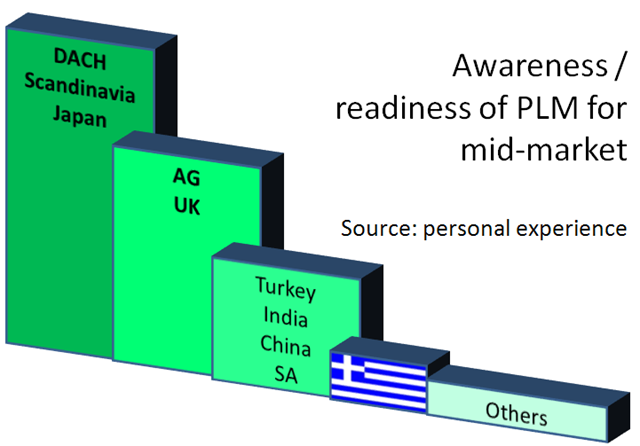 If you look around the world, to my understanding, and would rank countries on PLM awareness and need for data management, I would rank Western Europe, Scandinavia, Japan as the countries where concepts for PLM are understood, although in many mid-market companies I would still expect on the long term a culture change to real PLM. In my previous posts, I addressed several thoughts on that.
North America and the United Kingdom I rank differently, as somehow, there are big PLM implementations, but the majority of mid-sized companies is supplier of an OEM network or sees no return on investment on a PLM implementation
Then I would rank countries like Turkey, South Africa, India, and China as the next level. As they participate in manufacturing of global companies – mainly automotive and aerospace, they are driven into the basic needs of PDM as requirement from the OEMs. This pushes in parallel the country’s infrastructure – Internet / Intranet availability.
At the fourth position, I would rank a country like Greece. As due to the local economy there is not a focus on manufacturing or a huge participation in a global supply chain, they have to introduce their data management, growing to PDM or PLM slowly on a still developing infrastructure
Disclaimer: Countries not mentioned here can fall in any of the above categories (or even below). The fact that I did not mention them, is because I have not enough experience working with these countries to judge.
Back to Greece
 Apparently, due to all the beautiful islands in Greece, there are thousands of ferries traveling from island to island or other Mediterranean destinations. For that reason, there are companies that build ships, companies that refurbish ships and companies that maintain ships.
At the end, a ferryboat can be seen like single process plant. Like in a plant, you have equipment that needs to be operational and maintained during operation.
This requires a well-defined form of data management, often driven by quality processes around ISO 900x.
Companies often consider quality processes as a kind of document management. You have your manuals with procedures, templates spread around the company, and you update them before the next audit. Everyone is supposed to follow the procedures and supposed to know the latest procedures.
This is a labor-intensive activity if you want to execute as best as possible. In companies where the cost of labor is an issue, you will see that most people are loaded with work and usually the quality issue is the last activity these people will execute, first the operational issues then the rest.
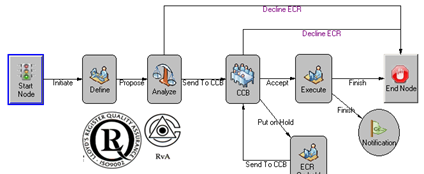
In order to improve the quality of the information, document management and workflow processes are functionalities used to address the availability of the documents and the workflow ensures information to be pushed and published in a guaranteed manner.
Instead of pushing the information to all the users, the company is now able to centralize the data and users can pull the latest information from the system. The workflow processes and the document management system guarantee the right steps are followed and you are always looking to the latest versions. Also you are aware of on-going changes.
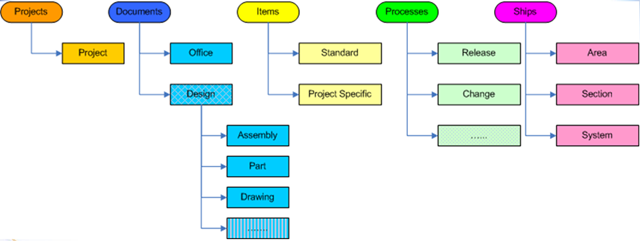
When it comes to ships however, there is more to address than ISO documentation and procedures. The ship itself has maintenance or refurbishing projects running on certain systems or locations in the ship. Here the advantages of a PDM system like ENOVIA SmarTeam appear. In the ENOVIA SmarTeam data model you are able to manage information (CAD documents and Bills or Materials too) related to a project, to a ship, to a location or system in the specific ship. There is no need for keywords on the document to describe where it applies, or have copies from a document because if applier to several ships. The data model below shows the types of information that can be stored around a ship.
Once the company has the vision, what to achieve in the upcoming years, a roadmap can be defined. Keeping user understanding, flexibility but still a continued move towards the PDM data model are parameters for the management to monitor and drive. Companies that build or refurbish ships of course have even higher needs to integrate their engineering activities with the ships maintenance data. This avoids a costly hand-over of data that already could be available in the right format.
Conclusion: Although Greece is in the fourth rank of PLM needs and awareness, the benefits to gain from PLM are there too, however due to awareness and infrastructure, they are not as visible as in the countries ranked as number one.

As Greece is the birthplace of many sciences, I am sure the awareness for where to apply PLM concepts is for sure something they will achieve.
 This week was again a week with several customer visits and discussions around PLM implementations. As analysts like CIMdata, AMR Research, the Aberdeen group are all claiming that PLM will be the next thing for small and medium manufacturing companies, the discussion around PLM is ongoing. Of course, PLM vendors are adapting their messaging and sometimes their products towards the SMB.
Some vendors like PTC and UGS try to downscale their existing products mainly by changing the packaging of the product (but it remains a PLM system originally designed for enterprises) others like Dassault Systemes have a special SMB offering with full PLM capabilities, ENOVIA SmarTeam.
But let’s assume we have the ideal PLM solution for an SMB company. This was the start point, I had during my meetings this week. How would you motivate a company to implement PLM, knowing all the constraints of SMB companies? Miki Lumnitz wrote about it in his blog –PLM for SMB who are those companies?
I noticed one of the main issues for discussion is the handling of the MBOM (Manufacturing BOM). So let’s look at the different viewpoints in a company.
EBOM (Engineering Bill Of Materials)
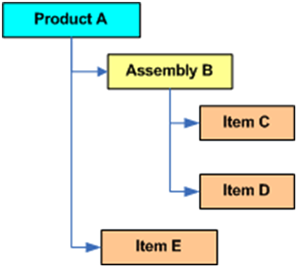 “The EBOM reflects the way a product was functionally designed”
When engineers define a product, they design (or reuse) assemblies (modules) and add new parts and assemblies to the design. When working with a 3D CAD system, saving the product results in a document structure that resembles a lot the engineering BOM. Traditionally companies got the impression that by changing this EBOM structure a little, they would have a structure ready for manufacturing, called the MBOM.
MBOM (Manufacturing Bill of Materials)
“The MBOM reflects the way a product will be manufactured”
The MBOM is a structure derived from the EBOM. The main changes from EBOM to MBOM are: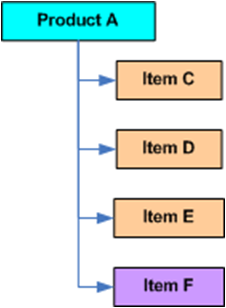
- removal of subassemblies that do not exist in the physical world. For example a grouping of two parts that are logically grouped by the designer, but as a group does not make sense for manufacturing (Assembly B).
- And in addition to non-design items which are needed for manufacturing the product. For example paint or grease. (Item F)
Traditionally – and also in the companies I was visiting – the EBOM is the domain for the engineering department and with additional modifications, they provide a BOM (is it EBOM or MBOM ?) to the ERP system. Some companies add non-engineering items to their design – they draw a can of paint in their design to make sure the paint is part of the BOM. Some work with phantom production order to address the usage of subassemblies by engineering.
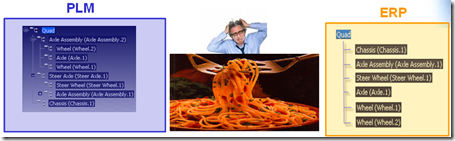
Both EBOM and MBOM definitions are preparations before production can start. The EBOM and MBOM contain the product knowledge, how to build and how to manufacture a product. For that reason, they should be handled in the PLM system. The main reasons for that are:
- during process engineering, there is a need to use, analyze and sometimes adapt engineering data. This can be done in the most efficient way within one system where all product data is available
- PLM systems, like ENOVIA SmarTeam, contain tools to create quickly based on certain rules an MBOM derived from the EBOM and when changes occur even compare both structures again, to adapt to these changes
- Having a single environment for product definition and manufacturing improves the total product understanding
So where is the MBOM?
Ask yourself as a company ” where do I handle the MBOM ?” Some of you might say, we do not have an MBOM as our EBOM with some modifications is already good enough for manufacturing. Many companies might say, we manage the MBOM in the ERP system as this is (was) the only system we had where we could define such structures. These companies are candidates for improving their Concept to Manufacturing process, as for sure either users or working methods are compromised to work with the MBOM in the ERP system.
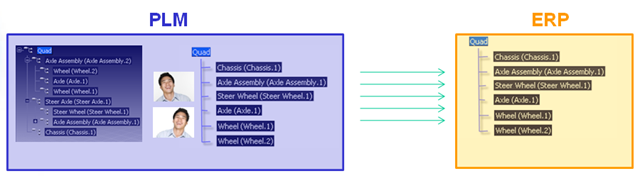
Some might says: Do we still need ERP systems?
Yes, as ERP systems are built to schedule and execute the production of well-defined products in the most efficient way. ERP systems are needed for the execution, often the core activity for manufacturing systems.
PLM systems are the reason that ERP systems can execute, they bring the product definition and information to produce a product. And in case the company designs and manufactures excellent and innovative products the future is bright.
But we should not consider engineering activities in the same way as production activities.
Einstein once said (and he is not an expert anyway):
Innovation is not the product of logical thought, even though the final product is tied to a logical structure
I am curious to learn where you manage your MBOM
 Last week I was working with several people on data management issues for the supply chain. As I mentioned in my previous post from the ECC in Munich, there is a trend where OEMs require more and more cooperation from their suppliers. Most of these suppliers are mid-sized companies and these companies often lack the management support to implement changes top-down in an organization.
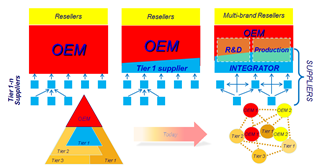
In mid-market companies the concept for quality guarantee and consistent responses is often implemented in design data management (control the product data), a quality system (ISO,—–) and the ERP system. See also PLM and ERP culture change. As these systems could be implemented on department level, not touching each other too much, it is relative easy from the cultural point of view to implement them. Each department can optimize themselves and often the quality system is not enforcing the users to work completely different.
But who and where is innovation managed ?
Large enterprises discovered that, in order to innovate, you need to connect and analyze all information around the products they are manufacturing. In simple words they realized PLM is needed to connect everyone around the product lifecycle from the concept phase till the production and after-sales phases. For these companies PLM became the backbone for their specific knowledge – we call it IP (Intellectual Property). Big companies could implement PLM because they had the management vision, the resources (people and budget) and the top-down approach to enable (and sometimes enforce) this change.
In mid-sized companies there might be the management vision, but resources and a top-down approach are rare. When it comes to a top-down approach, often the management believes that the goal is to enforce one IT system to the organization to manage all the critical data. Naturally this is the ERP system, and ERP vendors remain claiming that they can do PLM. It is a kind of overestimation of these companies as their nature lies in processing data, resources as efficient as possible, not in being creative to find new innovations.
Innovation is not CAD design as others may believe. These beautiful 3D designs smell like innovation, but in fact before a designer could start working on a concept, a lot of work has been done before. Analysis about what is it that the market, the customers require? What is de feedback on our current products in the field ? What is the competition doing etc, etc.
PLM requires culture change
As long as an organization remains thinking around 1 or 2 major IT systems (CAD data management and ERP) to manage all, there is no chance for PLM to be implemented successful. All departments and disciplines around the product lifecycle need to work together, change their departmental habits and learn to adapt to PLM best practices.
There is enough argumentation why to implement PLM and I believe solutions like ENOVIA SmarTeam Engineering Express are from the technology point a good start. See all related posts and comments to my previous post.
What I wanted to stress is that changes in a mid-market company are not done from the logical point of view. As the top-down vision and implementation often are not available, we are waiting for all departments to decide let’s change our way of working as we read all these beautiful benefits of PLM. This is of course not going to happen, only in advertisements.
Culture change even in mid-sized companies is a management responsibility and requires an open mind. We often forget that we have two sides in our brain. One side the logical side, analyzes all the arguments and stores them logically as good or bad. The other side of the brain, the emotional side is making the decisions, grabbing arguments that suit from the logical side in order to explain to others and ourselves why a decision is taken.
If you read books like The Language of Change (very theoretical, but the groundwork) or Blink: The power of thinking without thinking (very popular) you will understand that changes won’t happen if we stick to the traditional way of posting our arguments and keep on doing what we feel good with.
It is the management responsibility to think how to enforce a change in their companies. But as they also have a two sided brain, for that reason, management consultants were invented to reflect and discuss the emotional and logical side.
If after reading this post, you are more aware of the fact that one side of your brain fools you, then I achieved something. If however you will say “This is nonsense”, your other half of the brain has won.
Footnote: No more words about soccer – Holland is out
This week, I was in Bruxelles conducting a Engineering Express training for ENOVIA SmarTeam resellers. The feedback I got from the participants during the training made me again more aware from the culture change needed or dreamed about in the small and medium manufacturing enterprises.
As I wrote before in PLM and ERP – the culture change , there is for sure a conservative vision in the small and medium enterprises to stay with their major IT systems they invested in, usually ERP and (3D) CAD.
From the bigger enterprises and reading all the analyst reports, many of us project that the small and medium enterprises also need PLM in the same way as the bigger enterprises, but then in a more packaged, ready to use manner, instead of a custom implementation guided by PLM experts like the bigger enterprises did.
So ENOVIA SmarTeam Engineering Express is a prepackaged solution bringing PLM closer to the mid-market. However during the training many of the questions were not around the capabilities of the Engineering Express, but more about why do we(customers) need to use the same approach as bigger enterprises, why do we have the same needs?
Where big companies focus on defining and implementing processes in order to have a predictable outcome, I noticed in talking with SMB companies, they are proud of explaining they exist without these processes enforced, but work in a more flexible, human task oriented manner.
If we look to a classical ECR/ECO process, we see in bigger companies there are several steps to be identified to react on a outside request (the ECR) and to implement it (ECO).

An Engineering Change Request (ECR) process
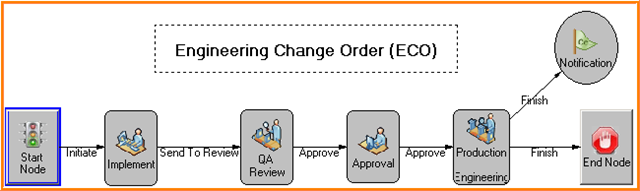
An Engineering Change Order (ECO) process
In smaller companies the ECR process is already embedded in one singe ECO process. Sometimes a formal (email) based activity takes place before a change is requested and implemented. One of the participants in the course – a manufacturing company – mentioned that they had the notice of a CCB in their company but all engineering change requests were sent to the CCB by email and as the CCB was meeting on a weekly base, this was the process to filter engineering change requests.
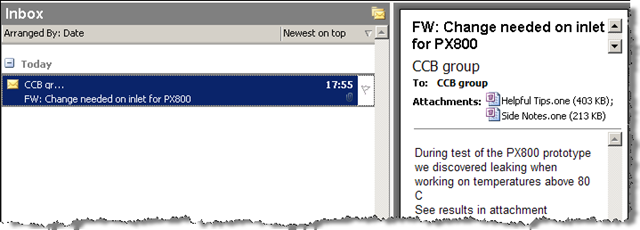
So here is the question: Big enterprises need processes to remain manageable – like a big tanker needs a predefined methodology to navigate through a harbor. Small and medium enterprises are more relying on their flexibility and they need a reliable and sustainable way to react – like a small ship in a harbor – as it can react quickly there is no need for the anticipation, still the capability to change direction is needed.
So are small and medium enterprises that behave like small ships in the harbor ?
If yes, they need to remain open for change as going straight ahead at the end will lead to a collision – and the challenge remains to make the (culture) change.
Or if no, how can you provide small and medium enterprises with means that enforce change without creating the overhead that compromises the flexibility ?

I am looking forward to comments and thought on this question – please post them.
However my first priority tonight is to survive in Milan where the match Italy-France will decide who continues to the next round in the European Soccer Championship. Worst case in parallel the Netherlands looses from Romania, in that case both Italy and France are gone and this might be my last post:)
Hoping to write my next post at the end of this week. ciao – adieu
Last week I visited the ECC in Munich, a conference where around 1000 people attended. It was an excellent event for networking and being in touch with customers, implementers of the ENOVIA brand. The V6 announcement and demonstrations were the major key-note sessions and they showed the focus on real global collaboration for big enterprises.
In the industrial tracks I followed the Aerospace / Defense track (approx 80 attendees), where European companies like Airbus, Aermacchi and Messier-Dowty gave their status and vision on their core development processes, supported by sessions from IBM and Dassault Systems.
 Interesting to learn from this session was that all agree that the classical hierarchical structure in the supply chain will disappear and that it will be more and more a network of suppliers working together, with much more responsibility and risk sharing for the supply chain partners. This higher responsibility and risk requires supplier to work with a PDM system too, and Airbus stated that for future contracts with suppliers this is a must – either integrated or interfaced.
Suppliers who do not meet these quality standards by having PLM implemented will not get new contracts anymore and in the next three years we will see a change in the supplier network and collaboration technology, based on solutions upcoming from Dassault and other software suppliers.
On the second day I attended the ENOVIA SmarTeam track (approx 100 people) where beside the current roadmap an interesting scenario was explained how the smaller and medium enterprises could work on V5 but thanks to the coexistence capabilities of V6 could collaborate with V6 companies or even inside their company could work on both levels in the future. It will be interesting to follow this approach.
Finally on June 9th the European soccer championship started. The Dutch team did not perform well during the qualification rounds and we were all afraid for the real tournament.
But miracles still happen – enjoy
 Jos Voskuil's Weblog
Interesting reflection, Jos. In my experience, the situation you describe is very recognizable. At the company where I work, sustainability…
[…] (The following post from PLM Green Global Alliance cofounder Jos Voskuil first appeared in his European PLM-focused blog HERE.) […]
[…] recent discussions in the PLM ecosystem, including PSC Transition Technologies (EcoPLM), CIMPA PLM services (LCA), and the Design for…
Jos, all interesting and relevant. There are additional elements to be mentioned and Ontologies seem to be one of the…
Jos, as usual, you've provided a buffet of "food for thought". Where do you see AI being trained by a…