
 After two posts, one describing the pre-conference “coffee-machine” discussion related to future directions of PLM and one sharing the discussion and findings from the AI panel discussion, it is time for another theme.
Both earlier discussions were interesting as the participants all had their personal perspectives.
In case you missed them, here they are:
Instead of a chronological review, here are some picks and highlights from the conference, starting in this post with one of the topics close to my heart – sustainability and the need for a digital transformation.
The conference
 This year’s conference was again sold out, showing there is still a large community interested in sharing and learning from PLM experiences – I believe a great part of the success is the fact that people can network and meet face-to-face – a typical human skill.
With over 140 attendees, there was a great and focused atmosphere during the event. Well organized, an as a shock, we had to miss our traditional starting keynote from Peter Bilello this time.
Take care, Peter and see you next time!
 The theme, AI in PLM: A Disruptive Opportunity and Challenge – Turning AI disruption into enterprise value, already set the scene – we cannot avoid AI discussions, and there were several.
There were also the traditional intermediate reporting stories from some of the Aerospace and Defense Action Groups, some customer transformation stories and, finally, a block of sustainability-related sessions back on the agenda.
In this post, I will focus on the latter. There were three presentations related to sustainability topics. I will discuss them in reverse order, as that makes the story flow better.
From Circular Economy to Industrial Strategy: Building Europe’s Resource Sovereignty
 Dr. Tom Voege, Policy Director of the PRO Circularity Alliance, came up with an interesting question – image below. It is a question we hear all the time: access to scarce materials, particularly for Europeans, has become part of geopolitical battles.
Tom Voege shared a strategic initiative for Europe to achieve resource sovereignty and strengthen its industrial competitiveness by transforming waste management into a robust circular economy.

An overlooked opportunity that was already discussed during the 2019 PLM Roadmap/PDT Europe conference by Graham Aid from the Swedish company Ragn-Sells AB , which specializes in waste management, environmental services and recycling.

 Graham mentioned that waste can sometimes contain a higher copper content than ore from a mine!.
At the time, he said we were not ready to transform our businesses because the economic benefits were not immediately visible and therefore neglected.
You can read my reflections in The weekend after PLM Roadmap/PDT 2019.
Now, seven years later, geographical strategies are being adopted with urgency, while frameworks for a more circular economy are being developed and improved.
 The framework for enhanced Extended Producer Responsibility (EPR) and Producer Responsibility Organizations (PROs) to manage end-of-life products effectively was discussed by Tom Voege to bridge the gap between collection and actual material recovery,
The integration of Digital Product Passports and artificial intelligence to trace material flows, optimize sorting processes, and ensure recycled inputs remain financially competitive was also discussed.
Ultimately, circularity is not merely an environmental policy, but an essential industrial strategy necessary to secure Europe’s supply chains and long-term economic resilience.

 It is a win-win strategy, and Tom Voege shared several challenges that need to be addressed. It is not just about recycling materials; we need to build circular value chains with trusted partnerships.
Why a Circular Economy in Manufacturing and How to Implement It Better Through PLM and AI
 Tom Sakao, a thought leader in the Circular Economy and having worked at Linköping University, shared his thoughts on transforming manufacturing through Circular Economy (CE) strategies, Product-as-a-Service (PaaS), and Digital Product Passports (DPP).
A great match with Tom Voege’s presentation and a connection to my 2024 presentation and blog post: The Product Service System and a Circular Economy. At that time, my blog post had the working title “The Weekend after Black Friday” – What a coincidence, and you can imagine the battle we are still fighting against the commercial pressure of such hype and the waste it creates.

Tom Sakao refreshed our minds about Product-as-a-Service (PaaS) and its environmental impact with a business example.
 Refurbishing product frames multiple times (e.g., 10 times under a Product-as-a-Service model) substantially lowers both the provider’s lifecycle costs and overall environmental impact compared to traditional one-off product sales. Remanufacturing processes alone can yield an 80–90% reduction in environmental burden, if companies are willing and able to change their business model.
Tom Sakao also introduced a new term for me: the Circular-Value-as-a-Service (CVaaS) concept.
 CVaaS aims to maximize and capture the economic value of end-of-use (EoU) products by exploiting their remaining useful life. Original Equipment Manufacturers (OEMs) can monetize circular value by offering CVaaS contracts with buy-back mechanisms or by taking a share of resale value.
Implementing CVaaS requires platforms to showcase EoU products, communicate their economic value, and calculate value in a standardized way.

While diving deeper into the concepts and implementation of the Digital Product Passport, Tom Sakao highlighted some of the topics that need to be addressed:
- The need for standardized data models & ontologies: Data integration across the product lifecycle—covering design, production, use, service, remanufacturing, and recycling. Standardized data models and ontologies enable OEMs and partners to query cross-organizational data on a strict need-to-know basis.
- A Double Systems Perspective: Successful circular transformation requires a double systems perspective that aligns internal product lifecycle management with a broader, multi-company value co-creation ecosystem. This systemic shift demands top-management strategy, organizational change, and complex cognitive skills in design, management, and ICT application.
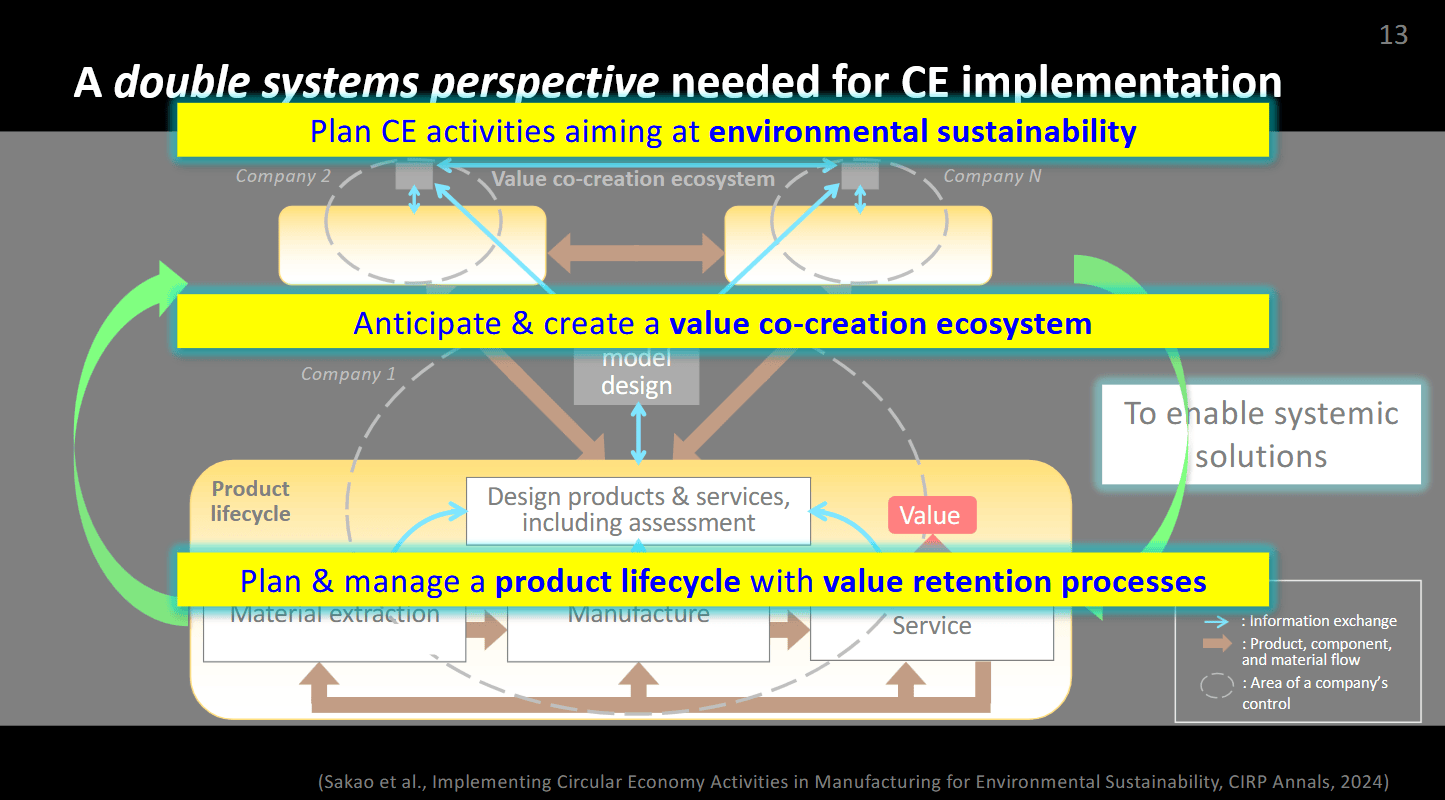
It was interesting to see that both Tom Sakao and Tom Voege aligned on using Digital Product Passports (DPP) and the need for collaborative, multi-stakeholder ecosystems to track, value, and retain embedded materials across the product lifecycle for a sustainable circular economy.
 The question for your company: Where to start, and who will define the strategy (and when)?
Digital Product Passport: From compliance to customer value
 Johan Anderson, working on global strategy projects within SSAB – the Swedish Steel mill, described their journey in implementing the Digital Product Passports (DPP) as part of the European Union’s Ecodesign for Sustainable Products Regulation (ESPR)
Traditional steel mills are the biggest carbon emitters when steel is produced traditionally. SSAB is moving toward near-zero carbon emissions for its steel products, using green hydrogen as the heating source.

According to Wikipedia, their currently built €4.5 billion fossil-free steel mill in Luleå, Sweden, is expected to reduce Sweden’s carbon dioxide emissions by 7% upon completion in 2028.
An impressive number, and it seems that Johan Anderson, who also calls himself the Emission Eliminator on LinkedIn, has an easy job here. However, there is more to do, and this time his presentation was about the digital product passport (DPP) at SSAB.
While many companies might consider it a compliance burden, Johan also shared further benefits that become available when preparing for a digital landscape that supports DPP compliance.
 In many of the PLM Green Global Alliance interviews, this topic is mentioned. Sustainability, in particular compliance regulations, but also Lifecycle Assessments, push companies to become more digital and therefore their digital transformation journey becomes a justifiable must.
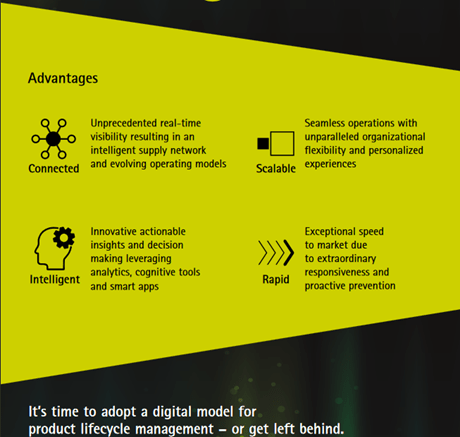 The digital transformation leads to improved internal processes, data-driven instead of document-driven, along the value chain.
One of the big promises of digital transformation was already mentioned by Accenture in 2014 (image to the left) and is an important theme at the PLM Roadmap/PDT conferences, as part of digital twin and digital thread discussions.
Next, the digital infrastructure needed for the digital product passport also allows SSAB to improve its market communication through digital channels and barcodes.
The third benefit Johan Anderson mentioned was bringing new customer value into the business, which will improve SSAB’s competitiveness. As we learned, steel is not just steel; there are many different premium steel products, making differentiation a profitable business.

The image above describes some of the capabilities SSAB can now provide. This is thanks to work on the digital product passport infrastructure.
Johan Anderson closed with a statement: “We should not consider the DPP implementation an IT project” – like every digital transformation project, it touches everyone in the organisation – from coordinated siloes towards connected value streams.

Where is your company on this journey?
A green dinner
Traditionally, the conference has a dinner organized for the participants after day 1 to enhance networking. The three afternoon lectures were a great opportunity to organize a “green dinner table”, as shown in the image below.

From left to right: James Wright (Our PGGA latest interview with CONTACT Software), Johan Anderson (SSAB), Jos Voskuil (PGGA/TacIT), Tom Voege (Policy Director of the PRO Circularity Alliance), Tom Sakao (TripleS), Torbjörn Holm and Håkan Kårdén (RESCOM veterans) and Evgeniya Burimskaya (PGGA/CIMPA PLM Services) – we had a lot to share.
Conclusion
The word sustainability is back at the conference, and I felt sorry that my presentation didn’t address sustainability either. However, Tom Voege, Tom Sakoa and Johan Anderson each showed from their own angle that sustainability should be part of every sustainable business, where sustainability is a business term as much as an environmental one. As SSAB demonstrated, remaining profitable means working on all those aspects at once.
For my American friends: A Happy Thanksgiving

Discover more from Jos Voskuil's Weblog
Subscribe to get the latest posts sent to your email.


Leave a comment
Comments feed for this article