
This time, not a post as expected. Normally, you would expect a long post from me after this conference, but this time I have to say AI! /ah-ee/.
 AI in Dutch is an expression similar to the English expression “ouch“, an expression you can use when you feel mild dismay or realize a problem.
And I had this problem: after the conference, it was a weekend full of political activities, and next Monday/Tuesday my home office was occupied by two carpenters making my office functional for the future.
Now it is already Wednesday, and I can finally start my series of posts about this great event. Usually, it takes me a few days to digest and sort the content, so given the limited time, I decided to start with one of the two multi-person experiences from the conference – the future of PLM discussion on November 3rd.
The future of PLM discussion
 Last year, we organized a pre-conference workshop, sponsored by the Arrowhead™ fPVN project, to discuss aspects of the future of PLM. Here, with almost 32 passionate PLM professionals, we discussed various future aspects of product lifecycle management and asset lifecycle management.
You can read my write-up from that workshop here:
 2025 –A week after Shaping the Future of PLM – No time to lose!
It was an interesting workshop; however, we also felt there wasn’t enough space to build networks of interest or for free discussion.
 Therefore, this time we aimed for a less publicly announced event, more of a coffee machine discussion with a group of selected opinions coming to the conference or living close to Gothenburg – to keep it informal and with an open agenda.
Bringing together professionals with different backgrounds and perspectives creates opportunities for innovative discussions.
No ultimate targets, drink the coffee together, listen and learn. The image below shows the mood, credit to Helene Ålander (and AI as we all look younger).
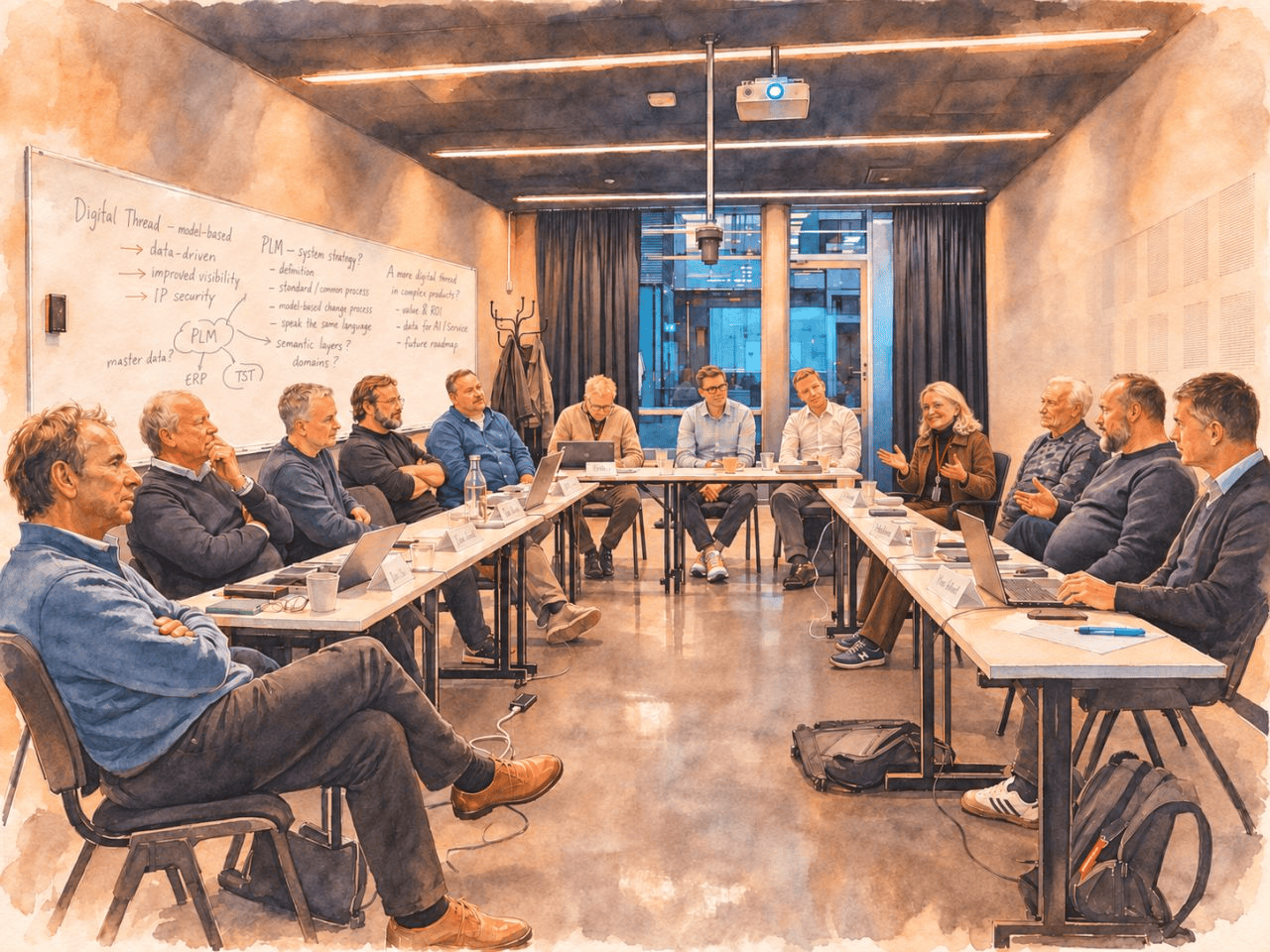
We discussed the various aspects of the Digital Thread – starting from the base for traceability, evolving into a more end-to-end, data-driven infrastructure to give a broader context, understanding that IP security is still an unsolved topic.
Next, to move further to benefit from agentic AI using this digital thread infrastructure, we dived into the need for ontologies and domain-specific semantic models.
 Markus Zimmermann, supported by Michael Kirsch, gave us a sneak peek at his CASCaRA and DDP (Digital Data Package) presentation. CASCaRA (Collaborative Artifact, Specification, Context and Resource Access) is a standardization initiative for digital engineering collaboration using an ontology and a common knowledge graph. Michael provided the ProSTEP background to the DDP.
Markus would give a keynote session the next day on this topic within Rolls-Royce Power Systems.
 The CASCaRA theme led to an interesting discussion where Martin Eigner hoped for a broader discussion related to the end-to-end digital thread. Why should we focus on external ontologies, as for most companies the ontologies of their major systems are already good enough?
Håkan Kårdén did not allow Martin to use the name of a famous ERP supplier as the German standard.
Martin is right here: for most companies, the current state of their system landscape does not call for overall ontologies; however, it creates vendor lock-in.
 Here you could also see Rob Ferrone‘s approach: not question the existing product lifecycle management landscape, but be pragmatic and fix things where needed. The former Digital PLuMber did not design new cars, houses or machines; he made the data flow – the reason we invited him.
 Mikkel Haggren Brynildsen, project lead for the ISO 23726-2 standard, working at Grundfos, was the real ontology expert in the room, working at the other end of the spectrum, claiming he is still curious why he is accepted by his PLM colleagues at Grundfos.
 The big differentiator, of course, is the core business model of the company. Traditional industrial manufacturing companies own the core process from the beginning to (their) end – be it service or disposal,
The (capital) Asset Lifecycle Management (also ALM) industry is characterized by a conglomerate of suppliers building a plant, a ship, a building or a platform, where the asset has to stay in operation for 30 years or more – nuclear plants, for example, can have a lifetime of over 60 years.

Building and maintaining capital assets is where the need for overarching standards comes in, as suppliers won’t use the same tools during the EPC (Engineering, Procurement, Construction) phase and later during the MRO (Maintenance, Repair and Overhaul) phase.
Plant Owners/Operators cannot force all their partners to work with the same systems.
 Given the lifetime of the assets, it is worthwhile to invest in ontologies and standards, one of the drivers behind Eurostep and the existing PLCS standard – the area where Peter Wedholm, Bjørn Fidjeland and Torbjörn Holm are active, now exploring existing standards to transform them into interoperable OWL 2 DL ontologies aligned through the IDO Upper Ontology.
For them, standards and ontologies matter.
 We all agreed that a future enterprise, using AI agents, relies on quality data with an understandable context for the agents. That’s why we were happy to have Peter Vind and Helene Ålander in the room, giving the perspective of an enterprise architect – a mandatory role in a modern organisation.
 Helene, the only woman in the room, raised the question upfront: is the future of PLM really about improving today’s processes and systems, or should we rethink some of the assumptions behind them?
A topic that also resonates a lot with me, Jos Voskuil, but we did not have the time or the audience to dive in that direction.
As you can see, everyone brought a perspective, illustrating the broad reach of product lifecycle management, its application to industrial practices and needs, and the move to a reliable, data-driven infrastructure that allows AI agents to provide us, humans, with richer context.
Will this all allow us to work differently, more efficiently and with less IT overload – time will tell.
No Conclusion
This time, no conclusion, because when Torbjörn, Håkan, and I discussed using the opportunity of so many PLM experts coming to Gothenburg to have this meeting, our goal was to satisfy each other’s curiosity and understanding of different perspectives. Thanks on behalf of the three of us: we can say:
“We Did It” – “Wir Haben Es Geschafft”, “Vi Gjorde Det”.
Next episode soon: The week after PLM Roadmap / PDT Europe – AI AI (AI²)

Discover more from Jos Voskuil's Weblog
Subscribe to get the latest posts sent to your email.


Leave a comment
Comments feed for this article