

Image: 21stcenturypublicservant.wordpress.com/
Over the past years, I have talked a lot about Digital Transformation, particularly its relation to PLM. This time, I want to focus a little more on Digital Transformation and my observations related to big and small enterprises. I will take you from the top, the C-level, to the work floor and then try to reconnect through middle management. As you can imagine from the title of this post, there is a challenge. And I am aware I am generalizing for the sake of simplicity.
Starting from the C-level of a large enterprise
Large and traditional enterprises are having the most significant challenge when aiming at a digital transformation for several reasons:
- They have shareholders that prefer short-term benefits above long-term promising but unclear higher benefits. Shareholders most of the time have no personal interest in these companies, they just want to earn money above the average growth.
- The CEO is the person who defines the strategy, which has to come with a compelling vision to inspire the shareholders, customers and employees of the company—most of the time in that order of priority.
- The CEO’s role is to prioritize investments and stop or sell core components to make the transformation affordable. Every transformation is about deciding what to stop, what to start and what to maintain.
- After four to seven years (the seven years’ itch), it is time for a new CEO to create new momentum, as you cannot keep the excitement up too long.
- Meanwhile, the Stop-activities are creating fear within the organization – people start fearing their jobs, and the start-activities are, most of the time, on such a small scale that their successes are not yet seen. So, on the work floor, there will be reservations about what’s next.
 Companies like ABB, Ericsson, GE, and Philips – in alphabetical order – are all in several stages of their digital transformation, and in particular, I have followed GE as they were evident and ambitious. Meanwhile, it is fair to say that the initial Digital Transformation plan from GE has stalled and a lot of lessons have been learned from that.
If you have time – read this article, The Only Way Manufacturers Can Survive – by Vijay Govindarajan & Jeff Immelt (you need to register). It gives valuable insights into the strategy and planning for digital transformation. And note PLM is not even mentioned there!
Starting from the C-level of a small and medium enterprise
 In a small or medium enterprise, the distance between the C-level and the work floor is most of the time much shorter and chances are that the CEO is a long-term company member in case of a long-standing family-owned business.
In this type of company, a long-term vision can exist, and you could expect that digital transformation is more sustainable there.
Unfortunately, most of the time, it is not, as the C-level is often more active in current business strategies and capabilities that are close to their understanding instead of investing energy and time to digest the full impact of a digital transformation.
These companies might invest in the buzzwords you hear in the market, such as IoT, Digital Twins and Augmented Reality/Virtual Reality. These are all very visionary topics, but they are of low value when implemented in an isolated way.
 In this paragraph, I also need to mention the small and medium enterprises that are in the hands of an investment company. Here, I feel sorry as the investment company is most of the time trying to optimize the current ways of working by simplifying or rationalizing the business, not creating a transformative vision (as they do not have the insights.
In this type of company, you will see the same investments made on a lesser scale as in the other categories of small and medium enterprises.
Do people need to change?
 Often, you hear that the problem with any change within companies is that people do not want to change. I think this is too much of a generalization. I have worked in the past five years with several companies where we explored the benefits and capabilities of PLM in a modern way, sometimes focusing on an item-centric approach and sometimes focusing on a model-based approach. In all these engagements, the users were not reluctant to change.
 However, there were two types of users in these discussions. I would characterize them as evolutionary thinkers (most of the time ten years or more in the company) and love-to-change thinkers (most of them five years or less in the company). The difference between these groups was that the evolutionary thinkers were responding in the context of the existing business constraints. In contrast, the love-to-change thinkers were not yet touched by the “knowledge of how good everything was”.
For digital transformation, you need to create a love-to-change attitude while using the existing knowledge as a base to improve. This is not a people change; it is an organizational change where you need to enable people to work in their best mode. It needs to be an end-to-end internal change – not changing the people but changing the organizational parameters: KPIs, divisions, departments, and priorities. Have a look at this short movie. You can replace the word ERP with PLM, and you will understand why I like this movie (and the relaxing sound)
The Middle Management dilemma
And here comes my last observation. At the C-level, we can find inspiring visions that are often outcome-based, such as a more agile company, closer to the customer, empowered workers, etc. Then there is the ongoing business that cannot be disrupted and needs to perform—so the business units and departments all get their performance KPIs, merely keeping the status quo in place.
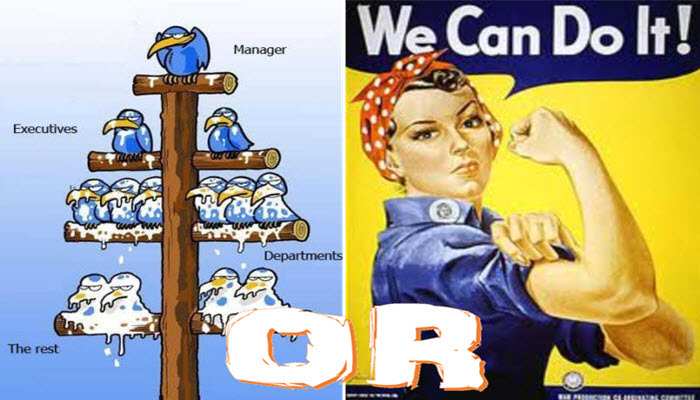 Also, new digital initiatives need to be introduced. They don’t fit in the existing business and are often started in separation – like the GE Digital division, and you can read Jeff Immelt’s thoughts and strategy on how this could work. (The Only Way Manufacturers Can Survive). However, as the majority of the business runs in the old mode, the Digital Business became another business silo in the organization, as the middle management could not be motivated to embed digital in their business (no KPIs or very low significance of new KPIs)
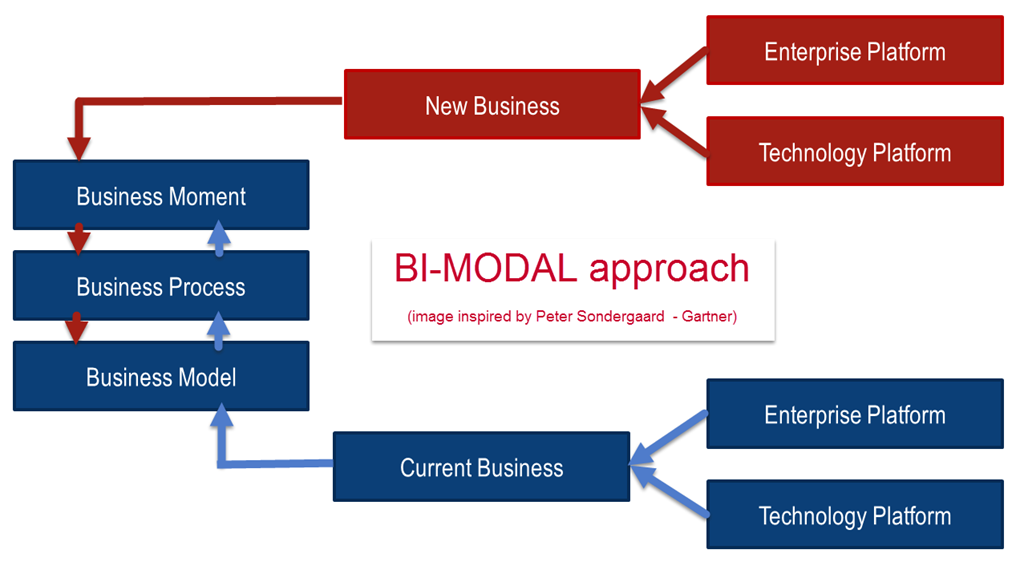 I discussed the hybrid/bimodal approach several times in my blog posts, most recently in The Challenges of a Connected Ecosystem. One point that I did not address was that probably nobody wants to work in the old mode anymore once the new approach is successful and scaled up.
When the new mode of business is still minor, people will not care so much and continue business as usual. Once the new mode becomes the most successful part of the company, people want to join this success if they can. And here, the change effort is needed. An interesting article in this context is The End of Two-Speed IT from the Boston Consultancy Group (2016). They already point to the critical role of middle management. Middle management can kill digital transformation or be part of it by getting motivated and adopting it.
Conclusion
Perhaps too much text in this post and even more content when you dive more in-depth into the provided content. Crucial if you want to understand the digital transformation process in an existing company and the critical place of middle management. They are likely the killers of digital transformation if not give the right coaching and incentives. Just an observation – not a thought 😉


 Jos Voskuil's Weblog
Leave a comment
Comments feed for this article