
 First, I wish you all a prosperous 2025 and hope you will take the time to digest information beyond headlines.
Taking time to digest information is my number one principle now, which means you will see fewer blog posts from my side and potentially more podcast recordings.
My theme for 2025 : “It is all about people, data,
a sustainable business and a smooth digital transformation”.
Fewer blog posts
Fewer blog posts, as although AI might be a blessing for content writers, it becomes as exciting as Wikipedia pages. Here, I think differently than Oleg Shilovitsky, whose posts brought innovative thoughts to our PLM community – “Just my thoughts”.
 Now Oleg endorses AI, as you can read in his post: PLM in 2025: A new chapter of blogging transformation. I asked ChatGPT to summarize my post in 50 words, and this is the answer I got – it saves you reading the rest:
The author’s 2025 focus emphasizes digesting information deeply, reducing blog posts, and increasing podcast recordings exploring real-life PLM applications. They stress balancing people and data-centric strategies, sustainable digital transformation, AI’s transformative role, and forward-looking concepts like Fusion Strategy. Success requires prioritizing business needs, people, and accurate data to harness AI’s potential.
 Summarizing blog posts with AI saves you time. Thinking about AI-generated content, I understand that when you work in marketing, you want to create visibility for your brand or offer.
Do we need a blogging transformation? I am used to browsing through marketing content and then looking for the reality beyond it – facts and figures. Now it will be harder to discover innovative thoughts in this AI-generated domain.
Am I old fashioned? Time will tell.
More podcast recordings
 As I wrote in a recent post, “PLM in real life and Gen AI“, I believe we can learn much from exploring real-life examples. You can always find the theory somewhere and many of the articles make sense and address common points. Some random examples:
- Top 4 Reasons Why PLM Implementations Fail
- 13 Common PLM Implementation Problems And How to Avoid Them
- 10 steps to a Successful PLM implementation
- 11 Essential Product Lifecycle Management Best Practices for Success
 Similar recommendations exist for topics like ERP, MES, CRM or Digital Transformation (one of the most hyped terms).
They all describe WHAT to do or not to do. The challenge however is: HOW to apply this knowledge in your unique environment, considering people, skills, politics and culture.
With the focus on the HOW, I worked with Helena Gutierrez last year on the Share PLM podcast series 2. In this series, we interviewed successful individuals from various organizations to explore HOW they approached PLM within their companies. Our goal was to gain insights from their experiences, particularly those moments when things didn’t go as planned, as these are often the most valuable learning opportunities.
 I am excited to announce that the podcast will continue this year with Series 3! Joining me this season will be Beatriz Gonzales, Share PLM’s co-founder and new CEO. For Series 3, we’ve decided to broaden the scope of our interviews. In addition to featuring professionals working within companies, we’ll also speak with external experts, such as coaches and implementation partners, who support organizations in their PLM journey.
Our goal is to uncover not only best practices from these experts but also insights into emerging “next practices.”
Stay tuned for series 3!
#datacentric or #peoplecentric ?
 The title of the paragraph covers topics from the previous paragraphs and it was also the theme from a recent post shared through LinkedIn from Lionel Grealou: Driving Transformation: Data or People First?
We all agree here that it is not either one or the other, and as the discussion related to the post further clarifies, it is about a business strategy that leads to both of these aspects.
This is the challenge with strategies. A strategy can be excellent – on paper – the success comes from the execution.
This discussion reminds me of the lecture Yousef Hooshmand gave at the PLM platform in the Netherlands last year – two of his images that could cover the whole debate:
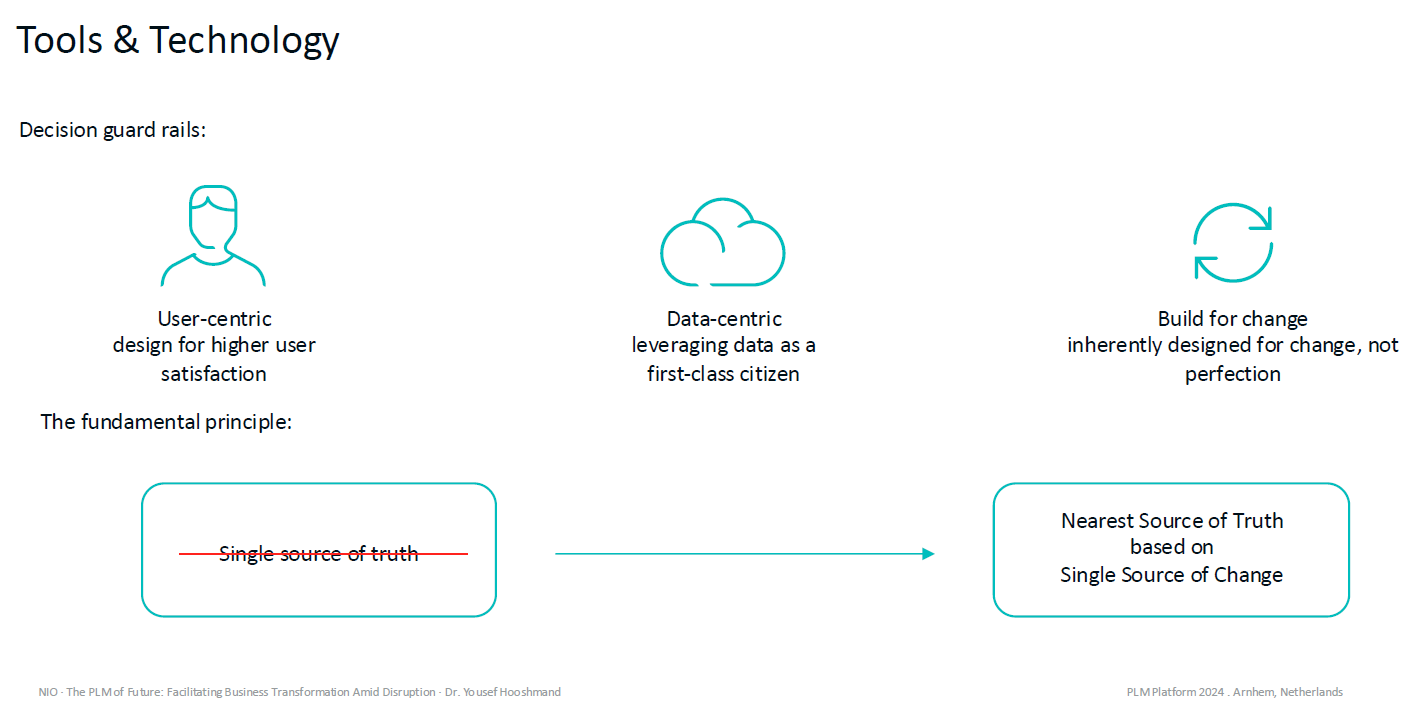
Whatever you implement starts from the user experience, giving the data-centric approach the highest priority and designing the solution for change, meaning avoiding embedded hard-coded ways of working.
 While companies strive to standardize processes to provide efficiency and traceability, the processes should be reconfigurable or adaptable when needed, reconfigured on reliable data sources.
Jan Bosch shared this last thought too in his Digital Reflection #5: Cog in the Machine. My favorite quote from this refection
“However, in a world where change is accelerating, we need to organize ourselves in ways that make it easy to incorporate change and not ulcer-inducing hard. How do we get there?”
Of course, before we reach tools and technology, the other image Yousef Hooshmand shared below gives a guiding principle that I believe everyone should follow in their context.

It starts with having a C-level long-term commitment when you want to perform a business transformation, and then, in an MVP approach, you start from the business, which will ultimately lead you to the tools and technologies.
 The challenge seen in this discussion is that:
most manufacturing companies are still too focused on investing in what they are good at now and do not explore the future enough.
This behavior is why Industry 4.0 is still far from being implemented, and the current German manufacturing industry is in a crisis.
It requires an organization that understands the big picture and has a (fusion) strategy.
Fusion Strategy ?
 Is the Fusion Strategy the next step, as Steef Klein often mentions in our PLM discussions? The Fusion Strategy, introduced by world-renowned innovation guru Vijay Govindarajan (The Three Box Solution) and digital strategy expert Venkat Venkatraman (Fusion Strategy), offers a roadmap that will help industrial companies combine what they do best – creating physical products – with what digital technology companies do best – capturing and analyzing data through algorithms and AI.
 It is a topic I want to explore this year and see how to connect it to companies in my ecosystem. It is an unknown phenomenon as most of them struggle with a data-driven foundation and skills and focus on the right AI applications.
The End of SaaS?
 A potential interesting trend als related to AI I want to clarify further is the modern enterprise architecture . Over the past two years, we have seen a growing understanding that we should not think in systems connected through interfaces but towards a digitally connected infrastructure where APIs, low-code platforms or standardized interfaces will be responsible for real-time collaboration.
I wrote about these concepts in my PLM Roadmap / PDT Europe review. Look at the section: R-evolutionizing PLM and ERP and Heliple. At that time, I shared the picture below, which illustrates the digital enterprise.
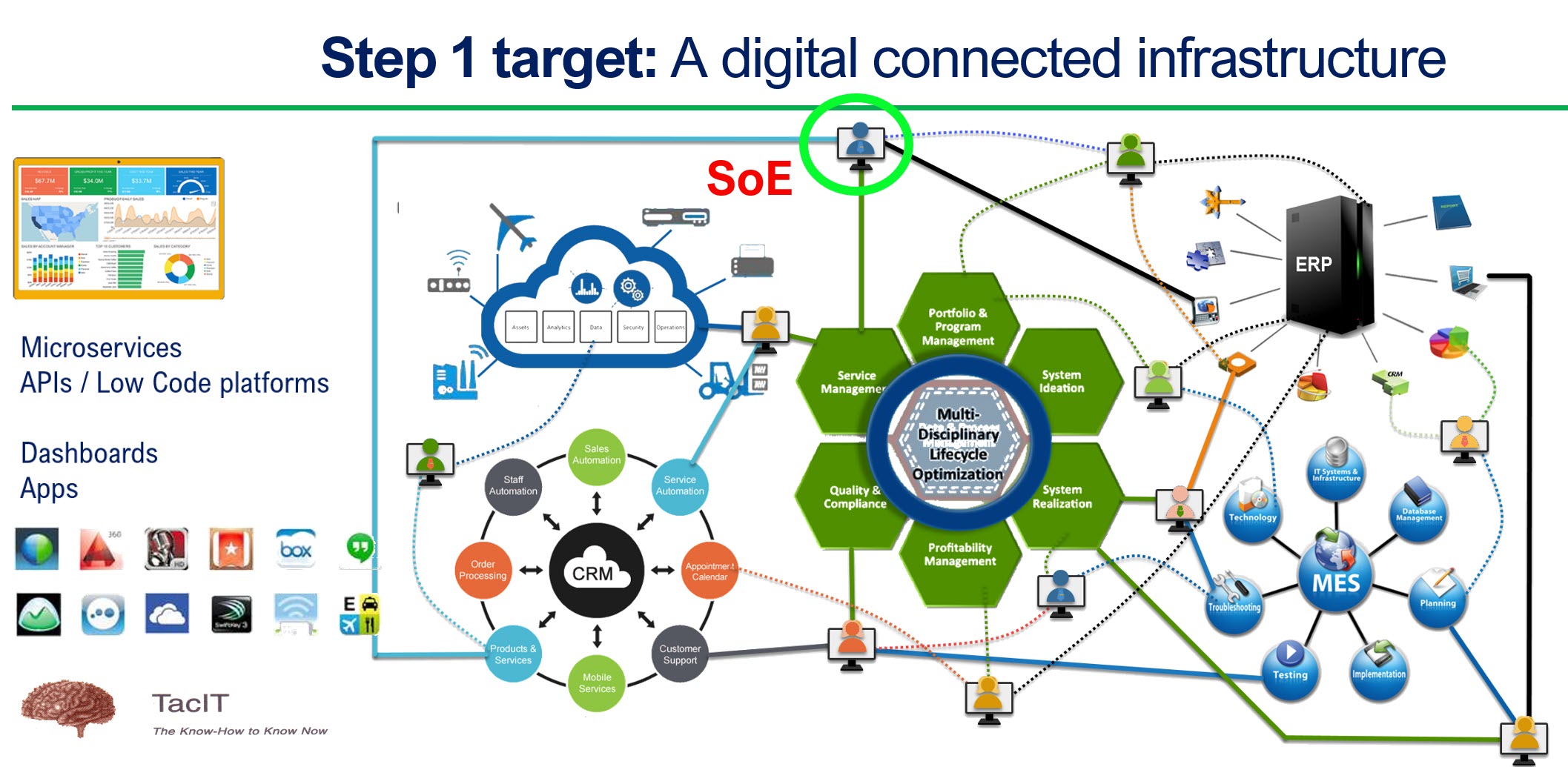
The five depicted platforms in the image ( IIoT, CRM, PLM, ERP, MES) are not necessarily a single system. They can be an ecosystem of applications and services providing capabilities in that domain. In modern ways of thinking, each platform could be built upon a SaaS portfolio, ensuring optimal and scalable collaboration based on the company’s needs.
Implementing such an enterprise based on a combination of SaaS offerings might be a strategy for companies to eliminate IT overhead.
However, known forward-thinking experts like Vijay Govindarajan and Venkat Venkatraman with their Fusion Strategy. Also, Satya Nadella, CEO of Microsoft, imagines instead of connected platforms a future with an AI layer taking care of the context of the information – the Microsoft Copilot message. Some of his statements:
This transformation is poised to disrupt traditional tools and workflows, paving the way for a new generation of applications.
The business logic is all going to these AI agents. They’re not going to discriminate between what the backend is — they’ll update multiple databases, and all the logic will be in the AI tier.
Software as a Business Weapon?
Interesting thoughts to follow and to combine with this Forbes article, The End Of The SaaS Era: Rethinking Software’s Role In Business by Josipa Majic Predin. She introduces the New Paradigm: Software as a Business Weapon.
Quote:
Instead of focusing solely on selling software subscriptions, innovative companies are using software to enhance and transform existing businesses. The goal is to leverage technology to make certain businesses significantly more valuable, efficient, and competitive.
This approach involves developing software that can improve the operations of “real world” businesses by 20-30% or more. By creating such powerful tools, technology companies can position themselves to acquire or partner with the businesses they’ve enhanced, thereby capturing a larger share of the value they’ve created.
It is interesting to see these thoughts popping up, usually 10 to 20 years ahead before companies adopt them. However, I believe with AI’s unleashed power, this is where we should be active and learn. It is an exciting area where terms like eBOM or mBOM sound hackneyed.
Sustainability?
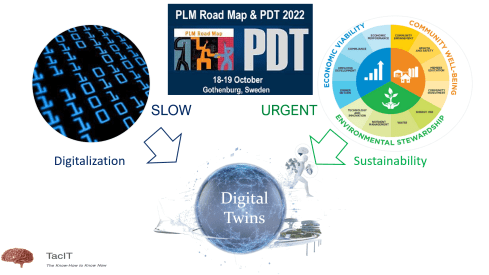
As a PLM Green Global Alliance member, I will continue to explore topics related to PLM and how they can serve Sustainability. They are connected as the image from the 2022 PLM Roadmap/PDT Europe indicates:
I will keep on focusing on separate areas within my PGGA network.
Conclusion
I believe 2025 will be the year to focus on understanding the practical applications of AI. Amid the hype and noise, there lies significant potential to re-imagine our PLM landscape and vision. However, success begins with prioritizing the business, empowering people, and ensuring accurate data.



 Jos Voskuil's Weblog
2 comments
Comments feed for this article
January 8, 2025 at 7:42 pm
Lewis Kennebrew
Jos, as usual, you’ve provided a buffet of “food for thought”. Where do you see AI being trained by a company’s internal IP data and what are the difficulties with accuracy and having a large enough data set?
Hi Lewis – thanks for the question. At this moments I have people in my network that experiment with RAG (Retrieval-Augmented Generation) based on internal datasets and generic, common knowledge in the engineering space – in theory if the the internal datasets are in the right quality this would mean a big step forward. Unfortunately in my network most companies don’t have enough internal 100 % reliable data, but they are making progress in that direction – size matters. Best regards, Jos
LikeLike
February 4, 2025 at 1:44 pm
Håkan Kårdén
Jos, all interesting and relevant. There are additional elements to be mentioned and Ontologies seem to be one of the hotter topics, at least in my LinkedIn flow. Ontology Based Integration, 2025 being the year of ontology etc. Much promising work is ongoing and there is a lot of sharing too. Check POSC CAESAR and their Youtube channel.
What you are posting will keep you busy during 2025!
Thanks for your feedback Hakan – ontologies were already high on my feed last year and it would be great to learn how standardization evolves here. Thanks for the tip
LikeLike