
You are currently browsing the tag archive for the ‘Culture change’ tag.
This week, I was in Bruxelles conducting a Engineering Express training for ENOVIA SmarTeam resellers. The feedback I got from the participants during the training made me again more aware from the culture change needed or dreamed about in the small and medium manufacturing enterprises.
As I wrote before in PLM and ERP – the culture change , there is for sure a conservative vision in the small and medium enterprises to stay with their major IT systems they invested in, usually ERP and (3D) CAD.
From the bigger enterprises and reading all the analyst reports, many of us project that the small and medium enterprises also need PLM in the same way as the bigger enterprises, but then in a more packaged, ready to use manner, instead of a custom implementation guided by PLM experts like the bigger enterprises did.
So ENOVIA SmarTeam Engineering Express is a prepackaged solution bringing PLM closer to the mid-market. However during the training many of the questions were not around the capabilities of the Engineering Express, but more about why do we(customers) need to use the same approach as bigger enterprises, why do we have the same needs?
Where big companies focus on defining and implementing processes in order to have a predictable outcome, I noticed in talking with SMB companies, they are proud of explaining they exist without these processes enforced, but work in a more flexible, human task oriented manner.
If we look to a classical ECR/ECO process, we see in bigger companies there are several steps to be identified to react on a outside request (the ECR) and to implement it (ECO).

An Engineering Change Request (ECR) process
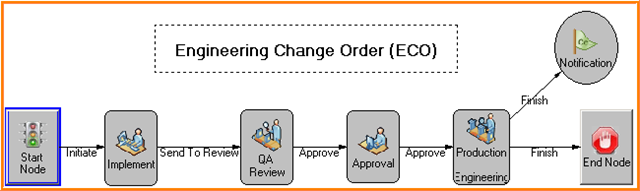
An Engineering Change Order (ECO) process
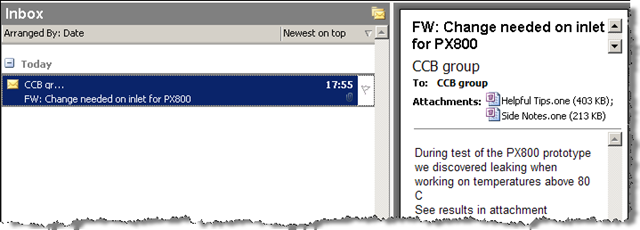
In smaller companies the ECR process is already embedded in one singe ECO process. Sometimes a formal (email) based activity takes place before a change is requested and implemented. One of the participants in the course – a manufacturing company – mentioned that they had the notice of a CCB in their company but all engineering change requests were sent to the CCB by email and as the CCB was meeting on a weekly base, this was the process to filter engineering change requests.
So here is the question: Big enterprises need processes to remain manageable – like a big tanker needs a predefined methodology to navigate through a harbor. Small and medium enterprises are more relying on their flexibility and they need a reliable and sustainable way to react – like a small ship in a harbor – as it can react quickly there is no need for the anticipation, still the capability to change direction is needed.
So are small and medium enterprises that behave like small ships in the harbor ?
If yes, they need to remain open for change as going straight ahead at the end will lead to a collision – and the challenge remains to make the (culture) change.
Or if no, how can you provide small and medium enterprises with means that enforce change without creating the overhead that compromises the flexibility ?

I am looking forward to comments and thought on this question – please post them.
However my first priority tonight is to survive in Milan where the match Italy-France will decide who continues to the next round in the European Soccer Championship. Worst case in parallel the Netherlands looses from Romania, in that case both Italy and France are gone and this might be my last post:)
Hoping to write my next post at the end of this week. ciao – adieu
The connection between PLM systems and ERP systems has kept many companies busy for many years. As both systems manage items in their system, all kind of battles are fought on ownership, redundancy of data and more. Last week I was involved in four different cases, which demonstrates this topic is very actual, and as most of the companies involved were in the mid-market, it shows also these companies are no in the phase of implementing and extending PLM within the organization.
In the first case, which I will comment here, it was a big enterprise using ENOVIA SmarTeam and SAP. As SAP has their own PLM module, the initial push was of course to use SAP all over, however the company considered the SAP PLM module not powerful and flexible enough for their engineering environment. For that reason the battle around the items and mainly the BOM for Manufacturing started.
The manufacturing BOM is usually the start point for production and the source for the ERP system to start production (and planning). For that reason, ERP systems claim ownership for this BOM, although the definition of the BOM is all based on engineering information within the PLM system. As ERP systems are already established for many years, companies are familiar with defining the manufacturing BOM in their system, often a labor-intensive job as data needs to be collected from the engineering department, often in the form of spreadsheets.
PLM systems are designed to manage the manufacturing BOM , connecting all information within the system. This requires however, a change in the way people and a company is working. Engineers have more responsibility to enter complete data – there is no one to review and complete the data afterwards and combined with the lack of flexibility that people had before with Excel this lead to a cultural refusal from the floor.
If the management realizes that managing the manufacturing BOM in the PLM system will lead to less errors, a shorter time to production and less labor cost, they will push this approach top-down. This happened in many big PLM centric enterprises. In smaller companies, this value is not visible for the management as often users, the IT department or the ERP team will pinpoint that the PLM system does not suit their needs, as it requires a change in working (their best practices).
Culture change will only come in the mid-market when PLM concepts become a commodity for companies too. The change will come, driven by ENOVIA SmarTeam with their mid market solutions. But we all know changes take time.
I will talk in my next posts in more details on PLM-ERP issues. FYI the customer mentioned in the beginning decided to keep the manufacturing BOM definition in SAP as this is what they understood and people decided not to take the risk with PLM.
Culture change takes time ….
 Jos Voskuil's Weblog
Interesting reflection, Jos. In my experience, the situation you describe is very recognizable. At the company where I work, sustainability…
[…] (The following post from PLM Green Global Alliance cofounder Jos Voskuil first appeared in his European PLM-focused blog HERE.) […]
[…] recent discussions in the PLM ecosystem, including PSC Transition Technologies (EcoPLM), CIMPA PLM services (LCA), and the Design for…
Jos, all interesting and relevant. There are additional elements to be mentioned and Ontologies seem to be one of the…
Jos, as usual, you've provided a buffet of "food for thought". Where do you see AI being trained by a…