
 This week was again a week with several customer visits and discussions around PLM implementations. As analysts like CIMdata, AMR Research, the Aberdeen group are all claiming that PLM will be the next thing for small and medium manufacturing companies, the discussion around PLM is ongoing. Of course, PLM vendors are adapting their messaging and sometimes their products towards the SMB.
Some vendors like PTC and UGS try to downscale their existing products mainly by changing the packaging of the product (but it remains a PLM system originally designed for enterprises) others like Dassault Systemes have a special SMB offering with full PLM capabilities, ENOVIA SmarTeam.
But let’s assume we have the ideal PLM solution for an SMB company. This was the start point, I had during my meetings this week. How would you motivate a company to implement PLM, knowing all the constraints of SMB companies? Miki Lumnitz wrote about it in his blog –PLM for SMB who are those companies?
I noticed one of the main issues for discussion is the handling of the MBOM (Manufacturing BOM). So let’s look at the different viewpoints in a company.
EBOM (Engineering Bill Of Materials)
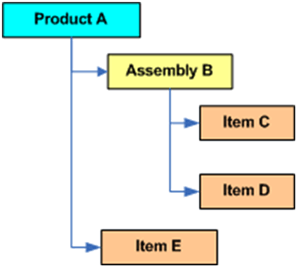 “The EBOM reflects the way a product was functionally designed”
When engineers define a product, they design (or reuse) assemblies (modules) and add new parts and assemblies to the design. When working with a 3D CAD system, saving the product results in a document structure that resembles a lot the engineering BOM. Traditionally companies got the impression that by changing this EBOM structure a little, they would have a structure ready for manufacturing, called the MBOM.
MBOM (Manufacturing Bill of Materials)
“The MBOM reflects the way a product will be manufactured”
The MBOM is a structure derived from the EBOM. The main changes from EBOM to MBOM are: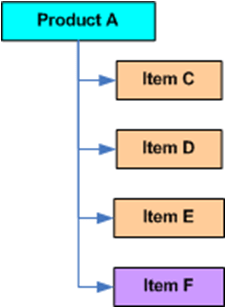
- removal of subassemblies that do not exist in the physical world. For example a grouping of two parts that are logically grouped by the designer, but as a group does not make sense for manufacturing (Assembly B).
- And in addition to non-design items which are needed for manufacturing the product. For example paint or grease. (Item F)
Traditionally – and also in the companies I was visiting – the EBOM is the domain for the engineering department and with additional modifications, they provide a BOM (is it EBOM or MBOM ?) to the ERP system. Some companies add non-engineering items to their design – they draw a can of paint in their design to make sure the paint is part of the BOM. Some work with phantom production order to address the usage of subassemblies by engineering.
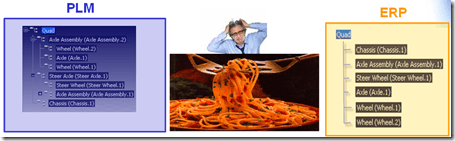
Both EBOM and MBOM definitions are preparations before production can start. The EBOM and MBOM contain the product knowledge, how to build and how to manufacture a product. For that reason, they should be handled in the PLM system. The main reasons for that are:
- during process engineering, there is a need to use, analyze and sometimes adapt engineering data. This can be done in the most efficient way within one system where all product data is available
- PLM systems, like ENOVIA SmarTeam, contain tools to create quickly based on certain rules an MBOM derived from the EBOM and when changes occur even compare both structures again, to adapt to these changes
- Having a single environment for product definition and manufacturing improves the total product understanding
So where is the MBOM?
Ask yourself as a company ” where do I handle the MBOM ?” Some of you might say, we do not have an MBOM as our EBOM with some modifications is already good enough for manufacturing. Many companies might say, we manage the MBOM in the ERP system as this is (was) the only system we had where we could define such structures. These companies are candidates for improving their Concept to Manufacturing process, as for sure either users or working methods are compromised to work with the MBOM in the ERP system.
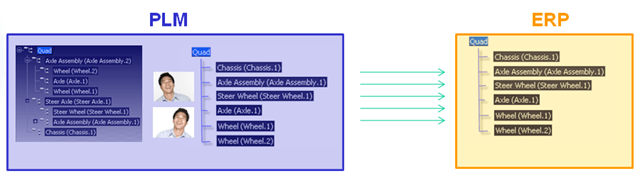
Some might says: Do we still need ERP systems?
Yes, as ERP systems are built to schedule and execute the production of well-defined products in the most efficient way. ERP systems are needed for the execution, often the core activity for manufacturing systems.
PLM systems are the reason that ERP systems can execute, they bring the product definition and information to produce a product. And in case the company designs and manufactures excellent and innovative products the future is bright.
But we should not consider engineering activities in the same way as production activities.
Einstein once said (and he is not an expert anyway):
Innovation is not the product of logical thought, even though the final product is tied to a logical structure
I am curious to learn where you manage your MBOM
Discover more from Jos Voskuil's Weblog
Subscribe to get the latest posts sent to your email.


11 comments
Comments feed for this article
July 7, 2008 at 2:15 pm
yml
The MBOM is used / Built in the ERP and the tree is different than the EBOM the granularity. All the parts in the MBOM are ordered by the logistic department. The level of detail is not the same and in addition as you have explained many part are added in the MBOM (packaging, paint, grease, glue, …)
It is important to note that most of the time this operation is not done in continuous it is performed only to the configuration of the EBOM that are “Approved for Manufacturing”.
Regards,
–yml
July 9, 2008 at 10:29 pm
josvoskuil
We all agree on the fact that the MBOM is different – i guess i was not clear enough on that in my post. What i wanted to mention is that (traditional) companies manage the MBOM in the ERP system as it seems to be information close to ERP. However with the availabillity of PLM systems, it became a best practice for bigger companies to manage all product IP, which includes the MBOM in the PLM system and then transfer the MBOM to ERP to be executed. In this way you get a clear connection between PLM and ERP (no spaghetti – EBOM/MBOM transformation) and no mix of activities in two systems
August 11, 2008 at 6:18 pm
Menk Slot
I agree that a MBOM is used in ERP, but I believe it should be Built in PLM. The most important reason for this is that it will be much easier to do an impact analyses when engineering is making a change. More and more companies maintain also there Process Plans and Tools in a PLM System. So I believe you should have a deep integration between all these object. Tool BOM, Process Plans, E-BOM and M-BOM
January 23, 2009 at 7:55 pm
Suhas
Good article. Keep up the good work!
September 29, 2012 at 11:14 am
Ville
Hi Jos,
You say ERP executes production. What about MES? Do you think it is needed?
BR,
Ville
Ville hello, MES is a system that is somehow in the middle between PLM and ERP, where PLM interacts on the content level (BOM, Process Definition,Work Procedures, Tests and results) and ERP interacts on the execution level (scheduling, material consumption, results). MES is more important for companies that have a make to stock, build to print process instead of a an engineering to order process, as interaction with the manufacturing execution has the highest value there. Wiki provides a good overview: http://en.wikipedia.org/wiki/Manufacturing_execution_system
Best regards
Jos
December 6, 2012 at 5:15 am
Vijay Rangan
I definetly agree, its always a tussle between EBom and MBom though Enditem is same. There are many cases, Plant comes back to Design about some parts are missing which suppose to be the Part of MBom only as like Raw materials,Etc.. Even I am finding a way where we can sync it.
I read some blog.. EBom is intellectual Property and MBom is Physical Property
Thanks Vijay for your comments. I would be curious to learn what is the meaning behind of Physical Property or is it just a term to refer to the Physical world, where EBOM often refers to the Virtual world ? Best rgeards
Jos
December 7, 2012 at 9:25 am
Vijay Rangan
Hi Jos, Physical Property nothing but the Product Built and Delivered. Hope this clears..
Yes – understood there is no big concept behind it
September 9, 2013 at 6:01 pm
Richard Anderson
Hi. When you say the MBOM is in the PLM system, does that include the routing and operation?
Richard hello, In general there are several steps you can perform in PLM related to the MBOM – depending on your type of product of course. The MBOM can be a restructure of the EBOM based on the manner a product is going to be manufactured. In case this is due to standard process steps – no matter where you manufacture – it can include also the operations required per step. In that case we talk about the BOP (Bill of Processes). If the BOP also describes a predefined routing, it could be included. This last part I haven´t seen yet in reality. Best regards Jos
November 22, 2013 at 6:11 pm
Steve
Hi Jos.. great article…Even though many PLM products have MBOM (for eg: in Enovia it is XBOM)..The restructuring capability is not up to the mark. Our Company have decided to restructure the EBOM to generate the MBOM in the PLM system itself based on Planners Need. If we restructure the EBOM to generate a MBOM. what are the things we need to consider? Thanks
Steve, thanks for your feedback. Meanwhile this article is already old and concepts have evolved, although not many companies have picked up the MBOM story anyway. In order to give a more precise advise there are more options to consider, as the eBOM / mBOM process varies per product delivery process. An eBOM / mBOM transfer makes sense if you want to prepare for multiple manufacturing locations. If you always manufacture from the same location (and therefore use only 1 ERP system this process might look different. Feel free to provide me some more detail at tacit@planet.nl and I will come back to you.
best regards
Jos
May 12, 2014 at 10:51 pm
Why BOM Management Is Complex? | Daily PLM Think Tank Blog
[…] – "What is a big deal about MBM"? Jos pointed me on his earlier post – Where is MBOM? This post as well as few other articles I posted earlier – Why companies are not ready for […]
March 8, 2017 at 10:06 am
Team
ERP- deals with financial status of a business process. The analyst will analyze whether this production will bring how much profit to the company.
MES and PLM are very much alike and I still cant really differentiate between them. As I’ve known so far, MES is like a simulation program to monitor the WIP of a process and PLM is like software to outline a production and send it to the people responsible in the MES area.
Can someone please help me?
Dear Team – there is a lot to learn. PLM is an approach (methodology, software, infrastructure) to manage a product among its full lifecycle – from concept to delivery and potential field-support, decommissioning. ERP is in the core the execution engine to schedule resources (machines, materials, people) to deliver a defined product to the customer/market. Financial transactions for this process are also registered and stored in ERP. MES is modern way to manage the manufacturing on the shopfloor in a detailed manner by connecting PLM and ERP data and deliver an optimized execution in the manufacturing plant. Note the definitions: PLM = Product Lifecycle Management / ERP = Enterprise Resource Planning / MES = Manufacturing Execution System.