
 During my summer break, I have been thinking about why companies struggle to start a digital transformation and how businesses keep going, struggling to change.
I ended up with Conway’s Law as a demonstration of the biggest inhibitor to digital transformation in companies.
But before that, I need to make two basic statements that form the basis of my plea.
1. PLM is a strategy
 When we mention PLM without the word system, we should think of it as a strategy supported by connected, federated systems.
Most of the time, when I hear people talk about PLM, it sounds like they are talking about their PLM system. A core system needed to implement a Product Lifecycle Management strategy.
For me, PLM (Product Lifecycle Management) starts with the core business processes a company needs to implement to remain a long-term (sustainable) product or solutions provider. More on the solution provider dimension later.

Every company that sells products has a product lifecycle management strategy – see the image above.
When a company focuses only on product data, I am tempted to call it PDM (Product Data Management), which can still support different disciplines.
For me, PLM is the operational environment that helps companies manage their products/solutions throughout the product lifecycle, which means it is influenced by sales, R&D, engineering, manufacturing, service and, increasingly, regulations.
This broad scope makes it clear to me that no single PLM system can effectively support all these demands while providing a user-friendly interface. Even if you are SAP or one of the three major PLM vendors.
To remember:
PLM (Product Lifecycle Management) is a strategy supported by a federated infrastructure, where a PLM or PDM system/platform can be one of the main components.
2. Conway’s Law
 If you have read my blog posts before, you might have come across Conway’s Law; although it is not a real law, more a description of a phenomenon, it’s largely true. Compare it to Moore’s Law or Murphy’s Law.
Let’s start with THE LAW:
Conway’s Law is an observation about how organizations design systems, formulated by computer scientist Melvin Conway in 1967:
“Any organization that designs a system… will inevitably produce a design whose structure is a copy of the organization’s communication structure.”
Conway meant that the organizational architecture of what you build tends to mirror the shape of the team that builds it. If you have a siloed organisation with Sales, R&D, Manufacturing and Service, you will build processes and install systems to support those siloes.
The reason: People can only design what they can communicate about. Coordination across team boundaries is harder than coordination within a team, so design decisions cluster along organisational boundaries.
This observation makes what I often call the COORDINATED approach, the approach companies are following and feel comfortable with – image below:

People can work in their silos, then share information in a linear, document-driven process when requested and needed. Sometimes it is not a document but a Bill of Materials. Handling the BOM is a great example of Conway’s Law that still exists.
An example: The PDM(PLM) – ERP integration
One topic that keeps our community busy is PDM-ERP integration, or, in a more advanced setting, PLM-ERP integration, especially when you consider the MBOM.


A recent debate can be found here: Turbulent times in PLM: The EBOM-MBOM chain is shaking, AI is rattling everything.
Without going into the debate, as there are many dimensions in the PLM domain, the first question to ask is: WHY DO WE PERCEIVE IT AS DIFFICULT?
 Let’s have a look through Conway’s eyes.
- Two silos need to collaborate: engineering on one side and manufacturing preparation, purchasing and manufacturing on the other. Each side has its favorite system, and that’s where the problem starts.
- Instead of analyzing the preferred process, the focus shifts to how to get data into my preferred system easily and reliably. Instead of People, Processes, Data and Tools, it becomes a Tools, Data and Process discussion. People are not considered anymore.
 This approach can lead to ludicrous situations, where an engineer has to request a part number when designing a new product, or, in another case, use a temporary part number until the part is mature enough to be registered in ERP, according to the ERP standard. These are real examples I encountered.
 Historically, SAP drove these scenarios, as its material master message and MDM approach were built around a single connected manufacturing environment.
For SAP, the bridge to engineering is built through custom solutions at the CAD level (CIDEON) or EBOM level, e.g., ECTR (DSC).
Technology has never limited a fluent PDM-ERP interaction, as long as you start at the process level before touching the systems.
I have written many posts around this topic in the past too. Here are a few of them:
2026: The BOM revisited – what are the challenges
2023: The rise and fall of the BOM
2020: Learning from the past
 For me, the discussion is closed; many companies already know the theory and best practices from the past or for their current operations. But will they work on a better future?
The future and Conway’s Law
 In my network, many PLM experts, like Prof. Jörg Fischer or Martin Eigner, can describe an ideal future approach to product lifecycle management. But Oleg Shilovitsky, Benedict Smith, Doug Macdonald and many other voices also describe a potential future, often inspired by an additional graph database layer, sometimes better supported by an ontology. The whole idea is that such an environment is a needed foundation for agent AI.
For example, I like the concept Martin Eigner expresses in the technical architecture. On paper (or slide), the concept looks explainable, though the details are missing.
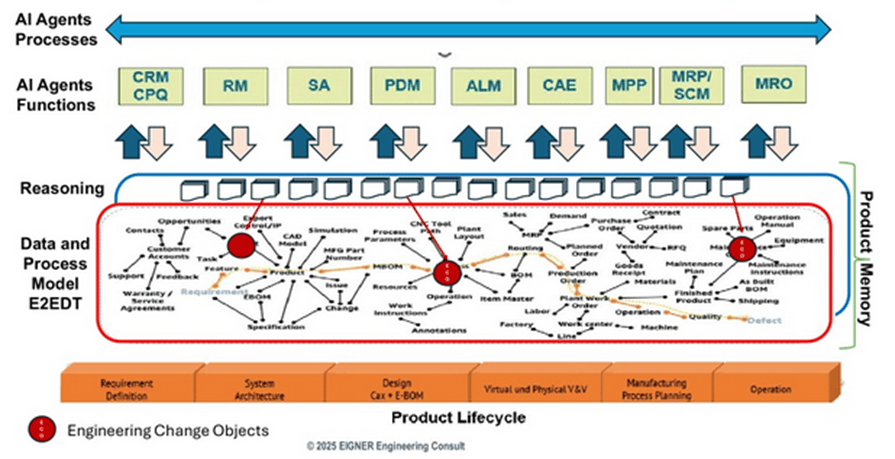
And of course all the PLM software vendors have similar offerings related to the concept above – the only question to ask yourself as an enterprise is:
“Who owns the data and who owns the knowledge – be aware of a lock-in”
At the upcoming PLM Roadmap & PDT Europe conference in Gothenburg on November 4th & 5th, we will learn about and discuss interesting future concepts, including the application of agentic AI.

Here, I am curious about the following sessions I saw in the agenda:
- Key Findings in the Arrowhead fPVN Project – A Knowledge Graph-Based Digital Twin for Semantic Lifecycle Interoperability
- AI in PLM – Balancing Innovation with Stable Enterprise Architecture
- Digital Threads for Digital Agents & Collaboration: Connecting ALM, Mechanics, E/E, Software and Production
- Ontology-based Data Governance and Enterprise Data Modelling: Standards, AI Readiness and Governance Processes for PLM Data Management, a “Data Town Plan” Approach
- Practical AI Transformation in Enterprise PLM
 Of course, there are more interesting presentations to watch and discussions to have, so if you are interested in a potential technical future, join us in Gothenburg; there are still places left; last year the conference sold out.
How to escape from Conway?
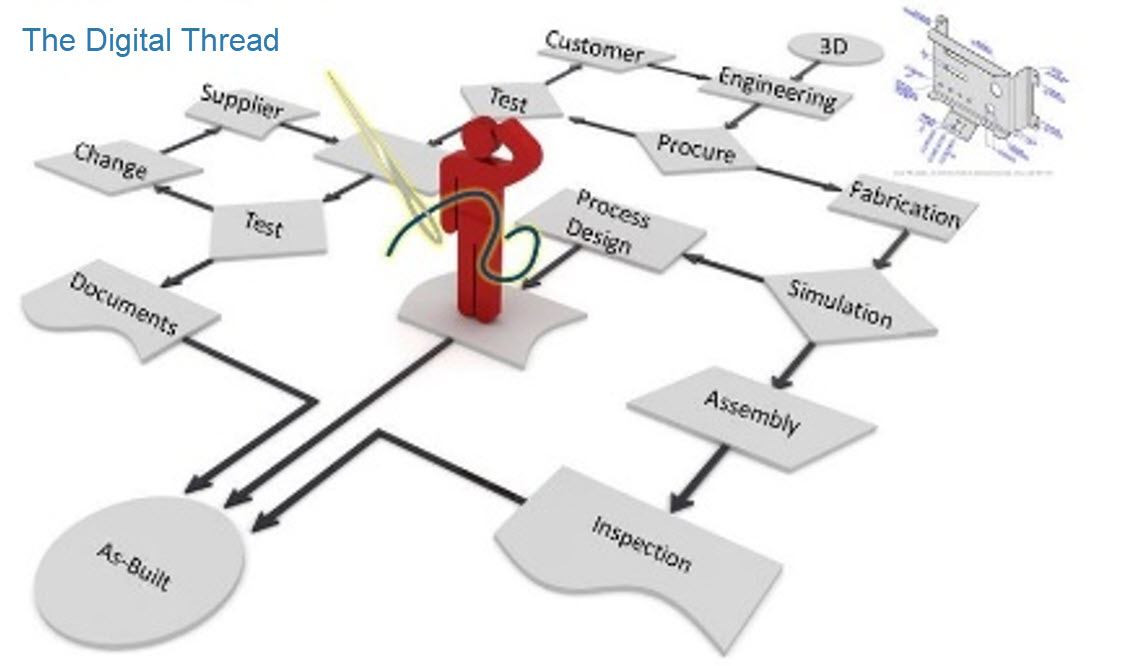 The digital thread is one of those topics that appeared even before AI and has now become a theme companies should implement, supported by their software vendors and system integrators. In many boardrooms, the term “Digital Thread” is mentioned to address the lack of end-to-end visibility in the company, finally enabling full traceability.
However, more important, I believe, is the horizontal business thread, where disciplines work together in real time. Technology and, for sure, AI agents can facilitate this approach; however, as long as every silo in the organisation is optimized for its own performance (Conway’s Law again), no horizontal business thread will emerge.
 I wrote about this topic in June, addressing the mood in the field at the time: The Human Thread, breaking the (PLM) blame game, where I look into the alerting messages that PLM is failing, already with Conway behind the scenes.
I don’t believe Product Lifecycle Management is failing; businesses are failing to transform their organisations, which will lead to new, better operating models.
Too many future strategies are built on an existing siloed organisation, blocking the potential change needed.
 A great book to read in this context is Reshuffle by Sangeet Paul Choudary; he describes the fundamental business changes required to break Conway’s trap.
The challenge is that you cannot delegate this job to middle management; top management needs to understand and execute it once they have mastered the potential strategy.
I consider this one of my major topics for the coming years: educating and coaching organisations to escape Conway’s Law and fully benefit from an AI-supported digital transformation.
Conclusion
This time, a short conclusion – Conway is the elephant in the room – what do you think?

Discover more from Jos Voskuil's Weblog
Subscribe to get the latest posts sent to your email.


Leave a comment
Comments feed for this article