
 Back on track after a side step (see: I am back), I restarted my PLM activities, and WOW, was I lucky with the first conference on my list: CONTACT Open World 2026 in Bonn.
Melanie Stadtler invited me as a guest (thanks, Melanie 🙏), and for the first time I connected in depth with CONTACT Software, their partners and customers.
 I knew CONTACT Software from a few brief interactions, but now I could experience their full ecosystem. As CONTACT Software has historically been active in the DACH region, our paths rarely crossed – most of my activities were elsewhere in Europe.
 So my key question was: Who is CONTACT Software, and where would I position them in an SAP/Teamcenter-dominated market?
Around 650 people attended this year’s biannual event. The World Conference Center Bonn, along the Rhine, was a great venue for sessions, networking and evening entertainment.
The conference theme was Industrial AI – from top floor to shop floor.
 Before the event, there was a great warm-up party with dinner and a variety show. Beyond the impressive show, it was a great first chance to network and catch up with peers. And then the event started.
Industrial AI — from Top Floor to Shop Floor
 Maximilian Zachries, Chief Operating Officer (COO) at CONTACT software, kicked off day 1 sharing CONTACT’s ambition and strategy to grow, with a repackaging of their solution – the CONTACT elements as the image below shows.
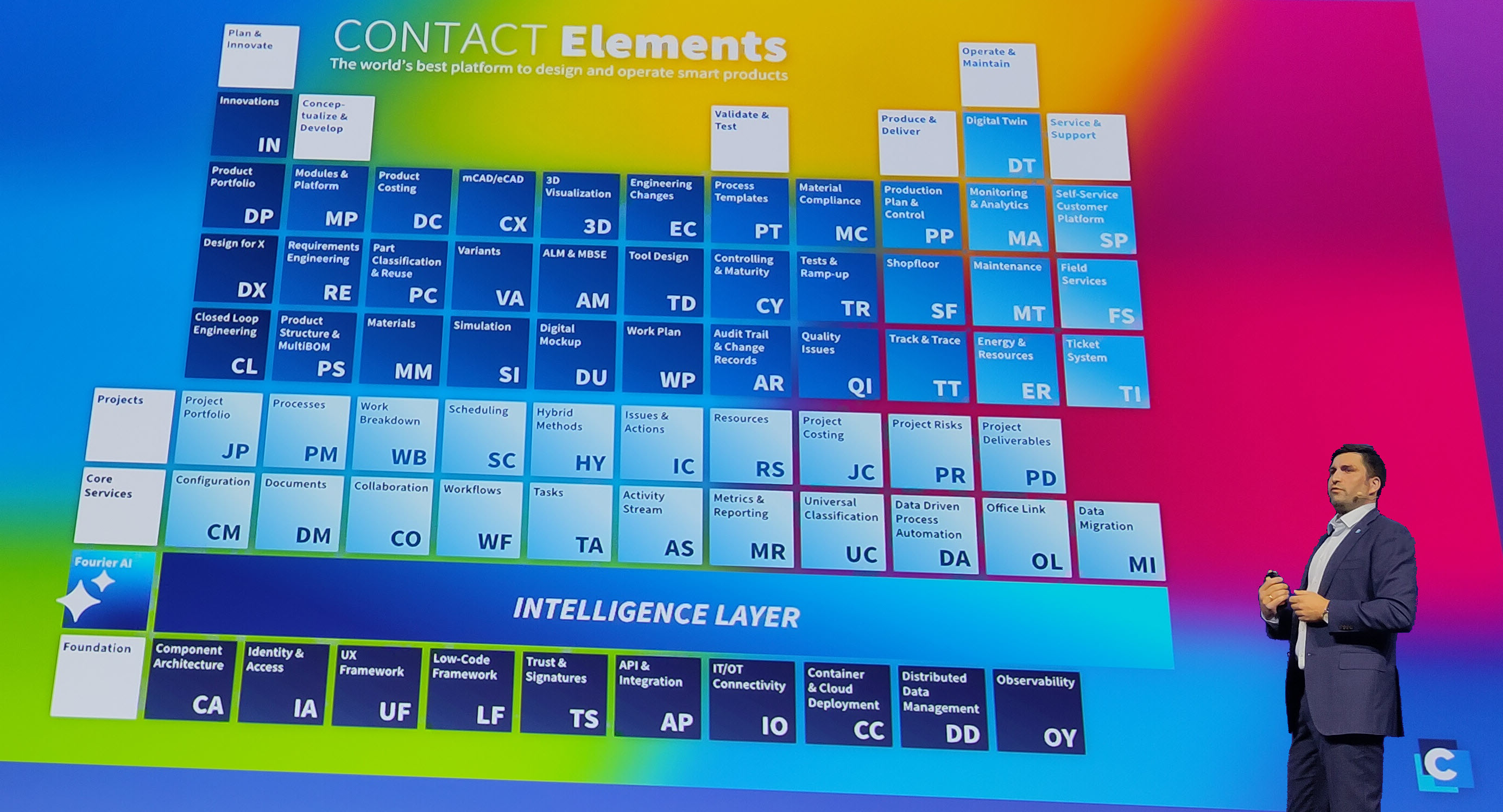
In the domain of PLM, I would position CONTACT software as a platform with a few foundational layers and op top of that customers can implement Elements, functional, pre-configured blocks on the platform or connect to other systems in the enterprise architecture.
Maximilian Zachries showed the unification of CIM database, Office, Project and IoT into a single collaboration platform based on Elements – coordinated PLM in my terminology.
Openness is a key driver for CONTACT software, so connectivity is crucial.
The image also shows the intelligence layer, named Fourier, which CONTACT has released and includes Elements related to its AI capabilities.

Initially focused on enhancing functionality within the platform and, in upcoming releases, also adding support for MCP connectivity, agentic AI, AI coding and even the option to bring your own model (BYOM)
The mood of the session was much more down-to-earth and factual than at other conferences I used to go to. The understated German culture was evident in this session and in other sessions too, which was a relief for me as a VirtualDutchman.
CONTACT’s intention to grow is also visible in its recent acquisitions and partnerships, including a significant investment in team neusta SE.
You snooze, you lose.
 Markus Dietrich (CEO, team neusta) then illustrated the complementary value they bring: modern front-end development, data-driven capabilities and dashboards on top of the CONTACT platform – the modern connected PLM in my terminology.
The trend, as Markus stated, is from components to systems, and in the long run from selling products to delivering products as a service.
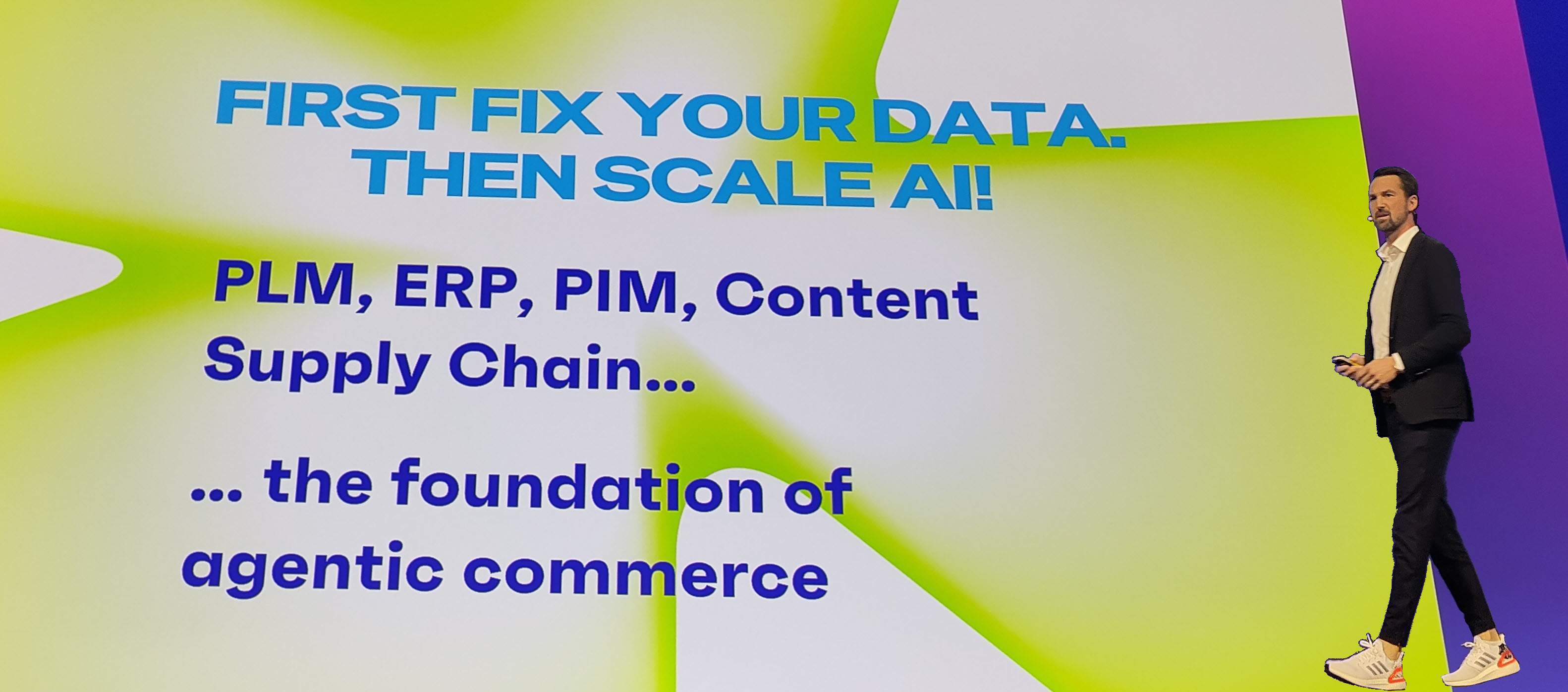
Driven by economic survival, it is crucial for a sustainable, circular economy.
Companies should start exploring data-driven capabilities now – AI only performs reliably when the underlying data is correct and in the right context.
 Hence the title: you snooze, you lose.
From Product Truth to Possible Futures – AI and the future of lifecycle management
 Frank Patz-Brockmann, Chief Product Officer at CONTACT Software, gave an interesting presentation, discussing AI’s impact on PLM—particularly in engineering.
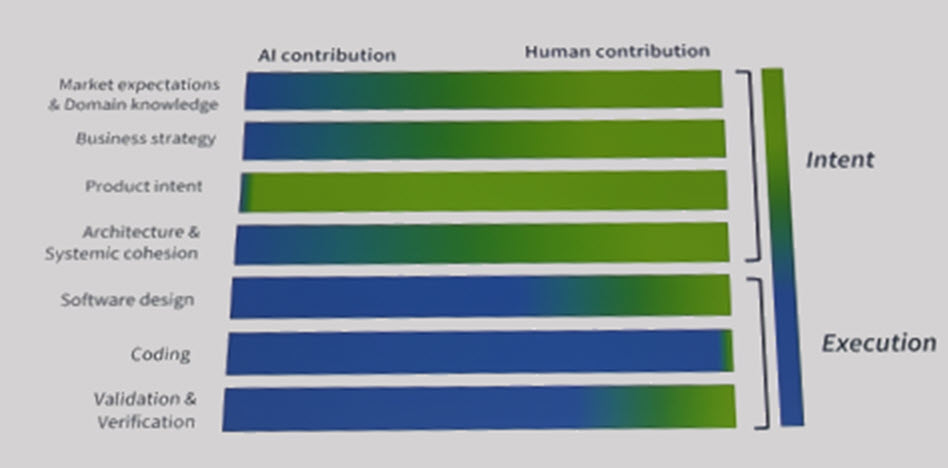
We already see what AI does in software development. And as the image below illustrates, the real human value is in dealing with the intent—the WHY behind what we do.
Of course, we should not forget that software changes are relatively cheap. A code change typically doesn’t affect the stock in the warehouse or your selected and approved suppliers, as it would in a mechanical world—one reason manufacturers push as many product features as possible into software.
Still, as Frank mentioned, creating engineering artifacts today is expensive and requires specific skills. As AI advances, authoring tools will likely become capabilities of the engineering system, while humans will still be needed to decide intent—the broader context AI cannot address through its trained models.

His ultimate conclusion: in the long run, traditional PLM systems built as the “Single Source of Truth” will be replaced or superseded by a collection of federated data sources, accessed and managed by AI agents. A statement that is supported by many of my forward-looking peers in the PLM community.
From systems to platforms to knowledge infrastructures.
After the guided tours—an excellent way to get a quick impression of sponsors grouped around a theme—it was time for the afternoon sessions.
From Connected R&D to Intelligent R&D: Apollo Tyres’ Digital Transformation Journey
 I listened with great interest to Hizmy Hassen, Chief Digital Officer at Apollo Tyres. Having worked with tyre companies before, and having a soft Dutch spot for their Vredestein brand, much of his story felt familiar.
What caught my attention even more was their “New House strategy” as shown below:

Too often, I have seen companies start their transformation from their pains and wishes, wrapped in a project based on the known As-Is situation. External consultants like this approach too—it lets them sell interviews and reporting while getting paid to learn the company. It is the traditional business model, and I understand it.
 However, I believe in a different approach: define the desired To-Be status from the company’s business strategy for the coming years, then derive the enterprise processes and the underlying data model needed to get there.
From there, you define the journey.
Instead of looking back and fixing what went wrong—an inherently negative mindset—the company looks forward, fostering a positive, aligned attitude when everyone is informed and on board.
 Of course, Organizational Change Management becomes crucial here, as systems, the organization, and even business models can and must change.
I saw exactly this mindset in Hizmy’s New House strategy.
One of his best examples: introducing AI/automation as the natural way of working with data in a context where data is available. And as his concluding slide showed, this forward-looking approach is already delivering its first wins.

Success Under Extreme Conditions – What Enables Innovation Under Pressure
 During the afternoon sessions, attendees chose from various tracks, and we concluded the day with an inspiring keynote from Jutta Kleinschmidt, a famous race car driver (Dakar), physicist and author, who shared how to succeed in an unpredictable environment.

After a great networking evening on board the Ocean Diva, sailing on the Rhine, we started Day 2 with an interesting opening session: the CONTACT software product management team shared their plans and roadmap.
Roadmap CONTACT Elements: opening the next chapter
 What surprised me first was the roadmap’s level of detail. Most vendors talk about roadmaps but rarely share specifics or commit to capabilities before a release is actually available. Here, I saw the opposite.
Some random thoughts I noted down:
- CONTACT Elements is primarily a platform of connected capabilities. It provides a foundation through its Elements, and customization remains possible. I did not hear any Out-Of-The-Box messaging.
- The focus on delivering 3D Search capabilities surprised me somewhat, as I have seen this capability in typical PLM systems before. I also assumed there would be vendor-independent solutions in the market to connect to. Apparently not.
- The roadmap suggests the current mindset is still to deliver more and more standard, traditional PLM capabilities. This makes it harder to distinguish between being a platform and being a PLM system.
- Combining ALM and MBSE into a single Element suggests that the full complexity of managing systems—hardware and software—through a model-based approach is not yet fully developed. Both ALM and MBSE could be domains on their own, with many elements.
 Of course, these are first impressions, and as I am not a CONTACT software insider, I am eager to learn more.
In the afternoon, there were more thematic sessions. I want to highlight one close to my heart:
Circular by Design – Anchoring Sustainability in Product Strategy
 Comparing the agendas of the 2022 and 2024 editions with this year’s, I noticed sustainability has become less prominent — less hype, fewer dedicated topics. Understandable, as we’re overwhelmed by other immediate global challenges, despite the extreme climate warnings we’re facing.
That’s why I was glad to attend this session. In Europe, we see fewer specialized sustainability discussions; however, more and more companies are being forced to anchor sustainability in their product strategy—mainly due to regulations and, hopefully soon, genuine business benefits and customer demands.
Sebastian Weber gave a great overview of the industry’s current state and CONTACT Software’s approach, where other speakers shared their detailed sustainability experiences (this blog space is too short to mention everything. 🙄 I had much more to tell and digest, but I already passed my 1500-word deadline.)
 As a core team member of the PLM Green Global Alliance (PGGA), I am happy to announce we’ll publish a dedicated interview with Sebastian on our PGGA channel in mid-October. There, we will definitely dive deeper into CONTACT software’s contribution to sustainability.
Conclusion
The CONTACT Open World conference was an eye-opener for me for several reasons. First, it was a warm, open community where I could discuss the typical challenges a medium-sized enterprise faces. Next, the clarity of the presentations and discussions helped me better understand where to position and recommend CONTACT software in the PLM domain as an exploration every potential customer should do.
CONTACT software is currently a niche player, but an interesting company that’s willing to expand. Keep them on your radar.

Next big event to meet
Discover more from Jos Voskuil's Weblog
Subscribe to get the latest posts sent to your email.


Leave a comment
Comments feed for this article